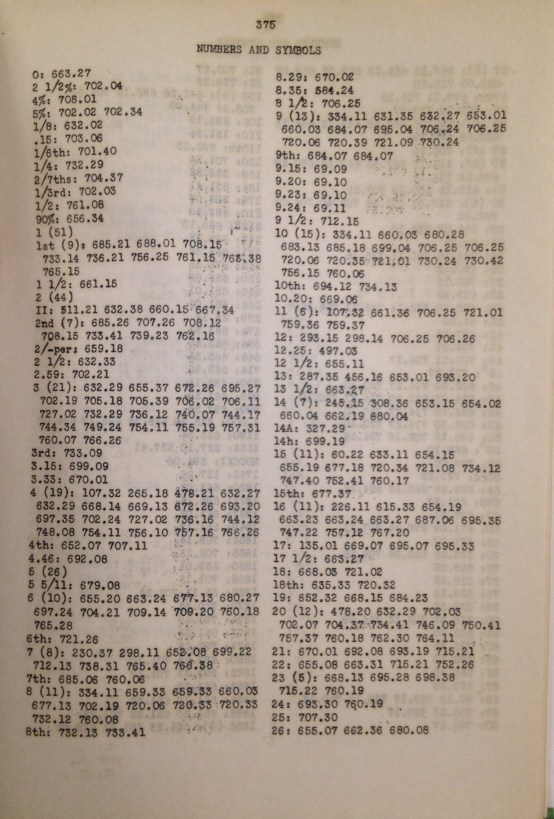
Numbers and Symbols in James Joyce’s Ulysses (“0” through “26”)

Ulysses_Numbers

From Miles L. Hanley’s Word Index to James Joyce’s Ulysses.

Mountain fable (Voltaire)

It is a very old, very universal fable that tells of the mountain which, having frightened all the countryside by its outcry that it was in labor, was hissed by all present when it brought into the world a mere mouse. The people in the pit were not philosophers. Those who hissed should have admired. It was as fine for the mountain to give birth to a mouse, as for the mouse to give birth to a mountain. A rock which produces a rat is a very prodigious thing; and never has the world seen anything approaching this miracle. All the globes of the universe could not call a fly into existence. Where the vulgar laugh, the philosopher admires; and he laughs where the vulgar open their big, stupid eyes in astonishment.

From Philosophical Dictionary.

William Burroughs with a brother Sphinx (Photo by Ginsberg)

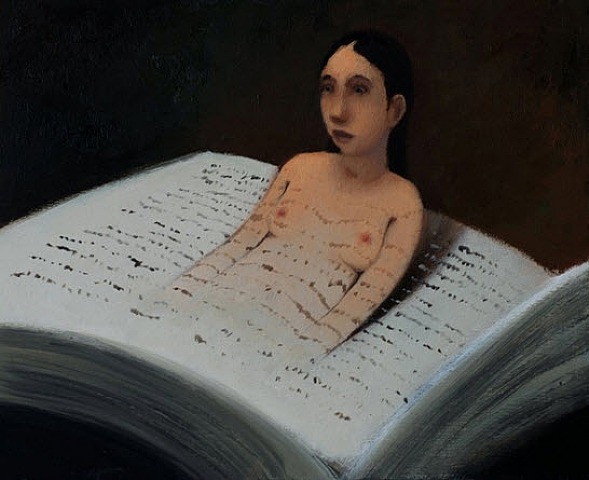
Johannes Hüppi Painting (Woman/Book)

Johannes Huppi  (8)

“We are things that labor under the illusion of having a self” | A Riff on True Detective, HBO’s Philosophical Crime Show

HBO debuted the first episode of True Detective this weekend. The series will be an anthology, with its first eight-episode season exploring a ritualistic murder in the backwoods of Louisiana. Written by series creator Nic Pizzolatto and directed by Cary Fukunaga (who filmed a moody 2011 adaptation of Jane Eyre), True Detective stars Woody Harrelson and Matthew McConaughey as State murder police trying to solve the crime.

I loved the opening episode, “The Long Bright Dark.” There’s a heavy streak of Cormac McCarthy and James Ellroy here, not to mention a dose of The Wire, Michael Mann (and a pinch of David Lynch). Detractors of the show will likely single out its ponderous and cerebral dialogue, or maybe point out that, yeah, we’ve seen this story before. Such criticisms would be (will be) intertwined; those who want a murder mystery delivered with a nice neat bow on it are almost surely going to be disappointed—and most likely, will fault the show’s philosophical tone.

It’s easy—comforting, maybe—to ignore that philosophical tone, most of it delivered by McConaughey’s Rust Cohle. There’s even something of an audience surrogate in Cohle’s partner Marty Hart (Harrelson), who bristles uncomfortably at Cohle’s near-nihilism. I found this particular scene electrifying (uh, language NSFW):

The lines that stand out in particular come at about the 2 minute mark. Cohle:

I think human consciousness is a tragic misstep in evolution. We became too self aware. Nature created an aspect of nature separate from itself—we are creatures that should not exist by natural law . . . We are things that labor under the illusion of having a self, a secretion of sensory, experience, and feeling—programmed with total assurance that we are each somebody, when in fact everybody is nobody.

It’s easy to dismiss these lines, as Hart would like to—to not listen, to fail to attend to the meaning there—to pin Cohle’s outlook down as meaningless, dark gobbledygook—because the lines essentially attack “the illusion of having a self,” an illusion we all hold dear, an illusion that protects us. Cohle here echoes what Jacques Derrida called “auto-affection”—the that thinks/feels itself into being. This auto-affection stabilizes us, tells us our certitude is, y’know, certain. It authorizes us.

I’ve seen only the first episode, but my guess is that the murder that the series would seem to foreground is really its backdrop. Murder—figured here in the gruesome, abject corpse that we (to use Cohle’s term) “bear witness” to in the show’s opening moments—destabilizes the illusion of having a self. It tears down the borders between the illusion and the real.

The murder is not to be solved/resolved then. The murder instead functions to call attention to the problem that Cohle posits in the middle of this first episode: The illusion of having a self.

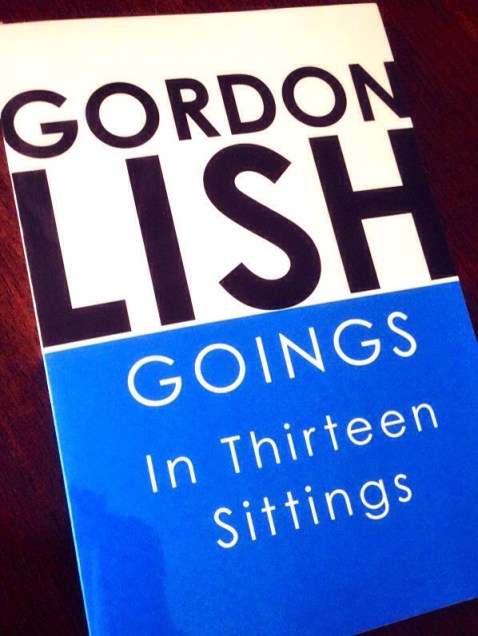
Gordon Lish’s Goings In Thirteen Sittings (Book Acquired, 1.13.2014)

20140115-151646.jpg

So I read five of the thirteen stories in Gordon Lish’s forthcoming collection Goings In Thirteen Sittings (OR Books) the afternoon it arrived. Each story, told by a narrator named “Gordon,” I could not help but here in Lish’s precise but gruff voice. Great stuff. Full review forthcoming.

Bonus:

Today, Electric Literature is running Lish’s story “In the District, Into the Bargain.” First paragraph:

Here’s a bit for you. It’s an impressive one too. My bet is you are going to be really refreshingly impressed with it, or by it, which I have to tell you is what I myself was when the woman involved in the event disclosed her heart to me. First, as to setting—temporal, spatial, all that. So, fine, so the thing starts maybe all of an hour ago just a block from where I am sitting right this minute typing this up for you to read it and get out of it the same kick I did. She types too—the woman. She is always typing, is my understanding—or was, back when I used to see her somewhat, let us just fancy, social-wise. As a matter of fact, when I said to her, “What’s up? I mean what are you doing here in this neighborhood? Do you have a pass, were you issued a pass, a license maybe, any kind of a permit you can show me authorizing you to come up here into this restricted district of mine?” she laughed. I think she thought I was trying to be funny. Let me tell you something—that’s the one thing I never try to be—namely, funny. No, no, I was just doing what I could to maybe get away with having to snoggle for the usual sort of talk, lay on her a smart-aleck greeting of a sort, which apposition I only went to the bother of just now constructing so I could say sort and sorts, repeating and repeating stuff to stuff the insidious silence with insidious sound, however otiose or bootless or inutile dexterity appears (to be?) on the surface. You get what I’m getting at?—the stressing of the effect of there being something sly down beneath down under things as regards below the surface, see? But which surface, eh wot? Or, anyway, surface of exactly what, eh wot? (You see? Can’t help myself. It’s like this thing I’ve got which is like an irresistibly compulsive thing.) Oh, boy, I am all of a sudden so tired. I, Gordon, son of Reggie, am all of a sudden so suddenly utterly all in, just fucking pooped. Like, you know, like weary, wearied, ausgespielt if you’re German, right? Nap. But, hey, before I fall and hit my head, I’m just going to go ahead and take myself a little teensy tiny nap, fair enough? Be back in a shake, I promise.

Shooting the Arrows in Kurosawa’s Throne of Blood Finale

“There’s a purity of intent and a lack of self-consciousness that I wish I could achieve when I was experiencing pleasure” (David Foster Wallace)

Let’s put it this way. Say you’ve got really serious art, and it takes really hard work, whether it’s painting or music or literature. That stuff’s not fun in the way commercial entertainment is fun. I mean fun — like eating a Twinkie. It’s like slipping into a warm bath after a hard day. It’s an escape. It’s a relaxation. And that’s fine, and that’s entirely appropriate. The danger comes when the escape becomes the overriding purpose. And one of the ways it seems that television has affected me is that my expectation for the amount of fun and pleasure to work — that ratio is very different than they are for my parents. I think my pain threshold is lower. My expectations are higher. My level of resentment at having to do anything I don’t particularly want to do that isn’t pleasurable is higher. I think a certain amount of that comes from the fact that for six hours a day I receive certain messages — you know, ‘relax, we’re going to give to you, you don’t have to give anything back, all you need to do is every so often go and buy this product.’ But animals have fun. My dogs play. And watching them play — there’s a purity of intent and a lack of self-consciousness that I wish I could achieve when I was experiencing pleasure. But Plato and John Stuart Mill both take books to talk about different types of pleasure. In my own personal life, I like really arty stuff a lot of the time. But there’s also times I watch an enormous amount of TV, and I’ve read probably 70 percent of Stephen King’s books. And I’ve read them basically because for a little while I want to forget that my name is David Wallace, you know, and that I have limitations, and that I’m sad that my girlfriend yelled at me. I think serious art is supposed to make us confront things that are difficult in ourselves and in the world. And one of the dangers is if we get conditioned to confront less and less and experience more and more pleasure, the commercial stuff’s gonna win out.

From a 1997 interview with David Foster Wallace by David Wiley, originally published in The Minnesota Daily, and archived here.

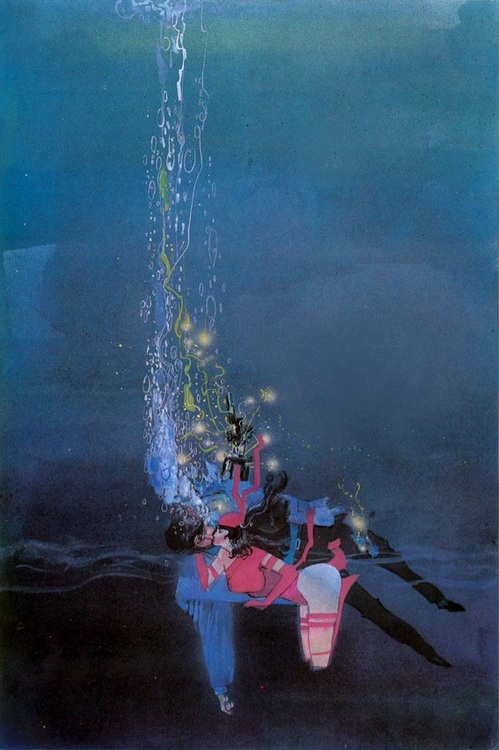
Elektra — Bill Sienkiewicz

elektra

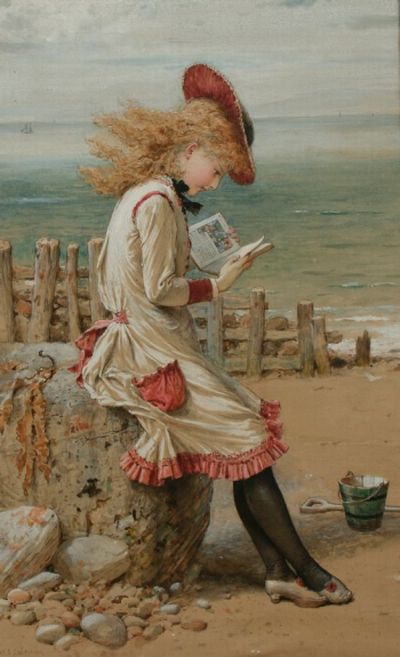
An Interesting Story — William Stephen Coleman

tumblr_m60hnfIpE11qjehcpo1_500

Idyll — Jacek Malczewski

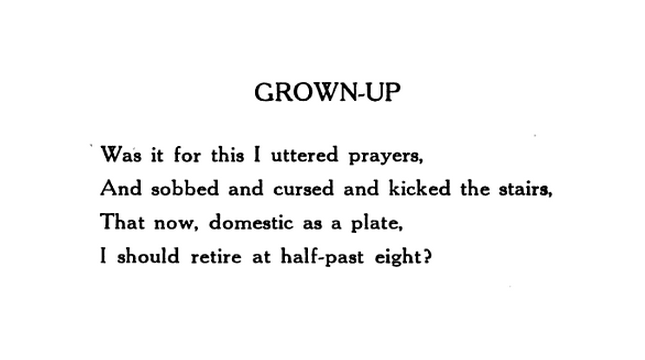
“Grown-Up” — Edna St. Vincent Millay

grown up

“All art constantly aspires towards the condition of music”

Mars and Venus Discovered by the Gods — Joachim Wtewael

William S. Burroughs looking serious, sad lover’s eyes, afternoon light in window (Photo by Ginsberg)

“Authors” — Voltaire

“Authors” — Voltaire

(From Philosophical Dictionary)

Author is a generic name which can, like the name of all other professions, signify good or bad, worthy of respect or ridicule, useful and agreeable, or trash for the wastepaper-basket.


We think that the author of a good work should refrain from three things—from putting his name, save very modestly, from the epistle dedicatory, and from the preface. Others should refrain from a fourth—that is, from writing.


Prefaces are another stumbling-block. “The ‘I,'” said Pascal, “is hateful.” Speak as little of yourself as possible; for you must know that the reader’s self-esteem is as great as yours. He will never forgive you for wanting to condemn him to have a good opinion of you. It is for your book to speak for you, if it comes to be read by the crowd.


If you want to be an author, if you want to write a book; reflect that it must be useful and new, or at least infinitely agreeable.


If an ignoramus, a pamphleteer, presumes to criticize without discrimination, you can confound him; but make rare mention of him, for fear of sullying your writings.


If you are attacked as regards your style, never reply; it is for your work alone to make answer.


Someone says you are ill, be content that you are well, without wanting to prove to the public that you are in perfect health. And above all remember that the public cares precious little whether you are well or ill.


A hundred authors make compilations in order to have bread, and twenty pamphleteers make excerpts from these compilations, or apology for them, or criticism and satire of them, also with the idea of having bread, because they have no other trade. All these persons go on Friday to the police lieutenant of Paris to ask permission to sell their rubbish. They have audience immediately after the strumpets who do not look at them because they know that these are underhand dealings.


Real authors are those who have succeeded in one of the real arts, in epic poetry, in tragedy or comedy, in history or philosophy, who have taught men or charmed them. The others of whom we have spoken are, among men of letters, what wasps are among birds.

The Princes in the Tower — Paul Delaroche