Woman with a Cup of Coffee — Edouard Vuillard

Three Sisters — Balthus

Miraculous chunk of meat (Calvin and Hobbes)

ch131227

J.G. Ballard on Fear of a Boring Planet (and Surrealism)

Balestrini’s Tristano (Book Acquired, 12.16.2013)

20131224-000725.jpg

I’m just two chapters shy of finishing Nanni Balestrini’s Tristano—I’ve kind of lax about these “book acquired” posts lately—so full review forthcoming. But here’s the blurb:

This book is unique as no other novel can claim to be: one of 109,027,350,432,000 possible variations of the same work of fiction.

Inspired by the legend of Tristan and Isolde, Tristano  was first published in 1966 in Italian. But only recently has digital technology made it possible to realise the author’s original vision. The novel comprises ten chapters, and the fifteen pairs of paragraphs in each of these are shuffled anew for each published copy. No two versions are the same. The random variations between copies enact the variegations of the human heart, as exemplified by the lovers at the centre of the story.

The copies of the English translation of Tristano  are individually numbered, starting from 10,000 (running sequentially from the Italian and German editions). Included is a foreword by Umberto Eco explaining how Balestrini’s experiment with the physical medium of the novel demonstrates ‘that originality and creativity are nothing more than the chance handling of a combination’.

I’ll write a proper review in the next week or two, but the quick version is that This Is Not for Everyone, but you can probably already tell that from the blurb, right? The prose is also Not for Everyone, which is what I suspect most people who come to Tristano, interested in the concept, will be most disappointed in. Balestrini isn’t delivering a plot driven story that “recombines” into new versions for the reader. This is something closer to Donald Barthelme’s disruptions and displacements—poetic, strange, occasionally funny, moving.
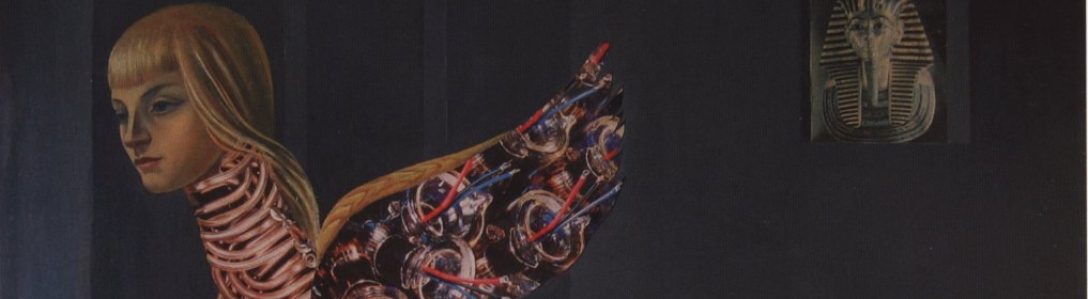
 

Allegoria Macabra — Rosso Fiorentino

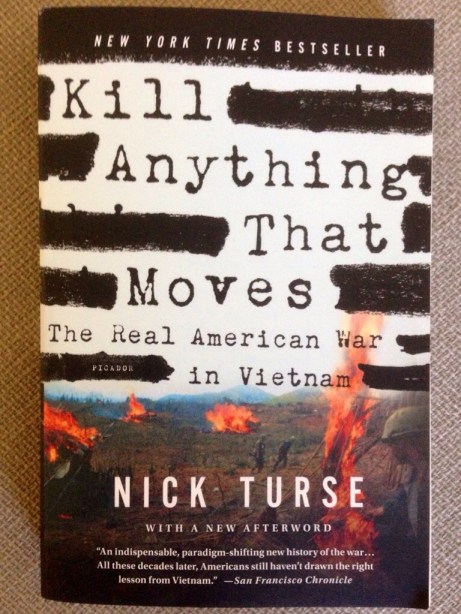
Kill Anything That Moves (Book Acquired Sometime in December 2013)

20131219-100411.jpg

Blurb for Nick Turse’s Kill Anything That Moves, new in paperback:

Americans have long been taught that events such as the notorious My Lai massacre were isolated incidents in the Vietnam War, carried out by just a few “bad apples.” But as award-winning journalist and historian Nick Turse demonstrates in this groundbreaking investigation, violence against Vietnamese noncombatants was not at all exceptional during the conflict. Rather, it was pervasive and systematic, the predictable consequence of official orders to “kill anything that moves.”

Drawing on more than a decade of research into secret Pentagon archives and extensive interviews with American veterans and Vietnamese survivors, Turse reveals for the first time the workings of a military machine that resulted in millions of innocent civilians killed and wounded—what one soldier called “a My Lai a month.” Devastating and definitive, Kill Anything That Moves finally brings us face-to-face with the truth of a war that haunts America to this day.

Library Rules of the Insane Asylum of California (1861)

1. The Library of the male department shall be under the charge of the Supervisor. Every volume taken therefrom shall be charged to the borrower, except for the use of the patients, when it shall be charged to the Attendant, into whose ward it is taken, who will be responsible for its being used with ordinary care and returned in proper time.

2. If a volume shall be lost or destroyed, by any patient, the Attendant, having charge of the patient, will report the fact to the Supervisor, and, if practicable, exhibit the fragments. If lost or destroyed, by any other person, it must be replaced.

3. No one will be permitted to take from the library more than one volume at a time, or to keep a volume more than two weeks, without permission from the Superintendent or Assistant Physician, except Bibles, Testaments and Prayer books placed in the hands of the patients for daily reading.

4. The Supervisor will be responsible for books taken from the library and not charged.

5. The Library of the female department will be under the charge of the Matron, who, in its management, will be governed by the above rules, prescribing the duties and responsibilities of the Supervisor.

From Rules and Regulations of the Insane Asylum of California (1861).

Michelangelo Being Shown the Belvedere Torso — Jean-Leon Gerome

Private Conversation — Felix Vallotton

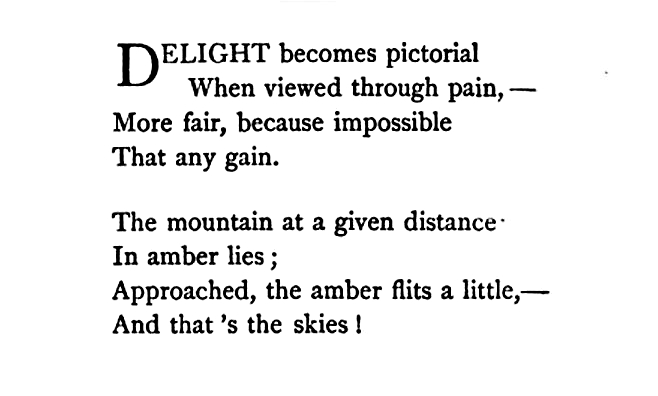
“Delight becomes pictorial” — Emily Dickinson

delight

Reading, rereading, trying to read

20131226-142706.jpg

“All art constantly aspires towards the condition of music”

Illustration for A Little Boy Lost — Dorothy Lathrop

“Of Games to Be Played by Those Who Draw” — Leonardo da Vinci

OF GAMES TO BE PLAYED BY THOSE WHO DRAW.

When, Oh draughtsmen, you desire to find relaxation in games you should always practise such things as may be of use in your profession, by giving your eye good practice in judging accurately of the breadth and length of objects. Thus, to accustom your mind to such things, let one of you draw a straight line at random on a wall, and each of you, taking a blade of grass or of straw in his hand, try to cut it to the length that the line drawn appears to him to be, standing at a distance of 10 braccia; then each one may go up to the line to measure the length he has judged it to be. And he who has come nearest with his measure to the length of the pattern is the best man, and the winner, and shall receive the prize you have settled beforehand. Again you should take forshortened measures: that is take a spear, or any other cane or reed, and fix on a point at a certain distance; and let each one estimate how many times he judges that its length will go into that distance. Again, who will draw best a line one braccio long, which shall be tested by a thread. And such games give occasion to good practice for the eye, which is of the first importance in painting.

From Leonardo’s Notebook

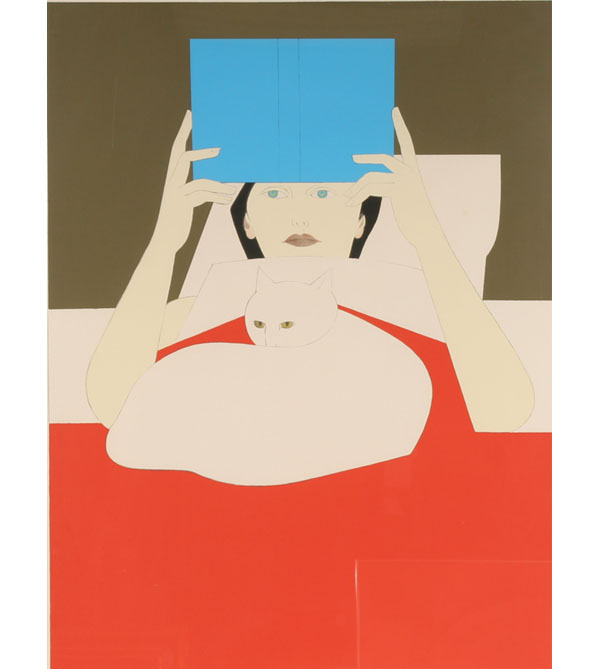
Woman Reading — Will Barnet

56635

Nativity (Holy Night, Christmas) — Lucas Cranach the Elder

Posted in Art