The Complete Short Stories of J.G. Ballard (Sixth Riff: 1963-1964)

jgb_complete_ss40031

PREVIOUSLY:

Introductions + stories 1956-1959

Stories of 1960

Stories of 1961

Stories of 1962

“The Subliminal Man,” Black Friday, and Consumerism

IN THIS RIFF:

“The Reptile Enclosure” (1963)

“A Question of Re-Entry” (1963)

“The Time Tombs” (1963)

“Now Wakes the Sea” (1963)

“The Venus Hunters” (1963)

“End-Game” (1963)

“Minus One” (1963)

“The Sudden Afternoon” (1963)

“The Screen Game” (1963)

“Time of Passage” (1964)

“Prisoner of the Coral Deep” (1964)

“The Lost Leonardo” (1964)

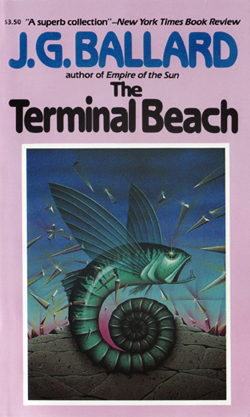
“The Terminal Beach” (1964)

“The Illuminated Man” (1964)

“The Delta at Sunset” (1964)

“The Drowned Giant” (1964)

“The Gioconda of the Twilight Noon” (1964)

“The Volcano Dances” (1964)

1.”The Reptile Enclosure” (1963) / “A Question of Re-Entry” (1963) / “The Time Tombs” (1963) / “Now Wakes the Sea” (1963) / “The Venus Hunters” (1963) / “Minus One” (1963) / “Prisoner of the Coral Deep” (1964) / “The Illuminated Man” (1964) / “The Delta at Sunset” (1964) / “The Gioconda of the Twilight Noon” /”The Volcano Dances” (1964)

There are 98 stories in The Complete Short Stories of J.G. Ballard. That’s a lot of stories. Maybe too many. Too many for me to write about in full, anyway. I’ve lumped these stories together because they are somewhat unremarkable: Ballard does his Ballardian thing way better elsewhere. Several of these stories feel like sketches (or leftovers) from Ballard’s early novels like The Drowned WorldThe Burning World, and The Crystal World. Themes of time, memory, art, and nature abound here, usually glommed on to simple adventure narratives or sci-fi pulp treadthroughs. Jungles, watches, crystals, structures, beaches. Misanthropy, paranoia, nagging wives, misunderstood heroes. Man apart from nature, but beholden to nature. Etc. The worst moments of these stories—and we can find these moments all through early Ballard, to be fair—suffer from a bad case of White Man’s Burden doubled up with a shot of misogyny. I’ve written it before in these posts, but the most disappointing aspect of early Ballard is our would-be futurist’s inability to transcend the patriarchal ideology of the post-war era. So now let’s move to the good stuff.

2. “End-Game” (1963)

I first read “End-Game” when I was sixteen or seventeen, and it’s always stuck with me. It’s the story of a former “party member” who’s been imprisoned under nebulous circumstances—only his prison isn’t that bad—a nice little villa, comfortable, with books and a chess set. He even has a housekeeper. Unfortunately, the housekeeper is also his executioner, and the date and method of the execution is forever withheld from him:

This ironic inversion of the classical Kafkaesque situation, by which, instead of admitting his guilt to a non–existent crime, he was forced to connive in a farce maintaining his innocence of offences he knew full well he had committed, was preserved in his present situation at the execution villa.

The psychological basis was more obscure but in some way far more threatening, the executioner beckoning his victim towards him with a beguiling smile, reassuring him that all was forgiven. Here he played upon, not those unconscious feelings of anxiety and guilt, but that innate conviction of individual survival, that obsessive preoccupation with personal immortality which is merely a disguised form of the universal fear of the image of one’s own death. It was this assurance that all was well, and the absence of any charges of guilt or responsibility, which had made so orderly the queues into the gas chambers.

Ballard directly invokes Kafka, whose tale “Before the Law” comes to mind here (not to mention The Trial and The Castle); “End-Game” also feels like Ballard’s take on 1984. It’s a great little tale, and I think it helps to prove that Ballard is at his best when he sticks to a confined, limited cast and setting. Much of the force of “End-Game” comes from Ballard pitting his prisoner/protagonist against the protagonist’s mental conception of his guard/executioner. Part of my ideal collection, The Essential Short Stories of J.G. Ballard.

3. “The Sudden Afternoon” (1963) / “Time of Passage” (1964)

In “The Sudden Afternoon” and “Time of Passage,” Ballard explores how time and place—context, I suppose—constitute identity. The former story is a tale of metempsychosis with a troubling take on Indian spirituality, wherein a doctor—an Indian, of course—transplants his psyche and his wife’s psyche into the bodies of another couple (his wife is dying of a terminal disease). Ballard’s own wife died a year after the story was first published (I’m reminded of Poe here, whose wife Virginia died after the publication of “The Raven”). “The Sudden Afternoon” isn’t very good, but structurally we see Ballard beginning to employ something approaching the cut-ups/fragments he’ll move to in the next decade.

“Time of Passage” is essentially a rewrite of F. Scott Fitzgerald’s “The Curious Case of Benjamin Button.” It’s also basically a rewrite of Ballard’s own 1961 tale “Mr. F Is Mr. F” — only this time, Ballard dispenses with abject-horror-for-maternal-body in lieu of a fable-like exploration of what a life in reverse might actually look like. A lovely story. Stick it in The Essentials.

4. “The Screen Game” (1963)

Another Vermilion Sands story. More insanity. Another femme fatale. An attempt at the story of Orpheus, perhaps. I would have lumped it in with the stories in point 1, but I wanted to clarify: The Vermilion Sands stories are the worst.
15. “The Lost Leonardo” (1964)

This is an excellent little detective tale with mystical-magic undertones. I’m a sucker for any story of art theft, too. We all know Dan Brown ripped off Umberto Eco, but maybe Eco ripped off Ballard? Who cares. Lovely stuff. Ballard is excellent at the detective story; Poe is one of his clearest predecessors, but like Poe, he’s more famous for other stuff. Too bad. Let’s call it Essential.

6. “The Terminal Beach” (1964)

1964’s “The Terminal Beach” is such a big break through for Ballard in terms of formal elements and structuring that it probably deserves its own post, but I’ll jab at it here anyway. Up until now, Ballard’s stories have been notable almost entirely for their ideas—his prose has improved some, but ultimately, the pulp fiction he’s writing for magazine publication constrains him to a pedestrian rhetoric that simply can’t match how far out his concepts are. With “The Terminal Beach,” Ballard finally approaches a narrative structure—fractured, polyglossic, shifting through interiors to exteriors, breaking through different forms—that can match the themes of his tale. The story–clearly an Essential—points to the finest of Ballard’s future work. You can read it here in two parts, but here’s a taste that I think stands alone as a microfiction:

The Fly

(A small fly, which Traven presumes has followed him into the fissure, now buzzes about the corpse’s face. Guiltily, Traven leans forward to kill it, then reflects that perhaps this minuscule sentry has been the corpse’s faithful companion, in return fed on the rich liqueurs and distillations of its pores. Carefully, to avoid injuring the fly, he encourages it to alight on his wrist.)

DR YASUDA: Thank you, Traven. In my position, you understand

TRAVEN: Of course, Doctor. I’m sorry I tried to kill it – these ingrained habits, you know, they’re not easy to shrug off. Your sister’s children in Osaka in ’44, the exigencies of war, I hate to plead them. Most known motives are so despicable, one searches the unknown in the hope that YASUDA: Please, Traven, do not be embarrassed. The fly is lucky to retain its identity for so long. ‘That son you mourn, not to mention my own two nieces and nephew, did they not die each day? Every parent in the world grieves for the lost sons and daughters of their earlier childhoods.

TRAVEN: You’re very tolerant, Doctor. I wouldn’t dare – YASUDA: Not at all, Traven. I make no apologies for you. Each of us is little more than the meagre residue of the infinite unrealized possibilities of our lives. But your son, and my nephew, are fixed in our minds forever, their identities as certain as the stars.

TRAVEN: (not entirely convinced) That may be so, Doctor, but it leads to a dangerous conclusion in the case of this island. For instance, the blocks – YASUDA: They are precisely what I refer to, Traven. Here among the blocks you at last find an image of yourself free of the hazards of time and space. This islandis an ontological Garden of Eden, why seek to expel yourself into a world of quantal flux?

TRAVEN: Excuse me (The fly has flown back to the corpse’s face and sits in one of the dried-up orbits, giving the good doctor an expression of quizzical beadiness. Reaching forward, Traven entices it on to his palm. He examines it carefully) Well, yes, these bunkers may be ontological objects, but whether this is the ontological fly is doubtful. It’s true that on this island it’s the only fly, which is the next best thing

YASUDA: You can’t accept the plurality of the universe – ask yourself why, Traven. Why should this obsess you? It seems to me that you are hunting for the white leviathan, zero. The beach is a dangerous zone. Avoid it. Have a proper humility, pursue a philosophy of acceptance.

TRAVEN: Then may I ask why you came here, Doctor?

YASUDA: To feed this fly. ‘What greater love – ?’

TRAVEN: (Still puzzling) It doesn’t really solve my problem. The blocks, you see

YASUDA: Very well, if you must have it that way

TRAVEN: But, Doctor

YASUDA: (Peremptorily) Kill that fly!

TRAVEN: That’s not an end, or a beginning.

(Hopelessly, he kills the fly. Exhausted, he falls asleep beside the corpse.)

7. “The Drowned Giant” (1964)

Another Essential, this puzzling fable readily recalls Gabriel García Márquez’s story “A Very Old Man with Enormous Wings.” Ballard rarely handles archetypes so directly as he does here. Even if the story’s theme seems almost too-plain—we lose the miracle, we cast down the old gods, we deny the sublime, etc.—its construction and telling are wonderfully achieved.

The lower jaw, typically, found its way to the museum of natural history. The remainder of the skull has disappeared, but is probably still lurking in the waste grounds or private gardens of the city – quite recently, while sailing down the river, I noticed two ribs of the giant forming a decorative arch in a waterside garden, possibly confused with the jaw–bones of a whale. A large square of tanned and tattooed skin, the size of an indian blanket, forms a backcloth to the dolls and masks in a novelty shop near the amusement park, and I have no doubt that elsewhere in the city, in the hotels or golf clubs, the mummified nose or ears of the giant hang from the wall above a fireplace. As for the immense pizzle, this ends its days in the freak museum of a circus which travels up and down the north–west. This monumental apparatus, stunning in its proportions and sometime potency, occupies a complete booth to itself. The irony is that it is wrongly identified as that of a whale, and indeed most people, even those who first saw him cast up on the shore after the storm, now remember the giant, if at all, as a large sea beast.

8. On the horizon:

Ballard plays with fragmentation again in “The Beach Murders” and “The Assassination of John Fitzgerald Kennedy Considered as a Downhill Motor Race” — and we finally get to his stories of the late sixties.

Hero and Leander (To Christopher Marlowe) — Cy Twombly

“On Mr. Rudyard Kipling and Making the World Small” — G.K. Chesterton

“On Mr. Rudyard Kipling and Making the World Small” by G.K. Chesterton

There is no such thing on earth as an uninteresting subject; the only thing that can exist is an uninterested person. Nothing is more keenly required than a defence of bores. When Byron divided humanity into the bores and bored, he omitted to notice that the higher qualities exist entirely in the bores, the lower qualities in the bored, among whom he counted himself. The bore, by his starry enthusiasm, his solemn happiness, may, in some sense, have proved himself poetical. The bored has certainly proved himself prosaic.

We might, no doubt, find it a nuisance to count all the blades of grass or all the leaves of the trees; but this would not be because of our boldness or gaiety, but because of our lack of boldness and gaiety. The bore would go onward, bold and gay, and find the blades of grass as splendid as the swords of an army. The bore is stronger and more joyous than we are; he is a demigod—nay, he is a god. For it is the gods who do not tire of the iteration of things; to them the nightfall is always new, and the last rose as red as the first.

The sense that everything is poetical is a thing solid and absolute; it is not a mere matter of phraseology or persuasion. It is not merely true, it is ascertainable. Men may be challenged to deny it; men may be challenged to mention anything that is not a matter of poetry. I remember a long time ago a sensible sub-editor coming up to me with a book in his hand, called “Mr. Smith,” or “The Smith Family,” or some such thing. He said, “Well, you won’t get any of your damned mysticism out of this,” or words to that effect. I am happy to say that I undeceived him; but the victory was too obvious and easy. In most cases the name is unpoetical, although the fact is poetical. In the case of Smith, the name is so poetical that it must be an arduous and heroic matter for the man to live up to it. The name of Smith is the name of the one trade that even kings respected, it could claim half the glory of that arma virumque which all epics acclaimed. The spirit of the smithy is so close to the spirit of song that it has mixed in a million poems, and every blacksmith is a harmonious blacksmith. Continue reading ““On Mr. Rudyard Kipling and Making the World Small” — G.K. Chesterton”

Still Life with Hourglass, Pencase and Print — Gerrit Dou

François Truffaut: The Man Who Loved Cinema (Documentary)

Shop (The Perry Bible Fellowship)

PBF261-Shop

A Lazy Riff on Margaret Atwood’s Novel MaddAddam

page1080monsters

1. Margaret Atwood’s latest novel, MaddAddam concludes the trilogy she began with Oryx and Crake (2003) and The Year of the Flood (2009).

2. Both of those novels are superior to MaddAddam (Oryx and Crake is the strongest, in my estimation, although I read it almost a decade ago).

3. I audited the audiobook of MaddAddam, read by Bernadette Dunne, Bob Walter and Robbie Daymond. The actors do a fine job and the production is swell.

4. I am now going to rip off elements of my own 2010 review for The Year of the Flood.

5. In that review I wrote:

Apocalypse lit isn’t so much predictive as it is descriptive of the contemporary world, and Atwood’s dystopian vision is no exception.

I still more or less agree with that sentence, and MaddAddam is, like the two books preceding it, a satire of sorts on modern life.

6. And–

Viscerally prescient, Flood paints our own society in bold, vibrant colors, magnifying the strange relationships with nature, religion, and our fellow humans that modernity prescribes.

I don’t know if it’s me or the book or just the fact that so much of what Atwood conjures in her trilogy seems more real than it was just a decade ago—but MaddAddam didn’t read quite so bold or vibrant as the first two books.

7. I also wrote:

Atwood ends her book in media res, with Toby and a handful of other characters somehow still alive, ready, perhaps, to become stewards of a new world. Flood concludes tense and, in a sense, unresolved, but Atwood implies hope: Toby will lead her small group to cultivate a new Eden. Despite all the ugliness and cruelty and devastation, people can be redeemed.

MaddAddam picks up right where Flood and O&C end (those novels essentially converge). In some ways—often very obvious, sometimes boring ways—MaddAddam provides a sense of resolution for the trilogy’s many threads.

monsters_03

8. What is the book about?

I will lazily slap in publisher Random House’s blurb here, interspersed with my riffage :

Months after the Waterless Flood pandemic has wiped out most of humanity, Toby and Ren have rescued their friend Amanda from the vicious Painballers.

The opening of MaddAddam was a bit too in media res for me: I think the beginning of the book will probably read much smoother if the reader has immediately read the first two books. I had to go reread a summary of the first two books (thanks Wikipedia!) to refresh my old brain.

They [Toby/Ren/Amanda] return to the MaddAddamite cob house, newly fortified against man and giant pigoon alike. Accompanying them are the Crakers, the gentle, quasi-human species engineered by the brilliant but deceased Crake.

The Crakers are potentially the most interesting aspect of MaddAddam, but Atwood keeps them on the margins; in the book’s most disappointing moments they’re behavior is basically relegated to punchlines. (Maybe I wanted the book to be an entirely different book—never a fair position for a reviewer to take, but hell, I’ll just say it here in the protection of parentheses—I wanted the book to be about the Crakers in the new world).

Their [the Crakers’] reluctant prophet, Snowman-the-Jimmy, is recovering from a debilitating fever, so it’s left to Toby to preach the Craker theology, with Crake as Creator. She must also deal with cultural misunderstandings, terrible coffee, and her jealousy over her lover, Zeb.

MaddAddam kinda sorta takes the form of an oral history (the novel is polyglossic, fragmented, decentered, blah blah blah). Toby, taking over Jimmy’s storytelling role with the Crakers, essentially invents a mythology. These are some of the best moments of the novel—little riffs on storytelling and memory and legend and myth and history and language and how meaning is made and preserved and transmitted. By the end of the novel, Toby has taught a Craker child—Blackbeard—to read and write. He becomes a translator between the MaddAddamites and the pigoons, but he also takes on the role of storyteller and scribe. He becomes Blackboard, Blackbard.

Zeb has been searching for Adam One, founder of the God’s Gardeners, the pacifist green religion from which Zeb broke years ago to lead the MaddAddamites in active resistance against the destructive CorpSeCorps. But now, under threat of a Painballer attack, the MaddAddamites must fight back with the aid of their newfound allies, some of whom have four trotters. At the center of MaddAddam is the story of Zeb’s dark and twisted past, which contains a lost brother, a hidden murder, a bear, and a bizarre act of revenge.

Atwood devotes most of the novel to Zeb’s backstory, which is mildly entertaining but oh lord! exposition exposition exposition. Even when Zeb’s backstory is conveyed with action and energy, there’s often this constant state of clarification/reminder/callback going on, where the narrative voice has to remind the reader for some reason how the particular event being narrated squares against events in the previous two books.

monsters_02

9. In my review for YotF I wrote

Atwood’s prose sometimes relies on placeholders and stock expressions common to sci-fi and YA fiction, and her complex plot (disappointingly) devolves to a simple adventure story in the end, but her ideas and insights into what our society might look like in a few decades are compelling reading (or, uh, listening in this case).

Okay, so ditto most of that for MaddAddam, only perhaps less compelling. There’s nothing wrong with the simple adventure story that Atwood uses to move her ideas along on here, but there’s also nothing especially engaging either.

10. MaddAddam features an overlong dénouement, culminating in several deaths and births. Even though the ending seems stretched (and often predictable), it nevertheless offers the most cohesive vision in the novel: A future of hybridization and radical diversity that is still beholden to the Darwinian economy of the natural world.

11. The novel resolves by clearing out all of its major characters (sorry if this is a spoiler, but it really isn’t), freeing the imaginative space that Atwood has created—and to be clear, that’s a rich, fertile space—for new adventures, new ways of living, new creatures. I suppose I wanted more What now? explored than the novel had to offer—more exploration of what the genetically-hybridized world might look like with  humans no longer the dominant species.

12. But a review (or even a lazy riff) shouldn’t fault a novel for what it doesn’t set out to do. Perhaps leaving the post-flood world barely explored is Atwood’s parting gift to the trilogy’s readers: She offers us a chance to imagine more.

“Heavy” — Tom Clark

heavy

Portrait of the Late Ms. Partridge — Leonora Carrington

“Of Studies” — Francis Bacon

“Of Studies” by Francis Bacon

STUDIES serve for delight, for ornament, and for ability. Their chief use for delight, is in privateness and retiring; for ornament, is in discourse; and for ability, is in the judgment, and disposition of business. For expert men can execute, and perhaps judge of particulars, one by one; but the general counsels, and the plots and marshalling of affairs, come best, from those that are learned. To spend too much time in studies is sloth; to use them too much for ornament, is affectation; to make judgment wholly by their rules, is the humor of a scholar. They perfect nature, and are perfected by experience: for natural abilities are like natural plants, that need proyning, by study; and studies themselves, do give forth directions too much at large, except they be bounded in by experience. Crafty men contemn studies, simple men admire them, and wise men use them; for they teach not their own use; but that is a wisdom without them, and above them, won by observation. Read not to contradict and confute; nor to believe and take for granted; nor to find talk and discourse; but to weigh and consider. Some books are to be tasted, others to be swallowed, and some few to be chewed and digested; that is, some books are to be read only in parts; others to be read, but not curiously; and some few to be read wholly, and with diligence and attention. Some books also may be read by deputy, and extracts made of them by others; but that would be only in the less important arguments, and the meaner sort of books, else distilled books are like common distilled waters, flashy things. Reading maketh a full man; conference a ready man; and writing an exact man. And therefore, if a man write little, he had need have a great memory; if he confer little, he had need have a present wit: and if he read little, he had need have much cunning, to seem to know, that he doth not. Histories make men wise; poets witty; the mathematics subtile; natural philosophy deep; moral grave; logic and rhetoric able to contend. Abeunt studia in mores. Nay, there is no stond or impediment in the wit, but may be wrought out by fit studies; like as diseases of the body, may have appropriate exercises. Bowling is good for the stone and reins; shooting for the lungs and breast; gentle walking for the stomach; riding for the head; and the like. So if a man’s wit be wandering, let him study the mathematics; for in demonstrations, if his wit be called away never so little, he must begin again. If his wit be not apt to distinguish or find differences, let him study the Schoolmen; for they are cymini sectores. If he be not apt to beat over matters, and to call up one thing to prove and illustrate another, let him study the lawyers’ cases. So every defect of the mind, may have a special receipt.


Perusal — Kenton Nelson

perusal

Riffing Over Gerald Murnane’s Inland

Zadie Smith’s essay, “Man vs. Corpse,” in the New York Review of Books asks us to

Imagine being a corpse. Not the experience of being a corpse—clearly being a corpse is the end of all experience. I mean: imagine this drawing represents an absolute certainty about you, namely, that you will one day be a corpse. Perhaps this is very easy. You are a brutal rationalist, harboring no illusions about the nature of existence. I am, a friend once explained, a “sentimental humanist.” Not only does my imagination quail at the prospect of imagining myself a corpse, even my eyes cannot be faithful to the corpse for long, drawn back instead to the monumental vigor.

“Corpsed” letters may be characterized by a certain kind of desperation that contradicts itself in the act of speech (or writing); by writing, narrators acknowledge the necessity of communication and the inscrutable feeling that s/he has failed in that act of communication. That failure signals the desperation, and so on. How to figure/perform a “corpsed” perspective, outside of reality? Gerald Murnane’s Inland makes a kind of utopia out of death, but not a death as the absence of life. Death as the space wherein all people are irrevocably connected. Death and loss as, perhaps, the only thing that can be shared between us without the mediation of language, with fiction paradoxically as the sole vehicle.

Continue reading “Riffing Over Gerald Murnane’s Inland”

The Doom Fulfilled — Edward Burne-Jones

Masks as Ruins — Otto Dix

Expectations (Sappho)

sappho

Werner Herzog and Errol Morris Embracing Under a Rainbow

hug

List with No Name #43

  1. Frost, Thomas Bernhard
  2. The Lost Scrapbook, Evan Dara
  3. JL Borges
  4. Donald Barthelme
  5. Against the Day, Thomas Pynchon
  6. Gargoyles, Thomas Bernhard
  7. Maqroll novellas, Álvaro Mutis
  8. Lenz, Georg Büchner
  9. Memories of the Future, Sigizmund Krzhizhanovsky
  10. Moby-Dick, Herman Melville
  11. At Swim-Two-Birds, Flann O’Brien