Gundulic’s Dream — Vlaho Bukovac

Bukovac_Gundulics_Dream-large

George Saunders Discusses His Writing

Alpine Scene — Léopold Rabus

2008_scenedalpage_01

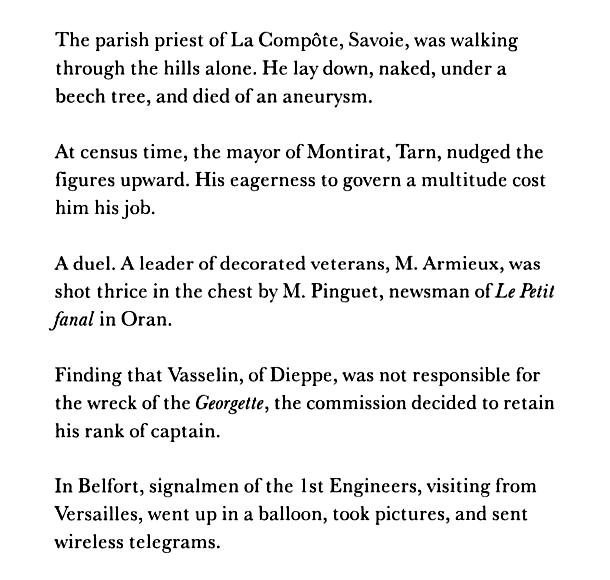
Five from Félix Fénéon

five

Schoolgirls — Nikolay Bogdanov-Belsky

Kites Are Fantastic! (Cowboy Henk)

kites

Keith Carradine on the Music of Altman’s Nashville

Landscape with the Temptation of St.Anthony — January Wellens de Cock

Bolaño/Knausgaard (Books Acquired, 12.04.2013)

20131205-120055.jpg

“Some of Us Had Been Threatening Our Friend Colby” — Donald Barthelme

“Some of Us Had Been Threatening Our Friend Colby” by Donald Barthelme

Some of us had been threatening our friend Colby for a long time, because of the way he had been behaving. And now he’d gone too far, so we decided to hang him. Colby argued that just because he had gone too far (he did not deny that he had gone too far) did not mean that he should be subjected to hanging. Going too far, he said, was something everybody did sometimes. We didn’t pay much attention to this argument. We asked him what sort of music he would like played at the hanging. He said he’d think about it but it would take him a while to decide. I pointed out that we’d have to know soon, because Howard, who is a conductor, would have to hire and rehearse the musicians and he couldn’t begin until he knew what the music was going to be. Colby said he’d always been fond of Ives’s Fourth Symphony. Howard said that this was a “delaying tactic” and that everybody knew that the Ives was almost impossible to perform and would involve weeks of rehearsal, and that the size of the orchestra and chorus would put us way over the music budget. “Be reasonable,” he said to Colby. Colby said he’d try to think of something a little less exacting.

Hugh was worried about the wording of the invitations. What if one of them fell into the hands of the authorities? Hanging Colby was doubtless against the law, and if the authorities learned in advance what the plan was they would very likely come in and try to mess everything up. I said that although hanging Colby was almost certainly against the law, we had a perfect moralright to do so because he was our friend, belonged to us in various important senses, and he had after all gone too far. We agreed that the invitations would be worded in such a way that the person invited could not know for sure what he was being invited to. We decided to refer to the event as “An Event Involving Mr. Colby Williams.” A handsome script was selected from a catalogue and we picked a cream-colored paper. Magnus said he’d see to having the invitations printed, and wondered whether we should serve drinks. Colby said he thought drinks would be nice but was worried about the expense. We told him kindly that the expense didn’t matter, that we were after all his dear friends and if a group of his dear friends couldn’t get together and do the thing with a little bit of eclat, why, what was the world coming to? Colbv asked if he would be able to have drinks, too, before the event. We said,”Certainly.”

The next item of business was the gibbet. None of us knew too much about gibbet design, but Tomas, who is an architect, said he’d look it up in old books and draw the plans. The important thing, as far as he recollected, was that the trapdoor function perfectly. He said that just roughly, counting labor and materials, it shouldn’t run us more than four hundred dollars. “Good God !” Howard said. He said what was Tomas figuring on, rosewood? No, just a good grade of pine, Tomas said. Victor asked if unpainted pine wouldn’t look kind of “raw,” and Tomas replied that he thought it could be stained a dark walnut without too much trouble.

[Read the rest of “Some of Us Had Been Threatening Our Friend Colby” here].

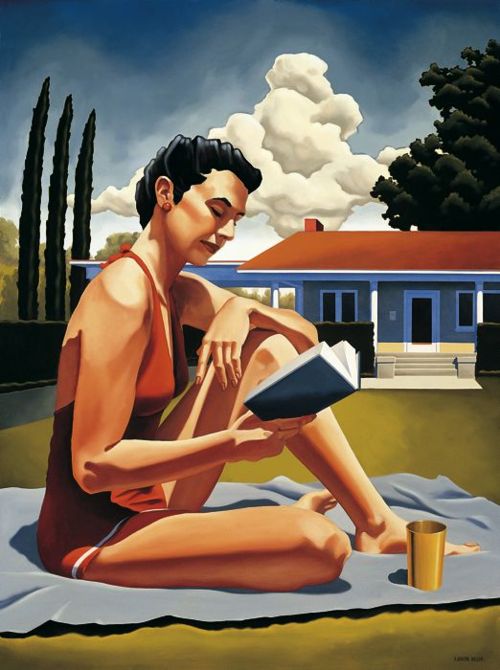
Beyond Evangeline — Kenton Nelson

beyond evangeline

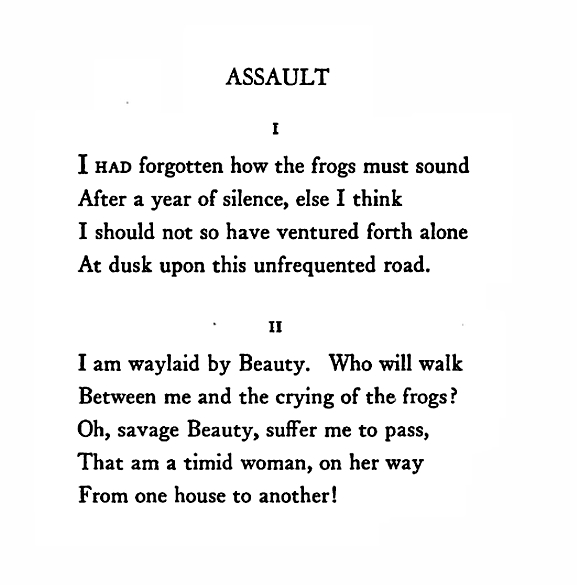
“Assault” — Edna St. Vincent Millay

esvm

Film of Max Ernst Working in His Studio

The Enchanted Spot — René Magritte

The Centaurs — Winsor McCay

The Arming of Perseus — Edward Burne-Jones

“To Read or Not to Read” — Oscar Wilde

“To Read or Not to Read” by Oscar Wilde

Books, I fancy, may be conveniently divided into three classes:

1.  Books to read, such as Cicero’s Letters, Suetonius, Vasari’s Lives of the Painters, the Autobiography of Benvenuto Cellini, Sir John Mandeville, Marco Polo, St. Simon’s Memoirs, Mommsen, and (till we get a better one) Grote’s History of Greece.

2.  Books to re-read, such as Plato and Keats: in the sphere of poetry, the masters not the minstrels; in the sphere of philosophy, the seers not the savants.

3.  Books not to read at all, such as Thomson’s Seasons, Rogers’s Italy, Paley’s Evidences, all the Fathers except St. Augustine, all John Stuart Mill except the essay on Liberty, all Voltaire’s plays without any exception, Butler’s Analogy, Grant’s Aristotle, Hume’s England, Lewes’s History of Philosophy, all argumentative books and all books that try to prove anything.

The third class is by far the most important.  To tell people what to read is, as a rule, either useless or harmful; for, the appreciation of literature is a question of temperament not of teaching; to Parnassus there is no primer and nothing that one can learn is ever worth learning.  But to tell people what not to read is a very different matter, and I venture to recommend it as a mission to the University Extension Scheme.

Indeed, it is one that is eminently needed in this age of ours, an age that reads so much, that it has no time to admire, and writes so much, that it has no time to think.  Whoever will select out of the chaos of our modern curricula ‘The Worst Hundred Books,’ and publish a list of them, will confer on the rising generation a real and lasting benefit.

After expressing these views I suppose I should not offer any suggestions at all with regard to ‘The Best Hundred Books,’ but I hope you will allow me the pleasure of being inconsistent, as I am anxious to put in a claim for a book that has been strangely omitted by most of the excellent judges who have contributed to your columns.  I mean the Greek Anthology.  The beautiful poems contained in this collection seem to me to hold the same position with regard to Greek dramatic literature as do the delicate little figurines of Tanagra to the Phidian marbles, and to be quite as necessary for the complete understanding of the Greek spirit.

I am also amazed to find that Edgar Allan Poe has been passed over.  Surely this marvellous lord of rhythmic expression deserves a place?  If, in order to make room for him, it be necessary to elbow out some one else, I should elbow out Southey, and I think that Baudelaire might be most advantageously substituted for Keble.

No doubt, both in the Curse of Kehama and in the Christian Year there are poetic qualities of a certain kind, but absolute catholicity of taste is not without its dangers.  It is only an auctioneer who should admire all schools of art.