(Not Quite Reviews of) Stuff I Read in September

20130927-141817.jpg

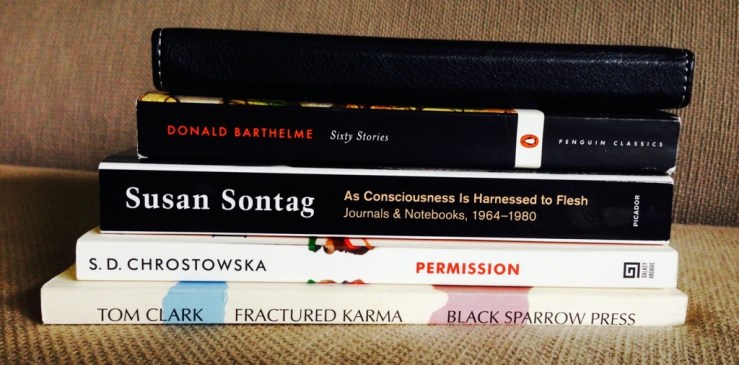
So somehow in September, I neglected to write a single book review—not even a riff!—on this blog. Mea culpa, mea culpa. This oversight (not really an oversight) I mayhap blame on the nascent Fall semester. Or perhaps I should pin it on a certain fatigue after working my way through Pynchon’s mammoth beast Against the Day and Bernhard’s caustic Gargoyles at the end of the summer. But I shouldn’t blame the Thomases. No, I’ve been reading too much at once again. Bad habit.

So, what have I been reading?

Thomas Bernhard’s early novel Frost (on my Kindle, in the dark, often not exactly sober). I posted an excerpt of Ben Marcus’s review of the novel earlier, which I think does a nice job of describing Bernhard’s project. I’m really close to the end, but the novel wears me down—I experienced a similar feeling when I doubled up Correction and The Loser—I should’ve taken a break I think. Still, an excellent, funny read.

Donald Barthelme’s Sixty Stories: I don’t know why anyone wouldn’t own this book. There are a lot of negatives in that sentence; let me reword: Sixty Stories is perfect, a trove, a performance of an author doing stuff that no other author can do. I think I read most of this in college and just sort of went “check” next to it and moved on and I’m certain I didn’t get what he was doing like I do now—just amazing stuff.

I’ve already posted a few excerpts from the latest collection of Susan Sontag’s journals and notebooks, As Consciousness Is Harnessed to Flesh. I like this collection more than the last one—there’s almost a curatorial aspect to Sontag, who is perhaps in her intellectual prime near the end of the journals—or, maybe prime is not the right word; rather, it’s like her mind (which we get to access in some sense via her entries) is so finely attuned (and at times perfectly out of tune) with the intellectual milieu of the day. I’ll be posting a full review sometime in the next two weeks.

S.D. Chrostowska’s novel Permission, new from Dalkey Archive, is lovely stuff—and again, it’ll get its own proper review on here once I can muster the strength. Chrostowska does all sorts of things here that shouldn’t work—cite directly from Blanchot, Derrida, et al—but it does work. The novel is Sebaldian, soaked in history and literature, a book about books, writing about writing. Full review forthcoming. Short review: It’s very very good.

I picked up Tom Clark’s Fractured Karma two weeks ago somewhat randomly. My local bookshop had reorganized some shelves, putting all the Black Sparrow titles together. Fractured Karma must have been on top, because I don’t see how else I would’ve picked up a book with the word “karma” in the title. The book opened to this page:
20130927-141831.jpg

That’s all there is on that page, and something about it—the form, the phrasing—cracked me up. It’s part of a long poem called “He was born blind” about the British comedy actor George Formby. The poem is amazing: I read it there in the store. It reminded me immediately of David Markson’s notecard novels—something about how Clark includes so much reality into his poem. But there’s also this perceptive (if oblique) sense of humor behind it all. I ended up devouring the book, reading the whole thing that weekend. It was one of those holy shit reading moments, frankly. Once I finish typing this I’m going to go pick my kids up and we’re going to go to the bookstore and I’m going to get another Tom Clark book and read it this weekend.

Here’s his poem about The Purple One:

20130927-141838.jpg


The Revenge — George de Forest Brush

It’s very confusing (Calvin & Hobbes)

ch130922

The Search — Ali Banisadr

3_ab-thesearchs

“The Gorgon’s Head” by Nathaniel Hawthorne

“The Gorgon’s Head” by Nathaniel Hawthorne

PERSEUS was the son of Danaë, who was the daughter of a king. And when Perseus was a very little boy, some wicked people put his mother and himself into a chest, and set them afloat upon the sea. The wind blew freshly, and drove the chest away from the shore, and the uneasy billows, tossed it up and down; while Danaë clasped her child closely to her bosom, and dreaded that some big wave would dash its foamy crest over them both. The chest sailed on, however, and neither sank nor was upset; until, when night was coming, it floated so near an island that it got entangled in a fisherman’s nets, and was drawn out high and dry upon the sand. The island was called Seriphus, and it was reigned over by King Polydectes, who happened to be the fisherman’s brother.

This fisherman, I am glad to tell you, was an exceedingly humane and upright man. He showed great kindness to Danaë and her little boy; and continued to befriend them, until Perseus had grown to be a handsome youth, very strong and active, and skilful in the use of arms. Long before this time, King Polydectes had seen the two strangers–the mother and her child–who had come to his dominions in a floating chest. As he was not good and kind, like his brother the fisherman, but extremely wicked, he resolved to send Perseus on a dangerous enterprise, in which he would probably he killed, and then to do some great mischief to Danaë herself. So this bad-hearted king spent a long while in considering what was the most dangerous thing that a young man could possibly undertake to perform. At last, having hit upon an enterprise that promised to turn out as fatally as be desired, he sent for the youthful Perseus.

The young man came to the palace, and found the king sitting upon his throne. Continue reading ““The Gorgon’s Head” by Nathaniel Hawthorne”

Portrait of Eric Satie — Santiago Rusinol

The Fight — James Ensor

“I lost a world the other day” — Emily Dickinson

Capture

Morrissey — Dawn Mellor

The Séance Society (Book Acquired, 9.18.2013)

20130924-200501.jpg

Michael Nethercott’s The Séance Society. Blurbish review from Publisher’s Weekly:

Nethercott’s first full-length novel, a classically styled Holmesian whodunit set in 1956, introduces Lee Plunkett, an underemployed PI following reluctantly in his late father’s detective footsteps, and Mr. O’Nelligan, a charmingly low-key and literary-minded Irishman. Together they investigate the death of Trexler Lloyd, a rich eccentric, egomaniac, and patron of the arts of spirit communication, who appears to have been electrocuted at a private demonstration of “the Spectricator,” a device for speaking with the dead, at his home in Braywick, Conn. The plot manages to be twisty while proceeding logically, though the unanalyzed clues are often obvious enough that the reader must assume that Plunkett is none too clever and the smarter O’Nelligan is holding his cards close before the grand gathering and reveal. The household’s collection of psychics, servants, and ghosts are a colorful lot, but in the end are merely quirky where they could have been hilariously bold. Agent: Susan Gleason, Susan Gleason Literary Agency

Watermelon — Katsuhiro Otomo

watermelon

(More/via).

Seven Jests from Leonardo da Vinci’s Notebooks

1281.

When wine is drunk by a drunkard, that wine is revenged on the drinker.

1283.

An artizan often going to visit a great gentleman without any definite purpose, the gentleman asked him what he did this for. The other said that he came there to have a pleasure which his lordship could not have; since to him it was a satisfaction to see men greater than himself, as is the way with the populace; while the gentleman could only see men of less consequence than himself; and so lords and great men were deprived of that pleasure.

1285.

A JEST.

A man wishing to prove, by the authority of Pythagoras, that he had formerly been in the world, while another would not let him finish his argument, the first speaker said to the second: “It is by this token that I was formerly here, I remember that you were a miller.” The other one, feeling himself stung by these words, agreed that it was true, and that by the same token he remembered that the speaker had been the ass that carried the flour.

A JEST.

It was asked of a painter why, since he made such beautiful figures, which were but dead things, his children were so ugly; to which the painter replied that he made his pictures by day, and his children by night.

1289.

An old man was publicly casting contempt on a young one, and boldly showing that he did not fear him; on which the young man replied that his advanced age served him better as a shield than either his tongue or his strength.

1291.

A JEST.

A man was desired to rise from bed, because the sun was already risen. To which he replied: “If I had as far to go, and as much to do as he has, I should be risen by now; but having but a little way to go, I shall not rise yet.”

1292.

A man, seeing a woman ready to hold up the target for a jousting match, exclaimed, looking at the shield, and considering his spear: “Alack! this is too small a workman for so great a business.”

From the Notebooks of Leonardo da Vinci.


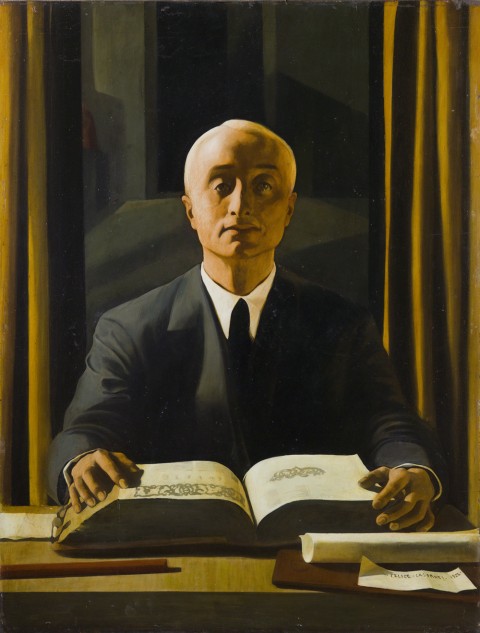
Portrait of Riccardo Gualino — Felice Casorati

03-Casorati_-480x633

Putney Swope — Robert Downey Sr. (Full Film)


Nocturne Black and Gold (The Rag Shop, Chelsea) — James McNeill Whistler

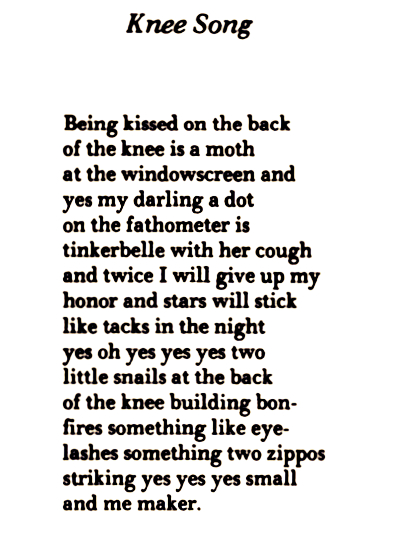
“Knee Song” — Anne Sexton

sexton

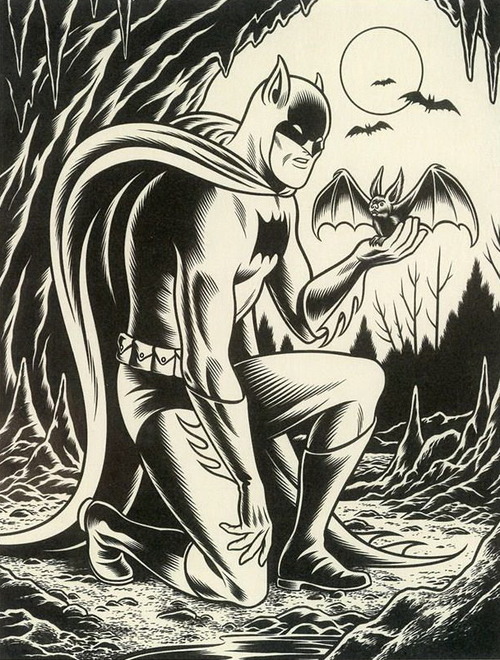
Batman — Charles Burns

batman burns