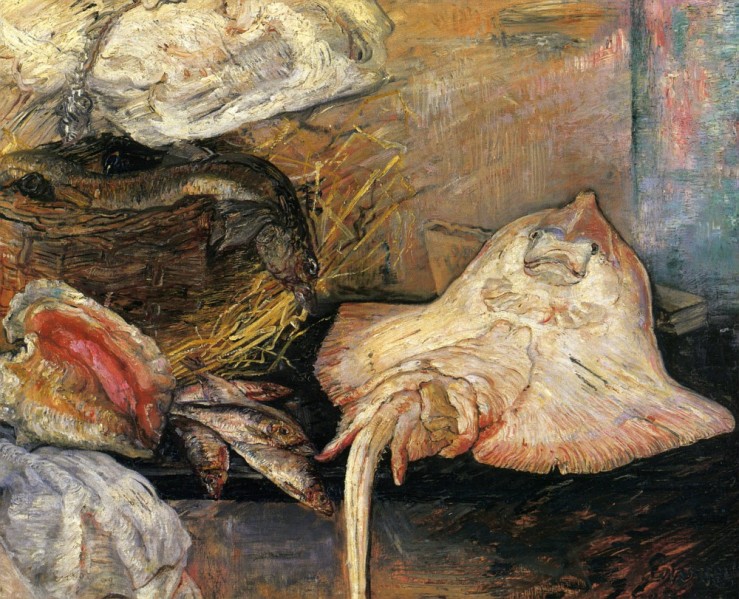
“Another Weeping Woman” — Wallace Stevens

ws

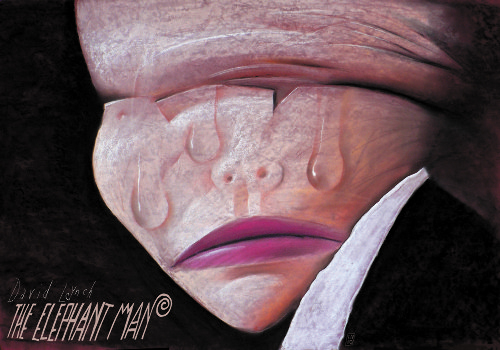
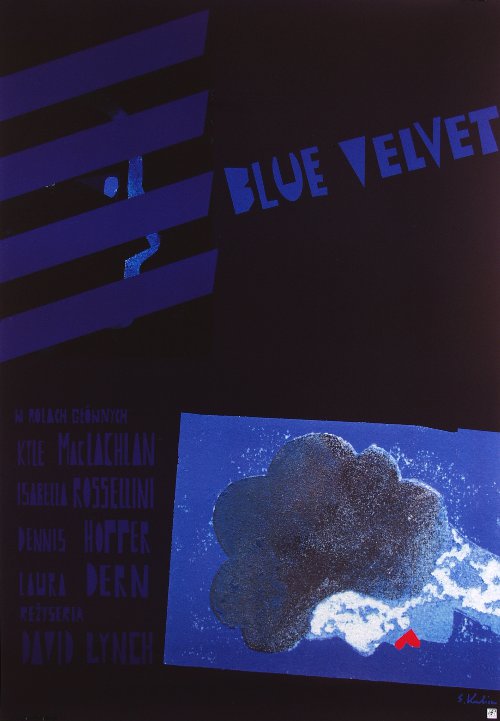
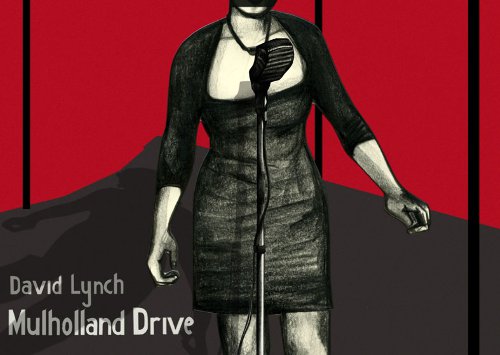
Polish Posters of David Lynch Films

Polish Poster

Polish Poster

dlbv1

dltp

Polish Poster

Polish Poster

dlie

Bonus Czech poster:

dlwah

Film Footage of the First Bloomsday Celebration in 1954

Film footage of the first Bloomsday celebration (June 16, 1954)–a great find by Antoine Malette, who posted the video along with an account of the journey as told in Flann O’Brien: An Illustrated Biography. The film was shot by John Ryan, and shows an extremely inebriated Brian O’Nolan (aka Flann O’Brien) having to be helped around by pals Anthony Cronin and Patrick Kavanagh. We’re also treated to a scene of Kavanagh taking a piss with Joyce’s cousin Tom Joyce, a dentist who joined the merry band. (The scene will undoubtedly recall to you that marvelous moment in Ulysses when “first Stephen, then Bloom, in penumbra urinated“). The troupe didn’t quite finish their mission, getting sidetracked by booze and quarrels. Read the full account at Malette’s site.

Eight Notes on “Life” from Samuel Butler’s Note-Books

  1. The beginning of life is the beginning of an illusion to the effect that there is such a thing as free will and that there is such another thing as necessity – the recognition of the fact that there is an “I can” and an “I cannot,” an “I may” and an “I must.”
  2. Life is not so much a riddle to be read as a Gordian knot that will get cut sooner or later.
  3. Life is the distribution of an error – or errors.
  4. Life is a superstition.  But superstitions are not without their value.  The snail’s shell is a superstition, slugs have no shells and thrive just as well.  But a snail without a shell would not be a slug unless it had also the slug’s indifference to a shell.
  5. Life is one long process of getting tired.
  6. Life is the art of drawing sufficient conclusions from insufficient premises.
  7. Life is eight parts cards and two parts play, the unseen world is made manifest to us in the play.
  8. Life is like music, it must be composed by ear, feeling and instinct, not by rule.  Nevertheless one had better know the rules, for they sometimes guide in doubtful cases – though not often.

—From Samuel Butler’s Note-Books.


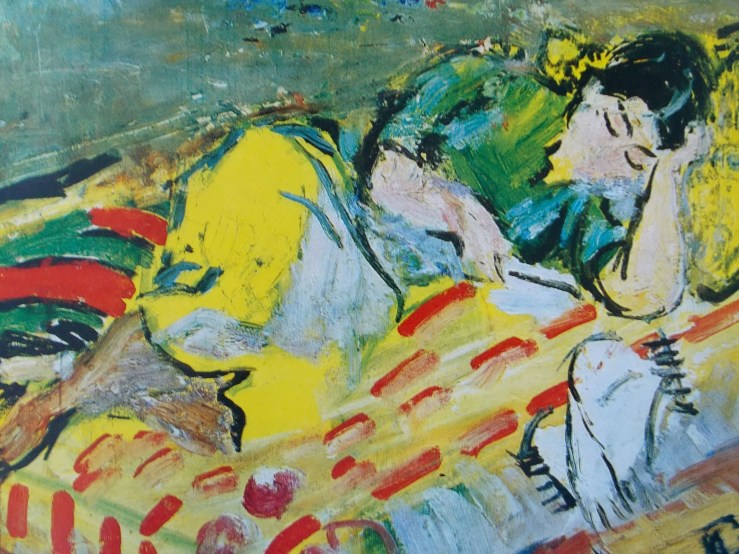
Reclining Woman Reading — Alexandru Ciucurencu

Reclining-Woman-Reading-Alexandru-Ciucurencu

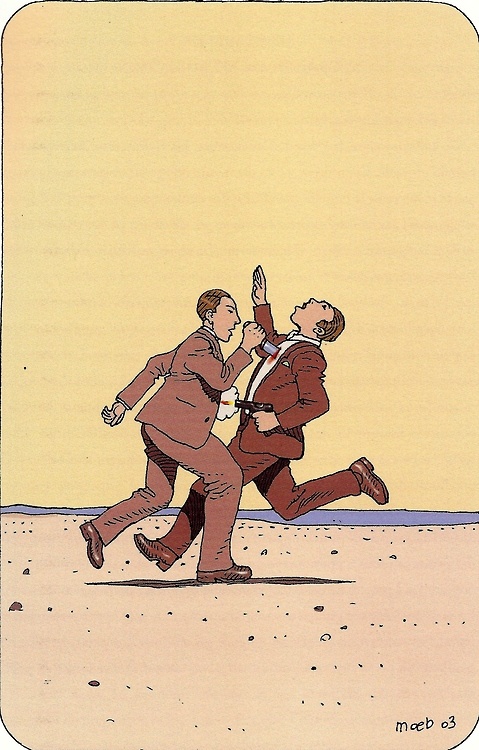
Double Murder — Moebius

double murder moebius

“Herman Melville” — Conrad Aiken

“Herman Melville” by Conrad Aiken:

‘My towers at last!’—
What meant the word
from what acknowledged circuit sprung
and in the heart and on the tongue
at sight of few familiar birds
when seaward his last sail unfurled
to leeward from the wheel once more
bloomed the pale crags of haunted shore
that once-more-visited notch of world:
and straight he knew as known before
the Logos in Leviathan’s roar
he deepest sounding with his lead
who all had fathomed all had said.

Much-loving hero—towers indeed
were those that overhung your log
with entries of typhoon and fog
and thunderstone for Adam’s breed:
man’s warm Sargasso Sea of faith
dislimned in light by luck or fate
you for mankind set sail by hate
and weathered it, and with it death.
And now at world’s end coasting late
in dolphined calms beyond the gate
which Hercules flung down, you come
to the grim rocks that nod you home.
Depth below depth this love of man:
among unnumbered and unknown
to mark and make his cryptic own
one landfall of all time began:
of all life’s hurts to treasure one
and hug it to the wounded breast,
in this to dedicate the rest,
all injuries received or done.
Your towers again but towers now blest
your haven in a shoreless west
o mariner of the human soul
who in the landmark notched the Pole
and in the Item loved the Whole.


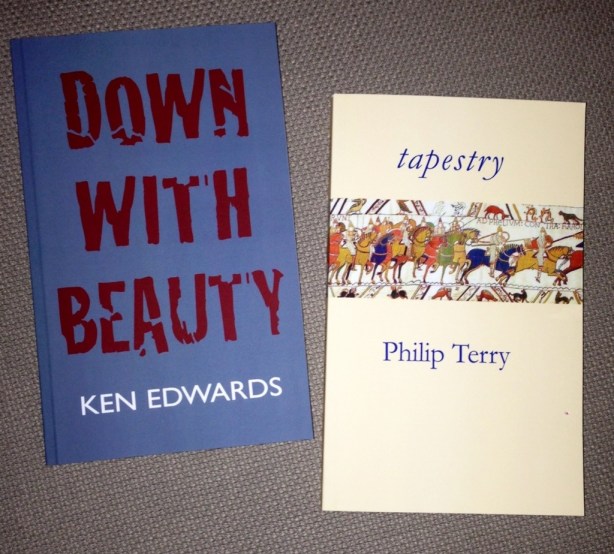
Down with Beauty/tapestry (Books Acquired, 7.17.2013)

20130723-112451.jpg

Two very intriguing new titles from Reality Street: Ken Edwards’s Down with Beauty, and tapestry by Philip Terry.

Here’s the publisher’s blurb for Down with Beauty:

DOWN WITH BEAUTY explores, in a series of linked dialogues, dramatic monologues and short fictions, the themes of exile, the aftermath of war, paranoia, improvised music and nothingness. The collection is completed with the full text of NOSTALGIA FOR UNKNOWN CITIES, previously published separately.  Some samples herehere and here – others will be revealed.

A very strange, scattered book—lovely.

Here’s Reality Street’s blurb for tapestry:

Taking as its starting point marginal images in the Bayeux Tapestry, which have been left largely unexplained by historians, Terry retells the story of the Norman Conquest from the point of view of the tapestry’s English embroiderers. Combining magic realism and Oulipian techniques, this is a tour de force of narrative and language.

tapestry also got a great review from The Guardian’s Nicholas Lezard:

By showing a language in flux,tapestry draws you into its world: that of the creation of the Bayeux tapestry (which, as we are reminded in the book by an exasperated narrator, isn’t a tapestry at all, but a work of embroidery) by a group of nuns in the late 11th century at a priory in Kent. …

Medieval works lend themselves to the picaresque, or multiple narration – think of The Decameròn or The Canterbury Tales. So while there is an overarching narrative, that of the commission and creation of the tapestry, work is paused while each nun tells a story related to her work. If you look at the tapestry, you will remember, or notice, that there are numerous extraneous designs along the borders that would appear to have nothing to do with the matter of the Norman usurpation. Terry has noticed, as have others, the Aesopian motifs that occur, and includes slender, playful versions, sometimes modernised, of Aesop’s fables himself. My favourite is one in which a lion, confronting Aesop, asks him to tell him a fable before the lion eats him. So Aesop says he was confronted by a lion who asked him to tell a fable … and so on; and eventually the lion gets bored and goes away.

Great to see some new stuff that’s, well, really new

Don Quixote and Sancho Panza in the Terrifying Forest at Night — Gustave Doré

(More at Gustave Doré’s Don Quixote)

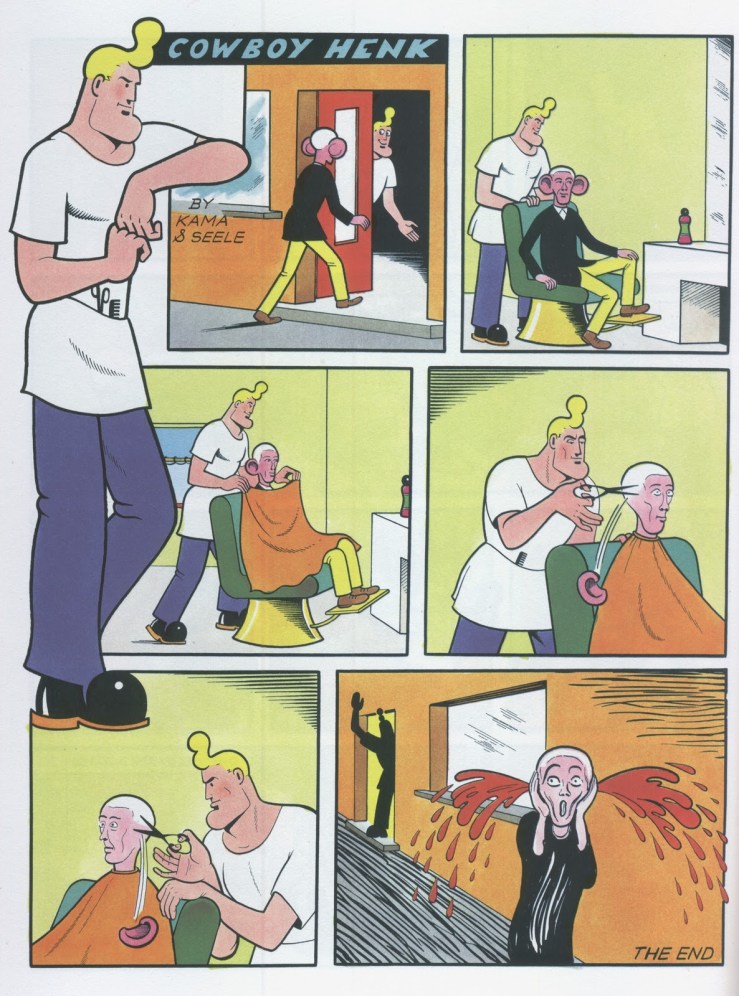
The Scream (Kamagurka & Herr Seele’s Cowboy Henk)

henk scream

Six Ideas and Images from Nathaniel Hawthorne’s Note-Books

  1. In an old London newspaper, 1678, there is an advertisement, among other goods at auction, of a black girl, about fifteen years old, to be sold.
  2. We sometimes congratulate ourselves at the moment of waking from a troubled dream: it may be so the moment after death.
  3. The race of mankind to be swept away, leaving all their cities and works. Then another human pair to be placed in the world, with native intelligence like Adam and Eve, but knowing nothing of their predecessors or of their own nature and destiny. They, perhaps, to be described as working out this knowledge by their sympathy with what they saw, and by their own feelings.
  4. A singular fact, that, when man is a brute, he is the most sensual and loathsome of all brutes.
  5. A snake taken into a man’s stomach and nourished there from fifteen years to thirty-five, tormenting him most horribly. A type of envy or some other evil passion.
  6. A sketch illustrating the imperfect compensations which time makes for its devastations on the person,–giving a wreath of laurel while it causes baldness, honors for infirmities, wealth for a broken constitution,–and at last, when a man has everything that seems desirable, death seizes him. To contrast the man who has thus reached the summit of ambition with the ambitious youth.

Notations from Nathaniel Hawthorne’s American Note-Books.

Map Reading — Stanley Spencer

Nicolas Winding Refn Picks DVDs from the Criterion Collection Closet

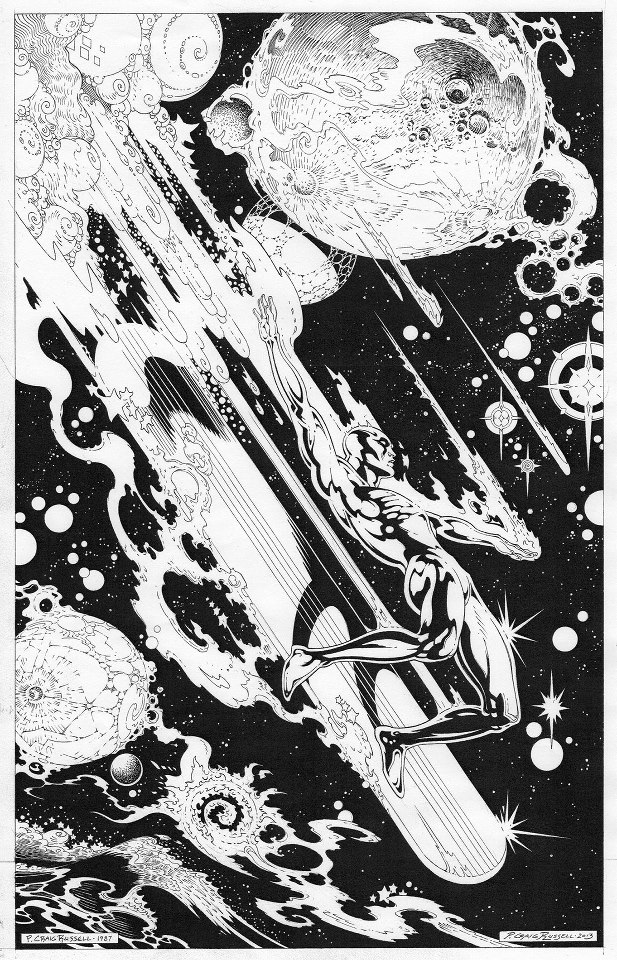
Silver Surfer — P. Craig Russell

surfer

Mikhail Bulgakov’s Novel The Master and Margarita Reviewed

masterandmargarita4

In his introduction to Mikhail Bulgakov’s novel The Master and Margarita, Richard Pevear (who translated the book with Larissa Volokhonsky) notes

the qualities of the novel itself — its formal originality, its devastating satire of Soviet life, and of Soviet literary life in particular, its ‘theatrical’ rendering of the Great Terror of the thirties, the audacity of its portrayal of Jesus Christ and Pontius Pilate, not to mention Satan.

Pevear also offers a concise (if mechanical) summary:

The novel in its definitive version is composed of two distinct but interwoven parts, one set in contemporary Moscow, the other in ancient Jerusalem (called Yershalaim). Its central characters are Woland (Satan) and his retinue, the poet Ivan Homeless, Pontius Pilate, an unnamed writer known as ‘the master’, and Margarita. The Pilate story is condensed into four chapters and focused on four or five large-scale figures. The Moscow story includes a whole array of minor characters. The Pilate story, which passes through a succession of narrators, finally joins the Moscow story at the end, when the fates of Pilate and the master are simultaneously decided.

As you might gather from its translator’s descriptions, there’s a lot going on in The Master and Margarita. 

Bulgakov satirizes early Soviet life, particularly focusing on the phonies and fops who populate Moscow’s art scene. This aspect of the narrative is full of disappearances; characters are taken away forever by the secret police. Bulgakov elides the secret police from the reader, a brilliant rhetorical move that heightens the book’s paranoia. The paranoid comedy edges quickly into horror though as the reality of living in such confined spaces and under such controlled surveillance bleeds into Bulgakov’s fantasy.

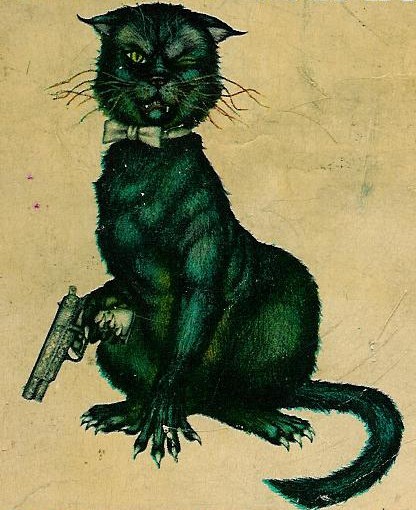
Indeed, the realities of life in the Soviet police state (“No papers, no person”) come across as far scarier than the supernatural characters of The Master and Margarita. Woland’s retinue, in particular his cat Behemoth (who seems to grace—can that be the right verb?—the covers of most editions of the novel), imbue the novel with a compelling manic energy. The most memorable sequences for most readers will likely involve Woland’s troupe’s antics, including their wild performance at the Variety Theatre, which climaxes in this bit of comic violence before culminating in a rush of greed and gratuitous nudity:

And an unheard-of thing occurred. The fur bristled on the cat’s back, and he gave a rending miaow. Then he compressed himself into a ball and shot like a panther straight at Bengalsky’s chest, and from there on to his head. Growling, the cat sank his plump paws into the skimpy chevelure of the master of ceremonies and in two twists tore the head from the thick neck with a savage howl.

The two and a half thousand people in the theatre cried out as one. Blood spurted in fountains from the torn neck arteries and poured over the shirt-front and tailcoat. The headless body paddled its feet somehow absurdly and sat down on the floor. Hysterical women’s cries came from the audience. The cat handed the head to Fagott, who lifted it up by the hair and showed it to the audience, and the head cried desperately for all the theatre to hear:

‘A doctor!’

(Don’t worry, Bengalsky gets his head back. Sort of).

Another highlight of the book is the Walpurgis Night episode—Chapter 23, “The Great Ball at Satan’s”—which I’d argue can stand on its own, free of context, as a lovely, dark, bizarre short story. Margarita plays hostess to a seemingly-endless parade of “kings, dukes, cavaliers, suicides, poisoners, gallowsbirds, procuresses, prison guards and sharpers, executioners, informers, traitors, madmen, sleuths, seducers,” who arrive via fireplace, their corpses reanimated to take part in the grand dance. Bulgakov cribs freely from history, populating the episode with condemned persons obscure and infamous alike.

The Walpurgisknacht episode highlights The Master and Margaritastrong Easter/Faust theme, which plays out for several characters who are reborn (figuratively or otherwise). The least interesting of these by far is the master himself. But perhaps this is unfair. It’s entirely plausible that the master is the storyteller of The Master and Margarita. In any case, his unnamed novel (within the text) depicts an alternate version of Jesus of Nazareth’s crucifixion, and it’s here that we find what I take to be The Master and Margarita’s most interesting and complex character, “the fifth procurator of Judea, Pontius Pilate.” The episodes with Pilate (who employs his own secret police, a wonderful parallel to the Soviet setting) offer a kind of moral ballast to the supernatural sequences, which fluctuate between manic-comic anxiety and big-R Romanticism. Of all the souls in turmoil in The Master and Margarita’s, I found the depiction of Pilate’s troubles the most profound.

The Master and Margarita’s lurching structure threatens narrative coherence until the novel’s final moments, when the master meets his creation. The moment is unexpectedly poignant, and does much to amend some of the novel’s ungainliness. The middle sections in particular get bogged down, as Bulgakov subjects his Muscovite extras to all sorts of fates (some more terrible than others). While some of these episodes are funny, and they certainly give the book some of its satirical power, they ultimately read as variations on a theme. I found my eyes glazing over in the novel’s epilogue when Bulgakov decides to check in on the survivors.

I’ve failed to remark on so much of The Master and Margarita, and I’m certain that much of its rich allusive texture was lost on me. (I should point out here how helpful the end notes of my edition were). Persons interested in early Soviet life who have not yet found their way to Bulgakov’s novel will wish to do so (as well as the work of Bulgakov’s contemporary Sigizmund Krzhizhanovsky); the novel also makes a strange but worthy companion piece to William Gaddis’s enormous Faust tale The RecognitionsAlthough The Master and Margarita sags at times, at its finest moments—of which there are many—it is funny, dark, and engrossing.

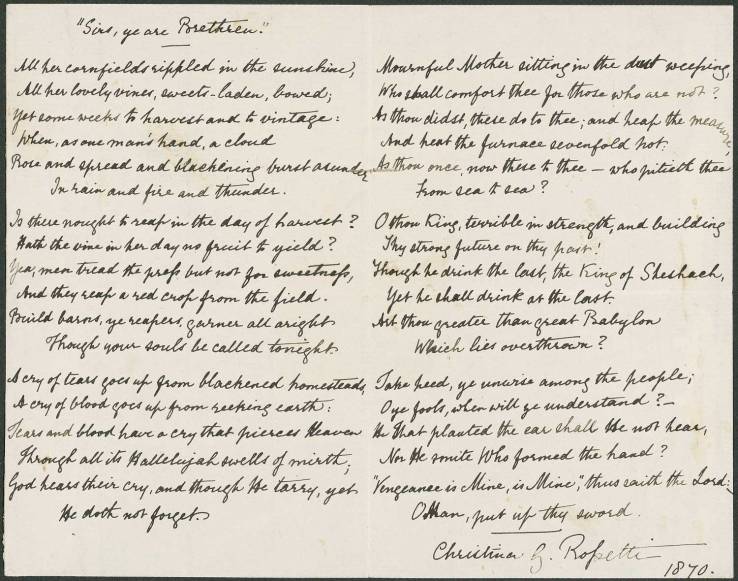
Christina Rossetti’s Manuscript for “Sirs, Ye Are Brethren”

sirsyearebrethren_holograph

(Via/about).