See the Trailer for Spike Lee’s Remake of Oldboy

“Democratic Vistas” — Walt Whitman

“Democratic Vistas” by Walt Whitman

Political democracy, as it exists and practically works in America, with all its threatening evils, supplies a training school for making first-class men. It is life’s gymnasium, not of good only, but of all. We try often, though we fall back often. A brave delight, fit for freedom’s athletes, fills these arenas, and fully satisfies, out of the action in them, irrespective of success. Whatever we do not attain, we at any rate attain the experiences of the fight, the hardening of the strong campaign, and throb with currents of attempt at least. Time is ample. Let the victors come after us. Not for nothing does evil play its part among us. Judging from the main portions of the history of theworld, so far, justice is always in jeopardy, peace walks amid hourly pitfalls, and of slavery, misery, meanness, the craft of tyrants and the credulity of the populace, in some of the protean forms, no voice can at any time say, They are not. The clouds break a little, and the sun shines out-but soon and certain the lowering darkness falls again, as if to last forever. Yet is there an immortal courage and prophecy in every sane soul that cannot, must not, under any circumstances, capitulate. Vive, the attack–the perennial assault! Vive, the unpopular cause–the spirit that audacious]y aims–the never-abandoned efforts, pursued the same amid opposing proofs and precedents.

Once, before the war (alas! I dare not say how many times the mood has come!) I, too, was filled with doubt and gloom. A foreigner, an acute and good man, had impressively said to me, that day-putting in form, indeed, my own observations: “I have traveled much in the United States, and watched their politicians, and listened to the speeches of the candidates, and read the journals, and gone into the public-houses, and heard the unguarded talk of men. And I have found your vaunted America honeycombed from top to toe with infidelism, even to itself and its own program. I have marked the brazen hell-faces of secession and slavery gazing defiantly from all the windows and doorways. I have everywhere found, primarily, thieves and scalliwags arranging the nominations to offices, and sometimes filling the offices themselves. I have found the north just as full of bad stuff as the south. Of the holders of public office in the Nation or the States or their municipalities, I have found that not one in a hundred has been chosen by any spontaneous selection of the outsiders, the people, but all have been nominated and put through by little or large caucuses of the politicians, and have got in by corrupt rings and electioneering, not capacity or desert. I have noticed how the millions of sturdy farmers and mechanics are thus the helpless supple-jacks of comparatively few politicians. And I have noticed, more and more, the alarming spectacle of parties usurping the government, and openly and shamelessly wielding it for party purposes. Continue reading ““Democratic Vistas” — Walt Whitman”

Drawing Room — Balthus

Trailer and Posters for Hayao Miyazaki’s Next Film, The Wind Rises

miya

I don’t know how I missed this—the teaser came out a few weeks ago—but a new Miyazaki is always promising. The Wind Rises is out in Japan in two weeks, out in the rest of the world, who knows when…but I’ve never minded watching his films sans subtitles or dubbing. Read more about The Wind Rises here; read my review of Ponyo, the last Studio Ghibli film that Miyazaki directed.

Kaze-Tachinu-610x859


Eine Kleine Nachtmusik — Dorothea Tanning

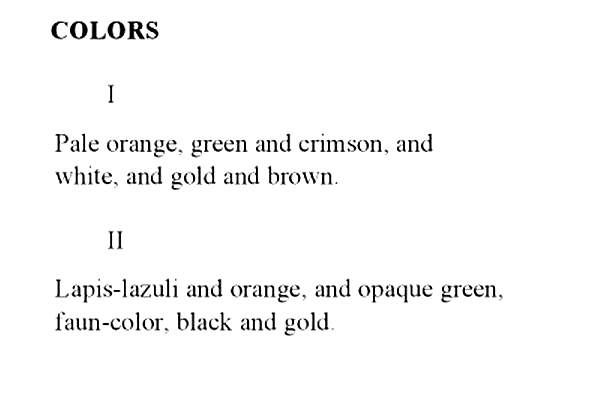
“Colors” — Wallace Stevens

colors

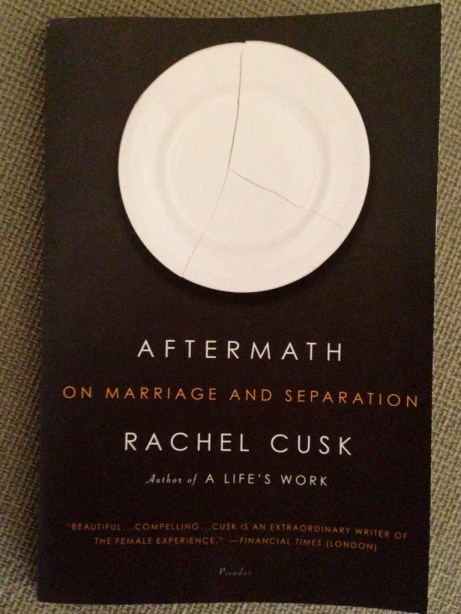
Aftermath (Book Acquired, 7.08.2013)

20130709-141450.jpg

When a review copy of Rachel Cusk’s memoir Aftermath: On Marriage and Separation (new in trade paperback from Picador) showed up the other day, a dim bulb went off—where did I know Cusk’s name? I’m not generally a fan of the memoir, so I doubt I’d read it. And then! Aha! Yes—it was a review of Cusk’s memoir that won Camilla Long this year’s “Hatchet Job of the Year” award.

From Long’s review (originally published in The Sunday Times):

The book is crammed with mad, flowery metaphors and hifalutin creative-writing experiments. There are hectic passages on Greek tragedy and the Christian concept of family, as well as fragments of ghost stories, references to the Anglo-Saxon heptarchy, and heavy Freudian symbolism, including a long description of the removal of a molar, “a large tooth,” she writes portentously, “of great…personal significance”. The final chapter is an out-of-body experience — her situation seen through the eyes of her pill-popping Eastern European au pair. Oddly, I read the whole thing in a Bulgarian accent.

I don’t know, that sounds pretty weird. Kinda intrigues me.


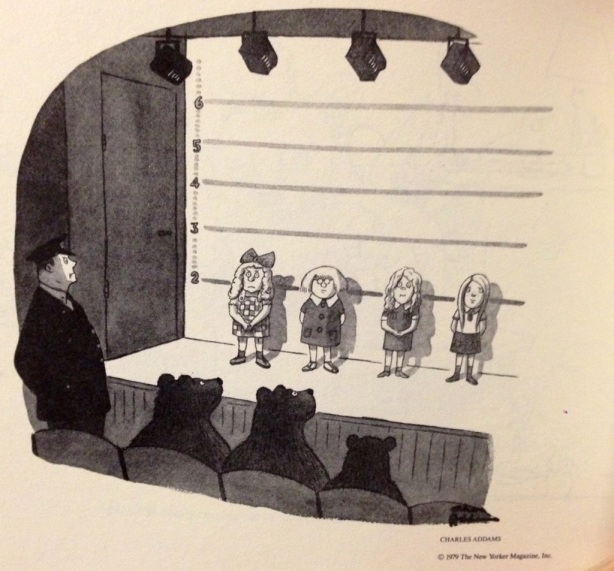
Goldilocks Lineup (Charles Addams)

20130601-101339.jpg

“Maybe there’s something wrong with our notion of paradise” — Slavoj Žižek

In an essay published today at the LRB, Slavoj Žižek addresses the current, disparate waves of protest around the globe and explores the

difference between a reformist and a revolutionary period: in a reformist period, global revolution remains a dream which, if it does anything, merely lends weight to attempts to change things locally; in a revolutionary period, it becomes clear that nothing will improve without radical global change.

Žižek continues:

Where do we stand today with respect to this difference? Are the problems and protests of the last few years signs of an approaching global crisis, or are they just minor obstacles that can be dealt with by means of local interventions? The most remarkable thing about the eruptions is that they are taking place not only, or even primarily, at the weak points in the system, but in places which were until now perceived as success stories. We know why people are protesting in Greece or Spain; but why is there trouble in such prosperous or fast-developing countries as Turkey, Sweden or Brazil? With hindsight, we might see the Khomeini revolution of 1979 as the original ‘trouble in paradise’, given that it happened in a country that was on the fast-track of pro-Western modernisation, and the West’s staunchest ally in the region. Maybe there’s something wrong with our notion of paradise.

If the examples in the above paragraph seem too concrete for a Žižekian riff, don’t worry. Our philosopher addresses what he takes to be the ideological underpinnings of protest:

It is also important to recognise that the protesters aren’t pursuing any identifiable ‘real’ goal. The protests are not ‘really’ against global capitalism, ‘really’ against religious fundamentalism, ‘really’ for civil freedoms and democracy, or ‘really’ about any one thing in particular. What the majority of those who have participated in the protests are aware of is a fluid feeling of unease and discontent that sustains and unites various specific demands. The struggle to understand the protests is not just an epistemological one, with journalists and theorists trying to explain their true content; it is also an ontological struggle over the thing itself, which is taking place within the protests themselves. Is this just a struggle against corrupt city administration? Is it a struggle against authoritarian Islamist rule? Is it a struggle against the privatisation of public space? The question is open, and how it is answered will depend on the result of an ongoing political process.

And an answer, perhaps, to some of these questions:

Only a politics that fully takes into account the complexity of overdetermination deserves to be called a strategy. When we join a specific struggle, the key question is: how will our engagement in it or disengagement from it affect other struggles? The general rule is that when a revolt against an oppressive half-democratic regime begins, as with the Middle East in 2011, it is easy to mobilise large crowds with slogans – for democracy, against corruption etc. But we are soon faced with more difficult choices. When the revolt succeeds in its initial goal, we come to realise that what is really bothering us (our lack of freedom, our humiliation, corruption, poor prospects) persists in a new guise, so that we are forced to recognise that there was a flaw in the goal itself. This may mean coming to see that democracy can itself be a form of un-freedom, or that we must demand more than merely political democracy: social and economic life must be democratised too. In short, what we first took as a failure fully to apply a noble principle (democratic freedom) is in fact a failure inherent in the principle itself. This realisation – that failure may be inherent in the principle we’re fighting for – is a big step in a political education.

“The study of life not to be neglected for the sake of books” — Samuel Johnson

“The study of life not to be neglected for the sake of books” by Samuel Johnson

 On life, on morals, be thy thoughts employ’d;
Leave to the schools their atoms and their void.

IT is somewhere related by Le Clerc, that a wealthy trader of good understanding, having the common ambition to breed his son a scholar, carried him to an university, resolving to use his own judgment in the choice of a tutor. He had been taught, by whatever intelligence, the nearest way to the heart of an academick, and at his arrival entertained all who came about him with such profusion, that the professors were lured by the smell of his table from their books, and flocked round him with all the cringes of awkward complaisance. This eagerness answered the merchant’s purpose: he glutted them with delicacies, and softened them with caresses, till he prevailed upon one after another to open his bosom, and make a discovery of his competitions, jealousies, and resentments. Having thus learned each man’s character, partly from himself, and partly from his acquaintances, he resolved to find some other education for his son, and went away convinced, that a scholastick life has no other tendency than to vitiate the morals and contract the understanding: nor would he afterwards hear with patience the praises of the ancient authors, being persuaded that scholars of all ages must have been the same, and that Xenophon and Cicero were professors of some former university, and therefore mean and selfish, ignorant and servile, like those whom he had lately visited and forsaken.

Envy, curiosity, and a sense of the imperfection of our present state, incline us to estimate the advantages which are in the possession of others above their real value. Every one must have remarked, what powers and prerogatives the vulgar imagine to be conferred by learning. A man of science is expected to excel the unlettered and unenlightened even on occasions where literature is of no use, and among weak minds, loses part of his reverence, by discovering no superiority in those parts of life, in which all are unavoidably equal; as when a monarch makes a progress to the remoter provinces, the rustics are said sometimes to wonder that they find him of the same size with themselves. Continue reading ““The study of life not to be neglected for the sake of books” — Samuel Johnson”

Smithers — Aubrey Beardsley

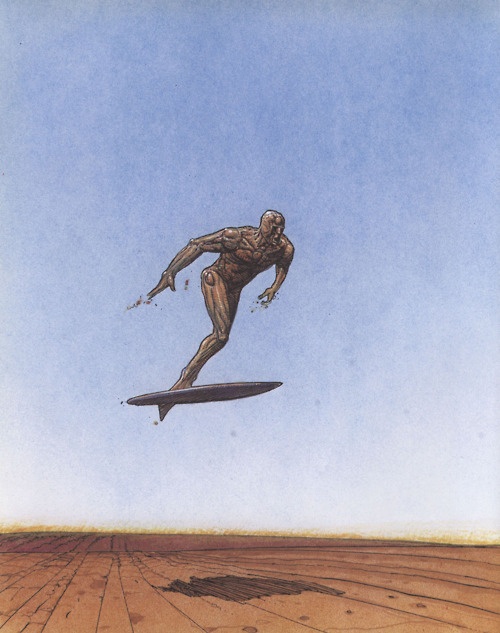
Silver Surfer — Moebius

silver surfer

The NewerYork #3 (Book Acquired, 6.17.2013)

20130709-154848.jpg

I kept meaning to do a book acquired post of the forthcoming issue of TheNewerYork but the smallish book was sort of with me in a lot of places, like tucked in my pocket or a car or my backpack. I actually should review it at this point, but I haven’t read everything in it yet. Short review: An increase in print quality over the last issue (read my review of The NewerYork #2), and the same spirit.

This little anthology’s vision might be bizarre, but it’s also clear. Anyway, good stuff (Anton Nimblett’s “Show & Tell: An American Game” might be my favorite—simultaneously witty and devastating). Full review to come. In the meantime, some samples: 

20130709-154256.jpg

20130709-154303.jpg
Detail from The Beauty Curse by Lori Nelson

20130709-154308.jpg


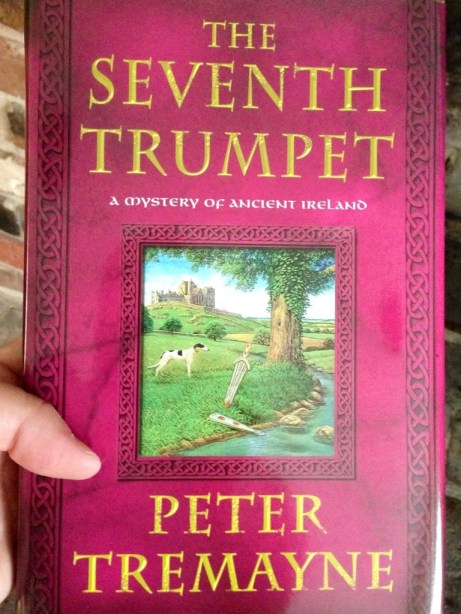
The Seventh Trumpet (Book Acquired, 7.01.2013)

20130709-140949.jpg

The Seventh Trumpet, another mystery from Peter Tremayne. Publisher Minotaur’s blurb:

When a murdered corpse of an unknown young noble is discovered, Fidelma of Cashel is brought in to investigate

Ireland, AD 670. When the body of a murdered young noble is discovered not far from Cashel, the King calls upon his sister, Fidelma, and her companion Eadulf to investigate. Fidelma, in addition to being the sister of the king, is a dailaigh—an advocate of the Brehon Law Courts—and has a particular talent for resolving the thorniest of mysteries.

But this time, Fidelma and Eadulf have very little to work with—the only clue to the noble’s identity is an emblem originating from the nearby kingdom of Laign. Could the murder be somehow related to the wave of violence erupting in the western lands of the kingdom? The turmoil there is being stirred up by an unknown fanatical figure who claims to have been summoned by “the seventh angel” to remove the “impure of faith.” Fidelma and Eadulf, once again grappling with a tangled skein of murder and intrigue, must somehow learn what connects the dead noble, a murdered alcoholic priest, and an abbot who has turned his monastery into a military fortress. When it appears that things cannot get more complex, Fidelma herself is abducted, and Eadulf must rescue her before the mystery can be solved.


Watch All the Memory in the World, A Short Film by Alain Resnais

The Collective Dream of the Chums of Chance (A Short Pynchon Riff)

1. This is one of the most extraordinary passages I’ve read so far in Pynchon’s Against the Day (pages 422-24 of my Penguin hardback).

It comes almost at the end of Iceland Spar, the second of the AtD’s five books, working as a surreal, dream-logic climax to the chapter.

Our heroes the Chums of Chance experience an existential identity crisis, one that makes them wonder if they themselves were mere dreamers, readers of the dime novels that chronicled their adventures, and not, y’know, actual adventurers:

Meantime, now and then in the interstices of what was after all not a perpetual midwestern holiday, the former crew of the Inconvenience became aware of doubts creeping in. What if they weren’t harmonica players? really? If it was all just some elaborate hoax they’d chosen to play on themselves, to keep distracted from a reality too frightening to receive the vast undiscriminating light of the Sky, perhaps the not-to-be-spoken-of betrayal now firmly installed at the heart of the . . . the Organization whose name curiously had begun to escape them . . . some secret deal, of an unspecified nature, with an ancient enemy . . . but they could find no entries in any of the daily Logs to help them remember. . . .

Had they gone, themselves, through some mutation into imperfect replicas of who they once were? meant to revisit the scenes of unresolved conflicts, the way ghosts are said to revisit places where destinies took a wrong turn, or revisit in dreams the dreaming body of one loved more than either might have known, as if whatever happened between them could in that way be put right again? Were they now but torn and trailing afterimages of clandestine identities needed on some mission long ended, forgotten, but unwilling or unable to be released from it? Perhaps even surrogates recruited to stay behind on the ground, allowing the “real” Chums to take to the Sky and so escape some unbearable situation? None of them may really ever have been up in a skyship, ever walked the exotic streets or been charmed by the natives of any far-off duty station. They may only have once been readers of the Chums of Chance Series of boys’ books, authorized somehow to serve as volunteer decoys. Once, long ago, from soft hills, from creekside towns, from libraries that let kids lie on the floor where it’s cool and read the summer afternoons away, the Chums had needed them . . . they came.

WANTED Boys for challenging assignments, must be fit, dutiful, ready, able to play the harmonica (“At a Georgia Camp Meeting” in all keys, modest fines for wrong notes), and be willing to put in long hours of rehearsal time on the Instrument. . . Adventure guaranteed!

So that when the “real” Chums flew away, the boys were left to the uncertain sanctuary of the Harmonica Marching Band Training Academy. . . . But life on the surface kept on taking its usual fees, year by year, while the other Chums remained merrily aloft, kiting off tax-free to assignments all over the world, perhaps not even remembering their “deps” that well anymore, for there was so much to occupy the adventurous spirit, and the others— “groundhogs” in Chums parlance—had known, surely, of the risks and the costs of their surrogacy. And some would drift away from here as once, already long ago, from their wholesome heartland towns, into the smoke and confusion of urban densities unimagined when they began, to join other ensembles playing music of the newer races, arrangements of Negro blues, Polish polkas, Jewish klezmer, though others, unable to find any clear route out of the past, would return again and again to the old performance sites, to Venice, Italy, and Paris, France, and the luxury resorts of old Mexico, to play the same medleys of cakewalks and rags and patriotic airs, to sit at the same café tables, haunt the same skeins of narrow streets, gaze unhappily on Saturday evenings at the local youngsters circulating and flirting through the little plazas, unsure whether their own youth was behind them or yet to come. Waiting as always for the “true” Chums to return, longing to hear, “You were splendid, fellows. We wish we could tell you about everything that’s been going on, but it’s not over yet, it’s at such a critical stage, and the less said right now the better. But someday . . .”

“Are you going away again?”

“So soon?”

“We must. We’re just so sorry. The reunion feast was delicious and much appreciated, the harmonica recital one we shall never forget, especially the ‘coon’ material. But now . . .”

So, once again, the familiar dwindling dot in the sky.

“Don’t be blue, pal, it must’ve been important, they really wanted to stay this time, you could tell.”

“What are we going to do with all this extra food?”

“And all the beer nobody drank!”

“Somehow I don’t think that’ll be a problem.”

But that was the beginning of a certain release from longing, as if they had been living in a remote valley, far from any highways, and one day noticed that just beyond one of the ridge-lines all this time there’d been a road, and down this road, as they watched, came a wagon, then a couple of riders, then a coach and another wagon, in daylight which slowly lost its stark isotropy and was flowed into by clouds and chimney smoke and even episodes of weather, until presently there was a steady stream of traffic, audible day and night, with folks beginning to venture over into their valley to visit, and offering rides to towns nearby the boys hadn’t even known existed, and next thing anybody knew, they were on the move again in a world scarcely different from the one they had left. And one day, at the edge of one of these towns, skyready, brightwork gleaming, newly painted and refitted and around the corner of a gigantic hangar, waiting for them, as if they had never been away, there was their ship the good old Inconvenience. And Pugnax with his paws up on the quarterdeck rail, tail going a mile a minute, barking with unrestrained joy.

2. Long passage, so short riff:

3. First (or third, if my enumeration is honest), let me point out that this passage recalls a similar identity transference that happened earlier in the novel to Reef Traverse when he reads a Chums of Chance novel.

4. Which, to rehash the point of the riff I linked to in point 3 above, is to say that the passage is very much about reader-identification, about the ways that we dream ourselves into the novels we read—that the places they occupy are very real.

So much of Against the Day is about doubling, about secret identities, secret powers, secret lives—the invisible (the word “invisible” pops up again and again and again in this book)—that we can lead these whole other lives in our imagination, and that books fuel these lives, etc.

5. This book of Against the Day is named for Iceland spar, a crystal with double-refraction properties. Earlier, the stage magician/minor character Luca Zombini (“Light Zombie”?) reveals that he’s actually split people into two versions of themselves (evidence of such doppelgangers are scattered throughout the novel) using the mineral in his shows.

When our Chums finally reassume the mantles of their “true identities” we’re told that “they were on the move again in a world scarcely different from the one they had left” — are these the same Chums, the same aircrew, the same adventurers? The adverb “scarcely” seems to work some strange magic here.

6. In any case, their loyal hound Pugnax identifies them as the real McCoy, his “tail going a mile a minute, barking with unrestrained joy.”

I’ll admit to feeling some of that joy myself.

Sanctuary — Earl Cunningham