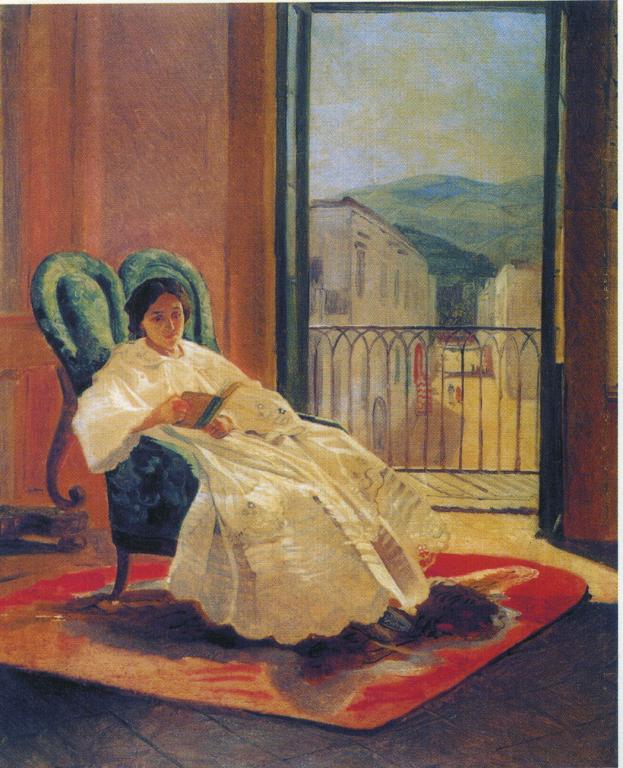
Portrait of the Artist’s Wife, Anna Ge — Nikolai Ge

portrait-of-the-artist-s-wife-anna-ge

Barfly (Full Film)

Letter to Ernest Hemingway — F.Scott Fitzgerald

Dear Ernest:

It’s a fine novel [For Whom the Bell Tolls], better than anybody else writing could do. Thanks for thinking of me and for your dedication. I read it with intense interest, participating in a lot of the writing problems as they came along and often quite unable to discover how you brought off some of the effects, but you always did. The massacre was magnificent and also the fight on the mountain and the actual dynamiting scene. Of the sideshows I particularly liked the vignette of Karkov and Pilar’s Sonata to death—and I had a personal interest in the Moseby guerilla stuff because of my own father. The scene in which the. father says goodbye to his son is very powerful. I’m going to read the whole thing again.

I never got to tell you how I like To Have and to Have Not either. There is observation and writing in that that the boys will be imitating with a vengeance—paragraphs and pages that are right up with Dostoiefski in their undeflected intensity.

Congratulations too on your new book’s great success. I envy you like hell and there is no irony in this. I always liked Dostoiefski with his wide appeal more than any other European—and I envy you the time it will give you to do what you want.

With Old Affection,

P.S. I came across an old article by John Bishop about how you lay four days under dead bodies at Caporetto and how I flunked out of Princeton (I left on a stretcher in November—you can’t flunk out in November) … What I started to say was that I do know something about you on the Italian front, from a man who was in your unit—how you crawled some hellish distance pulling a wounded man with you and how the doctors stood over you wondering why you were alive with so many perforations. Don’t worry—I won’t tell anybody. Not even Allan Campbell who called me up and gave me news of you the other day.

P.S. (2) I hear you are marrying one of the most beautiful people I have ever seen. Give her my best remembrance.

(November 8, 1940; republished in New Directions’ edition of The Crack Up).


“Is Ahab, Ahab? Is it I, God, or who, that lifts this arm?” (Moby-Dick)

“What is it, what nameless, inscrutable, unearthly thing is it; what cozening, hidden lord and master, and cruel, remorseless emperor commands me; that against all natural lovings and longings, I so keep pushing, and crowding, and jamming myself on all the time; recklessly making me ready to do what in my own proper, natural heart, I durst not so much as dare? Is Ahab, Ahab? Is it I, God, or who, that lifts this arm? But if the great sun move not of himself; but is as an errand-boy in heaven; nor one single star can revolve, but by some invisible power; how then can this one small heart beat; this one small brain think thoughts; unless God does that beating, does that thinking, does that living, and not I. By heaven, man, we are turned round and round in this world, like yonder windlass, and Fate is the handspike. And all the time, lo! that smiling sky, and this unsounded sea! Look! see yon Albicore! who put it into him to chase and fang that flying-fish? Where do murderers go, man! Who’s to doom, when the judge himself is dragged to the bar? But it is a mild, mild wind, and a mild looking sky; and the air smells now, as if it blew from a far-away meadow; they have been making hay somewhere under the slopes of the Andes, Starbuck, and the mowers are sleeping among the new-mown hay. Sleeping? Aye, toil we how we may, we all sleep at last on the field. Sleep? Aye, and rust amid greenness; as last year’s scythes flung down, and left in the half-cut swaths—Starbuck!”

But blanched to a corpse’s hue with despair, the Mate had stolen away.

From “The Symphony,” Chapter 132 of Melville’s Moby-Dick. The speaker is, of course, Ahab.


Ben Marcus Doing His David Markson Impression

In his early writings, Thoreau called the alphabet the saddest song. Later in life he would renounce this position and say it produced only dissonant music.

Letters, Montaigne said, are a necessary evil.

But are they? asked Blake, years later. I shall write of the world without them.

I would grow mold on the language, said Pasteur. Except nothing can grow on that cold, dead surface.

Of words Teresa of Avila said, I did not live to erase them all.

They make me sick, said Luther. Yours and yours and yours. Even sometimes my own.

If it can be said, then I am not interested, wrote Schopenhauer.

When told to explain himself, a criminal in Arthur’s court simply pointed at the large embroidered alphabet that hung above the king.

Poets need a new instrument, said Shelley.

If I could take something from the world, said Nietzsche, and take with it even the memory of that thing, so that the world might carry on ever forward with not even the possibility that thing could exist again, it would be the language that sits rotting inside my mouth.

I am a writer, said Picasso. I make my own letters.

Shall I destroy this now, or shall I wait for you to leave the room, said his patron to Kadmos, the reputed inventor of the alphabet.

Kadmos is a fraud, said Wheaton. Said Nestor. Said William James.

Do not read this, warned Plutarch.

Do not read this, warned Cicero.

Do not read this, begged Ovid.

If you value your life. Bleed a man, and with that vile release spell out his name in the sand, prescribed Hippocrates.

No alphabet but in things, said Williams.

Correction. No alphabet at all.

The entirety of Chapter 35 of Ben Marcus’s novel The Flame Alphabet. It’s a departure of style from the novel that seems to owe more than a passing nod to David Markson’s notecard novels.


List with No Name #17

  1. Gordon Lish
  2. Ed Sanders
  3. Nadine Gordimer
  4. Harry Matthews
  5. Doris Lessing
  6. Cynthia Ozick
  7. Philip Roth
  8. Derek Walcott
  9. William H. Gass
  10. John Ashberry
  11. E.L. Doctorow
  12. Lawrence Ferlinghetti
  13. Harold Bloom
  14. Gabriel García Márquez
  15. Joyce Johnson
  16. Milan Kundera
  17. Amiri Baraka
  18. Gary Snyder
  19. Joyce Carol Oates
  20. Mario Vargas Llosa
  21. Joan Didion
  22. Harper Lee
  23. John Barth
  24. Don DeLillo
  25. Cormac McCarthy
  26. Chinua Achebe
  27. Umberto Eco
  28. Günter Grass


RIP Kevin Ayers

RIP Kevin Ayers, 1944-2013

Orphan Man in Sunday Clothes with Eye Bandage — Vincent van Gogh

orphan-man-in-sunday-clothes-with-eye-bandage-1882

“The Triumph of Night” — Edith Wharton

“The Triumph of Night” by Edith Wharton

I

It was clear that the sleigh from Weymore had not come; and the shivering young traveller from Boston, who had so confidently counted on jumping into it when he left the train at Northridge Junction, found himself standing alone on the open platform, exposed to the full assault of nightfall and winter.

The blast that swept him came off New Hampshire snow fields and ice-hung forests. It seemed to have traversed interminable leagues of frozen silence, filling them with the same cold roar and sharpening its edge against the same bitter black and white landscape. Dark, searching, and sword-like, it alternately muffled and harried its victim, like a bullfighter now whirling his cloak and now planting his darts. This analogy brought home to the young man the fact that he himself had no cloak, and that the overcoat in which he had faced the relatively temperate airs of Boston seemed no thicker than a sheet of paper on the bleak heights of Northridge. George Faxon said to himself that the place was uncommonly well named. It clung to an exposed ledge over the valley from which the train had lifted him, and the wind combed it with teeth of steel that he seemed actually to hear scraping against the wooden sides of the station. Other building there was none: the village lay far down the road, and thither—since the Weymore sleigh had not come—Faxon saw himself under the immediate necessity of plodding through several feet of snow.

He understood well enough what had happened at Weymore: his hostess had forgotten that he was coming. Young as Faxon was, this sad lucidity of soul had been acquired as the result of long experience, and he knew that the visitors who can least afford to hire a carriage are almost always those whom their hosts forget to send for. Yet to say Mrs. Culme had forgotten him was perhaps too crude a way of putting it. Similar incidents led him to think that she had probably told her maid to tell the butler to telephone the coachman to tell one of the grooms (if no one else needed him) to drive over to Northridge to fetch the new secretary; but on a night like this what groom who respected his rights would fail to forget the order?

Faxon’s obvious course was to struggle through the drifts to the village, and there rout out a sleigh to convey him to Weymore; but what if, on his arrival at Mrs. Culme’s, no one remembered to ask him what this devotion to duty had cost? That, again, was one of the contingencies he had expensively learned to look out for, and the perspicacity so acquired told him it would be cheaper to spend the night at the Northridge inn, and advise Mrs. Culme of his presence there by telephone. He had reached this decision, and was about to entrust his luggage to a vague man with a lantern who seemed to have some loose connection with the railway company, when his hopes were raised by the sound of sleigh bells.

Two vehicles were just dashing up to the station, and from the foremost there sprang a young man swathed in furs.

“Weymore?—No, these are not the Weymore sleighs.” Continue reading ““The Triumph of Night” — Edith Wharton”

Ann Parolini Guicciardini — Agostino Carracci

ann-parolini-guicciardini-1598

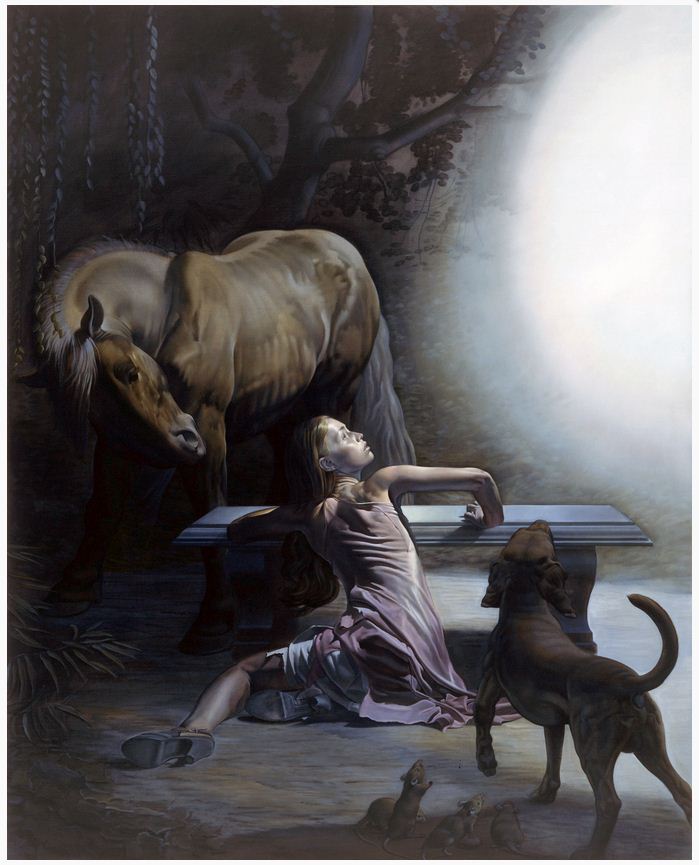
Cinderella — Nicola Verlato

cinderella verlato

(More at Nicola Verlota’s website).

Watch Surveyor, An Anti-Western by Scott Blake (Short Film)

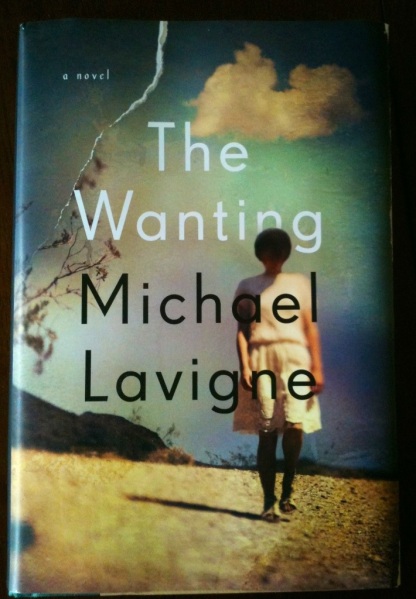
The Wanting (Book Acquired, 2.08.2013)

20130213-170623.jpgThe Wanting is new this month in hardback from Schocken. Here’s Publishers Weekly’s blurb:
Lavigne’s second novel (after Not Me) confronts the moral questions surrounding religious extremism and the Israeli-Palestinian conflict. The novel’s literally explosive opening takes place in Jerusalem in 1996, as a bomb goes off outside renowned architect Roman Guttman’s office, triggering a sort of fever dream that sends him into Palestinian territory and deep into memories of his communist youth in the U.S.S.R. Guttman narrates sections of the novel in language both vivid and disturbing. Also narrating is the suicide bomber, Amir Hamid, now dead, who has found in the afterlife not a martyr’s reward but rather the curse of following Guttman through the desert and retracing his own youthful journey toward violent extremism. Finally, Guttman’s 13-year-old daughter Anyusha, whose Zionist radical mother, Collette, died in a Soviet prison soon after giving birth, seeks answers of her own, revealing in diary form her attraction toward a messianic Jewish extremist group. Though some narrative digressions keep the novel from being truly elegant, Lavigne’s heartfelt examination offers what reportage never could: an intensely intimate and humane depiction of the forces that unite and powerfully divide this region and its people.


The Adventure with the Windmills (Don Quixote) — Gustave Dore

the-adventure-with-the-windmills

John Peel’s Record Box

Harold Bloom on “The School of Resentment”

Harold Bloom on his agon with “The School of Resentment.” From his 1991 interview with The Paris Review.

INTERVIEWER

How do you account historically for the school of resentment?

BLOOM

In the universities, the most surprising and reprehensible development came some twenty years ago, around 1968, and has had a very long-range effect, one that is still percolating. Suddenly all sorts of people, faculty members at the universities, graduate and undergraduate students, began to blame the universities not just for their own palpable ills and malfeasances, but for all the ills of history and society. They were blamed, and to some extent still are, by the budding school of resentment and its precursors, as though they were not only representative of these ills but, weirdly enough, as though they had somehow helped cause these ills and, even more weirdly, quite surrealistically, as though they were somehow capable of ameliorating these ills. It’s still going on—this attempt to ascribe both culpability and apocalyptic potential to the universities. It’s really asking the universities to take the place that was once occupied by religion, philosophy, and science. These are our conceptual modes. They have all failed us. The entire history of Western culture, from Alexandrian days until now, shows that when a society’s conceptual modes fail it, then willy-nilly it becomes a literary culture. This is probably neither good nor bad, but just the way things become. And we can’t really ask literature or the representatives of a literary culture, in or out of the university, to save society. Literature is not an instrument of social change or an instrument of social reform. It is more a mode of human sensations and impressions, which do not reduce very well to societal rules or forms.

INTERVIEWER

How does one react to the school of resentment? By declaring oneself an aesthete?

BLOOM

Well, I do that now, of course, in furious reaction to their school and to so much other pernicious nonsense that goes on. I would certainly see myself as an aesthete in the sense advocated by Ruskin, indeed to a considerable degree by Emerson, and certainly by the divine Walter and the sublime Oscar. It is a very engaged kind of mode. Literary criticism in the United States increasingly is split between very low level literary journalism and what I increasingly regard as a disaster, which is literary criticism in the academies, particularly in the younger generations. Increasingly scores and scores of graduate students have read the absurd Lacan but have never read Edmund Spenser; or have read a great deal of Foucault or Derrida but scarcely read Shakespeare or Milton. That’s obviously an absurd defeat for literary study. When I was a young man back in the fifties starting out on what was to be my career, I used to proclaim that my chosen profession seemed to consist of secular clergy or clerisy. I was thinking, of course, of the highly Anglo-Catholic New Criticism under the sponsorship or demigodness of T. S. Eliot. But I realized in latish middle age that, no better or worse, I was surrounded by a pride of displaced social workers, a rabblement of lemmings, all rushing down to the sea carrying their subject down to destruction with them. The school of resentment is an extraordinary sort of mélange of latest-model feminists, Lacanians, that whole semiotic cackle, latest-model pseudo-Marxists, so-called New Historicists, who are neither new nor historicist, and third generation deconstructors, who I believe have no relationship whatever to literary values. It’s really a very paltry kind of a phenomenon. But it is pervasive, and it seems to be waxing rather than waning. It is a very rare thing indeed to encounter one critic, academic or otherwise, not just in the English-speaking world, but also in France or Italy, who has an authentic commitment to aesthetic values, who reads for the pleasure of reading, and who values poetry or story as such, above all else. Reading has become a very curious kind of activity. It has become tendentious in the extreme. A sheer deliquescence has taken place because of this obsession with the methods or supposed method. Criticism starts—it has to start—with a real passion for reading. It can come in adolescence, even in your twenties, but you must fall in love with poems. You must fall in love with what we used to call “imaginative literature.” And when you are in love that way, with or without provocation from good teachers, you will pass on to encounter what used to be called the sublime. And as soon as you do this, you pass into the agonistic mode, even if your own nature is anything but agonistic. In the end, the spirit that makes one a fan of a particular athlete or a particular team is different only in degree, not in kind, from the spirit that teaches one to prefer one poet to another, or one novelist to another. That is to say there is some element of competition at every point in one’s experience as a reader. How could there not be? Perhaps you learn this more fully as you get older, but in the end you choose between books, or you choose between poems, the way you choose between people. You can’t become friends with every acquaintance you make, and I would not think that it is any different with what you read.

INTERVIEWER

Do you foresee any change, or improvement, in the critical fashions?

BLOOM

I don’t believe in myths of decline or myths of progress, even as regards to the literary scene. The world does not get to be a better or a worse place; it just gets more senescent. The world gets older, without getting either better or worse and so does literature. But I do think that the drab current phenomenon that passes for literary studies in the university will finally provide its own corrective. That is to say, sooner or later, students and teachers are going to get terribly bored with all the technocratic social work going on now. There will be a return to aesthetic values and desires, or these people will simply do something else with their time. But I find a great deal of hypocrisy in what they’re doing now. It is tiresome to be encountering myths called “The Social Responsibility of the Critic” or “The Political Responsibility of the Critic.” I would rather walk into a bookstore and find a book called “The Aesthetic Responsibilities of the Statesman,” or “The Literary Responsibilities of the Engineer.” Criticism is not a program for social betterment, not an engine for social change. I don’t see how it possibly could be. If you look for the best instance of a socially radical critic, you find a very good one indeed in William Hazlitt. But you will not find that his social activism on the left in any way conditions his aesthetic judgments, or that he tries to make imaginative literature a machine for revolution. You would not find much difference in aesthetic response between Hazlitt and Dr. Samuel Johnson on Milton, though Dr. Johnson is very much on the right politically, and Hazlitt, of course, very much an enthusiast for the French Revolution and for English radicalism. But I can’t find much in the way of a Hazlittian or Johnsonian temperament in life and literature anywhere on the current scene. There are so many tiresomenesses going on. Everyone is so desperately afraid of being called a racist or a sexist that they connive—whether actively or passively—the almost total breakdown of standards that has taken place both in and out of the universities, where writings by blacks or Hispanics or in many cases simply women are concerned.

INTERVIEWER

This movement has helped focus attention on some great novels, though. You’re an admirer, for example, of Ralph Ellison’s Invisible Man.

BLOOM

Oh, but that is a very, very rare exception. What else is there like Invisible Man? Zora Neale Hurston’s Their Eyes Were Watching God has a kind of superior intensity and firm control. It’s a very fine book indeed. It surprised and delighted me when I first read it and it has sustained several rereadings since. But that and Invisible Man are the only full scale works of fiction I have read by American blacks in this century that have survival possibilities at all. Alice Walker is an extremely inadequate writer, and I think that is giving her the best of it. A book like The Color Purple is of no aesthetic interest or value whatsoever, yet it is exalted and taught in the academies. It clearly is a time in which social and cultural guilt has taken over.

INTERVIEWER

I know you find this to be true of feminist criticism.

BLOOM

I’m very fond of feminist critics, some of whom are my close friends, but it is widely known I’m not terribly fond of feminist criticism. The true test is to find work, whether in the past or present, by women writers that we had undervalued, and thus bring it to our attention and teach us to study it more closely or more usefully. By that test they have failed, because they have added not one to the canon. The women writers who mattered—Jane Austen, George Eliot, Emily Dickinson, Edith Wharton, Willa Cather, and others who have always mattered on aesthetic grounds—still matter. I do not appreciate Elizabeth Bishop or May Swenson any more or less than I would have appreciated them if we had no feminist literary criticism at all. And I stare at what is presented to me as feminist literary criticism and I shake my head. I regard it at best as being well-intentioned. I do not regard it as being literary criticism.

INTERVIEWER

Can it be valued as a form of social or political literary criticism?

BLOOM

I’m not concerned with political or social criticism. If people wish to practice it, that is entirely their business. It is not mine, heavens! If it does not help me to read a work of aesthetic value then I’m not going to be interested in it at all. I do not for a moment yield to the notion that any social, racial, ethnic, or “male” interest could determine my aesthetic choices. I have a lifetime of experience, learning, and insight that tells me this.