Read “The Lady’s Maid,” a Short Story by Katherine Mansfield

“The Lady’s Maid” by Katherine Mansfield

Eleven o’clock. A knock at the door … I hope I haven’t disturbed you, madam. You weren’t asleep – were you? But I’ve just given my lady her tea, and there was such a nice cup over, I thought, perhaps …

… Not at all, madam. I always make a cup of tea last thing. She drinks it in bed after her prayers to warm her up. I put the kettle on when she kneels down and I say to it, “Now you needn’t be in too much of a hurry to say your prayers.” But it’s always boiling before my lady is half through. You see, madam, we know such a lot of people, and they’ve all got to be prayed for – every one. My lady keeps a list of the names in a little red book. Oh dear! whenever some one new has been to see us and my lady says afterwards, “Ellen, give me my little red book,” I feel quite wild, I do. “There’s another,” I think, “keeping her out of her bed in all weathers.” And she won’t have a cushion, you know, madam; she kneels on the hard carpet. It fidgets me something dreadful to see her, knowing her as I do. I’ve tried to cheat her; I’ve spread out the eiderdown. But the first time I did it – oh, she gave me such a look – holy it was, madam. “Did our Lord have an eiderdown, Ellen?” she said. But – I was younger at the time – I felt inclined to say, “No, but our Lord wasn’t your age, and he didn’t know what it was to have your lumbago.” Wicked – wasn’t it? But she’s too good, you know, madam. When I tucked her up just now and seen – saw her lying back, her hands outside and her head on the pillow – so pretty – I couldn’t help thinking, “Now you look just like your dear mother when I laid her out!”

… Yes, madam, it was all left to me. Oh, she did look sweet. I did her hair, soft-like, round her forehead, all in dainty curls, and just to one side of her neck I put a bunch of most beautiful purple pansies. Those pansies made a picture of her, madam! I shall never forget them. I thought to-night, when I looked at my lady, “Now, if only the pansies was there no one could tell the difference.”

 … Only the last year, madam. Only after she’d got a little – well – feeble as you might say. Of course, she was never dangerous; she was the sweetest old lady. But how it took her was – she thought she’d lost something. She couldn’t keep still, she couldn’t settle. All day long she’d be up and down, up and down; you’d meet her everywhere, – on the stairs, in the porch, making for the kitchen. And she’d look up at you, and she’d say – just like a child, “I’ve lost it, I’ve lost it.” “Come along,” I’d say, “come along, and I’ll lay out your patience for you.” But she’d catch me by the hand – I was a favourite of hers – and whisper, “Find it for me, Ellen. Find it for me.” Sad, wasn’t it? Continue reading “Read “The Lady’s Maid,” a Short Story by Katherine Mansfield”

Portrait of Dr. Hugo Koller — Egon Schiele

https://i0.wp.com/uploads5.wikipaintings.org/images/egon-schiele/portrait-of-dr-hugo-koller-1918.jpg

Other World — MC Escher

https://i0.wp.com/uploads1.wikipaintings.org/images/m-c-escher/other-world.jpg

Pier Paolo Pasolini Interviews Ezra Pound

(Thanks to Giovanni for sending this in).

The Spiderweb — Ohara Koson

https://i0.wp.com/uploads4.wikipaintings.org/images/ohara-koson/the-spiderweb.jpg

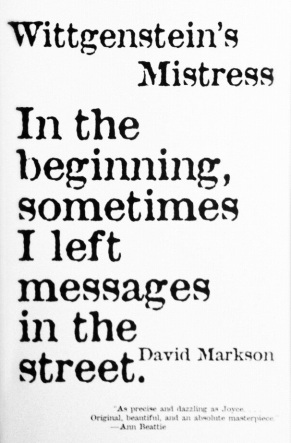
Something on David Markson’s Wittgenstein’s Mistress, Shamelessly Plagiarized and Rearranged from One-Star Amazon Reviews

20121129-203833.jpg

This is not a review.

This book was recommended to me.

An experimental, philosophical novel.

I really wanted to like this book.

I had read the reviews & after being unable for a few years to buy it secondhand, I bit the bullet & bought it new.

The beginning is intriguing.

The concept of the book is dead simple.

The idea is this: Kate is a painter; she is the last person on earth, maybe; she is alone in a house on the Long Island beach

Markson picks up Kate’s dialogue in media res and trusts the reader enough to piece together what the heck is going on: she is the last person left on earth and is making her way through it as best she can, telling us her story as she goes.

Short declarative sentences loop feverishly around her brain, repeating themselves, correcting themselves, contradicting themselves, and filling in missing information many pages later.

The narrator’s voice rings true.

It is frustrating, repetitive, and does not offer much in the way of style and language.

No chapter breaks, no real paragraphs even.

Read at random.

This book received 54 rejections before finding a publisher. This I can believe.

Her little apercus are all about observation and remembrance, the real and the false, blah, blah.

(Joyce, Baldwin, Pynchon, Cortazar).

The book was meandering, rambling & jumped all over the place.

Not that oddness is bad.

It never centers on anything.

It’s the type of book best discussed in groups, since it does bring up some interesting themes—the fragility of memory and sanity, the ineffectiveness of language, the impact of philosophy and literature.

There’s nothing for the reader to latch onto and follow, other than the voice.

What about the subtext?

Like Wittgenstein said, “Whereof we cannot speak, thereof we must be silent.”

I am mad. I am crazy. Yesterday I died but returned in time to write this.

Brian Eno 1971-1977: The Man Who Fell to Earth (Full Documentary)

The Law Student — Norman Rockwell

Big Electric Chair — Andy Warhol

https://i0.wp.com/uploads0.wikipaintings.org/images/andy-warhol/big-electric-chair.jpg

Low Concert

Book Shelves #49, 12.02.2012

20121202-134243.jpg

Book shelves series #49, forty-ninth Sunday of 2012

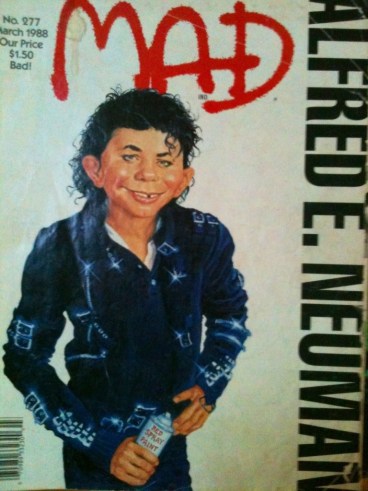
Unless I’ve somehow miscalculated, this is the last book shelf in my house. It’s difficult to describe the room it’s in—sort of like a storage corridor that serves as an attic (my attic is tiny) with an ersatz workshop. Kids paints and art supplies dominate the top shelf; photo albums and year books the bottom. The middle holds all sorts of books that I can’t bear to get rid of, including a coffee-table history of MAD Magazine which is one of the first books I can remember begging my parents to get me.

There are also many, many back issues of MAD:

20121202-134258.jpg

Also, lots of old books with out of date info, like a book about Jacques Cousteau, a book of Indian recipes which is more of a cultural guide, and this book of my home state:

20121202-134314.jpg

Several old music zines (I should probably donate them to a zine library).

20121202-134322.jpg

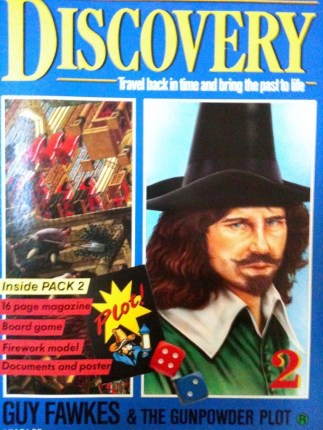
I have several dozens of these history packets called Discovery that I loved as a kid—they’d come with a booklet that illustrated the historical event in context, including opposing viewpoints, and they also had cool activities and games. I think they really helped me to learn as a child, and I can’t bear to get rid of them. Apparently Dennis Miller sat for the portrait of Guy Fawkes in the second issue.

20121202-134333.jpg

The Science in Science Fiction probably deserves its own post it’s so wonderfully weird and silly.

20121202-134341.jpg

Although this is the last shelf in my house, I said I’d do these posts each Sunday of 2012—and there are four more. I’ll visit the bookshelves in my office, the books in my car, take another look at the books on my nightstand (where I started) and then do a review post. Then I will never, ever do anything like this again.


Tango Drawing — Jorge Luis Borges

https://i0.wp.com/www.library.nd.edu/rarebooks/collections/rarebooks/hispanic/southern_cone/borges/images/ms_tango.gif

(Via).

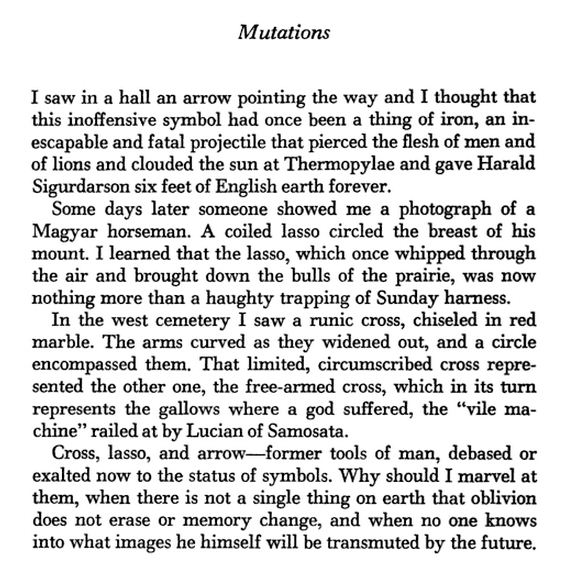
“Mutations” — Jorge Luis Borges

JLB

Leontine Reading — Pierre-Auguste Renoir

https://i0.wp.com/uploads4.wikipaintings.org/images/pierre-auguste-renoir/leontine-reading-1909.jpg

Birds, Fish, Snake, and Scarecrow — Max Ernst

https://i0.wp.com/uploads3.wikipaintings.org/images/max-ernst/birds-also-birds-fish-snake-and-scarecrow.jpg

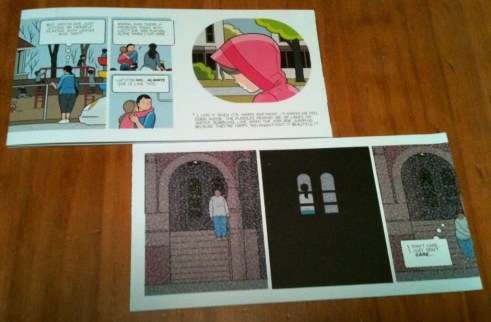
Reading Chris Ware’s Building Stories / Two Short Loops

20121201-162412.jpg

These two shorties in Chris Ware’s Building Stories showcase the novel’s thematic recursion, a recursion doubled in both its metastructure (14 pieces that the reader can read in any order) as well as the structure of many of the individual pieces. In the case of the two parts pictured above, we get Möbius strips that become richer with rereading. The strips seem to twin each other not just in their format, but also in their theme.

Both strips feature Lonely Girl, who perhaps emerges as the dominant protagonist of Building Stories. The one pictured at the top gives a voice to her daughter, a girl who seems to repeat some of her mother’s tendencies toward isolation and depression.

20121201-162435.jpg

Ware’s strength here (and always elsewhere) is the economy of storytelling: He packs entire short stories into just a few panels, coloring his narrative:

20121201-162443.jpg

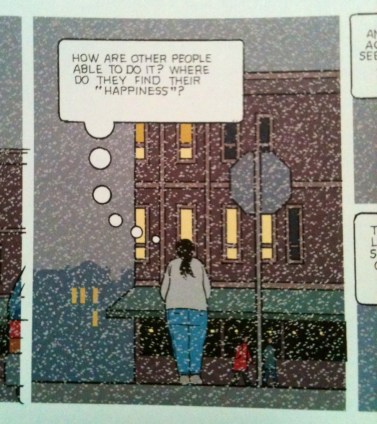
The second loop features a solitary Lonely Girl who trudges through the snowy night in a near-suicidal despair:

20121201-162451.jpg

Read recursively, the strip dooms Lonely Girl to an endless loop of despair—and it’s at moments like these that I’m happy there are other parts to Building Stories—some kind of existential “out” for our poor heroine.


Alychamps — Vincent van Gogh

https://i0.wp.com/uploads4.wikipaintings.org/images/vincent-van-gogh/alychamps-1888%281%29.jpg