A Skull on the Open Book — Vladimir Tatlin

Samson’s Fight with the Lion — Lucas Cranach the Elder

Man with a Movie Camera — Dziga Vertov (Full 1929 Film with Score by The Cinematic Orchestra)

“The Wish To Be a Red Indian” — Franz Kafka

The Wish To Be a Red Indian

If one were only an Indian, instantly alert, and on a racing horse, leaning against the wind, kept on quivering jerkily over the quivering ground, until one shed one’s spurs, for there needed no spurs, threw away the reins, for there needed no reins, and hardly saw that the land before one was smoothly shorn heath when horse’s neck and head would be already gone.

“The Wish To Be a Red Indian” by Franz Kafka.

Untitled (Book) — Philip Guston

See A.K., Chris Marker’s Film About Akira Kurosawa

RIP Chris Marker

RIP French filmmaker Chris Marker, 1921-2012

Like any kid who took way too many film studies courses in college, I was lucky to be introduced to the strange films of Chris Marker, who died at 91 yesterday in Paris. Marker is most famous for his film La jetéea sci-fi post-apocalyptic meditation shot as a series of still photos (the film was later adapted by Terry Gilliam into 12 Monkeys). Marker’s film San Soleil had a particular impact on me: it’s a beautiful, strange film essay, or travel novel, or I don’t know what you call it. Just find it and see it. Here’s the intro:

The Guardian has a proper obituary.

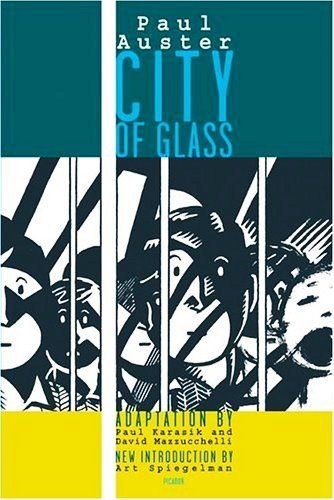
I Review City of Glass, A Comic Book Doppelgänger of Paul Auster’s Postmodern Detective Novel

Paul Auster’s 1985 novel City of Glass explores doubling, shadowing, and what it means to wear another person’s skin, so it’s fitting that the book has its own doppelgänger in the form of a graphic novel by Paul Karasik and David Mazzucchelli (maestro Art Spiegelman served as catalyst and counselor). I should admit upfront that although I’ve read a few of Auster’s books, I haven’t read City of Glass, considered by many to be his masterpiece. I have read Mazzucchelli’s excellent novel Asterios Polyp (and plenty of stuff by overseer Spiegelman), so the adaptation intrigued me. I wasn’t disappointed. I read Karasik and Mazzucchelli’s City of Glass in one brisk sitting and thoroughly enjoyed it. What’s it about?

Okay, so there’s this novelist, Quinn (“rhymes with twin”), who, after the death of his wife and son, takes up writing boilerplate detective novels under the pseudonym William Wilson. Late in the book, Quinn (if he’s still Quinn at that point, which I’ll get to) identifies the pseudonym with the “real” name of NY Mets center fielder (and future coach) Mookie Wilson—but savvy readers will also recognize “William Wilson” as the name of an Edgar Allan Poe story about a man haunted by a doppelgänger of himself to the point that he goes insane. In the Poe story, Wilson and his doppelgänger (whose name is, of course, William Wilson as well) share the same birthday, January 19th, which also happens to be E.A. Poe’s birthday (and my brother’s too, although that is not germane to this review). Auster is clearly working from Poe’s story, although he never announces this explicitly (at least not in the comic-bookization). Arthur Hobson Quinn, for example, wrote an exhaustive biography of Poe (published in 1941). Crossing from the real to the fictional, from authorial to character, Auster inserts himself into the story from its outset. At the beginning of the book, protagonist Quinn gets a mysterious call, like something out of the noir novels he writes:
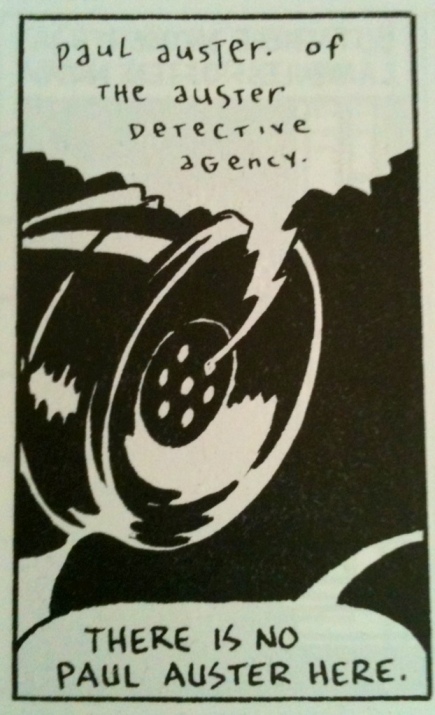
20120728-125217.jpg

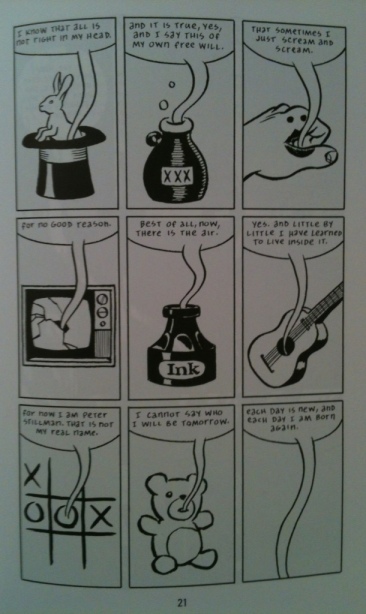
Bored, or perhaps ventriloquized by a force he doesn’t understand, Quinn takes up the identity of detective Paul Auster and agrees to take on a case for Peter Stillman, a man who, as a boy, suffered feralization at the hands of his insane father, who hoped to discover the Ur-language of god through the boy. Stillman’s monologue is one of the highlights of the book, showcasing the malleability of language—and also, significantly, the malleability of speakers:
20120728-125225.jpg

Stillman hires Quinn/Auster to track his father, also named Peter Stillman (Peter is also the name of Quinn’s dead son). Actually, it’s Stillman the Younger”s wife/speech pathologist who hires Quinn/Auster; she’s certain that Stillman the Elder, freshly released from a mental asylum, will return to harm his son.

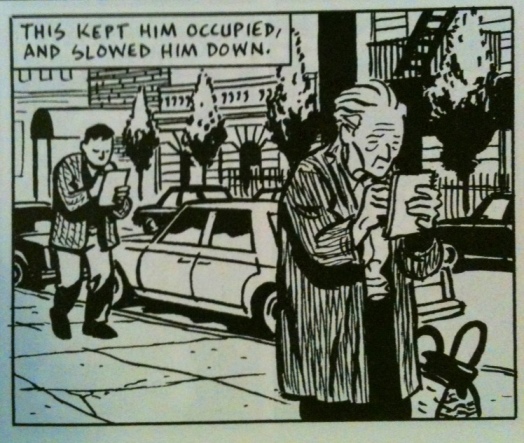
Quinn/Auster slides into the role of Max Work, his noir novel protagonist—or, perhaps more accurately, William Wilson’s noir protagonist—and begins tracking Stillman the Elder (or a version of Stillman the Elder—I won’t spoil the novel’s strangest, most maddening metaphysical gambit here). And, predictably, as Quinn/Auster/Wilson/Work  shadows Stillman Sr., he morphs into yet another doppelgänger:
20120728-125233.jpg

Quinn/Auster/Wilson/Work eventually confronts Stillman, and the pair have a series of fascinating conversations about language, Milton, Humpty Dumpty, and the Tower of Babel. The motifs and themes are telegraphed fairly straightforward here, but also communicated through a lens of madness that comes to dominate the book’s third act—an act that initiates in a meeting between Q/A/W/W and the “real” Paul Auster, a writer who’s working on an essay about the authorship of Don Quixote. The Don Quixote conversation is perhaps too overt, the sort of postmodern cleverness that I increasingly find a big turnoff, but it’s not clumsy or awkward. Still, there’s something mildly irritating about an author tipping his hand and then showing you how he’s tipping his hand.

The third act of City of Glass feels compressed, rushed even, and will definitely disappoint readers who wandered in for a detective stories, hoping for concrete answers and a neat and tidy plot. However, the book’s themes of fantasy and reality, play and work, sanity and madness, and character and author are rich if frustrating in their circuitousness. Mazzucchelli’s art is evocative and fitting, recalling at times the rough-hewn pop art of Raymond Pettibon and the traditional prowess of masters like Kirby and Eisner. (I’ll bring up Spiegelman again too, who introduces the volume. A friend of Auster’s, he brokered the project and oversaw its development, and his work as a creative director here is evident in the book’s cohesion). I imagine fans of Auster’s New York Trilogy, of which City of Glass is the first book, will be interested in checking this one out. Having come first to the graphic novel, I now look forward to reading its doppelgänger, Paul Auster’s City of Glass. Good stuff.
Wheat Field with a Lark — Vincent van Gogh

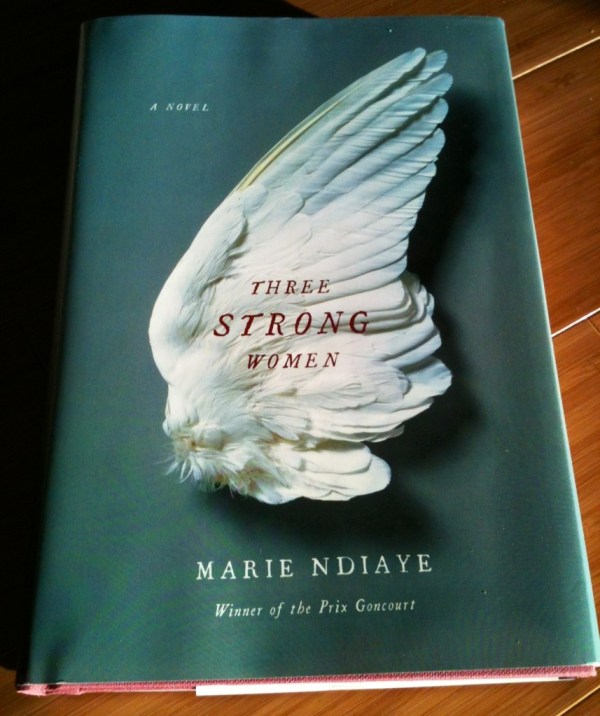
Three Strong Women (Book Acquired, 7.24.2012)


20120724-194511.jpg

Marie NDiaye’s novel Three Strong Women won the Prix Goncourt in 2009 and is now published in English translation (John Fletcher) from Random House. Their blurb:

In this new novel, the first by a black woman ever to win the coveted Prix Goncourt, Marie NDiaye creates a luminous narrative triptych as harrowing as it is beautiful.

This is the story of three women who say no: Norah, a French-born lawyer who finds herself in Senegal, summoned by her estranged, tyrannical father to save another victim of his paternity; Fanta, who leaves a modest but contented life as a teacher in Dakar to follow her white boyfriend back to France, where his delusional depression and sense of failure poison everything; and Khady, a penniless widow put out by her husband’s family with nothing but the name of a distant cousin (the aforementioned Fanta) who lives in France, a place Khady can scarcely conceive of but toward which she must now take desperate flight.

With lyrical intensity, Marie NDiaye masterfully evokes the relentless denial of dignity, to say nothing of happiness, in these lives caught between Africa and Europe. We see with stunning emotional exactitude how ordinary women discover unimagined reserves of strength, even as their humanity is chipped away. Three Strong Women admits us to an immigrant experience rarely if ever examined in fiction, but even more into the depths of the suffering heart.


Still Life with a Book — Lucian Freud

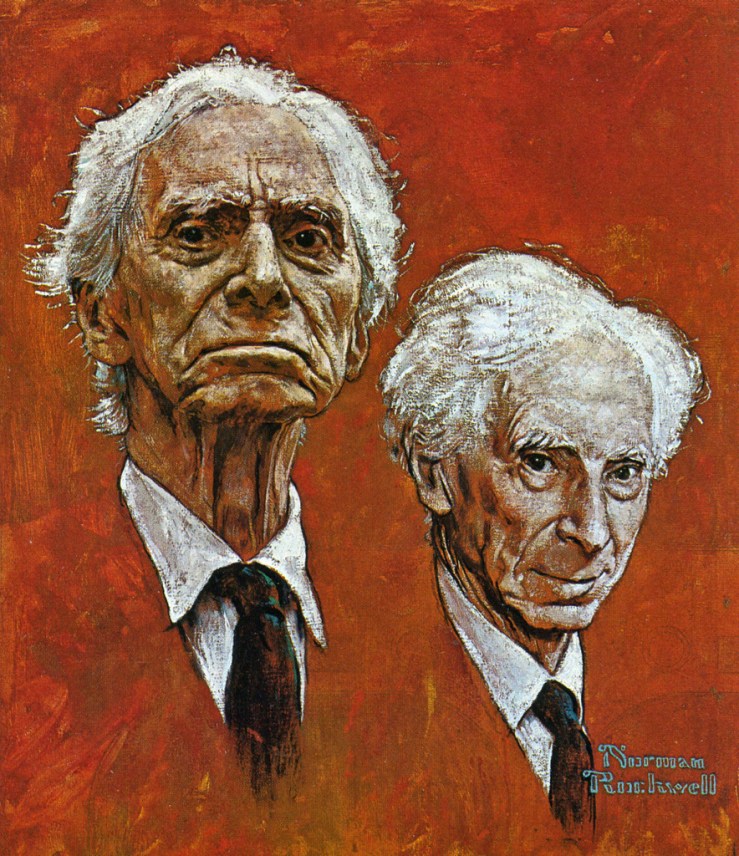
Portrait of Bertrand Russell — Norman Rockwell

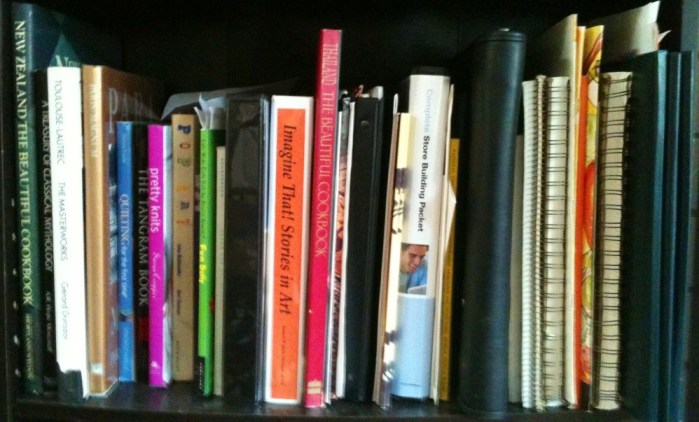
Book Shelves #31, 7.29.2012

20120729-141449.jpg


Book shelves series #31, thirty-first Sunday of 2012

When I started this project I thought it would be a fun way to keep stock of the books that I have, and also a way to perhaps question why I hold on to the books that I hold on to.

I mean, why keep a book after you’ve read it?

Anyway, at times throughout this series I’ve gotten bored, or rushed; other times I’ve thought the idea was stupid, or narcissistic, or something even worse (although I don’t know what).

I like the shelves above the pedestrian, utilitarian jobber that I’ll feature this Sunday and the next: lots of aesthetically pleasing stuff there.

Not so this one, which holds photos and cookbooks and art books and old notebooks and sketchbooks and every kind of etcetera:

20120729-141456.jpg

At least that’s what I thought until I started digging into the cramped top shelf, dutifully bound to this project.

I wound up really enjoying myself, pausing over volumes that I haven’t looked at in ages, like this beauty:

20120729-141509.jpg

I’m not sure if the aesthetic joy of this postcard collection comes across in these lousy iPhone photo shots.

I got this on a trip to London when I was 11. It was just my mom and my brother and I. First we went to Singapore. We were coming back to the States for Christmas, and also to live, eventually. My brother broke his leg in Singapore jumping down some stairs and we didn’t realize it was broken until we got back to Florida.

20120729-141515.jpg

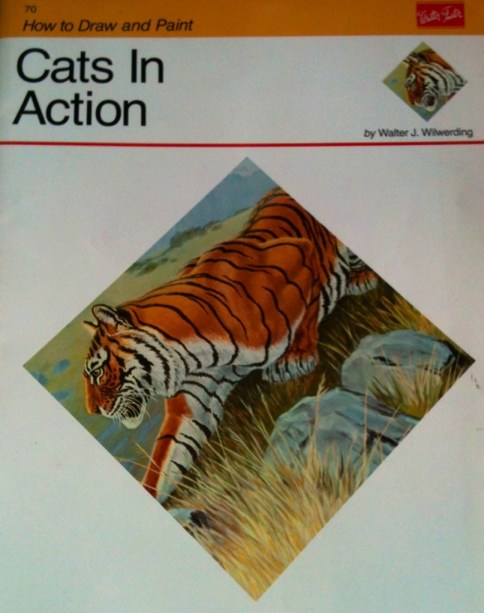
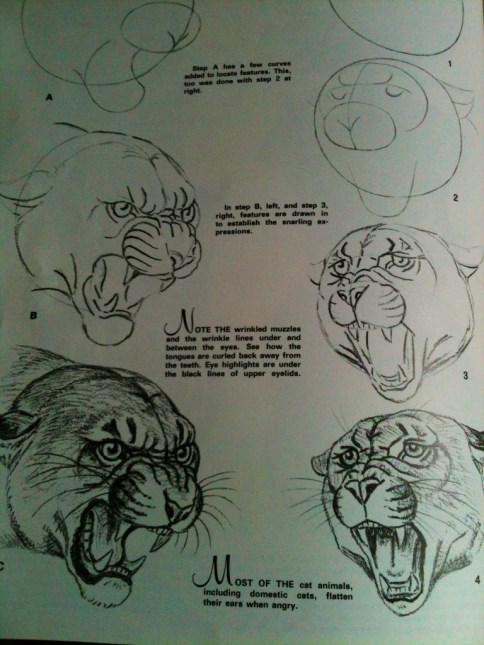
I used to draw and paint all the time, especially as a kid. Mostly animals.

There are at least a dozen skinny books like this on the shelf:

20120729-141522.jpg

I must have done hundreds of these as a kid:

20120729-141546.jpg

The shelf is also full of old comic strip collections that you probably recognize, like these guys:

20120729-141556.jpg

And this guy (and yes, I have the 7″ record from this collection)

20120729-141601.jpg

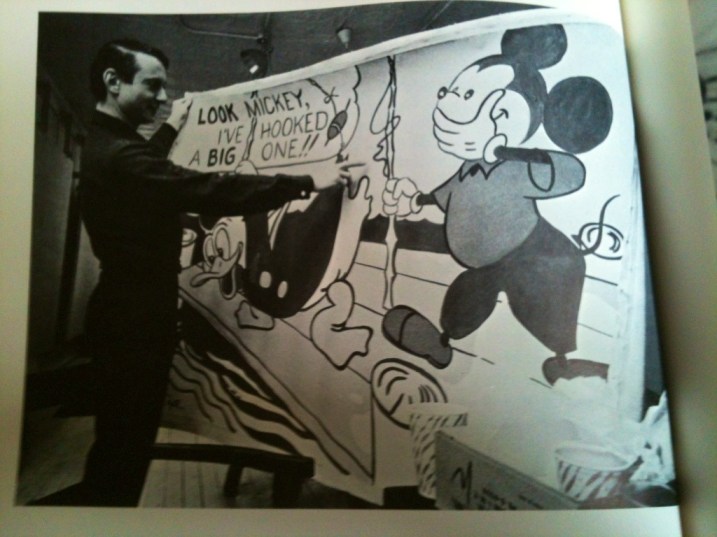
I also spent half an hour revising Rublowsky’s 1965 volume Pop Art, which is kind of fascinating in its contemporary proximity to its subject.

The cover’s not interesting, but Ken Heyman’s photos are; they show the artists in process. This one is kinda famous:

20120729-141609.jpg

And here’s Roy Lichtenstein:

20120729-141616.jpg


“In a House Besieged” — Lydia Davis

In a house besieged lived a man and a woman. From where they cowered in the kitchen the man and woman heard small explosions. “The wind,” said the woman. “Hunters,” said the man. “The rain,” said the woman. “The army,” said the man. The woman wanted to go home, but she was already home, there in the middle of the country in a house besieged.

“In a House Besieged,” from Lydia Davis’s first collection Break It Down (1986); available in The Collected Stories.

Armed Three Master with Daedalus and Icarus in the Sky – Pieter Bruegel the Elder

Still Life (French Novels) — Vincent van Gogh

The Holy Mountain — Alejandro Jodorowsky (Full Film)