Paul Robeson Talks About Othello

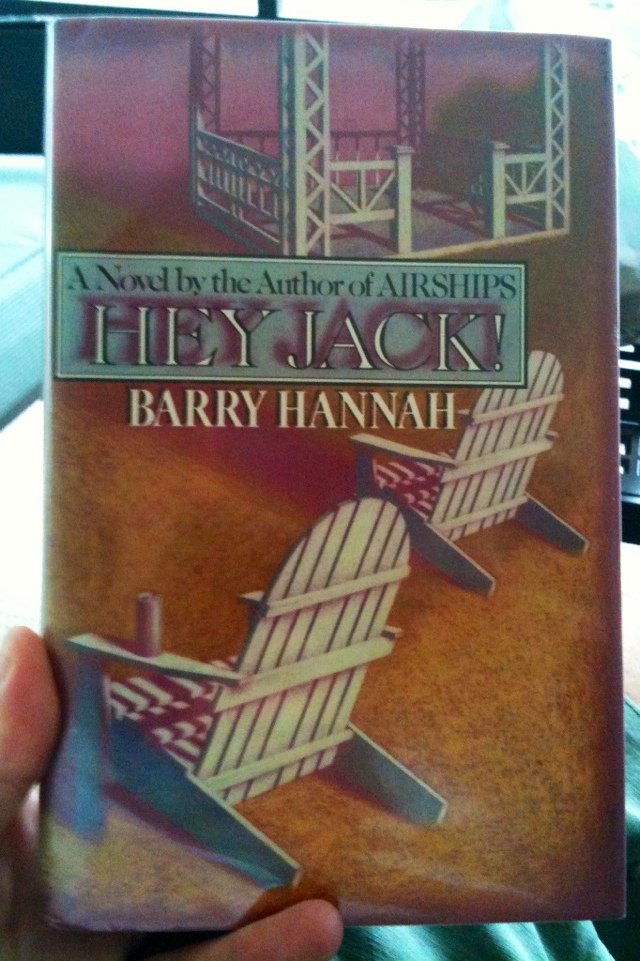
Barry Hannah’s Hey Jack! (Book Acquired, 3.23.2012; Or, Gee, Isn’t It Kinda Sad That This Ex-Library Book Was Checked Out Only Twice in 24 Years?)

20120324-143113.jpg

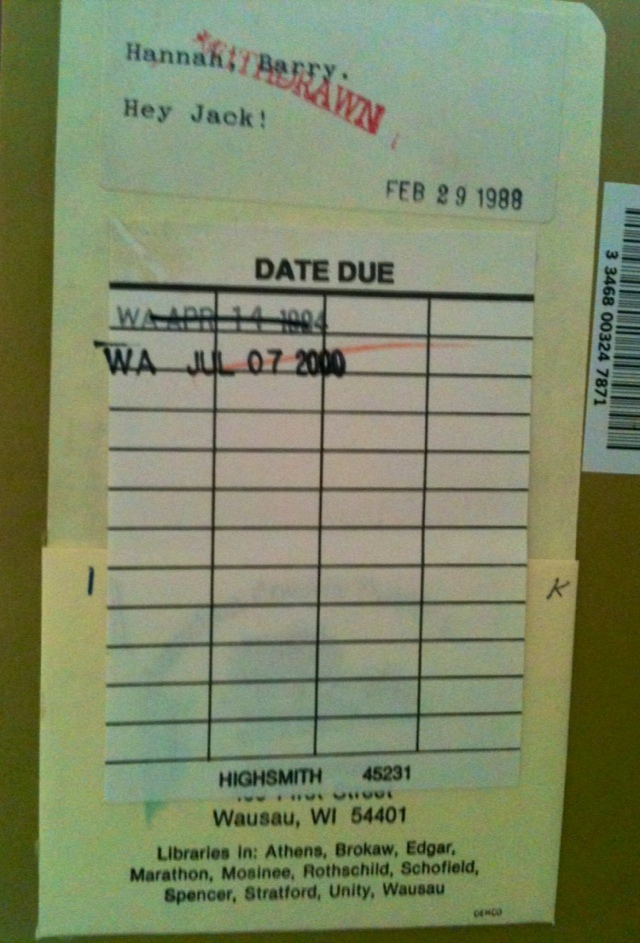
I bought Barry Hannah’s seventh book Hey Jack! over the internet after my favorite local bookstore told me it would be difficult or expensive for them to order. I bought a first edition hardback brokered by Amazon. It was an ex-library copy. It looks like no one ever read it, and it seems to have been checked out only twice in twenty-four years. A sad business.

I put some wear and tear on it today, reading it outside on my porch during a thunderstorm, using it as a beer coaster at one point, and then taking it into a salted bath where it got damp and curly. I read half of it. Hannah’s novel-in-vignettes is still ahead of its time. Who writes better sentences? (“Christ, the South has been pickled in the juice of its own image”).

20120324-143122.jpg

Tab. CXI (Strange Babies) — Albertus Seba

Robert Louis Stevenson: “The Most Influential Books, and the Truest in Their Influence, Are Works of Fiction”

From Robert Louis Stevenson’s essay “The Books Which Have Influenced Me”:

The most influential books, and the truest in their influence, are works of fiction. They do not pin the reader to a dogma, which he must afterwards discover to be inexact; they do not teach him a lesson, which he must afterwards unlearn. They repeat, they rearrange, they clarify the lessons of life; they disengage us from ourselves, they constrain us to the acquaintance of others; and they show us the web of experience, not as we can see it for ourselves, but with a singular change–that monstrous, consuming ego of ours being, for the nonce, struck out. To be so, they must be reasonably true to the human comedy; and any work that is so serves the turn of instruction. But the course of our education is answered best by those poems and romances where we breathe a magnanimous atmosphere of thought and meet generous and pious characters.

“I Put a Spell on You” (Stranger Than Paradise)

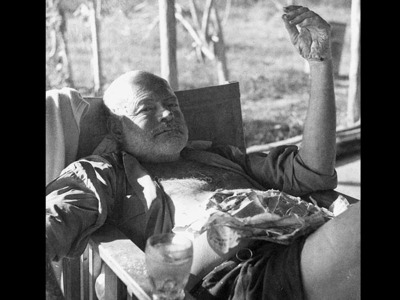
Topless Hemingway, Part IX

“Blue Moon” (Mystery Train)

William James on Walt Whitman: “He Is Aware Enough of Sin for a Swagger to Be Present in His Indifference Towards It”

William James on Walt Whitman; from The Varieties of Religious Experience (1902):

Walt Whitman owes his importance in literature to the systematic expulsion from his writings of all contractile elements. The only sentiments he allowed himself to express were of the expansive order; and he expressed these in the first person, not as your mere monstrously conceited individual might so express them, but vicariously for all men, so that a passionate and mystic ontological emotion suffuses his words, and ends by persuading the reader that men and women, life and death, and all things are divinely good Whitman is often spoken of as a “pagan.” The word nowadays means sometimes the mere natural animal man without a sense of sin; sometimes it means a Greek or Roman with his own peculiar religious consciousness. In neither of these senses does it fitly define this poet. He is more than your mere animal man who has not tasted of the tree of good and evil. He is aware enough of sin for a swagger to be present in his indifference towards it, a conscious pride in his freedom from flexions and contractions, which your genuine pagan in the first sense of the word would never show

Slavoj Žižek Uses Norman Bates’s House in Psycho to Illustrate Id, Ego, and Superego (Because Why Wouldn’t He?)

Hamlet and His Father’s Ghost — Henry Fuseli

“The Freest Writer” — Nietzsche on Laurence Sterne

Nietzsche upholds Laurence Sterne as “the freest writer of all times” in Human, All Too Human, Part II:

113. The Freest Writer. —In a book for free spirits one cannot avoid mention of Laurence Sterne, the man whom Goethe honoured as the freest spirit of his century. May he be satisfied with the honour of being called the freest writer of all times, in comparison with whom all others appear stiff, square-toed, intolerant, and downright boorish! In his case we should not speak of the clear and rounded but of “the endless melody”—if by this phrase we arrive at a name for an artistic style in which the definite form is continually broken, thrust aside and transferred to the realm of the indefinite, so that it signifies one and the other at the same time. Sterne is the great master of double entendre , this phrase being naturally used in a far wider sense than is commonly done when one applies it to sexual relations. We may give up for lost the reader who always wants to know exactly what Sterne thinks about a matter, and whether he be making a serious or a smiling face (for he can do both with one wrinkling of his features; he can be and even wishes to be right and wrong at the same moment, to interweave profundity and farce). His digressions are at once continuations and further developments of the story, his maxims contain a satire on all that is sententious, his dislike of seriousness is bound up with a disposition to take no matter merely externally and on the surface. So in the proper reader he arouses a feeling of uncertainty whether he be walking, lying, or standing, a feeling most closely akin to that of floating in the air. He, the most versatile of writers, communicates something of this versatility to his reader. Yes, Sterne unexpectedly changes the parts, and is often as much reader as author, his book being like a play within a play, a theatre audience before another theatre audience. We must surrender at discretion to the mood of Sterne, although we can always expect it to be gracious. It is strangely instructive to see how so great a writer as Diderot has affected this double entendre of Sterne’s—to be equally ambiguous throughout is just the Sternian super-humour. Did Diderot imitate, admire, ridicule, or parody Sterne in his Jacques le Fataliste ? One cannot be exactly certain, and this uncertainty was perhaps intended by the author. This very doubt makes the French unjust to the work of one of their first masters, one [pg 062] who need not be ashamed of comparison with any of the ancients or moderns. For humour (and especially for this humorous attitude towards humour itself) the French are too serious. Is it necessary to add that of all great authors Sterne is the worst model, in fact the inimitable author, and that even Diderot had to pay for his daring? What the worthy Frenchmen and before them some Greeks and Romans aimed at and attained in prose is the very opposite of what Sterne aims at and attains. He raises himself as a masterly exception above all that artists in writing demand of themselves—propriety, reserve, character, steadfastness of purpose, comprehensiveness, perspicuity, good deportment in gait and feature. Unfortunately Sterne the man seems to have been only too closely related to Sterne the writer. His squirrel-soul sprang with insatiable unrest from branch to branch; he knew what lies between sublimity and rascality; he had sat on every seat, always with unabashed watery eyes and mobile play of feature. He was—if language does not revolt from such a combination—of a hard-hearted kindness, and in the midst of the joys of a grotesque and even corrupt imagination he showed the bashful grace of innocence. Such a carnal and spiritual hermaphroditism, such untrammelled wit penetrating into every vein and muscle, was perhaps never possessed by any other man.

“Sources Agree Rock Swoon Has No Past” — Barry Hannah Short Story

“Sources Agree Rock Swoon Has No Past” by Barry Hannah. This short short was published in the June 2000 issue of Harper’s from a reading Hannah gave in 1986 at the Sigma Tao Delta Society at the University of Mississippi. The story appeared in Hannah’s 1988 novel Hey Jack!:

“Pa. Is it really true the old eat their young?”

Gives pause.

“Couldn’t rightly say, son. I’m a mid man. Feels like I’m walking on ice meself. Go on down to the barn, ask Grandpa.”

Grandpa’s down there in the back shadows, some loose bales around his old brogies. Seems to be humming and eating, pulling a nail out of a rotten piece of board with a pair of pliers.

“Is it true, Grandpa?”

“Wyoming’s not my home . . .”

“Yer nuts, Grandpa.”

Sings, “Ate ol’ Granny in a choo-choo car”

Kid goes to the hut to see Grandpa’s father. Withered beyond longevity, a tiny man in dwarf’s overalls, deeply addicted to codeine and Valium, fears colored people; occasionally makes scratching protests on his old violin, which has become too large for him. Every disease has had its success with him. Now he’s bare;u a scab demanding infrequent nutrients. Bald as a beige croquet ball, he rolls his own.

They’ve fixed him up a mike with a cord into an ancient Silvertone amplifying box. Even his snores can be heard, slightly, out in the yard.

“Double Gramps, is it true that the old eat their young?”

“God damn, I’m old!” blasts over the kid, feedback piercing too. The old man faints, recovers, goes into a codeine wither.

“But my question. Please, Double Gramps.”

Almost accidentally, the old man fits bow to fiddle and scrawls out the grand trio of “Stars and Stripes Forever.” Endlessly. It goes on the entire afternoon, amplifier picking up a prouder stroke here and there, screeching.

The kid grows up, a rock star, aging at twenty-three. He’s already eating the young by the thousands when the second though hits him.

“It’s Raining” (Down by Law)

Orange Disaster #5 — Andy Warhol

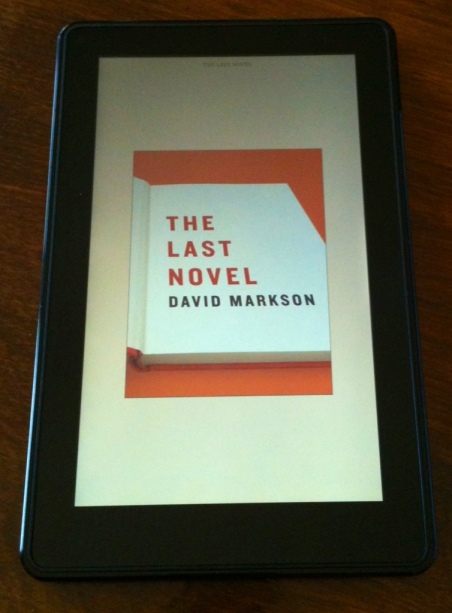
A Review of David Markson’s The Last Novel (Composed Mostly in Citations from Said Novel)

20120318-143327.jpg

Unsure of how to “review” David Marson’s last novel The Last Novel, I here provide a series of citations from said novel with my own brief comments. The citations are organized not by theme or idea, but rather simply by the order in which they appear in the book, from first to last. My intention is to provide a clear picture of Markson’s method with some brief commentary on his themes.

By way of recommendation: The Last Novel engrossed and obsessed me, commanding most of my attention for four days, during which time I read it twice and then picked at again and again, as one might return to the generous leftovers of a Thanksgiving meal.

I hope I have not strained the limits of copyright law with my citations of Markson’s citations. To wit, from the colophon:

Copyright © 2007 by David Markson

All rights reserved. No part of this book may be used or reproduced in any manner whatsoever without written permission from the Publisher, except in the case of brief quotations embodied in critical articles and reviews.

Library of Congress Cataloging-in-Publication Data

Markson, David.

The last novel / David Markson.

p. cm.

ISBN-13: 978-1-59376-143-1

ISBN-10: 1-59376-143-0

1. Novelists—Fiction. 2. Fiction—Authorship—Fiction.

3. Psychological fiction. I. Title.

Is The Last Novel fiction? Does this question matter? “Fiction–Authorship–Fiction” — this seems like a fair descriptor.

Our author, by way of summary, announces his themes, his name, and his prophetic conclusion:

Old. Tired. Sick. Alone. Broke.

All of which obviously means that this is the last book Novelist is going to write.

And now his method, followed by two examples of said method:

Nonlinear. Discontinuous. Collage-like. An assemblage.

I do not see why exposition and description are a necessary part of a novel.

Said Ivy Compton-Burnett.

I am quite content to go down to posterity as a scissors and paste man.

Said Joyce.

And a comment on that method, and Novelist’s textual place in it:

A novel of intellectual reference and allusion, so to speak minus much of the novel.

And thus in which Novelist will say more about himself only when he finds no way to evade doing so, but rarely otherwise.

On the first theme announced, “Old”:

Rereading a Raymond Chandler novel in which Philip Marlowe stops in for a ten-cent cup of coffee.

Old enough to remember when the coffee would have cost half that.

A citation that seems to hold all the themes, but especially “Sick” and “Broke”—-and then a Renard citation that fits Markson (or “Novelist,” if you prefer) into a grand tradition of starving artists:

The bleak image Novelist is granted of himself as he asks a question of a local pharmacist — and becomes aware of the woman contemplating the conspicuously threadbare and even ragged ends of his coat sleeves.

Writing is the only profession where no one considers you ridiculous if you earn no money.

Said Jules Renard.

On aging:

Moments in which Novelist does something like leaving his desk to retrieve a book from across the room — and finding himself staring vacantly into the refrigerator.

Or tossing his keys into a drawer — without having opened the drawer

Markson instructs us how to read his work, and at the same time makes a grand grab at glory; he then moves to reflect on death, and perhaps a fear of going unread, before pointing out the sublime powers of art :

Novelist’s personal genre. For all its seeming fragmentation, nonetheless obstinately cross-referential and of cryptic interconnective syntax.

Wondering why one is surprised to realize that Thoreau was dead at forty-five.

A lament of Schopenhauer’s:

Over how frequently the mere purchase of a book is mistaken for the appropriation of its contents.

Two pages of The Mill on the Floss are enough to start me crying.

Said Proust.

The intersection of commerce and art and madness (or, really, I just like this citation):

Because bookshops are among the very few places where one can spend time without spending any money, George Orwell noted, any number of practically certifiable lunatics are guaranteed to be regularly found in most of them.

My least favorite reading experience of all time is Clarissa:

The endless commentary, and analysis, and even retelling, in Clarissa. Anyone reading it just for the story would hang himself, Johnson said.

A good definition, but also a sideways description of entering The Last Novel:

Thinking with someone else’s brain.

Schopenhauer called reading.

Markson is fond of the dependent clause as a stand-alone thought. He often lets the reader complete the sentence, or, as below, responds perhaps obliquely with another citation—his synthesis is subtle but always in play:

Reviewers who have accused Novelist of inventing some of his anecdotes and/or quotations — without the elemental responsibility to do the checking that would verify every one of them.

Asking a working writer what he thinks about critics is like asking a lamppost what it feels about dogs.

Said John Osborne.

The Last Novel is in part a work of canon-formation, one that situates Markson’s place in arts and letters; it is often angry or bitter, as he tries to situate being “Alone” and “Broke” into a historical tradition of suffering writers:

Another of Novelist’s economic-status epiphanies:

Walking four or five blocks out of his way, and back, to save little more than nickels on some common household item.

While needing to stop to rest at least two or three times en route.

Writers are the beggars of Western society.

Said Octavio Paz.

There is no way of being a creative writer in America without being a loser.

Said Nelson Algren.

Markson repeatedly reveals his anxiety of influence: Where and how will he be remembered when he dies?:

Old enough to have started coming upon likenesses on postage stamps of other writers he had known personally or had at least met in passing.

Occasionally in The Last Novel, because he doesn’t always attribute his citations, it’s unclear to me if a string of sentences are original to Markson or not. Markson describes his method again:

A seminonfictional semifiction.

And with its interspersed unattributed quotations at roughest count adding up to a hundred or more.

A note on book theft, germane to (the original mission of) this website:

Please return this book. I find that though many of my friends are poor mathematicians, they are nearly all good bookkeepers.

Read Walter Scott’s bookplate.

A dependent clause:

Reviewers who protest that Novelist has lately appeared to be writing the same book over and over.

Again, the intersection of economics, art, and how we honor and remember genius (with the implicit underlying anxiety over Markson’s own fate):

Before the Euro, the portrait of Yeats on Ireland’s twenty-pound note.

America’s Whitman twenty-dollar bill, when?

The Melville ten?

I think the Melville ten is a grand idea. I’d put Hawthorne on the twenty and Emerson on the penny.

On death-dialing:

A quirky new impulse of Novelist’s, at news of several recent deaths — Dialing the deceased, in the likelihood that no one would have yet disconnected their answering machines — and contemplating their voices one eerie final time.

The voice of an agitated colleague? Friend? Student? Is the quote a composite of complaints? Is it verbatim?:

Listen, I bought your latest book. But I quit after about six pages. That’s all there is, those little things?

Many of us have wondered:

Why did Harper Lee never write another novel?

It is possible she never wrote that first one.

Again, money and writers:

America’s Emily Dickinson dime?

We could put Thoreau on the nickel and Poe on the fifty.

Conclusions as a kind of interception; the author offstage, off scene, ob skena — obscene:

Novelist’s personal genre. In which part of the experiment is to continue keeping him offstage to the greatest extent possible — while compelling the attentive reader to perhaps catch his breath when things achieve an ending nonetheless.

Conclusions are the weak point of most authors.

George Eliot said.

If you know what you’re doing, you don’t get intercepted.

Said Johnny Unitas.

I feel like I’ve skated over the book, failed to plumb it at all: But I also protest that the book is a work of autocriticism, a work that decenters its themes, bats them around, analyzes them, tosses them back to the reader, sometimes bitter, sometimes melancholy, always erudite and engaging.

I cite from the end now. Can the end be spoiled? Markson tells us this is his last, that he will die (“Old. Tired. Sick. Alone. Broke.”). He dies a few years after the publication of The Last Novel. (He dies on the day my son is born, or, rather, his body is found on the day my son is born. He is very much alone. The New York Times publishes his obituary on my birthday). The novel ends with a series of citations that mull on death:

Dispraised, infirm, unfriended age.

Sophocles calls it.

Unregarded age in corners thrown.

Shakespeare echoes.

And what it means to be an artist, a writer, a critic, to write in and on and through others’ books:

The worn copy of Donne’s verses, inked throughout with notes in Coleridge’s handwriting. And at the rear:

I shall die soon, my dear Charles Lamb, and then you will not be sorry that I bescribbled your book.

Life as pain, death as transcendence:

Then come kiss me, sweet-and-twenty,Youth’s a stuff will not endure. Be patient now, my soul, thou hast endured worse than this.

Odysseus once says.

Mais où sont les neiges d’antan? Is it true then, what they say — that we become stars in the sky when we die?

Asks someone in Aristophanes.

Banal signage or access to ascension?:

Access to Roof for Emergency Only.

Alarm Will Sound if Door Opened.

To reiterate and move on:

Old. Tired. Sick. Alone. Broke.

The old man who will not laugh is a fool.

Als ick kan.

“Als Ich Kan”

Portrait of a Man in a Turban -- Jan van Eyck

Edison Film of Mark Twain (1909)