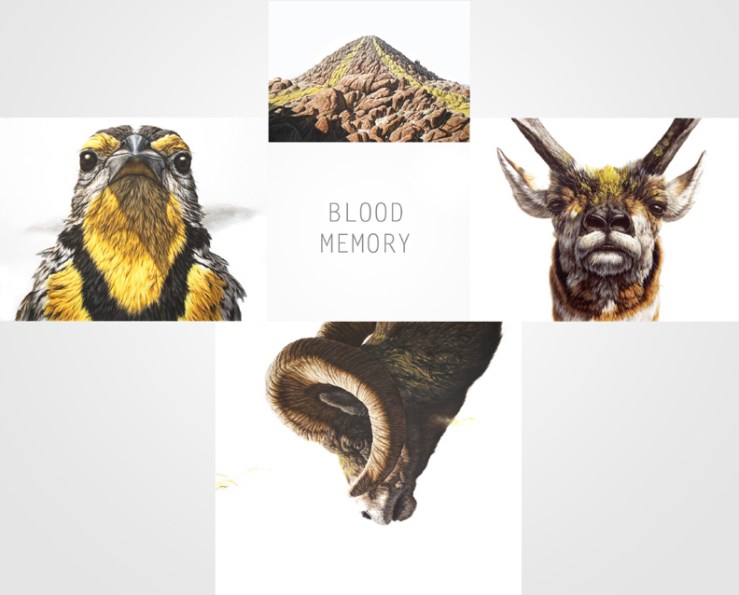
George Boorujy’s marvelous paintings explore humanity’s paradoxical engagements and disengagements with “Nature” — a system that we are manifestly a part of, yet nevertheless philosophically define ourselves against. The first Boorujy painting I saw, a gorgeous bluebird, stunned me: simultaneously delicate and fierce, it emanates pride but also an ineffable quality that surpasses rational, systematic thought. The painting’s vivid colors and subject recalled to me Albrecht Dürer’sWing of a Blue Roller. I soon found more of Boorujy’s work at the P.P.O.W. Gallery home to the artist’s second solo show, Blood Memory (535 W. 22nd St., NYC, March 15th — April 14th). Blood Memory continues Boorujy’s depiction of animals and landscapes, subjects that resonate with his extensive travels across the US as well as his background in marine biology, a subject the New Jersey native initially pursued at the University of Miami before switching to a BFA. He completed his MFA at the School of Visual Arts in NYC. Boorujy is based out of Brooklyn; he paints and teaches, and works a project called New York Pelagic, where he launches original drawings of water birds (along with a questionnaire) in glass bottles into New York waterways. Check out his website.
Father -- George Boorujy -- Part of Blood Memory
I was thrilled to talk to George over a series of emails: he was personable, funny, and very generous. He ended his first email with one of the best sign-offs I’ve ever read: “I’m gonna go drink in the shower now.” Like many folks of delicate sensibilities and fine upbringing, I too enjoy shower beers. We rapped about Florida, ecology, Swamplandia!, the arts and sciences, the Hipster Mujahideen, the possibility of a racist ibis, and much more.
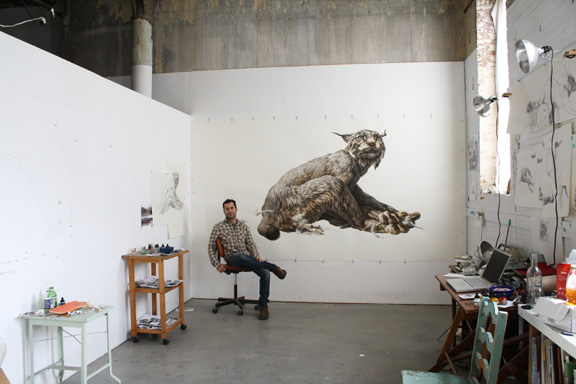
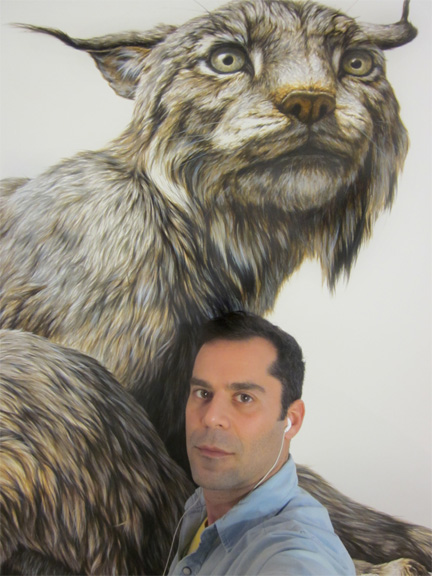
The Artist in repose next to the freshly completed work When Was It That I Knew You
Biblioklept: Tell us about your solo show at the P.P.O.W. Gallery. It’s called Blood Memory—what kind of pieces are you showing?
George Boorujy: Animals. Surprise! But really this is the most purely animal show or body of work that I’ve done. I think there’s only one piece that isn’t of an animal. They’re mostly portrait type pieces, some quite large. I’m finishing up a lynx which is 6 by 11 feet. It sort of looks like Goya’s Colossus. There’s a black white-tailed doe, a meadowlark, a blue jay, a ram, a pronghorn, a frigate bird, a cormorant, another few deer, a Burmese python (hi Florida!). And a mountain. I always seem to need a mountain.
Biblioklept: Your past work has often focused on animals and landscapes, often with implicit ecological arguments. I know you initially studied marine biology in school—how did that course of study influence your art?
GB: I think my brain is somewhat organized like a school where arts and sciences are lumped together. So I’m using the practice of art instead of the practice of science to explore the things I’m interested in. Art and science are very similar in many ways. They are often both a pursuit of the truth. Just different tools and methods are used. Although I am an environmentalist (whatever that actually means) I try not to have any explicit agenda with the work. I want it to stir the viewer or trigger something within them, but not give them an answer or a specific point of view. If I make a piece that shows a manipulated landscape, I’m not necessarily saying it is wrong to manipulate the landscape. We all do it, and we all take advantage of fossil fuels – I love fossil fuels! They’re amazing and we should respect them more and conserve them more – I just want to show what is. Same goes for the treatment of an animal. I’m sure they’re stand-ins for something in my deep sub-conscious, but they are also just what they are, with all attendant veins and ticks and dust in their fur.
Biblioklept: How do you make your animals look so imperious, so proud?
GB: I think maybe it’s because I make them big. I try to actually give them a very indifferent expression so that people can read whatever they want into it. I suppose there is an inherent pride in the form of the animal itself because it is the result of millions of years of evolution that have made it this far. A lot of people think they look sad, which isn’t intended either. I was leaving the studio a few months back when I had a lot of them up and they all looked very judgmental. But then it was better the next day.
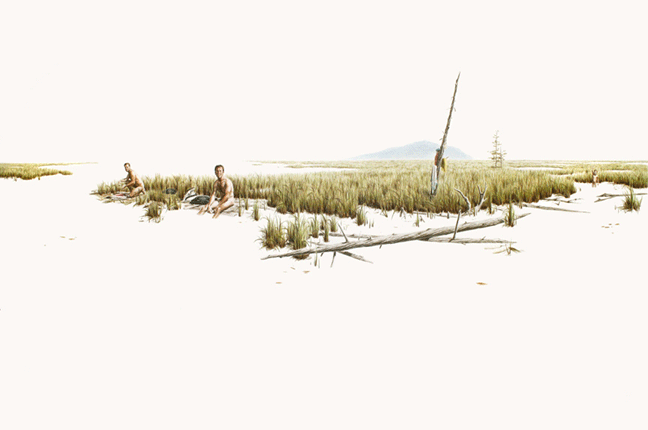
Hunters, George Boorujy
Biblioklept: Let’s shift to people for a moment (although people are animals too, of course). In works like Moraine and Hunters there’s a sense—at least for me—of distance, or almost intrusion (even voyeurism, if I’m being honest). I find your picture of Lincoln fascinating too. I’m curious about how you actually create these pictures: How do you plan them? How do you execute them? What motivates them?
GB: I’m happy that you felt like a voyeur. I never want the pieces to be just observations, I want them to be interactions. Those two pieces in particular could have ended up looking like dioramas or re-enactments or something if there wasn’t the eye contact and the acknowledgement of the viewer. In Hunters, there’s even a small boy hailing the viewer on the right hand side. As though the viewer was coming up in a canoe or something.
As much as I love to draw people, it’s tricky. As soon as you see someone you immediately jump to, “Who’s that? What’s her deal?” We have so much baggage and built in signifiers that it’s difficult to represent someone as a human not of a particular era or class or culture. I wanted both of those pieces to look as though they could be taking place a thousand years in the future or ten thousand years in the past. Hence, no clothes. But no clothes in situations where there would be no clothes – on the beach (a clue there with the title, Moraine, as in a glacial moraine. I live in Brooklyn down the hill from a glacial moraine, and really all of Long Island is a glacial moraine), or in the case of Hunters, people who have just come out of the water or are doing something in the water. I had to be careful with how to depict the men – one of which is me – would they be bearded? I was afraid they’d look too caveman-ish, or too much like the Hipster Muhajideen (I coined that by the way). I wanted them to be kempt as I wasn’t interested in depicting a post apocalyptic scenario or a definable Paleolithic one either. I also like the play between the indifferent expressions on the men and the smiling hailing boy.
As far as creating them, with the animals I usually make a sculpture first and then make the two-dimensional image out of that because there would be no pictures of the animals in the poses and situations that I put them. With the people, I took some pictures of myself and my friends. Then I changed some things here and there. The girls are my sister and her childhood best friend – but they weren’t naked! They had on bathing suits! And the guys are me and my friend, although it’s my body both times because I changed my mind on a pose. Nudity is a funny thing – I wanted to show them naked, but not in a sexy way. So that’s why they’re pretty modest, even though I guess you can see my dick in the one.
That same issue came up with the Lincoln piece. Originally I thought about doing him full body. But then I knew people would just be looking at his penis, which wasn’t the point. It’s easy to be sensationalistic. Harder to go for the slow burn. And I love the slow burn. Not saying that I always get there, but I am more interested in that generally. I looked at as many pictures of Lincoln that I could find and then came up with a good amalgam. With him it was almost the opposite of what I do when depicting people. Instead of going for neutrality, I was interested in showing one of the most recognizable figures as what he – and all of us – was. A human, an animal. It’s sort of like what I’m always doing, trying to make people re-see what they have seen a million times. Like, what was Lincoln? What does a jack-rabbit really look like? What are we? What are these other beings, what makes a horse?.
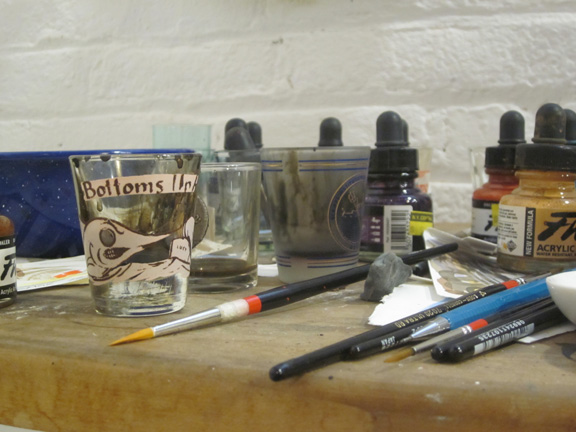
"I really do mix my inks in shot glasses. I'm not that much of a drunk."
Biblioklept: What are you reading now?
GB: This seems like a set-up but I actually am reading that biography of Audubon by Rhodes. It is such a good read. Tracing Audubon really traces the beginning of the country, and that guy got around. So you get these really interesting portraits of cities we know today in their infancy, and cities that were once prominent but are now considered backwaters. And the countryside and rivers before they were drastically changed. I often think about how weird it is that when my grandfather was a child we still had passenger pigeons and Carolina parakeets. That’s not so very long ago. Now the parakeets I see are introduced monk parakeets or escaped pets. If they become established then it will be less than a geological blip where we didn’t have parakeets here. The life between introduced and native is an interesting one to ponder.
Biblioklept: As we’re on birds, it seems like a good time to bring up your New York Pelagic project. You put original drawings of birds along with questionnaires in bottles and set them loose on New York waterways. Your blog discusses the motivations and goals behind the project in detail, but maybe you could give our readers a brief overview of your expectations? Is it difficult seeing your original work float away?
GB: It’s funny, I really had no idea what to expect. I was afraid none would ever be found. But, depending on how you count it, four or five have been found out of… 15? I actually have to update the blog and do some counting. So that’s a pretty good ration considering. I didn’t expect the project to become such an exploration of the city, I’ll tell you that much. But honestly, the history of New York is so amazing, and so rich, that you can’t pick your nose without flicking a booger on an old Dutch millstone or some such thing. And it is compelling. I didn’t expect to get so writer-y. I’ve never really written before, and it’s actually pretty fun. And as far as responses I was hoping people would be excited and happy. Which, except for once, they were.
As far as letting the work go, it is surprisingly easy. I thought I’d be more sad about it. But in actuality I’ve done some of them twice to make sure the one in the bottle is really good, not just middling. I want people to find something beautiful. And even if it never gets found there’s something very satisfying about letting something I’ve worked hard on go away. Christ, I ain’t no Buddhist, but there’s something zen about it I suppose. Maybe it’s a good foil to the other work I do which is so labor intensive and made to be seen and hopefully preserved. There’s also something so nice about it being pictures of seabirds that go (mostly) missing. We don’t see then really, just the gulls in the parking lot for most of us. The large majority of them live in habitats that don’t really overlap with ours.
Biblioklept: Let’s talk Florida — you went to Miami, I went to UF in Gainesville, and I live in Northeast Florida now, which is basically a different state than South Florida . . .
GB: Miami is totally a different country. From North Florida and from the rest of the U.S. I was always bummed about not doing a semester abroad when I was there, but then realized that going there is basically eight semesters abroad. So funny that you went to UF. Our big rivals were the Seminoles of course. Which I remember some people used to refer to as the Semen Holes. Which wasn’t as disturbing as a t-shirt I remember of our mascot — an ibis of all things! – jerking off on a Seminole Indian. I would kill for that shirt now, no matter how many racist nightmares it would induce. If an ibis can be racist against a Native American . . .
I love Florida in all it’s David Lynchian beauty. Hmmm . . . this brings me to something that I read recently having to do with Florida – [Karen Russell’s] Swamplandia! I hated it. And for very specific reasons. She is trying desperately to be funny, but she’s not. And it really brings down the whole thing.Every character in the book is trying so hard to out-quirk the next. There’s no straight man. Not that there has to be per se, but there is no anchor to the book. And I like flawed characters, but none of hers are particularly likeable. Even with all their quirks—in defter hands it would work. But like I said, she’s just not a funny writer and it seems like she thinks she has to be. Which is a shame, because there’s an interlude in the book (which I think was in The New Yorker) which is beautiful. So well written and evocative and moody. And well told. It’s not funny, but not everything has to be. I wish she had just expanded that into a whole novel instead of crowbarring a bunch of kooks around it. But now I’m listening to State of Wonder as I finish up a painting for the show and it is excellent.
Biblioklept: Have you ever stolen a book?
GB: I thought I hadn’t, but then I realized I had. And this seems almost like a plant as well. It was a Swedish publication about Seabirds. And I really passively stole it from the New York Public Library. I honestly think I was the only one who ever took it out. And then I kept bringing it back late. And then one time it was so late that they just billed me for it as a lost book. I could have returned it, but it was only like 14 bucks! Over the years I had probably paid 20 in late fees on it already. Wait—maybe I didn’t steal one because I paid the 14 bucks. But it was somehow dishonest.
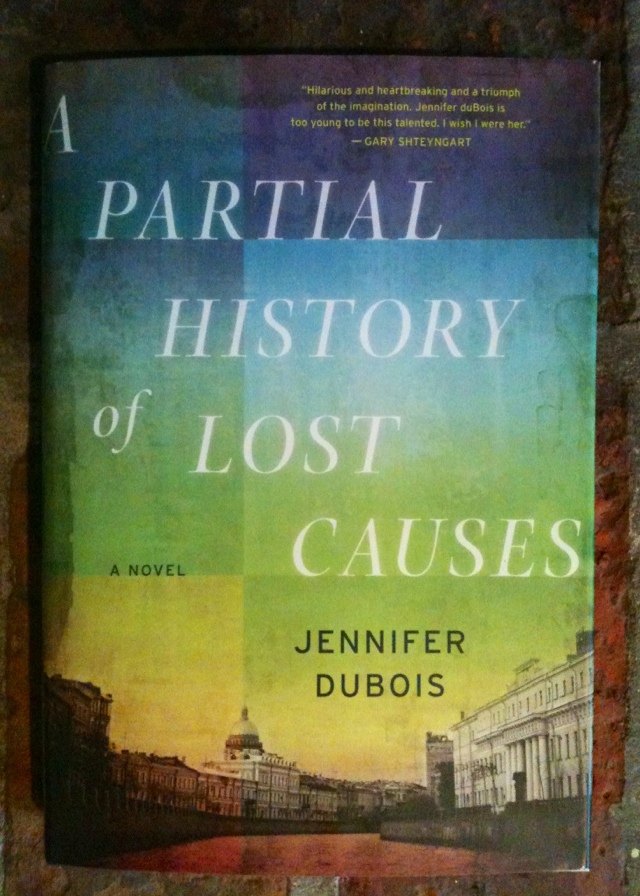
A Partial History of Lost Causes by Jennifer DuBois. Publisher Random House’s copy:
In Jennifer duBois’s mesmerizing and exquisitely rendered debut novel, a long-lost letter links two disparate characters, each searching for meaning against seemingly insurmountable odds.
In St. Petersburg, Russia, world chess champion Aleksandr Bezetov begins a quixotic quest. With his renowned Cold War–era tournaments behind him, Aleksandr has turned to politics, launching a dissident presidential campaign against Vladimir Putin. He knows he will not win—and that he is risking his life in the process—but a deeper conviction propels him forward. And in the same way that he cannot abandon his aims, he cannot erase the memory of a mysterious woman he loved in his youth.
In Cambridge, Massachusetts, thirty-year-old English lecturer Irina Ellison is on an improbable quest of her own. Certain she has inherited Huntington’s disease—the same cruel illness that ended her father’s life—she struggles with a sense of purpose. When Irina finds an old, photocopied letter her father had written to the young Aleksandr Bezetov, she makes a fateful decision. Her father had asked the Soviet chess prodigy a profound question—How does one proceed against a lost cause?—but never received an adequate reply. Leaving everything behind, Irina travels to Russia to find Bezetov and get an answer for her father, and for herself.
Spanning two continents and the dramatic sweep of history, A Partial History of Lost Causes reveals the stubbornness and splendor of the human will even in the most trying times. With uncommon perception and wit, Jennifer duBois explores the power of memory, the depths of human courage, and the endurance of love.
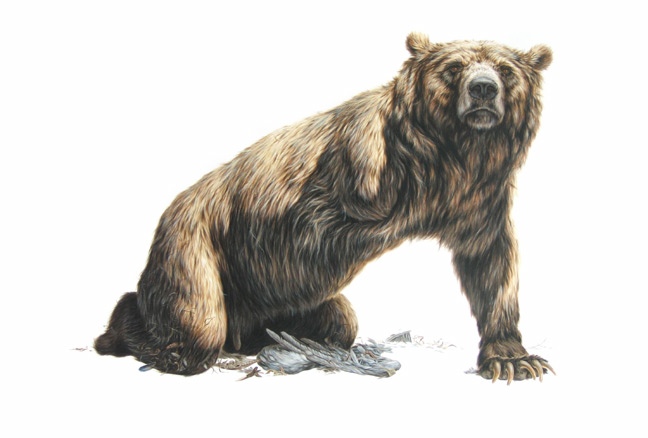
I have a fantastic interview with artist George Boorujy coming up this week—we chat about shower beers and Swamplandia and beasts and men and George’s new show Blood Memoryand all manner of marvels. It’s great stuff and includes some studio shots. Only I can’t quite finish editing it yet because I’m on vaykay and have neglected to bring along a laptop. Posting this piece now on an iPhone has taken all the wine- and sun-soaked concentration I can muster … So enjoy the bear (and look forward to the interview).
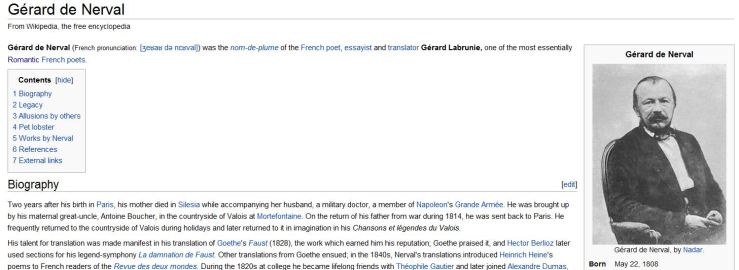
I’ve been reading Michel Houellebecq’s latest novel The Map and the Territory on my Kindle Fire, which is handy because I can easily hover my index over an unknown reference and figure out what Mich-dawg is getting at. Anyway, near the beginning of Part III, H-bomb drops a reference to French Romantic poet and essayist Gérard de Nerval, whom I will cop to not recognizing. But the detail seemed significant, so let my index finger hover I did, but, no dice, Nervs wasn’t in the preloaded dictionary—so I went to the next option: Le Wikipedia. And here’s a snapshot of what I saw:
The man’s life is divided into seven neat sections there on Wikipedia, and what’s right square in the middle? Pet lobster. Holmes had a pet lobster:
With all due respect for cats, however, let us consider the case for the humble lobster. The poet Gérard de Nerval had a penchant for lobsters, or at least for one lobster. Nerval was seen one day taking his pet lobster for a walk in the gardens of the Palais-Royal in Paris. He conducted his crustacean about at the end of a long blue ribbon. As word of this feat of eccentricity spread, Nerval was challenged to explain himself. “And what,” he said, “could be quite so ridiculous as making a dog, a cat, a gazelle, a lion or any other beast follow one about. I have affection for lobsters. They are tranquil, serious and they know the secrets of the sea.” (The episode is captured by Guillaume Apollinaire in a collection of anecdotes from 1911). Was there any basis to this story? A generation of Nerval scholars attempted to debunk it, but then a letter to his childhood friend Laura LeBeau was discovered. Nerval had just returned from some days at the seaside at the Atlantic coastal town of La Rochelle: “and so, dear Laura, upon my regaining the town square I was accosted by the mayor who demanded that I should make a full and frank apology for stealing from the lobster nets. I will not bore you with the rest of the story, but suffice to say that reparations were made, and little Thibault is now here with me in the city…” Nerval, it seems, had liberated Thibault the lobster from certain death in a pot of boiling water and brought him home to Paris. Thus we know that it was Thibault, and not just “some lobster,” who went for that celebrated promenade in the gardens of the Palais-Royal.
Book shelves series #11, eleventh Sunday of 2012. DeLillo, Denis Johnson, Pynchon (no, I have not read Against the Day nor finished Mason & Dixon). There’s also a hardback copy of Bolaño’s Between Parentheses; I have an ARC of the same shelved with the other Bolaños, which are on the shelf under—but the finished copy won’t fit on the shelf and it fits here. For now.
When General Grant Expelled the Jewsis new from historian Jonathan D. Sarna (and Shocken books). From Harold Holzer’s review at The Washington Post:
. . . no historian has been able to fully understand — much less justify — why, on Dec. 17, 1862, Grant issued his notorious General Orders No. 11 deporting Jewish citizens. “The Jews, as a class violating every regulation of trade,” went the chilling text, “. . . are hereby expelled from [his command in the West] within twenty-four hours.” Those returning would be “held in confinement until an opportunity occurs of sending them out as prisoners.” Just two weeks before Abraham Lincoln was scheduled to extend freedom to one minority group with the Emancipation Proclamation, his most promising general thus initiated a virtual pogrom against another.
In the end, as the gifted and resourceful historian Jonathan D. Sarna points out in this compelling page-turner, General Orders No. 11 uprooted fewer than 100 Jews. But for a few weeks, he suggests, it terrorized and infuriated the Union’s entire Jewish population. It also inspired one of the community’s first effective lobbying campaigns. Jewish newspapers compared Grant to Haman, the infamous vizier of Persia in the Book of Esther. A delegation of Jewish leaders traveled to the White House to protest directly to the president, who quickly but quietly had the order revoked, eager to right a wrong but reluctant to humiliate a valuable military commander. As Lincoln carefully put it, “I do not like to hear a class or nationality condemned on account of a few sinners.” He never mentioned the episode publicly.
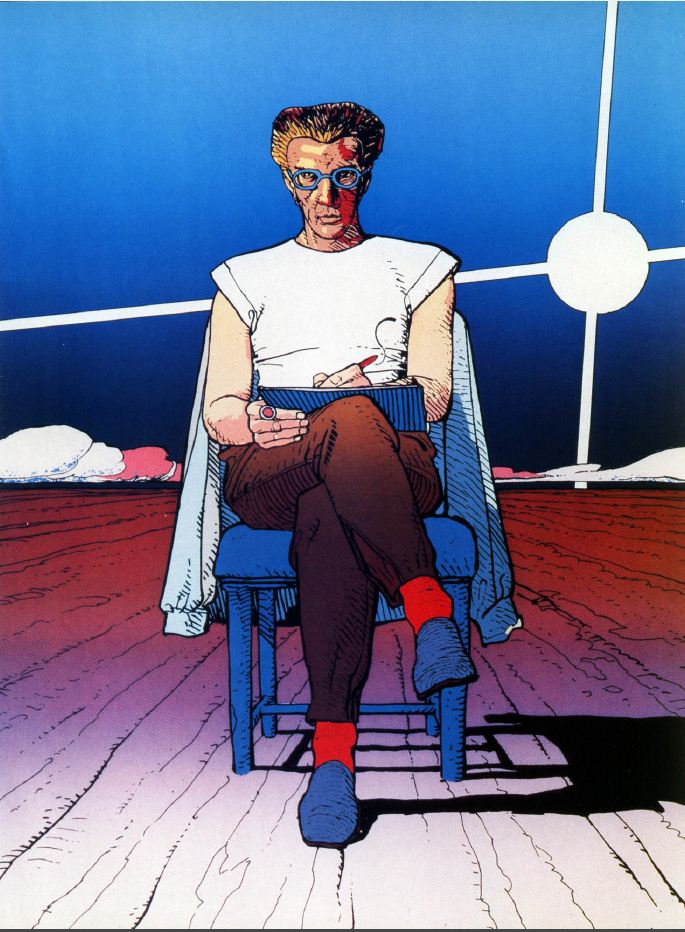
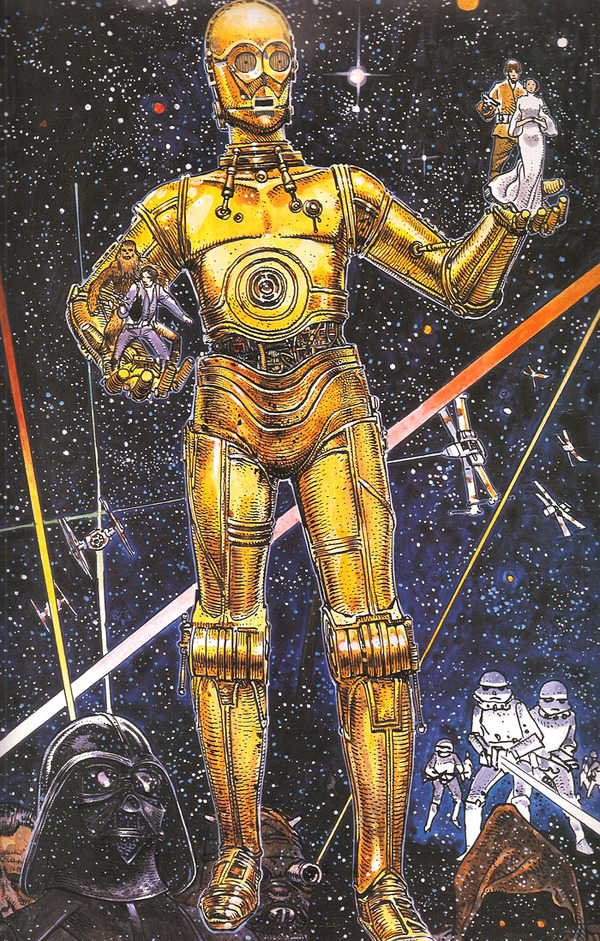
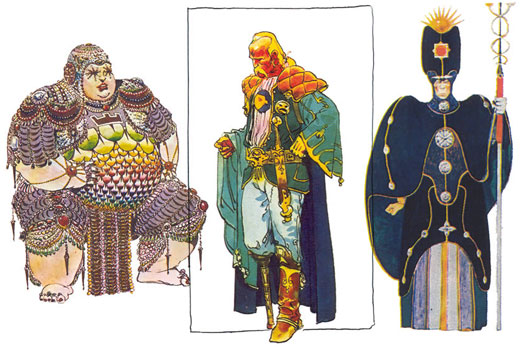
French comic book legend Jean Giraud, also known as Moebius, died today in Paris at 73.
Although Giraud’s work is more famous in Europe, and particularly France and Belgium, where comics tend to get more of the artistic esteem they deserve, his influence on contemporary American comics and sci-fi film design should not be underestimated.
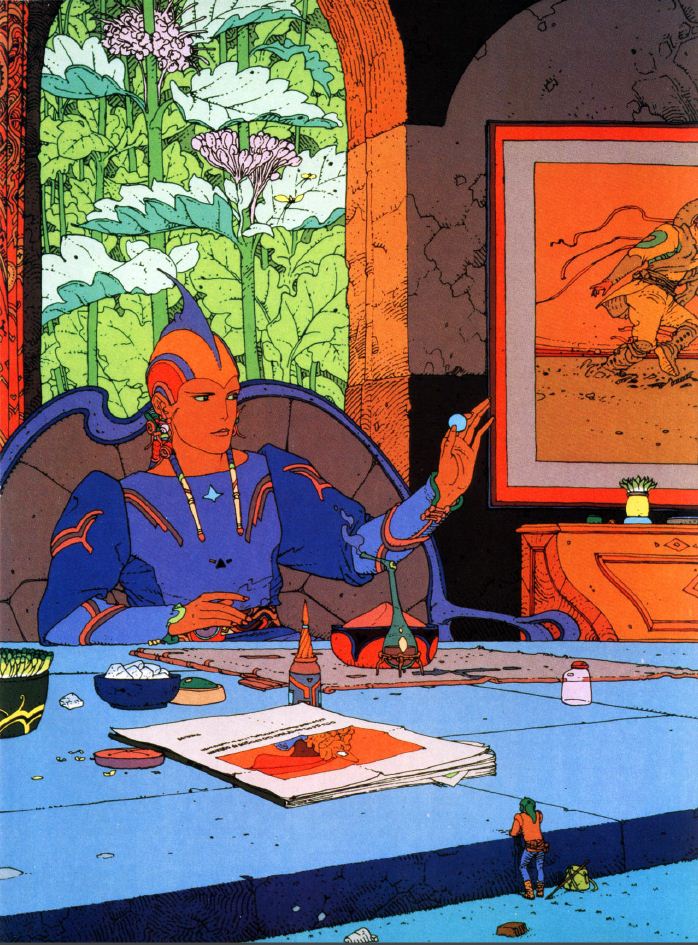
His take on Wild West culture is exemplified in what is likely his largest body of work Blueberry, but folks new to Giraud might wish to start with The Airtight Garage (or just check out this cool gallery).
Giraud/Moebius was never simply a genre artist; instead, his work taps into the mythological, exploring themes that seem at once both strangely familiar but also wildly divergent from our expectations. His imaginative disruptions made him a key partner for film directors like Alejandro Jodorowsky; he also worked on the art team behind Alien, among other films, like The Abyss,Willow, and Tron. Giraud was also close friends with Hayao Miyazaki.
Giraud leaves a rich, vibrant legacy. The imaginative spaces of his worlds will undoubtedly captivate generations to come.









 Biblioklept