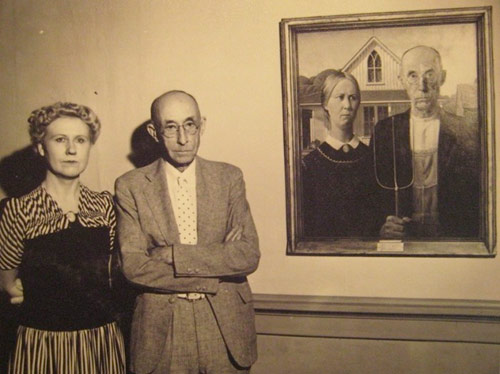
In Which the Models Stand Thin-Lipped Next to Wood’s American Gothic

The Great Ecstasy of the Woodcarver Steiner — Werner Herzog

Some Stories That Wes Anderson Should Adapt

Last month, I kinda sorta reviewed the trailer for Moonrise Kingdom, the new film from Wes Anderson. Moonrise Kingdom has all the hallmarks  of an Anderson joint: an idealistically romantic protagonist who strives to fit the world to his skewed view of it; an overtly hermetic setting (crammed like a Russian nesting doll with even more hermetic settings); a fetish for staginess; a fetish for once useful objects that are now obsolete; the usual cast of characters; etc.

Anyway, one commenter on that post suggested that Anderson adapt V.C. Andrews’s lurid gothic incest romance Flowers in the Attic—and I couldn’t agree more. Andrews’s story grotesquely enshrines the hermetic world of forbidden love that Anderson repeatedly engages in (see the incestuous, or at least Oedipally-displaced romances of The Royal Tennenbaums and Rushmore). The Flowers suggestion (and another comment suggesting a DeLillo adaptation) got me to thinking about other stories I’d love to see Anderson take on.

(Those who hate to see a silly, ridiculous, fanboyish, and entirely hypothetical post should exit anon).

(Oh, and let’s get this one out of the way too: Matt Bucher has already linked Tennenbaums to David Foster Wallace’s Infinite Jest).

While Anderson has authored most of his own scripts (with cowriters like Owen Wilson or Roman Coppola), he showed he could do fine work with people’s stories on Roald Dahl’s The Fantastic Mr. Fox. I’d love to see him do something with Shel Silverstein or Edward Gorey as well, perhaps as a series of animated shorts of some kind. Like Dahl, Silverstein and Gorey deftly explore the dark undercurrent of childhood in a way that’s simultaneously charming and meaningful.

I’d probably be happy with any Wes Anderson superhero movie, but I’d love to see him do a big screen live action version of The New Mutants, a title that ran in the 1980s that focused on teens who were basically X-Men junior. Anderson would be right at home in Charles Xavier’s School for Gifted Youngsters, and the types of missions these teenagers took on were not nearly as intense as the X-Men’s, allowing for a smaller, more emotional film, than, say, Bryan Singer’s bombastic nonsense. Bill Murray for Professor X?

While I’m on big-budget franchise type characters: James Bond. A Bond film would give Anderson plenty of opportunity to play with design and style, as well as humor; Anderson also showed a sense for old-fashioned adventure and action in The Life Aquatic. Owen Wilson as Bond? (As a side note, I should point out that in general I’d love to see the Bond franchise branch out to a series of stylized one-offs, featuring different actors playing Bond, and  helmed by different directors like Spike Lee and Quentin Tarantino).

How about Twain’s The Adventures of Tom Sawyer (not Huck Finn, people)? Maybe as a mini-series on HBO?

Anderson has always been deeply entrenched in J.D. Salinger territory, and although he arguably already did so in Tennenbaums, a film that somehow organizes the lives of the Glass family would be pretty cool.

Harold Brodkey’s overlooked masterpiece First Love and Other Sorrows may be a collection of short stories, but they share a common theme that resonates with Anderson’s aesthetic. Brodkey’s decaying families (which all seem to share a misplaced sense of privilege) would be fertile ground for Anderson (and their midcentury settings would make for some snappy outfits).

Also: Heller’s Catch-22.

Maybe Anderson could highlight some of the humor in Bret Easton Ellis’s Less Than Zero. (Okay, maybe not, but I’d love to see what he’d do with that milieu. And speaking of that milieu—).

I’d love to see the failure that would be Anderson’s take on Fitzgerald’s The Great Gatsby (suggestion: use Jim Henson-style puppets).

And: A Nabokov biopic, preferably one that focuses on his lepidoptery. Could Bill Murray play Nabokov? This question is rhetorical.

Anderson’s films have been repeatedly criticized for their racial insensitivity, but in spite of this (or, perhaps, because of this), I’d like to see his take on Kipling’s The Jungle Book

Speaking of imperialism: Another Tintin film. And while he’s at it: Lil’ Orphan Annie.

Faulkner’s a bit too gritty, too dirty (not to mention too Southern) for Anderson, but he would probably do a great feature length adaptation of “A Rose for Emily.” Decay, incest, the crumbling of an old value system.

And: It’s about time someone made that Night Court movie, right? Okay, maybe not.

Other suggestions?
What Would Patrick Bateman Do? — Bret Easton Ellis on the Death of Whitney Houston

Book Shelves #7, 2.12.2012

20120210-203625.jpg

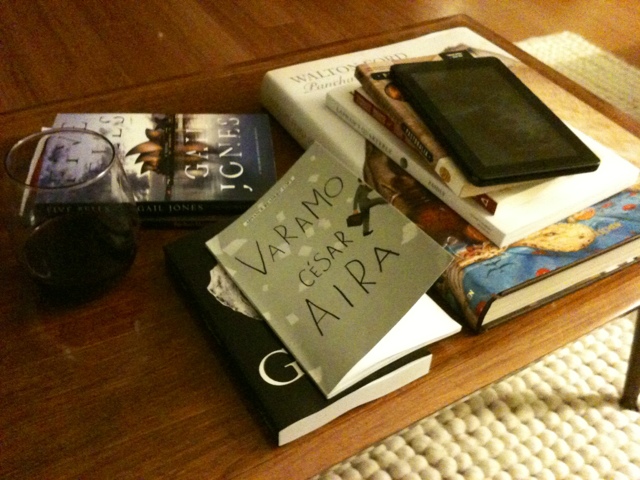
Book shelves series #7, seventh Sunday of 2012: In which I photograph a coffee table.

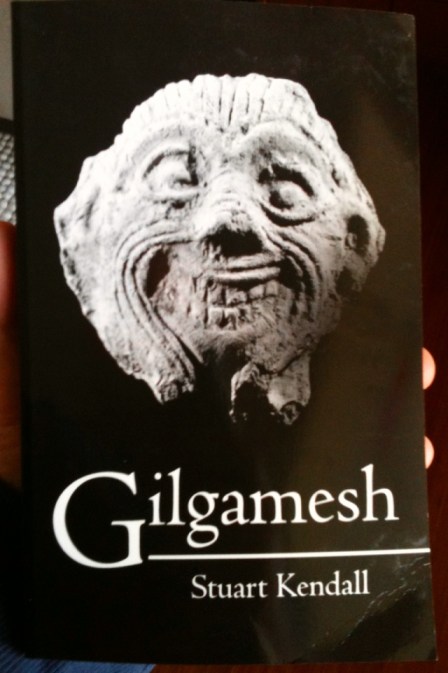
We have three coffee tables. This is one of them (it’s next to the unit I photographed last week). Like many folks’ coffee tables, I suppose, it gets littered with books; the books on this one tend to rotate. Pictured above: lots of recent books acquired, including the Aira on top and Stuart Kendall’s new translation of Gilgamesh. There’s also the new issue of Lapham’s Quarterly and, for some reason (can’t remember) George Saunders’s Pastoralia. The Kindle is also there: my daughter and I read the first three comics in a colorized version of Jeff Smith’s epic graphic novel Bone—amazing stuff, and the color adds depth and beauty to an already beautiful book. I took this photo on a Friday afternoon, or maybe Friday evening (or night). I was drinking wine.

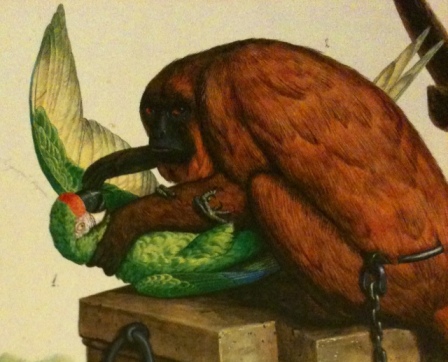
The big book is Walton Ford’s Pancha Tantra, which my lovely wife gave me for Christmas. Some images:

20120210-203648.jpg

20120210-203656.jpg

20120210-203704.jpg

Sonny Sharrock on Magic Guitar Jams with Keith Haring on Magic Marker

“May Your Loins Be Girt” (Book Acquired, 2.09.2012)

20120211-111518.jpg

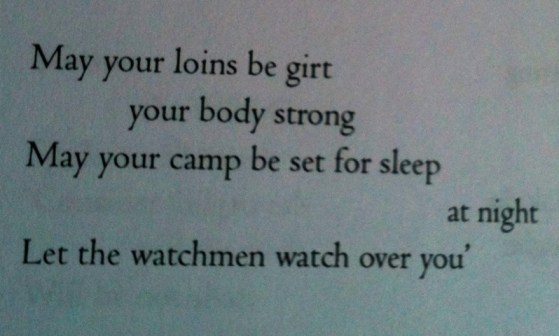
A few lines from Stuart Kendall’s new translation of Gilgamesh. Review and interview forthcoming. Read more here.

20120211-111512.jpg

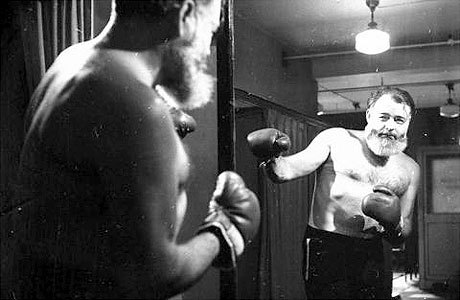
Topless Hemingway, Part II

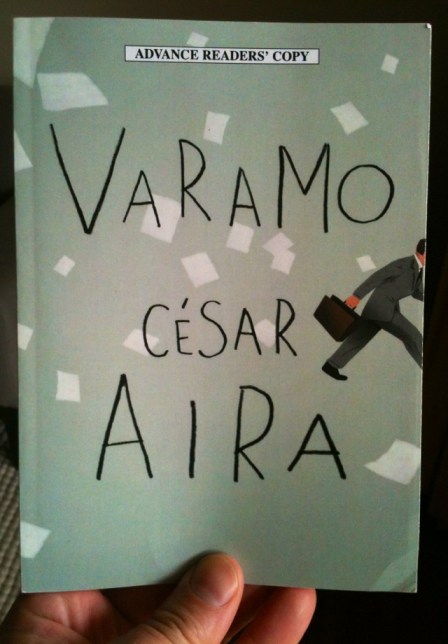
Book Acquired, 2.09.2012 — In Which I Finally Get My Mitts on Something by César Aira

20120209-150157.jpg

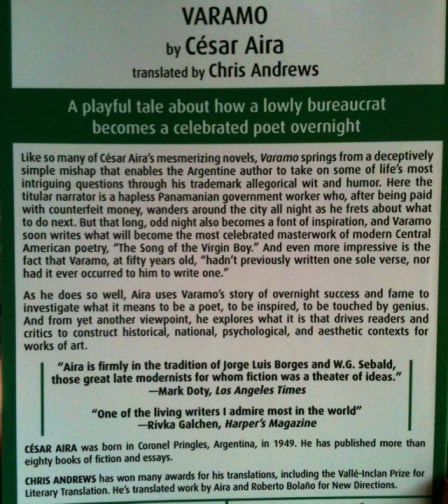
Varamo by César Aira (translated by Chris Andrews, whose work you should be familiar with). Forthcoming from the good people at New Directions.

I’ve been wanting to read some Aira since some readers suggested him (in the comments for this post where I bashed on Chad Harbach’s novel).

Anyway, details:


20120209-150205.jpg

The Max Fischer Players Present

Forensic Composite Portraits of Literary Characters

Check out literary mugshots at The Composites. (H/t to ‘klept reader JESCIE for pointing me to this cool site; yes, we know The Believer did a similar thing a few years ago).

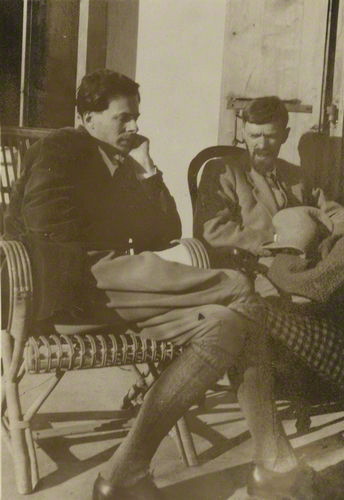
Just a Picture of Aldous Huxley and D.H. Lawrence

“A Book Lives as Long as It Is Unfathomed” — D.H. Lawrence on Reading

D.H. Lawrence in his long essay Apocalypse:

Now a book lives as long as it is unfathomed. Once it is fathomed, it dies at once. It is an amazing thing, how utterly different a book will be, if I read it again after five years. Some books gain immensely, they are a new thing. They are so astonishingly different, they make a man question his own identity. Again, other books lose immensely. I read War and Peace once more, and was amazed to find how little it moved me, I was almost aghast to think of the raptures I had once felt, and now felt no more.

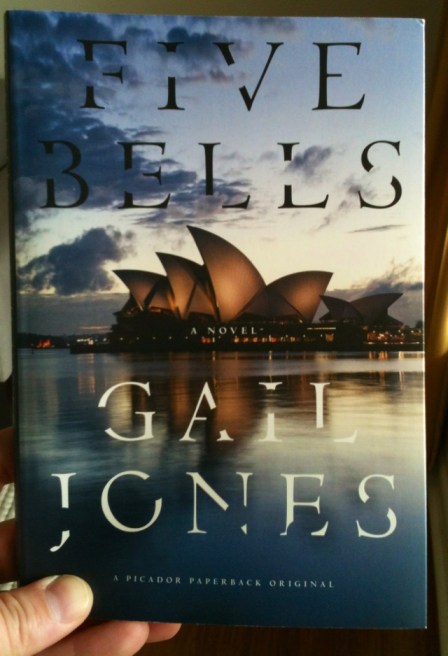
Book Acquired, 2.07.2012 — Gail Jones’s Five Bells

20120209-150101.jpg

Gail Jones’s Five Bells is new from Picador:

On a radiant day in Sydney, four adults converge on Circular Quay, site of the iconic Opera House and the Sydney Harbor Bridge. Crowds of tourists mix with the locals, enjoying the glorious surroundings and the play of light on water.

But just as Circular Quay resonates with Australia’s past, each of the four carries a complicated history from elsewhere. Each person is haunted by past secrets and guilt. Ellie is preoccupied by her sexual experiences as a girl, James by a tragedy for which he feels responsible, Catherine by the loss of her beloved brother in Dublin, and Pei Xing by her imprisonment during China’s Cultural Revolution.

Told over the course of a single Saturday, Five Bells describes four lives that come to share not only a place and a time but also mysterious patterns and ambiguous symbols, including a barely glimpsed fifth figure, a young child. By nightfall, when Sydney is drenched in a summer rainstorm, each life will have been transformed by the events of this day

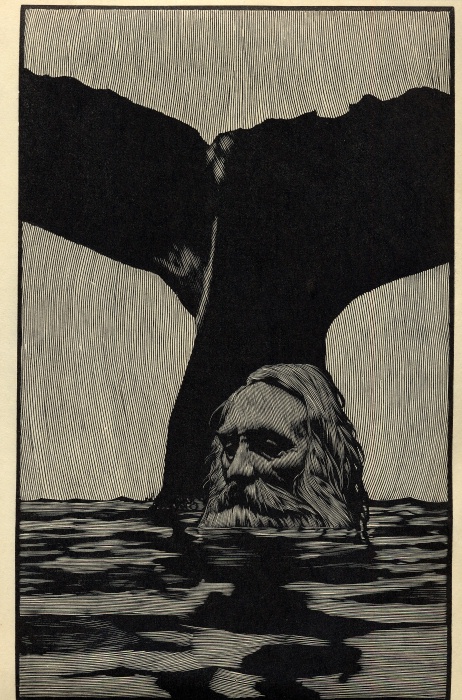
Jonah — Barry Moser

Book Acquired, 2.08.2012—D.H. Lawrence’s Apocalypse

20120209-145955.jpg

I need another book like I need a hole in the head, but, when I’ve had a stressful day at work, I like to browse the huge, labyrinthine used bookstore conveniently located just over a mile from my house. I don’t know how I wound up browsing D.H. Lawrence books, but Apocalypse stood out—first for its name, and second because, in a section of literally hundreds and hundreds of Lawrence volumes, it seemed to be the only one. Five minutes with the thing and I knew I was going to pick it up. It’s essentially a long essay on the Book of Revelation—and the concept of apocalypse and end-of-the-world in general.

Lawrence’s Studies in Classic American Literature is a seminal volume for me, one I return to repeatedly—but I’ve never made it through one of his novels; I even found his short fiction tedious. Anyway, read a huge chunk of this last night. More to come.

William S. Burroughs BBC Documentary