Topless Faulkner, Part II

(See also).

Richard Branson on Faust

Faust. It’s funny. They were our very, very first signing. Them and Mike Oldfield were the first albums that we put out. The Faust album we put out for the price of a single and it really got them established. We sold two or three-hundred thousand copies, which was unheard of for a brand new band. We quite liked that German [sound] — Tangerine Dream, Kraftwerk…

One amusing story is that [Faust] were going to a gig once, and they saw somebody digging up the road with one of these machines and they pulled over the van and threw him into the van with the machine… Then on the stage, he was drilling up the stage and pieces of the stage were flying everywhere.

(Via).

Faust Talk About Krautrock, Soothing the Village Idiot, Pissing Off Richard Branson, and the Awfulness of English Food

Book Acquired, 1.04.2012

20120104-171225.jpg

The Sweet Relief of Missing Children by Sarah Braunstein. I like the awkwardness of the title: what is “missing” modifying? Is it an adjective, describing the children? Is it a gerund? Who is gaining relief from what?

Publisher Norton’s description:

In New York City, a girl called Leonora vanishes without a trace. Years earlier and miles upstate, Goldie, a wild, negligent mother, searches for a man to help raise her precocious son, Paul, who later discovers that the only way to save his soul is to run away. As the narrative moves back and forth in time, we find deeper interconnections between these stories and growing clues about Leonora—this missing girl whose face looks out from telephone poles and billboards—whom one character will give anything to save.

The Sweet Relief of Missing Children is a suspenseful novel about the power of running and the desire for reinvention. It explores the terror and transcendence of our most central experiences: childhood, parenthood, sex, love.

Grand Larousse — Guy Laramée

(More).

“Hair Rebels” (A Favorite Scene from a Favorite Film, if . . . .)

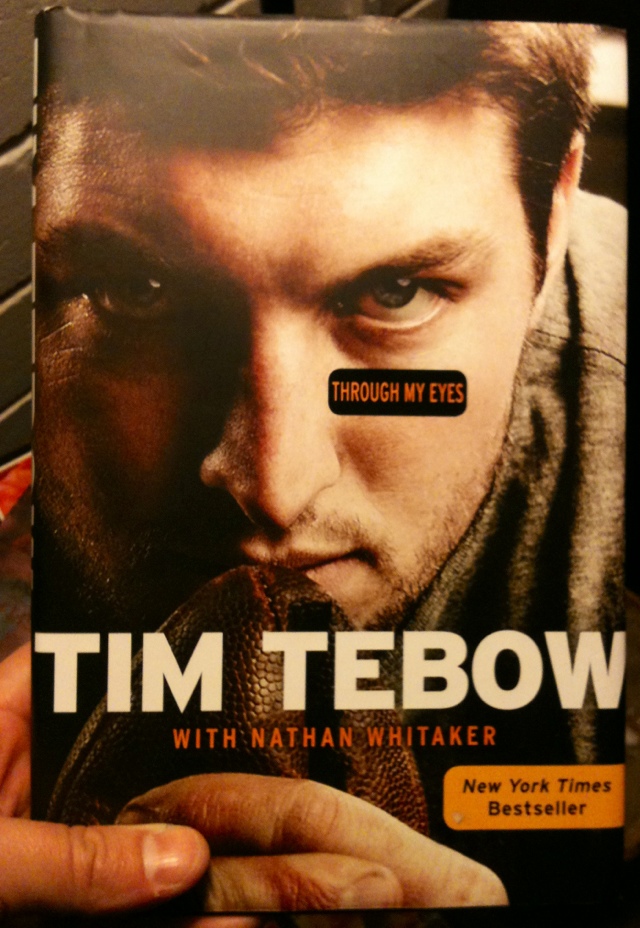
Book Acquired 1.03.2012 — Tim Tebow Edition

My father doesn’t read a lot of books, or at least I don’t think he does, but I know he read Through My Eyes, the Tim Tebow memoir. I’m pretty sure he must have gotten a duplicate for Christmas, because he sent a copy my way yesterday.

If you don’t know who Tim Tebow is (that is, if you’re not a fan of U.S. football, or not from the States, or you just don’t care about sports, or Twitter, or whatever), he was one of the greatest college players of all time, leading the Florida Gators to two national championship titles and two SEC titles. He’s also a devout Christian, the son of missionaries. He currently is the starting quarterback for the Denver Broncos, a team he helped take (quite improbably) to the playoffs this year.

Also: a vocal contingent of people really enjoy hating on him.

Not me. Tebow is from my hometown. I went to the University of Florida. I’m a big Gator fan. And even though I’m not exactly simpatico with evangelical Christianity, Tebow has always struck me as a genuinely good, nice person.

Anyway, I have some interest in the book, although I’m sure it’s pretty standard ghostwritten sports celebrity memoir stuff.

20120103-175429.jpg

Here is what my dad also got for Christmas: a signed Tebow ball. (My name is also Ed, so one day maybe I will have this ball too):

20120103-175448.jpg

“Seen in a Junk Yard” — F. Scott Fitzgerald

From F. Scott Fitzgerald’s Notebooks

Dogs, chickens with few claws, brass fittings, T’s elbow, rust everywhere, bales of metal 1800 lbs., plumbing fixtures, bathtubs, sinks, water pumps, wheels, Fordson tractor, Acetylene lamps for tractors, sewing machine, bell on dingy, box of bolts, No. 1 van, stove, auto stuff (No. 2), army trucks, cast iron, body hot dog stand, dinky engines, sprockets like watch parts, hinge all taken apart on building side, motorcycle radiators, George on the high army truck.

Blotter — Peter Doig

“Halleluhwah” — Can

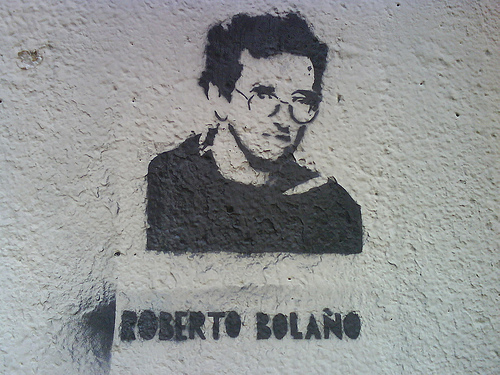
“Books Are Like Ghosts” — Roberto Bolaño on Lost Books

Roberto Bolaño on lost books. From Between Parentheses:

To search for those copies or similar copies, the same font, the same layout, the same plot, the dark or bright syntax, somehow forces me to remember a time when I was young and poor and careless, though I know that the same copies, the exact same ones, will never be found, and to set myself to such a task would be like marching into Florida in search of El Dorado.

Even so, I often browse used bookstores, sorting through stacks of books left behind by others or sold in a dark moment, and in corners like these I try to find the books that I lost or forgot more than thirty years ago on another continent, with the hope and dedication and bitterness of those who search for their first lost books, books that if found I wouldn’t read anyway, because I’ve already read them over and over, but that I would look at and touch just as the miser strokes the coins under which he’s buried.

But books have nothing to do with greed, though they do have something to do with coins. Books are like ghosts.

Slavoj Žižek on David Lynch’s Lost Highway

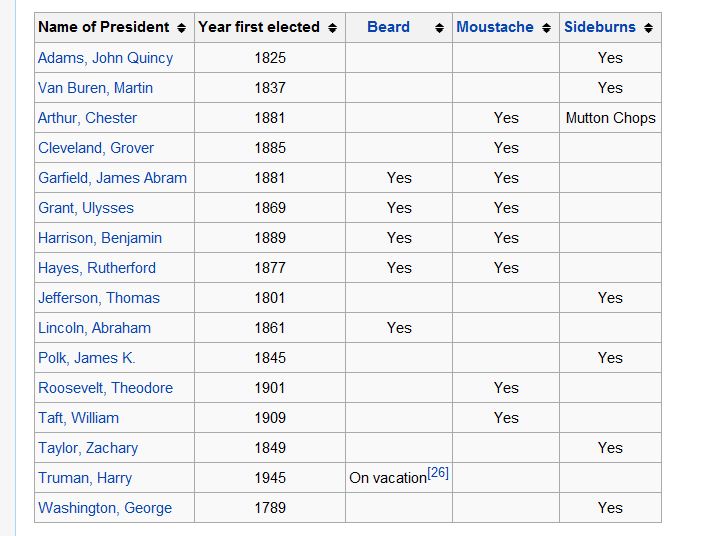
A Chart of U.S. Presidents Who Sported Facial Hair

(From Wikipedia, natch).

Book Shelves #1, 1.01.2012

Every library answers a twofold need, which is often also a twofold obsession: that of conserving certain objects (books) and that of organizing them in certain ways.

—Georges Perec, from “Brief Notes on the Art and Manner of Arranging One’s Books” (1978)

For all of 2011 and half of 2010, I ran a death mask on this blog every Sunday. I liked the idea of having a regular, uniform post on the blog, and I enjoyed searching for death masks (and life masks) and learning about them. However, my interest is waning; it’s time to move on.

Still wanting to run a regular post each Sunday, I’ve elected to photograph the bookshelves, or the surfaces that hold books in my house. These will not be beautiful, arranged pictures, but rather simple pics from my iPhone documenting the spaces that books occupy. I will photograph each space “as is” and then remove a book or two, photograph it, and then comment on it.

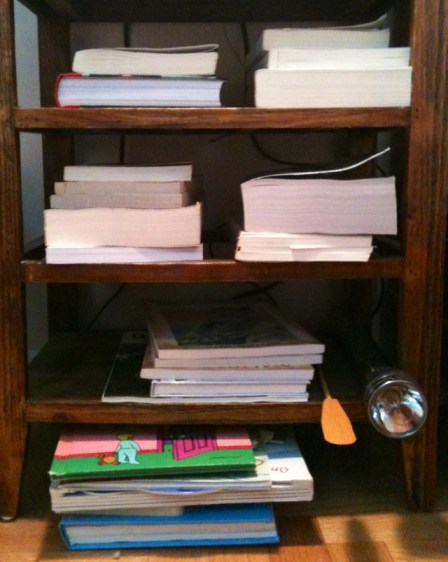
I didn’t know where to start, so I started with what may be the most plain book shelves in my home, the nightstand next to my bed. (Right now it is unusually tidy, having been cleaned out and partially restocked for the new year; in a week or two it will be crammed to its wooden gills). Here is what it looks like:

20111231-112128.jpg

Not very exciting, I know! This is perhaps the only photo in this book shelf series that will not feature shots of spines. Like I said, I don’t plan to arrange any of the shots in this series. I talked about a lot of what’s in here in yesterday’s riff on recent reading and a post last week on stuff I plan to read in 2012.

Stuff on the top tier tends to be stuff I’m currently reading; the second shelf is filled with books I’m always rereading, or picking at slowly. The third shelf is where stuff goes to marinate or get dusty or cry to be shelved.

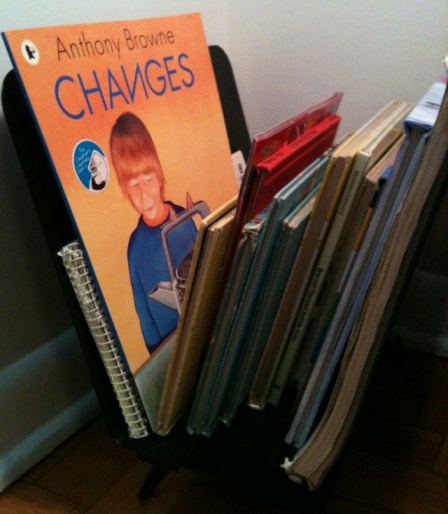
There’s also a bunch of kids book on the floor. More kids books are in this giant magazine stand, along with some notebooks, art pads, and probably an actual magazine or two (Anthony Browne’s book Changes is a surrealist masterpiece for kids, by the way):

20111231-112135.jpg

The Perec quote above comes from an essay collected in Species of Spaces and Other Pieces. “Brief Notes on the Art and Manner of Arranging One’s Books” will be in some ways the guiding inspiration for the Biblioklept book shelf series; my aim is not so much to present beautiful pictures that show off my books (I’m not equipped to do that, and other people do it very well already), but to comment on how my books are arranged and how they move and flow throughout the house; it will also give me a good opportunity to pick up books that might have been lingering (do books linger?) on a shelf for sometime.

I pulled these three books, not quite at random, from the shelves. The Perec book is one of those volumes I like to read scattershot-style. The latest issue of Paris Review still has a few pieces I haven’t read. Nausicaa: I meant to start it the other night. It will migrate to another room, a day-reading room, not a night-reading room:

20111231-112151.jpg

I don’t anticipate future book shelf posts being quite this long; my intention here is to kind of set the ground rules (for myself) or delineate both spirit and letter to this project. As such, a final note on movement: I will move “outward” from this nightstand, photographing any place where books are set. I will photograph every kind of book in this house in its natural habitat; this includes children’s books and cookbooks, but does not include personal photograph albums, instruction manuals, or anything else of that nature. I plan to do 53 total book shelf posts, including this one (there are 53 Sundays in 2012).

My hope is that readers will respond to these posts by sharing their own bookshelving habits.

An Incomplete List of Stuff I Wish I’d Written About in 2011

Let me get this out of my system:

In no particular order a list of stuff I wished I’d written about in 2011:

1. Renata Adler’s amazing novel-in-vignettes Speedboat.

2. Wittgenstein’s Mistress by David Markson. End of the world cultural riffage. No raffage.

3. The Stories of Breece D’J Pancake: soul-crashing sad. [Not a typo].

4. Season two of Boardwalk Empire: The Oedipal complex as a plot arc hasn’t been done so well since The Sopranos. Most HBO shows seem to be about capitalism and law (see also: Deadwood, The Wire, The Sopranos).

5. That first episode of Luck. I love David Milch. Michael Mann seems imminently capable of filming things (although I think Heat is overrated, even though it has Val Kilmer, and he’s radness in the form of a lion in the form of a sea lion). The opening episode was dry like vermouth. But I will watch, because of Deadwood.

6. Hung. My wife and I are the only two people in America who liked Hung. Then it got canceled.

7. Captain America: All of the shots + set design in this film seem to have been straight up stolen from the Star Wars films—except the shots that were stolen from the Indiana Jones films. It’s funny in a way because Lucas (and Spielberg) were stealing from old serial films that were contemporaneous with the age that Captain America is meant to be set in. (And, oh, yeah, the movie was contrived bullshit).

8. I wish I’d reviewed How to Keep Your Volkswagen Alive by Chris Boucher. It was new and fresh and strange and deserved a good review from this blog, but it was very difficult to write about. I tried. It’s simultaneously sad, funny, too-experimental, but also rich and rewarding. An excellent flawed début.

9. The Trip: Steve Coogan and Rob Brydon take a trip through Northern England, eating at Michelin starred inns, creeping on the wild misty moors, referencing plenty of Romantic lit, and riffing—and backbiting—a lot. Comedy + tragedy done right. Lovely.

10. The Adventures of Buckaroo BanzaiAcross the 8th Dimension: Okay, frankly, I was ashamed to admit that I hadn’t seen it until this summer. Batshit insane interstellar hi-jinks. Rasta aliens. Buckaroo and his men are in a band! The ending credits sequence is the second best I’ve ever seen (after Lynch’s closing credits for INLAND EMPIRE).

11. The last Harry Potter movie. It was good. I’m glad they’re over though.

12. Baudolino by Umberto Eco, which I listened to on mp3 while refinishing a room in my new house. The first half was great—silly, bawdy, funny—but it unraveled into a sloppy mess by the end.

13. The Hunger Games by whoever wrote The Hunger Games, I think her name is Suzanne Collins, but Christ I’m not gonna waste any time checking: I listened to this audiobook working on the same room project that I worked on while listening to Baudolino. Look, I get that these books are for kids, and that they’re probably a sight better than Twilight, but sheesh, exposition exposition exposition. There’s nothing wrong with letting readers fill in the gaps (especially when your book is ripping off The Running Man + a dozen other books). Also, there’s a character in this book who I think is named after pita bread.

14.  A Canticle for Leibowitz by Walter M. Miller. Another audiobook that I listened to working on the aforementioned project—only this book is pure excellence, a post-apocalyptic examination of faith and meaning set against Big Nothing. The first third recalled Blood Meridian to me, although McCarthy’s book must have been composed 25 years after Miller’s.

15. I finally watched Party Down after all of my friends kept telling me, “You gotta watch Party Down!” Have you seen Party Down? You gotta watch Party Down!

16. Various short stories by Melville and Hawthorne: I read a lot of short pieces from these guys, mostly obscure, often half-baked stories that were still better than 99.9% of the contemporary stuff American writers are doing.

17. Uncreative Writing by Kenneth Goldsmith. Goldsmith is a hero: Ubuweb is magic. But a lot of Uncreative Writing just felt like an excuse for Goldsmith to share his favorite riffs on avant gardism from the classroom. And I know he’s probably a great and inspiring teacher, and I’m sure his Uncreative Writing class was gangbusters and meaningful for his students. Maybe it’s because I teach at a community college; maybe I’m conservative—I’m a fan of Dada; I get Walter Benjamin, blah blah blah. I just think we should cite sources still. Originality may be a fiction, but synthesis isn’t. Research and documentation are meaningful. Still, an entertaining book.

18. Music. Although most writing about music sucks.

19. Probably several dozen other books, movies, TV shows, etc. But there’s always 2012 to become overwhelmed by!

Happy New Year!
A Scapegoat for Promiscuous Drunks, Friendly Calls, and Humbug Resolutions

mark-twain

From Mark Twain’s January 1st, 1863 column in the Territorial Enterprise:

Now is the accepted time to make your regular annual good resolutions. Next week you can begin paving hell with them as usual. Yesterday, everybody smoked his last cigar, took his last drink, and swore his last oath. To-day, we are a pious and exemplary community. Thirty days from now, we shall have cast our reformation to the winds and gone to cutting our ancient short comings considerably shorter than ever. We shall also reflect pleasantly upon how we did the same old thing last year about this time. However, go in, community. New Year’s is a harmless annual institution, of no particular use to anybody save as a scapegoat for promiscuous drunks, and friendly calls, and humbug resolutions, and we wish you to enjoy it with a looseness suited to the greatness of the occasion.

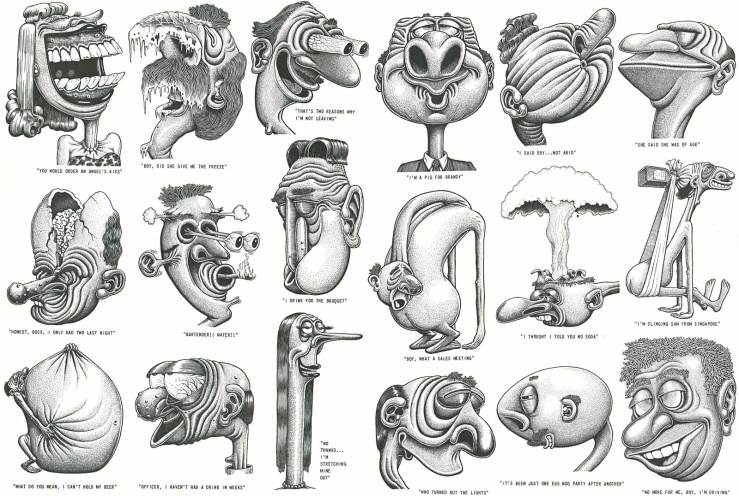
Basil Wolverton’s Guide to Drinking