Stuart McMillen’s webcomic does a marvelous job of adapting (and updating!) Neil Postman’s famous book-length essay, Amusing Ourselves to Death, which argues that Aldous Huxley’s vision of the future in Brave New World was ultimately more accurate than the one proposed by George Orwell in 1984. (Via).
“Idea for a Short Documentary Film” — Lydia Davis
“Idea for a Short Documentary Film,” a very short story by Lydia Davis, from The Collected Stories of Lydia Davis –
Representatives of different food products manufacturers try to open their own packaging.
“Peace on Earth/Little Drummer Boy” — Will Ferrell & John C. Reilly
Vodpod videos no longer available.
Heroes of 2010 — Ron Paul
“Escape from Spiderhead” — George Saunders
The New Yorker has published a new George Saunders short story,“Escape from Spiderhead.” Read it here. A sample–
“Drip on?” Abnesti said over the P.A.
“What’s in it?” I said.
“Hilarious,” he said.
“Acknowledge,” I said.
Abnesti used his remote. My MobiPak™ whirred. Soon the Interior Garden looked really nice. Everything seemed super-clear.
I said out loud, as I was supposed to, what I was feeling.
“Garden looks nice,” I said. “Super-clear.”
Abnesti said, “Jeff, how about we pep up those language centers?”
“Sure,” I said.
“Drip on?” he said.
“Acknowledge,” I said.
He added some Verbaluce™ to the drip, and soon I was feeling the same things but saying them better. The garden still looked nice. It was like the bushes were so tight-seeming and the sun made everything stand out? It was like any moment you expected some Victorians to wander in with their cups of tea. It was as if the garden had become a sort of embodiment of the domestic dreams forever intrinsic to human consciousness. It was as if I could suddenly discern, in this contemporary vignette, the ancient corollary through which Plato and some of his contemporaries might have strolled; to wit, I was sensing the eternal in the ephemeral.
I sat, pleasantly engaged in these thoughts, until the Verbaluce™ began to wane. At which point the garden just looked nice again. It was something about the bushes and whatnot? It made you just want to lay out there and catch rays and think your happy thoughts. If you get what I mean.
Then whatever else was in the drip wore off, and I didn’t feel much about the garden one way or the other. My mouth was dry, though, and my gut had that post-Verbaluce™ feel to it.
“What’s going to be cool about that one?” Abnesti said. “Is, say a guy has to stay up late guarding a perimeter. Or is at school waiting for his kid and gets bored. But there’s some nature nearby? Or say a park ranger has to work a double shift?”
“That will be cool,” I said.
“That’s ED763,” he said. “We’re thinking of calling it NatuGlide. Or maybe ErthAdmire.”
“Those are both good,” I said.
“Thanks for your help, Jeff,” he said.
Which was what he always said.
“Only a million years to go,” I said.
Which was what I always said.
Then he said, “Exit the Interior Garden now, Jeff, head over to Small Workroom 2.”
How Roberto Bolaño Handled Criticism
From Roberto Bolaño’s July, 2003 interview with Mexican Playboy, collected in The Last Interview and Other Conversations—
Every time I read that someone has spoken badly of me I begin to cry, I drag myself across the floor, I scratch myself, I stop writing indefinitely, I lose my appetite, I smoke less, I engage in sport, I go for walks on the edge of the sea, which by the way is less than 30 meters from my house, and I ask the seagulls, whose ancestors ate the fish who ate Ulysses: Why me? Why? I’ve done you no harm.
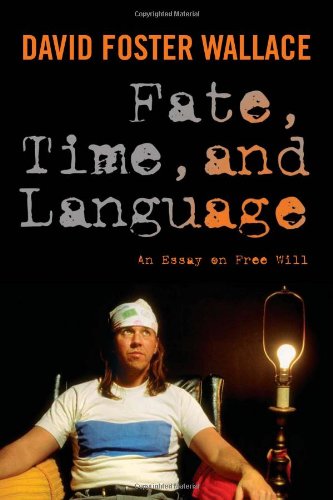
Fate, Time, and Language: An Essay on Free Will — David Foster Wallace

Sometime last year, during a rare visit to a big chain bookstore, I was disgusted to see what had happened to David Foster Wallace’s amazing Kenyon College commencement speech, “This Is Water.” Wallace’s speech, about 3,815 words, give or take (maybe twelve standard typed pages), was being sold as a 144 page hardback volume with only a sentence or two printed per page. The book was (and is) a nakedly commercial attempt to turn a text that is widely available on the web into the sort of thing that well-meaning uncles give to their nephews or nieces as graduation gifts. Of course, hardcore Wallace fans might want such a book — and I’d never begrudge them that — but it’s hard to imagine that Wallace would have been comfortable with how his book was marketed.
Which brings us to Fate, Time, and Language: An Essay on Free Will, new from Columbia University Press this week. The book publishes the 1985 honors thesis that Wallace submitted to the Amherst College’s Department of Philosophy, “Richard Taylor’s ‘Fatalism’ and the Semantics of Physical Modality.” The essay’s title alone signals a prohibitive level of academic specialization. In his introductory essay to the volume, “A Head That Throbbed Heartlike,” New York Times Magazine editor James Ryerson points out, “Its obscurity is easy to appreciate. A highly specialized, seventy-six page work of logic, semantics, and metaphysics, it is not for the philosophically faint of heart.” Ryerson then warns his reader to “Brace yourself for a sample sentence,” before offering a sample from Wallace’s essay that I do not have the patience or fortitude to type out (it would take me too long to locate all the diacritical marks and special logic symbols). Ryerson concludes the paragraph with this wry remark: “There are reasons that he’s better known for an essay about a cruise ship.”
Fortunately, the editors of Fate, Time, and Language make every effort to contextualize Wallace’s essay in a way that explains its aims, strengths, and even shortcomings. There’s Ryerson’s lengthy introduction, which provides an overview to Wallace’s life in philosophy. Then there’s Taylor’s “Fatalism” of course, a short, provocative argument combining six presuppositions that led Taylor to declare that humans have no control — none, whatsoever — over any future event. The volume collects four other essays by Taylor on fatalism, as well as eight other essays responding to his arguments, before delivering Wallace’s essay (the longest in the collection). Here’s Wallace—
So Taylor’s central claim, the Taylor problem, is that just a few basic logical and semantic presuppositions, regarded as uncontroversially true by most philosophers, lead directly to the metaphysical conclusion that human beings, agents, have no control over what is going to happen.
I ain’t even gonna front–pretty much everything that Wallace says after this was lost on me; if you want to read and comprehend the details of his argument you will need to have a grasp on the basics of Montague grammar and tensed modal logic. If you lack these skills, there will be skimming. Lots and lots of skimming. So, in short, I have no ideawhether Wallace’s logic is sound, although I find his conclusion (minus all the modal evidence) quite compelling—
This essay’s semantic analysis has shown that Taylor’s proof doesn’t “force” fatalism on us at all. We should now recall that Taylor was offering a very curious sort of argument: a semantic argument for ametaphysical conclusion. In light of what we’ve seen about the semantics of physical modality, I hold that Taylor’s semantic argument does not in fact yield his metaphysical conclusion.
After Wallace’s honors thesis, there’s a wonderful little memoir essay by his adviser on the project, Jay L. Garfield, who offers up this nugget—
I knew at the time, as I mention above, that David was also writing a novel as a thesis in English. But I never took that seriously. I though of David as a very talented young philosopher with a writing hobby, and did not realize that he was instead one of the most talented fiction writers of his generation who had a philosophy hobby.
These little pockets of insight appeal to me most in Fate, Time, and Language, and as such, Ryerson’s essay “A Head That Throbbed Heartlike” is the highpoint of the book. It weaves together Wallace’s personal life, writing career, and academic pursuits into a moving elegy of sorts, although one more rooted in ideas than feelings. He also spells out the book’s mission quite clearly—
For all its seeming inscrutability, though, the thesis is lucidly argued and–with some patience and industry on the part of the lay reader–ultimately accessible, which is welcome news for those looking to deepen their understanding of Wallace. The paper offers a point of entry into an overlooked aspect of his intellectual life: a serious early engagement with philosophy that would play a lasting role in his work and thought, including his ideas about the purpose and possibilities of fiction.
Many of us might shudder at the idea of our college essays being published posthumously. Of course, most of us aren’t Wallace, but there are undoubtedly critics out there who will cry foul at this publication. Fortunately, the team behind Fate, Time, and Language has produced a book of remarkable integrity, one that understands why it exists, readily acknowledges its obscurity without trying to gloss over that obscurity, and makes every effort to communicate with and engage its readers without sacrificing erudition. To return to my opening anecdote, this is not the naked commercialism that motivated a gimmicky edition This Is Water; rather, this is a book delivered by people who genuinely care about Wallace and his ideas. Make no mistake–it’s very dry and very specialized, but fanatics will no doubt want it.
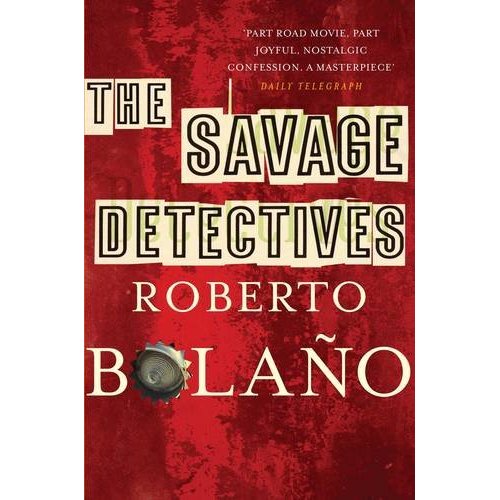
The Savage Detectives — Roberto Bolaño

Roberto Bolaño’s “other” masterwork The Savage Detectives has been previously reviewed on this website, but my view is that the previous writeup was unfair and premature. Perhaps those of us who love this book are not “serious” readers.
The plot was accurately diagrammed in the earlier post. The Savage Detectives is made up of three sections. The first section consists of the diary of seventeen year-old Visceral Realist poet Juan Garcia Madero, his record of his literary ambition and dawning appreciation of beauty and words. The second, lengthy section is a series of interviews, seemingly conducted by a single, unknown interviewer in an attempt to uncover the history of the Visceral Realist movement, a group of iconoclastic poets that lived in Mexico City in the early part of the 1970s. The third section revisits Garcia Madero’s diary as he and Arturo Belano and Ulises Lima, the nominal leaders of the Visceral Realists, scour the unforgiving Sonora desert in search of their own lost heroes.
Bolaño revisits familiar themes in this novel by asking what drives people to create, and what happens to those people when the things they create are pushed, like themselves, to the margins of society. Garcia Madero’s drive to write forces him to confront his everyday existence as he attempts to shed his innocence. He loses friends, quits school, moves in with a waitress, falls in love, has his heart broken. He writes when he eats, he writes when he should be doing something else, he writes about writing. He assumes that he and his comrades are on the verge of fame and that others are aware that everything the Visceral Realists do is bold and profound. Why then, Bolaño asks, is Garcia Madero satisfied with reading his poems to others when he dreams of placing his work in well-regarded anthologies? What happens when we realize that immortality is ultimately an illusion? Where does the spirit go when the ghost leaves only a sheet behind?
The answers to the questions posed in the first book are addressed in the second, but there is no sense that the unknown interviewer is close to mythologizing the Visceral Realists in the same manner as the scholars who made a hero of Hans Reiter in the first book of 2666. At least at the time the interviews were conducted, the Visceral Realists’ body of work is unknown to most, but to those with knowledge of their oeuvre, the Visceral Realists are remembered as hacks or kids from the wrong side of the tracks who preferred the commission of petty misdemeanors to dedication to their craft. The reality, as usual, is located somewhere in the middle. The Visceral Realists are shown to be like any other group of talented, excitable and intelligent young people because they’re bound to be disappointed. Their failure of their movement can be blamed on their own choices as well as on barriers erected by those ensconced in the Mexican literary establishment whose notions of where ideas ought to come from are not easily refuted. Especially by those demanding entry to their small but exclusive club.
Mr. Biblioklept’s first review was essentially right when he stated that The Savage Detectives “is an epic about the banal, ordinary things that fill our lives: jobs and eating and getting to places and having one’s friendships sour and being disappointed and so on.” Yes, sadness pervades the book. The Visceral Realists put down their pens, or they move to America, or they run and hide from the things that they cannot control at home. The Visceral Realists succumb to disease, lose their minds, attempt to cope, and they die. An early friend of Arturo Belano’s recounts–
I imagined him lost in a white space, a virgin space that kept getting dirtier and more soiled despite his best efforts, and even the face I remembered grew distorted, as if while I was talking to his sister his features melded into what she was describing, ridiculous feats of strength, terrifying, pointless rites of passage into adulthood so distant from what I thought would become of him.
Although the young poets suffer defeat, they enjoy small but significant triumphs, the most important of which is the existence of the book being argued about in this space. For Bolaño, whose business is the veneration of creators and their creation, the perseverance of the questions raised by the mere existence of the Visceral Realists and their permanent embodiment in a physical object capable of transmission in perpetuity is the ultimate victory. If the author is right that “the search for a place to live and a place to work [is] the common fate of all humanity,” then the young poets transitioning to adulthood don’t fare so poorly. Most of them, despite their backgrounds, become citizens with some stake in the places they live. They find work, they have children, they find adventure. Some, like Arturo Belano, continue to write at an immense personal cost. A man without a country, he’s the shadow who forms the substance of the book and allows his alter ego to demonstrate his remarkable narrative powers.
But what makes The Savage Detectives a complete work is that, like the characters of Borges and Cortazar, who so many in this novel profess to admire, the poets realize, sometimes too late, that brief and startling connections between people are always possible and love may be found anywhere. La Maga and Oliviera meet on strange bridges in Paris, condemned men revisit their lives in the moment between gunshot and blackness, and poor, unlettered poets will continue to read, and despite derision and hardship, will continue to express their own vision of hope and possibility.
Roberto Bolaño Explains the Good Thing About Stealing Books
From Roberto Bolaño’s July, 2003 interview with Mexican Playboy, collected in The Last Interview and Other Conversations—
The good thing about stealing books–unlike safes–is that one can carefully examine their contents before perpetrating the crime.
Heroes of 2010 — Bernie Sanders
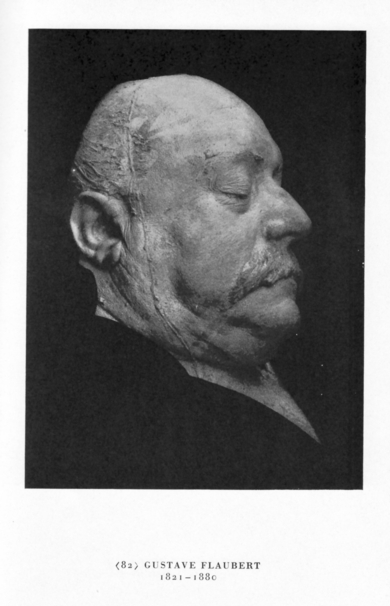
Gustave Flaubert’s Death Mask

Heroes of 2010 — Kenny Powers
As always, Kenny Powers is heroically NSFW —
And then there’s his seriously NSFW K-Swiss ad campaign —
Dr. Samuel Johnson, Origin of a Penis Euphemism
In his forthcoming cultural history of euphemisms, Euphemania, Ralph Keyes offers the following (seemingly apocryphal) origin of the euphemism “Johnson” (for “penis,” of course) —
Johnson is the last name most often used for the male sex organ. According to one theory, this slangy euphemism originated with the name of a large railroad brake lever. Lexicographer Eric Partridge thought it was more likely an abbreviated version of Dr. Johnson, a onetime synonym for “penis” that Partridge said might be based on the assumption that ‘there was no one Dr. [Samuel] Johnson was not prepared to stand up to.’ Working under the verbal restraints of his times, Partridge said this synonym was for the ‘membrum virile.’
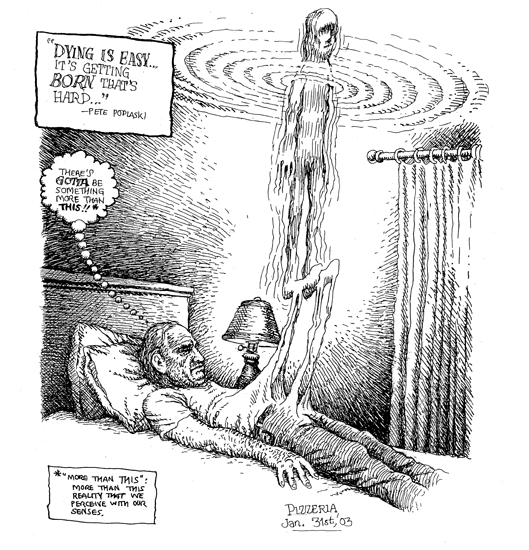
“Dying Is Easy” — Robert Crumb

(Via).
Heroes of 2010 — Yung Humma, Flossy Flynt, and Whatchyamacallit
Lie vs. Lay (with Help from Roy Peter Clark and Mad Men)
Roy Peter Clark, in his excellent guide to practical writing The Glamour of Grammar, offers the following advice on two of the trickiest homophones in the English language, lie and lay —
Here’s the simplest way to remember the difference: lie means “to recline”; lay means “to place.” As in “I lay the cushions on the floor so I can recline in comfort.” (You can use the vowel sounds as a memory aid: lie/recline; lay/place.)
Confusion sweeps in when we move from the present tense to the past. Alas, the past tense of lie happens to by lay: “When I heard the news, I lay on the bed in disbelief.” And the past tense of lay is laid, as in “The bank robbers laid their weapons on the ground.”
Clark then gives us the following helpful examples that distinguish the principal parts of these tricky irregular verbs —
Lie: Today I lie on the bed. Yesterday I lay on the bed. I have lain on that bed so many times there are holes in the mattress.
Lay: Today I lay my cards on the table. Yesterday I laid my cards on the table. I have laid my cards on the table so many times that I was bound to win.
Significantly, Clark uses lie and lay as part of a larger discussion about how a writer can master irregular verbs. He suggests that learning the principal parts of these verbs and understanding the distinction between transitive and intransitive verbs will help writers to communicate more clearly. (The Glamour of Grammar is a fantastic book, by the way, and would make a vital addition to the libraries of experience and inexperienced writers alike).
So, ready for a quiz? One of our favorite blogs, Ironic Sans, compiled every use and misuse of lay and lie from the first three seasons of Mad Men. You’ll have a moment after hearing a character use or misuse lay or lie to decide if he or she has done so with grammatic fidelity. After that, a graphic (and sound) will let you know if the word has been used correctly. Good luck!
Why Cormac McCarthy Doesn’t Write Short Stories
I’m not interested in writing short stories. Anything that doesn’t take years of your life and drive you to suicide hardly seems worth doing.
(Via).