
Craig Fehrman’s new article “Lost Libraries” (at The Boston Globe) provides a fascinating overview of how author libraries — that is, the books, usually heavily annotated, that authors own — find their way into archives, and why those archives matter. Fehrman begins by detailing the strange case of recently-deceased novelist David Markson, whose personal library was kinda sorta reassembled by fans after a reader named Annecy Liddell bought Markson’s (cleverly-annotated) copy of Don DeLillo’s White Noise–
The news of Liddell’s discovery quickly spread through Facebook and Twitter’s literary districts, and Markson’s fans realized that his personal library, about 2,500 books in all, had been sold off and was now anonymously scattered throughout The Strand, the vast Manhattan bookstore where Liddell had bought her book. And that’s when something remarkable happened: Markson’s fans began trying to reassemble his books. They used the Internet to coordinate trips to The Strand, to compile a list of their purchases, to swap scanned images of his notes, and to share tips. (The easiest way to spot a Markson book, they found, was to look for the high-quality hardcovers.) Markson’s fans told stories about watching strangers buy his books without understanding their origin, even after Strand clerks pointed out Markson’s signature. They also started asking questions, each one a variation on this: How could the books of one of this generation’s most interesting novelists end up on a bookstore’s dollar clearance carts?
Fehrman g0es on to point out that–
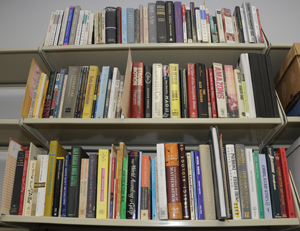
David Markson can now take his place in a long and distinguished line of writers whose personal libraries were quickly, casually broken down. Herman Melville’s books? One bookstore bought an assortment for $120, then scrapped the theological titles for paper. Stephen Crane’s? His widow died a brothel madam, and her estate (and his books) were auctioned off on the steps of a Florida courthouse. Ernest Hemingway’s? To this day, all 9,000 titles remain trapped in his Cuban villa.
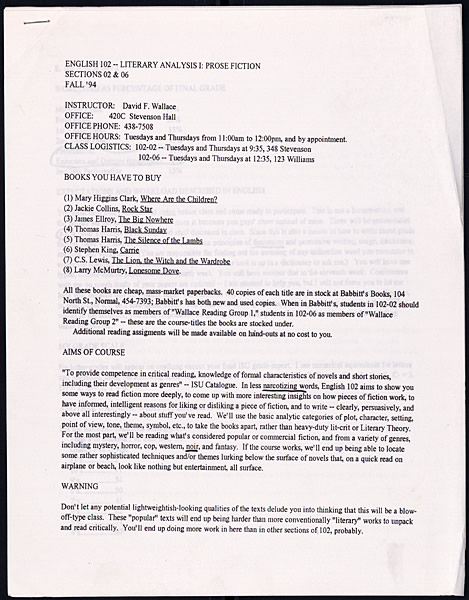
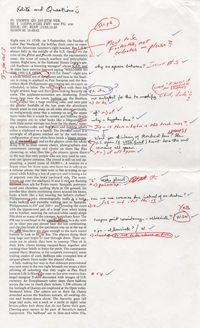
Why does this matter? As Fehrman notes, “authors’ libraries serve as a kind of intellectual biography.” And while universities do their best to archive these materials, as Fehrman’s article reveals, much of what gets saved is left to chance. For instance, how did David Foster Wallace’s personal library get to the Harry Ransom Archive?
When Wallace’s widow and his literary agent, Bonnie Nadell, sorted through his library, they sent only the books he had annotated to the Ransom Center. The others, more than 30 boxes’ worth, they donated to charity. There was no chance to make a list, Nadell says, because another professor needed to move into Wallace’s office. “We were just speed skimming for markings of any kind.”


 More info






 The
The 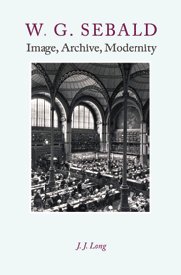 In W.G. Sebald: Image, Archive, Modernity, J.J. Long posits that the work of the late German author W.G. Sebald is best understood as the struggle for autonomous subjectivity in a world conditioned by the power structures of modernity. If the term “power structures” wasn’t a big enough tip-off, yes, Long’s analysis of Sebald is largely Foucauldian, and although he cites Foucault more than any other theorist (Freud is a distant second), the book is not a dogged attempt to make Sebald’s prose stick to Foucault’s theories. Rather, Long uses Foucault’s techniques to better understand Sebald’s works. As such, Long examines the ways that modernity affects power on the human body in Sebald’s work, tracing his protagonists’ encounters with modern institutions that exert power via archive and image.
 Long’s study of Sebald is very much a description of modernity; in particular, of modernity as a series of affects of power and discipline upon the subject (again, very Foucauldian). It’s not particularly surprising then that Long, after locating so many Sebaldian traumas in the 19th and early 20th centuries, asserts that Sebald is a modernist and not a postmodernist. He bases this claim not on the formal elements of Sebald’s prose, which he readily concedes can just as easily be read as postmodernist, but rather on the way his “texts respond to the specific historical constellation” of modernity. Long continues–
 Biblioklept