Imperial Vollmann, Populist Beach Reading, and Henry Louis Gates, Jr.

A few odds and ends (and perhaps a bit of ranting):

vollmann_imperial_cover1

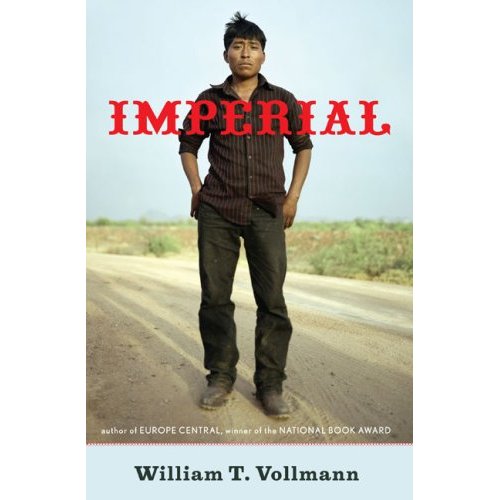
Read this fascinating profile of William Vollmann from this week’s New York Times. It makes me wish I had nothing to do but read everything this maniac writes. Vollmann’s new book Imperial comes out today from Viking. You can read an excerpt here.

Not really surprisingly, Vollmann did not make NPR‘s reader poll for the 100 Best Beach Books Ever. J.K. Rowling’s Harry Potter series topped a list that pretty much consists of a bunch of drivel (Twilight, Divine Secrets of the Ya-Ya Sisterhood), drivel posing as non-drivel (The Kite Runner, The Time Traveler’s Wife), overrated “classics,” (To Kill A Mockingbird), and a few surprises (Cormac McCarthy’s The Road is a fantastic book, but is it really best enjoyed on a sunny beach?)

TheClassicSlaveNarratives7517_f

This one didn’t make the beach reading list either. For a few years now, selections from The Classic Slave Narratives have been required reading in my high school classroom. I usually emphasize sections from Olaudah Equiano and Frederick Douglass, two masterful writers whose complex syntax and diction can be stunning, if not overwhelming, to the average AP student. I think that these narratives speak to why writing matters, and, importantly in today’s idiocracy, why reading matters as well. These first-person accounts of the horrors of slavery need to be read, and editor Henry Louis Gates, Jr. does a great job of setting the stage in his remarkable introduction to the collection. It’s sad, intellectually tragic, really, that Gates’s recent arrest should be given so much credit for sparking a “debate” or “teachable moment” about race, when Gates’s own scholarship makes the rootedness of racial tension in this country so plain. When a demagogue like Glenn Beck calls President Obama a “racist,” or a big fat idiot like Rush Limbaugh suggests that Obama simply has a “chip on his shoulder” because he’s black, we can see precisely why the first-person narratives of Equiano, Douglass, Mary Prince, and Harriet Jacobs are so important. These dangerous lunatics repeatedly suggest on their shows that America needs to keep its “traditions,” that our “history” is a strength, and that somehow the past was a place of better values. Perhaps if they read something outside of the dominant narrative they’d understand why someone might want to reappraise historically traditional values (and also, why someone might have a chip on his shoulder). But I’ve digressed from my main point: The Classic Slave Narratives is a valuable and important collection, and the stories collected here are a real entry point for any genuine discussion on race.

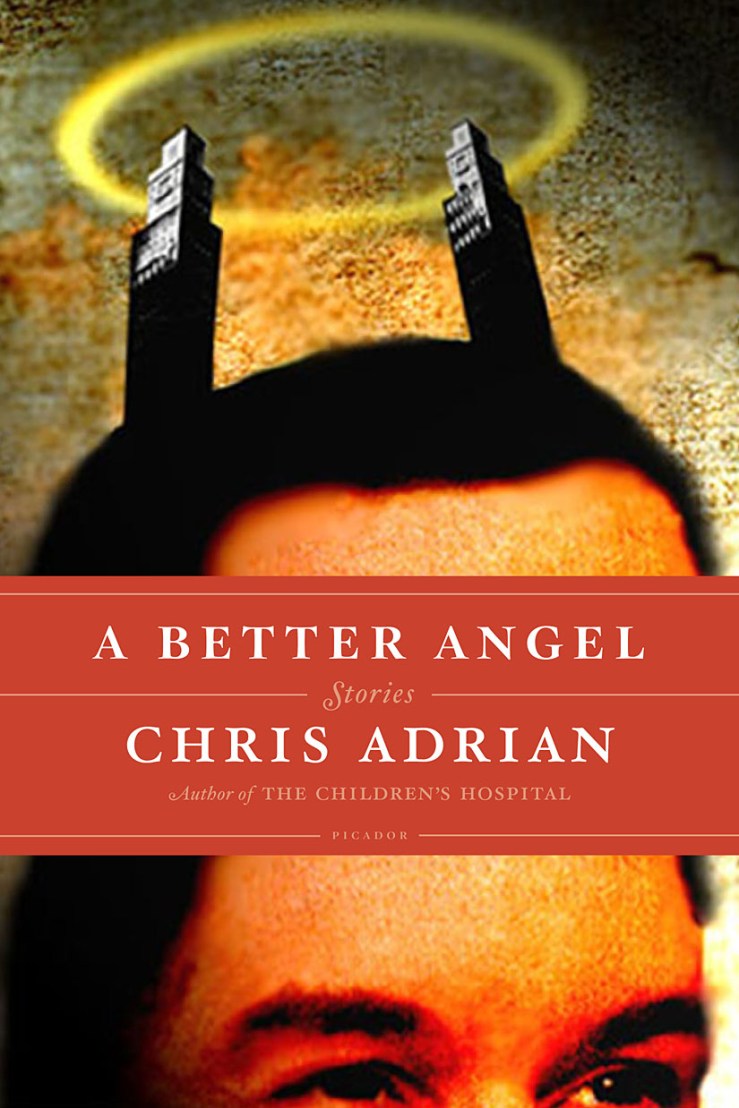
A Better Angel — Chris Adrian

Better Angel

How does one grieve? This central question runs through the nine stories that comprise Chris Adrian’s A Better Angel (available now in trade paperback from Picador). For Adrian’s protagonists, mostly adolescents and children, the past is inescapable and insurmountable, and the future promises only depression at best and eternal suffering at worst. These are stories about hauntings. In Adrian’s world (and it is a fully-realized world in the same way that Tolkien’s Middle Earth is its own discrete place), ghosts, angels, and even wayward friends are all likely to to demonically possess some sad, troubled weird kid. Again and again, these stories force their protagonists–and their readers–to question how one might witness to death, disease, and disaster–and still keep a modicum of sanity.

Those who’ve read Adrian’s novels The Children’s Hospital and Gob’s Grief will find that the stories in A Better Angel work to flesh out a distinctly Adrianesque milieu. There are hospitals and doctors and nurses, dead brothers and absent parents, events of epic destruction and personal crises of illness, drugs and alcohol, ouija boards, and plenty of angels and demons. Adrian’s narratives explore a fine line between metaphysics and pure biology that each protagonist has to navigate. In “The Sum of Our Parts,” nurses and doctors wonder how our body parts make us individuals as a ghost tries to escape her coma-bound body. The fraudulent doctor of “A Better Angel” uses drugs as a way of subduing the angel who haunts him. “I make my living praising the beauty of well children,” he says. “I love babies and I love ketamine, and that’s really why I became a pediatrician, not because I hate illnesses, or really ever wanted to make anybody better.” Indeed, Adrian’s characters seem doubtful that anyone can make anyone else better, but it doesn’t stop them from trying. There’s the father of “The Changeling,” whose son is possessed by the ghosts of those murdered in the 9/11 attacks on the World Trade Center, who parcels out his own body as a sacrifice to appease the dead. The story recognizes though that it’s not really the dead he is honoring–he’s really showing his love for his son–but this measure of love is not enough for the dead. “The Changeling” is one of three stories in A Better Angel addressing the 9/11 attacks (we’ll write more about this trio in an upcoming post, and we’ve already addressed one of the stories here), but the September 11th victims are hardly the only ghosts here. In “A Hero of Chickamauga,” Civil War re-enactors try to commune with the dead and somehow bring personal justice to something beyond comprehension. “A Child’s Book of Sickness and Death” posits disease as the ultimate affront to cosmic justice. Its protagonist Cindy, an ailing “short gut girl” who lives in semi-permanent residence at a children’s hospital, remarks to no one in particular after the death of a young child,

“It seems to me, who should really know better, that all the late, new sadness of the past twenty-four hours ought to count for something, out to do something, ought to change something, inside of me, or outside in the world. But I don’t know what it is that might change, and I expect that nothing will change–children have died here before, and hapless idiots have come and gone, and always the next day the sick still come to languish and be poked, and they will lie in bed hoping not for healing, a thing which the wise have all long given up on, but for something to make them feel better, just for a little while, and sometimes they get this thing, and often they don’t.”

Cindy’s is just one of many negative epiphanies here. It’s also worth noting that this Cindy is but one of several Cindys populating this book, and she also seems to be another version of a short gut syndrome Cindy who appears in The Children’s Hospital. In fact, most of the primary characters in “A Children’s Book of Sickness and Death” are also present in The Children’s Hospital, underscoring the sinew that connects Adrian’s milieu.

This holistic vision marks Adrian as an accomplished–and challenging–author. Adrian’s challenge is not so much an issue of readability; we found ourselves quickly devouring these stories. No, what we have here are tales that many will find hard to digest, the sort of stuff that some readers will find too bitter to ruminate and puzzle out. Adrian, through his protagonists’ bleak outlooks, doesn’t offer a cure or even much solace from the pain and sickness in the world, but he does offer some temporary, if mild, relief, a sort of reckoning with that pain and sickness. Although the angels and demons and ghosts of Adrian’s world cannot be ignored or dismissed, they can be confronted, even if that confrontation must repeat without solution. Instead of pandering to his readers with Panglossian platitudes or metaphysical escape hatches, Adrian dramatizes the realities of our mortality in a way that compels both sympathy and repulsion, and above all, some deep thinking. Highly recommended.

Cronenberg Does DeLillo

David_Cronenberg2_bw

Via the AV Club:

Because he likes nothing more than to bring impossible-to-adapt novels to the big screen (see: Naked Lunch, Crash), Canadian super-genius David Cronenberg is set to direct the feature adaptation of Don DeLillo’s Cosmopolis. Released in 2003 to mixed notices, DeLillo’s book takes place almost entirely inside the limousine of a 28-year-old billionaire asset manager as he makes his way slowly across Manhattan in order to get a haircut. Traffic is slowed by everything from a Presidential motorcade to a rapper’s funeral, and several character [sic] slip into the limo alongside him. The trick for Cronenberg is to figure out how to make his hero’s adventure remotely cinematic, but if he pulls it off, the book has plenty to say about life in the new economy.

Shooting will commence in Toronto and New York next year.

We’ve thoroughly enjoyed Cronenberg’s last couple of films (A History of Violence, Eastern Promises) but his adaptations of J.G. Ballard’s Crash was problematic at best, and his take on William Burroughs’s Naked Lunch doesn’t even make for a good flawed film, in our humble expert opinion (here’s our review). We didn’t really like Cosmopolis either. Still, our interest is piqued. Here’s Cronenberg discussing Viggo Mortensen’s bathhouse fight scene in Eastern Promises:

Chris Adrian, 9/11 Lit, Thomas Pynchon, Beach Reading and More

I’m about half way through two books right now: Chris Adrian’s A Better Angel, and Thomas Pynchon’s Inherent Vice. Pynchon’s latest novel–I’ll talk a little bit about it in a sec–comes out in hardback from Penguin August 4th. Picador will release the first trade paperback edition of Chris Adrian’s latest collection of short stories on August 3rd. I’m really digging A Better Angel so far, but before I talk about it, I just wanna shill for Picador. They put out really cool, great-looking books from really cool authors like Roberto Bolaño, J.G. Ballard, Denis Johnson, William Burroughs, and DJ Kool Herc, and they also have a sexy little imprint called BIG IDEAS//small books that puts out some killer jams. They’re also really nice about sending review copies. Shill shill shill. I’m a whore, but I’m an earnest whore.

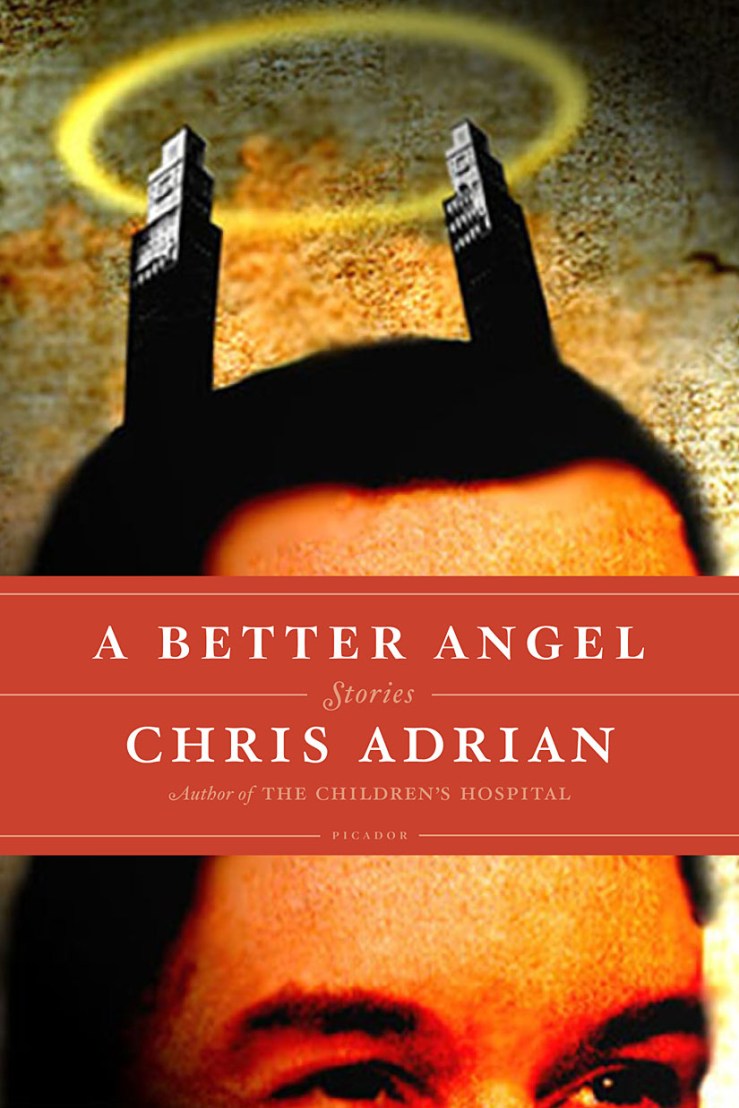
Better Angel

Anyway. Back to Adrian. Just finished “The Vision of Peter Damien,” a 9/11 story set in what seems to be nineteenth century rural Ohio. Damien, and then the other children of his small rural community, catch an illness that gives them unexplained, vivid hallucinations of the 9/11 attacks on the World Trade Center towers. Adrian works in a mode of distortion throughout most of these stories so far, repeatedly employing metaphysical disruptions as well as playing with time and setting as a way of alienating his characters from each other and the reader. Adrian uses the temporal/metaphysical disruptions of “The Vision of Peter Damien” to respond to 9/11, creating an uncanny milieu for his readers. The cognitive dissonance here reminds me of other responses to 9/11, like DeLillo’s Falling Man, David Foster Wallace’s short story “The Suffering Channel,” and even Art Spiegelman’s In the Shadow of No Towers. Actually, Wallace’s essay “The View from Mrs. Thompson’s” does a really good job of capturing all the problems of witnessing to, understanding, reacting to (etc.) spectacular disaster. Adrian’s story recapitulates the same paradoxes, injecting a motif of illness and brotherhood, contagious decay and redemption that seems to run through all of the stories collected here. I don’t have a larger comment about literature’s response to 9/11 yet, but I think that it’s fascinating to watch such stories emerge and evolve. We’re still seeing the various shapes, tropes, strategies, etc. that authors will employ to tackle (or chip at, or remark upon, or even elide) such a big historical marker. Full review of A Better Angel at the end of this month.

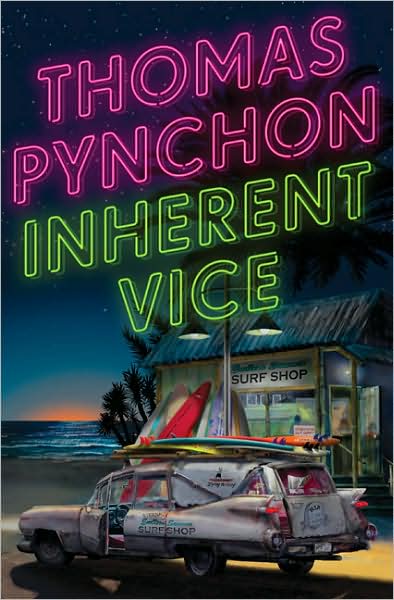
inherent_vice

Far less serious is Pynchon’s new novel, Inherent Vice, a detective noir painted in day-glo psychedelic swirls. Doc Sportello, at the behest of his ex-, is searching for a missing real-estate billionaire in the dope-haze of late 60s/early 70s LA (it appears to be set in 1969, as there are repeated references to “living in the sixties and seventies”). Pynchon’s new novel is a hard-boiled detective mystery, a psychedelic caper, an LA story, a comment on the decline of idealism and the emergence of media-unreality at the end of the 60s (because we needed another story about the 60s!), and probably a shaggy dog tale. The cover has gotten some criticism for its decidedly unliterary look, and last March I called it “horrendous.” I take it back: the campy cover, with its neon shock and beach-as-pastoral-idyll is lovingly ironic, satire that does not announce itself as satire and is thus always open to a straight-reading. Just like Pynchon’s novel, the cover can be read as an homage to both Dashiell Hammett and Elmore Leonard (with a sly nod to all the Leonard ripoffs out there (glancing your way, Jimmy Buffett). As its cover suggests, this is a Pynchon book you can read breezily on a beach or airplane. Sure, it’s got the usual Pynchon trademarks–it’s overcrowded with zany, one-dimensional characters, it operates on a Looney Toons system of logic, it’s full of linguistic goofs–but it’s also incredibly easy to read (unlike, say, just about everything else Pynchon has ever written). It’s also a lot of fun. And to prove it’s a beach read, I’ll finish it this week at St.Augustine Beach, inebriated by strong margaritas and even stronger sun. Full review when I get back.

Waiting for The Visitor

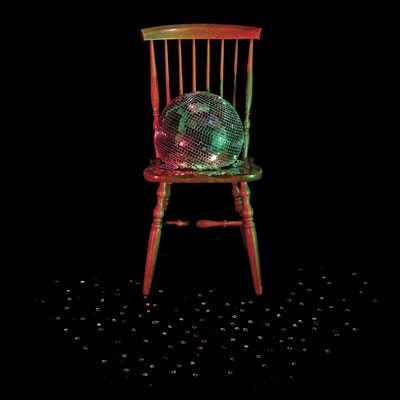
We’re pretty psyched about Jim O’Rourke‘s upcoming album, The Visitor, out on Drag City September 8th. O’Rourke hasn’t put out a “pop” record (as opposed to “experimental,” something of a false dichotomy really) since 2001’s Insignificance. Apparently, the new record is in the vein of one of our all-time favorite records, 1997’s Bad Timing. Supposedly the record will take the form of one long suite of music called “The Visitor,” and according to this interview from last year, “pretty much everyone is going to be disappointed.” He also says that the new record will be “pt. 4” after Bad Timing, Eureka, and Insignificance, so it’s hard to imagine being disappointed. Here’s the (we think) Nic Roeg connection (quick note: the three albums just cited are named after Nic Roeg films): in 1976’s The Man Who Fell to Earth, David Bowie plays a space alien stranded on Earth who records an album under the name The Visitor. Here’s the cover of The Visitor:

orourke-covermain

Here’s a Eureka-era audio interview with O’Rourke that you can download. He talks about his prolific powers, the influence of Godard and Roeg on his work, hierarchy and didacticism in music, the cheesy sax solo on “Eureka” (“Of course it’s stupid!”), and why listening to music is a process of education. Good stuff. Or, if you want music, not words, here’s the sorta kinda rarity, “Never Again,” from the Chicago 2018 comp. Also good stuff.

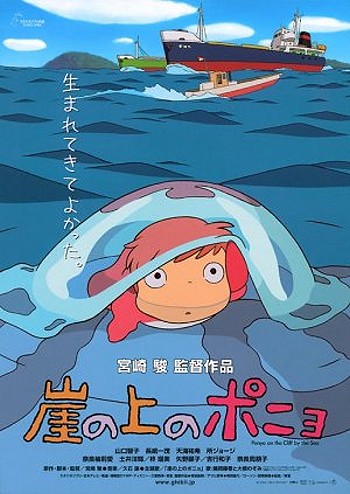
Hayao Miyazaki’s Ponyo on the Cliff by the Sea Reviewed

ponyo

Before Hayao Miyazaki‘s latest opus, Ponyo on the Cliff by the Sea (Gake no Ue no Ponyo) gets Disneyfied this August, interested parties might wish to purloin one of the pirate copies floating around and get a sneak peek. I’m not advocating not going to the movies to see the film–one of the greatest pleasures of Miyazaki’s works is the sensory overload of his stunning visuals–but Disney’s dubbed versions tend to over-explicate Miyazaki’s mysteries, draining his films of some of the unsettling ambiguities that make them so interesting.

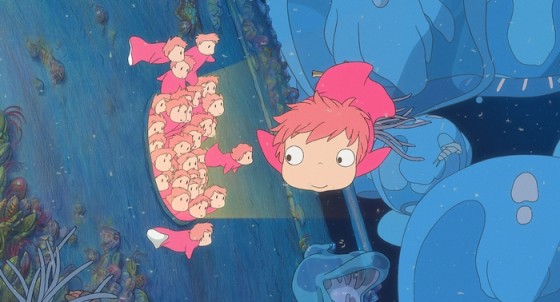
Ponyo tells the story of a little fish-girl (girl-fish?), a mermaid who escapes from her mad-scientist father and meets a boy named Sosuke. After tasting some of Sosuke’s blood, Ponyo begins to morph into a human. However, her transmutation causes bizarre and violent weather, including a giant tsunami resulting in a massive flood; even the moon starts to pull out of orbit. Sosuke and Ponyo navigate this surreal post-flood world, searching for Sosuke’s mother Lisa. The tale of these children is sweet but never maudlin, and like most Miyazaki films, Ponyo taps into sentimentality and pathos without ever becoming mawkish.

ponyo2-560x302

Visually, Miyazaki employs a sketchy, watery style here, painted in beautiful pastels and flashy complimenting brights. The look of this film is a significant departure from the fine detail and rich heaviness of Miyazaki’s masterpiece, Spirited Away (Sen to Chihiro no Kamikakushi), and might disappoint some, but we thought it was both beautiful and fitting. Of course, we were watching a pirated version that someone lovingly and bravely shot in a theater, undoubtedly inferior to the spectacle we expect from the theatrical release.

Perhaps the best critic of the film would be my two-year old daughter, who sat riveted and zombie-eyed throughout the whole film, only diverting her gaze occasionally to clarify some plot point. She loved the movie and talked about it the whole next morning, pretending that she was Ponyo (or, alternately, that someone else was Ponyo). Ponyo has more in common with Miyazaki’s lighter, kid-friendlier films like My Neighbor Totoro and Kiki’s Delivery Service than it does with his epic adventure films like Nausicaa and Princess Mononoke, but it retains enough adventure and glows with enough charm to keep longtime fans and newbies alike invested for all of its ninety minutes. Great good stuff. Here’s the trailer for the US release:


Harry Potter Sex Romp, Part II

First thing’s first: if you’re looking for Harry Potter slash fiction, you’ll have to check out our original Harry Potter Sex Romp post for links, you dirty dawg (you’re weird but you’re welcome). Just like that post a few years ago, this post’s title is really kinda sorta mostly irrelevant to what this post is about. What is it about? I want to take a look at some of the homoerotic tension in the new Harry Potter movie, Harry Potter and the Half-Blood Prince. If you want to find a proper review of the film, with plot summary and insight, shop around. That’s not gonna happen here.

Also, there will be SPOILERS, okay? Fair warning.

INTL_HarryDumbledore (Large)
#1 Stunnas

Okay. So, I saw the new film last night (henceforth HP6). And it was pretty good or whatever. But I noticed a subtext that cracked me up quite a bit, an underlying motif that might be lost on most summer blockbuster audiences. I’m talking about the implicit love between men and boys in this film.

At the beginning of the film, in an apparently insignificant scene, young Harry makes a date with an attractive young girl. However, old man Dumbledore shows up and dashes any hopes for a late sumer romance. Instead of meeting up with this lithe young thing, Harry has to grip hard to Dumbledore’s stiff arm to be apparated away to meet Horace Slughorn, an old potions master. Dumbledore uses Harry as fresh young bait for Slughorn, who has something the old wizard needs–a key memory about the development of Tom Riddle–Voldemort–a former protégé of Horace’s (lots of mentors and mentees here). Much of the narrative’s conflict revolves around the task Dumbledore has given Harry; it’s almost as if Dumbledore is pimping out the young wizard. These multiple man-boy relationships are doubled darkly in the failing bond between Snape and emo Draco.

In contrast, heterosexual relationships between the teens are treated with a lightness and even frivolity that codes such romances as ephemeral, or perhaps even inessential. Although the film solidifies the groundwork for the long-term relationships between the series’ principals (Harry-Ginny/Ron-Hermione), the real love story here is between older men and their young apprentices. HP6 depicts teen romance as silly without coloring any of its fragility with pathos. What the film really argues for is a sort of Greek or Platonic ideal of love; that love exists as a conduit for wisdom, passed from an older, experienced man to a younger boy in exchange for some of that youth’s beauty and vitality. Although moments of teenage adventure punctuate the film, the real scope of heroic encounters are shared between older men and their attendant lads (particularly Dumbledore and Harry, although even Snape, through the annotations of his old textbook, manages to plant part of himself into Harry).

The film reaches its climax with a lot of phallic wand waving and a bit of indecision over who gets to shoot off at whom. The climactic scene encodes the strange aggressions and series of shifting allegiances between the male wizards present. Dumbledore becomes the tragic figure; his death allows for Harry’s maturation, enacting a definitive arc in Harry’s Oedipal complex, where Dumbledore is both father figure and secret sex object. The weight of this tragedy initiates Harry into the adult world and adult responsibilities.

So why bother to write about this? No reason really, and I’m sure plenty of readers will find my analysis insupportable, silly, offensive, or just plain wrong. That’s fine. I guess I mostly find it remarkable that this motif should prevail so heavily in a summer blockbuster. There was also a whole drug motif going on–so many of the film’s plot development hinge on the ingestion of mind-altering substances–so maybe I just like the idea that the film is kinda sorta subversive.

Perdido Street Station/The City & The City — China Miéville

perdido_street_station_us

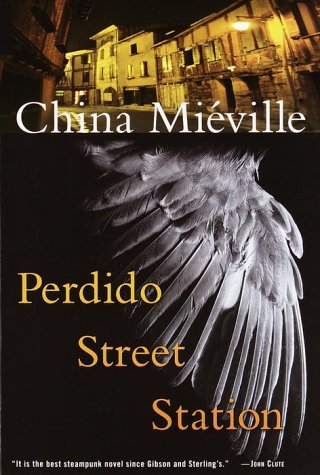
Despite being a bit too long, I enjoyed listening to Random House’s new audiobook recording of China Miéville‘s second novel, Perdido Street Station, read by John Lee. Perdido Street Station is Miéville’s first novel set in the steampunk world of Bas-Lag, a strange world populated by plenty of bizarre races and even more bizarre “Remades,” persons who have been forced (or in some instances have chosen) to restructure their biological makeup to perform (very) specific jobs. This sci-fi adventure story centers around protagonist Isaac Van der Grimnebulin, an overweight renegade scientist trying to perfect a new technology he calls “crisis energy.” Isaac is trying to help a Garuda named Yagherak who, as a form of punishment, has had his marvelous wings cut off. To this end, Isaac experiments with a strange caterpillar that feeds off of an hallucinogenic drug called “dreamshit.” Unfortunately, the caterpillar turns into a giant dream-feeding, brainsucking moth that, along with its relatives, terrorizes the city at night. Isaac tries to stop the moths and save his girlfriend, an artist with a bug’s head. Lots of picaresque adventuring ensues.

Miéville’s Bas-Lag world is finely detailed and richly imagined, and will no doubt appeal to anyone who digs H.P. Lovecraft or William Gibson. Miéville certainly has a handle on both of his many concepts (artificial intelligence, the nature of bodies, difference and (literal) alienation), and his story unfolds with the thrilling clip one expects from pulp fiction. Still, the book felt overwritten to me. Miéville never settles on just one adjective if two (or three) come to mind, and he’s in love with adverbs (oh the adverbs in this book! Is there a sentence without one?). And while exposition of a sort is certainly necessary in a novel about such a profoundly strange world, I think that Miéville would get a bigger payoff if he trusted his reader a bit more. Perdido Street Station feels rhetorically claustrophobic, as if Miéville is afraid to let his reader imagine even a little of Bas-Leg for him or herself. It’s a bit selfish, really. On the whole though, a great read (or listen, in this case), and it intrigued us enough to go straight into Miéville’s latest book, The City & The City (also newly released this summer from Random house, also read by John Lee).

the city and the city

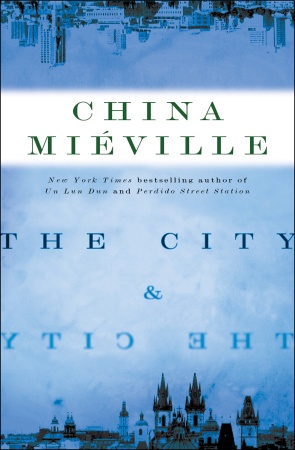
The City & The City combines noir detective fiction with one of science fiction’s greatest gambits, namely, positing something utterly implausible, unimaginable, and then making it ordinary. In The City & The City, two cities, Beszel and Ul Qoma, occupy the exact same geographic space, yet their citizens are trained from birth to “unsee” and “unhear” all aspects of the other city. Inspector Tyador Borlu is drawn into the mysterious death of a beautiful young woman (is there an older trope? Edgar Allan Poe even wrote an essay on why and how you should use beautiful yong dead girls in your literature). His investigation leads him into crossing the border between the cities, an impossible border, of course, and yet the genius of the book here is that, through Borlu’s narration, the reader doesn’t experience this bordercrossing (and its attendant “unseeing”) as satirical or even ridiculous; rather, we witness the uncanny alienation of double consciousness. Miéville, a Marxist, is working in part from some of Althusser‘s ideas, and he’s not afraid to namedrop Foucault or Žižek. Thankfully, however, Miéville not only knows his theorists, he knows enough not to let theory get in the way of a Chandleresque murder mystery that explores themes of surveillance, alterity, and what it means to see someone seeing you seeing them seeing you (seeing them seeing you . . .). Great stuff.

By Night in Chile – Roberto Bolaño

bynightchile

Toward the end of the 130 page monologue that is Roberto Bolaño’s novella By Night in Chile, narrator Father Sebastián Urrutia Lacroix claims that “An individual is no match for history.” His statement neatly encapsulates (what might be) the dominant theme of By Night in Chile, namely an individual person’s capacity and ability to correctly–and sanely–somehow measure, attest to, confront, and witness the horror and brutality of history. In this case, Bolaño’s narrator, a Catholic priest–and conservative literary critic (and, of course, failed poet)–Father Urrutia, via a sweeping deathbed confession of sorts, recounts his life story, leading inexorably to Pinochet’s coup and its attendant subsequent draconian reforms and abuses. While it would be a mistake to reduce Bolaño’s rich novella to one conflict, I think the root of Urrutia’s struggle emanates from his inability to come to terms with his role as an intellectual (let alone an artist, critic, or priest) complicit somehow in Pinochet’s crimes. Throughout the book, from the very beginning, Urrutia blames his inner turmoil on a “wizened youth” (I don’t want to spoil this antagonist’s identity, but puzzling out that paradoxical appellation provides a major clue), a kind of idealist who stands apart from the dying priest, mocking and taunting him. After his claim that “An individual is no match for history,” Urrutia avers that “The wizened youth has always been alone, and I have always been on history’s side.” For Urrutia, this is of paramount importance, not just as a Catholic priest (which, it must be pointed out, is a role he doesn’t seem particularly suited for) but also as a literary critic and intellectual: Urrutia wants to systematize and critique history, to be “on the right side of history,” to quote Barack Obama. And yet his own attempt to narrativize his own life ironizes and critiques this very possibility at every turn–he is a sham, a charlatan, motivated and prompted by fear and even hate.

And on that attempt to narrativize a life: I would call By Night in Chile an anti-bildungsroman. Although Urrutia relates a life story, the free flow of psychic impressions that characterizes his telling slip and sail and rock and crash throughout years and over decades, often flowing backwards and forwards, sometimes spending pages on what could only be considered inconsequential minutiae, while at times glossing over the profoundest events with little more than a word or two. It is often what Urrutia does not remark upon that characterizes what is of the greatest importance in this work, and this is a testament to the power of Bolaño’s writing, to his command of voice. In one of the greatest performances of the novel, Urrutia describes the time right before, during, and after Pinochet’s coup. The passage is less than four pages, and for every contemporary action of immediate consequence, Urrutia seems to provide twice as many examples of his retreat into the past: ” . . . the first anti-Allende march was organized, with people banging pots and pans, and I read Aeschylus and Sophocles and Euripides, all the tragedies, and Alkaios of Mytilene and Aesop and Hesiod and Herodotus . . . .” Urrutia doesn’t bother to scrutinize or analyze the visceral reality of history in the making around him, regressing instead to the comfort of established philosophical tradition–the history of Herodotus in favor of the chaos, anarchy, and brutality happening around him. He’s really quite a terrible priest, and as an intellectual he refuses to be engaged. Confident that he will always be “on history’s side,” he refuses to actively even try come to terms with history until he’s dying. And thus we get the narrative of By Night in Chile.

This reckoning with the past takes the form of a long monologue but, as those familiar with Bolaño will attest, there are plenty of other voices here, stories nested within stories like Russian dolls. The force and vitality of Urrutia’s speech is astonishing; one envisions the monologue as a single immediate and discrete exhalation, a stream of memory, the living wail of a dying man. Bolaño’s rhetorical style here conveys this ironic energy. He employs long (very, very long) sentences, sometimes going on for several pages, and often uses little or no transitions between what should be major shifts of space and time. There are plenty of references to writers, of course, many obscure, and more motifs and leitmotifs than I can work out here (or elsewhere, to be honest). I’m going to go out on a limb and suggest that the book is probably even more intense in the original Spanish, although I think Chris Andrews has done a brilliant job translating here, just as he did in Last Evenings on Earth. And since I’ve brought up that book, I’m going to make another suggestion: if you’ve yet to read Bolaño, you should, and Last Evenings of Earth (or 2666 if nearly a thousand pages doesn’t seem too daunting)is probably the best place to start–which is kind of another way of saying that By Night in Chile is not the best entry point to Bolaño–at least not for anyone intimately familiar with Latin American history. It’s not that By Night is particularly challenging or hard to read. However, I think that this particular book will probably be better enjoyed with more context. As Rodrigo Fresán points out in his essay “The Savage Detective,” (published in the March 2007 issue of The Believer), By Night in Chile could be (should be?) read as part of one cohesive book along with Amulet and Distant Star. (I will read these once I get my grubby little fingers on them). Indeed, as many critics have pointed out, Bolaño’s works seem to coalesce into one great work, a secret universe parallel to Tolkien’s Middle Earth or Proust’s France. Urrutia’s voice enriches this universe, but one must have something of a foothold on Bolaño’s themes in order to appreciate the complex ironies of By Night in Chile. Or maybe not. Maybe this is a great entry point to Bolaño. Either way, great book. Highly recommended.

Javier Moreno on the Geometry of Bolaño’s Fiction

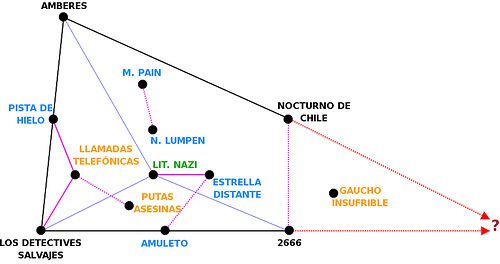
Still working through this Roberto Bolaño jag: I will finish By Night in Chile tonight or tomorrow, and I’ll get to my own thoughts on that then. For now: while looking for an interview in English with Bolaño, I came across this marvelous essay in The Quarterly Conversation–a site Biblioklept links to, oddly enough, yet I missed it (probably because it’s a few years old). In “Roberto Bolaño: A Naïve introduction to the geometry of his fictions,” Javier Moreno doesn’t really analyze or criticize or Bolaño’s oeuvre ; instead, he treats the work like a strange, maddening (and fun, beautiful) game. And if you’ve read Bolaño, you know how appropriate that approach is. Here is Moreno’s attempt to diagram Bolaño’s corpus:

triangle

That question mark represents what Moreno suggests is Bolaño’s “unreachable book,” a tome that (might) exist as the dialogic interplay of all of Bolaño’s works. Moreno concludes (more or less; concludes is really not the right word) that 2666 is that “unreachable book”; he writes:

I believe that even if Bolaño hadn’t died prematurely 2666 would still have been published posthumously. The “real” and impossible 2666 was larger and richer. My guess is that if Bolaño had lived forever 2666 would have been at the very end of the diagram, located in the vertex where the question mark is. Since he died, since he was mortal (too mortal) after all, we have to resign ourselves to the promise of a triangle and only dream of its asymptotic completion.

Consider this fragment of an interview as evidence for Moreno’s claim:

Amambay Guevara: What’s the novel you dream of writing?

Roberto Bolaño: One novel that will be called 2666.

Ricardo Bello: That novel, 2666, would it be a science fiction one? Would it be located in Latin America?

Roberto Bolaño: Partially, it will be science fiction. It will take place in the state of Sonora, north of México, and in Arizona.

I think Moreno’s essay is pretty great–it’s the sort of writing I like, and its tone is spot on for the psychology and rhythm of Bolaño’s writing. Still, I think you’d probably go crazy thinking about what’s at the end of that triangle, of some great work out there, intangible, unfinished, unclaimed, disparate. In the end, Moreno gives up on his diagram, writing:

The system doesn’t stay still. That’s the way it is. Conscious of the impossible task, I resign. I cannot capture it. I cannot shoot the video. The dots are moving as I stare at them, still puzzled, marveled by their strangeness and beauty. The diagram, after all, is just a waste of time.

I like the way his line about moving dots subtly recalls the strange ending of The Savage Detectives. Also, I’m not sure that the diagram is a waste of time. I think that what Moreno might not see (or shit, maybe he does see it, how would I know) in his own diagram is that that question mark might not be some unwritten masterpiece, but rather it might be the reader who enters into the game with Bolaño and his texts. The irony is that that is precisely what Moreno has done. And–sign of a great critic–he’s made me want to read more.

Kafka’s Metamorphosis Cover Gallery

metamorphosis-jacket-of-first-book-edition

Not sure if anything can top the subtle pain and alienation this original edition. Still, it doesn’t really translate any of the humor in Kafka’s masterpiece. More after the jump.

Continue reading “Kafka’s Metamorphosis Cover Gallery”

Hemingway House

DSC02393

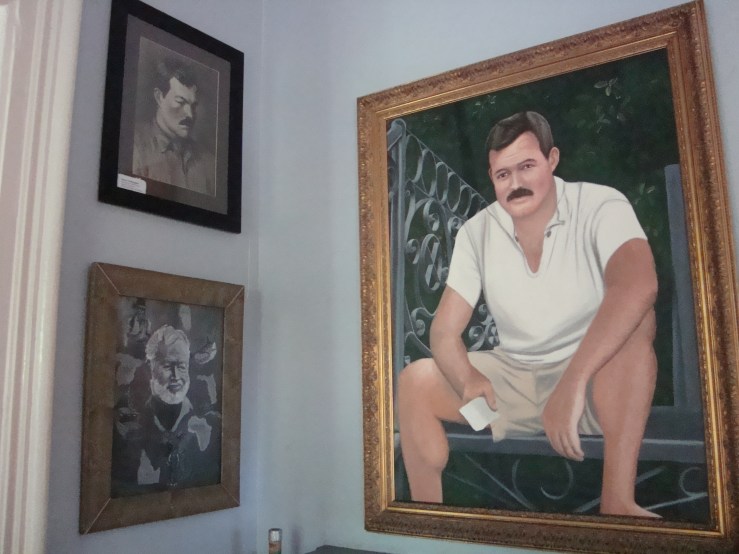
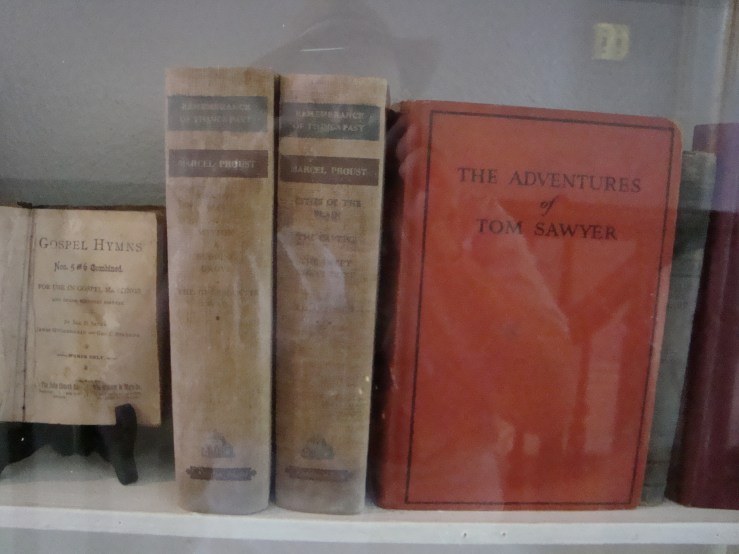
We spent a long July 4th weekend in beautiful Key West, celebrating freedom via endless barhopping and overeating. Somehow, between the Key lime margaritas, street beers, and moonlight reggaeton, we managed to stumble into Hemingway House (officially named The Ernest Hemingway Home & Museum), the house where Hemingway lived for most of the 1930s, and the place where he wrote some of his best stuff. I had been to Hemingway house almost two decades ago, when I was about twelve or thirteen. I was obsessed with Hemingway then, so I took the tour. This time, however, it was too hot. My wife works for a museum, so we got in free, which also affects how one values/reviews a place of interest, so bear that in mind when I say that, unless you’re a literary nut, go ahead and skip Hemingway House and head to Kelly’s for a drink or six. Still, the house is beautiful, outfitted with plenty of artifacts related to Papa, including some books from his personal library that I photographed and included below. (I was the only nerd photographing the books; everyone seemed far more interested in the ancestors of Hemingway’s freakish cats).Here are the books (more after the jump):

DSC02407

Continue reading “Hemingway House”

Last Evenings on Earth — Roberto Bolaño

Lasteveningswiki

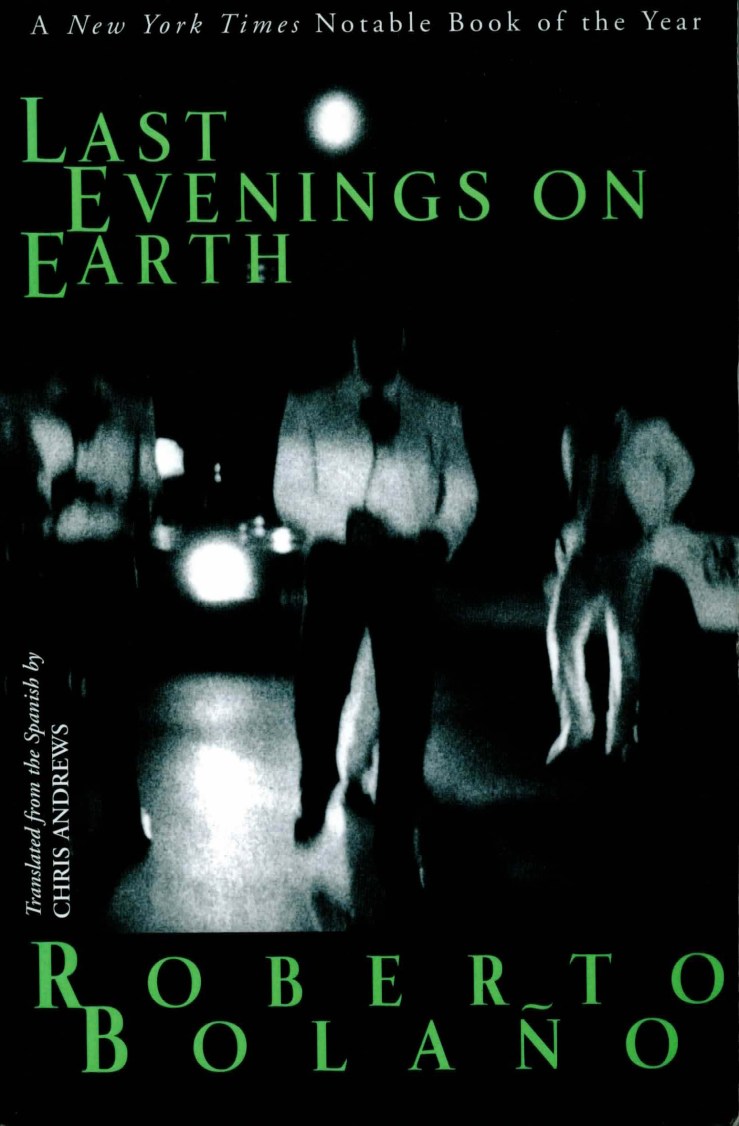
Although the fourteen stories in Roberto Bolaño‘s superb collection Last Evenings on Earth are the result of collating and translating two previously published volumes, Llamadas telefónicas and Putas asesinas–and therefore ostensibly have nothing to do with each other (other than being the work of a singularly gifted author)–I couldn’t help reading them, especially towards the end of the book, as a strange, fragmented novel. Beyond Bolaño’s inimitable style (more on that in a moment), the collection is unified by its protagonists, or protagonist, really, who really must be a stand-in for Bolaño himself. Tenets of New Criticism be damned! It’s impossible not to read Bolaño into these stories, whether his narrators or protagonists are young teens or middle-aged men, petulant sons or struggling writers. Scratch that last one. They’re all struggling writers; in fact, just about everyone in this book is a struggling writer, or an exile, or a vagabond, or on the run, or so enamored and wound up in Big Romantic Ideals that they make plenty of foolish decisions (one of my favorite things about this book is how easily Bolaño posits and then ironizes and the tears apart Big Romantic Ideals at the very same time he makes you feel wistful and nostalgic for those days when you believed in them yourself). Bolaño uses a character named only “B” for most of these stories; elsewhere, (anti-)hero (and obvious Bolaño stand-in) Arturo Belano of The Savage Detectives is revealed to be a narrator. In other stories the young male protagonist is simply not identified by any name, yet all of these characters are so fully realized, so psychologically real, that they must contain at least some part of Bolaño.

And these protatgonists are so very, very real, almost frighteningly so, like “B” in “A Literary Adventure,” whose paranoia over receiving a career jump-starting review from a writer–“A,” of course, who B has actually mocked in his book–poisons any enjoyment B might have had with his new success. B’s slow descent into a mild madness is perfectly drawn, the sort of thing you might see in your own life, the sort of anxiety that many of us feel but cannot communicate or explain because of the silly shame of it all. In “Last Evenings on Earth,” B (the same B? Must be) takes a vacation to Acapulco with his father. Bolaño’s rhetoric in this tale is masterful: he draws each scene with a reportorial, even terse distance, noting the smallest of actions, but leaving the analytical connections up to his reader. Even though B sees his holiday with his dad heading toward “disaster,” toward “the price they must pay for existing,” he cannot process what this disaster is, or what paying this price means. The story builds to a thick, nervous dread, made all the more anxious by the strange suspicion that no, things are actually fine, we’re all just being paranoid here. (Not true!)

That ebb and flow between dread and release, fear and humor, ironic detachment and romantic idealism works throughout each of the stories, even ones not specifically about B (or Belano, or, let’s be honest maybe, Bolaño). “Anne Moore’s Life” is an incredible (yet thoroughly credible) portrait. The story is both journalistic and personal; Anne’s life is at once banal and bizarre–like anyone’s life, perhaps, but not. “Mauricio (“The Eye”) Silva” relates the story of another Chilean exile (did I forget to mention that, in a way, this whole book is about Chilean exiles, that if Last Evenings on Earth is a fragmented novel, then it tells the fragmented story of these artists and activists fleeing from Pinochet’s coup? If I forgot to mention that, I suppose I didn’t want to over-politicize my review, or suggest that one had to have some contextual knowledge of the Chilean diaspora in order to enjoy this book, because I don’t think you have to–but where were we? “The Eye,” right), the titular Mauricio (AKA “The Eye”), a photographer whose travels take him to the depths of depravity in the poorest parts of India. What parts of India? Well, the narrator never finds a specific answer, because those don’t really exist in Bolaño’s universe. All claims are under suspicion. Things may or may not have happened, and if they did happen, they might have happened in myriad ways. But how is it then that Bolaño is never murky? How can a writer who posits so many possibilities, whose characters repeatedly aver that they don’t really remember exactly the way things happened (if they even happened at all), how can such a writer be at the same time so sharp and exacting? It’s one of Bolaño’s great gifts of course and we’re lucky to share in it.

It would be hard–impossible really–to pick the best story from the collection. They’re all great, they all demand to be reread, and they made me want to read more Roberto Bolaño. But if I had to pick one as a starting point, if I had to foist one on a friend, I suppose it would be “Enrique Martín,” the story of a failed poet that made me laugh out loud several times and then almost cry. Arturo Belano narrates this story with a wry, acerbic, deadpan humor that veers at times into unexpected and affecting poignancy. Poor Enrique only wants Belano’s respect, or at least Belano to read his poems with a modicum of dignity–a fact that Bolaño shares with his readers while still keeping his narrator in the dark. As the story plunges to its tragic end, Belano finally sees what the reader has already cottoned onto: our individual choices in relations to others might be far more impactful than we realize, and human empathy is in sorry supply in this world. “Life is mysterious as well as vulgar,” Belano nonchalantly suggests in the middle of the story, but Bolaño goes to exacting pains to show us that there can be a saving beauty and humor in all that strange visceral ugliness. One of the best stories I’ve ever read in one of the best collections I’ve ever read. Very highly recommended.

“What Lies Beyond Violent Drunkeness” — Guy Debord on Drinking Booze

guydebord1jv7

In the following short chapter from his 1989 memoir Panegryic, Volume 1, Situationist mastermind Guy Debord writes a love letter to alcohol. He explains why he loves to drink, what he loves to drink, and where he loves to drink, and he does so with a scholar’s flair for quotation and an anarchic humor. Towards the end, he attacks the current state of mass-produced wines, liquors, and beers, complaining that regional flavors and varieties are being destroyed. Great stuff!

Wines, spirits and beers: the moments when some of them became essential and the moments when they returned have traced out the main course and meanders of days, weeks and years. Two or three other passions, which I will talk about, have almost continually taken up a lot of space in this life. But drinking has been the most constant and the most present. Among the small number of things that I have liked and known how to do well, what I have assuredly known how to do best is drink. Even though I have read a lot, I have drunk even more. I have written much less than most people who write; but I have drunk much more than most people who drink. I can count myself among those of whom Baltasar Gracián, thinking about an elite distinguishable only among the Germans — but here very unfair, to the detriment of the French, as I think I have shown — could say: “There are those who have got drunk only once, but it has lasted them a lifetime.” […]

Continue reading ““What Lies Beyond Violent Drunkeness” — Guy Debord on Drinking Booze”

The Spectacle of Michael Jackson’s Body

For the next few weeks, thousands, hundreds of thousands, possibly millions will remember, laud, argue over, and grieve Michael Jackson. His death, like his life, was utterly mediated–broadcast live on national television, Twittered, Facebooked. We were able to follow the accretion of details and speculations (facts?) in real time, as the status of Jackson’s body was updated (he was dead, he was rushed to the hospital, he was in a coma, no, he was dead). His death even precipitated a rush of other celebrity death notices, hoaxes that mutated across the internet. That Jackson’s death should precipitate so much confusion and rumor is commensurate with his strange life.

Jackson was probably the first person in the world to live a truly mediated life. From the age of eleven, Jackson’s image, voice, and dancing body became the communal property of the modern (industrialist, capitalist) world. Written roughly the same time as young MJ’s rise to national prominence, Guy Debord’s The Society of the Spectacle opens with the following salvo: “In societies where modern conditions of production prevail, all of life presents itself as an immense accumulation of spectacles. Everything that was directly lived has moved away into a representation.” What was Michael Jackson’s life but a series of transmogrified spectacular representations? Not only did we hear the development of modern music through his records, or watch fashions change through his bizarre styles, but, most significantly, we saw in Jackson a mapping of spectacle culture on to the very body itself. Like his character who mutates in the iconic “Thriller” video, or the faces at the end of his “Black or White” video, Michael Jackson’s body slowly morphed before our collective eyes, mediated in print and video, discussed and mocked and puzzled over. A full accounting of Jackson’s eccentricities is neither necessary or possible here, but it’s worth pointing out that the man’s level of estrangement was of such an acute degree that, beyond attempting to remap the world (turn it into a Neverland) and reconfigure the flow of time (an attempt to reach an imaginary past), he remapped his whole body.

While he wasn’t the first celebrity whose body became a site of/for spectacle culture (Marilyn Monroe springs immediately to mind), Jackson’s corpus is undoubtedly the signal symbol of the mediated American Dream, the most hyperbolic example how the human body might mediate consumerist desires. As Debord also pointed out in Society, “The spectacle is not a collection of images, but a social relation among people, mediated by images.” The death of Michael Jackson is precisely not the death of Michael Jackson’s body, which will continue to live on, like one of the “Thriller” zombies, a spectacle absorbed and batted about by the spectacle culture. It will continue to exist as a rarefied nostalgic currency, for if we grieve the death of Michael Jackson, what precisely are we grieving if not a spectacular reflection of our own (mediated) development? Michael Jackson’s body (of work) will always be resuscitated as a nostalgic marker for at least three generations of Americans (and the rest of the world, really). I do not believe that most of us mourn the death of Michael Jackson; instead, we continue to participate in his spectacle (or, rather, the spectacle of him) as a means of prolonging our own vitality and placating our own sense of self. It is not the loss of Jackson that we might acutely feel but instead a demarcation upon our own mortal bodies, for if a changeling like Jackson cannot escape bodily death, what hope do we have? At the same time, paradoxically, participating in the spectacle of the death of Michael Jackson’s body partially alleviates (even as it subtly calls attention to) these anxieties. By affording Jackson (the illusion) of a certain immortality, we retain our own developmental, life-long investments in his spectacle, and, in turn, hope to secure our own bodies against the ravages of age, disease, decay, accident, gravity.

But what are the long-term costs of maintaining such grand illusions? As our society becomes increasingly mediated, are we arcing toward a more democratic and enriching series of personal connections, or are we fragmenting and disassociating into solipsism and self-reflexivity? Or, to return to Jackson, does his music represent personal connection and the transmission and articulation of genuine sentiment, or is it simply the glamorous reduction of crass popular culture? Is it possible to feel genuine empathy toward Jackson? Or has the spectacle of Michael Jackson’s body infiltrated our culture to the point at which any real, unmediated human response to his passing become an impossibility, an articulated fiction masking narcissistic nostalgia? Although these are not intended as rhetorical questions, I don’t suppose there are simple answers for them either. Ultimately, I think as long as our spectacle society exists, Michael Jackson’s body will continue to exist. And probably, as our culture ages–and this is scary–it will become a relic or monument to a simpler time.

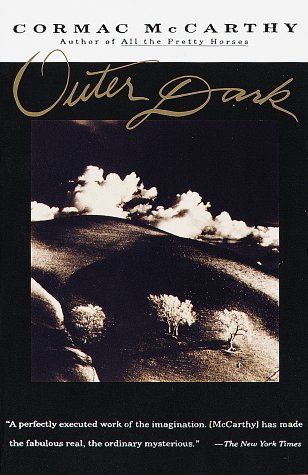
Outer Dark — Cormac McCarthy

outerdark

In Cormac McCarthy‘s second novel, Outer Dark, set in the backwoods and dust roads of turn-of-the-century Appalachia, Culla Holme hunts his sister Rinthy, who has abandoned the pair’s shack to find her newborn baby. Culla has precipitated this journey by abandoning the infant in the woods to die; a wandering tinker finds the poor child and absconds with it. As Rinthy and Culla independently scour the bleak countryside on their respective quests, a band of killers led by a Luciferian figure roams the wilderness, wreaking violence and horror wherever they go.

In a recent interview with the AV Club, critic Harold Bloom noted that Cormac McCarthy “tends to carry his influences on the surface,” pointing out that McCarthy’s major influence, William Faulkner, tends to proliferate throughout McCarthy’s early work to such an extent that those works (The Orchard Keeper, Outer Dark, Child of God, Suttree) suffer to a certain degree. Indeed, it’s hard not to read Outer Dark without the Faulkner comparison invading one’s perception. It’s not just McCarthy’s Appalachian milieu, populated with Southern Gothicisms, hideous grotesques, rural poverty, incest, and a general queasiness. It’s also McCarthy’s Faulknerian rhetoric, his elliptical syntax, his dense, obscure diction, his bricks of winding language that seem to obfuscate and resist easy interpretation. Like Faulkner, McCarthy’s language in Outer Dark functions as a dare to the reader, a challenge to venture to the limits of what words might mean when compounded. And while the results are sometimes (literally) startling, they often strain, if not outright break, the basic contract between writer and reader: at times, all cognitive sense is lost in the word labyrinth. Take the following sentence that ends the first chapter, where Culla looks back on the infant he has just abandoned:

It howled execration upon the dim camarine world of its nativity wail on wail while lay there gibbering with palsied jawhasps, his hands putting back the night like some witless paraclete beleaguered with all limbo’s clamor.

A “paraclete” is someone who offers comfort, an advocate. I’m thinking that the “jawhasps” must be a twisted mouth. No idea what “camarine” means. But it’s not just the obscure diction here: the whole action is obscure (how does one go about “putting back the night”?). This confusing passage is hardly an isolated incident in Outer Dark; instead McCarthy repeatedly employs long, dense, nearly unintelligible sentences, constructions that defy the reader’s ability to visualize the words he or she is being asked to decode. This unfortunate tendency alienates the reader in ways that are no doubt intentional, yet ultimately unproductive. More often than not, McCarthy’s long twisting hydras of obscurantism are not so much moving or thought-provoking as they are laughably ridiculous, and while his vocabulary is surely immense, it’s hard enough to get through such abstract sentences without having to run to a dictionary every other word.

Readers of mid-period, or even more recent McCarthy works will no doubt recognize this complaint, so it’s important to note that we’re not talking about the density and alienating syntax of Blood Meridian, the philosophical pontificating of The Border Trilogy, or the occasional run-to-a-thesaurus word choice one can find in The Road. No, Outer Dark is full-blown Faulkner-aping (Faulkner at his worst, I should add); over-written, ungenerous, and just generally hard to get into, especially the early part of the novel which is particularly guilty of these crimes. Which is a shame, because once one penetrates the wordy exterior of the first few chapters, there’s actually a pretty good novel there. While no one could accuse Outer Dark of having a tight, gripping plot, the intertwined tales of Culla and Rinthy–and the band of outlaws–gives McCarthy an excellent venue to showcase his biggest strength in the novel–the dialogue.

Spare and terse, the strange, strained conversations between McCarthy’s Appalachian grotesques are often funny, usually tense, and always awkward. Culla and Rinthy are outcasts who don’t quite understand the extent of their estrangement from the dominant social order. They frequently encounter fellow outcasts, often freaks of a mystical persuasion, like the witchy old woman who frightens Rinthy, or the old snake-trapper who freaks out Culla (a task not easily achieved). The dialogue between McCarthy’s characters reads with authenticity and intensity, and the author gets far more mileage out of the gaps in conversation, the elisions, the omissions–what is not said, what cannot be said. These odd characters culminate in the trio of outlaws who terrorize the fringes of Outer Dark. Their ominous black-clad leader prefigures many of McCarthy’s later antagonists, like the Judge of Blood Meridian or Chigurh in No Country for Old Men, but he pales in comparison to the former’s eloquent anarchy and the latter’s bloody intensity. McCarthy doesn’t really seem to know what to do with him, to tell the truth. Still, fans of Chigurh and the Judge will find the roots of those characters in this unnamed villain, and will probably have some interest in McCarthy’s evolution of this type.Indeed, it’s tracking this progression of themes and types throughout McCarthy’s body of work that was of the greatest interest to me, and in turn, I suspect that Outer Dark is probably going to be of greatest interest to those who’ve been reading McCarthy more or less chronologically backwards (like I have). It’s certainly not the starting place for this gifted author, and while its early dense prose will certainly provoke a few mournful groans, the end of the book redeems the bog of language at its outset.

Ulysses “Seen” — Robert Berry

telemachus-color-18

Because of its daunting reputation, many readers shy away from James Joyce’s Ulysses, when really the book is not nearly as challenging as some literati would have you believe. It’s funny and poignant and moving, and sure, it’s loaded with so many allusions that you’d have to spend a lifetime sorting them out, but once you get into its rhythm, its voices, it’s actually not that hard to read, and it’s certainly one of the most rewarding books I’ve ever read. One of the key difficulties for readers new to Ulysses is simply penetrating those first few pages, getting a visual for what’s going on with Buck Mulligan and young Stephen. Because Joyce is transposing events, both mythically, religiously, and chronologically, the opening is particularly challenging–especially because Joyce doesn’t explicate these shifts for the reader. There are plenty of aids out there, of course, from Harry Blamires’s The New Bloomsday Book to Joseph Campbell‘s fantastic lectures, and readers new to the book should not feel daunted or put off by the fact that this book might require a good. Led by Robert Berry, the folks at  Throwaway Horse have started a new project, a comic book representation of Ulysses that is, to say the least, wildly ambitious. I’ll let them put it in their own words:

“Ulysses ‘SEEN’” is the inaugural project of Throwaway Horse LLC. Throwaway Horse is devoted to fostering understanding of public domain literary masterworks by joining the visual aid of the graphic novel with the explicatory aid of the internet. By creating “Web 2.0” versions of these works, we hope to proliferate and help to not only preserve them, but ensure their continued vitality and relevance. Throwaway Horse projects are meant to be mere companion pieces to the works themselves—by outfitting the reader with the familiar gear of the comic narrative and the progressive gear of web annotations, we hope that a tech-savvy new generation of readers will be able to cut through jungles of unfamiliar references and appreciate the subtlety and artistry of the original books themselves which they otherwise might have neglected.

So far, Berry has illustrated the first chapter (commonly referred to as “Telemachus”). Berry’s work is far more detailed than I initially had imagined was possible, and there are even useful annotations by scholar Mike Barsanti. This is truly a massive project, given the level of detail Berry has committed to the first chapter, and I think it will be an invaluable resource to readers new to Ulysses as well as those who’ve already been through the book before. Here’s hoping that we’ll get all the way to Molly’s final monologue!

(Thanks to Nick for the tip).