The Ten-Cent Plague — David Hajdu

10centplague

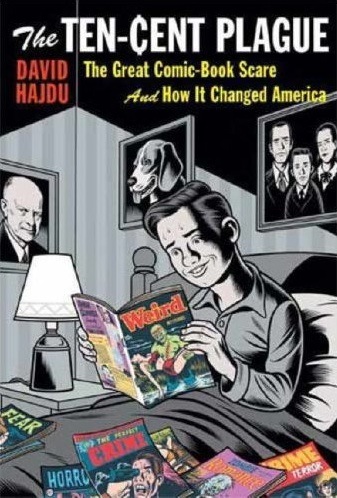
David Hajdu’s The Ten-Cent Plague serves as a fascinating cultural history of Cold War-era America. Hajdu’s book, subtitled “The Great Comic-Book Scare and How It Changed America,” illustrates the strange paradoxes at work in the post-WWII zeitgeist. Under the veneer of the conformity and suburban affluence of the Eisenhower years, a counter-cultural movement was finding its voice in the unlikely medium of comic books. Hajdu traces the history of the comic from its beginnings at the turn of the twentieth century through the end of the 1950s. Working in part from Gilbert Seldes‘s thesis that comics exemplified a type of “critical democratization” of art (along with “the movies, ragtime, vaudeville [and] popular song”) that “challenged aesthetic elitism,” Hajdu explains how such a maligned medium became a conduit for social change.

Although Hajdu covers the early strips like “Katzenjammer Kids” and “The Yellow Kid,” tracks the rise of Walt Disney and the pulp beginnings of Will Eisner, and explores the rise of seminal superheroes like Superman, the majority of the book is devoted to the national panic that arose from the massive popularity of crime and horror comics in the 1950s. Many of these comics were published by Bill Gaines’s EC comics. Bill Gaines became a crusader against the false morality of the Comics Code Authority (ironic side note: Gaines actually created the CCA as an attempt to bypass censorial influence, a maneuver that backfired) and its champions like Frederic Wertham whose pseudopsychological tome Seduction of the Innocent led to Congressional hearings on comic books, of all things. Hajdu explores not only the underlying civil rights battle on this censorship front, but also the themes of civil rights to which these comics were ultimately sensitive. Hajdu makes a persuasive case for comics as the foment of the anti-establishment youth culture of the 1960s–a beginning many cultural historians choose to identify exclusively with rock and roll and television. The epilogue of the book neatly dovetails this theme, moving from the establishment of Stan Lee’s Marvel Comics, a group that would feature outsiders and misfits of every stripe and color, to the bizarre and outlandish comix of Robert Crumb, who attests that “Mad was probably the biggest influence of all” on both himself and most of the other underground comix artists. So even though Gaines–the erstwhile hero of Hajdu’s narrative–has to give up EC–his legacy influenced not only the mainstream heroism of Marvel, but also forever affected the underground current of the counter-culture.

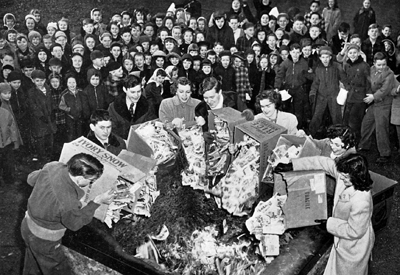
Comics on fire at St. Patrick's Academy in Binghamton, New York, 1949

Hajdu’s writing is both erudite and populist, well-researched with a thorough bibliography and index but also highly narrativized, the sort of nonfiction that reads at a tidy clip. In short, the book works on two levels, both as a scholarly undertaking, ready for handsome quoting in any MA’s term paper for Graphic Narratives, but also as simply a good beach read for those fascinated–or astounded–by the paranoia of America’s McCarthyian past. If you’ve read Michael Chabon’s The Amazing Adventures of Kavalier & Clay, you may know a bit of this history, and The Ten-Cent Plague would be an entertaining way to learn more. Most die-hard comics fans will know the background here, but will surely want Hajdu’s book to get the full story. An entertaining, often funny, and even sometimes enraging narrative. Recommended.

The Ten-Cent Plague is now available in paperback from Picador Books.

Strange Fruit

In cynical times, it’s far too easy to dismiss the value of the arts. But listen to Billie Holiday’s recording of “Strange Fruit.” When Holiday put Bronx high-school teacher Abel Meeropol‘s lyrics to music, she captured the bizarre pain and insanity of a legacy of lynching in the American South. Meeropol’s morbid lyrics juxtapose a “Pastoral scene of the gallant south” against the gruesome spectacle of a lynching. The “strange and bitter crop” of history–the hanging flesh of dead black men–is preserved forever in this sad and bitter elegy. Art–song and poetry–has a capability to tell an abstract truth in a way that the concrete annals of history cannot achieve.

“Strange Fruit”

Southern trees bear strange fruit,
Blood on the leaves and blood at the root,
Black bodies swinging in the southern breeze,
Strange fruit hanging from the poplar trees.

Pastoral scene of the gallant south,
The bulging eyes and the twisted mouth,
Scent of magnolias, sweet and fresh,
Then the sudden smell of burning flesh.

Here is fruit for the crows to pluck,
For the rain to gather, for the wind to suck,
For the sun to rot, for the trees to drop,
Here is a strange and bitter crop.

Langston Hughes Reads Three Poems

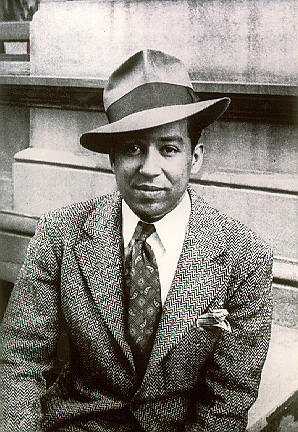
langstonhughes

Renaissance man Langston Hughes reads three of his poems–

The Negro Speaks of Rivers

Ballad of the Gypsy

Mulatto

Also, read one of our favorite Hughes poems, “I, Too, Sing America” (a response, we believe, to Walt Whitman’s “I Hear America Singing” (Elizabeth Alexander’s inauguration poem, “Praise Song for the Day” seems to respond to both of these poems))–

I, too, sing America.

I am the darker brother.
They send me to eat in the kitchen
When company comes,
But I laugh,
And eat well,
And grow strong.

Tomorrow,
I’ll be at the table
When company comes.
Nobody’ll dare
Say to me,
“Eat in the kitchen,”
Then.

Besides,
They’ll see how beautiful I am
And be ashamed–

I, too, am America.

The Sunset Limited — Cormac McCarthy

thesunsetlimited

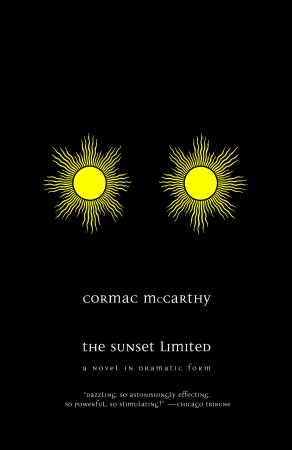
Cormac McCarthy’s The Sunset Limited is a lean, spare dialectic between two characters named simply “Black” and “White.” Black, a recovering addict who found Jesus in prison, saves White, an aging professor, who attempts to kill himself by jumping in front of a commuter train, the Sunset Limited. Black keeps White in his apartment, probing the older man’s justification for suicide. White makes it very clear that he intends to finish the job the moment he can leave Black’s apartment, leading Black to stall the professor through argument and storytelling. As such, Black sustains most of the book’s driving questions about morality, redemption, and love for one’s fellows, until near the end, when White unleashes a tirade of nihilism. As the story charges to its climactic conclusion, it becomes clear that it is not just White’s soul at stake, but also Black’s own spirituality.

The cover of The Sunset Limited attests that the book is “A Novel in Dramatic Form,” a conceit that may divide many of McCarthy’s admirers. The language here is precise and visceral, loaded with meaningful ideas yet also utterly concrete. McCarthy’s grasp of colloquial diction shines through these two voices, carrying the story forward in a hurtling momentum with minimal stage directions. Still, some readers may feel cheated out of McCarthy’s rich prose in this bare story (they need only to pick up Blood Meridian or The Road or All the Pretty Horses, of course). I found the story engaging, poignant, dark, and often surprisingly funny, and I read it in one taut sitting. The Sunset Limited is not the starting place for those interested in McCarthy, but fans who’ve yet to read it will probably enjoy it quite a bit. I’m already anticipating a second reading. Highly recommended.

Cormac McCarthy — Andrew Tift

cormac-mccarthy-portrait

Last week, the Smithsonian’s National Portrait Gallery acquired Andrew Tift’s kinda stark portrait of Cormac McCarthy. More info here.

William Faulkner, As I Lay Dying, The Perils of Assigned Reading, and A Call for Second Chances

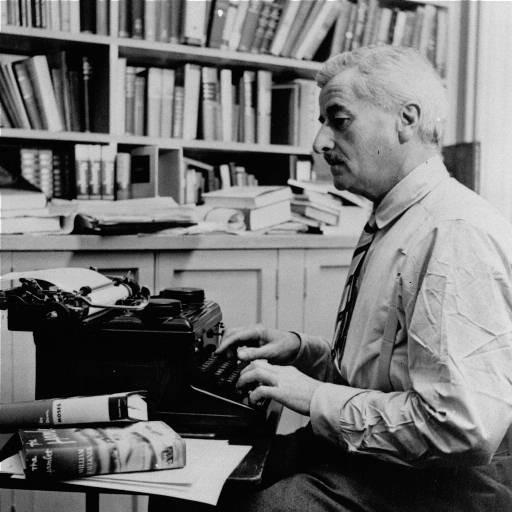
WKD WILLIAM FAULKNER

Not quite two years ago, I wrote some pretty awful things about William Faulkner on this blog. In a review of his first published novel Sancutary, I argued, quite ineffectually, that, “Faulkner as an American Great is nothing but a scam.” Elsewhere, I proffered this ignorant nugget:

“…it seems that a few critics–notably Malcolm Cowley and Cleanth Brooks–decided either that a. Faulkner is really great and/or b. America needs a new master of literary fiction, and it might as well be Faulkner. It seems amazing to me that these two critics conned a whole generation into believing that someone whose books were so unbelievably poorly written was actually, like, a totally awesome and important writer.”

Ouch. At the time I wrote that rant, I was still in grad school, which is to say I was still being assigned reading by well-intentioned professors. I was also laboring under a cruel miscalculation, the mistaken belief that I had actually read most of Faulkner’s great works–As I Lay Dying, The Sound and the Fury, and Absalom, Absalom!–in my high school and undergraduate courses–where said books were assigned reading. The truth, I realize now, is that while Faulkner’s strange, dense, elliptical prose might have passed under my eyes, I completely failed to read his books when I was a young man. It wasn’t until last spring, when I read one of Faulkner’s last novels, Go Down, Moses, that I came to understand the genius of his writing, which is to say I came to learn to read his voices in a non-academic, non-studied fashion, intuitively and rhythmically. Go Down, Moses is strange and sad and funny and truly an achievement, a book that works as a sort of time machine, an attempt to undo or recover the racial and familial (in Faulkner, these are the same) divides of the past.

So. Skip ahead a year.

After reading Bolaño’s stunning 2666, I strategically read Cormac McCarthy’s Child of God, knowing that I’d need a voice at least equal to Bolaño’s in order to not get totally bummed out and sort of paralyzed with that “What do I read next?” feeling. The strategy worked, but of course I needed a follow up book. So I picked up As I Lay Dying, the story of a poor rural family who labor to return their dead matriarch to her family’s home town for burial. I’d “read” the book in high school; I remembered the plot, but I could not in any way comment on it. This time, with the freedom to choose to read it–and perhaps, older, better equipped–I truly entered the book, entered into each of the character’s heads, their eyes, their voices. I “got” it.

as-i-lay-dying

I read As I Lay Dying in essentially three or four long sittings, sustained by Faulkner’s incomparable, engrossing language. I realize now that as a high school student, and then again as an undergrad, I resisted the book, attempted to impose my own consciousness into the narrative in order to “understand” the plot, rather than letting the book happen to me–which I believe is how one must read Faulkner. I was amazed how quickly I read the book once I attuned myself to Faulkner’s rhythm, and I was equally amazed at how conflicted and confused I felt about the story. I can’t recall a novel whose characters I’ve ever felt so hateful and sympathetic toward at the same time. Great, great book.

Anyway. The point of this post is to say, “Hey, I was wrong, mistaken, terribly wrong about Faulkner when I said he wasn’t a Great American Writer.” I suppose I’m also implicitly arguing that the necessary evil of assigned reading can sometimes be less necessary and more evil: How many kids are we turning away from the really great stuff forever by forcing it upon them when they are too young, too unequipped to appreciate it? The other side of this logic, of course, is to point out that often assigned reading can turn us on to great writers forever; this was the case for me, with most of what I read in high school. Still, as an English teacher I do worry that in assigning and then dissecting literature–under the pretense of explaining it and appreciating it and learning from it–we always run the risk of killing it, draining it of the very vitality that was the rationale for reading it in the first place. Of course, there’s a simple, simple antidote to reconciling yourself to all those books you hated in high school, those books you were supposed to love and be moved by and learn important and meaningful lessons from–you can read them again for the first time. The worst that could happen is a confirmation of your own prejudice; far more likely, in assigning your own reading, you’ll find something truly great and meaningful.

Sum — David Eagleman

sum

In his new book Sum, neuroscientist David Eagleman proposes forty visions of what an afterlife might be. Each of the tales is a short thought-experiment written in the second-person, a rhetorical device that literally engages the reader — the “you” — in the text. Eagleman’s background as a scientist is evident in many of these short tales. In “Giantess,” for example, he asks us to ponder the whole of the universe as a woman with whom we cannot communicate because of our infinitesimal scale in relation to her. In “Conservation,” Eagleman imagines all of time and space and what we know of it as the traces of a single little quark. Elsewhere, technology informs Eagleman’s depictions of the afterlife, as in “Impulse,” where the minutest of human interactions are compared to a massive computer program; in “Great Expectations” a company offers customers the experience of uploading their digitized souls to their own pre-programmed heavens–the customers are devastated when the upload fails and all that they get is regular old heaven. A bummed-out God wrings his hands, saying, “Your fantasies have cursed your realities…The Company offered you no evidence that it would work; why did you believe them?” Still, in this tale, God goes “to bed at night” knowing that “one of His best gifts — the ability to have faith in an unseen hereafter — has backfired.”

Many of Eagleman’s little stories evoke these moods of sad dissatisfaction and disappointment, repeatedly asking the reader to question their own values. And, as the god of “Great Expectations” shows, it’s not just the everyday folk who get their expectations crushed, but often the deities themselves. Take the god of “Mary,” for example. His favorite book is Frankenstein–he loves the end, where Victor Frankenstein flees his own creation. This is a god who can’t help his creation and chooses to run away from it. Particularly sad is “Descent of Species,” wherein the dead get to choose whatever they like to be. The “you” in this tale unfortunately chooses a horse, believing you’ll enjoy freedom–however, as “you” morph into a horse, so does your consciousness, and you realize that “you cannot revel in the simplicity unless you remember the alternatives.”

Not all of the stories in Sum are bummers (and even the downers are thought-provoking)–many play out like jokes or riddles. In the afterlife of “Quantum,” “everything exists in all possible states at once, even states that are mutually exclusive.” When simultaneously “bowling and not bowling” becomes too much for “you,” an angel helps you out by letting you spend some time “in a closed room, one-on-one with your lover.” You find yourself “simultaneously engaged in her conversation and thinking about something else; she both gives herself to you and does not giver herself to you; you find her objectionable and you deeply love her; she worships you and wonders what she might have missed with someone else.” Finally, you thank the angel, saying, “This I’m used to.”

As “Quantum” shows, most of the tales in Sum are ultimately not so much about a metaphysical afterlife as they are about what we value in this world–what are our expectations, desires, hopes, and dreams–and why do we expect, desire, hope, and dream these things? Eagleman is an astute observer of the human condition with a keen insight into our strange animal psychologies. I found his tales about identity to be the most affecting of the lot, like in “Mirrors,” where Eagleman points out that we are “much better at seeing the truth about others than” we are at “seeing ourselves,” and we therefore rely on others to hold up “mirrors” of our selves in order to know our selves. In “Prism,” Eagleman imagines an afterlife where you exist at every age in your life, only to find out that “you” at seventeen really is not “you” at seventy–your “compound identity” was hardly as unified as you’d imagined; rather, it “was like a bundle of sticks from different trees.” If these lines evoke a whiff of the postmodern philosopher, don’t be surprised. While Pantheon lists the book as “Fiction” it seems it would be just as at home in the Philosophy section.

I enjoyed Sum very much, blowing through its 110 pages in just two sittings, and then re-reading several of the tales again–they’re meant to be re-read, I believe. The cover boasts a glowing bit of praise from Philp Pullman, author of the “His Dark Materials” trilogy (a Biblioklept favorite). Fans of Pullman’s trilogy will find many of the same ideas played with in Sum, only handled in quite a different (but no less inventive) manner. This is the kind of science fiction we love. Highly recommended.

Sum is available 2.10.09 from Pantheon Books.

Coraline

coraline-poster

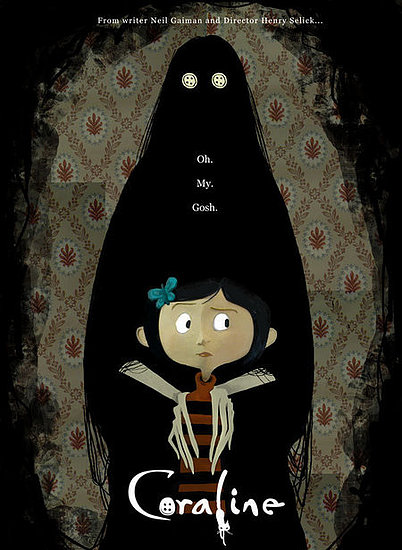
Even if Coraline didn’t have an engaging plot, well-developed characters an audience can really care about, and an especially singular sense of setting, rhythm, and movement, it would still be worth seeing in the theater for its astounding 3D visuals. Director Henry Selick (The Nightmare Before Christmas), working from Neil Gaiman‘s short novel of the same name, has created an endearing, imaginative, and often disturbing fairytale in meticulous stop-motion animation, dramatically enhanced in 3D. Selick doesn’t rest simply on the film’s amazing optical effects; rather, Coraline‘s plot and characterization are seamlessly, often dreamily (or nightmarishly) crafted through those marvelous visuals. Even when a scene veers into outright spectacle, it is always purposeful, cohesive, and forwards the logic of the plot, the story of young Coraline and her strange adventures in an alternate universe.

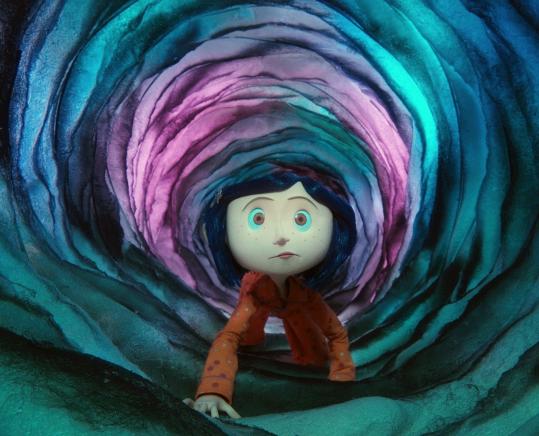
Bored and largely ignored by her parents who have just moved her to a country boarding house, Coraline discovers a tunnel to a world that doubles her own, replete with an “other mother” who cooks all sorts of delicious foods and loves to play games, and an “other father” who dotes on his little girl. This alternate universe also contains more glamorous versions of the boarding house’s other tenants, a circus performer who works with musical mice, and two aging actresses with a predilection for salt water taffy. The alternate world becomes a site of spectacle and wonder for Coraline, as well as the setting for some pretty mind-bending 3D set-pieces for the audience–however, like all fairy tales, Coraline always toes the line between fantasy and nightmare, joy and shocking horror. Savvy audience members will pick up on a sinister thread underlying the early scenes with Coraline’s “other mother,” a creepiness artfully balanced with the notion that this woman represents Coraline’s wish-fulfillment to be loved, adored, and entertained at all times. The reality of this fantasy world soon becomes painfully apparent to Coraline, who must go on a hero’s quest–in her own home–to save her “real” parents.

coraline

Coraline thrills at all the right moments, and at times is downright scary (although the seven year old behind me seemed unafraid; he just kept saying “Awesome!” every five minutes). The plot is rich with allusions to Alice and Wonderland and the Brothers Grimm fairy tales, and, in keeping with these sources, Coraline often exposes its dark side with little or no buffer. From frightening birthing tropes to threats of infanticidal cannibalism, Coraline always purchases its spectacular fantasy with reminders of grim, almost cruel reality. One scene in particular lays this cost literally bare; the aging actresses perform a high-wire trapeze act half-naked, their clumsy, inept bodies overexposed to every kind of peril–including the potential mockery of the audience. In an act of fantastic wish-fulfillment, the old women strip their fat, wrinkled bodies away like the husks of fruit; they emerge young women, their impossible rejuvenation the climax of a fantasy involving an intricate clash of sexuality and death. And yet Coraline repeatedly makes clear the costs of these fantasies, working its way toward a satisfying conclusion that doesn’t attempt to gloss over the erosion, corrosion, and mundane deathliness of life, but rather reconciles how a person might live happily in the “real world.” Very highly recommended.

Convicts and Sailors, Yagé and Nutmeg, Seeing Things from a Special Angle, and the Uncut Kick that Opens Out Instead of Narrowing Down: Don’t Try This at Home, Kids

Do you remember when you were like thirteen or fourteen and you read that bit in Naked Lunch about the supposed mind-expanding properties of nutmeg? Nutmeg! Like your mom baked with! Like, readily-available, no questions asked! And then you took it, just like Burroughs indicated, and it made your stomach hurt and gave you a headache (just like he said it would). And nothing else happened. No visions, no enlightenment, nada. Do you remember that? Oh, wait…that wasn’t you? That was someone else? Sorry…

From “Afterthoughts on a Deposition,” an index to Naked Lunch:

Convicts and sailors sometimes have recourse to nutmeg. About a tablespoon is swallowed with water. Results are vaguely similar to marijuana with side effects of headache and nausea. Death would probably supervene before addiction before addiction if such addiction is possible. I have only taken nutmeg once.

There you go, kids. Knock yourselves out. Actually, don’t. Just rent Altered States instead.

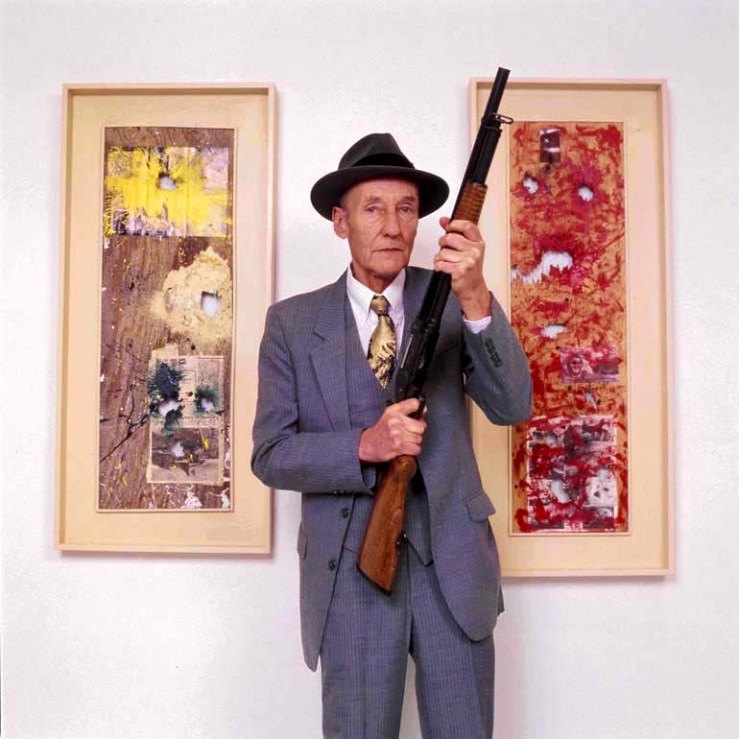
Burroughs, of course, was far more interested in yagé, or ayahuasca, a psychoactive preparation of a South American vine. At the end of his spare, funny, first novel Junky, Burroughs writes:

I decided to go down to Colombia and score for yage. … My wife and I are separated. I am ready to move on south and look for the uncut kick that opens out instead of narrowing down like junk.

Kick is seeing things from a special angle. Kick is momentary freedom from the claims of aging, cautious nagging, frightened flesh. Maybe I will find in yage what I was looking for in junk and weed and coke. Yage may be the final fix.

I’ve read Junky a few times and it seems that these lines are strangely half-hopeful and also deeply ironic. Burroughs’s stand-in, narrator William Lee doesn’t get what the writer William Burroughs seems to realize: there is no permanent solution, no “final fix.” Still, Burroughs sure did have some wacky adventures looking for it. Check out this clip from a documentary, apparently called Ayahuasca, narrated by Burroughs (if anyone out there knows anything about this movie, please let us know):

Your Knowledge Of What Is Going On Can Only Be Superficial And Relative

williamburroughs

“You were not there for the beginning. You will not be there for the end. Your knowledge of what is going on can only be superficial and relative” — Naked Lunch

The Unspeakable Mr. Hart and Ah Pook Is Here– William Burroughs/Malcolm McNeill

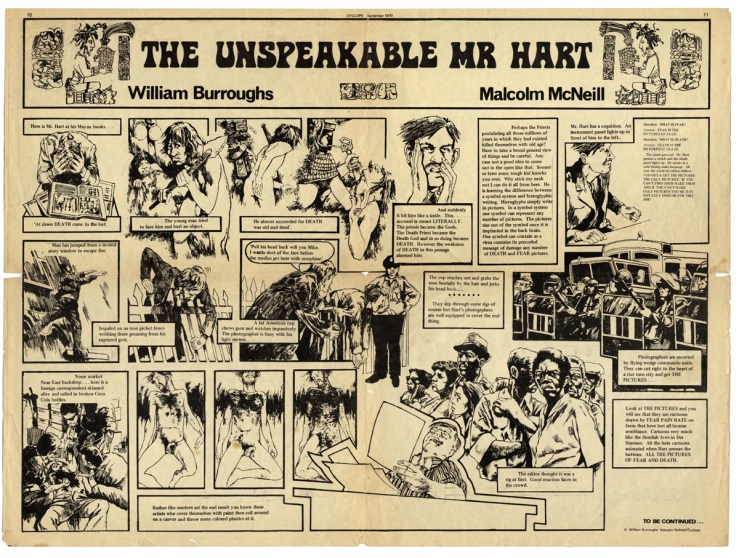
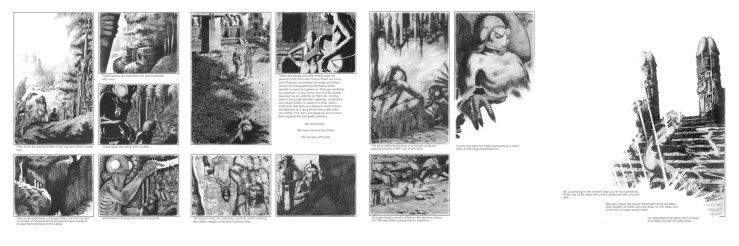
In 1970, William Burroughs was living in London. While there, he collaborated with young English artist Malcolm McNeill on a comic series for a magazine called Cyclops. The series was called The Unspeakable Mr. Hart, and remains uncollected/reprinted to date. Too bad, because it looks like really cool stuff. We got these images via The Virtual Library’s Beats collection, where there’s a really cool interview with McNeill (he discusses Burroughs habit of “going to movies to admire hard-ons and talking about them all afternoon,” which is kinda hilarious):

mcneillmrhart1mcneillmrhart2

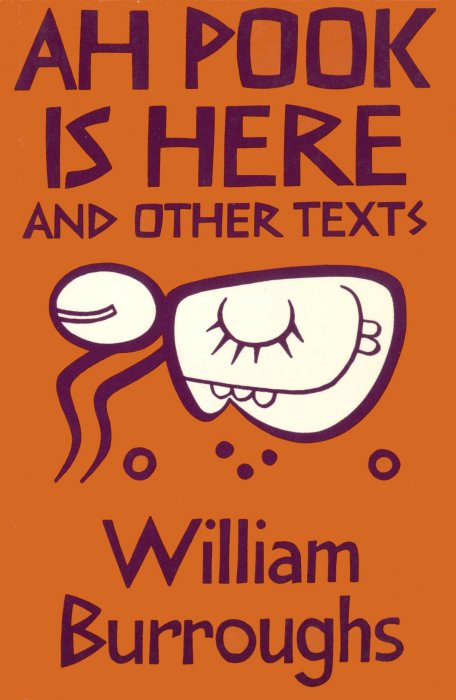
After Cylcops went kaput, Burroughs and McNeill continued the story in a project called Ah Pook Is Here, (a reference to the Mayan death god). Ah Pook Is Here, unfinished, was collected in the early eighties in Ah Pook Is Here and Other Texts which unfortunately is out of print. And very expensive. (Feel free to send it to me, anyone).

ah_pook_is_hereukcalder1979

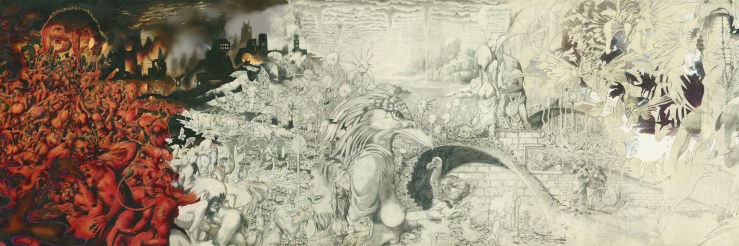
Fortunately, we can at least get a peek at some of McNeil’s hellish art at burroughsmcneillart.com. A few Boschian samples

burroughs_mcneill3

burroughs_mcneill

burroughs_mcneill2

Again, we want this book. Please send us this book. In the meantime, filmmaker Philip Hunt made this 1994 6 minute animated short of Ah Pook Is Here:

The Discipline of DE — Gus Van Sant/William Burroughs

Gus Van Sant’s great little short film from 1978, based on William Burroughs’s essay, explains the art of DE, or “Do Easy.” Our clumsy ass has been trying too hard, apparently. The film is quite funny but also useful, and well worth watching in full. It’s also included in the latest issue of Wholphin, if thou art so moved.

William S. Burroughs/John Giorno

burroughs_giorno

Look at these guys! I kind of have to have this record. If you have a copy, go ahead and send it to me. No? Okay, what about uploading the tracks somewhere as mp3s? No? Okay…

Image and LP info via Brainwashed.

William S. Burroughs/John Giorno (1975), GPS 006-007

William Burroughs

1. “103rd Street Boys” from Junkie 2. excerpt from Naked Lunch 3. “From Here To Eternity” from Exterminator 4. excerpt from Ah Pook Is Here 5. “The Chief Smiles” from Wild Boys 6. “The Green Nun” 7. excerpt from Cities Of The Red Night

John Giorno 8. “Eating Human Meat”

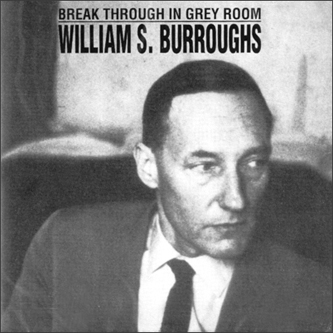
And so as not to just beg for mp3s but to also give, check out Burroughs explaining how tape manipulation helps to expand conciousness in “Origin and Theory of the Tape,” and get horrified by an example of said technique with “Present Time Exercises,” both from Break Through in Grey Room, a collection of Burroughs’s tape experiments and speeches (not to mention a dash of Ornette Coleman freaking freestyle in Morocco).

sr08_cover

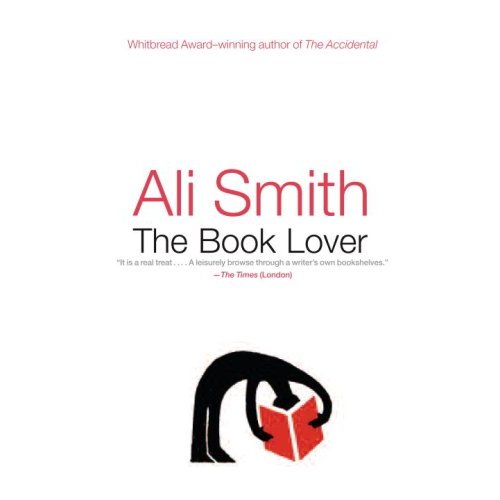
The Book Lover – Ali Smith

the-book-lover1

Let’s start with a confession–I haven’t finished reading all of Ali Smith’s anthology The Book Lover yet. Like most collections I own, there’s a fair chance that I won’t read every story, essay, or poem collected here, but chalk that up to the nature of anthologies. With any compilation, there are always going to be those great, transcendental moments where you’re suddenly hipped to a new voice, a new sound, a new vision, or re-introduced to an old friend you hadn’t thought about in quite some time. There will also be those texts that fail to grab you at the first sentence (or, rather, you fail to put the work in), and those texts that are simply a bit too long for the gap you’re presently trying to fill. So far, The Book Lover has been mostly filled with bits of shining revelation, startling wit, and plain old great writing, and I’m not going to spoil the meal by forcing it all down at once.

In collecting some of her favorite voices, Scottish author Ali Smith displays a keen understanding that the literary omnibus is peculiarly open to discontinuous and scattered readings. She prefaces The Book Lover with a quote from Virginia Woolf: “Any method is right, every method is right, that expresses what we wish to express, if we are writers; that brings us closer to the novelist’s intentions if we are readers.” Woolf’s words invite us to read the collection in any manner we wish, and I followed suit, picking it up in spare moments, usually at work, where I rarely get the time to concentrate on anything like a novel for a sustained amount of time. Still, Smith has put a great deal of thought into the arrangement of her sources, grouping them into six sections, GIRLS, DIALOGUES, JOURNEYS, THE WORLD, HISTORIES, and BELIEFS. The pieces in the section sometimes speak to each other directly (Hilda Doolittle’s “The Cinema and the Classics: Beauty” followed by Colette on “Mae West” followed by Lee Miller on “Colette”), but more often than not the pieces respond to each other in an oblique, layering fashion. It’s left to the reader to link William Blake’s “Infant Joy” to a section from Anne Frank’s diary, or connect the dots between Tom Leonard’s hilarious poem “baa baa black sheep” and the strange journalism of Lorna Sage’s “Our Lady of the Accident.” These connections were most interesting to me when re-encountering a text I was utterly familiar with, like the “pear tree” passage from Zora Neale Hurston’s Their Eyes Were Watching God, re-contextualized with something I’d never read, like the selection from Billie Holiday’s autobiography, Lady Sings the Blues (note to self: go get Lady Sings the Blues).

Ultimately, The Book Lover is successful in that it doesn’t attempt to be a “greatest hits” collection; instead, we’re treated to a wide selection of diverse and often dazzling writers. Smith’s project will not only introduce you to writers you haven’t yet read, it will make you want to read their works as well. I will, however, admit to being a little bit jealous: I think I’d love to put my own anthology together. After all, I’m a book lover too. In this sense, The Book Lover inspires its readers to think about the value of their own libraries, the way that the authors that they love speak to each other across time and space. Recommended.

The Book Lover is now available in the US from Anchor Books.

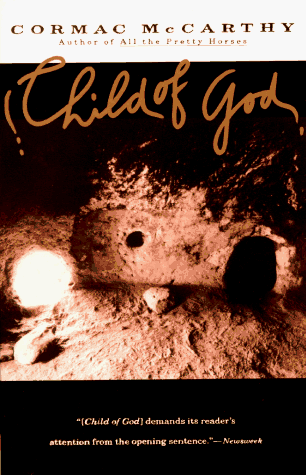
Child of God — Cormac McCarthy

child-of-god

In Greek drama, acts of violence or sex were “ob skena” and had to take place off stage. Thus, the horrific violence of Oedipus gouging out his eyes is not shown, but rather reported by a messenger. We see the same tradition in Shakespeare, of course, as well as the modern novel. And while many writers elide scenes too taboo or offensive to the sensibilities of the general reading public, books like Ulysses, Lolita, and Tropic of Capricorn, demonstrate that novels are often the site of debate over what can and cannot be shown or described or articulated plainly in our culture. Our concept of “the obscene” (the Greek “ob skena” simply translates to “off stage”) demands that certain actions might only be referred to or implied, but not graphically depicted, that the offensive action takes place out of our vision. The great lie or paradox of the obscene then is that in pushing the offensive action off stage, the author necessitates that the audience must envision that very action that was removed, that they must articulate their own understanding or schema or representation of what is taboo. While this strategy can often be quite effective and affecting (think of Tarantino pulling the camera away as Mr. Blonde cuts off the cop’s ear in Reservoir Dogs), in a character-centered novel it can also lead to a larger denial, a larger exclusion. What if one’s whole life was obscene? In his third novel, Child of God, Cormac McCarthy tells the story of a man who has been pushed from life’s stage, who exists in the uncanny and indigent margins of society.

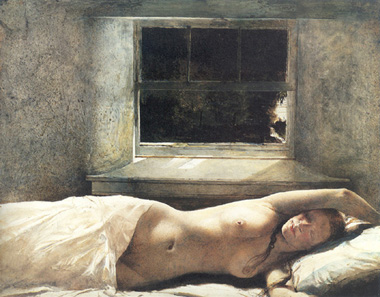
The ersatz protagonist of Child of God, Lester Ballard, is a poor, stooped, abject wretch of a man. The book opens with Ballard losing his house in a humiliating debacle. From there, he wanders the earth, finding an abandoned shack and barely eking out the means to leave. Ballard is an outsider, literally, always looking in at the lives of more normal, more stable people. His voyeurism leads him to creep up to parked cars to spy on the lovers inside. Wanting some connection or sense of love–or perhaps just out of general dejected weirdness–he masturbates against the cars, watching the people inside. His identity as voyeur is magnified in his only apparent skill. Ballard is an ace sharpshooter who carries his rifle almost everywhere he goes, surreptitiously spying on the normal folks through its lethal scope.

wyeth2

As the book develops in McCarthy’s spare, terse prose, Ballard becomes more and more unhinged. Everywhere he goes he is slighted or outright rejected and cheated by his fellow man. The indignities and affronts against Ballard range from being falsely accused of rape to simply being ignored by his neighbors. At the same time, Ballard is a creep, a loser, and seems largely deserving of this treatment. And yet, as McCarthy points out early in the novel, he is a “child of God, much like yourself perhaps.” This early call to identify with Ballard as a fellow human being is constantly strained by his wildly antisocial behavior, and yet it’s McCarthy’s genius as a writer that anchors the novel in some measure of sympathy for such a wretched anti-hero. When a young girl rejects Ballard’s advances, she taunts him, saying, “You ain’t even a man. You’re just a crazy thing.” In many ways, this is the major question of the novel: Is Ballard a man, or a thing? What makes a person a person, and not simply an object estranged from the human race? To test this question, McCarthy has Ballard plumb almost every conceivable taboo, from murder to arson to necrophilia. However, Ballard isn’t the only one in these Tennessee backwoods who behaves despicably: there’s the father who rapes his daughter, the gangster behavior of the Ku Klux Klan, and the mob justice of the townspeople as a whole. Still, Ballard’s descent into violence and madness–graphically portrayed by McCarthy–is the central action in this compelling novel.

Readers looking for redemptive story arcs or tales of heroism will likely be turned off by Child of God, and squeamish readers will probably not get past the first fifty pages. Those interested in McCarthy’s fiction will find more in common here with the visceral grit of The Road or Blood Meridian than the reflective romanticism of his “Border Trilogy” novels (including crowd pleaser All the Pretty Horses). Child of God is in many ways a response to the Gothicisms of Carson McCullers and William Faulkner, and certainly bears favorable comparison to those writers’ works. And like those writers’ works, McCarthy’s novel has its challengers–just as recently as 2007 an English teacher found himself in quite a bit of trouble for loaning the book to a student. Those who see the book as obscene are perhaps right, in the sense that the word implies “that which must be shown off stage.” However, one of the legal definitions of obscenity necessitates that the work “lacks serious literary, artistic, political or scientific value,” a claim that I do not think can be seriously substantiated against Child of God. Don’t believe me? Read it for yourself.

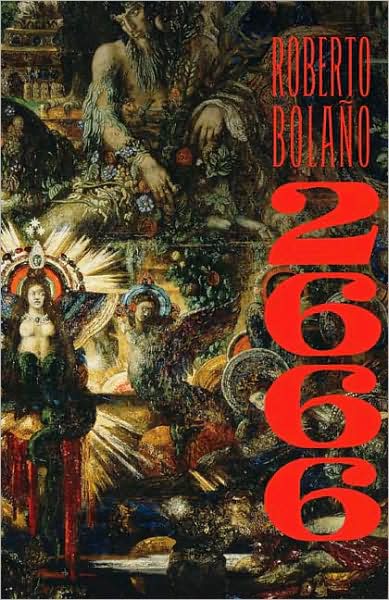
2666 – Roberto Bolaño

2666

Where to start, where to start…

Do I say that the book is good, great, fantastic, a literary achievement? These words don’t seem big enough, or they seem like hackneyed clichés, ugly inadequacies. Here’s a very short review: go get the book and read it. Worried that 900 pages is too long? Don’t worry. They fly by. I read the book in less than a month, usually in forty or fifty page sittings, something I usually don’t make time to do. But hang on, I’m already off to a bad start I admit, there’s no context here, is there? Let me try again.

2666 is Chilean exile Roberto Bolaño’s posthumous magnum opus. The book comprises five sections, each focusing on a separate but often overlapping set of characters and locations. The book is, in my paperback edition (composed of three separate books) 893 pages long. The book is excellent, addictive, full of pain and pathos and humanity. Most of the sentences are very, very long. What is it about, then? There are too many answers to that question, but here goes–

There are two major, intertwined plot threads in 2666, one about a series of gruesome rapes and murders in the fictional city of Santa Teresa, Mexico, and the other concerning an obscure German writer with the improbable name Benno Von Archimboldi. These two threads weave through the labyrinth that is 2666, connecting the many themes and tropes and moods and tones of this massive novel. Bolaño’s styles shift and weave and morph throughout the book, evoking laughter and rage and pity and anticipation and overwhelming sadness. He’s very often philosophical but never abstract, lyrical but grounded, and always entertaining. Bolaño’s command of thousands of different voices is on display here, whether he’s telling the tale of an ex-Black Panther or an exiled Russian sci-fi writer, a Romanian general or a crippled Italian critic. Bolaño’s voices layer upon each other in a strange chorus; often I found myself shocked at how, 300 pages later, a different character in a different place and time will hit on the same note–a comment about semblances and reality, or graveyards, or fate and chance and choice, or mirrors, or dreams and nightmares, or giants, or insane asylums, or aliases and pseudonyms–only this new character will express this note in a new or different tone, adding to the richness and dazzling complexity of the tale. Bolaño’s voices are often framed in a series of tales like Russian nesting dolls, only, where a writer like John Barth might explicitly announce or call attention to this device, Bolaño’s storytelling has a humanistic, natural quality, a quality that provokes and calls attention to the limits of human memory and our collective capabilities to narrativize our lives. But hang on again, I’ve gotten away from plot summary, haven’t I? Do you really need a summary? Yes? Will, “It’s about everything. Life, death, all that shit,” will that not do? Okay. Another attempt, then.
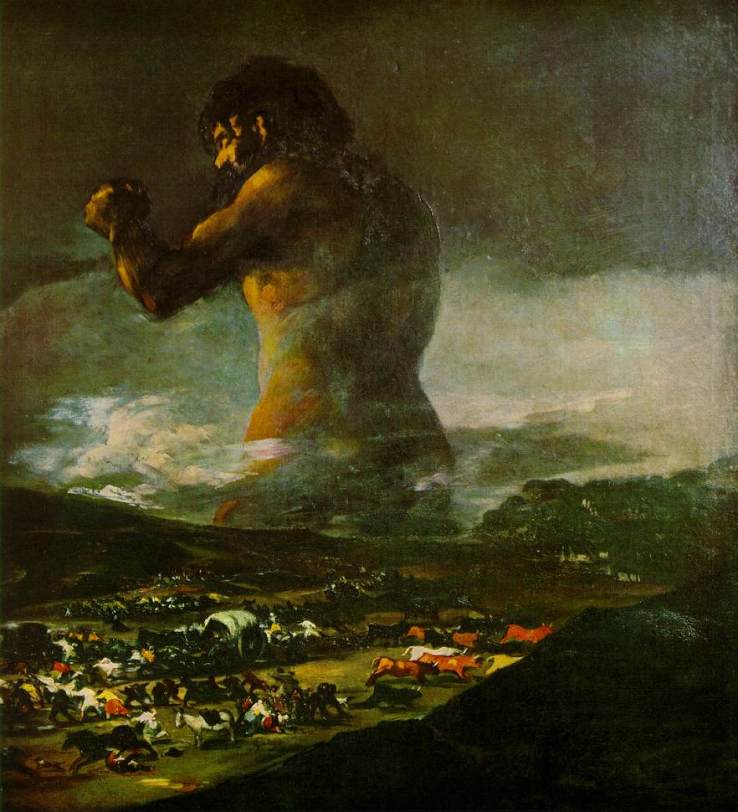
goya-colossus

The first section of 2666, “The Part About The Critics,” tells the story of four critics from four European countries who specialize in Archimboldi; in fact, two of the critics pretty much invent Archimboldi studies. Through their critical endeavors, the obscure, unphotographed writer rises to greater prominence. The four set out to find him, initiating the novel’s detective lit thread. They wind up in Santa Teresa, a city experiencing a seemingly endless slew of murders. In Santa Teresa, they meet a Chilean professor named Amalfitano, who (obviously) features heavily in the next section, “The Part About Amalfitano.” At this point, we start discover more about the unsolved rapes and murders of young women in Santa Teresa, but these crimes linger in the background, the story of Amalfitano, his ex-wife, his daughter, and a geometry book hanging from a clothes line at the fore. Amalfitano’s teenage daughter returns in the third section, “The Part About Fate.” This part of the novel details Oscar Fate, an African-American reporter who travels to Santa Teresa to cover a boxing match only a few days after the death of his mother. “The Part About Fate” builds to a rapid, grotesque, nightmarish climax, where the journalist, alien and impartial visitor, silent observer, becomes implicated in the ugly violence and grim desperation of Santa Teresa. This rhetorical move leads the reader into the longest section of 2666, “The Part About The Crimes,” in which we finally learn about the gruesome murders–hundreds and hundreds of murders–of the young women who work in the factories of Santa Teresa. The final section, “The Part About Archimboldi,” works as a partial bildungsroman, revealing the life story of the man who becomes Benno von Archimboldi. But does “The Part About Archimboldi” wrap up all the riddles, seal the deal, lead us out of the labyrinth and into the light–do we get answers? Let’s see–

Readers enthralled by the murder-mystery aspects of the novel, particularly the throbbing detective beat of “The Part About The Crimes,” may find themselves disappointed by the seemingly ambiguous or inconclusive or open-ended ending(s) of 2666. While the final moments of “The Part About Archimboldi” dramatically tie directly into the “Crimes” and “Fate” sections, they hardly provide the types of conclusive, definitive answers that many readers demand. However, I think that the ending is perfect, and that far from providing no answers, the novel is larded with answers, bursting at the seams with answers, too many answers to swallow and digest in one sitting. Like a promising, strangely familiar turn in the labyrinth, the last page of the book invites the reader back to another, previously visited corridor, a hidden passage perhaps, a thread now charged with new importance. Like Ulysses or Moby-Dick or Infinite Jest before it–and yes, yes, I would class this book with those without batting an eye–2666 is a book that demands multiple readings. Fortunately, despite its grim subject, it’s endlessly entertaining, rich with literally hundreds and hundreds of stories, stories that impel and compel you to read, read, read. But, again like Ulysses or Moby-Dick or Infinite Jest before it, 2666 is not for everyone.
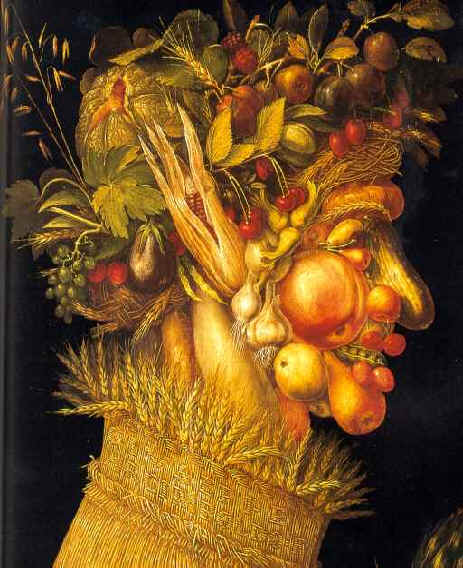
arcimb1

I’ll quote from the only negative review at Amazon right now, by one Mr. Nathan King, who writes, “This is not an enjoyable/pleasurable book to read. . . . this book is a GRUESOME and HORRIFICALLY VIOLENT book. The largest section of the book is basically 300+ pages of autopsy reports. You will read the words “vaginally and anally raped” over and over and over, until it runs through your mind day and night.” King’s review is accurate in several ways, although I fundamentally disagree with his overall assessment, of course. The book’s violence will run through your mind day and night: the book is awfully affecting. One of Bolaño’s missions in the book, it seems, is to continually press on the reader a horrific assemblage of dead, raped, mutilated bodies, bodies found in Dumpsters, trash heaps, ditches, alleys; violated, nameless, unclaimed bodies. While “The Part About The Crimes ” clearly contains most of these horrors, disposable bodies litter the entire book, whether they are Jews to be executed by Nazis in WWII or young men murdered in prison while the wardens watch. Bolaño’s method then is to confront his readers with all these unsolved, perhaps unsolvable crimes, and ask how one can witness to the horrors of life without giving in to despair or madness or suicide. Callous or cynical readers, looking for a simple answer to “Whodunnit?” will miss the multiplicity of answers that Bolaño provides, which might be boiled to: We all did it. We are all responsible for these crimes.

At many points throughout the massive tome Bolaño addresses this central problem, but this passage from “The Part About Amalfitano” sums up one possible solution quite beautifully. Amalfitano, slowly going insane, wondering about existence and movement and sleep and reality, thinks–

Anyway, these ideas or feelings or ramblings had their satisfactions. They turned the pain of others into memories of one’s own. They turned pain, which is natural, enduring, and eternally triumphant, into personal memory, which is human, brief, and eternally elusive. They turned a brutal story of injustice and abuse, an incoherent howl with no beginning or end, into a neatly structured story in which suicide was always held out as a possibility. They turned flight into freedom, even if freedom meant no more than the perpetuation of flight. They turned chaos into order, even if it was at the cost of what is commonly known as sanity.

To systematize, to narrativize then, to try to put order and meaning into one’s life, or the lives around you, to witness to others’ pain by claiming it as your own, these moves then betray one’s ability to accurately, or sanely, perceive the world. It’s this great cost that Bolaño navigates in 2666, and he does so with aplomb and precision and grace.

Have I still not convinced you to read 2666? I could keep going and going, on and on, and I won’t be the only one–Bolaño’s book will be one for posterity, a great work that literary critics (much like the ones he sympathetically parodies and valorizes here) will debate over, ponder over, discuss, write about, love, and be tortured by for ages to come. At the same time, this is not a book that one should feel is only for the “literary élite” (whatever that means)–with its force and vitality and inventiveness, with its rich, detailed dream/nightmare world, 2666 is a book that you, dear reader, should read, must read. Very highly recommended.

“Praise Song for the Day” — Elizabeth Alexander

“Praise Song for the Day” by Elizabeth Alexander (Obama 2009 inaugural poem)

Praise song for the day.

Each day we go about our business, walking past each other, catching each others’ eyes or not, about to speak or speaking. All about us is noise. All about us is noise and bramble, thorn and din, each one of our ancestors on our tongues. Someone is stitching up a hem, darning a hole in a uniform, patching a tire, repairing the things in need of repair.

Someone is trying to make music somewhere with a pair of wooden spoons on an oil drum with cello, boom box, harmonica, voice.

A woman and her son wait for the bus.

A farmer considers the changing sky; A teacher says, “Take out your pencils. Begin.”

We encounter each other in words, words spiny or smooth, whispered or declaimed; words to consider, reconsider.

We cross dirt roads and highways that mark the will of someone and then others who said, “I need to see what’s on the other side; I know there’s something better down the road.”

We need to find a place where we are safe; We walk into that which we cannot yet see.

Say it plain, that many have died for this day. Sing the names of the dead who brought us here, who laid the train tracks, raised the bridges, picked the cotton and the lettuce, built brick by brick the glittering edifices they would then keep clean and work inside of.

Praise song for struggle; praise song for the day. Praise song for every hand-lettered sign; The figuring it out at kitchen tables.

Some live by “Love thy neighbor as thy self.”

Others by first do no harm, or take no more than you need.

What if the mightiest word is love, love beyond marital, filial, national. Love that casts a widening pool of light. Love with no need to preempt grievance.

In today’s sharp sparkle, this winter air, anything can be made, any sentence begun.

On the brink, on the brim, on the cusp — praise song for walking forward in that light.