Dinner with Henry Miller

Vodpod videos no longer available.

Via Ubuweb

Dinner With Henry is a rare, 30-minute documentary about Henry Miller. It is exactly what the title implies: footage of Henry having dinner. With him at the table is the film crew, and actress/model Brenda Venus, to whom Henry was enamoured in the final years of life. Henry – at age 87 – spends the majority of his time speaking on a number of subjects, the most persistent of which is Blaise Cendrars. Occasionally, he complains about the food. That is all. It may not be of much interest to a general audience, but is a curious “slice of life” for any Miller fan who likes to imagine being at the table with him.

Jonathan Safran Foer Talks About His New Book, Tree of Codes

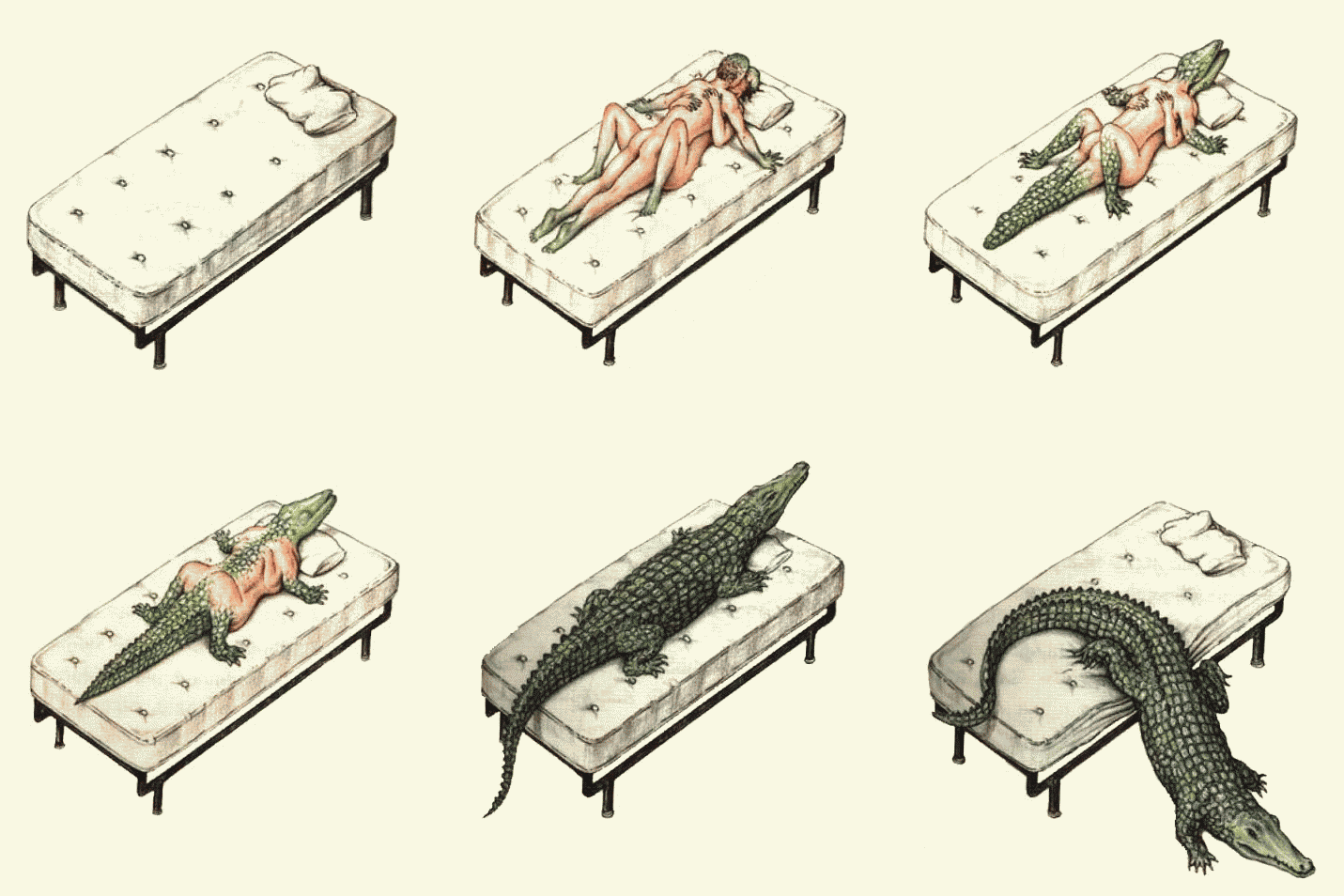
Jonathan Safran Foer’s new book, Tree of Codes, is a cut-up — or cut-out, rather — of Bruno Schulz’s The Street of Crocodiles. More here.

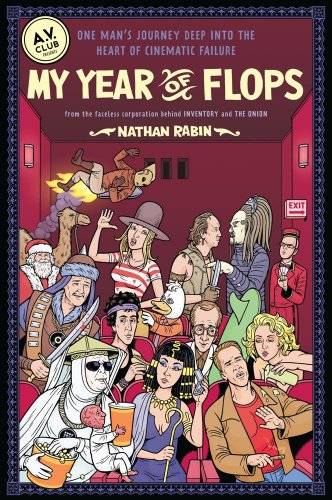
My Year of Flops — Nathan Rabin

Let me admit biases up front: for the past few years, I’ve looked forward every Wednesday to Nathan Rabin’s regular column at the AV Club,“My Year of Flops,” where he reviews–and reappraises–some of the worst-received films of all time. I’m also a fan of Rabin’s other columns, “THEN! That’s What They Called Music!” and “Nashville or Bust,” as well as the general tone of the AV Club, which he no doubt helps set as its head writer. I also thought Rabin’s memoir The Big Rewind was pretty good. So, I’m probably not the most objective person to review Rabin’s new book My Year of Flops, which comprises 35 of Rabin’s past columns, 15 new entries, and interview snippets with some of the actors who had the (mis)fortune to turn up in these flops. I’ll do my best to assess how well these columns–most of which were written for the internet–hold up as a book.

So, what, exactly, constitutes a flop?  There are the biggies here, of course, infamous studio-busting career-killers like Heaven’s Gate, Battlefield Earth, and Ishtar;  the batshit crazy weirdfests that were destined to become cult classics, like Southland Tales, Howard the Duck, and The Apple; the disposable movies made to be forgotten, like Bratz: The Movie; there are forgotten and overlooked oddballs, like Robert Altman’s teen sex comedy, O.C. and Stiggs, and Gospel Road, where Johnny Cash tells the life story of Jesus. All of these films share disappointing (or non-existent) box office results as well as general critical disapproval (or at least bewilderment). As part of his revisionist project, Rabin ends each entry by declaring the re-appraised film a “Secret Success,” a “Fiasco,” or a “Failure.” Tellingly, most of the time Rabin finds his subject to be a “Fiasco.” He’s willing to take each film on its own terms; he’s also incredibly open to viewing each film in a way that transcends the trappings of its marketing to an intended audience.

Take, for example Tough Guys Don’t Dance, a film macho novelist Norman Mailer thought it would be a totally sound idea to not only write but direct. Rabin’s initial analysis derides the film for its cardboard characters, debased gimmickry, and embarrassing dialog. By the end of his reassessment, however, Rabin has given the would-be thriller a new life as “a darkly comic, horror-tinged melodrama about the emptiness of excess and the soul-crushing costs of pursuing endless pleasure.” His review rests not on a personal ironic vision, but rather on a willingness to see Mailer’s own ironic vision at work behind (and in front of) the camera.

In the same way, Rabin is able to put aside–even while acknowledging–the dreadful reputations surrounding films like Ishtar and Heaven’s Gate. Even though the latter film essentially destroyed both its studio and the maverick filmmaking style of the 1970s, Rabin finds in it more than a slight redemption–he finds a flawed masterpiece, a gorgeous treatise on Manifest Destiny that doesn’t deserve its reputation. Similarly, Rabin would have us believe that Istar actually is funny. Both of these entries are remarkable not just in their clear revisionist goal, but also for how instructive they are. In both write-ups, Rabin reveals much of how movies are made, and how movies are made flops–the ways that infighting, firings, and studio expectations can damn a film before it even premieres.

While My Year of Flops is instructive in its criticism, it’s also very entertaining. Rabin has a keen sense of satire, and if he occasionally tips into snark, it’s always earned (and if you have a problem with a writer being snarky at the expense of Battlefield Earth, well, you’re probably a prig anyway). A great illustration of how Rabin combines his sense of humor with his instructive criticism in his coinage of the term “Manic Pixie Dream Girl”–

The Manic Pixie Dream Girl exists solely in the fevered imaginations of sensitive writer-directors, who use them to teach broodingly soulful young men to embrace life. The Manic Pixie Dream Girl serves as a means to an end, not a flesh-and-blood human being. Once life lessons have been imparted, the Manic Pixie Dream Girl might as well disappear in a poof! for her life’s work is done.

Cameron Crowe is particularly guilty of employing the MPDG trope, but you can find her pretty much everywhere you look–at least in the domain of rom-coms. Rabin proposes the term in his first entry in the series (also the first entry in the book) a review of Crowe’s much maligned Elizabethtown. Rabin finds it to be a Fiasco. In a move that sums up both Rabin’s program and his generous spirit, Rabin concludes My Year of Flops by re-reassessing Elizabethtown–he now dubs it a Secret Success. While I don’t subscribe to the idea that a critic should-be a starry-eyed optimist who finds the best of all possible worlds in each work, I do think that it has become far too easy to outright dismiss someone’s hard work. We live in a hyper-mediated age that moves too fast: all propositions are disposable, including the arts. Rabin, in taking each work on its own terms, does a service to both criticism and creativity.

Rabin’s own columns might, of course, fall prey to this disposable age. Today’s columns and blog posts are meant to be consumed quickly; although the best might find a life of new clicks in cyberspace, most are tomorrow’s virtual bird-cage liners. The blog-book is thus a tenuous grasp at some permeability–or at least respectability. My Year of Flops is fun, energetic, and insightful, but it does not bear sustained reading. The entries are best consumed one at time, probably between other tasks (or other books). It’s a great book for the john. Still, in an ideal library, My Year of Flops would stand squarely along side any other work of film criticism (it’s certainly sharper than anything by Leonard Maltin or Gene Shalit). Ultimately, Rabin does here what all great critics do–he makes a case for the works he’s appraising. He makes you want to see his Secret Successes and even the Fiascos (and, at times, even the Failures). I’ll even forgive him for making me watch The Apple. Recommended.

Silly CNN Report on Thomas Pynchon

Timothy Leary Just Wanted to Meet Thomas Pynchon

Roland Barthes on Alain Robbe-Grillet

From Roland Barthes’s essay Objective Literature: Alain Robbe-Grillet

Robbe-Grillet’s purpose . . . is to establish the novel on the surface: once you can set its inner nature, its “interiority,” between parentheses, then objects in space, and the circulations of men among them, are promoted to the rank of subjects. The novel becomes man’s direct experience of what surrounds him without being able to shield himself with a psychology, a metaphysic, or a psychoanalytic method in his combat with the objective world he discovers. The novel is no longer a chthonian revelation, the book of hell, but of earth–requiring that we no longer look at the world with the eyes of a confessor, of a doctor, or of God himself (all significant hypostases of the classical novelist), but with the eyes of a man walking in his city with no other horizon than the scene before him, no other power than that of his own eyes.

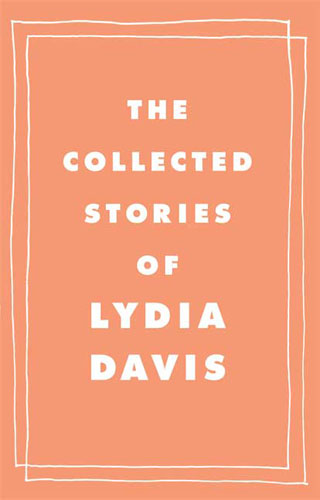
The Collected Stories of Lydia Davis

The Collected Stories of Lydia Davis compiles all 198 of Davis’s short stories in one handsome volume. That’s all four of Davis’s exceptional short story collections: Break It Down, Varieties of Disturbance, Samuel Johnson Is Indignant, and Almost No Memory. FS&G debuted the hardback edition a year ago, and this month Picador offers up a lovely (and more affordable) trade paperback version; it sports deckle edge pages and French flaps, and runs over 700 pages.

I front-load my review with this data to make it obvious that, if you have any interest in Lydia Davis, this is a book to pick up. It’s a wonderful collection, a tidy brick of words that begs for immersion, the kind of book you float around in, flipping pages at random to find and enjoy yet another strange little gem. Go get it.

If you’re not sure why you should be interested in Davis, read on.

Most of Davis’s stories are very short; many are just a paragraph or two, and some a mere sentence in length. They are not stories in the traditional sense: don’t look for sweeping character development or grand plot arcs. These stories thrive rather on tone, a keen sense of inspection, perception, and mood, and an intensity of observation on matters large and small. They are tales, fables, riffs, annotations, skits, jokes, japes, anecdotes, journals, thought experiments, epigrams, half-poems, and would-be aphorisms.

“In a House Besieged,” from her first collection Break It Down (1986) reveals much about the Davis program. Here it is in full–

In a house besieged lived a man and a woman. From where they cowered in the kitchen the man and woman heard small explosions. “The wind,” said the woman. “Hunters,” said the man. “The rain,” said the woman. “The army,” said the man. The woman wanted to go home, but she was already home, there in the middle of the country in a house besieged.

“In a House Besieged” illustrates a number of the themes and motifs that run throughout Davis’s oeuvre: unnamed protagonists identified only as “the man” and “the woman” (later stories might call them “the husband” and “the wife”) who are at once allegorical placeholders and at the same time singular individuals; a domestic setting (with family members as protagonists); an unknowable and perhaps unidentifiable threat; a pervasive sense of alienation balanced by an ironic sense of humor. The story’s brevity also shows that, from the outset of her publishing career, Davis was already working toward something wholly different from the Carveresque stories that dominated MFA fiction in the 80s.

The domestic settings of Break It Down–spaces often haunted by mothers and fathers–rear up again and again throughout the collection. 1997’s Almost No Memory kicks off with “Meat, My Husband,” a story about a wife who is trying to get her husband to eat healthier–a difficult prospect considering his affection for beef. The tale should be utterly banal, but instead it is humorous and even oddly moving; the wife, who narrates the piece, concludes by realizing that her husband would really just prefer to cook for himself. The insight transcends the particular domestic scenario: it seems applicable to the reader’s own life (or to this reader’s, anyway). “How He Is Often Right,” also from the same collection, is a short paragraph where the narrator concludes that the titular “he” is often wrong, “but wrong for circumstances different from the circumstances as they actually were, while [his decision] was right for circumstances I clearly did not understand.” The story captures the way that we impart great meaning to the smallest arguments, dwelling on them, connecting them to our sense of identity. We see the same analysis at work in “The Outing” (also from Almost No Memory). In full–

An outburst of anger near the road, a refusal to speak on the path, a silence in the pine woods, a silence across the old railroad bridge, an attempt to be friendly in the water, a refusal to end the argument on the flat stones, a cry of anger on the steep bank of dirt, a weeping among the bushes.

Davis’s sentence might be telescopic, but it also, paradoxically, puts the relationship in the story under a microscope. The reader can fill in the gaps with his or her own background: we’ve all experienced this anger, this silence, this refusal. We’ve been there. The story is real. It’s true.

The truth of Davis’s stories is what unites them; it’s the reader’s recognition of their truth that makes them so pleasurable. Take “Boring Friends” from 2001’s Samuel Johnson Is Indignant (again, in full)–

We know only four boring people. The rest of our friends we find interesting. However, most of the friends we find interesting find us boring: the most interesting find us the most boring. The few who are somewhere in the middle, with whom there is reciprocal interest, we distrust: at any moment, we feel, they may become too interesting for us, or we too interesting for them.

Davis’s treatment on friendship consistently penetrates facades, exposes our competitive cores, and, at the same time, celebrates the joys we might take in others. This precarious line also evinces in Davis’s stories about taking care of young children. The short scene “Child Care” focuses on a grumpy father who’d rather watch TV than take his turn with the baby. Solution: “Together they watch The Odd Couple.” And perhaps it is because I have two young children, but I can’t recall a more accurate depiction of the simultaneous wonder and boredom of taking care of a new baby than “What You Learn About the Baby” (a lengthy treatise at six pages).

Not all of Davis’s stories focus on family and friends. There’s much here about academia: troubles with translation, grappling with tenure, the perils of teaching, and so on. There are at least three entries on grammar here. If not all readers can connect with these stories (although I certainly did), they need not worry–part of the joy of the book is its diversity. If a story doesn’t catch right away, flick to the next one, or one a hundred pages down the line. Perhaps you will alight on one of the collection’s imaginative historical biographies, like “Kafka Cooks Dinner” or “Marie Curie, So Honorable Woman,” positively epic at 18 pages. Davis’s histories fascinate; they seem utterly real and true and absurd and improbable, all at the same time.

Indeed, discursive movement is the core of Davis’s, but her digressions all point to a thematic analysis of truth, of an individual’s attempt to understand the world in terms other than the individual herself. They dwell on problems of self-consciousness, often employing literary distortion as an analytical tool. Davis’s literary distortions always point to a concrete reality, a livable, experiential reality; the fact that we should experience the real as surreal or absurd only makes her work more truthful.

It would be easy to park Davis with the postmodernist counter-tradition, but I think her work looks to something else, something post-postmodernist (I write this, I know, at the risk of falling into an abyssal loop).  Davis’s work presages contemporary “flash fiction”; her stories’ brevity reflect the simultaneous contraction of our attention spans and the expansion of our diverse interests. Her story “Samuel Johnson Is Indignant:” reads like a Facebook update. Here it is in full — “that Scotland has so few trees.” Davis transmutes an amusing annotation into a story that somehow brings the great critic back to life. The title of the story is also the title of the book; what follows then is a kind of meta-joke on reader expectations, subverting our expectations of Dr. Johnson’s (supposed) meta-commentary on the book-proper. But I fear I’m headed into a lit-crit navel-gazing snoozefest (in what has already been a long review). Far better to wrap things up, I think, by simply noting again how joyful it is to move through the book, to open at random and read. Very highly recommended.
Kurt Vonnegut Talks Cat’s Cradle

“Nietszche” — Lydia Davis

“Nietszche” [sic] by Lydia Davis, from Varieties of Disturbance, and reprinted in The Collected Stories of Lydia Davis

Oh, poor Dad. I’m sorry I made fun of you.

Now I’m spelling Nietszche wrong, too.

“Self Portrait at Twenty Years” — Roberto Bolaño

“Self Portrait at Twenty Years,” a poem by Roberto Bolaño, from Laura Healy’s translation of The Romantic Dogs

I set off, I took up the march and never knew
where it might take me. I went full of fear,
my stomach dropped, my head was buzzing:
I think it was the icy wind of the dead.
I don’t know. I set off, I thought it was a shame
to leave so soon, but at the same time
I heard that mysterious and convincing call.
You either listen or you don’t, and I listened
and almost burst out crying: a terrible sound,
born on the air and in the sea.
A sword and shield. And then,
despite the fear, I set off, I put my cheek
against death’s cheek.
And it was impossible to close my eyes and miss seeing
that strange spectacle, slow and strange,
though fixed in such a swift reality:
thousands of guys like me, baby-faced
or bearded, but Latin American, all of us,
brushing cheeks with death.

Six Paul Auster Interviews

Several Paul Auster interviews for those inclined. Also, read our review of his new novel Sunset Park.

Auster on NPR’s Marketplace with Kai Ryssdal.

Auster on NHPR.

Auster at the AV Club.

Auster at The Cult.

Auster at Goodreads.

And, on a video interview with Borders, Auster leaves his shades on for the duration of the interview, perhaps commenting on the brightness of his future.

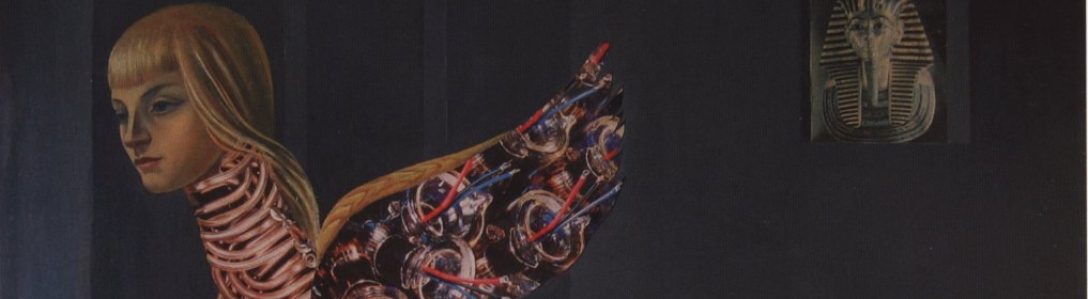
More from Codex Seraphinianus

Flannery O’Connor on Freaks in the Christ-haunted South

From Flannery O’Connor’s 1960 lecture, Some Aspects of the Grotesque in Southern Fiction

Whenever I’m asked why Southern writers particularly have a penchant for writing about freaks, I say it is because we are still able to recognize one. To be able to recognize a freak, you have to have some conception of the whole man, and in the South the general conception of man is still, in the main, theological. That is a large statement, and it is dangerous to make it, for almost anything you say about Southern belief can be denied in the next breath with equal propriety. But approaching the subject from the standpoint of the writer, I think it is safe to say that while the South is hardly Christ-centered, it is most certainly Christ-haunted. The Southerner, who isn’t convinced of it, is very much afraid that he may have been formed in the image and likeness of God. Ghosts can be very fierce and instructive. They cast strange shadows, particularly in our literature. In any case, it is when the freak can be sensed as a figure for our essential displacement that he attains some depth in literature.

Hear O’Connor read a version of her lecture here.

New Books from Dinaw Mengestu, Stephen-Paul Martin, and Susan Straight

Dinaw Menestu’s new novel How to Read the Air tells the story of a family over two generations. The novel opens in the 1970s as Mariam and Josef, a young married couple from Ethiopia, take a road trip through the American heartland. The pair has been separated for over three years–after just one year of marriage–and they hope that the trip will help renew their bonds and in some way forge their new identities as Americans. But they don’t really know each other, and perhaps they can’t; the violence they sought to escape in Ethiopia’s communist revolution recapitulates in their own marriage, eventually sundering it. Nearly 30 years later, their son Jonas–the introspective, sensitive, and inventive narrator of this novel–tries to come to terms with his own crumbling marriage, job, and identity, by re-examining the past. By literally recreating his parents’ journey, Jonas tries to convert his father’s pain and fear into a stable identity in this moving novel about family, place, and the need to move both our bodies and our souls. How to Read the Air is new in hardback from Riverhead Books.

There’s a thread of vengeful anger that runs through Stephen-Paul Martin’s new collection of stories, Changing the Subject. Although a tidy portion of that anger is reserved for George W. Bush and his nefarious gang (the stories seem to have been composed under last decade’s regime), Martin’s various characters also aim their anger at scientists, whalers, cell phones, born-again Christians, college students, journalists, fast food restaurants, Americans, and all the people of the world. That anger works best when working in a reflective mode, especially when Martin blends his vitriol with humor. The opening paragraph of the first story “Safety Somewhere Else” provides a nice illustration of Martin at his finest–

The greatest mistake of all time took place thousands of years ago, when God let Noah’s family survive the flood. God’s plan was to start a new human race with a man he though he could trust, but the limits of Noah’s moral awareness were obvious right from the start. No sooner had God’s rainbow vanished into the clouds than Noah was getting drunk and cursing his grandson, declaring that Canaan’s descendants–one-third of the human race–would be the lowest of slaves, a monstrous over-reaction that would have tragic consequences for countless generations of innocent people. Clearly, Noah wasn’t the man God thought he was.

The story then shifts into a bizarre picaresque involving revenge against a scientist who uses animals as research subjects (there’s also an attack on a whaling vessel, a fascinating reading of The Odyssey, and a woman whose son was consumed by a bear). Great stuff, but I think I would have been just as happy to hear more of Martin’s thoughts (or, his narrator’s thoughts, to be fair) on the Old Testament. Changing the Subject is new in trade paperback from Ellipsis Press.


Susan Straight’s
new novel Take One Candle Light a Room explores the physical and psychic traumas that evince from America’s long, painful, complicated history of race relations. FX Antoine, the novel’s narrator, is an LA-based travel writer who found herself, as a young girl, transplanted from rural Louisiana to California at the end of the fifties, in order to escape the rapes perpetrated by a local plantation owner on three of her sisters. In 2005, FX–Fantine to her friends and family–watches over Victor, her godson, a recent community college graduate. Fantine encourages Victor to expand his unlikely success (he is the son of a crack-addicted murder victim, one of Fantine’s childhood friends) by applying to four-year schools; however, after Victor is implicated in a shooting (wrong place, wrong time), he runs away to Louisiana. Fantine follows, attempting to save the young man and find some sense of personal redemption as well. The novel’s climax is set against the devastating backdrop of Hurricane Katrina. For more on Take One Candle, read Francesca Mari’s review at The New York Times. Take One Candle Light a Room is new in hardback from Pantheon Books.

A Selection from “Hierogylphic Silence” by William S. Burroughs

The following selection is from William S. Burroughs’s “Hieroglyphic Silence,” collected in the totally out-of-print volume The Third Mind, a book of cut-ups Burroughs co-authored with Brion Gysin (you can access the book here via extralegal means). From “Hieroglyphic Silence”–

“I am the Egyptian,” he said, looking all flat and silly, and I said: “Really, Bradford, don’t be tiresome.”

All right, let’s put it apple-pie simple with a picture of a wedge of apple pie there, containing fifty-three grams of carbohydrates.(See the L-C diet.)

Well now, if you don’t know the word for apple pie where you happen to be and want it, you can point to it or you can draw it. So, when and why do you need a word for it? When and why do you need to say, I want apple pie, if you just don’t care how fat you get?

You need to say it when it isn’t there to point to and when you don’t have your drawing tools handy\ In short, words become necessary when the object they refer to is not there.

No matter what the spoken language may be, you can read hieroglyphs, a picture of a chair or what have you; makes no difference what you call it, right? You don’t need subvocal speech to register the meaning of hieroglyphs. Learning a hieroglyphic language is excellent practice in the lost art of inner silence. “It would be well, today, if children were taught a good many Chinese ideograms and Egyptian hieroglyphs as a means of enhancing their appreciation of our alphabet.” If you are able to look at what is in front of you in silence, you will be able to write about it from a more perceptive viewpoint.

What keeps you from seeing what is in front of you? Words for what is in front of you, which are not what is there. As Korzybski pointed out: whatever a chair may be, it is not a “chair.” That is,it is not the label “chair.”So, now try this: pick up your Easy Lessons in Egyptian Hieroglyphics, by Sir E. A. Wallis Budge, and copy out the following phrases:

p. 104; They fall down upon face their in land their own.

p. 173; Stood the prince alone in the presence of the gods.

p. 181; The lock of hair which was in.

p. 79; the wind

p. 202; Giver of winds is its name.

p. 190; coming forth waiting for thee from of  old

p. 200; night that of the destruction of the enemies

p. 208; come thou to us not having thy memories of evil come thou in thy form

p. 103; In the writing of the god himself he writeth for thee the book of breathings with his fingers his own.

p. 195; Shall it be that thou wilt be silent about it.

Now, having memorized the above passage, turn to the hieroglyphs on the following page and read in silence.

Historic Photos of Heroes of the Old West

In 200 black and white archival photos with accompanying captions by historian Mike Cox, Historic Photos of the Old West winds its way through almost two centuries of American history, tracing the exploration of the West from its earliest pathfinders like Lewis and Clark, through later generations who mythologized the practitioners of Manifest Destiny. Along the way, we’re treated to photos of lawmen and settlers, civilizers and politicians, along with plenty of roustabouts, rustlers, and rascals (admittedly, some of these “heroes” had no problem slipping from the former category to the latter and back). There are all the famous names you’d expect to see in here–Wild Bill Hickok, Calamity Jane, Pat Garrett, the Earp brothers, just to name a few–but its photos like this one, below, of a pioneer family in Nebraska that signal the less sensational (and perhaps more human) side of the Western migration.

Of course, those settlers needed land when they arrived out West, as well as protection from the Indians who had been there first (not to mention each other). The picture below shows the bureaucrats of the U.S. Land Office who doled out Indian land to white people, along with the armed U.S. marshals who enforced these actions. Are they heroes?

The following picture depicts a company of Texas Rangers, posing with their Winchesters in South Texas in the mid 1880s. Some tough-looking hombres.

Historic Photos of Heroes of the Old West, available now from Turner Publishing, makes a nice companion piece to Historic Photos of Outlaws of the Old West.

Vladimir Nabokov, Butterfly Hunter

Oh my god. Look at that poise. That athleticism. That self-assurance. That spark of incandescent grace vibrating through his form. The lower lip lunging over the upper. The short pants.  Vladimir Nabokov, hunting butterflies. See the whole set.