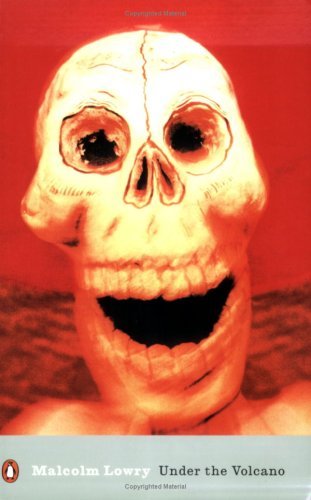
Under the Volcano — Malcolm Lowry

Most of Malcolm Lowry’s dense, depressing novel Under the Volcano takes place over the course of November 2nd, 1938, the Mexican Day of the Dead. Like a reticent, dour Virgil, Lowry guides the reader through the day’s tragic arc, floating between the minds of his novel’s three protagonists: Geoffrey Firmin, his half-brother Hugh, and Geoffrey’s estranged wife Yvonne. Geoffrey is British Consul to Mexico — ex-Consul, really, as British-Mexican relations sour against the backdrop of Spanish fascism and the rise of nationalism in Mexico — but he is almost always referred to as “the Consul,” a blackly ironic title. See, the Consul bears little authority aside from an extreme expertise on how to stay drunk (or “drunkly sober un-drunk”) 24/7. He’s ambassador to bar stools, a manager of mescal and little else (certainly not his own life; certainly not diplomatic affairs). The Consul is a wreck, an alcoholic to put Hemingway and Fitzgerald’s (and even Bukowski’s) alter-egos to shame.

After a first chapter that seems to derail all but the most patient readers, the narrative conflict arrives when Yvonne returns to Quauhnahuac, Mexico, a year after leaving (and divorcing) the Consul. She arrives to find the Consul (“Geoffrey,” as he’s called when the free indirect style inhabits her mind) drinking whiskey in a hotel bar in order to sober up (yep). It’s not immediately clear why Yvonne has returned to the Consul, but it seems that she hopes to save him from drowning in a drunken downward spiral. As the pair walks to the Consul’s house, they pass numerous advertisements for a boxing match; a child’s funeral proceeds down the avenue. These motifs of fighting, death, and futility permeate the novel.

During the walk we learn that Yvonne is not the only one concerned about the Consul’s health; his (much) younger brother Hugh has come to stay with him in the hopes of sobering him up. (Hugh employs a revolting and unsuccessful “strychnine cure”). That Hugh has also returned doubly complicates the plot. Much of Under the Volcano remains implicit, unnamed, hinted at, and this seems especially true of the implication that Yvonne cheated on the Consul with Hugh in the recent past (this implication may have been stated conclusively at some point in the novel, but I’ve only read the book once, which is perhaps like not having read it at all). What’s certainly clear is that Yvonne cheated on the Consul with a French filmmaker, Jacques Laruelle, a man whom the Consul, through sheer bizarre coincidence (but of course it isn’t sheer bizarre coincidence), spent a childhood summer with, and experience which bonded them as brothers in an Edenic holiday that eventually (inevitably) soured.

Despite her infidelities, Yvonne is generally present (I choose the verb “present” over “presented as” to highlight Lowry’s impeccable Modernist style) as a sympathetic character. Still, it is hard not to identify with the Consul (with “Geoffrey,” I suppose, if we are going to be familiar), the dark soul of this novel, and his complicated, painful feelings for Yvonne form the core of Volcano’s tragedy. He longs for her, pines for a complete life with her, yet resents her, cannot forgive her, hates her. For what? For leaving him. For betraying him. But perhaps foremost, he despises her inability to understand his alcoholism (he is particularly upset when she refuses to share a morning libation with him when they meet for the first time in a year). I’ll quote a passage at length now, one that showcases Lowry’s free indirect style, and one that reveals the strange indignities of the Consul’s sense of his own alcoholism. For context, dear reader, you must only know that Yvonne has suggested that she and the Consul might make long-term plans when he is sober “in a day or two”—

The Consul sat perfectly still staring at the floor while the enormity of the insult passed into his soul. As if, as if, he were not sober now! Yet there was some elusive subtlety in the impeachment that still escaped him. For he was not sober. No, he was not, not at this very moment he wasn’t! But what had that to do with a minute before, or half an hour ago? And what right had Yvonne to assume it, assume either that he was not sober now, or that, far worse, in a day or two he would be sober? And even if he were not sober now, by what fabulous stages, comparable indeed only to the paths and spheres of the Holy Cabbala itself, had he reached this stage again, touched briefly once before this morning, this stage at which alone he could, as she put it, “cope,” this precarious precious stage, so arduous to maintain, of being drunk in which alone he was sober! What right had she, when he had sat suffering the tortures of the damned and the madhouse on her behalf for fully twenty-five minutes on end without having a decent drink, even to hint that he was anything but, to her eyes, sober? Ah, a woman could not know the perils, the complications, yes, the importance of a drunkard’s life! From what conceivable standpoint of rectitude did she imagine she could judge what was anterior to her arrival? And she knew nothing whatever of what all too recently he had gone through, his fall in the Calle Nicaragua, his aplomb, coolness, even bravery there—the Burke’s Irish whiskey! What a world! And the trouble was she had now spoiled the moment.

The “fall in the Calle Nicaragua” the Consul references is quite literally a drunkard’s blackout (followed by the aforementioned fortifying whiskey, courtesy of a tourist), but it — falling — is perhaps the dominant motif in a novel crammed with motifs. In allegorical terms, if we want to ruin a good book (I don’t recommend this, of course), Volcano is pure Faust-stuff: end of innocence, fall of man, intractability of the human condition, ethical peril, moral inertia. While the Consul’s fall dominates the novel, Lowry brings this decline into dramatic relief in a late, climactic episode when his (anti-)heroic trio encounter a dying (dead?) man on the side of the road. Hugh tries to help, but the Darwinian venality of Mexican commonplace law makes his attempt impotent. Yvonne and the Consul are basically paralyzed.

Hugh’s attempt to save the man is a desperate call to action, an endeavor to perform some good in a world dominated by war and fascism. Hugh’s character fascinates. We learn of his past in one of the novel’s most intriguing episodes, a mini-bildungsroman that finds young Hugh working in the merchant marine as a calculated ploy to lend romance to his persona — he longs to prevail as a songwriter. He returns to find that no one cares about — has even heard — his guitar compositions; his publicity stunt fails. Although Hugh is only twenty-nine, he already seems himself as a failure, a fallen hero; he obsesses over the Battle of Ebro, daydreaming of helming a ship laden with hidden arms that he will deliver to the Loyalists who oppose the Fascists. Hugh’s greatest pain — and perhaps (only perhaps) Lowry’s greatest cruelty — is the awareness that the idealism of romantic heroism is intrinsically bound to a kind of selfish egoism. Hugh, perhaps with the visceral signal of his half-brother as a kind of radical prescience, can already see his own fall; his parts in Volcano are in a sense a constant meditation on falling. Hugh tries to save the dying man on the road, the cold double of his brother, whom he also tries to save — and yet it is all to little avail.

In Lowry’s world, in the volcano-world, there is only expulsion from the Eden. Lowry spells out this theme near the middle of his novel in a strange episode. The Consul wanders into his neighbor’s garden and reads a sign —

¿LE GUSTA ESTE JARDÍN?
¿QUE ES SUYO?
¡EVITE QUE SUS HIJOS LO DESTRUYAN!

The Consul stared back at the black words on the sign without moving. You like this garden? Why is it yours? We evict those who destroy! Simple words, simple and terrible words, words which one took to the very bottom of one’s being, words which, perhaps a final judgement on one, were nevertheless unproductive of any emotion whatsoever, unless a kind of colourless cold, a white agony, an agony chill as that iced mescal drunk in the Hotel Canada on the morning of Yvonne’s departure.

Significantly, either the sign is posted with improper punctuation, or (and?) the Consul’s translation is wrong — in either case a meaningful misreading occurs. We later receive the “proper” version of the sign: “¿Le gusta este jardín, que es suyo? ¡Evite que sus hijos lo destruyan! – “Do you like this garden that is yours? See to it that your children do not destroy it!”  The Consul’s first reading is a corruption, a cruel misreading that questions humanity’s right to happiness, and, tellingly, he connects the sign to the end of his relationship with Yvonne. The second version of the sign, while still foreboding, perhaps signals a kernel of hope in Lowry’s bleak work — the idea that a garden might be preserved, might be tended to; that children might be raised who do not kill, cheat, steal, rape, enslave, or otherwise prey on each other. Still, Lowry refuses to imagine what such a world might look like for us. Did I mention that Volcano is really, really sad?

For all its bleak, bitter bile, Volcano contains moments of sheer, raw beauty, especially in its metaphysical evocations of nature, which always twist back to Lowry’s great themes of Eden, expulsion, and death. Lowry seems to pit human consciousness against the naked power of the natural world; it is no wonder then, against such a grand, stochastic backdrop, that his gardeners should fall. The narrative teems with symbolic animals — horses and dogs and snakes and eagles — yet Lowry always keeps in play the sense that his characters bring these symbolic identifications with them. The world is just the world until people walk in it, think in it, make other meanings for it.

In many ways, Under the Volcano is an antipodal response to Joyce’s Ulysses. Both novels stream through a number of consciousnesses over the course of one day; both novels invert and subvert mythical frameworks against diurnal concerns; both novels point to the ways that the smallest meannesses — and kindnesses — can color and affect our lives. And while there are many divergences (chiefest, I believe, the spirit of redemption in Ulysses that seems entirely absent from Volcano), the greatest similarity may be their difficulty. Simply put, Lowry, like Joyce, throws his readers into the deep end. The first chapter of the novel inhabits the mind of Jacques Laruelle and takes place exactly one year after the events of the rest of the novel. It is both overture and context for all that follows, and yet it is radically alienating; indeed, it only fully makes sense after one finishes the novel and goes back and reads it again, realizing it is the rightful coda, the sad epilogue of a sad story. Lowry leads with his conclusion, show us the fall-out up front, the splinters and shards of the narrative to come. Picking up these pieces is hardly easy and never joyful, but it is a rewarding experience. Very highly recommended.
Nabokov Discusses Lolita Covers

See more Lolita covers.

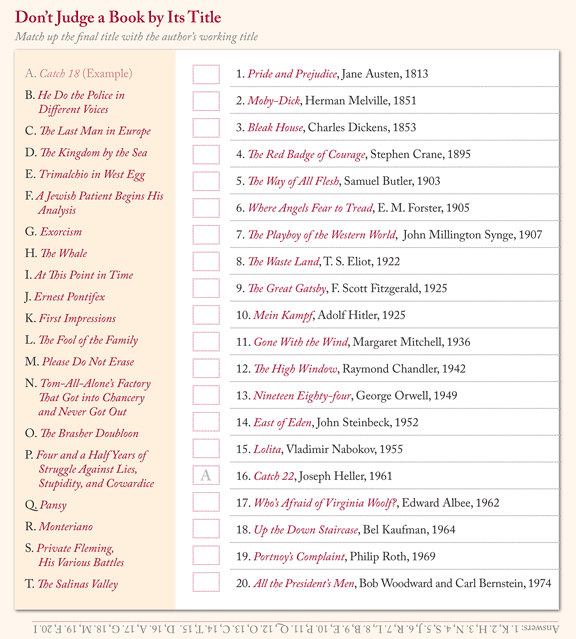
Don’t Judge a Book by Its Title

From Lapham’s Quarterly, via.

Bob Dylan Plans Six New Books

According to AV Club, Bob Dylan has inked a deal with Simon & Schuster to write six books, including the long-awaited follow ups to Chronicles, Volume One (easily one of our favorite memoirs or music books or Dylan books or whatever you want to call it). Also connected: MobyLives reports that literary agent/villain-in-an-alternate-universe-where-everyone-actually-cares-about-publishing Andrew “The Jackal” Wylie may be the guy responsible for the delay of Chronicles Volume 2.

Here’s Dylan haranguing a journalist in one of my favorite scenes from Don’t Look Back—

Lydia Davis Reads Five of Her Short Stories

Eugene Mirman Talks with Wesley Stace About Charles Jessold, Considered as a Murderer

Electric Literature Shoots Guns at Jonathan Franzen, David Mitchell, the Kindle, and Others

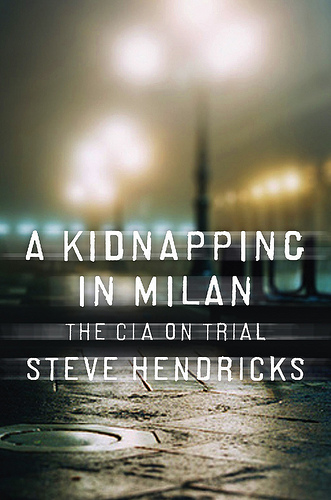
A Kidnapping in Milan: The CIA on Trial — Steve Hendricks

Steven Hendricks’s A Kidnapping in Milan: The CIA on Trial details the story of radical imam Abu Omar. Omar, an Egyptian radical who sought political asylum in Italy, was the focus of an investigation by the Milan police force, who, via wiretaps and other forms of surveillance, were building a case against Omar for recruiting a network of Islamist terrorists. In early 2003, the Milanese case fell apart when Omar was disappeared in what turned out to be one of the most conclusively documented cases of the CIA’s “extraordinary renditions.” Omar was kidnapped, relocated to Germany, and then returned to Egypt, where he was tortured and held by Egypt’s SSI–under the watchful eyes of the CIA. Italian prosecutor Armando Spataro, erstwhile protagonist of Kidnapping, reconstructed the evidence of the CIA’s extraordinary (and extra-legal) rendition, leading to the prosecution of twenty-six CIA operatives for kidnapping; twenty-three were convicted.

Hendricks combines journalistic clarity with the structure of a detective novel in Kidnapping, giving his book the urgency of a modern thriller, all the more striking for its cold reality. The book is well-researched; Hendricks interviewed, among others, Spataro, Omar, and even some of the indicted CIA agents–but Kidnapping never reads as a dry recitation of facts or a ponderous series of analyses. Additionally, Hendricks fleshes out his story with a consideration of the CIA’s history in Italian politics, with an emphasis on why Milan is such a hotbed for clandestine activities. Guiding the narrative is a refined sense of moral outrage against the idea that dark deeds done in the dark make our world somehow safer. While there are some that will remain unmoved by his descriptions of Omar’s torture — the cleric is a “bad guy,” in the Bush admin’s parlance, after all — Hendricks builds a clear case that the “outsourcing of torture” is a vile practice, and one antithetical to the spirit of our Constitution. And, even if the Obama administration is unwilling to shed further light on such crimes, it is good to know that there are writers who will.

A Kidnapping in Milan is new in hardback from W.W. Norton.

(An Incomplete List of) Writers Who Died in 2010

J. D. Salinger, 91, American author

Howard Zinn, 87, American historian

Barry Hannah, 67, American novelist and short story writer

David Markson, 82, American writer

Harvey Pekar, 70, American comic book writer (American Splendor)

Tuli Kupferberg, 86, American poet, cartoonist and musician (The Fugs)

David Mills, 48, American author, journalist and television writer (NYPD Blue, The Corner, Kingpin)

Dick Giordano, 77, American comic book artist and editor (Batman, Green Lantern)

José Saramago, 87, Portuguese novelist, playwright and journalist, Nobel Prize winner for literature

Lucille Clifton, 73, American poet (Blessing the Boats), Poet Laureate of Maryland

Robert Dana, 80, American poet, Iowa poet laureate

Rajendra Keshavlal Shah, 96, Indian poet

Tibet, 78, French comics artist

Mary Daly, 81, American radical feminist philosopher

Knox Burger, 87, American editor, writer, and literary agent

George Leonard, 86, American writer, editor and educator, pioneer of the Human Potential Movement

Robert B. Parker, 77, American detective writer

Laura Chapman Hruska, 74, American writer, co-founder and editor in chief of Soho Press

Stephen Morse, 65, American poet

P. K. Page, 93, Canadian poet

Bingo Gazingo, 85, American performance poet

Kage Baker, 57, American science fiction and fantasy author

Ralph McInerny, 80, American philosopher (University of Notre Dame) and mystery author

Erich Segal, 72, American professor, author (Love Story), and screenwriter (Yellow Submarine)

Carlos Montemayor, 62, Mexican writer

Violet Barclay, 87, American comic book artist

David Severn, 91, British author

Colin Ward, 85, British anarchist writer

William Tenn, 89, American science fiction writer

Liz Carpenter, 89, American feminist author, press secretary to Lady Bird Johnson (1963–1969)

John Eric Holmes, 80, American science fiction and fantasy author

Ai Ogawa, 62, American poet, breast cancer

Patricia Wrightson, 88, Australian children’s writer

Matilde Elena López, 91, Salvadoran poet, essayist and playwright

Elena Schwarz, 61, Russian poet

Ella Mae Johnson, 106, American social worker and author

Miguel Delibes, 89, Spanish author, journalist and scholar

Sid Fleischman, 90, American children’s writer

Bill DuBay, 62, American comic book editor, writer, and artist

Henry Scarpelli, 79, American comic book artist (Archie)

Alan Sillitoe, 82, British writer (Saturday Night and Sunday Morning)

Jan Balabán, 49, Czech writer, recipient of the Magnesia Litera award

William Neill, 88, British poet

Carolyn Rodgers, 69, American poet

Peter Orlovsky, 76, American poet

Leslie Scalapino, 65, American poet, publisher and playwright

Peter Seaton, 67, American poet

Judson Crews, 92, American poet

Hoàng Cầm, 88, Vietnamese poet and playwright

Donald Windham, 89, American novelist

Bree O’Mara, 42, South African novelist

Robert Tralins, 84, American author

Ruth Chew, 90, American children’s author

Randolph Stow, 74, Australian writer

Arthur Herzog, 83, American writer

Peter O’Donnell, 90, British writer

T. M. Aluko, 91, Nigerian writer

Kovilan, 86, Indian novelist

F. Gwynplaine MacIntyre, 62, Welsh science fiction author

Allen Hoey, 57, American poet

José Albi, 88, Spanish poet

Andrei Voznesensky, 77, Russian poet and writer

Vladimír Bystrov, 74, Czech writer and translator

Suso Cecchi d’Amico, 96, Italian screenwriter (Bicycle Thieves)

Tom Mankiewicz, 68, American screenwriter (James Bond, Superman)

Iris Gower, 75, Welsh novelist

Jon Cleary, 92, Australian novelist (The Sundowners, High Road to China)

James P. Hogan, 69, British science fiction author

Michèle Causse, 74, French lesbian theorist, author and translator

Vance Bourjaily, 87, American novelist

Patrick Cauvin, 77, French novelist

Sir Frank Kermode, 90, British literary critic and writer

Ludvík Kundera, 90, Czech writer and translator

George Hitchcock, 96, American poet and publisher

Jennifer Rardin, 45, American author

Edwin Charles Tubb, 90, British science fiction author

Micky Burn, 97, British writer and poet

Belva Plain, 95, American novelist (Evergreen)

Bärbel Mohr, 46, German author

George Cain, 66, American author

Claire Rayner, 79, British author

Alí Chumacero, 92, Mexican writer and poet

Monica Johnson, 54, American novelist and screenwriter (Lost in America, Modern Romance)

Philip Carlo, 61, American crime author

Adrian Păunescu, 67, Romanian author, poet and politician

Dmitry Gorchev, 47, Russian writer

Richard Stanley “Dick” Francis, 79, a British jockey who later wrote crime novels about horse racing

The Minimum Number of Books in Harvard’s Libraries That Are Bound in Human Flesh (and Other Fun Facts from Harper’s Index)

The following citations are culled from a search of Harper’s Index that used the term “literature.” (If it’s not obvious, the numbers before each datum are the month and year that Harper’s originally published the datum in its Index)–

5/84    Percentage of Americans who say they never read books: 45

Percentage of these who can’t read: 13

12/87  Number of direct-mail solicitations sent to Henry David Thoreau at Walden Pond this year: 90

4/87   Copies of Gabriel García Márquez’s new book burned by the Chilean government last November: 15,000

2/88   Exclamation points in Tom Wolfe’s The Bonfire of the Vanities: 2,343

10/90   Number of years George Bush has been citing Bonfire of the Vanities as an example of his pleasure reading: 2

11/90   Number of Georgia third-graders Representative Newt Gingrich paid $2 for every book they read last summer: 282

3/91   Percentage of American households in which no books were bought last year: 60

12/92   Chances that an attempt to ban or restrict access to school materials or books last’ year was successful: 2 in 5

6/94   Amount Random House lost on the 29 of its books included on the 1993 New York Times Notable Books list: $698,000

11/95   Estimated number of books banned since 1965 in Indonesia: 2,000

3/95   Amount for which a Mississippi man attempted to sue “the Bible” last year, citing it as “oppressive hearsay”: $45,000,000

5/95   Tons of remaindered books destroyed in the United States each year: 250,000

5/95   Number of Shakespeare’s thirty-seven plays quoted on the Senate floor last year by Robert Byrd: 37

9/95   Percentage of Americans who own at least five Bibles: 27

9/95   Number of California library books of modern American poetry from which pages have been reported stolen this year: 250

1/00   Estimated temperature of Hell, according to two Spanish physicists ‘ interpretation of the Bible: 832° F

Estimated temperature of Heaven: 448°F

3/00  Number of Playboy centerfold models since 1959 whose bios claimed their favorite book was by Ayn Rand: 12

9/00   Ratio of the number of copies of The Great Gatsby sold each month in the U.S. to the number sold in the author’s lifetime: 5:3

9/03   Estimated acres of forest Henry David Thoreau burned down in 1844 trying to cook fish he had caught for dinner: 300

6/04   Minimum number of the brand names mentioned in James Joyce’s Ulysses that are still extant: 28

Number of the brand holders that are sponsoring Dublin’s centennial Bloomsday celebration this month: 2

9/06   Minimum number of books in Harvard’s libraries that are bound in human flesh: 2

The Best Books of 2010

Here are our favorite books published in 2010 (the ones that we read–we can’t read every book, you know).

Sandokan — Nanni Balestrini

A dark, elliptical treatise on the mundane and inescapable violence wrought by the Camorra crime syndicate in southern Italy.

Everything Ravaged, Everything Burned — Wells Tower (trade paperback)

Tower’s world is a neatly drawn parallel reality populated by down-on-their-luck protagonists who we always root for, despite our better judgment, even as they inadvertently destroy whatever vestiges of grace are bestowed upon them.

The Union Jack — Imre Kertész

Kertész’s slim novella explores a storyteller’s inability to accurately and properly communicate spirit and truth against the backdrop of an oppressive Stalinist regime.

BodyWorld — Dash Shaw

Shaw’s graphic novel is sardonically humorous in its psychoanalytic/post-apocalyptic visions. It’s a sweet and sour subversion of 1950’s comics and contemporary conformist groupthink politics. Witty and poignant, it advances its medium.

The Thousand Autumns of Jacob de Zoet — David Mitchell

An unexpected historical romance from postmodern poster boy David Mitchell. Thousand Autumns is a big fat riff on storytelling and history and adventure–but mostly, Mitchell’s Shogunate-era Japan is a place worth getting lost in.

C — Tom McCarthy

“I see what I’m doing as simply plugging literature into other literature,” McCarthy said in an interview this year. “For me, that’s what literature’s always done.” C, our favorite novel of 2010, seems plugged into the past and the present, pointing to the future.

Wolf Hall — Hilary Mantel (trade paperback)

Who knew that we needed to hear the Tudor saga again? Who knew that Thomas Cromwell could be a good guy?

The Ask — Sam Lipsyte

A mean, sad, hilarious novel that simultaneously eulogizes, valorizes, and mocks the American Dream.

X’ed Out — Charles Burns

Charles Burns does Tintin in William Burroughs’s Interzone. ‘Nuff said.

The Collected Stories of Lydia Davis — Lydia Davis

An epic compendium of, jeez, I don’t know, how do you define or explain what Davis does? Inspection, perception, mood, observation. Tales, fables, riffs, annotations, skits, jokes, japes, anecdotes, journals, thought experiments, epigrams, half-poems, and would-be aphorisms. Great stuff.

Check Out This Amazing Fore-edge Painting


Suttree — Cormac McCarthy

In his 1992 interview with The New York Times, Cormac McCarthy said, “The ugly fact is books are made out of books. The novel depends for its life on the novels that have been written.” McCarthy’s fourth novel, 1979’s Suttree is such a book, a masterful synthesis of the great literature — particularly American literature — that came before it. And like any masterful synthesis, Suttree points to something new, even as it borrows, lifts, and outright steals from the past. But before we plumb its allusions and tropes and patterns, perhaps we should overview the plot, no?

The novel rambles over several years in the life of Cornelius Suttree. It is the early 1950s in Knoxville, Tennessee, and Suttree ekes out a mean existence on the Tennessee River as a fisherman, living in a ramshackle houseboat on the edge of a shantytown. This indigent life is in fact a choice: Suttree is the college-educated son of an established, wealthy family. His choice is a choice for freedom and self-reliance, those virtues we like to think of, in our prejudicial manner, as wholly and intrinsically American. Suttree then is both Emersonian and Huck Finnian, a reflective and insightful man who finds his soul via a claim to agency over his own individuality, an individuality poised in quiet, defiant rebellion against the conforming forces of civilization. These forces manifest most pointedly in the Knoxville police, a brutal, racist organization, but we also see social constraint in the form of familial duty. One thinks of the final lines of Huckleberry Finn: “I reckon I got to light out for the Territory ahead of the rest, because Aunt Sally she’s going to adopt me and sivilize me and I can’t stand it. I been there before.”

Like Huck, Suttree aims to resist all forces that would “sivilize” him. His time on the river and in the low haunts of Tennessee (particularly the vice-ridden borough of McAnally) brings him into close contact with plenty of other outcasts, but also his conscience, which routinely mulls over its place in the world. Suttree is punctuated by–perhaps even organized by–several scenes of hallucination. Some of these psychotrips result from drunkeness, one comes from accidentally ingesting the wrong kind of mushrooms (or, the right kind, if that’s your thing), and the final one, late in the novel, sets in as Suttree suffers from a terrible illness. In his fever dream, a small nun–surely a manifestation of the guilt that would civilize us–accuses him–

Mr. Suttree it is our understanding that at curfew rightly decreed by law in that hour wherein night draws to its proper close and the new day commences and contrary to conduct befitting a person of your station you betook yourself to various low places within the shire of McAnally and there did squander several ensuing years in the company of thieves, derelicts, miscreants, pariahs, poltroons, spalpeens, curmudgeons, clotpolls, murderers, gamblers, bawds, whores, trulls, brigands, topers, tosspots, sots and archsots, lobcocks, smellsmocks, runagates, rakes, and other assorted and felonious debauchees.

The passage is a marvelous example of McCarthy’s stream-of-consciousness technique in Suttree, moving through the various voices that would ventriloquize Suttree, into the edges of madness, strangeness, and the sublimity of language. The tone moves from somber and portentous into bizarre imagery that blends humor and pathos. This is the tone of Suttree, a language that gives voice to transients and miscreants, affirming the dignity of their humanity even as it details the squalor of their circumstance.

It is among these criminals and whores, transvestites and gamblers that Suttree affirms his own freedom and humanity, a process aided by his comic foil, Gene Harrogate. Suttree meets Harrogate on a work farm; the young hillbilly is sent there for screwing watermelons. After his release, Harrogate moves to a shantytown in Knoxville. He’s the country mouse determined to become the city rat, the would-be Tom Sawyer to Suttree’s older and wiser Huck Finn. Through Harrogate’s endless get-rich-quick schemes, McCarthy parodies that most-American of tales, the Horatio Alger story. Simply put, the boy is doomed, on his  “way up to the penitentiary” as Suttree constantly admonishes. In one episode, Harrogate tries to buy arsenic from “a grayhaired and avuncular apothecary” to poison bats he hopes to sell to a hospital (don’t ask)–

May I help you? said the scientist, his hands holding each other.

I need me some strychnine, said Harrogate.

You need some what?

Strychnine. You know what it is dont ye?

Yes, said the chemist.

I need me about a good cupful I reckon.

Are you going to drink it here or take it with you?

Shit fire I aint goin to drink it. It’s poisoner’n hell.

It’s for your grandmother.

No, said Harrogate, craning his neck suspectly. She’s done dead

Suttree, unwilling father-figure, eventually buys the arsenic for the boy against his better judgment. The scene plays out as a wonderful comic inversion of William Faulkner’s “A Rose for Emily,” from which it is so transparently lifted. McCarthy borrows liberally from Faulkner here, of course, most notably in the language and style of the novel, but also in scenes like this one, or a later episode that plays off Faulkner’s comic-romantic story of a man and a woman navigating the aftermath of a flood, “Old Man.” Unpacking the allusions in Suttree surpasses my literary knowledge or skill, but McCarthy is generous, if oblique, with his breadcrumb trail. Take, for example, the following sentence: “Suttree with his miles to go kept his eyes to the ground, maudlin and muttersome in the bitter chill, under the lonely lamplight.” The forced phrase “miles to go” does not immediately present itself as a reference to Robert Frost’s famous poem, yet the direction of the sentence retreats into the history of American poetry; with its dense alliteration and haunted vowels, it leads us into Edgar Allan Poe territory. Only a few dozen pages later, McCarthy boldly begins a chapter with theft: “In just spring the goatman came over the bridge . . .” The reference to e.e. cummings explicitly signifies McCarthy’s intentions to play with literature. Later in the book, while tripping on mushrooms in the mountains, Suttree is haunted by “elves,” the would-be culprits in Frost’s poem “Mending Wall.” The callback is purposeful, but tellingly, McCarthy’s allusions are not nearly as fanciful as their surface rhetoric might suggest: the goatman does not belong in Knoxville–he’s an archaic relic, forced out of town by the police; the elves are not playful spirits but dark manifestations of a tortured psyche.

Once one spots the line-lifting in Suttree it’s hard to not see it. What’s marvelous is McCarthy’s power to convert these lines, these riffs, these stories, into his own tragicomic beast. An early brawl at a roadhouse recalls the “Golden Day” episode of Ralph Ellison’s Invisible Man; a rape victim’s plight echoes Hubert Selby’s “Tralala”; we find the comic hobos of John Steinbeck’s Cannery Row–we even get the road-crossing turtle from The Grapes of Wrath. A later roadhouse chapter replays the “Circe/Nighttown” nightmare in James Joyce’s Ulysses. Ulysses is an easy point of comparison for Suttree, which does for Knoxville what Joyce did for Dublin. Suttree echoes Ulysses’s language, both in its musicality and appropriation of varied voices, as well as its ambulatory structure, its stream-of-consciousness technique, its rude earthiness, and its size (nearly 600 pages). But, as I argued earlier, there’s something uniquely American about Suttree, and its literary appropriations tend to reflect that. Hence, we find Mark Twain, Herman Melville, Ernest Hemingway, Walt Whitman, Emerson and Thoreau, Emily Dickinson, and William Carlos Williams, to name just a few writers whose blood courses through this novel (even elegant F. Scott Fitzgerald is here, in an unexpected Gatsbyish episode late in the novel).

Making a laundry list of writers is weak criticism though, and these sources–all guilty of their own proud plagiarisms–are mentioned only as a means to an end, to an argument that what McCarthy does in Suttree is to synthesize the American literary tradition with grace and humor, while never glossing over its inherent dangers and violence. So, while it appropriates and plays with the tropes of the past, Suttree is still pure McCarthy. Consider the following passage, which arrives at the end of a drunken, awful spree, Suttree locked up for the night–

He closed his eyes. The gray water that dripped from him was rank with caustic. By the side of a dark dream road he’d seen a hawk nailed to a barn door. But what loomed was a flayed man with his brisket tacked open like a cooling beef and his skull peeled, blue and bulbous and palely luminescent, black grots his eyeholes and bloody mouth gaped tonguless. The traveler had seized his fingers in his jaws, but it was not alone this horror that he cried. Beyond the flayed man dimly adumbrate another figure paled, for his surgeons move about the world even as you and I.

Suttree’s dark vision points directly toward the language of McCarthy’s next novel, 1985’s Blood Meridian, roundly considered his masterpiece. Critics who disagree tend to point to Suttree as the pinnacle of McCarthy’s writing. I have no interest at this time in weighing the books against each other, nor do I think that doing so would be especially enlightening. For all of their sameness, they are very different animals: Suttree provides us intense access to its hero’s consciousness, where Blood Meridian always keeps the reader on the outside of its principals’ souls (if those grotesques could be said to have souls). And while Blood Meridian does display some humor, it is the blackest and driest humor I’ve ever read. Suttree is broader and more compassionate; it even has a fart joke. Blood Meridian, at least in my estimation (and many critics will contend this notion) has no flawed episodes; much of this results from the book’s own internal program–it resists love, compassion, and even human dignity. In contrast, Suttree is punctuated by two deaths the audience is meant to read as tragic, yet I found it impossible to do so. The first is the death of Suttree’s child, whom he has abandoned, along with its mother. As such, he is not permitted to take part in the funeral, observing the process rather from its edges. The second tragedy is the death of Suttree’s young lover in a landslide. The book begs us to empathize with Suttree, just as he often empathizes with the marginal figures in the novel, but ultimately these tragedies are a failed ploy. They underwrite a sublime encounter with death for Suttree, an encounter that deepens and enriches his character while paradoxically freeing him from the burdens of social duty and familial order. McCarthy is hardly alone in such a move; indeed, it seems like the signature trope of American masculine literature to me. It’s the move that Huck Finn wishes to make when he promises to light out for the Territory to escape the civilizing body of Aunt Sally; it’s the ending that Hemingway was compelled to give to Frederic Henry at the end of A Farewell to Arms; it’s all of Faulkner, with his mortification of fatherhood and the dramatic responsibility fatherhood entails. It is a cost analysis that neglects any potential benefits.

But these are small criticisms of a large, beautiful, benevolent novel, a book that begs to be reread, a rambling picaresque of comic and tragic proportions. “I learned that there is one Suttree and one Suttree only,” our hero realizes, but this epiphany is set against a larger claim. Near the end of the novel, Suttree goes to check on an old ragman who he keeps a watchful eye on. He finds the man dead, his shack robbed, his body looted. Despairing over the spectacle’s abject lack of humanity, Suttree cries, “You have no right to represent people this way,” for “A man is all men. You have no right to your wretchedness.” Here, Suttree’s painful epiphany is real and true, an Emersonian insight coded in the darkest of Whitman’s language. If there is one Suttree and one Suttree only, he is still beholden to all men; to be anti-social or an outcast is not to be anti-human. Self-hood is ultimately conditional on others and otherness. To experience the other’s wretchedness is harrowing; to understand the other’s wretchedness and thus convert it to dignity is life-affirming and glorious. Suttree is a brilliant, bold, marvelous book. Very highly recommended.

Ian McEwan’s Fish Stew

Here’s another entry in our Thanksgiving series of literary recipes–a recipe for fish stew, adapted from Ian McEwan’s novel Saturday. The recipe is Henry Perowne’s, the novel’s protagonist who makes it for dinner on the titular day. The adaptation below comes from journalist Damian Barr, who wrote an excellent article about recipes in literature for The Times.

Into a stockpot of boiling water (a litre or more), put the bones of three skates (or other boned fish), with heads intact. If you have no obliging local fishmonger, use a pound or more of white fish.

Add a dozen or so mussels to the stock. Simmer for 25 minutes.

Meanwhile, strip and chop three onions and eight fat cloves of garlic. Soften over a low heat in a casserole with a lot of olive oil. When they have melted sufficiently, add: a couple of crushed red chillies, a pinch of saffron, some bay leaves, orange-peel gratings, oregano, five anchovy fillets, two cans of peeled tomatoes

When these have blended together in the heat, add a quarter bottle of white wine. Then strain off the stock and add to the casserole. Simmer the mix for 20 minutes.

Rinse and/or scrub the clams and remaining mussels and place in a bowl.

Cut the monkfish tails into chunks and place in a separate bowl.

Wash the tiger prawns and add to the monkfish bowl. Keep both bowls refrigerated until ready to cook. Just before dinner, reheat the casserole.

Simmer the clams, monkfish, mussels and prawns in the casserole for ten minutes.

Eat the stew with brown bread, or garlic bread, salad and a hearty red wine.

Zora Neale Hurston’s Mulatto Rice

[Editorial note: We originally ran a version of this post in November of 2009. We’re republishing it as part of a series celebrating Thanksgiving, featuring recipes and food from some of our favorite books].

At the beginning of Zora Neale Hurston’s novel Their Eyes Were Watching God, Janie returns from the Everglades to Eatonville in ragged overalls to a gossipy and unwelcoming town. The one exception is her best friend Phoeby, who brings Janie a “heaping plate of mulatto rice.” Janie gobbles up the simple, delicious meal, even as Phoeby notes that it “ain’t so good dis time. Not enough bacon grease.” She does however concede that “it’ll kill hongry.” No doubt.

We’ve always been intrigued by mulatto rice. What could it be? Is the dish still around today, but under a new name? Although the term “mulatto” has fallen into disuse, and perhaps distaste (just ask Larry David if you don’t believe us), organizations like mulatto.org have also taken a certain ownership of it. For Hurston, mulatto rice is a positive thing. Hurston could have had Phoeby bring any number of dishes to her friend Janie, so it’s telling that she chooses “mulatto rice” as a homecoming meal. The dish represents a communion, an admixture that reflects Janie’s multiracial identity as well as her resistance to gender-typing. “Mulatto” is also probably etymologically akin to the word “mule,” and if you’ve read Eyes, you know that mules are a major motif in the story. But enough literazin’.

Down to the nitty-gritty–we made up a mess of mulatto rice tonight thanks to a recipe from The Savannah Cook Book by Harriet Ross Colquitt. Not that we found this 1933 cookbook ourselves. No, the real merit here goes to the very cool website Take One Cookbook, which explores the history and culture and sociology behind old, weird cookbooks–all while making the recipes. Colquitt’s recipe, via Wendy at Take One Cookbook (see Wendy’s versionhere):

Mulatto Rice

This is the very chic name given to rice with a touch of the tarbrush.

Fry squares of breakfast bacon and remove from the pan. Then brown some minced onion (one small one) in this grease, and add one pint can of tomatoes. When thoroughly hot, add a pint of rice to this mixture, and cook very slowly until the rice is done. Or, if you are in a hurry, cold rice may be substituted, and all warmed thoroughly together.

The rice is very easy to make and very, very tasty. We substituted green onions for a small onion, and used a hickory-smoked bacon that infused the rice with a lovely sweetness (we also included a tablespoon of brown sugar right after the tomatoes). We served the dish, pictured above, with ham steaks and fried green tomatoes with a spicy yogurt sauce. Hearty and rich and satisfying–just the sort of thing one wants to eat after a soul-searching quest (or maybe just a long day). Recommended.


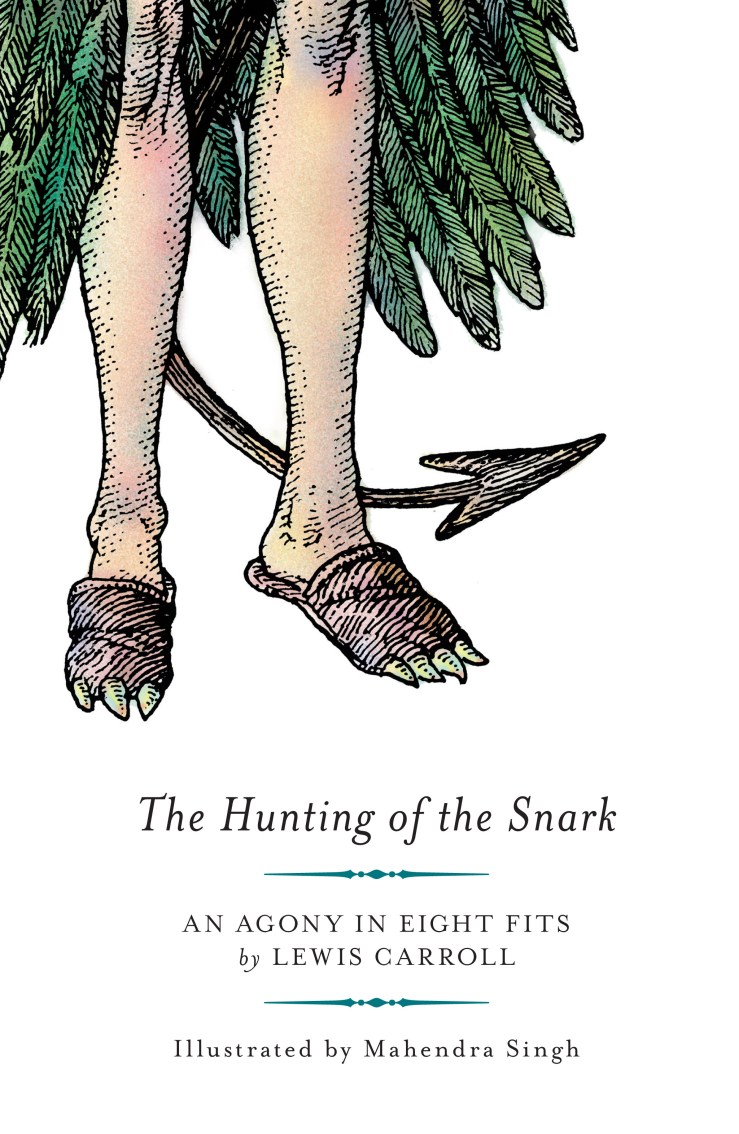
The Hunting of the Snark — Lewis Carroll (with Surreal New Illustrations by Mahendra Singh)

I scrapped my first two drafts for a review of Melville House’s new edition of Lewis Carroll’s The Hunting of the Snark. The problem was that I was struggling to figure out Carroll’s Nonsense poem (subtitled An Agony in Eight Fits) about a ten man crew who take to the sea, to, you know, hunt a Snark. The Bellman seems to lead them. There’s the Banker, Baker, and other guys whose names start with “b” — including enemies the Beaver and the Butcher (who wind up tight allies). The poem is both silly and dense, rippling with weird wordplay and allusions that are, for the most part, beyond me. It’s often hard to follow, and sometimes has the effect of making the reader (or at least this reader) feel like he’s skating on the surface of some deeper profundities — or, alternately, maybe it’s just Nonsense, to use Carroll’s term.

Anyway. I solve my dilemma by retreating to the real occasion for reviewing the book, namely Mahendra Singh’s marvelous and strange illustrations. Singh, a member of the Lewis Carroll Society of North America (and an editor of their journal, Knight Letter), describes his illustrated version as “fitting Lewis Carroll into a proto-Surrealist straitjacket with matching Dada cufflinks.” In both its imagery and heavy, dark lines, Singh’s project readily recalls one of my favorite books, Max Ernst’s proto-graphic novel, Une Semaine de Bonté, as well as Henry Holiday’s original illustrations for the book. Singh lards his illustrations with visual paradoxes, puzzles, and puns, as well as references to artists ranging from de Chirico and Magritte to Dali and Bosch. There are also nods to pop culture (including the Beatles).  And Freud, because, hey, why not. Observe–

Singh’s puzzles, like Lewis’s, do not immediately reveal their meaning, but of course this is part of the joy of the book. In his instructive afterword, Singh tells us that “each drawing should make some sort of sense of the verse it explains or at least, make Nonsense.”  His greater goal though seems to be to share his love of Carroll with his readers (“in particular the younger ones”), who he hopes will “further pursue on their own that immense cultural heritage which silently — and so faithfully — awaits them.” My three year old daughter enjoyed the book very much, and had the good sense (Nonsense?) not to get too flummoxed over what Snark means. This is probably a wise course to follow. As Singh observes in his afterword, “whenever Carroll was asked what the poem meant, he always replied that he did not know. “Of course, just because its creator didn’t know its meaning (or at least claimed not to) doesn’t mean that Snark doesn’t have meaning–it’s just the kind of ambiguous meaning that floats around on dream logic, and Singh’s surrealism, with its playful, amorphous shifts, is the right choice to illustrate the poem. I’m not sure if “illustrate” is the right verb here, though. Certainly these are illustrations, but Singh’s goal isn’t so much to literally render Lewis’s words in pictures as it is to echo their spirit. Singh’s art works in tandem with the poem, accompanying it through symbolic and metaphorical transfers, arriving at times to weird conjunctions and discordances, and, perhaps, generating new meanings. Recommended.

The Hunting of the Snark is new in hardback this month from Melville House. More at Singh’s blog.

Jonathan Lethem Talks to Patti Smith