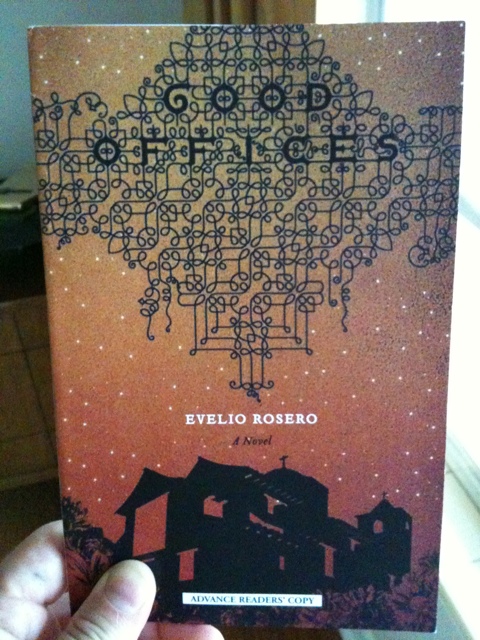
The good people at New Directions were kind enough to send me a copy of Colombian author Evelio Rosero’s novel, Good Offices, a satire of the Catholic Church in Latin America with a hunchback for a hero. I am intrigued. Anne McClean translates. Review forthcoming.
Lars Iyer’s first novel Spurious (Melville House) is by turns, witty, sad, and profound, and garnered serious acclaim on its release earlier this year. Spurious originated in a blog of the same name. There are two sequels on the way—Dogma should be on shelves in early 2012, and Exodus the year after. Lars teaches philosophy at Newcastle University (so it’s no wonder that Spurious reads like a discursive philosophy course by way of the Marx brothers). Lars was kind enough to talk to Biblioklept in depth about his work and writing. In addition to his teaching, writing, and blogging, you will also find Lars on Twitter.
Biblioklept: Your novel Spurious began as a blog and then was published by Melville House, a thriving indie publisher that also began life as a blog. At a recent talk you gave at the HowTheLightGetsIn philosophy and music festival, you discuss the freedom blogging allows for writers to develop their “legitimate strangeness.” Why is “legitimate strangeness” important for writers, and how does blogging help facilitate it?
Lars Iyer: Sometimes it is necessary to depart. Sometimes it is necessary to leave it all behind. That’s how I understood the act of blogging, back when I started Spurious, the blog which shares thesame name as the novel.
As someone who had made some progress as an academic – a journey which implies valuable training as well as compromise and despair – I thought a kind of exodus was necessary, from existing forms of published writing. Leave it all behind!, I told myself. Leave the Egypt of introductory books and academic journals and edited collections behind. Leave the slave-drivers behind, and the sense you have of being a slave. Leave capitalism and capitalist relations behind. Leave behind any sense of the importance of career and advancement. Leave behind those relationships that are modelled on investment and return.
Sometimes a kind of solitude is necessary. You need to be alone, to regather your forces, to marshall your strength. But what is really necessary is a solitude in community. You’re on your own, depending on your own resources. But your solitude is lightened: because you know that there are others like you, who have likewise expelled themselves from captivity; because you know that others share your sense of disgust and self-disgust, that they too have gone out to the desert to do battle with the demons sent by capitalism into each of our souls; because there are others, like you, who see writing as both scourge and liberation, others who see it as a spiritual trial, others looking to destroy who they were and be reborn, and to keep themselves in rebirth.
In the end, the desert is paradise, and the world the blogger has left behind, with its whips and fleshpots, is the real desert.
Cultivate your legitimate strangeness: that was my mantra. ‘Cultivate’, because it is a struggle, a kind of asceticism. To drive the demons out, you have to know that they are there. A kind of self-knowledge is necessary – not the petty narcissism we find in the ‘misery memoir’, but a growing awareness of those forces that have constituted you, that have made you what you are. ‘Your legitimate strangeness’: ‘Your’, because it is yours, your space, the person you are, that you have become, even as you might alter this space, remake it. ‘Legitimate’ – that part of you that is not yet subsumed by capitalism, that free part of yourself that is not a slave. ‘Strangeness’ – because it must appear strange to the slaves and their masters, to everyone around you.
Why is this important to the writer? Some of us write because of our alienation. We have had no one to speak to, no friends, no conversations. There was no one around. Thoreau went to the woods to find himself. We went to our rooms. We went to literature, and philosophy, without knowing anything of literature and philosophy. We worked on our own.
There is something pathetic about this. Shouldn’t we have been fighting the world instead? Shouldn’t we have been ready on the barricades? But there were no barricades. There was no solidarity. We belonged to nothing, and had gone a little mad, a little reclusive, from belonging to nothing.
In one sense, since we lacked education, lacked culture, since our world was not one which valued the ideas and writers that we came to, our exodus was pathetic. We were imitators, play-pretending at being what we are not. We’d come too late; the party was over. We stood in the ruins, and the ruins mocked us. What could we have achieved, that had not been achieved to a much higher level before? What could we have made, that had not already been made, and much more competently, much more measuredly? We lacked the basic skills. We lacked the ability to write – even that. We lacked the breadth of culture, the breadth of scholarship.
But seen in another light, we discovered ourselves as outsiders, like those outsider artists who practiced their vocation outside of institutions. What we made was crude and simple, true — especially when compared to what went before – but it did have a certain power to affect. It had an urgency, a desperation, which might, perhaps, appeal to others. We were capable of only scraps and fragments, to be sure – dreck – but dreck marked by a moving sincerity.
I wondered – and this was the beginning of Spurious, the novel, and of its sequels – whether there was a way of folding this sense of posthumousness, of coming too late and lacking the old skills, into the practice of writing. Maybe it was time to come back from the desert, which had taught me only the extent and depth of my stupidity. Maybe it was time to write with a new kind of writing . . .
A Portrait of the Novelist as a Smiling Man
Biblioklept: That “sense of posthumousness, of coming too late” figures heavily in Spurious. Is Spurious the “new kind of writing” you are aiming for? While the book has a fragmentary, even elliptical quality, it also reminds me of novels in the picaresque tradition. What form does this new kind of writing you invoke take?
LI: Spurious is a book on its hands and knees. For me, it feels like the last book, the last burst of laughter before the world ends. But it also feels like the first one, because it has loosened the hold of the past. It says: a whole form of literary pretence is over.
Writing to a friend, in 1916, before the composition and publication of the work that would make him famous, the philosopher Franz Rosenzweig wrote, ‘My true book will appear only as an opus posthumum: I do not want to have to defend it or know about its “influence”’. He writes something similar, a year later, in another letter: ‘I will only truly speak after my death …, I place my entire life beneath the sign of that “posthumousness”’. Rosenzweig was confident that there would be a culture to evaluate his work. He was confident that there would be a place for his posthumous work among the greats – that there would still be greats, such that he might find his place among them. He was sure, in other words, that the old world would continue as it was; that there would still be master-works, still be the geniuses who wrote them, and still be the critics whose evaluations would be trusted by a general public.
A similar confidence in an author today would be a sign of delusion. Literature is one strand among many in our multi-braided culture. True, it retains something of its prestige; it is studied at universities, reviewed in serious newspapers — but it occupies an increasingly marginal role. The ‘great names’ are, for the most part, only cultural markers, ready for commercialisation (Kafka oven gloves in the tourist shop in Prague; the Brontë Balti House in Haworth; the Pride and Prejudice fully immersive interactive environment). But it is not only marginalisation that should be feared; recognition, too, should be. I think of the stupidity of documentary ‘infotainment’ on writers and artists, and rise of the vast, say-everything biography, that says nothing at all (as Mark Fisher has written, the biography is an end of history form, making the reassuring claim that ‘it was all about people’).
Literature continues. But it does so, in contemporary literary fiction, as a kind of empty form. As the anonymous blogger of Life Unfurnished has put it: contemporary literary fiction gives ‘the appearance alone of literature’; it is a genre ‘in which, for the writer, the sense of Writing Literature is dominant, and, for the reader, the sense of Reading Literature is dominant’.
Reviewing Jean-Luc Godard’s film Every Man For Himself, Pauline Kael writes, ‘I got the feeling that Godard doesn’t believe in anything anymore; he just wants to make movies, but maybe he doesn’t really believe in movies anymore, either’. Without agreeing with Kael’s assessment of Godard, I’d like to paraphrase her formulation: I think literary writers want to write literary fiction without believing in literature – without, indeed, believing in anything at all.
It seems to me that the literary gestures are worn out – the creation of character, plot, the contrivance of high-literary language and style as much as the avoidance of high-literary language and style, and the abandonment of most elements of the creation of character and plot. The ‘short, elliptical sentences’ of which the blogger of Life Unfurnished writes, the ‘absence of fulsome description’, the ‘signs of iconoclastic casualness’, the ‘colloquialisms’, the ‘lack of trajectory’, the ‘air of the incidental’: all are likewise exhausted.
What, then, is to be done? As writers, as readers, we are posthumous. We’ve come too late. We no longer believe in literature. Once you accept this non-belief, once you affirm it in a particular way, then something may be possible.
Witold Gombrowicz seems to advocating a return to older forms of literary insouciance: ‘Where are the good old days, when Rabelais wrote as a child might pee against a tree, to relieve himself? The old days when literature took a deep breath and created itself freely, among people, for people!’ But we cannot simply return to Rabelais, as Gombrowicz knew. Too much has happened! If a kind of self-consciousness is a distinguishing mark of the contemporary literary novelist, this is not something that can be relinquished altogether. The role of centuries of writing – of the rise of the nineteenth century bourgeois novel, of modernism and so on – must be marked.
But it can be marked by portraying our distance now from the conditions in which the great works of literature and philosophy were written. W. and Lars, the characters in Spurious, revere Rosenzweig. But this is also reverence for a culture that would deem Rosenzweig and his work important – a culture that is completely different from the one which W. and Lars occupy. True, they revere contemporary masters, too – the filmmaker Béla Tarr, for example – but Tarr lives far away, in very different conditions. W. and Lars occupy the world of the present, and the world that valued the ideas they value, the world that sustained those ideas and nurtured their production, has disappeared. Much of the humour of the book comes from the fact that its characters are men out of time – gasping in awe at Rosenzweig’s work at one moment, leafing through gossip magazines at another; proclaiming a great love of Kafka one minute, playing Doom on a mobile phone the next.
It is in this sense that there might appear to be an overlap between Spurious and novels in the picaresque tradition, which extends from sixteenth century Spain to the present day. Picaresque, it has been argued, appears as a result of a tension between an old world and a new one. The Spain of the first picaresque novels was in a period of difficult transition, from the stability of the medieval order to the age of a new, self-assertive individuality. Poverty and war were all around. The picaresque is produced in a world where human solidarity is lacking, and the individual no longer has a place in the world. The episodic journeys of the picaresque novel reflect the lack of coherence of its central characters, the lack of secure identity – a kind of cosmic loneliness.
Some picaresque features can be found in Spurious. The novel is episodic, and its characters lack a place in the world, even a place in history. W. and Lars play-pretend at various roles, trying on the mantle of the religious person or the philosophical thinker. W., in particular, yearns after friendship. But the characters are not roguish, as the picaro of a picaresque novel is supposed to be. W. is perfectly sincere. And picaros do not usually come in pairs.
Biblioklept: Speaking of your pair Lars and W., there’s a strong friendship there that strikes me as very realistic and actually quite moving. Reading Spurious I was reminded strongly of one of my own friendships, which is perhaps based on equal parts degradation and love. Lars and W. evoke both extreme pathos and a kind of deep existential anxiety that manifests in humor. Parts of Spurious read almost like verbal slapstick (if that metaphor can hold any water). How important is humor—what do you think the humor in Spurious is “doing”?
LI: Humour? I’m with Gilbert Sorrentino: ‘In a country such as ours we have reached a point at which there is hardly anything left to do but laugh or cry. It’s a kind of hysterical laughter, it’s strained and unreasoning laughter, or it is a morbid, bleak sobbing. I don’t think that anything is going to get changed in this country except that it’s going to become grimmer’.
Sorrentino’s referring to the USA, but he could just as well be referring to the UK. We lack the grounds for belief, for hope, for a future. There’s economic disaster — not simply the credit crunch, but neoliberalism in general: corporatisation, unemployment, job insecurity, casualisation, the privatisation of public utilities. Beyond this, there are the effects of climate change: drought and hunger, failure of whole nations, wars, migrants. The temptation of ‘morbid, bleak sobbing’ is extreme, as is the desire to drink oneself into oblivion like the barflies in Béla Tarr films.
Sometimes, it feels that there is an imposture in the very fact of being alive. It is as though getting out of bed in these terrible conditions were already an imposture, let alone trying to think or write. What can we do, really do, about the disaster? ‘To hope is to contradict the future’, Cioran says somewhere. Better to lie down and wait for the end. Better to give up before you begin.
‘I think joy is a lack of understanding of the situation in which we find ourselves’, Andrei Tarkovsky says, with marvellous ill-temper. And, on another occasion: ‘I accept happiness only in children and the elderly, with all others I am intolerant’. It’s true that joy and happiness seem ill-suited to our times, all the more in that joy and happiness are promoted in that ideology of positivity which is everywhere today. But perhaps there is a sense in which one might legitimately laugh at the apocalypse, albeit with what Sorrentino calls a ‘hysterical laughter’.
A sage in the Ramayana tells us that there are three things which are real: god, human folly, and laughter. ‘Since the first two surpass human comprehension’, he says, ‘we must do what we can with the third’. So we must laugh at folly, laugh at greed and smugness, opportunism and corruption, as eternal flaws in the human condition; laugh, and dream of a better world, knowing that it won’t come.
But this kind of laughter is too genial for me. It treats human folly as eternal, which I’m sure in many ways it is, but ignores suffering, dying, the real hell of our globalised world. And I worry that it also spares the one who laughs. True, you can laugh retrospectively at your own stupidities. What an idiot I was when I young!, you might say. But there is a broader sense in which we are, each of us, implicated in the present state of the world. It is our responsibility, in some important way. For me, to laugh sagely at one’s own foolishness is still too little.
What is the humour of Spurious doing, then? As many reviews of the novel have shown, the ‘verbal slapstick’ of the characters is part of a whole tradition of double acts and comic routines. I wanted W.’s insults of Lars to exhibit the same virtuosity as the physical humour of the Marx Brothers or Buster Keaton. I think there is a whole art of the insult. But I think something else is going in the novel, too.
Alenka Zupančič argues that comedies are never truly intersubjective. ‘[C]omedy is above all a dialogical genre’, she grants; but comic heroes are ‘extracted, by their passion, from the world of the normal intersubjective communication’. What they are really doing is seeking ‘to converse solely with their ‘it/id”’. Dialogues, in comedy, are really monologues; the hero is really only obsessed with his basic, chaos-ridden drives. As Zupančič suggests, ‘The comedy of such dialogues does not come from witty and clever exchanges between two subjects, or from local misunderstandings that make (comic) sense on another level of dialogue, but from the fact that the character is not really present in the dialogue he is engaged in’. On this account, the cruelty of the ‘verbal slapstick’ of the friendship in Spurious, which sees W. continually berating his poor friend, would actually be directed at W. himself. W., the only candidate for being the ‘comic hero’ of Spurious, would use Lars as merely the occasion for the continuation of his monologue.
But this interpretation doesn’t quite work for me, either. The ‘it’ that drives the exchanges of the characters is not only a feature of W.’s psychic makeup, of the chaos of his drives. Both characters are mesmerised by a real disaster. And both — particularly W. — are mesmerised by their partial responsibility for this disaster. The ‘strained and unreasoning’ laughter of Spurious is a response to the grimness of the world that is of our making.
Biblioklept: For me, that “strained and unreasoning” laughter is a big part of why I enjoyed the book—I identified with the characters. Spurious isn’t really, to borrow a phrase from David Shields, a “novelly-novel,” but it does have elements of a “novelly-novel” (including characters with whom some readers will strongly identify). At the same time, its short sections, fragmentary nature, and willingness to cite entire paragraphs of other texts point to a new kind of writing, one perhaps anchored in its origins as a blog. How did you compose Spurious? How does the novel differ from the blog?
LI: ‘A page is good only when we turn it and find life urging along …’, says one of Calvino’s characters in Our Ancestors. I hope that’s what a reader can find in Spurious: life urging along. I hope readers recognise something of their own friendships in that of W. and Lars. Spurious is not, I think, a ‘novelly-novel’. It’s new in some way – it has characters, some elements of plot, but it doesn’t resemble other books. And I think this is due to its origins. Blogging, and then combining different categories of posts, allowed me to discover, through editing, a new kind of novel.
Blogging demands immediacy. Telling the story of W. and Lars, I couldn’t rely on readers having followed it from the start. Every day, with my blog posts, I had to present these characters and their situation anew, and in a manner vivid enough to engage any potential reader. In doing so, I felt rather like the writer of a strip cartoon. Charles Schultz’s Peanuts had longer narrative arcs, but each sequence he published in daily newspapers had to stand on its own. Likewise with the posts at the blog. Each post had to have its own internal drama, a kind of ‘verbal slapstick’, even as it could be contained within a larger narrative arc.
My loyalty was, for a long time, to the readers of my blog, and I produced new material for them daily. But I thought some of the thematic strands developing at the blog – the trips to Freiburg and Dundee, for example, or the reflections on Kafka and on the Messiah – were being obscured by the quantity and disparateness of W. and Lars material. A selection had to be made. This is where the work of editing began, of the practice of literary montage that would lead to Spurious.
Tarkovsky, in his book about film, narrates the long process of assembling the various fragments that comprise the finished film, Mirror. ‘I am seeking a principle of montage which would permit me to show the subjective logic — the thought, the dream, the memory — instead of the logic of the subject’, he said. He was looking for a way to combine various elements – short narrative sequences, pieces of music and poetry, etc. – into a living whole.
I was doing the same thing, in my own way. Spurious is a hybrid of many elements of the blog. There was a story about W. and Lars, but also one about damp –– a real story, which I wrote about at the blog. I added quotations, too, as well as incorporating the narratives of the lives of various thinkers. And I edited until I felt that life was urging along.
Biblioklept: Have you ever stolen a book?
LI: I have thousands of pages of photocopies, which I made, full of ardour, during my first jobs as an academic. I thought I’d never get a permanent job, and wanted to make my own library of knock-off books in my rented room. Perse, Trakl, Tsvetayeva, Duras, and so many others: no printed book could mean as much to me as my annotated duplicates.
Literature has a unique power to echo not just from the past into the future, but also backwards through time—later works can somehow cast shadows on earlier ones, and later details of a writer’s biography sometimes seep into fiction that the writer produced earlier. Take for example Edgar Allan Poe. He published his long poem “The Raven,” about a man mourning his lost love, two years before the death of his wife, yet the autobiographical detail nevertheless freights the work with deeper emotional weight. Poe was a hero to Roberto Bolaño (“The honest truth is that with Edgar Allan Poe we would all have more than enough good material to read”), whose own early death seems to haunt the writing that came before it. In turn, the late opus 2666 seems to cast a huge shadow over the rest of Bolaño’s fiction, which of course preceded it. I’ve argued before that 2666 is the labyrinthine culmination of the Bolañoverse, a mirror-world of dread and paranoia and violence and literary criticism and strange beauty. The Third Reich, one of Bolaño’s earliest novels, now in its second part of a four-part serialization from The Paris Review, continues to show Bolaño gesturing toward the beast that would become 2666.
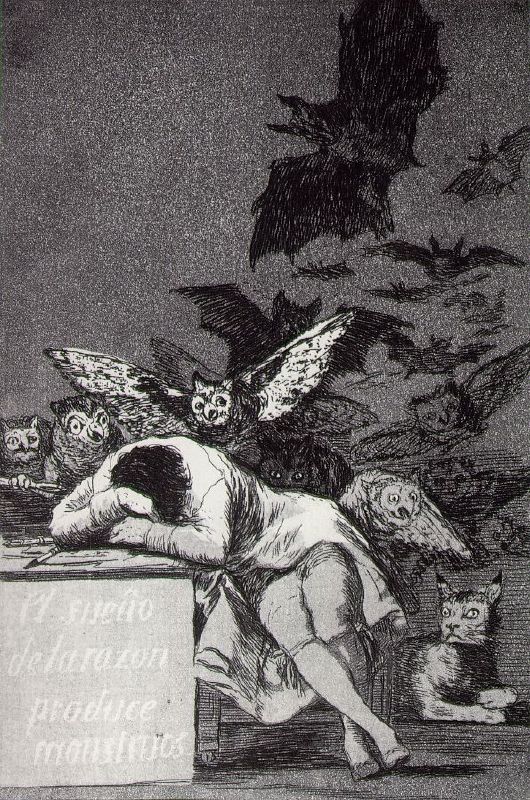
The Sleep of Reason Produces Monsters -- Goya (1797)
If 2666 impossibly haunts The Third Reich from the future, then paranoid Poe haunts it from the past. Last time we checked in, Udo Berger and his beautiful girlfriend Ingeborg had made tentative friends with another German couple while spending the summer at a seaside resort in Spain. Through this pair, they meet up with two nefarious locals, the Wolf and the Lamb; Udo also begins obsessing over a man named El Quemado, a burn victim who rents paddle boats to tourists. For Udo, the holiday is meant to be a working vacation—he’s a wargame enthusiast, and he plans to write a defining strategy for a new game called “The Third Reich” (implicitly, he plays the Nazi’s side). In the meantime, he’s also taken with the hotel’s owner, Frau Else, a German transplant who mysteriously disappears to take care of an ill husband who no one seems to see.
The first part of The Third Reich (published in the Spring ’11 issue) set the stage for dread, mystery, and extreme paranoia—all while on a sunny seaside holiday. The set-up recalls the seemingly innocuous first section of 2666, “The Part About the Critics,” where four European literature professors spend a vacation of sorts in sunny Mexico while ostensibly searching for a mysterious author. The Third Reich showcases the same sinister tension, describing—but never explaining—the stress between differing cultures, the radical alterity of “being on holiday,” of “vacating,” of being in a different place for a different purpose than what is usual, normal.
The second part of The Third Reich (in the new Summer ’11 issue) increases the dread and paranoia, all with a strange, mordant humor. The novel’s conceit is that the writing is Udo’s holiday’s journal; as such, he controls not only perspective and tone, but what details we learn—or don’t learn. It’s what Udo leaves out that becomes increasingly distressing and fascinating. Indeed, at a crucial point in the novel, Udo fails to explain to us why he remains in Spain after his holiday should be over, even as Ingeborg returns to Germany. There is an ostensible explanation—Charly has disappeared and Udo perhaps wants an answer to the mystery (I will withhold further details for fear of spoiling the plot). It seems more likely that Udo remains to work out his strategy for “The Third Reich”; he finds an unlikely gaming partner in El Quemado. Indeed, the wargame begins to define Udo’s perspective at all times—
When I saw from the balcony that the bathers were beating a mass retreat toward the hotels and campgrounds, I went down to the beach. It’s a sad time of day, and the bathers are sad: tired, sated with sun, they turn their gazes toward the line of buildings like soldier s already sure of defeat; with tired steps they cross the beach and the Paseo Maritimo, prudent but with a hint of scorn, of arrogance in the face of remote danger, their peculiar way of turning down side streets where they immediately seek out the shade leading them directly—they’re a tributue—toward the void.
German nihilism on holiday! Still, Udo finds perverse joy in his gaming sessions with El Quemado; in these episodes, his tone escalates to a manic pitch, reminiscent of some of Poe’s crazies (the narrator of “The Tell-Tale Heart” comes to mind in particular), as well as the mounting insanity of Oscar Amalfitano in 2666. And, just as in the early parts of 2666, The Third Reich begins to buzz with rumors of rape. Udo hints at these rumors, but is unwilling to explore them. Also mysterious is the identity of Frau Else’s husband, a pointedly Gothic conceit, of course, that nonetheless may be the beating heart of horror at the center of the story. He haunts Udo’s sleep—
I dreamed that someone was knocking at the door. It was nighttime and when I opened the door I saw someone slipping down the hall. I followed. Unexpectedly we came to a huge dark room filled with the outlines of heavy old furniture. The smell of mildew and dampness was strong. On a bed a shadowy figure was twisting and turning. At first I thought it was an animal. Then I recognized Frau Else’s husband. At last!
I’ve done my best to omit some of the sharp twists in this section of The Third Reich for fear of spoiling the book, but I will add that Part II ends with something of a subtle cliffhanger (as I write the term “subtle cliffhanger” I realize that it is pure oxymoron; mea culpa). In any case, I’m enjoying the serialization very much and look forward to reading Part III.
LM: You Bright and Risen Angels is a long, difficult, obsessive work. Were you aware when you were writing it that it was going to be difficult for this book to attract a large audience? In other words, is audience much of a consideration for you when you’re starting out with something, or do you just write the book you feel compelled to write?
WV: I just make the best book that I can and try to not worry about audience or if it will sell. The odds are against you, so why abuse your talent for the sake of a chimera? The only real pleasure for me in writing comes from pleasing myself. What readers think is interesting and illuminating (and it may even be correct), but that is nothing compared to the excitement of seeing a world develop. Besides, even though I like most individuals I meet, I have a pretty low opinion of people in general. So if I were to write for people in general, I would have to drastically lower my estimation of the intelligence of my reader. Rather than doing that, I write the way it seems the book has to appear. I don’t think that’s egotistic. There are often things I would like to include in my books—things about me personally and other materials—that I feel I have to leave out because they aren’t relevant to the book. I’m fairly ruthless along those lines, because I try to let nothing come in the way of what’s best for the book. If that means that the book won’t sell or that a publisher won’t buy it, then that’s my problem. I’ll suffer for that, but I won’t let the book suffer for it.
Today is Raymond Carver’s birthday. Read excerpts of Carver’s letters to his editor Gordon Lish at The New Yorker. A few highlights (the letter from July 8, 1980 is fantastic and should be read in full, by the way)—
July 15, 1970
Hombre, thanks for the superb assist on the stories. No one has done that for me since I was 18, I mean it. High time I think, too. Feel the stories are first class now, but whatever the outcome there, I appreciate the fine eye you turned on them. Hang tough.
February 1, 1979
I’m going to Mardi Gras with Tess; and the Fords are coming down in March for spring break and we’re going into Mexico by train for a week. . . . I’m happy, and I’m sober. It’s aces right now, Gordon. I know better than anyone a fellow is never out of the woods, but right now it’s aces, and I’m enjoying it.
July 8, 1980, 8 a.m.
Dearest Gordon,
I’ve got to pull out of this one. Please hear me. I’ve been up all night thinking on this, and nothing but this, so help me. I’ve looked at it from every side, I’ve compared both versions of the edited mss—the first one is better, I truly believe, if some things are carried over from the second to the first—until my eyes are nearly to fall out of my head. You are a wonder, a genius, and there’s no doubt of that, better than any two of Max Perkins, etc., etc. And I’m not unmindful of the fact of my immense debt to you, a debt I can simply never, never repay. This whole new life I have, so many of the friends I now have, this job up here, everything, I owe to you for “Will You Please.” You’ve given me some degree of immortality already.
January 21, 1983
What’s the matter, don’t you love me anymore? I never hear from you. Have you forgotten me already? Well, I’m going back to the [Paris Review] interview and take out all the good things I said about you.
A sample of Roberto Bolaño’s short essay “Translation Is an Anvil” (from New Directions’ forthcoming Between Parentheses, a collection of Bolaño’s essays, newspaper columns, and other ephemera)——
How to recognize a work of art? How to separate it, even if just for a moment, from its critical apparatus, its exegetes, its tireless plagiarizers, its belittlers, its final lonely fate? Easy. Let it be translated. Let its translator be far from brilliant. Rip pages from it at random. Leave it lying in an attic. If after all of this a kid comes along and reads it, and after reading makes it his own, and is faithful to it (or unfaithful, whichever) and reinterprets it and accompanies it on its voyage to the edge, and both are enriched and the kid adds an ounce of value to its original value, then we have something before us, a machine or a book, capable of speaking to all human beings; not a plowed field but a mountain, not the image of a dark forest but the dark forest, not a flock of birds but the Nightingale.
The memoir-in-food is something of a cliché at this point, but Gabrielle Hamilton’s new book Blood, Bones & Butter came with enough accolades (including a glowing blurb from Anthony Bourdain) and positive early reviews (like Kakutani’s at The NYT) for me to spend a few hours thumbing through it. Much has been made of Hamilton’s writing bona fides (an MFA in fiction writing from University of Michigan), and while she can put a sentence together without relying on the stock phrases and tropes that lard most memoirs these days, that skill wouldn’t really matter if she didn’t have a tale to tell. Blood, Bones & Butter follows a strange culinary career (it’s subtitled The Inadvertent Education of a Reluctant Chef), complete with drug abuse, theft, and, of course cooking. Only I wish there was more cooking, more time in the kitchen, the butcher’s, the market. Instead, Hamilton seems to channel her (often mean-spirited) energy on her family; her parents’ divorce hangs over the narrative like a Greek tragedy, and her own attitude toward her husband is bizarre, to say the least. The results are mixed, but fans of food-writing à la Bourdain’s Kitchen Confidential will likely enjoy Blood, Bones & Butter. New in hardback from Random House.
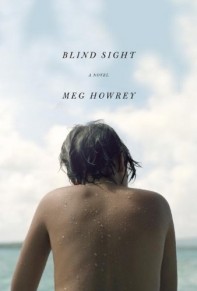
Meg Howrey’s new novel Blind Sight tells the story of Luke Prescott, a bright, introspective seventeen year old obsessed with brain biology. Raised by a hippie mother and two half-sisters, Luke gets the opportunity to the summer before college with his estranged father, a famous television star. In Los Angeles, Luke gets to know his father better, sorting out the difference between public persona and private truth; this process in turn leads Luke to re-evaluate his own sense of identity. There’s also some pot-smoking and sex. Howrey moves the narrative between Luke’s first-person voice (in the past tense) to a third person present tense narrator. At times this disjunction seems like a lazy shorthand to allow the reader to see something Luke can’t see (or doesn’t want the reader to see), but it works nicely on the whole, underlining the gaps between truth and belief that the novel seeks to explore. Blind Sight is new in hardback from Pantheon.
In The Woman Who Shot Mussolini, Frances Stonor Saunders plays historical detective, reconstructing the story of Violet Gibson, who fired on Mussolini in April of 1926 (she grazed his nose). Gibson, the daughter of the Lord Chancellor of Ireland, was 50 when she shot Mussolini, and perhaps more than a little crazy. She was almost lynched after shooting Il Duce, but the not-so-benevolent dictator pardoned her, and she was quickly returned to England, where she spent the rest of her life in an insane asylum. Saunders’s book explores whether Gibson’s attack was the motivation of an insane woman or part of a bigger conspiracy theory, illustrating her mystery with poignant black and white photos. And although Saunders focuses on the little-known Gibson, she works to draw parallels between the would-be assassin and Mussolini. Saunders’s exploration of an otherwise unremarked upon episode balances historical scholarship with the pacing and rhythm of an historical thriller. New in trade paperback edition from Picador.
According to a number of sources, including Neil Gaiman and the fan-operated site she approved of, author Diana Wynne Jones has passed away after fighting cancer. Jones wrote dozens of novels, mostly in the fantasy genre, for adults and children alike, although she is perhaps most known for Howl’s Moving Castle, which Hayao Miyazaki adapted into an excellent film in 2004. Jones’s work bears comparison to the Harry Potter series, and recent reissues of her novels insure that a younger generation will have access to her work.
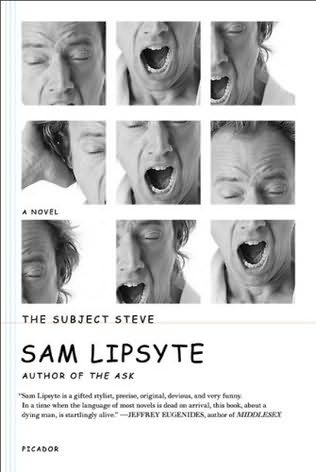
A few years ago, I wrote about cult novels, and, in trying to define them, I suggested that “a cult book is not (necessarily) a book about cults.” Sam Lipsyte’s first novel The Subject Steve is a cult novel about a cult, or at least heavily features a cult. Like many cult novels, there’s an apocalyptic scope to Steve, one in this particular case (or subject, if you will), that extends from the personal to the universal.
I’ll let Lipsyte’s compressed acerbic prose spell out the book’s central conflict—
The bad news was bad. I was dying of something nobody had ever died of before. I was dying of something nobody had ever died of before. I was dying of something absolutely, fantastically new. Strangely enough, I was in fine fettle. My heart was strong and my lungs were clean. My vitals were vital. Nothing was enveloping me or eating away at me or brandishing itself towards some violence in my brain. There weren’t any blocks or clots or seeps or leaks. My levels were good. My counts were good. All my numbers said my number wasn’t up.
The problem of death, or the problem of how to live a meaningful life against the specter of death, is of course an ancient conceit, and Lipsyte makes it the core of his book, upon which he hangs an often shaggy picaresque plot. The Subject Steve is post-modernist caustic satire in the good old vein of Candide; put another way, it’s just one damn thing happening after the next.
So, what are some of those things that happen? Steve (not his real name) is condemned to die of a disease with no name; he tries to make contact with his estranged wife and not-quite-a-genius daughter; he blows his life savings on hookers and blow; he heads upstate to a cult’s compound in the hopes of finding a cure to his unnamed (unnameable) disease; he suffers the cult’s sadistic practices; he escapes the cult’s sadistic practices; he reunites with his wife and daughter; he abandons his wife and daughter; he reunites with a new version of the cult somewhere in the Nevada desert; he becomes enslaved by the cult in the Nevada desert; he escapes the cult; &c. And he reflects on his life (and his death) repeatedly. I’ll let Steve reflect on his life at length, if for no other reason than to share more of Lipsyte’s marvelous prose—
And I was still dying, wasn’t I? Who would note? What had I ever noted? I’d taken my pleasures, of course, I’d eaten the foods of the world, drunk my wine, put this or that forbidden particulate in my nose until the room lit up like a festival town and all my friends, but just my friends, were seers. I’d seen the great cities, the great lakes, the oceans and the so-called seas, slept in soft beds and awakened to fresh juice and fluffy towels and terrific water pressure. I’d fucked in moonlight, sped through desolate interstate kingdoms of high broken beauty, met wise men, wise women, even a wise movie star. I’d lain on lawns that, cut, bore the scent of rare spice. I’d ridden dune buggies, foreign rails. I’d tasted forty-five kinds of coffee, not counting decaf.
I love this passage. In almost any other book I can think of, the final detail about coffee would puncture the passage’s inflation, serve as a comic anti-climax. In Lipsyte’s phrasing it’s both tragic and triumphant.
I don’t mean to gloss over the plot of The Subject Steve, but the book’s narrative, its sense of time, is so radically compressed (again, I think of the compression of Candide) that reading it is more like experiencing a rapid series of scenarios. I’m particularly fond of books like this, that seem to ramble and erupt in strange and unexpected moments. I think of Ellison’s Invisible Man or Woolf’s Orlando, but there’s also something of Aldous Huxley in Steve, that apocalyptic-comic axis, the satire of despair. The book is one of those pre-9/11 novels (forgive the phrase) that seems utterly prescient. Take the following observation for example—
Someday sectors of this city would make the most astonishing ruins. No pyramid or sacrificial ziggurat would compare to these insurance towers, convention domes. Unnerved, of course, or stoned enough, you always could see it, tomorrow’s ruins today, carcasses of steel teetered in a halt of death, half globes of granite buried like worlds under shards of street. Sometimes I pictured myself a futuristic sifter, some odd being bred for sexlessness, helmed in pulsing Lucite, stooping to examine an elevator panel, a perfectly preserved boutonniere.
The language here anticipates the Dead America that Lipsyte explores in his latest novel, The Ask, and reinforces a general argument I’d like to make, which is that Lipsyte is at heart a writer of dystopian fictions, fictions so contemporary that their dystopian nature becomes effaced.
These dystopian tropes coalesce in the frantic, hyperbolic ending of Steve, where our subject becomes the object of a bizarre cult’s ritual sadistic practices, all available via the panopticon of the internet. Lipsyte’s vision is of a post-human existence, a radical otherness of degradation through technological alienation. At this late moment in the book, the satire is so black that even Lipsyte’s tightest, pithiest sentences fail to elicit a laugh or a smile — indeed, I am almost certain that they are not intended to do so. Instead we are immersed in the apocalyptic horror of dehumanization (the book here reminded me of Hunter S. Thompson’s Fear and Loathing, of all things, both in its desert location and in its gradual movement from sardonic humor to vivid terror).
Like any cult novel, or destined cult novel, The Subject Steve is Not For Everyone. Those looking for plot development and tidy endings will not find them here, and, if the tone of this review has not already made it clear, the book is extremely dark. But it’s also very, very funny, and there are few stylists working today who can match Lipsyte’s mastery of the sentence. Highly recommended.
The Subject Steve is now available in trade paperback from Picador.
Sam Lipsyte read live from his novel The Ask last year on HTML GIANT’s Ustream channel. The reading was cool but the best part was the q&a session afterward. We asked Lipsyte the one question all true biblioklepts are dying to know (and the one question we ask every person we interview): “Have you ever stolen a book?”
Vodpod videos no longer available.
Here’s Lipsyte’s response, which you can hear/see at 31:25 in the video:
‘Have you ever stolen a book?’ There was one time when I stole a few books when I worked in a library; it was a university library and my job was to stick the metal strips into the spines of the books that would set off the alarm. And so if a particularly good book came through (and this only happened three or four times) I just wouldn’t–I don’t know if I’d call it stealing–but I wouldn’t put the strip in. And then once it was shelved I would take it.
That’s a pretty sophisticated operation. Kudos to Lipsyte for his candor.
[Editorial note: Biblioklept ran a version of this review last year; we run it again in the spirit of Sam Lipsyte Week].
In Sam Lipsyte’s 2004 novel Home Land, minor loser Lewis Miner sends missives to his high school alumni newsletter, Catamount Notes, about his awful, sad misadventures in small-time drug use, petty copy-writing, itinerant busboyism, and chronic masturbation (he has a strong erotic disposition toward leg warmer porn. If this idea repels you (with no reciprocal attraction) this book is not for you). Miner wants to be sweet but he can be mean. He’s obsessed with the past–and who can blame him? His nickname in high school was Teabag, an appellation literally thrust upon him by the dumbest of jock-bullies. He carries this kernel of spite for years like a pebble in the sock, one that rubs up a giant blister–Miner is all blister. Writing ostensibly to his former classmates, but really just for himself, another form of masturbation:
It’s always been this way, as many of you might recall. Somebody chucks a snowball, I’m scouring the school yard for rocks. The bully just wants to shove sadness around, shake me down for spare change, I’m looking to scrape out his eye. I lack a sense of proportion. I have no sensitivity to sport. I’m the aggrieved rider on the grievous plain. I’m still pissed about the parade.
For all his anger though, Miner is an engaging, preternaturally sensitive voice. Along with his best friend/foil Gary, he muddles through a wretched life, finding solace (and an outlet for an outsized comic voice) in his letters to Catamount Notes–even if disgraced Principal Fontana won’t publish them. Despite his censorious discretion, Fontana reignites a downright silly mentorship with Miner. Fontana, a man after Holden Caulfield’s heart who calls everyone a “phony,” plays a weird father-figure to our favorite loser (even though Lewis’s own “Daddy Miner” is an ever-present terror in this tragicomedy).
Fontana, Daddy Miner, and the other characters in Home Land often feel like props rather than fully-drawn beings. Take the aforementioned Gary, for example, flush with cash after suing the hypnotherapist who convinced him that his parents sexually abused him repeatedly as part of elaborate Satanic rituals. His ridiculous past is par for course in the book. Such characters are the stock-in-trade of Home Land; they are, paradoxically, both its strength and weakness, beings who seem to speak entirely in misplaced metaphors and fucked-up aphorisms. There are too many of them for the book’s 200 pages. The fast writing never sags under the huge cast, but, nonetheless, its spine, its plot, its quick rhythm can’t bear their weight. There’s a much bigger novel here, but I don’t think I’d want to read it. Even Lipsyte’s normals are grotesques–or maybe it’s just Miner’s bilious perspective. In any case, sympathy is in short supply in Catamount country.
None of this is meant to disparage the reading experience of Home Land, which is marvelous, quick, funny, and a little bit gross (in a good way). Lipsyte crafts his sentences with a concrete, witty excellence that is near unrivaled in contemporary lit. It’s true that he sacrifices the depth of his characters here from time to time, and then includes passages that add nothing to the plot as a whole, like this one:
An older shapely woman swerved past on rollerblades. Bronzed, undulant in black Lycra, she clutched a pack of menthol cigarettes, danced on her wheels to something pumped through headphones. It was an admirable kind of ecstasy, hard-won. I wanted her for a lewd aunt.
That last line, of course, tells us so much about Lewis Miner and is also indicative of his overall method of storytelling. Not that he sees his letters to his alumni newsletter as part of a larger narrative–indeed, he’s to be forgiven all his esoterica, his mean, incisive commentary on contemporary life that doesn’t add up. Halfway through the book he tells us:
It occurs to me, Catamounts, sitting here composing this latest update, that someday, if and when the collected works of Lewis Miner ever see the light of day, some futuristic editor-type might attempt to assemble these dispatches in a certain manner, to, for example, tell a story, or else effect some kind of thematic arrangement of interwoven leitmotifs: Work, Love, Masturbation, Gary.
This would be a mistake. There are no leitmotifs. There is no story.
Miner then goes on to makes a pretty convincing case against stories (or at least against narrative arcs) and, tellingly, Home Land is better as a series of ugly, gross, hilarious anecdotes than it is as a novel with a traditional character arc. Which it is–a novel with a traditional character arc, climax, all that good stuff. Strangely, this is the book’s biggest failure. But that failure doesn’t get in the way of what is a pretty great and often very funny reading experience. Miner’s voice is a pleasure to inhabit for a while, a postmodern Falstaff heavy on the self-loathing. Home Land is a quick, easy read, a novel destined for cult-status, and Lewis Miner’s pathetic ironic braggadocio will hit home for many folks. Recommended.
Home Land is available in trade paperback from Picador.
[Editorial note: Biblioklept ran a version of this review last year; we run it again in the spirit of Sam Lipsyte Week].
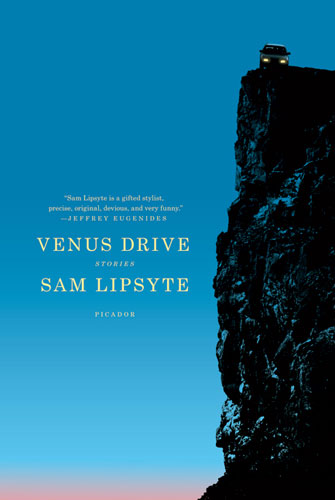
The thirteen stories in Venus Drive compose a sort of novel-in-stories. The title of the collection takes its name from a banal suburban street mentioned in a few of the stories, and many of the characters seem like iterations of the same type or voice. There are washed up would-be indie rock stars, small-time coke peddlers, and underemployed and overeducated addicts. There are deviants and perverts and outsiders. There are bullies. There are dead or dying mothers, dead or dying sisters. In short, Venus Drive is its own tightly-drawn, tightly-coiled, and highly-compressed world.
As the plot points double and re-double in these stories, so do the themes. “Our culture is afraid of death, and considers it something we must wage battle against,” says Tessa, a pain specialist, a peripheral character in “Cremains.” She continues: “I say, surrender, submit. Go gentle. Terminal means terminal.” Death informs almost all of these stories in some way, and Tessa’s commentary presents the problem with death, or at least the problem these characters have with dealing with death: it’s not easy to go gentle. It goes against our culture and our nature to surrender. If she’s presented as a voice of wisdom, she’s also an ironic character, one of the many would-be authorities Lipsyte’s weirdos and outsiders can’t help but mock. “The Drury Girl,” part-suburban satire and pure pathos, posits a pre-pubescent narrator obsessed with his teenage babysitter; his dad’s cancer plays second fiddle to his lust. Thus the story neatly ties together the overarching themes of Venus Drive, sex and death. Admittedly, these are probably the only real themes of proper literature, but Lipsyte does it so damn well and lays it all out so bare and does so in such humor and grace that it really sticks. It’s good stuff.
That humor is desert-dry, of course, and succeeds so well because his characters are so endearing in their pathetic pathologies. The antiheroes of “Beautiful Game” and “My Life, for Promotional Use Only,” are also-rans in the sordid history of underground rock, addicts approaching washed-up (Are they the same person? Maybe. They have different names, of course. Doesn’t matter). A scene from “Beautiful Game” shows the ambivalence at the core of many of these characters: “At the bank machine, Gary doesn’t check the balance. Better to leave it to the gods. Someday the bank machine will shun him. Why know when?” Gene, the ex-rocker in “My Life, for Promotional Use Only” now suffers the indignities of working for his ex-girlfriend. Everyone in the story is an ex-something, everyone is growing up and leaving art (or is it “Art”?) behind. In a poignant and funny and cruel scene, familiar to many of us, Gene sees some of himself in a waitress:
Rosalie calls over the waitress and they talk for a while about somebody’s new art gallery. The waitress is famous for a piece where she served the Bloody Marys mixed with her menstrual blood. Word had it she overdid the tabasco.
I wait for the moment when our waitress stops being a notorious transgressor of social mores and becomes a waitress again, look for it in her eyes, that sad blink, and order a beer.
Gene, a former “notorious transgressor of social mores” himself feels both sorrow and hate for the waitress. He sees her job as menial and pathetic — just like his own. He doesn’t seem to think much of her art, either. Lipsyte telegraphs so much there with so few words, his sentences clean, spare, precise, and rarely of the compound variety. There’s a truncated, clipped rhythm that Lipsyte builds over the thirteen-story run that helps propel the immediacy of his tales. The stories are short, too; the longest is sixteen pages and most run to eight or ten. Lipsyte’s rhetorical gift is to shine the grubby and, at times, his sentences can feel almost too perfect, too-fussed over–but this (minor) complaint, it must be noted, comes from someone who admires occasional ambiguity or incoherence. Lipsyte removes his own authorial voice and thus achieves lucidity in his characters’ voices; somehow, though — and paradoxically — these voices bear the ghostly trace of his absence. But that seems like a silly conversation, and certainly not one for this post.
Venus Drive reminds me very much of one of my favorite books, Denis Johnson’s Jesus’ Son, which I would also call a novel-in-stories, also a spare and precise collection, also a study of weirdos and addicts and outsiders. Jesus’ Son is something of a standard in creative writing workshops (or at least it used to be) and a sensible teacher would add Venus Drive to her syllabus as well. Finally, like Jesus’ Son, Lipsyte’s book is seething, funny, and poignant, with characters tipped toward some redemption, awful or otherwise, for all their myriad sins. The book might take its name from a geographic location, but the “Venus drive” is also a spiritual inclination toward love and hope. Highly recommended.
Venus Drive is available in trade paperback from Picador.
It’s Sam Lipsyte week at Biblioklept. Why? Why not? Okay, here’s a more concrete reason: this month, Picador publishes the trade paperback début of his most recent novel, The Ask, as well as a new edition of his first novel The Subject Steve. We’ll be running new reviews for The Ask and Steve, as well as re-running older reviews, an excerpt or two of Lipsyte’s weird comic goodness, and other odds n’ ends. Like this video of Lipsyte reading from The Ask. Thou hast beenst warnedst.
Hey. Do you like bourbon? I like bourbon a lot. It’s always been of a mild shame to me that the men in my family prefer the smoother stylings of Canadian whiskeys to the more robust corn-fueled liquors we produce here in the south. Now, as to whether Kentucky or Tennessee makes the finer product, I abstain from any definitive opinions (although a particular favorite brand of mine comes from Kentucky) because, as Sam K. Cecil’s book Bourbon: The Evolution of Kentucky Whiskey shows, there are many, many, many distilleries of bourbon (and that’s just in Kentucky alone).
Cecil’s book aims to be a comprehensive cataloging of every bourbon distillery in Kentucky, and he devotes over 200 pages to brief histories of these distilleries — a full two-thirds of the book. And while his stories are hardly dry, I found myself thirsty for more of what leads the book, an overview of the history of corn alcohol in the South that winds through days of yore to prohibition problems, from running moonshine under the Volstead act to the brass tacks of bourbon business after the repeal. Cecil incorporates many images in this section, including pictures of the distilling process, excited drinkers, and more than one vaguely racist advertisement. It’s a fun, snappy summary, delivered with love. As the bulk of the book — the detailing of Kentucky distilleries, county-by-county — attests, Cecil knows his stuff. Bourbon is hardly the kind of gimmick book that one often encounters when alcohol is the subject, nor is it for casual fans of the brown stuff. Serious drinkers only. Bourbon is new in trade paperback from Turner Publishing.

 Lars Iyer’s first novel Spurious (
 The memoir-in-food is something of a cliché at this point, but Gabrielle Hamilton’s new book Blood, Bones & Butter came with enough accolades (including a glowing blurb from Anthony Bourdain) and positive early reviews (
 Meg Howrey’s new novel Blind Sight tells the story of Luke Prescott, a bright, introspective seventeen year old obsessed with brain biology. Raised by a hippie mother and two half-sisters, Luke gets the opportunity to the summer before college with his estranged father, a famous television star. In Los Angeles, Luke gets to know his father better, sorting out the difference between public persona and private truth; this process in turn leads Luke to re-evaluate his own sense of identity. There’s also some pot-smoking and sex. Howrey moves the narrative between Luke’s first-person voice (in the past tense) to a third person present tense narrator. At times this disjunction seems like a lazy shorthand to allow the reader to see something Luke can’t see (or doesn’t want the reader to see), but it works nicely on the whole, underlining the gaps between truth and belief that the novel seeks to explore. Blind Sight is new in hardback from
  In The Woman Who Shot Mussolini, Frances Stonor Saunders plays historical detective, reconstructing the story of Violet Gibson, who fired on Mussolini in April of 1926 (she grazed his nose). Gibson, the daughter of the Lord Chancellor of Ireland, was 50 when she shot Mussolini, and perhaps more than a little crazy. She was almost lynched after shooting Il Duce, but the not-so-benevolent dictator pardoned her, and she was quickly returned to England, where she spent the rest of her life in an insane asylum. Saunders’s book explores whether Gibson’s attack was the motivation of an insane woman or part of a bigger conspiracy theory, illustrating her mystery with poignant black and white photos. And although Saunders focuses on the little-known Gibson, she works to draw parallels between the would-be assassin and Mussolini. Saunders’s exploration of an otherwise unremarked upon episode balances historical scholarship with the pacing and rhythm of an historical thriller. New in trade paperback edition from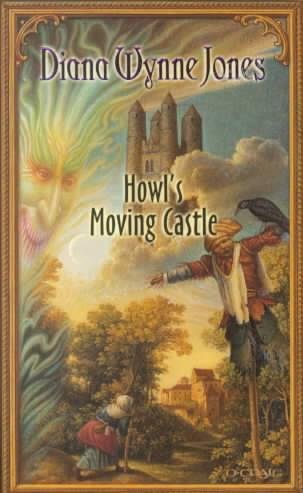

 Hey. Do you like bourbon? I like bourbon a lot. It’s always been of a mild shame to me that the men in my family prefer the smoother stylings of Canadian whiskeys to the more robust corn-fueled liquors we produce here in the south. Now, as to whether Kentucky or Tennessee makes the finer product, I abstain from any definitive opinions (although a particular favorite brand of mine comes from Kentucky) because, as Sam K. Cecil’s book Bourbon: The Evolution of Kentucky Whiskey shows, there are many, many, many distilleries of bourbon (and that’s just in Kentucky alone).
