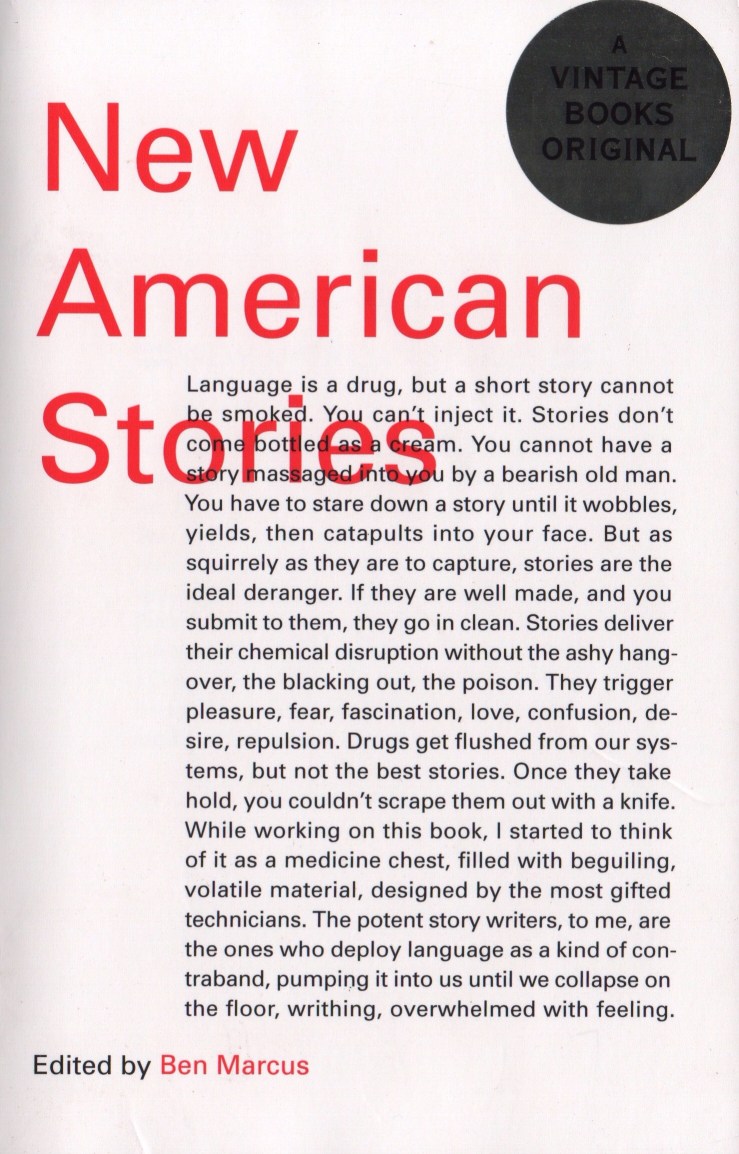
New American Stories, a collection edited by Ben Marcus (Book acquired, 8.04.2015)

IMG_7908

New American Stories is an anthology out now in enormous paperback from Vintage. The collection was collected by collector Ben Marcus. An excerpt from his introduction:

Language is a drug, but a short story cannot be smoked. You can’t inject it. Stories don’t come bottled as a cream. You cannot have a story massaged into you by a bearish old man. You have to stare down a story until it wobbles, yields, then catapults into your face. And yet, as squirrely as they are to capture, stories are the ideal deranger. If they are well made, and you submit to them, they go in clean. Stories deliver their chemical disruption without the ashy hangover, the blacking out, the poison. They trigger pleasure, fear, fascination, love, confusion, desire, repulsion. Drugs get flushed from our systems, but not the best stories. Once they take hold, you couldn’t scrape them out with a knife. While working on this book, I started to think of a it as a medicine chest, filled with beguiling, volatile material, designed by the most gifted technicians. The potent story writers, to me, are the ones who deploy language as a kind of contraband, pumping it into us until we collapse on the floor, writhing, overwhelmed with feeling.

You actually can smoke a short story, but to do so is inadvisable.

I’ll be riffing on the book over the next few weeks with our Correspondent in Colorado, Mr. Ryan Chang.

Here’s the tracklist:

Said Sayrafiezadeh, Paranoia

Rebecca Lee,  Slatland

Jesse Ball, The Early Deaths of Lubeck, Brennan, Harp, and Carr

Deborah Eisenberg, Some Other, Better Otto

Anthony Doerr, The Deep

Yiyun Li, A Man Like Him

George Saunders, Home

NoViolet Bulawayo, Shhh

Maureen McHugh, Special Economics

Sam Lipsyte, This Appointment Occurs in the Past

Lydia Davis, Men

Donald Antrim, Another Manhattan

Zadie Smith*, Meet the President!

Denis Johnson, The Largesse of the Sea Maiden

Joy Williams, The Country

Christine Schutt, A Happy Rural Seat of Various View Lucinda’s Garden

Don DeLillo, Hammer and Sickle

Mathias Svalina, Play

Lucy Corin, Madmen

Mary Gaitskill, The Arms and Legs of the Lake

Wells Tower, Raw Water

Rachel Glaser, Pee on Water

Tao Lin, Love is a Thing on Sale for More Money than There Exists

Rebecca Curtis, The Toast

Robert Coover, Going for a Beer

Charles Yu, Standard Loneliness Package

Deb Olin Unferth, Wait Till You See Me Dance

Kyle Coma-Thompson, The Lucky Body

Rivka Galchen, The Lost Order

Donald Ray Pollack, Fish Sticks

Kelly Link, Valley of the Girls

Claire Vaye Watkins, The Diggings

*Isn’t she English? I guess it’s the stories that are American.

A probably incomplete list of books I’ve read so far this year

The Crying of Lot 49, Thomas Pynchon

Dockwood, Jon McNaught

A German Picturesque, Jason Schwartz

Inherent Vice, Thomas Pynchon

Two Serious Ladies, Jane Bowles

Flee, Evan Dara

Birchfield Close, Jon McNaught

Signs Preceding the End of the World, Yuri Herrera

Infinite Fictions, David Winters

Syrian Notebooks, Jonathan Littell

Girl in a Band, Kim Gordon

Can’t and Won’t, Lydia Davis

Gravity’s Rainbow, Thomas Pynchon

Gaha: Babes of the Abyss, Jon Frankel

The Spectators, Victor Hussenot

Mumbo Jumbo, Ishmael Reed

Infinite Jest, David Foster Wallace

The Wallcreeper, Nell Zink

Cess, Gordon Lish

Station Eleven, Emily St. John Mandel

High Rise, J.G. Ballard

Millennium People, J.G. Ballard

Pale Fire, Vladimir Nabokov


Updating the reviews page to this blog today (a chore! a bore!) I realized just how many books I’d read this year and failed to write about…so far, anyway. The list above is probably incomplete, and only includes books I read cover-to-cover (or in a few cases audited on mp3)—so stuff like essays by William Gass and collections like Vollmann’s Last Stories and William T. Vollmann: A Critical Companion (etc.) I left off. And yes, I’m aware that the list is heavy on white guys.

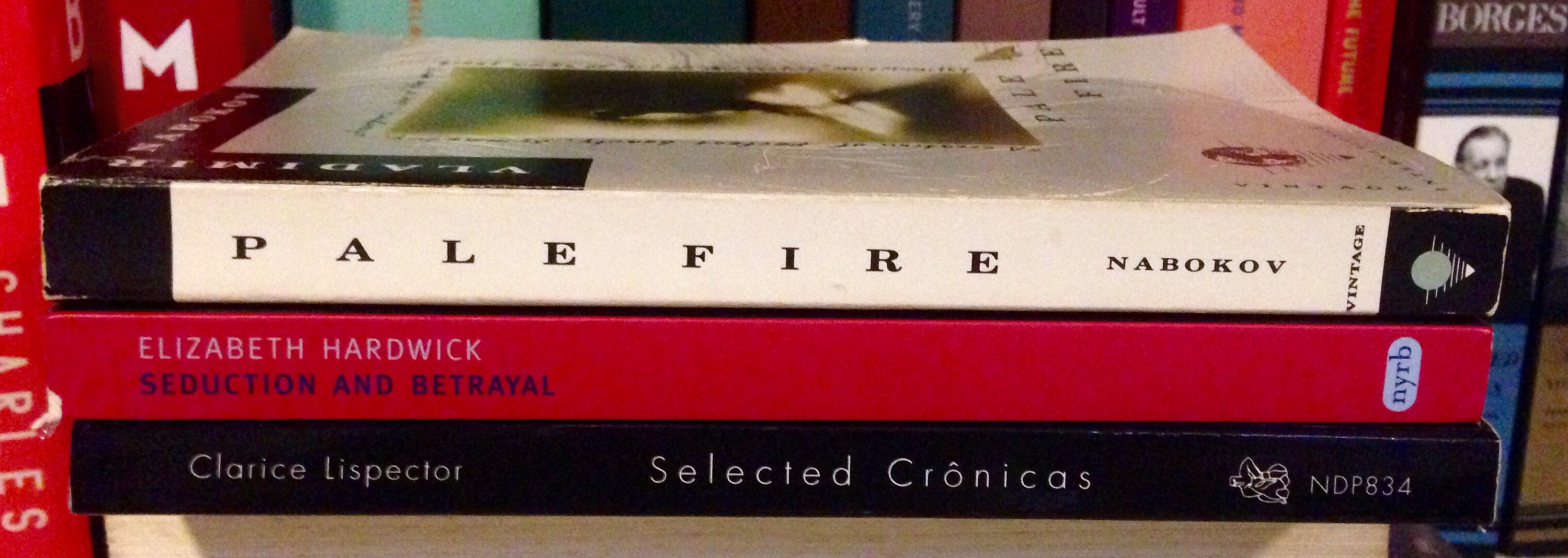
Nabokov/Hardwick/Lispector (Books acquired, 7.21.2015)

I picked up Vladimir Nabokov’s novel Pale Fire on a weird whim. I mean, I quite literally passed by it in the bookshop I frequent; it was misshelved, or unshelved, really. Someone had left it in sci-fi, near the “Bs” (B-for-Ballard, if you must know). Pale Fire, eh? I thought. Can’t remember this one. Because I had never read it, somehow. An amazing novel, one I dove into after sampling a bit of Clarice Lispector’s Selected Cronicas (still sampling—this is one of those books that’s lovely to dip gently into between selections) and after failing to get through the first essay in Elizabeth Hardwick’s Seduction and Betrayal. Not sure if I can (should?) muster a “review” of Pale Fire, but it’s one of the better prepostmodern-postmodernist novels I’ve ever read—very very funny and a beautiful mindfuck.

Maid Reading in the Library — Edouard John Mentha

“The Adventure of the Three Robbers” by Apuleius

“The Adventure of the Three Robbers” by Apuleius

An episode from The Golden Ass, reproduced here from The Lock and Key Library’s Classic Detective and Mystery Stories of All Nations series, edited by Julian Hawthorne. The translator is likely Frederick Taber Cooper.


As Telephron reached the point of his story, his fellow revelers, befuddled with their wine, renewed the boisterous uproar. And while the old topers were clamoring for the customary libation to laughter, Byrrhæna explained to me that the morrow was a day religiously observed by her city from its cradle up; a day on which they alone among mortals propitiated that most sacred god, Laughter, with hilarious and joyful rites. “The fact that you are here,” she added, “will make it all the merrier. And I do wish that you would contribute something amusing out of your own cleverness, in honor of the god, to help us duly worship such an important divinity.”

“Surely,” said I, “what you ask shall be done. And, by Jove! I hope I shall hit upon something good enough to make this mighty god of yours reveal his presence.”

Hereupon, my slave reminding me what hour of night it was, I speedily got upon my feet, although none too steadily after my potations, and, having duly taken leave of Byrrhæna, guided my zigzag steps upon the homeward way. But at the very first corner we turned, a sudden gust of wind blew out the solitary torch on which we depended, and left us, plunged in the unforeseen blackness of night, to stumble wearily and painfully to our abode, bruising our feet on every stone in the road. Continue reading ““The Adventure of the Three Robbers” by Apuleius”

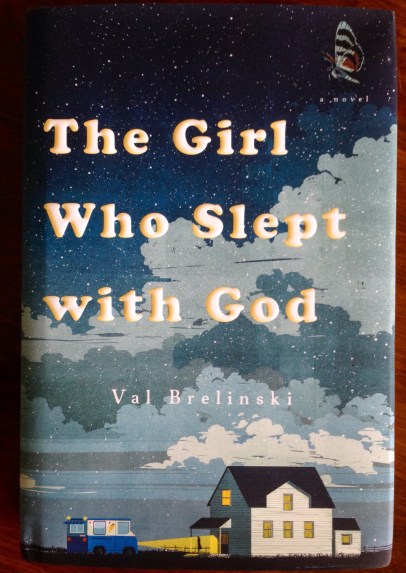
The Girl Who Slept with God (Book acquired, 7.24.2015)

IMG_7842

Val Brelinski’s novel The Girl Who Slept with God is new in hardback this week from Penguin Random House. Their blurb:

Set in Arco, Idaho, in 1970, Val Brelinski’s powerfully affecting first novel tells the story of three sisters: young Frances, gregarious and strong-willed Jory, and moral-minded Grace. Their father, Oren, is a respected member of the community and science professor at the local college. Yet their mother’s depression and Grace’s religious fervor threaten the seemingly perfect family, whose world is upended when Grace returns from a missionary trip to Mexico and discovers she’s pregnant with—she believes—the child of God.

Distraught, Oren sends Jory and Grace to an isolated home at the edge of the town. There, they prepare for the much-awaited arrival of the baby while building a makeshift family that includes an elderly eccentric neighbor and a tattooed social outcast who drives an ice cream truck.

The House of Nazareth — Francisco de Zurbaran

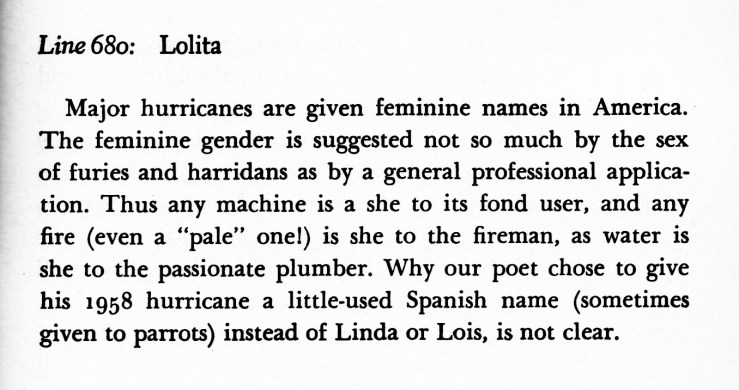
Lolita (Nabokov’s Pale Fire)

IMG_7865

Young Woman Reading in Bed — Lucien Abrams

display_image (3)

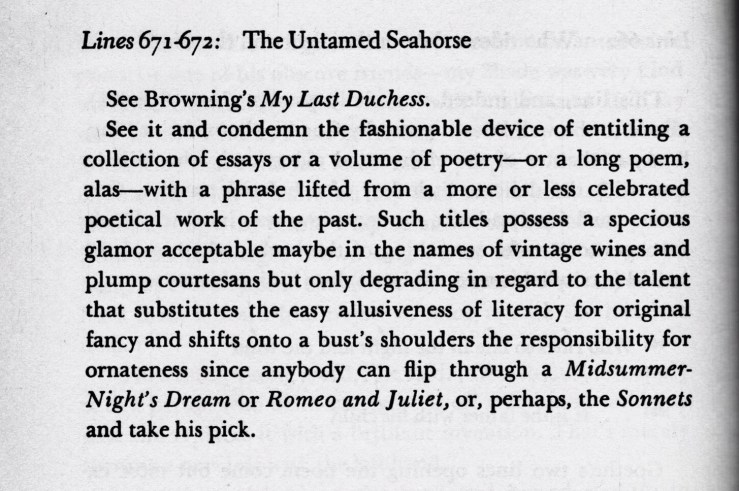
See it and condemn (Nabokov’s Pale Fire)

IMG_7867

I love this passage from Nabokov’s Pale Fire. The title of Pale Fire, of course, comes from Shakespeare’s Timon of Athens. Ironies aside, I dig the sentiment here, and would extend it to the glut of contemporary novels that rest heavily on the weight of other, better would-be precursor texts.

Reviews and riffs of June and July, 2015 (and an unrelated owl)

The second part of my (long) interview with Christopher K. Coffman and Daniel Lukes, editors of William T. Vollmann: A Critical Companion. Chock full of all sorts of riffage: sincerity, authenticity, Vollmann’s visual art, etc. Special bonus: slightly frazzled Franzen pic.

I reread David Foster Wallace’s novel Infinite Jest in June/July. First time I’d read the whole thing since 2001. I wrote about reading the first 299 pages. I was also reading some of the essays in William H. Gass’s Fiction and the Figures of Life, and I riffed at some length on Wallace contra Gass, masscult entertainment, etc. From that riff:

…this is Wallace’s big insight in Infinite Jest, right?—that our consciousnesses, mapped in the muck, are framed in desire and reward, and we are conditioned/subjected into that system of desire/reward, so that we desire the desire, even as our consciousnesses…can sneer at something we love, can dismiss the muck that helped shape us even as we plunge into it, the muck. And—too, part of Wallace’s insight in Infinite Jest—too, the consciousness of the consciousness of the desire of desire—that that’s, like, the contemporary condition. And what Wallace…seems to want to point to is some way out of the muck of pop consciousness, a reconciliation toward a pure consciousness that doesn’t sneer—right?

I also wrote a brief note to readers new to Infinite Jest, and included a list of motifs, which (the list) may or may not be helpful.

Nell Zink’s debut novel The Wallcreeper is fucking incredible.

Loved loved loved J.G. Ballard’s degenerate debauched depraved novel High-Rise

—but his later novel Millennium People, despite a great concept and some fascinating ideas, really isn’t so good.

Here’s that owl—with a special guest no less!

tumblr_m35xhxxMkN1qekndso1_500

Untitled — Markus Schinwald

tumblr_m2jforxW681qdzczno1_1280

Penguin Classics’ reissue of Jean Lartéguy’s The Centurions (Book acquired, 7.27.2015)

IMG_7840

Although I’ve been having to turn down review copies left and right lately, Penguin Classics’ reissue of Jean Lartéguy’s 1960 novel The Centurions looked to promising to pass up. Lartéguy was a soldier and a journalist—and the English translator, Xan Fielding, was a Special Operations Executive agent in WW2 (among other things).

Penguin’s blurb:

The military cult classic with resonance to the wars in Iraq and Vietnam—now back in print

When The Centurions was first published in 1960, readers were riveted by the thrilling account of soldiers fighting for survival in hostile environments. They were equally transfixed by the chilling moral question the novel posed: how to fight when the “age of heroics is over.” As relevant today as it was half a century ago, The Centurions is a gripping military adventure, an extended symposium on waging war in a new global order, and an essential investigation of the ethics of counterinsurgency. Featuring a foreword by renowned military expert Robert D. Kaplan, this important wartime novel will again spark debate about controversial tactics in hot spots around the world.

A review of Millennium People, J.G. Ballard’s novel of middle-class boredom and meaningless violence

Act of Violence, Rene Magritte

Early in J.G. Ballard’s 2003 novel Millennium People, our narrator David Markham remarks that “A vicious boredom ruled the world, for the first time in human history, interrupted by meaningless acts of violence.” The sentence delivers three of the novel’s key terms: boredommeaningless, and violence. These words (or iterations of these words) repeat so often in Millennium People that any connotative spark they might bear becomes dulled. Even the violence becomes boring.

The violence in the novel resonates from its central plot about a middle-class revolution in Chelsea Marina, an “enclave of middle-class decorum.” Corporate psychologist David Markham is drawn into this revolution after his ex-wife dies in an apparently-meaningless bombing at Heathrow Airport. (She dies at the baggage carousel—symbolically-overloaded and thoroughly-Ballardian). Initially, Markham’s goal is to infiltrate the group as a kind of unwitting police spy. However, he soon takes part in acts of terrorism and meaningless violence, led in large part by Kay Churchill, an ex-film studies professor who rails against the evils of Hollywood and travel. Soon, Kay ventriloquizes Markham:

…I could hear her voice inside my head: bullying, pleading, sensible and utterly mad. The middle class was the new proletariat, the victims of a centuries-old conspiracy, at last throwing off the chains of duty and civic responsibility.

Kay eventually leads Markham to Millennium People’s would-be heart of darkness, demented pediatrician Dr. Richard Gould. Kay and Markham:

‘Richard says that people who find the world meaningless find meaning in pointless violence.’

‘Richard? Dr Richard Gould?’

‘You’ll meet him again, when he’s ready. He’s the leader of our middle-class rebellion. His mind is amazingly clear, like those brain-damaged children he looks after. In a way, he’s one of them.’

Kay is a far more interesting character than Gould. Unfortunately, Ballard teases out Gould as the Big Bad, occasionally having him show up to dialogue with Markham on finding big-em Meaning in all the meaninglessness of the world. God as a Void, the evils of the 20th century infecting the new millennium, etc. These ideas repeat and repeat and repeat, bumping along a muddled plot. Indeed, much of the plot and many of the themes of Millennium People might be condensed into this conversation between Markham and his one-time colleague/boring-assed doppelgänger Henry the psychologist. Markham speaks first in this exchange, explaining the revolution to Henry (I’ve added bold-faced emphasis if you’re in a hurry):

‘Middle-class pique. We sense we’re being exploited. All those liberal values and humane concern for the less fortunate. Our role is to keep the lower orders in check, but in fact we’re policing ourselves.’

Henry watched me tolerantly over his whisky. ‘Do you believe all that?’

‘Who knows? The important thing is that the people at Chelsea Marina believe it. It’s amateurish and childish, but the middle classes are amateurish, and they’ve never left their childhoods behind. But there’s something much more important going on. Something that ought to worry your friends at the Home Office.”

“And that is?’

‘Decent and level-headed people are hungry for violence.’

‘Grim, if true.’ Henry put down his whisky. ‘Directed at what?’

‘It doesn’t matter. In fact, the ideal act of violence isn’t directed at anything.’

‘Pure nihilism?’

‘The exact opposite. This is where we’ve all been wrong – you, me, the Adler, liberal opinion. It isn’t a search for nothingness. It’s a search for meaning. Blow up the Stock Exchange and you’re rejecting global capitalism. Bomb the Ministry of Defence and you’re protesting against war. You don’t even need to hand out the leaflets. But a truly pointless act of violence, shooting at random into a crowd, grips our attention for months. The absence of rational motive carries a significance of its own.

While Ballard’s diagnosis of the end of the 20th century is both perceptive and prescient, the novel’s repetitions build to very little. Ballard puts his interlocutors into fascinating territory, but then squirms away. Here’s Gould holding forth to Markham:

We’re living in a soft-regime prison built by earlier generations of inmates. Somehow we’ve got to break free. The attack on the World Trade Center in 2001 was a brave attempt to free America from the 20th Century. The deaths were tragic, but otherwise it was a meaningless act. And that was its point.

Markham then immediately turns the conversation to the Heathrow bombing that killed his ex-wife. The potential for a shocking exchange simply veers back to the novel’s central thesis.

And that thesis becomes muddied. Markham, Gould, Kay, and other revolutionaries make bold, radical declarations, but often append them in a sentimentality at odds with their revolutionary claims. Ballard’s characters let us know that they think murder is wrong. The contradiction between the impulse for meaningless violence and the core (and very middle-class) values that often restrains the impulse remains unexplored. This unresolved contradiction might have been a purposeful tactic meant to highlight the limits of our narrator’s desire for real revolution, but there’s little to lead a reader to this conclusion beyond his own hopeful imagination. Ballard seems as uncommitted as the characters.

A lack of force and shock—that’s the problem of Millennium People, I suppose. It’s unfair and unproductive to expect Ballard to rewrite Crash or High-Rise here, even though he’s playing with many of the same themes and motifs. And yet those novels exist. Dr. Richard Gould is a pale answer to Crash’s Dr. Robert Vaughan (or Richard Wilder of High-Rise or Strangman of The Drowned World or Dr. Barbara of Rushing to Paradise…). Ballard’s satire suffers from a lack of full commitment. The hyperbole peters out; the tonal inconsistencies, far from clashing, become dull.

Still, there’s much to commend in Millennium People even if it falls short of Ballard’s finest work. The novel’s larded with little riffs and satirical observations: “America invented the movies so it would never need to grow up,” Kay remarks. Markham observes in a riot “the outrage of professional men and women who had never known pain and whose soft bodies had been pummelled only by their lovers and osteopaths.” We’re informed that “From now on ordering an olive ciabatta is a political act.” (I would love to read the notebook where Ballard recorded these phrases, if such a treasure exists).

Millennium People’s prescience—like most of Ballard’s previous work—only comes into sharper relief over time. The erosion of the middle class, the spike in income inequality, the inability of regular working people to live in places like London or New York City anymore—Ballard’s mapped it all out here. The contemporary world Ballard satirizes in Millennium People—published just a few years before his death in 2009—is already thoroughly Ballardian. The millennium caught up to the man.

Read Clarice Lispector’s short story “Report on the Thing”

In advance of New Directions’ forthcoming Clarice Lispector collection The Complete Stories, Vice has published “Report on the Thing” in a new English translation by Katrina Dodson (who translated the entire volume of 86 stories. First few paragraphs:

This thing is the most difficult for a person to understand. Keep trying. Don’t get discouraged. It will seem obvious. But it is extremely difficult to know about it. For it involves time.

We divide time when in reality it is not divisible. It is always immutable. But we need to divide it. And to that end a monstrous thing was created: the clock.

I am not going to speak of clocks. But of one particular clock. I’m showing my cards: I’ll say up front what I have to say and without literature. This report is the anti-literature of the thing.

The clock of which I speak is electronic and has an alarm. The brand is Sveglia, which means “awake.” Awake to what, my God? To time. To the hour. To the instant. This clock is not mine. But I took possession of its infernal tranquil soul.

It is not a wristwatch: Therefore it is freestanding. It is less than an inch tall and stands upon the surface of the table. I would like its actual name to be Sveglia. But the owner of the clock wants its name to be Horácio. No matter. Because the main thing is that it is time.

Read the rest of “Report on the Thing.”

What books does William T. Vollmann find himself returning to again and again?

William T. Vollmann is the interviewee in the New York Times feature “By the Book” this week. It’s a fun read (he chooses Sappho to write his life story, which cracked me up). From the piece:

What books do you find yourself returning to again and again?

I often reread certain parts of my Oxford Revised Standard Bible, which I recommend for the maps and footnotes. The parables of Jesus are haunting in the fashion of certain Zen koans. And the story of Jacob, Leah and Rachel, and the way it leads to young Joseph’s conceit and fall, is of gripping psychological interest. When she was very young I used to tell my daughter about the coat of many colors, and she would say: “But, why, Daddy? Why did they throw Joseph underground?” — “Because they were jealous.” — “Why were they jealous?” — “Because his father loved him more than the others.” She and I would follow the story backward and forward; its elegance was so perfect that my little child could understand it.

Georg Christoph Lichtenberg always inspires me to try to be myself. Here is one of his powerful aphorisms: “I believe that man is in the last resort so free a being that his right to be whatever he believes himself to be cannot be contested.”

I love that fountainhead of Norse myth and saga, the Elder Edda. It is, after all, part of my ethnocultural heritage. Its glorification of ruthless and often pointless cruelty troubles me, and I refuse to identify with that. But I can enjoy the delicate eeriness of other ghost stories without reveling in gruesome murders and wailing horrors, so why can’t I drink in the strangeness of Skirnir’s ride down to Hel on his quest to win the giant maiden? Moreover, the Norse ethos privileges steadfast endurance in the face of pain, bravery in the face of inevitable doom, and loyalty. These qualities would well become all of us mortals, and may grow more relevant once climate change really kicks in.

Freedom and the Self: Essays on the Philosophy of David Foster Wallace (Book acquired 7.21.2015)

IMG_7813

Freedom and the Self: Essays on the Philosophy of David Foster Wallace is new from Columbia University Press. Their blurb:

The book Fate, Time, and Language: An Essay on Free Will, published in 2010 by Columbia University Press, presented David Foster Wallace’s challenge to Richard Taylor’s argument for fatalism. In this anthology, notable philosophers engage directly with that work and assess Wallace’s reply to Taylor as well as other aspects of Wallace’s thought.

With an introduction by Steven M. Cahn and Maureen Eckert, this collection includes essays by William Hasker (Huntington University), Gila Sher (University of California, San Diego), Marcello Oreste Fiocco (University of California, Irvine), Daniel R. Kelly (Purdue University), Nathan Ballantyne (Fordham University), Justin Tosi (University of Arizona), and Maureen Eckert. These thinkers explore Wallace’s philosophical and literary work, illustrating remarkable ways in which his philosophical views influenced and were influenced by themes developed in his other writings, both fictional and nonfictional. Together with Fate, Time, and Language, this critical set unlocks key components of Wallace’s work and its traces in modern literature and thought.