Things I have been reading that are not Moby-Dick

img_6979

I have been rereading Moby-Dick.

I have also been reading things that are not Moby-Dick

I have been reading emails.

I have been reading and very much enjoying Anakana Schofield’s novel Bina. I should have finished it by now—there’s just one remaining section—but I’ve been reading it exclusively in the bathtub. And I only take baths on Sunday. But I did not, unlike the narrator of Squeeze’s wonderful ditty “Up the Junction”,  take a bath on Sunday. (After I get the weight of Moby-Dick off my conscience I will write a review.)

I have been reading student writing.

I have been reading more emails.

I have been rereading lots of (so-called) early American literature. I am teaching a course in early American literature for the first time in a long time, and I have read again, for the first time in a long time, stuff like A Short Account of the Destruction of the Indies by Bartolomé de Las Casas, and The Interesting Narrative of the Life of Olaudah Equiano; or, Gustavus Vassa, the African, Written by Himself and A Narrative of the Captivity and Restoration of Mrs. Mary Rowlandson. America is founded in blood and bounding, violence and strange hope.

I have been reading Twitter.

I have been reading Reddit.

(I cannot remember the last book review I read.)

I have been reading bits of The Posthumous Works of Thomas Pilaster by Éric Chevillard (translated from the French by Chris Clarke) and I like it so far.

I have been reading more student writing.

I have been reading news articles, particularly English-language news articles from non-U.S. news organizations; particularly articles focused on U.S. politics.

I have been reading poetry on the internet, somewhat at random. 

I have not been reading Ann Quin’s novel Passages—it just showed up the other day—but it will be the next novel I read (after Moby-Dick; after Bina), and I am very excited about it. 

I have been reading Wikipedia articles, very much at random. (Is there a greater 21st-century novel?)

I have not been reading the audiobook recording of Cormac McCarthy’s novel Blood Meridian narrated by Richard Poe. I have been falling asleep to it every night for the past forty or so nights. I set an hour timer and either fall asleep in five, ten, twenty minutes or not at all. One night I listened to the novel’s final third. Some nights I wonder into it disoriented—Where are we? Other nights I’m thrilled at the particular episode we start with—too thrilled. I’m supposed to be asleep. Last night I listened to most of Ch. 8—the bit in the bar where Toadvine, Bathcat, and the kid go drink in a bar and are accosted by an old man who declares that he two is “Texas.” A guy gets stabbed in the shadows, but remains moaning. Where would he go? The chapter ends with the Apache attacking, but I don’t recall getting there. What the fuck is wrong with me that I find Blood Meridian a comforting soporific to send me to my slumbers?

I have been reading Moby-Dick.


Ann Quin’s Passages (Book acquired, 30 Jan. 2021)

A new edition of Ann Quin’s third novel Passages is out in a few days from indie juggernaut And Other Stories. The new edition (the first in nearly two decades) features a new introduction from Claire-Louise Bennett, whose book (novel?) Pond was a favorite of mine a few years back.

Ann Quin’s first novel Berg was one of the best books I read in 2019, and one of the best books I’ve read in years. In my review of the novel a few years back, I wrote,

Read the book. There’s nothing I can do in this review that approaches the feeling of reading Ann Quin’s Berg. I can make lame comparisons, saying that it reminds me of James Joyce’s Ulysses (in its evocations of loose consciousness), or David Lynch’s Blue Velvet (in its oedipal voyeuristic griminess), or Luis Buñuel’s The Exterminating Angel (for its surreal humor and dense claustrophobia). Or I can point out how ahead of her time Quin was, how Berg bridges modernism to postmodernism while simply not giving a fuck about silly terms like modernism and postmodernism.

I’m psyched to get into Passages.

Here’s And Other Stories’ blurb:

Ann Quin’s third novel Passages – an instant classic when published in 1969 – is perhaps her most harrowing investigation of the limits of identity and desire, as well as the possibilities of fiction. It is the story of a woman, accompanied by her lover, searching for her lost brother, who may have been a revolutionary, and who may have been tortured, imprisoned or killed. Roving a Mediterranean landscape, they live out their entangled existences, reluctant to give up, yet afraid of where their search will lead.

In ‘passages’ that alternate between the two protagonists’ perspectives, taking the form of diary excerpts, annotations and Burroughsian cut-ups, this fractured tale builds an intricate, musical system of theme and repetition. ‘All seasons passed through before the pattern formed, collected in parts.’

Erotic and terrifying by turns, Quin’s third novel allowed her writing freer rein than ever before, blazing a trail still being followed by such authors as Eimear McBride, Chris Kraus and Anna Burns. It stands as Quin’s most beguiling, poetic, and mysterious work.

Read an excerpt here.

All men live enveloped in whale-lines. All are born with halters round their necks | Moby-Dick reread, riff 16

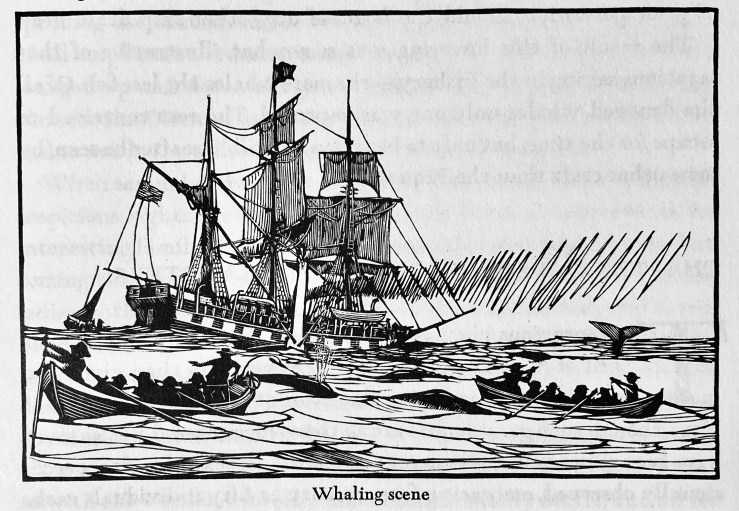
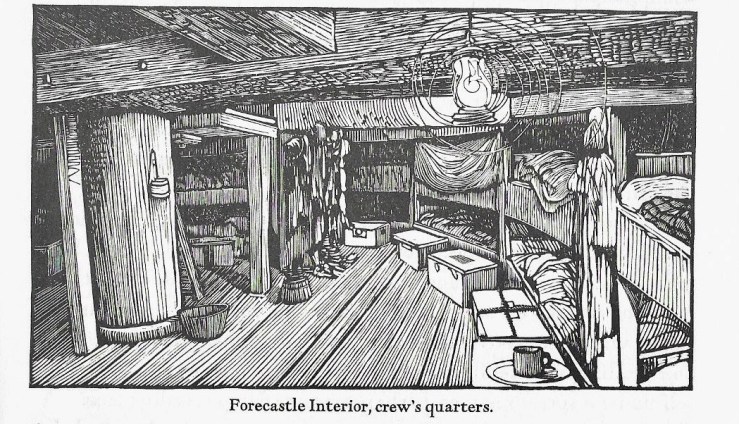
Moby-Dick illustration by Barry Moser

I. In this riff: Chapters 58, 59, and 60 of Moby-Dick.

II. Ch. 58, “Brit.”

With all of Ishmael’s metaphysical flights into philosophy, as well as the intrigue of Ahab’s revenge quest, it can be easy to lose track of just where in the watery world the Pequod is. Ishmael gives us our bearings again in the opening of “Brit”:

Steering north-eastward from the Crozetts, we fell in with vast meadows of brit, the minute, yellow substance, upon which the Right Whale largely feeds. For leagues and leagues it undulated round us, so that we seemed to be sailing through boundless fields of ripe and golden wheat.

The image of “boundless fields of ripe and golden wheat” seems out of place in these antarctic climes. It ties the sea back to the land—ever a concern of Ishmael, who posits his reader as the “landsman” afloat with him in alien waters.

III. And yet Ishmael, despite his sympathies, occasionally condescends landlubbers. He suggest that “to landsmen in general, the native inhabitants of the seas have ever been regarded with emotions unspeakably unsocial and repelling,” which may be more or less true. Ish continues:

…we know the sea to be an everlasting terra incognita, so that Columbus sailed over numberless unknown worlds to discover his one superficial western one; though, by vast odds, the most terrific of all mortal disasters have immemorially and indiscriminately befallen tens and hundreds of thousands of those who have gone upon the waters; though but a moment’s consideration will teach, that however baby man may brag of his science and skill, and however much, in a flattering future, that science and skill may augment; yet for ever and for ever, to the crack of doom, the sea will insult and murder him, and pulverize the stateliest, stiffest frigate he can make; nevertheless, by the continual repetition of these very impressions, man has lost that sense of the full awfulness of the sea which aboriginally belongs to it.

Moby-Dick illustration by Barry Moser

III. Ishmael then evokes the infinite apocalypse of the seventh chapter of Genesis:

 Yea, foolish mortals, Noah’s flood is not yet subsided; two thirds of the fair world it yet covers.

IV. Ch. 59, “Squid.”

Ishmael again situates us geographically. The Pequod is now near Java. There, they behold “The great live squid, which, they say, few whale-ships ever beheld, and returned to their ports to tell of it.” At first though, the crew believes that the “great white mass” is Moby Dick. Starbuck mutters that he would have preferred to meet and battle the White Whale than glimpse the giant squid, which is an ill omen to him.

Ishmael retreats from superstition and heads instead into scientific speculation:

Whatever superstitions the sperm whalemen in general have connected with the sight of this object, certain it is, that a glimpse of it being so very unusual, that circumstance has gone far to invest it with portentousness. So rarely is it beheld, that though one and all of them declare it to be the largest animated thing in the ocean, yet very few of them have any but the most vague ideas concerning its true nature and form; notwithstanding, they believe it to furnish to the sperm whale his only food. For though other species of whales find their food above water, and may be seen by man in the act of feeding, the spermaceti whale obtains his whole food in unknown zones below the surface; and only by inference is it that any one can tell of what, precisely, that food consists. At times, when closely pursued, he will disgorge what are supposed to be the detached arms of the squid; some of them thus exhibited exceeding twenty and thirty feet in length. They fancy that the monster to which these arms belonged ordinarily clings by them to the bed of the ocean; and that the sperm whale, unlike other species, is supplied with teeth in order to attack and tear it.

V. Ch. 60, “The Line.”

“The Line might be a good example of what turns many readers off in Moby-Dick. Ishmael riffs for a few pages on rope. Like, the qualities, textures, durability of different types of rope.

At the end though, our Ishmael turns the rope into a metaphor:

All men live enveloped in whale-lines. All are born with halters round their necks; but it is only when caught in the swift, sudden turn of death, that mortals realize the silent, subtle, ever-present perils of life. And if you be a philosopher, though seated in the whale-boat, you would not at heart feel one whit more of terror, than though seated before your evening fire with a poker, and not a harpoon, by your side.

Moby-Dick illustration by Barry Moser

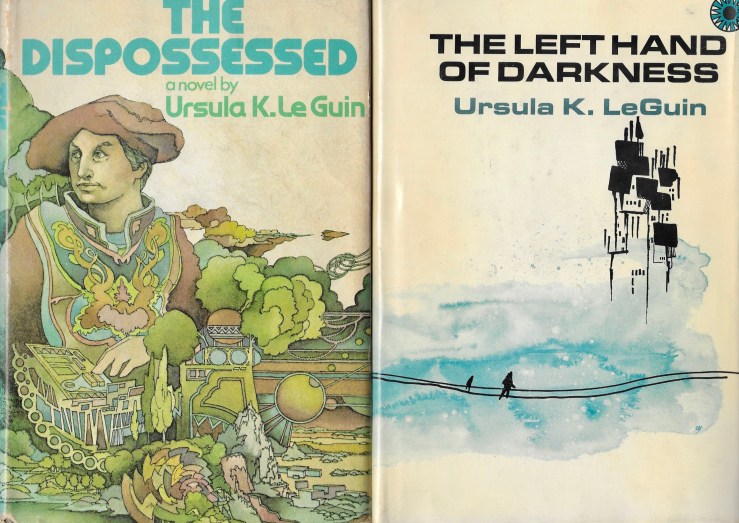
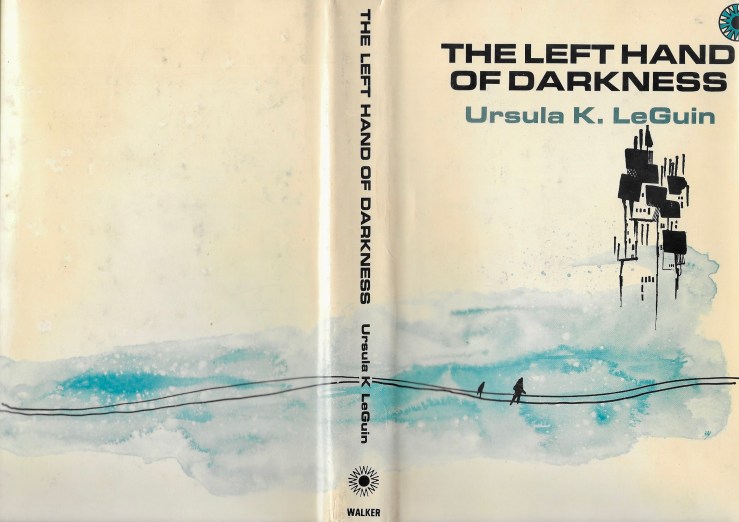
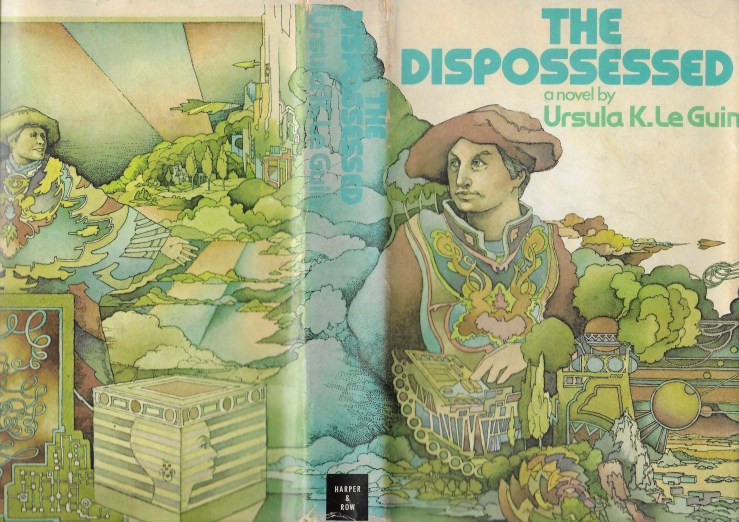
Two Lovely Le Guins (Books acquired, 22 Jan. 2021)

I found two first-edition hardback Ursula K. Le Guin novels—my favorite Le Guins at that!—for next to nothing last week at my favorite local used bookstore.

The simple, elegant cover for Le Guin’s 1969 novel The Left Hand of Darkness was designed by Lena Fong Lueg. It employs an illustration by Jack Gaughan.

The jacket for 1974’s The Dispossessed was designed by Fred Winkowski.

In 2015, I undertook the project of reading (or in some cases rereading) Le Guin’s so-called Hainish novels. I wrote about those novels in a long post in January of 2016. Of the (maybe) eight novels in the Hainish cycle, The Left Hand of Darkness and The Dispossessed are easily the strongest (although I really loved the one-two punch of Planet of Exile (1966) and City of Illusions (1967)).

Here is what I wrote about The Left Hand of Darkness:

The Left Hand of Darkness is amazing. Perfect in its strange imperfections and crammed with fables and myths and misunderstandings, it is the apotheosis of Le Guin’s synthesis of adventure with philosophy. Darkness is about shadows and weight. About pulling weight—literally, figuratively. It’s also the story of an ice planet. (A stranger comes to the ice planet!). It’s a political thriller. It’s a sexual thriller. But the impression that lingers strongest: The Left Hand of Darkness is one of the better literary evocations of friendship (its precarious awful strange wonderful tenuous strength) that I’ve ever read.

And here is what I wrote about The Dispossessed:

The Dispossessed feels closer to Le Guin’s non-Hainish 1971 novel The Lathe of Heaven in some ways than it does to its so-called Hainish kin. Both novels formally (and spiritually) evoke yin and yang, opposition, conflict, stress, and, ultimately, synthesis. The Dispossessed is a riff on anarchy and stability, allegiance to one’s community and family weighed against personal vision and ecumenical dreams.

I also claimed that The Dispossessed is the best starting place for those new to Le Guin, but I think The Left Hand of Darkness is equally good, as are her Earthsea novels.

Talk not to me of blasphemy, man; I’d strike the sun if it insulted me | Moby-Dick reread, riff 11

Moby-Dick illustration by Barry Moser

I. In this riff: Just one goddamn chapter, Ch. 36, “The Quarter-Deck.”

II. There’s too much in “The Quarter-Deck” — too many savory lines, too much foreshadowing, too much language language language — and by too much I mean Too much for me to parse here.

III. (I never intended for these riffs to provide insight into Moby-Dick, but I also was hoping that they wouldn’t just be a collection of greatest hits. Most of “The Quarter-Deck” is greatest hits material.)

IV. “The Quarter-Deck” begins in Melville’s Shakespearean mode:

“(Enter Ahab: Then, all.)”

Ahab takes the quarter-deck, the stage, the novel—his voice overwhelms.

V. The plot of this chapter is fairly simple: Ahab reveals to his crew that the true mission of The Pequod is not to hunt whales and harvest their oil, but rather to exact revenge on the great white whale Moby Dick, who took Ahab’s leg.

VI. Starbuck, first mate and second conscience (to Ishmael’s Captain Conscience—or maybe I mean Captain Consciousness)—Starbuck, the first mate of The Pequod is horrified:

“Vengeance on a dumb brute!” cried Starbuck, “that simply smote thee from blindest instinct! Madness! To be enraged with a dumb thing, Captain Ahab, seems blasphemous.”

VII. Ahab replies with some of the book’s greatest lines:

Hark ye yet again—the little lower layer. All visible objects, man, are but as pasteboard masks. But in each event—in the living act, the undoubted deed—there, some unknown but still reasoning thing puts forth the mouldings of its features from behind the unreasoning mask. If man will strike, strike through the mask!

Our half-mad captain wants pure contact with the ineffable, even if it means death.

He continues, delivering another classic zinger:

 That inscrutable thing is chiefly what I hate; and be the white whale agent, or be the white whale principal, I will wreak that hate upon him. Talk not to me of blasphemy, man; I’d strike the sun if it insulted me.

And:

Who’s over me? Truth hath no confines.

VIII. Ahab worries that Starbuck’s conscience might override the crew. He calls for “the measure” of spirits to be poured, and passes a pewter chalice of alcohol around several times, having the steward refill it. He then supplies his own rhetorical intoxication, a performance that drives the crew into a frenzy that finds its dizzying fruition in Ch. 40, “Midnight, Forecastle.”

Ahab calls his three mates to him and they quail “before his strong, sustained, and mystic aspect.” He calls then his three harpooneers (twinning triplets) whom he commands to “draw the poles” — their lances, their phallic harpoons.  He fills the “goblet end” of the harpoons with “the fiery waters from the pewter,” and has toasts the end of his Great Enemy—

Now, three to three, ye stand. Commend the murderous chalices! Bestow them, ye who are now made parties to this indissoluble league. Ha! Starbuck! but the deed is done! Yon ratifying sun now waits to sit upon it. Drink, ye harpooneers! drink and swear, ye men that man the deathful whaleboat’s bow—Death to Moby Dick! God hunt us all, if we do not hunt Moby Dick to his death!

IX. God hunt us all—it seems he will.

Moby-Dick illustration by Barry Moser

Whaling may well be regarded as that Egyptian mother who bore offspring themselves pregnant from her womb | Moby-Dick reread, riff 8

I. In this riff: Chapters 23-27.

II. Ch. 23, “The Lee Shore.”

In what is possibly the shortest chapter of Moby-Dick, Ishmael pulls a metatextual move, declaring that “this six-inch chapter is the stoneless grave of Bulkington.” Bulkington is actually one of the first named characters in Moby-Dick. He shows up in Ch. 3 (“The Spouter-Inn”), just having returned to land from a whaling voyage…and just a few days later is back at it. Why? Ishmael links the open, borderless ocean to the ineffable: “…in landlessness alone resides highest truth, shoreless, indefinite as God—so, better is it to perish in that howling infinite, than be ingloriously dashed upon the lee, even if that were safety.” (And as always, our narrator keeps pointing towards M-D’s inevitable, deathly conclusion.)

III. Ch. 24, “The Advocate.”

“The Advocate” is a long and memorable chapter, wherein Ishmael takes it upon himself to speak of the nobility of the maligned whaleman: “I am all anxiety to convince ye, ye landsmen, of the injustice hereby done to us hunters of whales.” He lists a variety of reasons—economic, literary, historical, political, geographic—for his claims that whaling is a deeply important calling. In one of the more remarkable images thus far in the novel, he likens whaling—and to be clear here, Ish believes that whaling is a kind of primal movement across the globe by men both isolate and egoless, ego-maniacal yet intimately spliced—Ish sees whaling as a self-germinating, self-sustaining apotheosis:

One way and another, it has begotten events so remarkable in themselves, and so continuously momentous in their sequential issues, that whaling may well be regarded as that Egyptian mother, who bore offspring themselves pregnant from her womb. It would be a hopeless, endless task to catalogue all these things.

(The reference is likely to the Isis and Osiris.)

IV. (“It would be a hopeless, endless task to catalogue all these things.” This is perhaps a summary of Ishmael’s impossible mission.)

V. (Another line I love (and have hijacked for my own purposes before) from “The Advocate” — Ishmael: “That great America on the other side of the sphere, Australia, was given to the enlightened world by the whaleman.”)

VI. In his advocacy, Ishmael the advocate anticipates imaginary literary objections to his praise of the whaleman:

The whale has no famous author, and whaling no famous chronicler, you will say.

The whale no famous author, and whaling no famous chronicler? Who wrote the first account of our Leviathan? Who but mighty Job! And who composed the first narrative of a whaling-voyage? Who, but no less a prince than Alfred the Great, who, with his own royal pen, took down the words from Other, the Norwegian whale-hunter of those times! And who pronounced our glowing eulogy in Parliament? Who, but Edmund Burke!

The move here anticipates another metatextual technique. Melville, through Ishmael, positions himself in a literary tradition that he tacitly seeks to master. He will be the whale chronicler ne plus ultra:

And, as for me, if, by any possibility, there be any as yet undiscovered prime thing in me; if I shall ever deserve any real repute in that small but high hushed world which I might not be unreasonably ambitious of; if hereafter I shall do anything that, upon the whole, a man might rather have done than to have left undone; if, at my death, my executors, or more properly my creditors, find any precious MSS. in my desk, then here I prospectively ascribe all the honor and the glory to whaling; for a whale-ship was my Yale College and my Harvard.

VII. Ch. 25, “Postscript.”

Above, I wrote that “The Lee Shore” was possibly the shortest chapter in Moby-Dick. Looking back over it, “Postscript” is actually shorter. It focuses on anointing kings with sperm oil.

VIII. Ch. 26, “Knights and Squires.”

This is first of two consecutive chapters with the same title. This double naming always confounded me when I was younger, and I don’t really have an answer for it now.

The first “Knights and Squires” focuses on Starbuck, whom Ish is maybe a little hot for, at least in a spiritual way. (“His pure tight skin was an excellent fit; and closely wrapped up in it, and embalmed with inner health and strength, like a revivified Egyptian, this Starbuck seemed prepared to endure for long ages to come.”)

We learn that Starbuck’s father and brother were both lost to the sea in whaling voyages, and he presents as a kind of cautious and sober (yet buoyant) figure. Starbuck is also a “pious” man, and the end of this chapter that introduces him in detail seems to give way to this consciousness—or, perhaps, Ishmael’s imitation of Starbuck’s consciousness. The chapter culminates in a kind of fervid prayer delivered in an approximation of an older English, concluding with: “Thy selectest champions from the kingly commons; bear me out in it, O God!”

I read this desire to be selected as one of God’s champions as Starbuck’s desire, not Ishmael’s.

IX. (Or, alternately—here again the dead and the lost wail through Ishmael.)

X. Ch. 27, “Knights and Squires.”

Maybe the second “Knights and Squires” is actually a rhetorical reset. Ishmael has worked himself into a lather of thines and thous and beseeching unto God, etc. by the end of the first chapter, and forgets to include the other knights and their squires. He takes care of that in Ch. 27, introducing Stubb and Flask, as well as their “squires,” the harpooneers Tashtego and Daggoo. (Queequeg is Starbuck’s harpooneer. “But Queequeg is already known.”)

Much academic hash has been made of the racial distinctions Melville evokes here. Starbuck, Stubb, and Flask are all white Americans. They are management. The skilled labor, and really the superstars, of the ship, are all non-white: Queequeg is a Pacific Islander, Tashtego “is an unmixed Indian from Gay Head, the most westerly promontory of Martha’s Vineyard, where there still exists the last remnant of a village of red men,” and Daggoo is “a gigantic, coal-black negro-savage, with a lion-like tread—an Ahasuerus to behold.” While Ishmael clearly esteems the harpooneers, Melville’s exoticizing language is nevertheless tinged with racism.

XI. At the end of Ch. 27, Ishmael describes the crew of The Pequod as—

An Anacharsis Clootz deputation from all the isles of the sea, and all the ends of the earth, accompanying Old Ahab in the Pequod to lay the world’s grievances before that bar from which not very many of them ever come back.

Ishmael here romanticizes the whaling voyage again, putting it in league with political revolution, suggesting that theirs is a spiritual mission to address “the world’s grievances” at the risk of not coming back.

And although he doesn’t directly pair “Old Ahab” with his own squire, “Knights and Squires” concludes with the image of Ahab’s implicit squire/double—who is of the “not very many [to] ever come back”:

Black Little Pip—he never did—oh, no! he went before. Poor Alabama boy! On the grim Pequod’s forecastle, ye shall ere long see him, beating his tambourine; prelusive of the eternal time, when sent for, to the great quarter-deck on high, he was bid strike in with angels, and beat his tambourine in glory; called a coward here, hailed a hero there!

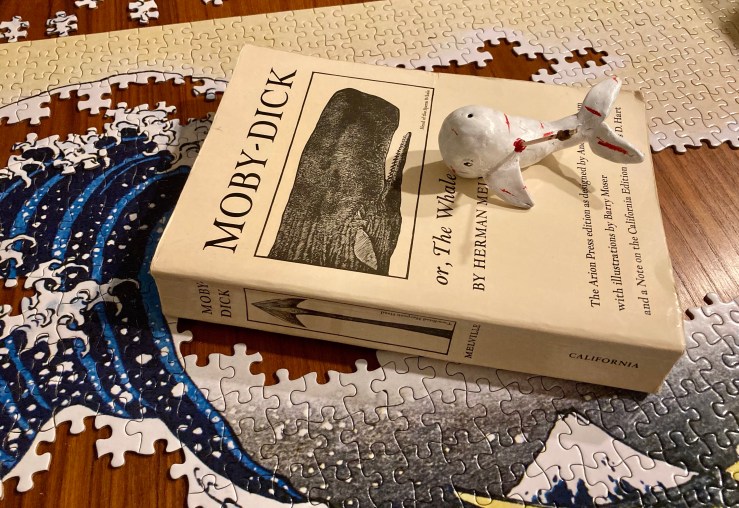
XII. So somehow there are no Barry Moser illustrations for this section (I was spoiled in the last batch of chapters), so here’s a photo of my copy, adorned by a little sculpture my daughter made for me last year; the book is set in the blank space of the puzzle of Hokusai’s Wave we’ve been working on. Where the book sets is a section of pure white. Hard to puzzle out.


First kick | Riff 7 on rereading Herman Melville’s Moby-Dick (All Astir/Going Aboard/Merry Christmas)

Moby-Dick illustration by Barry Moser

I. Look. Moby-Dick is a long book. Not all of these riffs are gonna sing.

II. (I might have had a glass or two of red.)

III. Chapters 20, 21, and 22 see The Pequod supplied, boarded, and piloted away from Nantucket out into the wide watery world. They are not especially memorable chapters.

Moby-Dick illustration by Barry Moser

IV. (There are a few choice lines in this ultrahomophallic novel: In “Going Aboard” (Ch. 21), Queequeg helps himself to a seat on a sleeping sailor’s seat: “He put his hand upon the sleeper’s rear, as though feeling if it was soft enough, and then, without more ado, sat quietly down there.” He promises not to hurt the sleepers face.

The rearing rerears in Ch. 22, “Merry Christmas,” when Ishmael declares: “I felt a sudden sharp poke in my rear.” It’s Captain Peleg kicking his ass. “That was my first kick,” Ishmael attests, a line that recalls his conversation with Peter Coffin of the Spouter Inn, who kicked his son out of the marriage bed. Paternal Peleg’s infanticidal foot foreshadows a shadowy future.)

Moby-Dick illustration by Barry Moser

V. (I’ll also point out that The Pequod departs on Christmas, linking it to Christ’s birth, linking the novel back to the resurrection theme I’ve been pointing out in these riffs—but yeah, that’s pretty obvious. I didn’t find much to ironize or problematize or whateverize the symbolism on this reread.)

VI. (And still in the parentheses, where I’ll keep most of this riff. We meet, sorta, but not really, Starbuck and Stubbs (but not Flask) in these chapters.)

VII. (Swearing in “Christmas” includes “sons of bachelors” and “Blood and thunder!”)

VIII. Look. Moby-Dick is a long book. Like I said, not all of these riffs are gonna sing.

But! The edition I’m reading this time has some wonderful illustrations by Barry Moser, and there were several for these (workmanlike, occasionally melancholy, not particular profound) chapters. They are dispersed in this brief riff.

Moby-Dick illustration by Barry Moser

IX. I look forward to getting out into the watery world…and the arrival of Ahab!


Oblique hints | Riff 5 on rereading Herman Melville’s Moby-Dick (Nantucket/Chowder/The Ship)

Moby-Dick illustration by Barry Moser

I. Two short chapters followed by a rather long one, as we almost nearly maybe might head out on the great whaling voyage!

II. Ishmael and Queequeg arrive at their titular destination in “Nantucket,” Ch. 14.

Ish gives us a story—which I think is entirely fabricated, but I could be wrong—about Nantucket’s founding (emphasis mine):

Look now at the wondrous traditional story of how this island was settled by the red-men. Thus goes the legend. In olden times an eagle swooped down upon the New England coast, and carried off an infant Indian in his talons. With loud lament the parents saw their child borne out of sight over the wide waters. They resolved to follow in the same direction. Setting out in their canoes, after a perilous passage they discovered the island, and there they found an empty ivory casket,—the poor little Indian’s skeleton.

As I stated in my opening riff on rereading M-D, I believe that Melville’s novel can be read as a kind of grieving how against the genocidal scope of American culture. This genocide is frequently coded in infanticidal imagery, as well as images of lost children, orphans, and widows.

Ishmael’s (fanciful) version of the founding of Nantucket shows a US American emblem, the eagle, stealing and destroying an avatar of Indian futurity.

III. The motif of genocide shows up again (somewhat indirectly) in Ch. 16, “The Ship.” Queeg tasks Ish with choosing the ship they will sail on, and Ish chooses carefully (emphasis mine):

After much prolonged sauntering and many random inquiries, I learnt that there were three ships up for three-years’ voyages—The Devil-dam, the Tit-bit, and the Pequod. Devil-Dam, I do not know the origin of; Tit-bit is obvious; Pequod, you will no doubt remember, was the name of a celebrated tribe of Massachusetts Indians; now extinct as the ancient Medes. I peered and pryed about the Devil-dam; from her, hopped over to the Tit-bit; and finally, going on board the Pequod, looked around her for a moment, and then decided that this was the very ship for us.

The Pequod’s voyage symbolically re-enacts an American extinction agenda—an ill-fated, suicidal project with only one (apparent) survivor, saved in the end by the ship the Rachel, which, “in her retracing search after her missing children, only found another orphan.”

IV. Ishmael chooses The Pequod because of her gnarly outfitting:

She was apparelled like any barbaric Ethiopian emperor, his neck heavy with pendants of polished ivory. She was a thing of trophies. A cannibal of a craft, tricking herself forth in the chased bones of her enemies. All round, her unpanelled, open bulwarks were garnished like one continuous jaw, with the long sharp teeth of the sperm whale, inserted there for pins, to fasten her old hempen thews and tendons to.

Ish notes that The Pequod is a “noble craft, but somehow a most melancholy! All noble things are touched with that.”

V. Ish is a bit of a romantic, choosing his ship—and, significantly, his partner Queequeg’s fate—-because of its aesthetic.

As a romantic, he tends to read a bit much into the signs and wonders of the world. In Ch. 15, “Chowder,” Melville has ironic fun with Ish’s tendency toward foreshadowing and symbolic overdeterminism.

On a tip, Ish and Queeg head to the Try Pots for some grub and find—

Two enormous wooden pots painted black, and suspended by asses’ ears, swung from the cross-trees of an old top-mast, planted in front of an old doorway. The horns of the cross-trees were sawed off on the other side, so that this old top-mast looked not a little like a gallows. Perhaps I was over sensitive to such impressions at the time, but I could not help staring at this gallows with a vague misgiving. A sort of crick was in my neck as I gazed up to the two remaining horns; yes, two of them, one for Queequeg, and one for me. It’s ominous, thinks I. A Coffin my Innkeeper upon landing in my first whaling port; tombstones staring at me in the whalemen’s chapel; and here a gallows! and a pair of prodigious black pots too! Are these last throwing out oblique hints touching Tophet?

It turns out that this place has some delicious fucking chowder.

And, for the most part, all of the slight events at the Try Pots skewer towards comedy, ironizing Ish’s gloomy symbolic reading of the events of his journey thus far.

And yet!

Ish’s choice of words at the end of his forecasting is telling: “Are these last throwing out oblique hints touching Tophet?”

While “Tophet” (and, alternately, “Tophet,” “Topheth,” and “Topeth”) might generically be defined as “hell,” the meaning here is more distinct. For Ishmael, the giant pots signal the sacrificial roasting of children. “Tophets” were ancient infant burial grounds, but both legend and scholarship suggest these burials were the resort of ritual sacrifice. Infanticide again.

VI. And yet much of “Chowder” is comical and delicious. Ishmael, prompted with “Clam or Cod” by the owner of the Try Pots, showcases the horror we all face when failing to order correctly at some semi-famous local dive where we are not a local:

‘A clam for supper? a cold clam; is that what you mean, Mrs. Hussey?’ says I, ‘but that’s a rather cold and clammy reception in the winter time, ain’t it, Mrs. Hussey?’

Ish and Queeg devour the chowder.

VII. Mrs. Hussey is, unless I am mistaken, the first woman to speak in Moby-Dick. There are very few others. The novel is heavy-phallic, homo-horny, pricking stiff with spears and dripping in (whale) sperm. I hope it is not uninviting.

VIII. I remarked a bit above on Ch. 16, “The Ship,” mostly focusing on the nomenclature of The Pequod. It’s a long chapter and introduces two comical characters, the Quaker captains Peleg and Bildad, who own the majority shares in The Pequod.

IX. (As an aside, in response to the last bit of language above, id est, majority shares—look, Moby-Dick is full of economic metaphors and the language of commerce. It is a novel that reckons with American capitalism, repeating phrases like shares and insurance in a way divorced from actual dollars and cents—in Moby-Dick capitalism becomes some kind of extended metaphor that I haven’t fully thought through, but, if I had to say something now, as I type this in a bit of a rush, I might write something like, Melville ironically maps terms of American capitalism over transcendentalist ideology, e.g. Emerson’s “Over-Soul.” Not sure what that last sentence means, but there’s clearly a relationship between religion/soul and insurance/bodily life in M-D that I haven’t thought about much before this reread. I might riff more on these going forward.)

X. “The Ship” is full of humor but also dark foreshadowing. We get the name “Ahab” but no formal introduction. Still, Ishmael is put off by the name: “When that wicked king was slain, the dogs, did they not lick his blood?”

But Peleg puts Ish in his place: “Captain Ahab did not name himself,” he points out. We are all called into the world by signs and symbols that we neither created nor chose.

“Ahab has his humanities,” Peleg concludes, asking both Ish and we readers to find kernels of sympathy for the mad captain (“he ain’t sick; but no, he isn’t well either“).

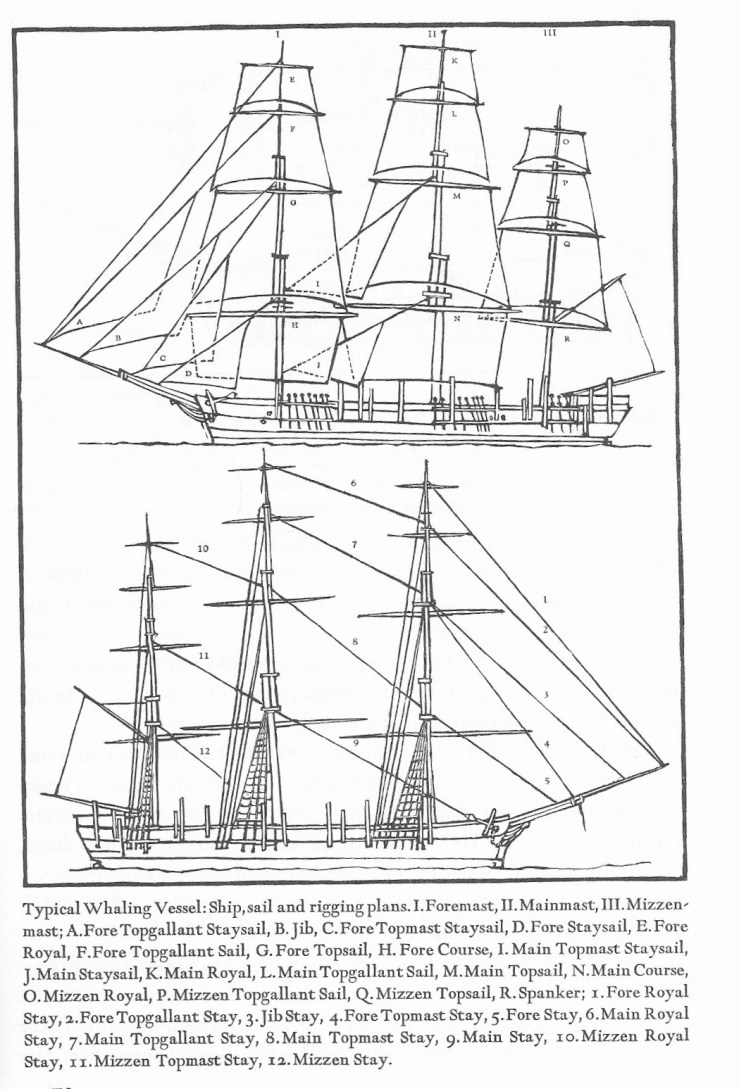
XI. Let me close with Barry Moser’s wonderful diagrams of “The Ship”:

No more my splintered heart and maddened hand were turned against the wolfish world | Riff 4 on rereading Herman Melville’s Moby-Dick (A Bosom Friend/Nightgown/Biographical/Wheelbarrow)

Moby-Dick illustration by Barry Moser

I. “A Bosom Friend” (Ch. 10)  is another one of the remarkable key early chapters of Moby-Dick. It twins Ch. 4, “The Counterpane,” book-ending Ishmael’s Wild New Bedford Nights with Queequeg.

II. While Ishmael’s largehearted acceptance and quick love for Queequeg probably does not seem as eccentric to contemporary readers as it might have been to Melville’s 1851 audience, it’s nevertheless an enduring emblem of Moby-Dick’s expansive spirit.

“Better sleep with a sober cannibal than a drunken Christian,” Ish intones in Ch. 3; by Ch. 10, he admiringly attests that, “Queequeg was George Washington cannibalistically developed.” In a curt but not impolite dismissal of his own culture’s moral compass, Ish declares he’ll, “try a pagan friend…since Christian kindness has proved but hollow courtesy.” Like Huck Finn, another American prototype who wishes to escape into the wild, Ishmael will always value raw truth over empty artifice.

III. There are so many good lines in “A Bosom Friend,” but I think this must be my favorite:

…I began to be sensible of strange feelings. I felt a melting in me. No more my splintered heart and maddened hand were turned against the wolfish world.

Ishmael claims that Queequeg, a “soothing savage” has “redeemed” the world for him.

IV. It is more than possible (and so much has been written on M-D that I’m sure much has been made on the topic) that Ish (and Melville) has (have) taken what might be a complex and nuanced character in Queequeg and othered it into a flat projection screen.

Ishmael, who finds “no civilized hypocrisies and bland deceits” in Queeg, might be accused of turning his bosom friend into a romanticized avatar of Ish’s own desire for a noble “savage” unconstrained by the dictates of Christian morality. However, the events of the novel and its developed characterization of Queequeg do not merit such a facile reading (or is my estimation at this point).

V. Indeed—and to jump ahead, maybe—in Ch. 12, “Biographical,” we learn Queequeg’s origin story.

Queeg is a prince of “Rokovoko, an island far away to the West and South.”

Pause a moment, and look it up, seek it out.

(Wait! “It is not down in any map; true places never are.”)

Queequeg desires to travel the world in the hopes of advancing his culture, and, like so many folks in M-D, runs away to sea (to see). However, his time on whaleboats and in ports of the western world soon soon reveal to him that “it’s a wicked world in all meridians.”

He decides to “die a pagan.”

VI. Notably and necessarily, Queequeg’s “Biographical” chapter is delivered entirely in Ishmael’s voice (unlike Ch. 9, “The Sermon,” where Father Mapple overtakes the narrative).

Queequeg is always a linguistic outsider in M-D—and indeed, an outsider in general, an outsider among outsiders—but also a superhuman superhero, as the events of Ch. 13, “The Wheelbarrow,” show.

VII. I seem to be skipping around, so, fine, okay—

—in “The Wheelbarrow,” Ish and Queeg take a packet schooner from New Bedford to Nantucket, where they plan to join a whaling ship’s crew. On the schooner, one of the several “boobies and bumpkins” aboard mocks Queequeg. Queeg catches ahold of the redneck and tosses him playfully into the air, leaving him shaken but unhurt. Captain, crew, and passengers threaten the “devil” outsider, but chaos erupts when the main-sail’s boom sets loose due because of high winds. The boom knocks the redneck into the ocean. Others panic; Queeg calmly secures the spar dives into the ocean, and rescues his mocker: “The poor bumpkin was restored,” Ishmael remarks. He then tells us that “From that hour I clove to Queequeg like a barnacle; yea, till poor Queequeg took his last long dive,” foreshadowing that not all are to be resurrected in Moby-Dick.

VIII. (Or, alternately—all are to be resurrected in Moby-Dick, but only through Ishmael’s wailing tale.)

IX. But I have skipped around so much—back to Ch. 10, “A Bosom Friend.” In one of the more-remarked upon moments in the book, Ish and Queeg tie the knot after a good smoke:

…he pressed his forehead against mine, clasped me round the waist, and said that henceforth we were married; meaning, in his country’s phrase, that we were bosom friends; he would gladly die for me, if need should be. In a countryman, this sudden flame of friendship would have seemed far too premature, a thing to be much distrusted; but in this simple savage those old rules would not apply.

X. Ishmael then, through a kind of tortuous logic, describes why he, “a good Christian; born and bred in the bosom of the infallible Presbyterian Church,” “must turn idolator” and pray to Queeg’s pagan idol. It’s what God would want him to do, see? Ishmael’s logic is predicated on two simple principles:

–He is “to do to my fellow man what I would have my fellow man to do to me”

and

–“Queequeg is my fellow man”

For me, the remarkable part of Ishmael’s commitment to Queequeg isn’t the first Jesusian imperative to do unto others—it is, in other terms, to recognize the other as a fellow man.This recognition is the moral imperative of Moby-Dick.

XI. And then a sweet ending: “Thus, then, in our hearts’ honeymoon, lay I and Queequeg—a cosy, loving pair.”

XII. “Nightgown,” Ch. 11, is a short chapter where something remarkable and likely inexplicable occurs: Ishmael and Queequeg learn to communicate.

And not just communicate at the level of base transaction or simple need, but rather share philosophical and even aesthetic viewpoints, as born out in the details of Queequeg’s story in Ch. 12, “Biographical.” Again, we might criticize Ishmael as ventriloquizing Queequeg, painting his own broad romantic visions over the possibility of a complex and nuanced character that Melville can’t muster. But I ultimately believe—or at least, I believe up until now on this reread—that Ish and Queeg’s accelerated ability to communicate points to an aspirational transcendental horizon, post-culture, post-language.

XIII. “Nightgown” also has one of my favorite moments in Moby-Dick, a little riff by Ishmael that anticipates the deconstruction of oppositions we later locate in the work of late twentieth-century language theorists:

We felt very nice and snug, the more so since it was so chilly out of doors; indeed out of bed-clothes too, seeing that there was no fire in the room. The more so, I say, because truly to enjoy bodily warmth, some small part of you must be cold, for there is no quality in this world that is not what it is merely by contrast. Nothing exists in itself. If you flatter yourself that you are all over comfortable, and have been so a long time, then you cannot be said to be comfortable any more. But if, like Queequeg and me in the bed, the tip of your nose or the crown of your head be slightly chilled, why then, indeed, in the general consciousness you feel most delightfully and unmistakably warm.

XIV. (As a final note—I remembered this passage in Thanksgiving, 2020, after receiving a very sad text message from my aunt, who we would not be seeing that year, after having not seen her for July 4th—like so many other people feeling the smallbig losses of the year, of the absences of festival and visitation—but also feeling those traditions of festival and visitation so much dearer and warmer in their absence. Nothing exists in itself.)

Happy New Year! // Some books I’ll try to read/re-read in 2021

Happy New Year!

Time for the cliched “Stuff I May or May Not Read This Year” post!

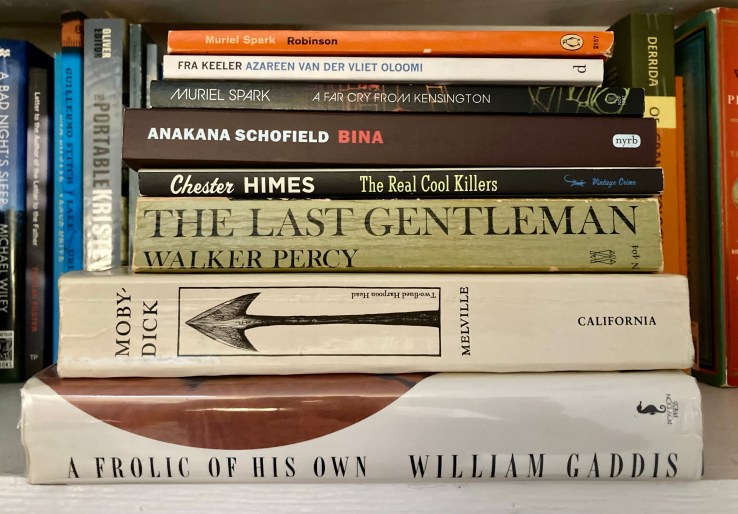
Bottom to top–

A Frolic of His Own is the only Gaddis I haven’t read. I read the first fifty or so pages a few years ago, but got distracted with something else.

I haven’t re-read Moby-Dick in a few years, but I found myself sifting through it a bit at the end of 2020. Time for a re-read, sooner than later.

I’ll continue the Walker Percy reading with The Last Gentleman.

I actually finished Chester Himes’s The Real Cool Killers about 45 minutes ago—it’s a wonderful mix of breezy brutality and brutal humor. This one had an unexpectedly sweet ending. More Himes in 2021.

I’ve been reading through Anakana Schofield’s novel in “warnings,” Bina, and I really dig it so far—very different stuff. It reminds me a bit of Claire-Louise Bennett’s Pond or Helen DeWitt’s The Last Samurai or David Markson’s Wittgenstein’s Mistress, but also unlike those things.

I read a bunch of Muriel Spark in 2020 and I aim to read more in 2021. The ones I have (unread) by her are Robinson and A Far Cry from Kensington.

I also look forward to Azareen Van der Vliet Oloomi’s short novel Fra Keeler as well.

I hope this year is better for all of us than the last one. Peace and love &c.

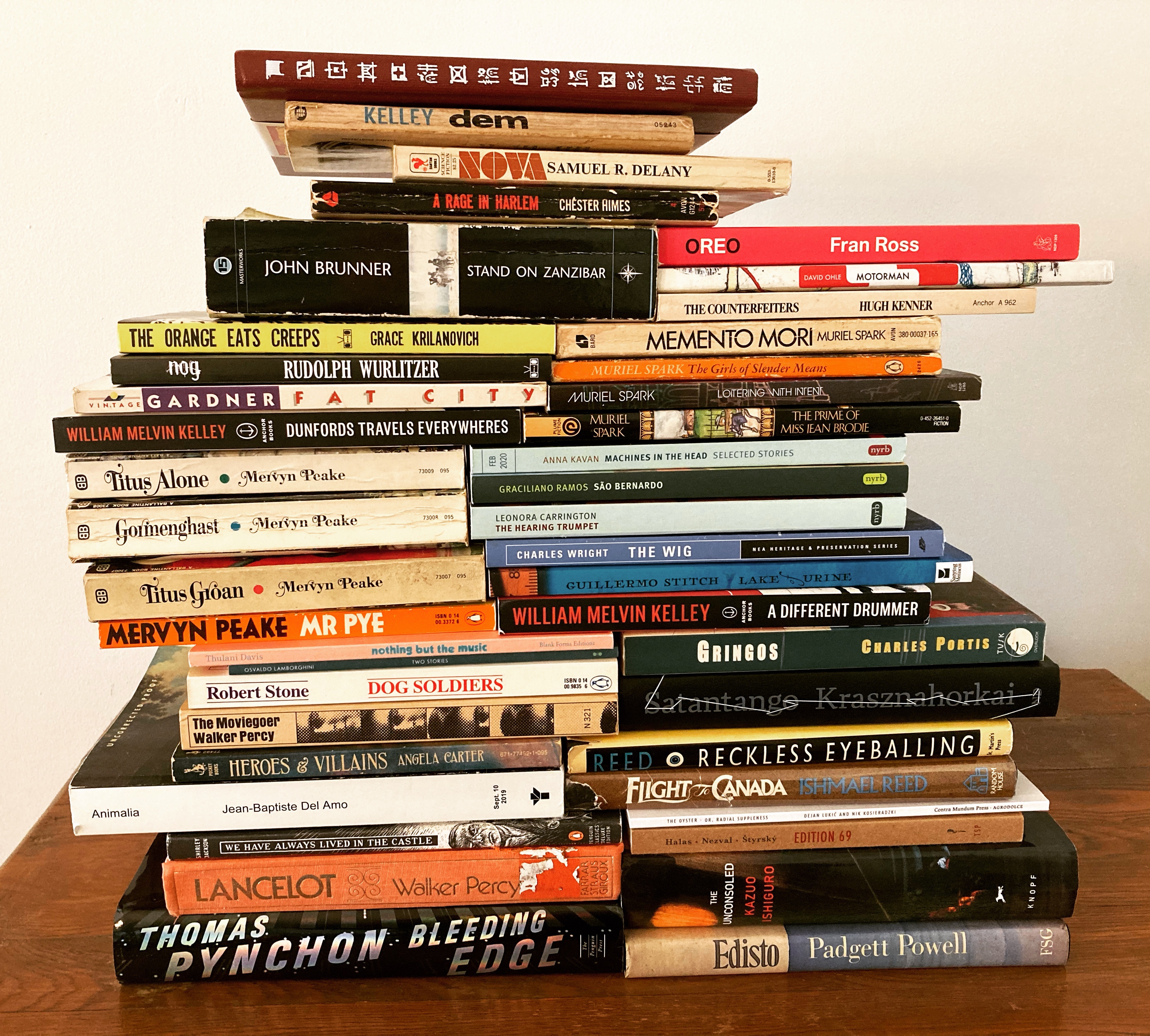
Annotations on a list of books I read in full in 2020

2d27b454-7e45-4ffc-8faf-1c2ba9bda56a


Flight to Canada, Ishmael Reed

A frenetic, zany achronological satire of the American Civil War. I wrote about it here.

We Have Always Lived in the Castle, Shirley Jackson

Jackson gives us a quasi-idyllic-but-also-dystopian world delivered through narrator Merricat, an insane witch whom I adored. Merricat hates with beautiful intensity. The novel’s premise, prose, and mood are more important than its plot, which is littered with trapdoors, smoke and mirrors, and gestures toward some kind of greater gothic paranoia. It’s a slim novel that feels like 300 pages of exposition have been cut away, leaving only mystery, aporia, ghostly traces of maybe-answers.

Titus Groan, Mervyn Peake

The first of Mervyn Peake’s strange castle (and then not-castle trilogy (not really a trilogy, really)), Titus Groan is weird wonderful grotesque fun. Inspirited by the Machiavellian antagonist Steerpike, Titus Groan can be read as a critique of the empty rituals that underwrite modern life. It can also be read for pleasure alone.

926 Years, Tristan Foster and Kyle Coma-Thompson

The blurb on the back of 926 Years describes the book as “twenty-two linked stories,” but it read it not so much as a collection of connected tales, but rather as a kind of successful experimental novel, a novel that subtly and reflexively signals back to its own collaborative origin. My review is here.

Anasazi, Mike McCubbins and Matt Bryan

One of the best books I read (and reread) all year. The joy of Anasazi is sinking into its rich, alien world, sussing out meaning from image, color, and glyphs. This graphic novel has its own grammar. Bryan and McCubbins conjure a world reminiscent of Edgar Rice Burroughs’ Martian novels, Charles Burns’ Last Look trilogy, Kipling’s Mowgli stories, as well as the fantasies of Jean Giraud.

Machines in the Head, Anna Kavan

I have a longish review here.

Machines in the Head was the first book I was able to write about after the onset of the Great Quarantine of 2020.

Gormenghast, Mervyn Peake

Probably the best novel in Peake’s trilogy, Gormenghast is notable for its psychological realism, surreal claustrophobia, and bursts of fantastical imagery. We finally get to know Titus, who is a mute infant in the first novel, and track his insolent war against tradition and Steerpike. The novel’s apocalyptic diluvian climax is amazing.

Gringos, Charles Portis

Gringos was the last of Portis’s five novels. I read the other four greedily last year, and pulled them all out when he passed away in February. I started in on Gringos, casually, then just kept reading. Sweet and cynical, spiked with strange heroism, strange grace, and very, very funny, Gringos might just be my favorite Portis novel. But I’d have to read them all again to figure that out.

Titus Alone, Mervyn Peake

A beautiful mess, an episodic, picaresque adventure that breaks all the apparent rules of the first two books. The rulebreaking is fitting though, given that Our Boy Titus (alone!) navigates the world outside of Gormenghast—a world that doesn’t seem to even understand that a Gormenghast exists (!)—Titus Alone is a scattershot epic. Shot-through with a heavy streak of Dickens, Titus Alone never slows down enough for readers to get their bearings. Or to get bored. There’s a melancholy undercurrent to the novel. Does Titus want to get back to his normal—to tradition and the meaningless lore and order that underwrote his castle existence? Or does he want to break quarantine? 

The Wig, Charles Wright

Hilarious stuff. I read most of it on a houseboat in Jekyll Island, right before lockdown.

Nog, Rudolph Wurlitzer

 Rudolph Wurlitzer’s 1969 cult novel Nog is druggy, abject, gross, and shot-through with surreal despair, a Beat ride across the USA. Wurlitzter’s debut novel is told in a first-person that constantly deconstructs itself, then reconstructs itself, then wanders out into a situation that atomizes that self again.

I should’ve loved it, but I didn’t.

I reviewed it here.

Herman Melville, Elizabeth Hardwick

Typee, Herman Melville

Like a lot of people I was going out of my mind in April of 2020. Elizabeth Hardwick’s lit-crit bio of Melville isn’t necessarily great, but she does work in big fat slices of his texts, making it a kind of comfort read. It also led me to read Typee for the first time, a horny and good novel.

Fade Out, Rudolph Wurlitzer

I liked it more than Nog and wrote about it here.

Welcome Home, Lucia Berlin

A slight and unfinished collection of memoir-slices that will appeal to those already familiar with Berlin’s autofiction.

Reckless Eyeballing, Ishmael Reed

Reed’s 1986 novel skewers Reaganism, but there’s a marked shift from the surreal elastic slapstick anger of Reed’s earlier novels (like 1972’s Mumbo Jumbo). That elastick anger starts to harden into something far more bitter, harder to chew on.

Lake of Urine, Guillermo Stitch

A very weird book. I felt awful that I could never muster a proper review of it. Weird book, indie press, all that. I felt less bad when Dwight Garner praised it in The New York Times. What is Lake of Urine? That was my trouble in reviewing it. The plot is, uh, wild, to say the least. Zany, elastic, slapstick, and often surreal, Stitch’s novel is all over the place. He seems to do whatever he wants on each page with a zealous energy that’s difficult to describe. Great stuff.

Mr. Pye, Mervyn Peake

I recall enjoying it but thinking, Oh, this isn’t Gormenghast stuff.

Bleeding Edge, Thomas Pynchon

I wrote about it here. What may end up being the last Pynchon novel was also the last one I read. It turned out to be much, much better than I thought it would be. It also made me very, very sad. It reminded me of our huge ideological failure after 9/11, an ideological failure we are watching somehow fail even more today.

São Bernando,Graciliano Ramos; translation by Padma Viswanathan

I enjoyed São Bernardo  mostly for the narrator’s voice (which reminded me very much of Al Swearengen of Deadwood). Through somewhat nefarious means, Paulo Honorio takes over the run-down estate he used to toil on, restores it to a fruitful enterprise, screws over his neighbors, and exploits everyone around him. He decries at one point that “this rough life…gave me a rough soul,” which he uses as part confession and part excuse for his failure to evolve to the level his younger, sweeter wife would like him to. São Bernardo is often funny, but has a mordant, even tragic streak near its end. Ultimately, it’s Honorio’s voice and viewpoint that engages the reader. He paints a clear and damning portrait of himself and shows it to the reader—but also shows the reader that he cannot see himself.

The Unconsoled, Kazuo Ishiguro

Kazuo Ishiguro’s The Unconsoled is over 500 pages but somehow does not read like a massive novel, partly, I suppose, because the novel quickly teaches you how to read the novel. The key for me came about 100 pages in, when the narrator goes to a showing of 2001: A Space Odyssey starring Clint Eastwood and Yul Brynner. There’s an earlier reference to a “bleeper” that stuck out too, but it’s at the precise moment of this alternate 2001 that The Unconsoled’s just-slightly-different universe clicked for me. Following in the tradition of Kafka’s The CastleThe Unconsoled reads like a dream-fever set of looping deferrals. Our narrator, Ryder, is (apparently) a famous pianist who arrives at an unnamed town, where he is to…do…something?…to help restore the town’s artistic and aesthetic pride. (One way we know that The Unconsoled takes place in an alternate reality is that people care deeply about art, music, and literature.) However, Ryder keeps getting sidetracked, entangled in promises and misunderstanding, some dark, some comic, all just a bit frustrating. There’s a great video game someone could make out of The Unconsoled—a video game consisting of only side quests perhaps. Once the reader gives in to The Unconsoled’s looping rhythms, there’s an almost hypnotic pleasure to the book. Its themes of family disappointment, artistic struggle, and futility layer like musical motifs, ultimately suggesting that the events of the novel could take place entirely in Ryder’s consciousness, where he orchestrates all the parts himself. Under the whole thing though is a very conventional plot though—think a Kafka fanfic version of Waiting for Guffman.

The Counterfeiters, Hugh Kenner

I wanted to like it a lot more than I did.

Animalia, Jean-Baptiste Del Amo; translation by Frank Wynne

Animalia begins in rural southwest France at the end of the nineteenth century, and ends at the end of the twentieth century, chronicling the hardships of a family farm. The preceding sentence makes the novel sound possibly hokey: No, Animalia is a visceral, naturalistic, and very precise rendering of humans as animals. I had to read Animalia in stages, essentially splitting its four long chapters into novellas. Animalia made me physically ill at times. It’s an excellent novel.

The Prime of Miss Jean Brodie, Muriel Spark

Loved it! Can’t believe I hadn’t read Spark until 2020. Went on a binge.

The Girls of Slender Means, Muriel Spark

I liked it even more than PrimeSlender Means unself-consciously employs postmodern techniques to paint a vibrant picture of what the End of the War might feel like. The climax coincides with the bombings of Hiroshima and Nagasaki, the title takes on a whole new meaning, and the whole thing unexpectedly ends in a negative religious epiphany.

Loitering with Intent, Muriel Spark

My favorite of the four I read by Spark this year: funny, mean, angry postmodern perfection.

Memento Mori, Muriel Spark

A novel that about aging, memory, loss, and coming to terms with death. I was surprised to learn that this was Spark’s third novel, and that she would’ve been around 41—my age—when it was published. Most of the characters are over seventy, and Spark inhabits their consciousnesses with a level of acuity that surprised me. The weakest of the four I read, but still good.

Cherry, Nico Walker

I initially liked Walker’s war-drug-crime-romance-autoficition Cherry–the sentences are zappers and the wry, deadpan delivery approximates an imitation of Denis Johnson. Halfway through the charm starts to wear off; its native ugliness fails to compel, even Walker keeps pushing for the sublime in each chapter, only to puncture it in some way. I probably would’ve liked it at 20.

Skin Folk, Nalo Hopkinson

A mixed bag of fantasy and sci-fi stories based on Caribbean myth, some more successful than others. “A Habit of Waste” and “Slow Cold Chick” are standouts.

Zeroville, Steve Erickson

An excellent novel about film. Does in fiction what Peter Biskind’s history of New Hollywood, Easy Riders, Raging Bulls could not. Zeroville’s unexpectedly-poignant ending transcends the novel’s parodic parameters. It makes you want to go to the movies.

Citizen, Claudine Rankine

A discursive prose-poem-memoir-essay on racism, erasure, bodies, and more. I read it in two afternoons. Highly recommended.

The Divers’ Game, Jesse Ball

I kept waiting for the chapters of Ball’s “novel” to explicitly tangle together, but they never did. One of the very few cases where I feel there should be more pages in a book.

Nova, Samuel R. Delany

I couldn’t make it through Delany’s cult favorite Dhalgren a few years back, but Nova was easier sledding. The book is a riff on Moby-Dick, tarot, monoculture, and the grail quest. It’s jammed with ideas and characters, and if it never quite coheres into something transcendent, it’s a fun quick read (even if the ending, right from the postmodern metatextual playbook is too clever by half).

Zac’s Drug Binge, Dennis Cooper

I don’t know if Dennis Cooper’s gif novels are really novels or something else. I’m not sure if putting this gif novel on a list of books I read is any different than adding, say, a list of paintings by Mu Pan that I viewed over the year. The inclusion of ZDB also helps highlight the artificiality of a numbered list of books read in a year. (I know this list isn’t numbered, but it’s countable. I think it’s fifty-seven or fifty-eight.) It took me maybe 10 or 15 minutes to “read” ZBD while novels by Ishiguro, Pynchon, and Brunner are like 500 pages. The Ishiguro is actually pretty “easy” to read though, in a way that Zac’s Drug Binge is not. The Brunner is much “easier” than the many, many stories I read this year in The Complete Gary Lutz. The Lutz is 500 pages, and I read more of those pages than I did of some of the shorter works listed here like Rankine’s Citizen or Ball’s The Divers’ Game—but I didn’t “finish” the Lutz (and I don’t want to ever “finish” the Lutz), so its not on the list. Ditto Brian Dillon’s essay collection Suppose a Sentence, another collection that I’ve used to cleanse my palate between books. I could probably do a whole post on books like that (John Domini’s The Sea-God’s Herb, the Charles Portis MiscellanyThe Minus Times Collected, etc. etc.)

You can read Zac’s Drug Binge here (and, uh, careful who you’re around if you click this link!).

Oreo, Fran Ross

Loved loved loved Oreo. The novel is thoroughly overlooked as a metafictional masterpiece. In my review, I wrote:

“Fran Ross’s 1974 novel Oreo is an overlooked masterpiece of postmodern literature, a delicious satire of the contemporary world that riffs on race, identity, patriarchy, and so much more. Oreo is a pollyglossic picaresque, a metatextual maze of language games, raps and skits, dinner menus and vaudeville routines. Oreo’s rush of language is exuberant, a joyful metatextual howl that made me laugh out loud. Its 212 pages galloped by, leaving me wanting more, more, more.”

A Different Drummer, William Melvin Kelley

I read it after OreoOreo is neon zany polyglossic hijinks, crackling, zipping, and zapping. Kelley’s first novel, despite its rotating set of viewpoints (and conceit of an invented Southern state), was much more down to earth—modernist, not postmodernist—rendered in rusty oranges, dusty browns, muted greens. I enjoyed Kelley’s later novels dem and Dunfords Travels Everywheres more, but A Different Drummer could be his best book. I wrote about it here.

A Rage in Harlem, Chester Himes

Gonna read more Himes in 2021. Any tips? I loved loved loved it.

dem, William Melvin Kelley

From my review:

“As its subheading attests, dem is, like Drummer, a take on white people viewing black people, and over a half-century after its publication, many of the tropes Kelley employs here still ring painfully true. His “hero,” Mitchell Pierce is a lazy advertising executive, bored with his wife, a misogynist who occasionally longs to return to the “wars in Asia.” He’s also deeply, profoundly racist; structurally racist; the kind of racist who does not think of his racism as racism. At the same time, Kelley seems to extend little parcels of sympathy to Pierce, even as he reveals the dude to be a piece of shit, as if to say, What else could he end up being in this system but a piece of shit?

Sátántangó, László Krasznahorkai; translation by George Szirtes

Years ago I put Sátántangó on a list of books I started the most times without finishing.  This summer I listened to the audiobook version while I painted the interior of my house. The novel’s postmodern ending made me pick up the physical copy I acquired like eight years ago, making Sátántangó the only novel I re-read this year.

Edition 69, Jindřich Štyrský, Vítězslav Nezval, František Halas, and Bohuslav Brouk; translation by Jed Slast

Hey yo you like horny Czech interwar surrealism?

Lancelot, Walker Percy

The first Percy I read, and so far, my favorite–a postmodern Gothic screed against postmodernity. I reviewed it here.

The Moviegoer, Walker Percy

Percy’s first novel is probably much better than I credited in my review, but I was disappointed after the claustrophobic zany madness of Lancelot. I think if The Moviegoer were the first Percy I read it would have been the last.

Dunfords Travels Everywheres, William Melvin Kelley

My favorite of the three Kelley novels I read this year.

Edisto, Padgett Powell

 I read most of Padgett Powell’s 1984 debut Edisto in a few sittings, settling down easily into its rich evocation of a strange childhood in the changing Southern Sea Islands. I’d always been ambivalent about Powell, struggling and failing to finish some of his later novels (Mrs. Hollingsworth’s MenThe Interrogative Mood), but Edisto captured me from its opening lines. The story takes two simple tacks–it’s a coming of age tale as well as a stranger-comes-to-town riff. Powell’s sentences are lively and invigorating; they show refinement without the wearing-down of being overworked. The book is fresh, vital.

When I finished Edisto, I thought I’d go for some more early Padgett. I picked up his second novel, A Woman Named Drown, started it that afternoon, and put it down 70 pages later the following afternoon. There wasn’t a single sentence that made me want to read the next sentence. Worse, it was turning into an ugly slog, a kind of attempt to refine Harry Crews’s dirty south into something closer to grimy eloquence. I like gross stuff, but this wasn’t my particular flavor.

The Orange Eats Creeps, Grace Krilanovich

I remember buying this book very clearly. The yellow spine called to me; the fact it was a Two Dollar Radio title; the title itself; and then, the blurb from Steve Erickson. From my review:

“Krilanovich’s novel is coated in brown-grey paste, an accumulation of scum and cum and blood, a vampiric solution zapped by orange bolts of sex, pain, drugs, and rocknroll. It’s a riot grrrl novel, a psychobilly novel, a crustgoth novel. It’s a fragmented, ugly, revolting mess and I loved it. The Orange Eats Creeps is ‘A vortex of a novel,’ as Steve Erickson puts it in his introduction, that will alternately suck in or repel readers.”

The Silence, Don DeLillo

In my unkind review, I wrote:

“The Silence is a slim disappointment, a scant morality play whose thinly-sketched characters speak at (and not to) each other liked stoned undergrads. At least it’s short.”

Motorman, David Ohle

David Ohle’s lean mean mutant Motorman is a dystopia carved from strange stuff. Ohle’s cult novel leaves plenty of room for the reader to wonder and wander around in. Abject, spare, funny, and depressing, Motorman sputters and jerks on its own nightmare logic. Its hapless hero Moldenke anti-quests through an artificial world, tumbling occasionally into strange moments of agency, but mostly lost and unillusioned in a broken universe. I loved it.

Two Stories, Osvaldo Lamborghini; translation by Jessica Sequeira

Not sure if I found a book so baffling all year.

Stand on Zanzibar, David Brunner

John Brunner’s big fat dystopian novel Stand on Zanzibar frankly overwhelmed me and then sorta underwhelmed me there at the end. This sci-fi classic is a big weird shaggy dog that managed to predict the future in all kinds of ways, and it’s mean and funny, but it’s also bloated and booming, the kind of novel that sucks all the air out of the room. It’s several dozen essays dressed up as sci-fi adventure—not a bad deal in and of itself—but there’s very little space left for the reader

Fat City, Leonard Gardner

Fat City is about an “old” boxer (he’s not thirty) on the way out of his career and a young boxer on the rise. (Rise here is a really suspect term.) I really can’t believe I was 41 when I read this. I should’ve read it at 20. I wouldn’t have understood it the same way, of course, and the biggest sincerest compliment I can pin on the novel is that I would’ve loved it at 20 but I know that I would’ve appreciated it more 20 years later. There are plenty of novels that I read and think, Hmm, would’ve loved this years ago, but now, nah, but Fat City is wonderful. It’s a boxing story, sure, but it’s really a book about bodies breaking down, aging, getting stuck in dreams and fantasies. Gardner’s only novel (!) is simultaneously mock-tragic and real tragic, pathetic and moving, and very very moving. Great stuff.

Dog Soldiers, Robert Stone

I read Robert Stone’s Dog Soldiers on the late David Berman’s recommendation) and loved it. Set at the end of the Vietnam War, Dog Soldiers is about a heroin deal going sideways. The CIA is involved, some twisted Hollywood folks, and a fallen cult leader. Everyone’s a bit grimy. I guess it comes from the Hemingway tree, or really, maybe, the Stephen Crane tree—Denis Johnson’s tree, Leonard Gardner’s tree, Raymond Carver’s tree, etc. It reminded me a lot of Johnson’s Angels (and, to some extent, Tree of Smoke), but also Russell Banks’s 1985 novel Continental Drift—and Gardner’s Fat City.

Dog Soldiers gets better and better and ends with an ecstatic punchline—a big Fuck you to God in the whirlwind. Great stuff.

Nothing but the Music, Thulani Davis

In my review, I wrote:

Nothing but the Music cooks raw joy and raw pain into something sublime. I like poems best when they tell stories, and Davis is a storyteller. The poems here capture place and time, but most of all sound, sound, rhythm, and sound. Lovely stuff.”

Love in the Ruins, Walker Percy

Loved this one—more in line with the madness of Lancelot than the ennui of The MoviegoerLove in the Ruins posits a USA falling apart to reveal there never was a center.

The Hearing Trumpet, Leonora Carrington

From my review:

“Leonora Carrington’s novel The Hearing Trumpet begins with its nonagenarian narrator forced into a retirement home and ends in an ecstatic post-apocalyptic utopia “peopled with cats, werewolves, bees and goats.” In between all sorts of wild stuff happens. There’s a scheming New Age cult, a failed assassination attempt, a hunger strike, bee glade rituals, a witches sabbath, an angelic birth, a quest for the Holy Grail, and more, more, more.”

The Oyster, Dejan Lukic and Nik Kosieradzki

I still need to write a proper review of this one. It’s something between an essay and a prose-poem and an aesthetic object.

Heroes and Villains, Angela Carter

One of Carter’s earlier novels, Heroes and Villains takes place in a post-apocalyptic world where caste lines divide the Professors, the Barbarians, and the mutant Out People. After her Professor stronghold is raided, Marianne is…willingly abducted?…by the barbarian Jewel. Marianne goes to live with the Barbarians, and ends up in a weird toxic relationship with Jewel, marked by rape and violence. Heroes and Villains throws a lot in its pot—what is consent? what is civilization? what is language?—but it’s a muddled, psychedelic mess in the end.

Just Us, Claudia Rankine

A short, sometimes painful read, Just Us is a mix of essaying and poetry that documents the horrors of the past few years against the backdrop of the horrors of all American history, all in a personal, moving way.

Lolly Willowes, Sylvia Townsend Warner

Starts subtle and ends sharp. A mix of satire and earnestness, purely modern, wonderful stuff. Our hero surmises at the end that Satan might actually be quite stupid. I love her.


[Ed. note–some of the language of these annotations has been recycled from previous posts.]

Trees and Books — Samplerman

Trees and Books, 2020 by Samplerman (Yvan Guillo)

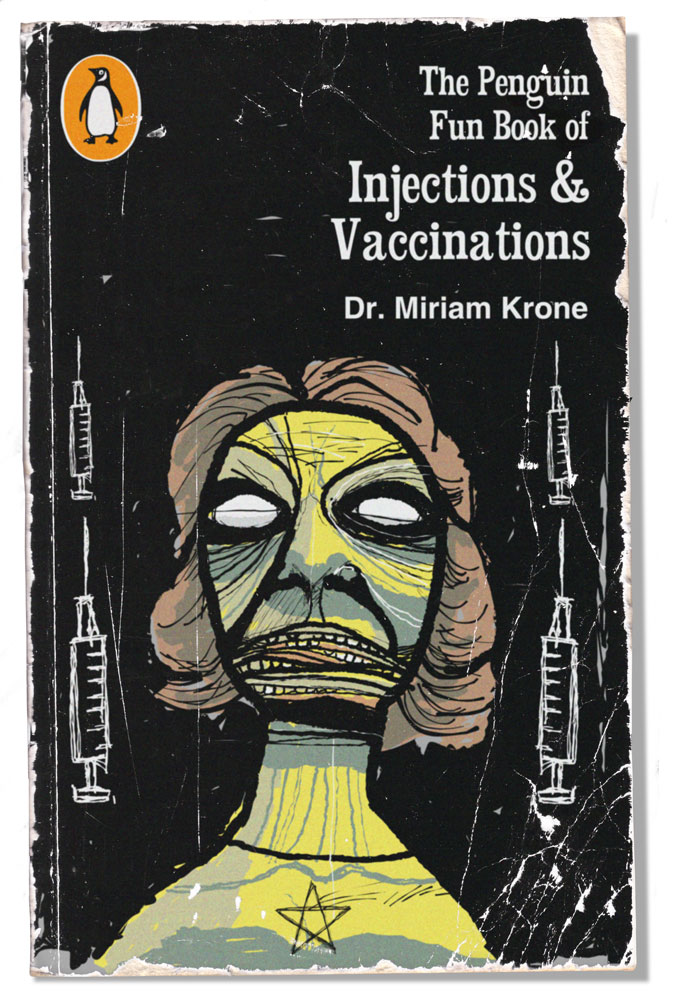
The Penguin Fun Book of Injections & Vaccinations

Via; more Scarfolk.

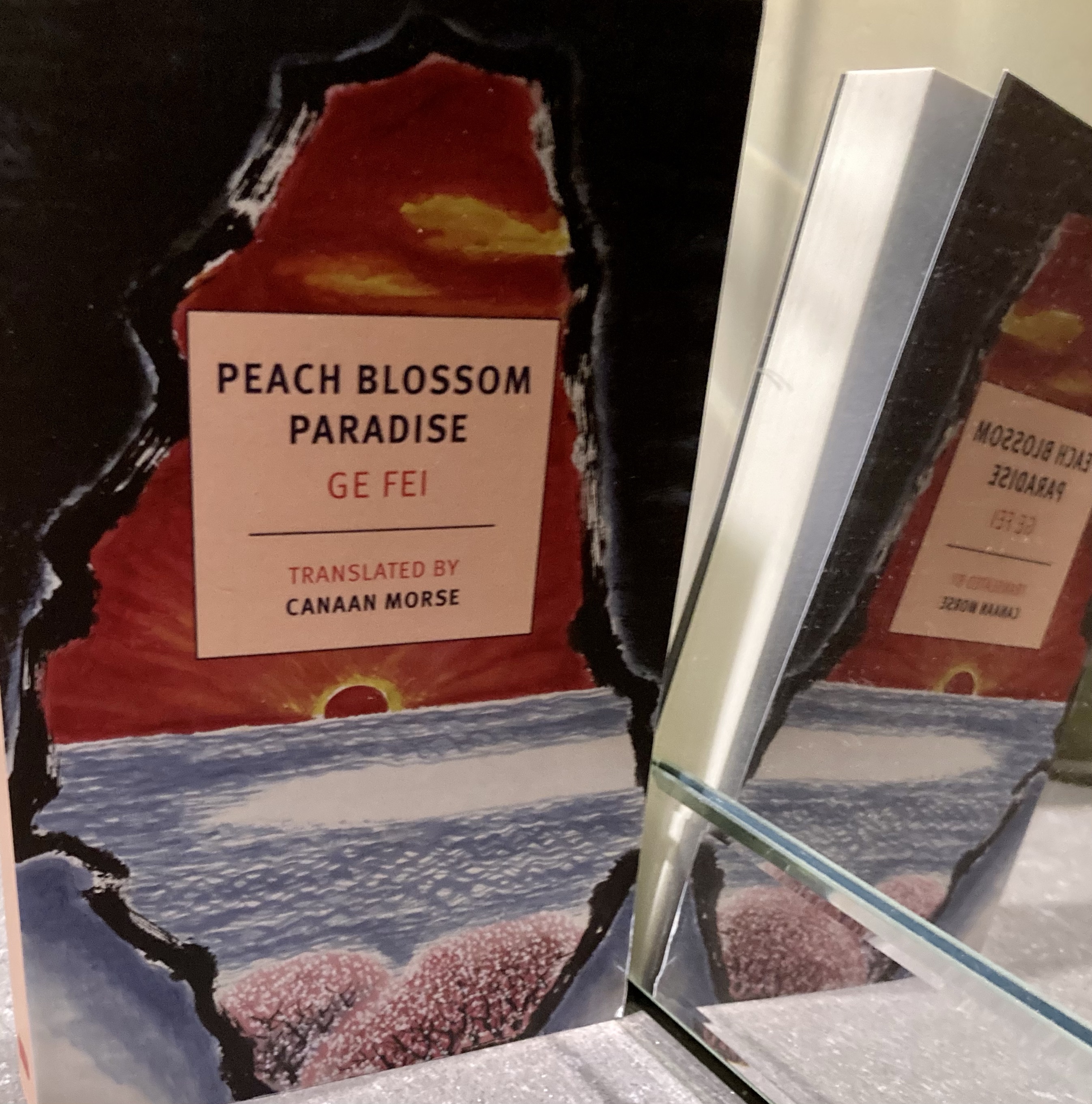
Ge Fei’s Peach Blossom Paradise (Book acquired, 12 Nov. 2020)

Ge Fei’s novel Peach Blossom Paradise, translated from the Chinese by Canaan Morse, is forthcoming from. Their blurb:

In 1898 reformist intellectuals in China persuaded the young emperor that it was time to transform his sclerotic empire into a prosperous modern state. The Hundred Days’ Reform that followed was a moment of unprecedented change and extraordinary hope—brought to an abrupt end by a bloody military coup. Dashed expectations would contribute to the revolutionary turn that Chinese history would soon take, leading in time to the deaths of millions.

Peach Blossom Paradise, set at the time of the reform, is the story of Xiumi, the daughter of a wealthy landowner and former government official who falls prey to insanity and disappears. Days later, a man with a gold cicada in his pocket turns up at his estate and is inexplicably welcomed as a relative. This mysterious man has a great vision of reforging China as an egalitarian utopia, and he will stop at nothing to make it real. It is his own plans, however, which come to nothing, and his “little sister” Xiumi is left to take up arms against a Confucian world in which women are chattel. Her campaign for change and her struggle to seize control over her own body are continually threatened by the violent whims of men who claim to be building paradise.

Leonard Gardner’s Fat City (Book acquired, 12 Nov. 2020)

I’ve been wanting to read Leonard Gardner’s Fat City for a while, and how could I pass up this Vintage Contemporaries edition?

I think I first heard of the book years ago in conjunction with its influence on Denis Johnson. In Salon, in 1996, Johnson wrote, or gushed, really–

Exactly which year of the 1960s the book came out, I can’t remember, but I remember well which year of my lifetime it was — I was discovering that it wasn’t a joke anymore, I was actually going to have to become a writer, I was too emotionally crippled for real work, there wasn’t anything else I could do — I was 18 or 19. Newsweek reviewed “Fat City,” a first novel by Leonard Gardner, in a tone that seemed to drop the usual hype — “It’s good. It really is.” I wanted to get a review like that.

I got the book and read about two Stockton, California boxers who live far outside the boxing myth and deep in the sorrow and beauty of human life, a book so precisely written and giving such value to its words that I felt I could almost read it with my fingers, like Braille.

The stories of Ernie Munger, a young fighter with frail but nevertheless burning hopes, and Billy Tully, an older pug with bad luck in and out of the ring, parallel one another through the book. Though the two men hardly meet, the tale blends the perspective on them until they seem to chart a single life of missteps and baffled love, Ernie its youth and Tully its future. I wanted to write a book like that.

My neighbor across the road, also a young literary hopeful, felt the same. We talked about every paragraph of “Fat City” one by one and over and over, the way couples sometimes reminisce about each moment of their falling in love.

And like most youngsters in the throes, I assumed I was among the very few humans who’d ever felt this way. In the next few years, studying at the Writer’s Workshop in Iowa City, I was astonished every time I met a young writer who could quote esctatically line after line of dialogue from the down-and-out souls of “Fat City,” the men and women seeking love, a bit of comfort, even glory — but never forgiveness — in the heat and dust of central California. Admirers were everywhere.

My friend across the road saw Gardner in a drugstore in California once, recognized him from his jacket photo. He was looking at a boxing magazine. “Are you Leonard Gardner?” my friend asked. “You must be a writer,” Gardner said, and went back to the magazine. I made him tell the story a thousand times.

Between the ages of 19 and 25 I studied Leonard Gardner’s book so closely that I began to fear I’d never be able to write anything but imitations of it, so I swore it off.

I haven’t owned a copy of “Fat City” in over 20 years, but I recently learned that the University of California Press is bringing out an edition this November, and I’ve ordered one.

When I was about 34 (the same age Gardner was when he published his), my first novel came out. About a year later I borrowed “Fat City” from the library and read it. I could see immediately that 10 years’ exile hadn’t saved me from the influence of its perfection — I’d taught myself to write in Gardner’s style, though not as well. And now, many years later, it’s still true: Leonard Gardner has something to say in every word I write.

I just finished John Brunner’s big baggy shaggy dog of a sci-fi novel, Stand on Zanzibar (reading David Ohle’s spare abject wild dystopian prose-poem Motorman, in between Zanzibar chunks)—I think Fat City might be a nice reset.

North (1971 Ford Torino) — Eric White

North (1971 Ford Torino), 2020 by Eric White (b. 1968)

Blog about The Orange Eats Creeps, Grace Krilanovich’s Slutty Teenage Hobo Vampire Junkies novel

Hey, it’s Halloween, spooky times, dark times, right? So here’s a novel recommendation: Grace Krilanovich’s “Slutty Teenage Hobo Vampire Junkies” novel The Orange Eats Creeps.

Here is the first paragraph of The Orange Eats Creeps:

The sun is setting. The hobo vampires are waking up, their quest for crank and blood is just beginning. Over the course of the frigid night they will roam the area surrounding the train stop looking for warm bodies to suck, for cough syrup to fuel a night of debauched sexual encounters with fellow vampires and mortals alike. They distribute sexually transmitted diseases like the daily newspaper but they will never succumb, they will never die, just aging into decrepit losers inside a teenage shell. They have a sense of duty to their habit and their climax — twin addictions that inform their every move. They are lusty, sad creatures, these Slutty Teenage Hobo Vampire Junkies. They traverse the Pacific Northwest’s damp, shitty countryside, forests and big trees, the dusty fields and gravel pits clearing a path of desolation parallel to the rail lines of Oregon and Washington, the half-blown-out signs for supermarket chains in strip malls featuring exactly one nail place, one juice-slash-coffee place, and one freshmex-type grill chain restaurant. Here everything is coated in brown-grey paste like moss at the bottom of a crappy tree…

Krilanovich’s novel is coated in brown-grey paste, an accumulation of scum and cum and blood, a vampiric solution zapped by orange bolts of sex, pain, drugs, and rocknroll. It’s a riot grrrl novel, a psychobilly novel, a crustgoth novel. It’s a fragmented, ugly, revolting mess and I loved it. The Orange Eats Creeps is “A vortex of a novel,” as Steve Erickson puts it in his introduction, that will alternately suck in or repel readers.

The vortex of The Orange Eats Creeps recalls another black hole, Charles Burns’s Black Hole, also set in the Pacific Northwest, also crawling through subcultural punk detritus. Visually and thematically, there are also echoes of Kathryn Bigelow’s 1987 film Near Dark, Tim Hunter’s 1986 film River’s Edge, and Harmony Korine’s 1997 film Gummo. (And yeah, I’m sure a long essay could be worked out in the ways that this book grimes the gilt glam from Joel Schumacher’s 1987 film The Lost Boys.)

As a prose stylist, Krilanovich recalls Kathy Acker or William Burroughs, and the vomitiness and abject bodiness of it all is reminiscent of Julia Kristeva’s theory. Krilanovich’s style seems to have roots in punk rock, in zines, and cut-ups, in theft and weird Xerox collages. The novel is fragmentary, random. We’re trapped—trapped?—in the narrator’s ESP-consciousness, zipping through time and space, drugged out, immortal, wishing to nullify time and space, to achieve a comforting and insensate zero.

All the shooting galleries and basement punk shows and drugstore robberies and gallon buckets of cold coffee won’t be everyone’s cup of tea. Readers looking for a tightly-plotted vampire novel will find themselves frustrated. The lore here is a separate lore: foster families and parking lots and quick scores and quicker sex. The world is boxcars and group homes and 7-Elevens. But there’s plenty of weirdness: vampire boys, punk rock legends and would-be legends, a warlock, a serial killer called Dactyl, the Donner Party, and ESP, ESP, ESP. There’s a core quest: The narrator searches for her sister. Maybe the quest is a metaphor; hell, maybe vampirism itself is a metaphor in The Orange Eats Creeps. It doesn’t matter.

What matters is the aesthetic impression, a swirl of images, words, and motifs coagulating around the reader’s mind’s eye. The Orange Eats Creeps is a survey of consciousness in crisis—the crisis of late capitalism, with vampires making their way through a gig economy, addicted, transient, desperate, enthralled to a particularly Western weirdness. It doesn’t all work, but who cares? Good gross stuff.