I’m not tired of all good books, I’m just tired of novels and stories, even good ones, or ones that are supposed to be good. These days, I prefer books that contain something real. I don’t want to be bored by someone’s imagination. Most people’s imaginations just aren’t very interesting—you can guess where the author got this idea and that idea. You can predict what will come next before you finish reading the sentence. It all seems so arbitrary.
From Lydia Davis’s story “Not Interested,” published in this month’s Harper’s and originally published in NOON.
What grand irregular thunder, thought I, standing on my hearth-stone among the Acroceraunian hills, as the scattered bolts boomed overhead, and crashed down among the valleys, every bolt followed by zigzag irradiations, and swift slants of sharp rain, which audibly rang, like a charge of spear-points, on my low shingled roof. I suppose, though, that the mountains hereabouts break and churn up the thunder, so that it is far more glorious here than on the plain. Hark!–someone at the door. Who is this that chooses a time of thunder for making calls? And why don’t he, man-fashion, use the knocker, instead of making that doleful undertaker’s clatter with his fist against the hollow panel? But let him in. Ah, here he comes. “Good day, sir:” an entire stranger. “Pray be seated.” What is that strange-looking walking-stick he carries: “A fine thunder-storm, sir.”
“Fine?–Awful!”
“You are wet. Stand here on the hearth before the fire.”
“Not for worlds!”
The stranger still stood in the exact middle of the cottage, where he had first planted himself. His singularity impelled a closer scrutiny. A lean, gloomy figure. Hair dark and lank, mattedly streaked over his brow. His sunken pitfalls of eyes were ringed by indigo halos, and played with an innocuous sort of lightning: the gleam without the bolt. The whole man was dripping. He stood in a puddle on the bare oak floor: his strange walking-stick vertically resting at his side. Continue reading ““The Lightning-Rod Man” — Herman Melville”→
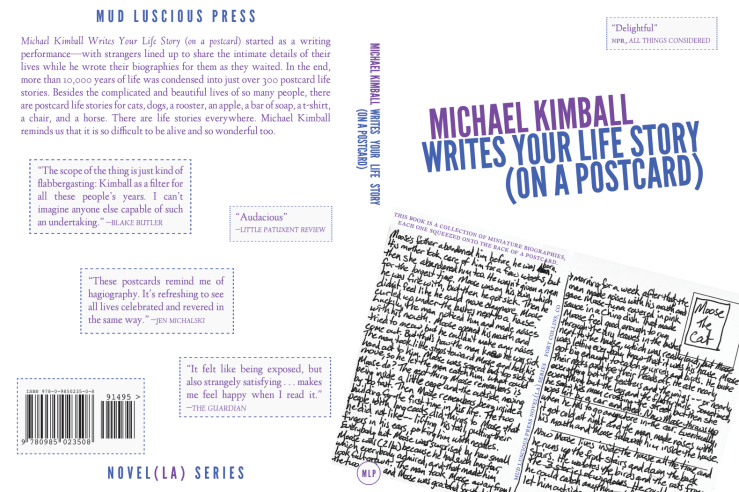
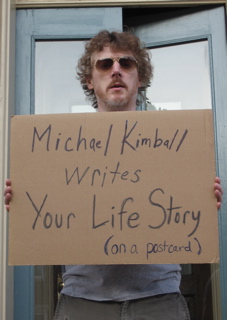
Michael Kimball’s latest book Michael Kimball Writes Your Life Story (On a Postcard) had its genesis in a performance piece at the Transmodern Performance Festival a few years back: Michael interviewed people for a few minutes and then crammed their biographies onto postcards. The project soon evolved into a blog, where Michael interviewed hundreds of people of all ages from around the world. The work is now collected in a book from Mud Luscious Press that features over fifty of the biographies, including the life stories of several contemporary writers, one dead U.S. President, a rooster, a T-shirt, a few cats, Edgar Allan Poe, and Michael himself.
In addition to Michael Kimball Writes Your Life Story (On a Postcard), Michael is the author of Big Ray, Us, Dear Everybody, and The Way the Family Got Away. He still holds the Meryl S. Colt Elementary School record for the 600-yard dash. Check out his website.
Michael was kind enough to talk to me about this latest book over a series of emails.
Biblioklept: What’s the hardest thing about writing someone’s life story on a postcard?
Michael Kimball: There are difficult things at different stages of the process. The first difficult thing is asking the right questions for the particular participant. The second difficult thing is being representative when condensing what I’ve been told. The third difficult thing is writing small enough to squeeze six hundred words or so onto a single postcard.
Biblioklept: When you started the project, it was a planned performance piece of sorts, but your description of it at the beginning of the book makes it seem rather off-the-cuff. Did you have a plan for the questions you would ask? How did the questions change as the project progressed?
MK: That first performance was definitely off-the-cuff. I had no idea what I was going to ask people and how I was going to write their life stories on a postcard. I mostly started with something pretty open-ended and then asked more specific questions about whatever I was told. As the project progressed, I developed a set of starter questions that elicited basic information and then asked more specific questions from there. Basically, I considered whatever I was being told to be important and then asked more questions about it.
Biblioklept: You interviewed people by email, in phone, in person — how did howyou were doing the interview affect the process? Did you prefer one way over the other?
MK: I preferred the in-person interviews. There was a different kind of intimacy with those and there are a bunch of people I interviewed that way who are now friends. Of course, that wasn’t practical for lots of the interviews, since most people lived so far away from me. And the method did influence the process. With the phone interview and in-person interviews I was taking notes as fast as I could, but that was never fast enough. With the email interviews, it was easier for people to give me more detailed answers. Also, since I had the full text of their answers, I could use more of their language.
Biblioklept: Did you prefer to use as much of the subject’s language as possible? Maybe I’m getting into what you described as “the second difficult thing” — how much of yourself do you see in the pieces? I think there’s clearly a voice, a tone that unifies the pieces . . . I’m curious how much of the process was crafting or editing or revising or repurposing the subject’s original language…
MK: I tried to use the participant’s language wherever I thought it gave some sense of the person. At times, I thought of like using third-person close narration. Besides that, I was trying to be as objective as possible and I think that gave the life stories a certain consistency of tone. Clearly, I tend to write sentences a certain way, but beyond that I tried to keep myself out of it.
Biblioklept: What about pieces like “Chair” or “T-Shirt” — how did they come about?
MK: The first non-person one I wrote was Red Delicious Apple, which popped into my head almost fully formed, which happened because I used to almost always have apples on my desk, which just meant that I spent a lot of time with apples. But writing Red Delicious Apple opened up a lot of possibilities and so T-Shirt is written about my favorite t-shirt and Chair was written about a chair I once broke. And I have a great affection for animals, so I loved writing ones like Moose the Cat, Sammy the Dog, and Abby the Horse.
Biblioklept: You wrote over three hundred postcards. How did you choose which ones you would include in the book?
MK: The book would have been over seven hundred pages long if I had included all the postcard life stories, but it was difficult leaving any of them out. So, ultimately, it came down to trying to showing the range of the postcard life stories, which is why nearly every one I wrote about a non-human made it into the book.
Biblioklept: How did the Poe biography come about?
MK: That was for Gigantic’sGigantic America issue. They asked me to write one of the great American bios that they printed on special card inserts and I suggested Poe, who had just had some anniversary of his life or his death.
Biblioklept: Several pieces in Life Story are about contemporary writers. Was writing about these writers different than writing about anyone else in the collection?
MK: Early on, it was other writers who seemed particularly keen on the project — Adam Robinson, Karen Lillis, Elizabeth Ellen, Elizabeth Crane, Blake Butler, etc. I approached every postcard life story the same way, but then let the participant tell me where they wanted to take it. I tried to ask questions that followed their answers.
Biblioklept: I imagine most people who asked to participate in the project were forthcoming with their answers. I’m curious though if you noticed any topics that people avoided or glossed over or maybe required additional prodding from you. Did you ever feel like your part of the interviewing process pushed your subject into uncomfortable territory?
MK: I didn’t realize it until later, but part of what made the project work was that people came to me wanting to tell their life story (rather than me asking them if they wanted it told). Still, there were a few times that people were reluctant to say things. There was one woman who was reluctant to talk about her husband and I couldn’t figure out why, but then they divorced not long after that. And there was one man who didn’t want to talk about his mother because she was really sick. But usually if there was reluctance, it was some kind of abuse or some other horrible thing that had happened to the person. In fact, I was reluctant to talk about the abuse I grew up with in my own postcard life story when it was initially written. In general, I tried to ask the difficult question, but then let the participant decide whether they wanted to answer and how much they wanted to tell me. And with particularly difficult life stories, I always showed the participant what I wrote and asked them if they were OK with it being public before I ever put their postcard life story out into the world.
Biblioklept: Talking about one’s own life clearly has some kind of therapeutic value. Do you think reading about one’s own life carries a similar value?
MK: Since starting the project, I’ve learned there are quite a few therapeutic techniques that involve narrative and telling (or retelling) one’s life story. Part of that process is hearing one’s life story told back or reading about one’s own life. There can be something useful in that perspective and there can be something reassuring about having a manageable version of one’s life story.
Biblioklept: What are you working on now?
MK: I’m very slowly working on two different novels and thinking about a third. I’m not sure if I’ll ever finish any of them.
Biblioklept: Have you ever stolen a book?
MK: I used to steal so many books, especially when I didn’t have the money to keep pace with my reading appetite and I couldn’t find the things I wanted to read in the library. I’ve tried to make up for that by giving away lots of books these days. I stole so many books that I’m not sure I can remember a specific instance. But it was always kind of thrilling and it seemed to make reading all the more exciting. Sometimes, if I didn’t like a book I would sneak it back into the bookstore.
It was a dark autumn night. The old banker was pacing from corner to corner of his study, recalling to his mind the party he gave in the autumn fifteen years before. There were many clever people at the party and much interesting conversation. They talked among other things of capital punishment. The guests, among them not a few scholars and journalists, for the most part disapproved of capital punishment. They found it obsolete as a means of punishment, unfitted to a Christian State and immoral. Some of them thought that capital punishment should be replaced universally by life-imprisonment.
“I don’t agree with you,” said the host. “I myself have experienced neither capital punishment nor life-imprisonment, but if one may judge a priori, then in my opinion capital punishment is more moral and more humane than imprisonment. Execution kills instantly, life-imprisonment kills by degrees. Who is the more humane executioner, one who kills you in a few seconds or one who draws the life out of you incessantly, for years?”
“They’re both equally immoral,” remarked one of the guests, “because their purpose is the same, to take away life. The State is not God. It has no right to take away that which it cannot give back, if it should so desire.”
Among the company was a lawyer, a young man of about twenty-five. On being asked his opinion, he said:
“Capital punishment and life-imprisonment are equally immoral; but if I were offered the choice between them, I would certainly choose the second. It’s better to live somehow than not to live at all.”
There ensued a lively discussion. The banker who was then younger and more nervous suddenly lost his temper, banged his fist on the table, and turning to the young lawyer, cried out:
“It’s a lie. I bet you two millions you wouldn’t stick in a cell even for five years.”
“If you mean it seriously,” replied the lawyer, “then I bet I’ll stay not five but fifteen.”
“Fifteen! Done!” cried the banker. “Gentlemen, I stake two millions.”
“Agreed. You stake two millions, I my freedom,” said the lawyer.
So this wild, ridiculous bet came to pass. The banker, who at that time had too many millions to count, spoiled and capricious, was beside himself with rapture. During supper he said to the lawyer jokingly:
“Come to your senses, young roan, before it’s too late. Two millions are nothing to me, but you stand to lose three or four of the best years of your life. I say three or four, because you’ll never stick it out any longer. Don’t forget either, you unhappy man, that voluntary is much heavier than enforced imprisonment. The idea that you have the right to free yourself at any moment will poison the whole of your life in the cell. I pity you.”
And now the banker, pacing from corner to corner, recalled all this and asked himself:
“Why did I make this bet? What’s the good? The lawyer loses fifteen years of his life and I throw away two millions. Will it convince people that capital punishment is worse or better than imprisonment for life? No, no! all stuff and rubbish. On my part, it was the caprice of a well-fed man; on the lawyer’s pure greed of gold.” Continue reading ““The Bet” — Anton Chekhov”→
I spent most of this day—Sunday that is—swamping out my garden shed, recently rat-infested. Big wood rats, or river rats as we sometimes call them here, some of us.
This meant sterilizing the whole deal, spraying a bleach solution, wearing appropriate eye and nose and mouth protection, because getting older and having kids I now seem to care about my oh-so-important sensory organs more than I did in my twenties. This meant removing rat feces and a few dead rats. Just fucking gross, really.
I don’t know.
2. Point 1 has almost nothing to do with Ben Marcus’s novel The Flame Alphabet. It’s just that I told myself I’d finally write about it here, after finishing it a few weeks ago and all. The farther out it gets, the harder it is to write about.
3. But really, there is some kind of corollary between my rat business and The Flame Alphabet: Both were repellent experiences. Now, to be fair, the rat purging dealie was wholly repellent and in no way intriguing, whereas Marcus’s book was simultaneously attractive and repellent. The novel’s ugliness hit me hard sometimes, and the final chapters were a sludgy slog.
4. Maybe you’re just like, Hey, c’mon, cut it out with the rats, nobody came here for that, get with the program, tell us the plot:
Okay:
So, language becomes toxic. First in kids, who hold an immunity of some kind, but the toxicity spreads to all elements of language and just kills people and makes them sick &c. In this mix our (reliably unreliable) narrator Sam kinda sorta tries to protect/save/help his family, wife Claire and daughter Esther. He undertakes home experiments, his “smallwork,” and keeps up the old time religion of the forest Jews (you’ll have to read the book for clues to this mysticism; I am too exhausted from rat-swamping to further explicate).
Society falls apart, sort of. (This is one of the major maybe-problems with The Flame Alphabet: There’s this hideous apocalypse underway but there also seems to be authority somewhere, external to the narrative, a government or scientific cadre or just really a they who keep the system moving, bread baking, electricity crackling &c).
There’s our narrator’s nemesis LeBov (the name undoubtedly borrowed from William Labov, who you learned about in your linguistics classes, I’m sure).
Midway through the novel our feckless hero starts new smallwork for Labov. LeBov is my favorite character—whenever he shows up the novel is alchemically invigorated.
Other stuff happens.
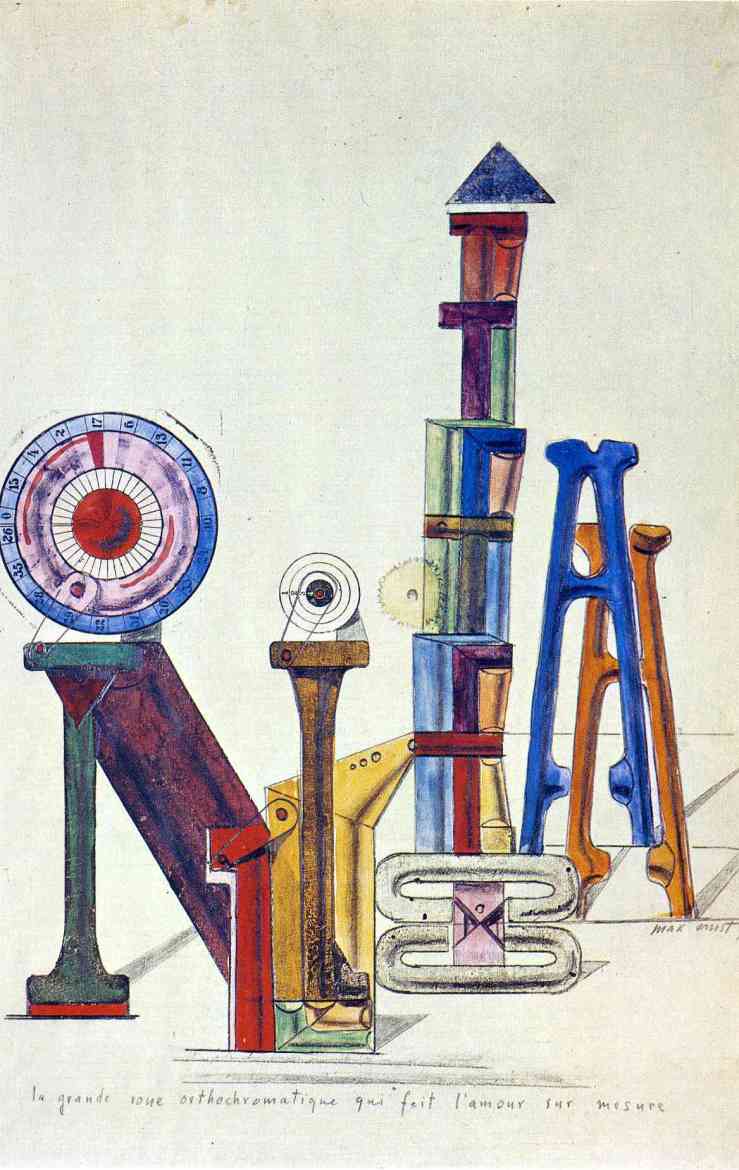
La Grande Roue Orthochromatique…, Max Ernst
5. Really though, The Flame Alphabet is an apocalypse novel, filled with mounds of salt and despair and isolation and probably madness, rarely energized by action, but hardly ponderous.
6. (Here’s a paltry criticism for me to critically make: I wish The Flame Alphabet was shorter. Like significantly shorter. Maybe a novella. Maybe a long short story).
7. Finishing the novel, I sketched out a list, which hey why not just cut and paste here:
Joseph Cornell’s boxes.
Much of J.G. Ballard, especially the stuff in the ’70s and ’80s.
The Residents.
The films of the Brothers Quay.
Charles Burns’s stuff.
Wm. Burroughs, or the idea of Wm. Burroughs.
Joseph Beuys and his goddamn fat and felt.
This is the stuff that The Flame Alphabet reminded me of—this and David Cronenberg’s films, which Jesus, how did they not make the list?
8. I mean, really, I think Ben Marcus has given us a sort of lost Cronenberg film here. Maybe what the book most reminded me of, language plot aside, was Cronenberg’s underrated icky 1999 effort eXistenZ, a film that seems to take place in several worlds at once (including the imaginations of the protagonist and the viewer).
9. Actually, comparing Marcus’s novel to a film is stupid.
Really, I think what The Flame Alphabet most resembles—its best parts, I mean—are directions to some kind of far-out art installation.
Which may be a way of saying The Flame Alphabet is best—or really, I like The Flame Alphabet best—when it recalls Ben Marcus’s older, more “experimental” stuff.
10. To wit:
The practice of language smoking originates in Bolivia but quickly travels north. In Mexico City it is perfected. Words and sentences tested by a delegate in a smoke-filled tube, at the end of which is stationed a sacrificial listener called, for unknown reasons, the bell.
The bell’s brain, when he dies, is pulled and separated into loaves. The loaves are tagged and named. Only drawings survive.
11. Or maybe you want some textual evidence of TFA’s Cronenbergian contours:
Ruptured mattresses littered the floor, sleeping bags with the bottoms kicked through. A brittle pillow bore the facial welt of the last patient who slept here. A man’s work shirt had been chewed, swallowed, spit up in a glaze of bile.
Mesh baggies of hair hung from the ceiling, repelling flies. Possibly the hair attracted them instead.
The Pack, Joseph Beuys
12. Or a Joseph Beuys moment. Our narrator in his language lab:
To test this I created white text on white paper, gray on gray, froze water into text-like shapes and allowed it to melt on select surfaces—slate, wood, felt—which it scarred so gently, you’d need a magnifying glass to spot the writing.
13. And a passage that showcases our narrator’s smallwork as an act of love (of sorts):
On Esther’s final birthday in our house I went to the kitchen to get to work on the cake. There wasn’t much food left in the cupboard, just some pancake mix and a blend of baking powders I’d dumped into a bag. From the meaty, mineral smell I figured this would give a lift to the cake, at least if I got the batter down to room temperature and shocked it into a hot oven so it might have some spring.
For liquids I had an egg and some buttermilk, the custardy sludge from the bottom of the carton.
I could boil the buttermilk to kill off bacteria, then flash freeze it before dumping it into the batter. The egg, too, would need flame, because it was likely spoiled by now.
I broke it into a pan, stifled a gag, then whisked it over a simmer until it frothed up, sputtered, and grew clear again. Mostly it did not congeal. The hardened parts were easy to flick out. When the pan cooled I slid it into the freezer, went to work on sifting the powders.
For sugar I reduced the last of the orange juice until it thickened into a syrup, then whipped in a thread of honey. This would have to do, because I needed the last of the sugar for frosting. I liked to feather it on lightly, then comb it up while hardening it with the medical cold blower, as if the cake had a fright wig.
The frosting I colored silver with a bead of food-grade aluminum.
14. These are all great fragments. Let’s keep going:
15. Desire—need—predicates language:
Presumably if you wanted nothing, you’d have no occasion to speak.
16. And Beckett:
“Failures have their place in our work,” he admitted, after hearing me out. “I’ve had my flirtations with failure. There is a small allure there. I commend you for seeking out failure so aggressively. But this idea people have of failing on purpose, failing better? Look at who says that. Just look at them. Look at them very carefully.”
17. Failure: Failure to imagine (better):
The linguist held forth, smugly dismissing an idea that had recently come into its own. It interested me that the linguist’s inability to imagine something constituted a sound rejection of its possibility.
Hotel Eden, Joseph Cornell
18. And:
We kept believing it couldn’t get any worse, as if our imaginations held sway in the natural world. We should have known that whatever we couldn’t imagine was exactly what was coming next.
19. I think I’ve shared a nice slice of Marcus’s prose. Dude can sling it. Seriously. I think he’s a great writer. I just wish more was stripped away from The Flame Alphabet. Feels overtly novelly at times—I mean, yes, it’s a novel, but this seems to be its biggest weakness: Marcus’s concessions to the form.
20. ( Let me parenthetically insert here what might be my biggest problem with The Flame Alphabet: I felt the ghost of Sam Lipsyte working under its contours. And I love Lipsyte’s stuff, seriously—but I often felt like Marcus was copping Lipsyte’s syntax, rhythms etc. as a means to a more, I dunno, normal narrative.
And while I’m here, in these parentheses, maybe I should direct you to a good and proper and real review. David Winters does a marvelous job at The Millions. And he brings up the Lipsyte thing that I just brought up, but he does a better job parsing the two styles than I.
21. The biggest tussle I had with TFA though is undoubtedly my agon (look how I make myself protagonist!) with its confounding reading rules.
The novel’s overtly parricidal/infantical scope, its estranging metaphors of language and extinctions, its remote anxieties of parenting—all of these pop up like red flags.
I wanted to—no, I set out to––deny the book as an allegory. I sought to resist metaphor, symbolism, analogy. But it’s hard, you know?
22. “Mythology is the lowest temptation,” our narrator tells us at one point.
And then Marcus wedges fairy tales and fables into the mixology.
23. And then our narrator:
I grew so alert to its obvious meanings that they sickened me, leading me to secondary, ironic intentions, disguises of rhetoric I would not normally notice. But soon these, too, felt fraudulent and then I returned to the literal meanings, which had gained more force now that I’d spurned them. That, however, did not last, and by the end the words had shucked their meaning entirely and evolved into a language of groaning, beyond interpretation. Or susceptible to the most obvious interpretation of all.
Language! Language! The problem of language!
24. And hence, what I take to be the book’s thesis, a two-sentence manifesto:
Explanations of any kind, in fact, were simply extinct.
Among the many rhetorical modes that had perished.
25. Does The Flame Alphabet enact its own holocaust, its own perishing; does it self-immolate? I don’t think so—although maybe that’s not what it sets out to do, maybe that’s just what I think it should do. I see a stronger book writhing there under the language, eager to consume some of the unnecessary pages, paragraphs, sentences, words. A book that would consume itself. (This is a silly metaphysical conceit; please move on).
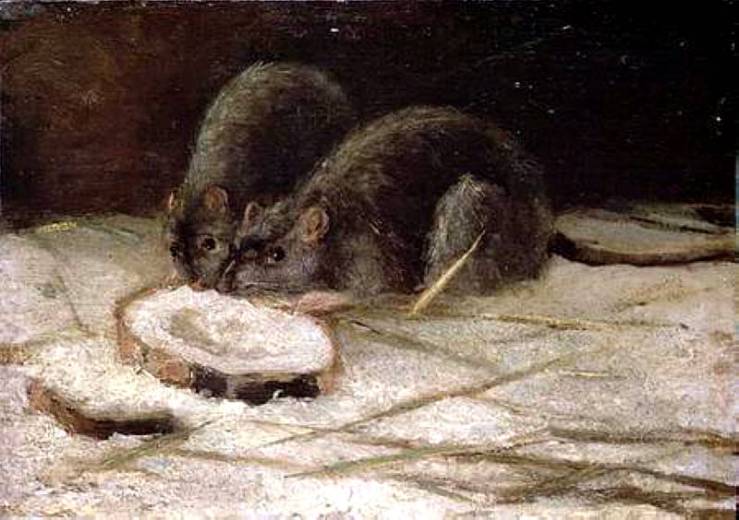
Two Rats, Vincent van Gogh
26. So maybe I’ve knocked on the book a bit, rated it low even, you may perceive, dear reader: Let me be clear then: The Flame Alphabet is the sort of burning ugly vibrant affecting blazing grueling confounding bizarre novels that we need more of. It’s stronger than most of the contemporary stuff out there, definitely the stuff coming from the major houses. And if I seem to pick at it, it’s only because I see in it concessions to a so-called reading public; I wished to see Marcus pull publishing and readers closer to him.
I won’t forget cleaning the dead rats from the shed anytime soon; neither will I forget reading The Flame Alphabet.
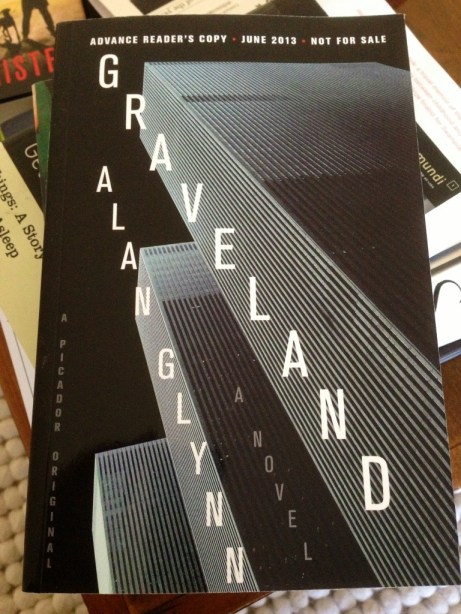
Graveland, a thriller from Alan Glynn, comes out this summer. Here’s publisher Picador’s blurb:
On a bright Saturday morning, a Wall Street investment banker is shot dead while jogging in Central Park. Later that same night, one of the savviest hedge-fund managers in the city is gunned down outside a restaurant. Are these killings a coordinated terrorist attack, or just a coincidence? Investigative journalist Ellen Dorsey has a hunch they’re neither, and her obsessive attention to detail leads her to an unexpected conclusion. Days later, when an attempt is made on the life of another CEO, the story blows wide open—and Ellen’s theory is confirmed. Racing to stay ahead of the curve, she soon encounters Frank Bishop, a recession-hit architect, whose daughter’s disappearance is tied to the murders.
Set deep in a shadow world of crooked business deals and radical politics, Alan Glynn’s Graveland is a mind-blowing thriller.






 Biblioklept: Did you prefer to use as much of the subject’s language as possible? Maybe I’m getting into what you described as “the second difficult thing” — how much of yourself do you see in the pieces? I think there’s clearly a voice, a tone that unifies the pieces . . . I’m curious how much of the process was crafting or editing or revising or repurposing the subject’s original language…




 Biblioklept