From his 1997 interview with Charlie Rose (which Jesus yeah I know you’ve seen before, but hey, it’s worth reading this anecdote from the transcript), David Foster Wallace describes seeing David Lynch’s Blue Velvet—
The screen gets all fuzzy now as the viewer’s invited to imagine this. Coming out of an avant garde tradition, I get to this grad school and at the grad school, turns out all the teachers are realists. They’re not at all interested in post-modern avant garde stuff. Now, there’s an interesting delusion going on here — so they don’t like my stuff. I believe that it’s not because my stuff isn’t good, but because they just don’t happen to like this kind of esthetic.
In fact, known to them but unknown to me, the stuff was bad, was indeed bad. So in the middle of all this, hating the teachers, but hating them for exactly the wrong reason — this was spring of 1986 — I remember — I remember who I went to see the movie with — “Blue Velvet” comes out. “Blue Velvet” comes out.
“Blue Velvet” is a type of surrealism — it may have some — it may have debts. There’s a debt to Hitchcock somewhere. But it is an entirely new and original kind of surrealism. It no more comes out of a previous tradition or the post-modern thing. It is completely David Lynch. And I don’t know how well you or your viewers would remember the film, but there are some very odd — there’s a moment when a guy named “the yellow man” is shot in an apartment and then Jeffrey, the main character, runs into the apartment and the guy’s dead, but he’s still standing there. And there’s no explanation. You know, he’s just standing there. And it is — it’s almost classically French — Francophilistically surreal, and yet it seems absolutely true and absolutely appropriate.
And there was this — I know I’m taking a long time to answer your question. There was this way in which I all of a sudden realized that the point of being post-modern or being avant garde or whatever wasn’t to follow in a certain kind of tradition, that all that stuff is B.S. imposed by critics and camp followers afterwards, that what the really great artists do — and it sounds very trite to say it out loud, but what the really great artists do is they’re entirely themselves. They’re entirely themselves. They’ve got their own vision, their own way of fracturing reality, and that if it’s authentic and true, you will feel it in your nerve endings. And this is what “Blue Velvet” did for me.
I’m not suggesting it would do it for any other viewer, but I — Lynch very much helped snap me out of a kind of adolescent delusion that I was in about what sort of avant garde art could be. And it’s very odd because film and books are very different media. But I remember — I remember going with two poets and one other student fiction writer to go see this and then all of us going to the coffee shop afterwards and just, you know, slapping ourselves on the forehead. And it was this truly epiphantic experience.
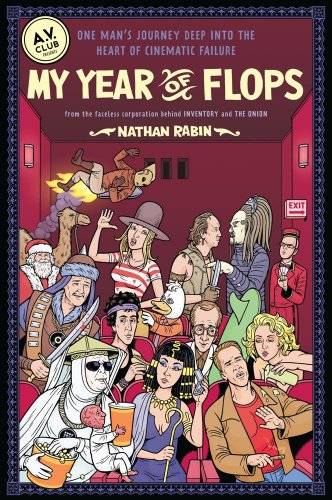
Let me admit biases up front: for the past few years, I’ve looked forward every Wednesday to Nathan Rabin’s regular column at the AV Club,“My Year of Flops,” where he reviews–and reappraises–some of the worst-received films of all time. I’m also a fan of Rabin’s other columns, “THEN! That’s What They Called Music!” and “Nashville or Bust,” as well as the general tone of the AV Club, which he no doubt helps set as its head writer. I also thought Rabin’s memoir The Big Rewind was pretty good. So, I’m probably not the most objective person to review Rabin’s new book My Year of Flops, which comprises 35 of Rabin’s past columns, 15 new entries, and interview snippets with some of the actors who had the (mis)fortune to turn up in these flops. I’ll do my best to assess how well these columns–most of which were written for the internet–hold up as a book.
So, what, exactly, constitutes a flop? There are the biggies here, of course, infamous studio-busting career-killers like Heaven’s Gate, Battlefield Earth, and Ishtar; the batshit crazy weirdfests that were destined to become cult classics, like Southland Tales, Howard the Duck, and The Apple; the disposable movies made to be forgotten, like Bratz: The Movie; there are forgotten and overlooked oddballs, like Robert Altman’s teen sex comedy, O.C. and Stiggs, and Gospel Road, where Johnny Cash tells the life story of Jesus. All of these films share disappointing (or non-existent) box office results as well as general critical disapproval (or at least bewilderment). As part of his revisionist project, Rabin ends each entry by declaring the re-appraised film a “Secret Success,” a “Fiasco,” or a “Failure.” Tellingly, most of the time Rabin finds his subject to be a “Fiasco.” He’s willing to take each film on its own terms; he’s also incredibly open to viewing each film in a way that transcends the trappings of its marketing to an intended audience.
Take, for example Tough Guys Don’t Dance, a film macho novelist Norman Mailer thought it would be a totally sound idea to not only write but direct. Rabin’s initial analysis derides the film for its cardboard characters, debased gimmickry, and embarrassing dialog. By the end of his reassessment, however, Rabin has given the would-be thriller a new life as “a darkly comic, horror-tinged melodrama about the emptiness of excess and the soul-crushing costs of pursuing endless pleasure.” His review rests not on a personal ironic vision, but rather on a willingness to see Mailer’s own ironic vision at work behind (and in front of) the camera.
In the same way, Rabin is able to put aside–even while acknowledging–the dreadful reputations surrounding films like Ishtar and Heaven’s Gate. Even though the latter film essentially destroyed both its studio and the maverick filmmaking style of the 1970s, Rabin finds in it more than a slight redemption–he finds a flawed masterpiece, a gorgeous treatise on Manifest Destiny that doesn’t deserve its reputation. Similarly, Rabin would have us believe that Istar actually is funny. Both of these entries are remarkable not just in their clear revisionist goal, but also for how instructive they are. In both write-ups, Rabin reveals much of how movies are made, and how movies are made flops–the ways that infighting, firings, and studio expectations can damn a film before it even premieres.
While My Year of Flops is instructive in its criticism, it’s also very entertaining. Rabin has a keen sense of satire, and if he occasionally tips into snark, it’s always earned (and if you have a problem with a writer being snarky at the expense of Battlefield Earth, well, you’re probably a prig anyway). A great illustration of how Rabin combines his sense of humor with his instructive criticism in his coinage of the term “Manic Pixie Dream Girl”–
The Manic Pixie Dream Girl exists solely in the fevered imaginations of sensitive writer-directors, who use them to teach broodingly soulful young men to embrace life. The Manic Pixie Dream Girl serves as a means to an end, not a flesh-and-blood human being. Once life lessons have been imparted, the Manic Pixie Dream Girl might as well disappear in a poof! for her life’s work is done.
Cameron Crowe is particularly guilty of employing the MPDG trope, but you can find her pretty much everywhere you look–at least in the domain of rom-coms. Rabin proposes the term in his first entry in the series (also the first entry in the book) a review of Crowe’s much maligned Elizabethtown. Rabin finds it to be a Fiasco. In a move that sums up both Rabin’s program and his generous spirit, Rabin concludes My Year of Flops by re-reassessing Elizabethtown–he now dubs it a Secret Success. While I don’t subscribe to the idea that a critic should-be a starry-eyed optimist who finds the best of all possible worlds in each work, I do think that it has become far too easy to outright dismiss someone’s hard work. We live in a hyper-mediated age that moves too fast: all propositions are disposable, including the arts. Rabin, in taking each work on its own terms, does a service to both criticism and creativity.
Rabin’s own columns might, of course, fall prey to this disposable age. Today’s columns and blog posts are meant to be consumed quickly; although the best might find a life of new clicks in cyberspace, most are tomorrow’s virtual bird-cage liners. The blog-book is thus a tenuous grasp at some permeability–or at least respectability. My Year of Flops is fun, energetic, and insightful, but it does not bear sustained reading. The entries are best consumed one at time, probably between other tasks (or other books). It’s a great book for the john. Still, in an ideal library, My Year of Flops would stand squarely along side any other work of film criticism (it’s certainly sharper than anything by Leonard Maltin or Gene Shalit). Ultimately, Rabin does here what all great critics do–he makes a case for the works he’s appraising. He makes you want to see his Secret Successes and even the Fiascos (and, at times, even the Failures). I’ll even forgive him for making me watch The Apple. Recommended.
Here’s F.W. Murnau’s seminal 1922 vampire film, Nosferatu, in full, thanks to public domain laws. Nosferatu is a horrifying and beautiful example of German expressionism at its finest. Max Schreck is terrifying as the vampire Count Orlok (an adaptation of Bram Stoker’s character Dracula). Observe–
Werner Herzog’s 1979 remake is also gorgeous, but employs a more naturalistic style. Klaus Kinski plays Dracula. Two scenes–
In 2000, director E. Elias Merhige gave us the underrated gem Shadow of the Vampire, a fictionalized account of the making Murnau and his crew making the original Nosferatu. Willem Dafoe is amazing as Max Schreck–or really, as Orlok, rather, as he stays in makeup and costume for the entirety of the production. The movie is both hilarious and frightening, and at times even sadistic. It’s also of a piece with the wave of meta-textual films that surged in the last decade,like Being John Malkovich, I Heart Huckabees, and Adaptation.
Japanese filmmaker Satoshi Kon died yesterday at the young age of 47, apparently from cancer. Kon’s films included Tokyo Godfathers, Perfect Blue, Millennium Actress, and Paprika, visually stunning and emotionally resonant works that helped to prove that manga was a medium, not a genre. More here. Watch the parade scene from Paprika. Chaotic eye candy.
Things that happen in director Nicolas Winding Refn’s new film Valhalla Rising:
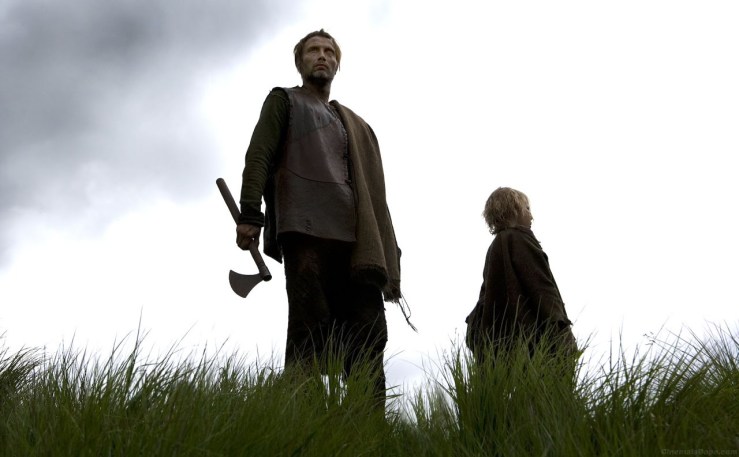
A one-eyed warrior (let’s just call him One Eye) gets revenge against the dudes who have enslaved him (they’ve been making him fight chained-to-a-pole gladiator-style for kicks).
(This is, by the way, likely set in some Scandinavian country during the Middle Ages, in case you need some context).
One Eye does not kill the slave boy who brought him food when he was chained up. The boy becomes One Eye’s mouthpiece, because One Eye never talks. The boy names One Eye “One Eye.” In the film’s only moment of humor, the boy says “You need a name. And you do have only one eye.”
For some unclear reason, One Eye and the boy team up with a band of Christian Vikings who are planning to invade the Holy Land. Maybe they join the Christian Vikings because the bastards who enslaved them were pagans? No. I don’t think that’s it.
The Viking ship gets lost in an existential mist. Despair ensues.
They arrive somewhere. Are they in the Holy Land? They’re somewhere.
There’s no food. Some Vikings dissent. People are flipping out. They want to go home. Some Lord of the Flies-type craziness kicks in.
Valhalla Rising rumbles to an intense, surreal climax, which I will not spoil here.
Things that don’t happen in director Nicolas Winding Refn’s new film Valhalla Rising:
Lots of talking.
Any appearance by a woman.
Explicit context or exposition with respect to setting, plot, or character motivation.
Coherent or unproblematic resolution, clear and defined conflict, epiphanies, or other moments of transformation. (Hang on, maybe there is an epiphany, but it’s likely the viewer’s, not a character’s).
Some more thoughts on Valhalla Rising, in a non-list form:
Valhalla Rising begins with a quotation asserting that before the introduction of monotheism, there’s just man and nature in the world. The film then goes about showing how cruel this relationship is and how the apparently assuaging claims of Christianity have no purchase on the world’s intrinsic, bloody Darwinism. There is no social contract in Valhalla Rising, only brain busting with axes, confounding weather, and a lack of easily available food. If there’s a religious commentary that links the fact that the Norse god Odin only had one eye to One Eye tenuously throwing in his lot with Christian marauders, I can’t find it. The film plays out like a version of King Lear where all sense of family, philosophy, and art has been stripped away, leaving only the cruel heath (and maybe the eye-gouging scene). Valhalla Rising may actually be closer to Ran, Akira Kurosawa’s version of Lear, with its unrelenting silence punctuated by moments of warrior violence. But hang on, Lear is a bad comparison altogether, isn’t it? Maybe better to say Valhalla Rising recalls Werner Herzog’s jungles and madmen, or Terrence Malick’s lonely vistas. But if Refn’s film recalls those greats, it also has a strong whiff of Jason Statham all over it. Not that its violence is cartoonish or that it’s a mere actioner, but it is a violent film that refuses to reflect on its violence, that posits violence not just as a necessity but as normal, as constituent of existence itself. In some ways the film recalls Cormac McCarthy’s novel The Road, only more meandering and aimless. One Eye and the slave boy are not “carrying the fire.”
Valhalla Rising was shot in the gorgeous highlands of Scotland, and director of photography Morten Soborg evokes expressionist depth in this landscape, balancing the natural deep browns, verdant greens, and grays of the setting with rich blues and bursts of fireblood red. Peter Peter and Peter Kyed’s soundtrack sounds at times like an arty death metal band’s extended druggy tune up, but when it starts chugging, it really works. Mads Mikkelsen’s silent performance as One Eye will likely strike a cultish cord for those who like their badassery served up cold and mean. It’s more nuanced than it has a right to be in a film that is, like the aforementioned Herzog and Malick’s films (as well as maybe Wong Kar Wai), more of a mood than a narrative. Valhalla Rising is not a film for everyone; those who want the swelling moral clarity of say, Braveheart, need not apply, and even though I’ve name dropped Herzog and Malick in this review, Refn’s film is something else. Whatever it is, I enjoyed it very much.
After five five fun-filled (mostly) sun-soaked days on Florida’s glorious Gulf Coast, Biblioklept returns from July 4th reveries. I found time to finish Adam Langer’sThe Thieves of Manhattan–full review forthcoming, but now, I’m still in a lazy-loungy mood: so, links and vids and so forth–
First, I ripped my title from Edgar Allan Poe’s “The Fall of the House of Usher,” which you obviously knew of course, gentle reader, because of course you’ve read it, but maybe you haven’t seen Jan Svankmajer’s 1981 film adaptation. Creepy stop motion that completely dispenses with actors. Ignore the subtitles.
Another great little film I saw this weekend is Oliver Laric’s Versions (2010), an essay that playfully updates Walter Benjamin’s “The Work of Art in the Age of Mechanical Reproduction.” Watch Versions. A choice line–perhaps appropriated?–from Laric’s essay: “There is more work in interpreting interpretations than in interpreting things and more books about books than any other subject.”
Still on film: watched John Huston’s 1956 adaptation of Moby-Dick on a lazy post-July 4th demi-hangover. Melville’s novel is unfilmable, really, but Huston’s effort isn’t half bad, although the tone of “high adventure” and the downright jaunty soundtrack hardly fit the grisly images of whale killing that permeate the work. The climax doesn’t really read as big as it should either. Key scene: Orson Welles delivers Father Mapple’s sermon–
Finally, I listened to a good chunk of the audiobook of David Mitchell’s new novel The Thousand Autumns of Jacob de Zoet. Good stuff so far (great stuff, really), and a full review forthcoming, but for now, here’s Dave Eggers’s review.
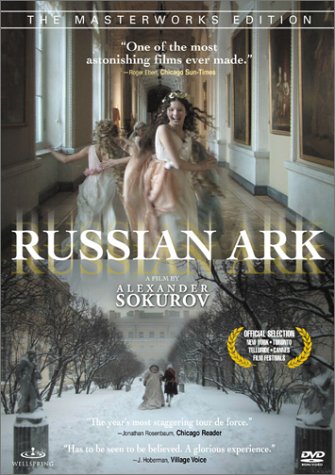
Before I get into the details of Aleksandr Sokurov’s 2002 film Russian Ark, I implore you to stop reading my review and simply get a hold of the film and watch it. It’s a marvelous, rewarding, dreamy experience. That’s not a very convincing argument of course, but I think that the best way to see this gorgeous film is with no preconceptions, with as little information as possible–not because there are plot twists that a review might give away, but rather because the pleasure of Russian Ark is its narrative immediacy–and any review will seek to mediate that immediacy. So I’ve hemmed and hawed. If you need further convincing, read on.
It’s hard to know where to begin, so I’ll let Don DeLillo do it for me. In his latest novella, Point Omega, his filmmaker protagonist describes it as an ideal for the kind of truth he’d like to capture in one of his own films:
There’s a Russian film, feature film, Russian Ark, Aleksandr Sokurov. A single extended shot, about a thousand actors and extras, three orchestras, history, fantasy, crowd scenes, ballroom scenes and then an hour into the movie a waiter drops a napkin, no cut, can’t cut, camera flying down hallways and around corners. Ninety-nine minutes.
That was enough for me to get hold of Russian Ark and watch it, or rather experience it (I think experience is the best verb here, corny as that sounds), but perhaps, gentle reader, you’d like some plot details. Let’s give it a shot. The film begins in darkness, with its unnamed/unseen protagonist describing the vague details of his last memory, a violent accident that he remembers little about. But before we go on, I should point out a few things: this protagonist is unseen because he is essentially the camera; his movement propels the film–is the film–and although he is his own character, he is also a surrogate for the audience. His first-person experience dictates the film, is the film, and although he has ghostly access to the characters who float through the gorgeous halls of the State Hermitage in St. Petersburg, they cannot see or hear him. There is one character who can see him however, an unnamed black-clad 19th-century French aristocrat who the protagonist comes to call “the European.” Neither the European or the protagonist understand why they are in the Hermitage or how they got there; the European is even more perplexed to find that he now speaks perfect Russian. Unlike the protagonist, the European can interact with the denizens of the Hermitage, and interact he does, by turns offending, menacing, or charming (or at least attempting to charm) the characters that the pair encounters as they drift through the ballrooms, galleries, and courtyards of this beautiful palace. Initially, the European repeatedly insults Russian culture, which he believes a pale imitation of European aesthetics. He even protests that one of the fine orchestras that they stumble upon must be manned with Italian players, as Russian musicians simply couldn’t be so skilled. But as they wander the halls, the European slowly succumbs to the rich beauty and opulence of the Hermitage; although he never states it outright, he relents his prejudice against Russian culture, and perhaps even learns a new way of seeing beauty.
And who wouldn’t be moved by the beauty here? Russian Ark functions in some way as a guided tour of the Hermitage, although that term, “guided tour” implies a stuffiness that’s antithetical to the looseness of this film. The camera lingers on a painting or statue; the protagonist offers his thoughts, the European his; perhaps an erstwhile docent steps in to explicate a point of technique or symbolism. It’s wonderful. In one stunning moment (scene would not be the right word for this movie which is of course one long scene), the European argues violently with a boy over a painting of the apostles Peter and Paul. The boy admits to knowing nothing of the scriptures, yet he’s deeply moved by the wisdom and promise that the painting connotes; the European cannot understand how the painting’s aura alone can transmit its meaning to the ignorant lad. The scene begins at 6:38 in the clip below:
The European’s clash with the boy echoes the larger (and yet subtle) clashes of the film, as characters, artworks, and musical styles of different epochs float into or burst out of or parade around in the grand rooms of the Hermitage. There’s Pushkin, Peter the Great, Catherine the Great, Anastasia. There’s an incredible scene where Tsar Nicholas I is offered an apology by the Shah of Iran for the death of an ambassador; there’s a wonderful ballroom dance that moves the European to great joy. In one of the film’s pockets of horror, a layman labors in a strange utility room building his coffin; it is the siege of Leningrad in WWII where over a million people died at the hands of the Nazis. The European, of course, has no knowledge of these events, being after his time, and the disjunction between the protagonist’s contemporary perspective of history and his own provides for a fascinating, if not wholly fleshed out, conflict.
Indeed, one of the greatest pleasures of Russian Ark is its refusal to narrativize or philosophize history beyond a first-person perspective walk through the halls of the Hermitage. The movie erupts into little pockets of exuberant joy or strange, desperate violence; sometimes the protagonist is drawn in, but just as often he’s repelled, and looks for another avenue, like a dreamer willing his own escape. To call the movie dream-like would be an understatement, and like a dream, Russian Ark‘s divergent set pieces overwhelm the senses in their rich splendor. Like the protagonist and the European, I found myself repeatedly entranced by a painting or a concert or a dance or a strange little moment, only to be interrupted by another character intruding into the frame, bearing new information, discordant news that disrupts the dream logic (while paradoxically ushering in a new set piece). Russian Ark distracts its audience, sending them inward; in contemplation, the viewer loses the thread–but is there a thread? Is real life a narrative? Are dreams even narratives? Some of my favorite moments of the film happened when my anxiety at having been distracted by some gorgeous detail was confirmed by the protagonist, who all of a sudden has lost the European, or who is startled by the bustling arrival of new people. But of course, in this film, the viewer is the protagonist.
But writing about Russian Ark is no good, not really. You have to just see it (but I already said that, right?) To quote again from DeLillo’s Point Omega, “The true life is not reducible to words spoken or written, not by anyone, ever.” Sokurov’s film collapses history and art and beauty into a beautiful, edifying, sometimes terrifying dream, a dream that, in its adherence to first-person perspective, is a marvelous approximation of true life. Highly recommended.



 Biblioklept