David Mitchell Discusses His New Novel, The Thousand Autumns of Jacob de Zoet

Hear the whole interview here.

Biblioklept Interviews Adam Langer about His New Book, The Thieves of Manhattan

Adam Langer’s newest novel, The Thieves of Manhattan hits bookstores across the country this week. It’s a smart, funny hybrid that blends and bends genres with startling results. Adam was kind enough to talk to Biblioklept over a series of emails about his new book, truth vs stuff that actually happened, literary hoaxes, and being mistaken for the author of The Magicians. You can read more about Adam Langer at his website, including info on his previous novels Crossing California, The Washington Story, and Ellington Boulevard, and his memoir My Father’s Bonus March. The Thieves of Manhattan is available from Spiegel & Grau.

Biblioklept: Your new novel (or novel-posing-as-memoir-posing-as-novel-posing-as-memoir . . .) The Thieves of Manhattan is about a con game, a literary hoax, and the problems of art and truth, love and theft. It’s also a send-up of the publishing industry and a clever adventure story with a noir flavor and a self-referential sense of humor. I want to talk about all of that, but let’s begin with your protagonist, Ian Minot, a barista with literary aspirations. Early in the novel, he attends a Manhattan party crammed with literary types, most of whom he thinks are poseurs and hacks. At the same time, under his bitterness, we sense that he’d love to be a part of that world. How much of Ian’s experiences correlate to your own with the publishing world? How much hyperbole is in your satire?

Adam Langer: Looking back on writing Thieves, it’s sometimes hard for me to remember exactly where the reality ends and the satirical hyperbole begins. At some point, fact and fiction fuses in my mind, which is, of course, one of the themes of the book. On the one hand, it’s totally true that, as an editor of Book Magazine, I attended many a literary wingding in which actual events described at the book took place. Yes, just as Francine Prose happily greets our hero until she realizes she has confused him with someone else, I too was happily greeted by Ms. Prose until she realized that she thought I was Lev Grossman (Argh). On the other hand, though, a majority of Ian’s experiences and Ian’s biography emerge completely from my imagination—my resumé has a lot of odd items on it, but New York barista isn’t one of them. I liken this experience of melding the actual with the fanciful to one of those live action/animation movies like Who Framed Roger Rabbit? or Mary Poppins, in which the two coexist to create another reality.

B: At the beginning of Thieves, Ian is writing “small,” realistic, character-based stories that no one wants to read. He enters into a literary con with a man named Roth to produce a big adventure story that they will sell as a memoir–as “true,” despite how improbable and fantastical it is. Thieves is in many ways an analysis on our modern obsession for true stories (and the way that “truth” can unravel). Why do people demand truth–even when it might not be what they really want from a narrative?

AL: I think we, or at least speaking for myself, I do want truth from a narrative. When I read a book or see a movie, I do want it to resonate; I want it to either connect with my viewpoints or to challenge them and make me rethink them; I don’t like when my BS-o-meter is constantly going off. But I think people often get bogged down when they confuse Truth with Stuff That Actually Happened. Tim O’Brien has an awesome essay on this topic that kind of blew my mind when I was in college. As for me, I’d much rather read a story of space aliens or baboons or Elizabeth Barrett Browning’s dog that rang true than a self-aggrandizing purportedly-true memoir or celebrity autobiography. There’s a line in Steve Toltz’s A Fraction of the Whole, which I quite liked–”If someone said to me, ‘I’ve got this great story to tell you, and every word of it is an absolute lie!’ I’d be on the edge of my seat.” That line has stuck with me. Also, more prosaically, in the publishing industry, there’s a perception that, with the decline of traditional book coverage, a good novel isn’t enough anymore, that the author needs a compelling biography as well. Ian certainly has this perception and part of his frustration is that he assumes his lack of success is directly related to his lack of an interesting autobiography. He later learns he was wrong regarding just about all of his
perceptions.

B: In his recent book Reality Hunger, David Shields makes a point similar to yours that audiences “get bogged down when they confuse Truth with Stuff That Actually Happened.” Shields also calls for the extinction of the “novelly novel” or the “novel qua novel” — he wants hybrid or “remix” novels. Thieves strikes me as such a novel, clearly in its treatment of memoir vs. novel, but also in its self-aware incorporation of genre fiction tropes from adventure stories and crime noir. Had you tried your hand at crime fiction or adventure tales before Thieves? Were there any difficulties you faced in crafting your hoax story?

AL: I haven’t read Reality Hunger, but my sense is that Shields is probably a lot more dogmatic in his views than I am. I’m not particularly interested in rendering any particular literary form “extinct,” except maybe the genre of Manifestoes That Declare Certain Literary Forms Extinct. I’m a fan of novelly novels just as I am a fan of remix novels or hybrid novels. I love writers who experiment with form and writers who hew to the “well-made-novel” and haven’t advanced past the 19th Century. Though Thieves probably does fit the definition of hybrid or remix, I don’t think that’s all I’ll be writing from now on. As for crime fiction, I’ve dabbled. In fact, the first novel I wrote after moving to New York in 2000 was a thriller of sorts set in the publishing world and concerned a research assistant to a crime novelist who becomes chief suspect once that novelist disappears. It had a lot of problems, and I haven’t taken it out of the drawer in about nine years. Although I have other crime/genre fiction ideas, I think my tastes and skills tend more towards character-based, comic social novels. But putting together the hoax plot was really a blast or a hoot or something like that. It was really incredible fun to try. Normally, when I’m writing, I read certain books to inspire me; while writing Thieves, I was religiously doing New York Times crossword puzzles.

B: Speaking of crossed-words, your narrator Ian uses a rhetorical device that will stand out to many readers: he substitutes the names of famous authors, alter-egos, and literary characters for words he associates them with–so, sex becomes “chinaski,” after Bukowski’s stand-in, a bed becomes a “proust,” a thick head of hair becomes a “chabon,” and so on. How did you come up with this idea?

AL: Well, it seemed to me that so many thrillers I’ve read are filled with jargon, whether hard-boiled patois or technical procedural details, that I thought my narrator needed his own lingo. At the same time, the lingo worked for me because it established Ian’s mindset, one completely immersed in the contemporary literary universe. Before I even started Thieves, I heard this voice that spoke in this literary slang, much of which I didn’t wind up using because I didn’t want to overdose on it. The idea of the slang is that it should be understandable in context without anyone needing to understand or even care about what is being referenced.

B: There is an “answer key,” though–a glossary at the end. Was that your idea? Or was that a publisher’s or editor’s inclusion?

AL: My idea, and I was just having fun with the glossary. I don’t like when readers can flip to the last page and see how it turns out. So, my previous books have featured glossaries, an index, and in the case of Ellington Boulevard, song lyrics.

B: Like you, I’m a big fan of literary hoaxes–so one of my favorite passages in Thieves was a detailed list of various literary forgeries and hoaxes, many of which I’d never heard of, like Li-Hung Chang or the works of Emanuel Morgan and Anne Knish. How much of Thieves was born of your interest in literary hoaxes, and how much research did you do along the way?

AL:: I’ve always been fascinated by literary hoaxes and, while editing Thieves, I was reading as many as I could including the titles you mention, as well as watching great literary hoax movies such as Orson Welles’s F For Fake and Forbidden Lies, the documentary about Norma Khouri, and some awesome YouTube footage of “Margaret B. Jones.” I was slightly disheartened to note how many literary hoaxes have been forgotten. My personal favorites are the Diary of a Young Lady of Fashion in 1764-5 by Madalen King Hall aka Cleone Knox, an incredibly fun read, and the poems of the fictional “Ern Malley,” who has some great turns of phrase no matter how nonsensical. I have no idea what “I am still the black swan of trespass on alien waters” means, but man, it sounds cool.

B: While we’re on literary hoaxes, one of my favorite things about Thieves is that both Clifford Irving and Laura Albert (aka JT LeRoy) blurb it, and then, in the plot, a hoaxer agrees to blurb Ian’s book. How did the Albert/LeRoy blurb come about?

AL: I actually take a very active part in soliciting blurbs for my books, which is partially related to control freakishness and partially related to the fact that, as an author, I much prefer hearing from other writers than from editors, publicists or agents. Clifford Irving’s was the first blurb I got for the book, and getting it was remarkably simple. I found his agent, wrote her a letter that she forwarded to him. We had a very gentlemanly correspondence. I sent him the book and he provided a very generous endorsement. As for Laura, we were introduced via a mutual friend and, after I sent her a galley of the book, we traded dozens of e-mails back and forth and had a number of hilarious, wild and profane telephone conversations. She’s a lot of fun to talk to and correspond with.

My initial idea was to have writers blurb as their alter egos or writer characters in their books—Steven King would write as Jack Torrance, Gary Shteyngart would write as Jerry Shteynfarb, Michael Chabon would write as Grady Tripp, and so on. But I was advised that this would be confusing and most readers who got the joke would think that the blurbs were fake.

B: Have you ever stolen a book?

AL: When I was about eleven, I shoplifted a copy of Arthur C. Clarke’s Fountains of Paradise from Rosen’s Drug Store on Devon Avenue a few blocks away from my house in Chicago. But I felt guilty about it, so the next day, I actually wound up sneaking it back.
“Plugging Literature Into Other Literature” — Tom McCarthy on His New Novel, C

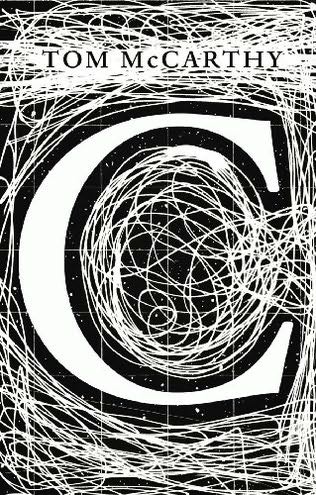
British Cover for C

Surplus Matters has reprinted last week’s edition of The Sunday Times interview with/profile of Tom McCarthy about his new novel C, our favorite new novel of 2010 (The Sunday Times is not free, so thank you, Surplus Matters). The author of the article, Robert Collins, situates McCarthy’s C as an indirect answer to David Shields’s argument in Reality Hunger that the successful modern novel must be a synthesis or remix. We’ve been critical of Shields’s argument, which ultimately rests on aesthetic assumptions that allow Shields to pick what texts will count in his reality canon. To put it another way, great works of literature, from Homer to Ovid to Shakespeare to Henry Miller have always been appropriating and recontextualizing the texts that came before them. McCarthy’s C doesn’t respond to Shields’s would-be manifesto; it obliterates it, following in the (counter)tradition of Joyce, Woolf, Faulkner, and William Burroughs, writers who navigated the treacherous straits of history, art, representation, and reality. C is rich and inventive, telling the life story of Serge Carrefax in the early part of the 20th century. We follow Serge through his strange youth, where he experiments with wireless technology, to the skies of WWI, where he maps the terrain below him; we follow him through his drug-soaked twenties in the ’20s and eventually to the tombs of Egypt. C isn’t a response to the demands of a marketplace that increasingly demands gimmicky concepts and reality-soaked memoirs; instead, to use McCarthy’s term, C plugs into the reservoir of literature that precedes it. From the article:

If McCarthy — as [Zadie] Smith has suggested — presents a radically fresh prospect for the future of the novel, it is probably, paradoxically, because he has instinctively ignored contemporary literature almost completely. He would argue, in fact, that it is only by immersing oneself in all that has gone before that any contemporary novelist has even the faintest chance of coming up with something new. “I don’t think most writers, most commercial middlebrow writers, are doing that,” he says. “I think they’ve become too aligned with mainstream media culture and its underlying aesthetic of ‘self-expression’. I see what I’m doing as simply plugging literature into other literature. For me, that’s what literature’s always done. If Shakespeare finds a good speech in an older version of Macbeth or Pliny, he just rips it and mixes it. It’s like DJing.”

HTMLGIANT Interviews Lee Rourke about His New Novel, The Canal

At HTMLGIANT, Catherine Lacey interviews Lee Rourke about boredom, the writing process, dialogue, foxes, and his new novel The Canal. Read our review of The Canal here. From the interview:

Your narrator speaks a lot about his philosophy on boredom. How much of this do you share with him?

Well, I would have to say quite a lot. I mean, I truly believe – as Bertrand Russell did before me – that if we truly embraced boredom there would be less violence in the world. When I say truly embrace boredom I mean that we should make an effort not to fight it – we especially shouldn’t do something just to stop us from feeling bored (this just leads to the type of passive nihilism the philosopher Simon Critchley warns us about). I think we should just accept it and naturally feel bored and ultimately do nothing. Fighting boredom only leads to friction, which can cause myriad things, including the type of violence that haunts my novel. But I know this is a losing battle. It is a losing battle because boredom reveals to us the nothingness that makes up our lives: the gaping void of our existence, its meaninglessness and finiteness. Obviously this gaping void scares the shit out of us. And it is because of this intrinsic fear that we mostly fail.

Pop Damage Interviews James Grauerholz, Executor of William Burroughs’s Literary Estate

Pop Damage interviews James Grauerholz, executor of William Burroughs’s literary estate. From the interview:

SF: William’s magickal experimentation, the aspects of recording what he called “Danger Sounds” and replaying them in proximity to his target, or using collage to hit a specific target has become the stuff of legend. Some attribute the closing of one particular establishment to William’s hexes. Is there another specific instance which you can recall that is as dramatic and apparently self-evident?

JG: Nope, not really. You are likely referring to the Moka Bar in London, where William said he received snide, snotty service and lousy, weak tea — and his tape-recorders-and-cameras mock-surveillance routine, back and forth on the sidewalk of Frith Street, and how the Moka Bar failed and was shuttered not too long after that.

Forgive me please, but my cast of mind leads me to suspect the Moka Bar, if it really did sell lousy tea with terrible service, might have been headed out of business, with or without the sound-text-tape-film sidewalk-pacing routine…

As with William’s long-ago theory that, because he had never known a NYC junky ever to get a seasonal cold, it was likely that Junk provided a protective covering to the cells (or else, maybe Junk kept the cells well-exercised and in-shape with a constant cycle of shrinking to kick, swelling back up in re-addiction, kicking, hooked again, etc.) — I pointed out that, because a junky with a good supply on hand rarely leaves his apartment to mingle on the sidewalk with other people (which would expose him to more airborne rhinovirus particles), maybe the apparent immunity was more the result of limited exposure to current pathogens…

Biblioklept Interviews Michael Wiley about His New Book, The Bad Kitty Lounge

Michael Wiley is a mystery writer and professor of British Romantic literature and culture at the University of North Florida. He’s published academic volumes about geography and migration in Romantic literature, but we spoke to him about the latest edition in his detective series, The Bad Kitty Lounge. Dr. Wiley was kind enough to talk to us via email about ambiguity and resolution in mystery fiction, giving readers what they want, and the prospects of Wordsworth with a Glock. The Bad Kitty Lounge is available new in hardcover from Minotuar/St. Martin’s. Read more press at Michael Wiley’s website.
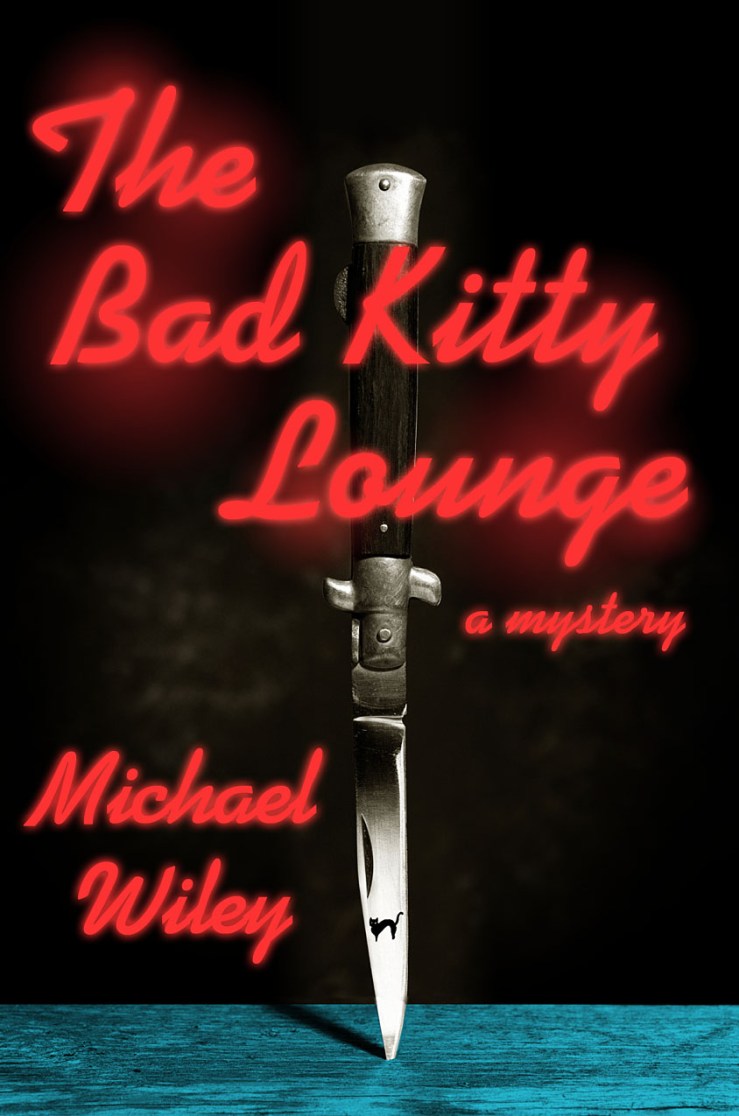
Biblioklept: Your new novel The Bad Kitty Lounge picks up with P.I. Joe Kozmarski, the protagonist from your first novel The Last Striptease; both books are set in Chicago. When you were working on Striptease did you envision it as the beginning of a series?

Michael Wiley: I did. To tell the truth, The Last Striptease catches the story already in motion. I wrote an earlier Joe Kozmarski manuscript that I called Little Girl Lost, almost got published, and then tucked into a box, where it remains. I liked the character and the settings well enough that I wrote a new manuscript, which became The Last Striptease. I had set Little Girl Lost in August and Last Striptease in September, so when I started writing The Bad Kitty Lounge I decided to set it in October and aim for a series that covers each month of the year. There’s no great logic to aiming for a twelve-book series, but it seems as good of a number as any.

B: There’s a tradition in detective fiction of recurring characters (Chandler’s Marlowe comes immediately to mind). When you are writing these books, do you consciously follow or inject tropes of mystery and crime fiction? How important is it to give mystery readers what they want?

MW: It’s always important to give readers what they want. But readers might not know what they want until a book gives it to them. In genre fiction and mysteries and thrillers in particular, conventions matter, but if a writer sticks too closely to conventions the result is cliché. The key isn’t to ignore the conventions but to finesse them, use them in new ways, invert or subvert them. The best mysteries, I think, are recognizable in form but still manage to surprise us and give us great unanticipated pleasures. Before Chandler’s Marlowe, there’s Arthur Conan Doyle’s Sherlock Holmes, and before Holmes, there’s Poe’s Dupin. Each of the greats has reinvented the form in big ways and has given readers what they’ve always wanted without knowing that they’ve wanted it. The rest of us innovate where we can.

B: Sometimes though it seems that writers who experiment too much with genre conventions can subvert, invert, or innovate in ways that trample on some of the great pleasures of mysteries and thrillers. I’m thinking explicitly about novels like Jonathan Lethem’s Gun, with Occasional Music, which weds PK Dick with hard boiled noir, or Thomas Pynchon’s recent exercise Inherent Vice. Such books prize ambiguity, which leads to a shaggy dog story. There’s certainly a pleasure in reading them but many of us read mysteries because Dupin or Sherlock Holmes or Marlowe (or whomever) actually solves the case. How important do you think it is to give mystery readers an answer or solution? What place does ambiguity have in your detective fiction?

MW: Right. Most of the best mystery writing right now includes at least some ambiguity, though. I’ve been reading and re-reading James Lee Burke’s Dave Robicheaux books lately, and while each of them solves a case at hand, we never have the sense that Robicheaux has restored a proper order to the universe. Just the opposite: we know that the universe is deeply screwed up and that Robicheaux is as much a part of the problem as he is part of the solution. Aside from that, some of Burke’s villains pop up again in later books even after we’re sure that Robicheaux has put them to rest.

My own books resolve crimes. At the end, we know who did what and when and why. But my books are also full of moral ambiguity. Some of the guilty parties don’t get punished. Some of the innocent parties do. Good people sometimes do bad things for either good or bad reasons. Bad people sometimes do good things. We get answers but we don’t necessarily like them.

B: I realize that I may have been putting carts before horses with some of these questions–can you tell us a little bit about the plot of The Bad Kitty Lounge?

MW: I like carts before horses. Here’s a synopsis that I wrote for the book flap:

Greg Samuelson, an unassuming bookkeeper, has hired Joe Kozmarski to dig up dirt on his wife and her lover Eric Stone. But now Samuelson has taken matters into his own hands. It looks like he’s torched Stone’s Mercedes, killed his boss, and then shot himself, all in the space of an hour. The police think they know how to put together this ugly puzzle. But as Kozmarski discovers, nothing’s ever simple. Eric Stone wants to hire Kozmarski to clear Samuelson. Samuelson’s dead boss, known as the Virginity Nun, has a saintly reputation but a red-hot past. And a gang led by an aging 1960s radical shows up in Kozmarski’s office with a backpack full of payoff money, warning him to turn a blind eye to murder. At the same time, Kozmarski is working things out with his ex-wife, Corrine, his new partner, Lucinda Juarez, and his live-in nephew, Jason. If the bad guys don’t do Kozmarski in, his family might.

In short, it’s a gritty hardboiled mystery set in Chicago. If your sense of humor runs the way mine does, it has some laughs. Booklist Magazine calls it “howlingly funny.” That may be overstating the case, but I appreciate the compliment.

B: Books critics must always be forgiven hyperbole, positive and negative.

You’re a professor of English literature; specifically, you’re an expert on the British Romantic poets. You might tire of this question–and forgive me if so–but do elements of British Romanticism find their way, consciously or not, into your detective fiction? It seems like a detective’s mission would be at odds with the spirit of Keats’s Negative Capability.

MW: From my perspective, it’s easier to deal with the positive hyperbolic criticism than the negative.

I once told an editor jokingly that I planned to write a mystery featuring William Wordsworth with a Glock. To my surprise, the editor was enthusiastic. I suppose there’s a market for these books. Abe Lincoln: Vampire Hunter has been doing well, and Pride and Prejudice and Zombies was a hit.

I mostly think of my day job as a British Romanticist as being separate from my night job as a writer of pulp fiction, but I know that that the two intersect and inform each other. Wordsworth and Raymond Chandler are two of the great English-language locodescriptive writers, and they’ve both influenced my handling of place. William Blake deals with ideas of innocence and experience, good and evil, and heaven and hell in ways that no noir writer has ever surpassed. And Lord Byron is great for moral ambiguity, as is S.T. Coleridge though in different ways.

So, I’ll probably get to that Wordsworth-with-a-Glock manuscript sooner or later.

B: Wordsworth with a Glock sounds great. Then you could write John Keats Vs. The Lamia; make it a graphic novel. Or just a screenplay. For now though, is the next Kozmarski book already in the works?

MW: I see a series here. My friend Kelli Stanley has set mysteries in ancient Rome. She calls them “Roman Noir.” I’ll just add a “tic” and I’ll have “Romantic Noir.” In the meantime, Joe Kozmarski will ride again. St. Martin’s Minotaur has said that they want to publish the third in the series. It’s done, it’s called A Bad Night’s Sleep, and it’s the best one yet. It should be out in 2011.

B: You teach full time and have a family–how do you make time to write? What advice could you give to young writers who want to develop that kind of discipline?

There’s never enough time in the day — or the week or the year — to write a book. There are thousands of excuses for doing something else, and nearly all of the excuses are good. I accept these facts and then write anyway. I write in the morning before breakfast if I can, or write in the evenings after the kids are in bed. I write in between. And when I’m not writing, I’m often thinking about plot, characters, and setting.

I draw from my own experience when I give advice, which is very simply (and annoyingly) this: “Just write.” Writing seems to me to be more of an act of will than of discipline. Don’t spend time worrying that you’re not writing enough; don’t spend time thinking about the act of writing (unless that’s the subject of your short story or novel) — Spend your time writing. Tell your story. Then revise it. Then think of another story and tell it. Oh, and when you’re not telling or revising or thinking of new details for your story, read other people’s stories and learn from them. That seems important too: others have told better stories than I’ll ever tell. I can learn from them. We all can.

B: Have you ever stolen a book?

MW: No. But I hope someone steals one of mine.

Vice Interviews Bret Easton Ellis

Vice interviews Bret Easton Ellis at length. Topics include troublesome editors, that “Cranky old bastard” J.D. Salinger (“who hated us all, by the way”), the weirdness of L.A., and his forthcoming novel Imperial Bedrooms, the sequel to his first big hit Less Than Zero. Here’s a taste of the interview, where BEE talks (mild smack) about Jonathan Franzen, Michael Chabon, and former classmate Jonathan Lethem:

Vice: [I]t seems like people will never get tired of probing you about how much of your fiction is autobiographical.
BEE: I wonder why? No other authors, when I read about them, get asked this. Michael Chabon doesn’t get asked this. Jonathan Franzen doesn’t get asked this. Jonathan Lethem doesn’t get asked this. I get asked this. Maybe because I’m just not as good a writer as they are.

Vice: No. You’re as good or better than all of them. But I don’t know, I don’t want to get off topic too much. Never mind.
BEE: I want you to just briefly get off topic. You can say anything you want to me. I really don’t know any of them. I mean, I know them kind of, but I’m not friends with any of them.

Vice: I like Chabon, but I get this weird sense that I wouldn’t like him as a person. Not that that matters, of course.
BEE: No, it doesn’t matter. Always look at the art, not the artist.

Vice: But it’s difficult for me sometimes. I think there’s something kind of too cute about Lethem, or at least something too cute about his last novel, Chronic City.
BEE: I really like The Fortress of Solitude. That’s the only book of his I’ve liked. And the only book of Michael Chabon’s that I really liked was Kavalier & Clay.

Vice: That was great.
BEE: And I really don’t like anything by Jonathan Franzen but The Corrections, which I think is a great American novel.

Vice: Those are kind of their inarguable books I guess, those three.
BEE: Yeah, but everything else by those three is just, you know, I go, “Grrrrrr.” You know, I went to school with Jonathan Lethem.

Vice: Oh, really?
BEE: We were in the same class at Bennington.

Vice: I didn’t know that. What was he like in school?
BEE: Nice. He was a nice guy. I had no idea that he wanted to be a writer. He wasn’t in any of the main workshops. Like Donna Tartt would be in there, and Jill Eisenstadt. You know, the people who really wanted to write were the people who always managed to get into the major workshop that term. And Jonathan never got into any of them. And then I got a galley in the mail a long time after we graduated, and it was for a novel by Jonathan Lethem about talking animals or something. And I was like, “What the hell is this?”

Hoax, Italian Style

In this week’s issue of The New Yorker Judith Thurman reports on the literary hoaxes of Tommaso Debenedetti, an Italian “journalist” who has apparently fabricated dozens of interviews with famous authors in the paper Il Piccolo. Authors–so far–include Philip Roth, John Grisham, Gunter Grass, Toni Morrison, Herta Müller, Nadine Gordimer (Thurman is continuing to investigate Debedenetti’s archival interviews).

Thurman contacted Debenedetti, who denied that he faked the interviews. From the article:

Debenedetti said he was completely “shocked and saddened” that all these writers would have denied the veracity of his reporting. When I asked him about the interviews with Roth and Grisham, he flatly denied having invented them, and told me that Roth and Grisham were lying for “political” reasons—because their views on Obama would make them unpopular with left-leaning intellectuals. Roth, he added, might have decided that it was impolitic to express hostility toward Obama because it might spoil his chances for the Nobel.

I then read the list of other writers who had denied or questioned his conversations with them. In every case, Debenedetti asserted that he had invented nothing. When I asked if he could produce any recordings or notes from his interviews, he laughed and, admitting that it sounded like a “tired” excuse, told me that he had lost the tapes in some cases, and in others had “thrown them away.”

Biblioklept Interviews Melville House’s Dennis Johnson

Dennis Johnson, along with wife Valerie Merians, heads Melville House Publishing, an independent book house putting out some of the best stuff on the market today. They also have a bookstore in Brooklyn that regularly hosts all kinds of neat literary-type events. Melville House is the outgrowth of Johnson’s literary blog MobyLives, an insightful source of reportage on the literary world today. In 2007, the Association of American Publishers awarded Melville House the Miriam Bass Award for Creativity in Independent Publishing and in 2009 The Village Voice declared Melville House “The Best Small Press of the Year.” I talked to Johnson by phone last week and he answered my questions with patience and humor. We discussed how Johnson finds the marvelous books he publishes, translation, novellas, and upcoming releases from Melville House. After the interview he was kind enough to ask me about my own blog and offer me some encouraging words. Just a few days after our talk it was announced that one of Melville House’s recent publications, The Confessions of Noa Weber by Gail Hareven had won the 2010 Best Translated Book Award for fiction.

Biblioklept: I want to begin by congratulating Melville House on Hans Fallada’s novel, Every Man Dies Alone. It’s done really well both critically and commercially. The book is something of a “recovered classic,” published just last year for the first time in English. Can you tell us a little bit about how Melville House came to publish the book?

Dennis Johnson: Well, it was a search it’s a real saga about hunting down that book. I’m always interested in finding material from that part of the world and that time of history because I think a good deal of very good literature was lost between the two wars. And it’s just writing that I like a lot. So a friend of mine, the fashion designer Diane von Furstenberg had family that came through that part of the world at that time and I asked her if she had any recommendations and she told me I should look into Hans Fallada, who I’d never heard of. So I tracked down a couple of his titles that had been translated–because he was a bestselling writer here in the 1930s–and it took a while but I found some of those books which had been out of print for a long time and I really loved them. And then, von Furstenberg told me that his best one had never been translated. That was Every Man Dies Alone. And so we set about going after it and acquiring it. And, at that point, once we’d discovered it, it was pretty easy sailing. But tracking down his stuff that had been translated and finding out more about him was really kind of a fun bit of detective work.

B: Did Michael Hoffman translate it specifically for Melville House?

DJ: Yeah, he did. We hired him to do it.

B: Is that normally how you go about with these works–like Nanni Balestrini’s Sandokan or Imre Kertész’s The Union Jack? Hiring a translator?

DJ: Well, there’s a couple of things you can do. You can find the translator, or you can reprint things that have been translated already, if you think it’s already a good translation–that’s a less expensive way to do a translated book. So for example, with the Fallada, I bought some old translations of his other books and published them simultaneously with the new translation of Every Man. There was, you know, there was no old translation to buy. But two of his other books, two great books, one called The Drinker and one called Little Man, What Now? I thought were pretty well translated so we just bought those old translations. They were out of print, they were available [for publication].

B: It seems like a lot of the books you guys put out are–I don’t know how to put it–recovered classics or cult books or just books that English-reading audiences just aren’t necessarily exposed to. Is that purposeful with Melville House?

DJ: I think we have a fairly mixed list. The names you were citing a minute ago . . . Balestrini, he’s only been translated once, I think, thirty or forty years ago. But he’s a very prominent writer in Italy. And it wasn’t exactly a “discovery,” it was just someone that we thought American audiences should know about. Imre Kertész on the other hand is extremely famous, he’s a Nobel Prize winner and he’s published by Knopf. We were thrilled when he wanted to come to Melville House. So, you know, some of these writers are here, some are not. We publish some well known writers, some very obscure writers. We try to mix it up. You know, there’ s no rule, just good literature.

B: Can you talk a little bit about the Contemporary Art of the Novella series? How did it come about?

DJ: Well, we originally had a series called just the Art of the Novella. It’s classics, many of them translated, classics from around the world, lots of European classics, and some of those are new translations that we did it, some are old translations that we reprinted. And that series did really, really well and people really seemed to love it so we decided that we would do a contemporary version of that series and try to mix it up the same way. And so the new series has new discoveries in it, some old reprints, things from around the world, we’re expanding beyond Europe and Russia, we’ve got a native Japanese author named Banana Yoshimoto in it coming out, we’ve got African writers, South American writers . . . It’s been off to a very good launch. I think we’ve done about fourteen or fifteen books in that series so far and it’s going really well. You know, it’s very hard to publish translation in the United States. It doesn’t . . . it doesn’t sell. It’s hard to keep it in store for a long time. And it’s expensive to do translated books because you have to pay your translator. In the Contemporary series we often use new translations because it’s new work that’s never been translated before and that can get very expensive because you’ve got two authors, you know, you have to pay the author, the translator, and that’s why a lot of people are cutting back on doing translations. But we wanted to keep doing translations and we had to figure out a way to keep doing it and one idea we had was, if we had this series of short novels . . . well, one, they’re just cheaper to do, they cost less to buy from another publisher, they cost less to make because they’re less paper and they cost less to translate because they’re shorter. And you know, you pay by how long. So, it suddenly became a more economical way for us to publish translated books. The booksellers, they like the Contemporary series. They get the whole series and they keep it in the store. So, for example, we’re about to do a deal with a new book store in Fort Greene called Greenlight where they would do a whole wall of these books. Other stores do a spin-rack of these books. And they just keep them. And what usually happens with new books is you just get a few weeks in the bookstore and if it doesn’t sell they return it. And so we would get really creamed on the translated work because it wouldn’t have very long in the store and it’s hard to get publicity for them and then they just didn’t have enough time to sell. But, if they’re taking the whole series and keeping them on display, forever, well, then these books have a real chance of surviving. So there were a lot of good reasons for us to do a Contemporary series. And in the end, the reason was that it allowed us to keep doing really good, serious, translated work.

B: What do you think about “rock star” writers like Haruki Murakami and Roberto Bolaño whose English translations sell very well? Does that help the prospects of translated books at all?

DJ: Well, every year there are one or two books that are translated that do very well. But they’re the exception to the rule. At any given point in the year, you look at the New York Times bestseller list for fiction, there’s almost never a translated book on it. Or if there is, it’s some, you know, Scandinavian murder mystery or something. It’s very rare it’s a serious work of literature. So I would say those writers are the exception to the rule. But it’s certainly does help those of us selling translated fiction to be able to point to those things. It encourages booksellers to give us a chance.

B: Can you tell us a little bit about upcoming titles and authors you’re excited about?

DJ: Well, we’re doing another Fallada–

B: Wolf Among Wolves, right?

DJ: We’re doing Wolf among Wolves in May. And we’re doing the paperback for Every Man Dies Alone at the end of this month, as a matter of fact. So those are two that I’m really excited about. We have some really great nonfiction coming out. We just published a book about North Korea called The Cleanest Race. It’s about understanding North Korea through its propaganda. It’s got a lot of really wild art showing the propaganda posters and movie stills and things. And then we’ve got some novels coming out, one from a young British writer named Lee Rourke. It’s the first novel. It’s called The Canal and I think it’s one of the very best novels we’ve ever published. It’s generating a lot of excitement. We’re doing another one with Kertész next year, which is a big novel called Fiasco. He wrote a trilogy years ago about his experience in the camps. What was he, fifteen or something, when he was sent to Auschwitz-Birkenau, working in a Nazi factory trying to turn coal into gasoline? And he wrote a novel called Fatelessness about that and another one called Kaddish for an Unborn Child. And Knopf published Kaddish and Fatelessness but they never published Fiasco. So we’re really excited about that.

B: Something I enjoy about MobyLives is your perspective as a publisher covering real news about book selling.

DJ: Thanks. It’s a labor of love. If you look at the historic arc of the website, you can see that we became more informed by being a publisher. I wasn’t a publisher when I started it and it was much more general-interest reader kind of thing. I try to get help. I try to make the staff here participate, I think it makes it a little more wide-ranging.

B: So, have you ever stolen a book?

DJ: Sure, yeah. I used to steal a lot of books from my brother. I remember stealing Gore Vidal’s Burr. My big brother’s a lot older than me and he left the house when I was a kid and I remember stealing a lot of his books. So Burr yeah, a novel Vidal wrote about Aaron Burr. Fantastic book. I still have it. He hasn’t asked for it back. I don’t think he knows.

“If We Do This as a Conversation, It Will Be Easier for Me” — David Foster Wallace

David Foster Wallace’s 2003 interview on German TV station ZDF has been viewable for awhile in its full 84 minute glory, but it’s only just now been uploaded to YouTube in more digestible and manageable 10 minute chunks.

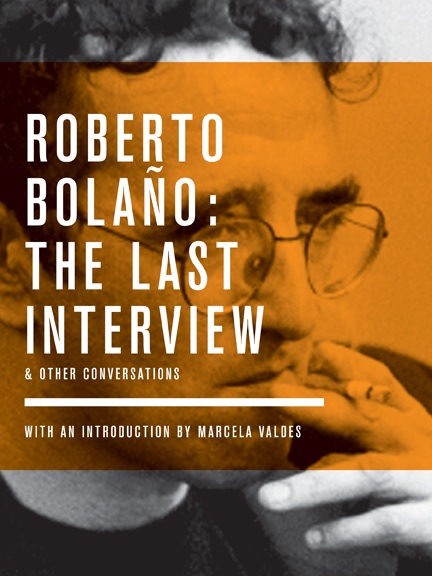
Roberto Bolaño: The Last Interview

I hate reviews that hem and haw too much over context, but I feel that a proper review of Roberto Bolaño: The Last Interview has to begin with some background information. But because I love you, gentle reader, as much as I hate context-driven reviews, here’s the quick version: if you, like me, have found yourself compelled to read everything by Bolaño that you could get your hands on in the the past year or two, then you should buy and read The Last Interview because you will enjoy it. Now for the context:

When Bolaño died at age 50 in 2003, he was only just rising to prominence as a fiction writer, with most of that prominence still restricted to the Spanish-speaking world. Bolaño’s tremendous success has been mostly posthumous and there really aren’t that many interviews with the man. Roberto Bolaño: The Last Interview collects four of them, scattered between 1999 and 2003. Up until now, not all of these interviews were available in English (unless you took the time to put them in a translator program like Babel Fish. Which I did. Quick note: Sybil Perez’s translations here are better than the syntax soup I got via Babel Fish). The book gets its name from Bolaño’s last interview, conducted by Mónica Maristain in a 2003 issue of the Mexican edition of Playboy; that longish interview makes up the bulk of this book. There’s also an essay entitled “Alone Among the Ghosts” by Marcela Valdes, previously published in a 2008 issue of The Nation.

“Alone Among the Ghosts” works as a sort of preface for the interviews, providing a brief overview of Bolaño’s oeuvre and shedding light on his working methods. In particular, “Ghosts” details how Bolaño researched the gruesome crimes at the heart of 2666. The interviews that follow range in tone from flighty (Maristain’s Playboy interview) to intimate (Carmen Boullosa’s inteview in Bomb), but all share one common trait: each interviewer attempts to get Roberto Bolaño to name his place in the canons of Spanish and world literature. The interviews, much like Bolaño’s at-times-esoteric (at least to this English speaker) novel The Savage Detectives, are chock full of literary references to Spanish-language writers, poets, and critics, and each interviewer seems to delight in pushing Bolaño into saying something provocative about other writers. Tom McCartan’s annotations, located in the margins of this extra-wide book, help to enlighten those of us who are unfamiliar with the greater (and lesser) fights and scandals of Latin American literature. In his books, Bolaño often satirized the petty in-fighting between various literary groups, at the same time revealing the paradoxically serious nature of these conflicts. One of the best examples comes from The Savage Detectives–Bolaño’s stand-in Arturo Belano fights a duel with a critic on a beach in an episode that’s both hilarious, pathetic, and slightly horrifying. In the interviews, you get the sense that Bolaño is both provoking literary battles and, at the same time, downplaying them. He’s serious about his aesthetic values but knows that most of the world is not–he knows that most of the world is concerned with more immediate and perhaps weightier concerns like family, sex, and death. It’s on these subjects that Bolaño the interviewee is more poignant and candid–and fun.

There is a sense of creation in these interviews, of Bolaño creating a public self through his answers. It’s at these times that you can almost sense Bolaño writing. On the one hand, it’s a treat to see his voice so fresh and immediate, but on the other hand, in the context of an interview, it lends credence to the notion that he’s resisting presenting an authentic “self” (please put aside all postmodern arguments about authenticity, identity, and textuality for a few moments). Consider his response to his “enemies”:

Every time I read that someone has spoken badly of me I begin to cry, I drag myself across the floor, I scratch myself, I stop writing indefinitely, I lose my appetite, I smoke less, I engage in sport, I go for walks on the edge of the sea, which by the way is less than 30 meters from my house, and I ask the seagulls, whose ancestors ate the fish who ate Ulysses: Why me? Why? I’ve done you no harm.

A lovely passage. Apparent sincerity gives way to hyperbole gives way to healthy habits gives way to literary allusion–and perhaps hints of bathos. I get the sense that Bolaño is pulling a collective leg here, yet, there must be a kernel of truth to the notion that his critics affect him. In any case, the response, in its compelling rhythm and pathetic humor, might fit neatly into one of Bolaño’s books, where the author has often blurred the lines between fact and fiction.

These interviews will no doubt be pored over as “Bolaño Studies” hits academia hard, and would-be Bolaño scholars try to parse out their own narratives against the myriad gaps in Bolaño’s record. For more on the many inconsistencies in Bolaño’s life, check out this story from the The New York Times, which interviews family, friends, and literary associates to tease truth out of some of Bolaño’s grander embellishments. Of course, Bolaño was not solely responsible for all exaggerations. From the interview first published in Turia:

“It’s the typical Latin American tango. In the first book edited for me in Germany, they give me one month in prison; in the second book–seeing that the first one hadn’t sold so well–they raise it to three months; in the third book I’m up to four months, in the fourth it’s five. The way it’s going, I should still be a prisoner now.”

The New York Times article questions whether Bolaño even spent the eight days in a Chilean prison that he claims he did. Whether or not that ruins the authenticity of Bolaño’s short story “Dance Card,” collected in Last Evenings on Earth, is totally up to you of course, dear reader, but I think that self-invention has always been the privilege of the writer. If the interviews collected in The Last Interview reveal a myth-maker creating a self, they are also transparent and humorous in these creations. Highly recommended.

Roberto Bolaño: The Last Interview is now available from Melville House. For a detailed account of the authors mentioned in the interviews, read Tom McCartan’s fantastic series “What Bolaño Read.”

Let’s Not Be Pretentious

Mónica Maristain interviewing Roberto Bolaño, collected in Roberto Bolaño: The Last Interview:

MM: John Lennon, Lady Di, or Elvis Presley?

RB: The Pogues. Or Suicide. Or Bob Dylan. Well, but let’s not be pretentious: Elvis forever. Elvis and his golden voice, with a sheriff’s badge, driving a Mustang and stuffing himself with pills.

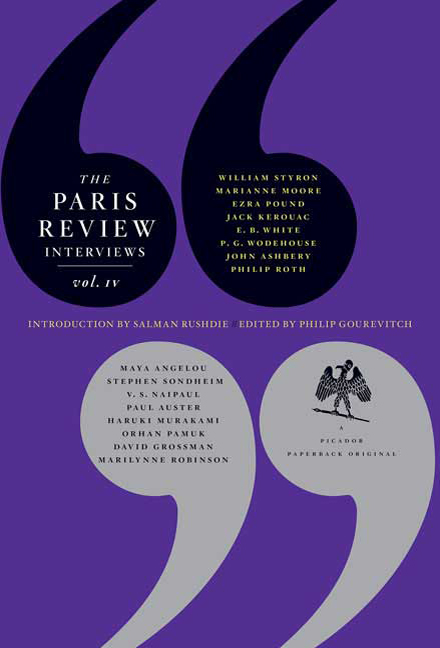
The Paris Review Interviews, IV

9780312427443

The Paris Review Interviews, IV, new this week from Picador, continues a great tradition of writers discussing their motivations, inspirations, methods, and, inevitably, other writers. Volume IV collects sixteen author interviews and is perhaps a bit heavier on contemporary writers than past volumes have been, showcasing current luminaries like Haruki Murakami, Orhan Pamuk, Paul Aster, and Marilynne Robinson. Although most of the interviews take place after the 1970s (with half in the past two decades), elder statespeople like William Styron, Marianne Moore, and the venerable Ezra Pound are also present.

Pound’s interview from 1962 is paradoxically revealing in its guardedness: one senses that the aged poet is trying to edit as he speaks, to achieve some sort of perfection. It’s a bit sad too, as Pound, holed up in a sort of self-imposed exile in an Italian castle, admits, “I suffer from the cumulative isolation of not having had enough contact–fifteen years of living more with ideas than with persons.” (On a less-serious note, however, he also praises Disney’s 1957 film “Perri, that squirrel film, where you have the values of courage and tenderness asserted in a way that everybody can understand. You have got absolute genius there.”)

As one might expect, Jack Kerouac comes off as the complete opposite, talking about his troubles with editor Malcolm Cowley, problems with poetry and prose, and Neal Cassady. There’s a free-flowing verbosity to Kerouac’s speech, but also an intimacy. It’s really quite beautiful. At one point, he gets one of the two poets interviewing him, Aram Saroyan, to repeat each line of Poem 230 from Mexico City Blues as he reads it aloud (Kerouac claims he wrote the poem “purely on morphine.”) As they recite the poem over several pages, Kerouac steps outside of it every now and then to compliment Saroyan’s reading or to critique a particular line, or simply to explain what he was trying to do with his words. We’re not huge fans of Kerouac’s writing, but after this interview, we wanted to be. (Later in the book, a surprised P.G. Wodehouse on Kerouac: “Jack Kerouac died! Did he?” Interviewer: “Yes.” Wodehouse: “Oh . . . Gosh, they do die off, don’t they?” Yes, they do).

One of the stranger interviews in the books is between James Lipton, of all people, and composer Stephen Sondheim. Although we don’t doubt the literary merit of Sondheim, the interview does seem a little out of place (although we will attest that the interview with Maya Angelou convinced us to give her a little more cred. A little). Elsewhere, E.B. White asserts that “You have to write up, not down” to children, and Haruki Murakami sheds insight into his own methods and passions (he often conceives his protagonist as a twin brother, lost at birth; his favorite director is Aki Kaurismäki; he’s thrilled to be mentioned in the liner notes of Radiohead’s Kid A). Murakami also talks about the writers he loves, admires, and feels insecure around (he’s shy to meet Toni Morrison at a special luncheon).

Of course, Murakami’s not alone–there’s plenty of writers dishing on writers here. When we reviewed Volume III of The Paris Review Interviews last year, we noted that both Evelyn Waugh and Raymond Chandler take the time to dis William Faulkner in their interviews. Volume IV kicks off with William Styron, who kinda sorta disses Faulkner as well, saying that “The Sound and the Fury . . . succeeds in spite of itself. Faulkner often simply stays too damn intense for too long a time.” Or Marianne Moore, on fellow poet Hart Crane: “Hart Crane complains of me? Well, I complain of him.” Ah, writers . . . great to know they can be as petty and self-absorbed as the rest of us. And it’s that humanity that shines through in these interviews. The series’s greatest accomplishment is its ability to reveal the frailties and insecurities of its subjects, but also their true personalities and tastes. Many writers work hard to control how they are perceived; cultivating a persona, one often aloof, academic, or roguish, is perhaps key to a successful writer’s identity. The interviews here are never fawning, nor do they aspire to sensationalism in revealing their subjects. Instead, each works as a neat, detailed, and very engrossing little portrait of a fascinating personality. Highly recommended.

Javier Moreno on the Geometry of Bolaño’s Fiction

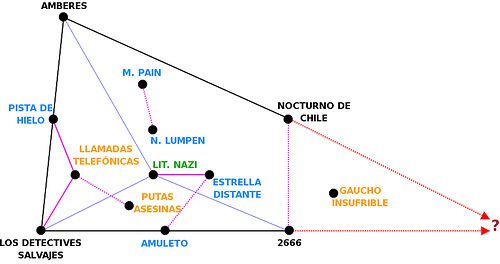
Still working through this Roberto Bolaño jag: I will finish By Night in Chile tonight or tomorrow, and I’ll get to my own thoughts on that then. For now: while looking for an interview in English with Bolaño, I came across this marvelous essay in The Quarterly Conversation–a site Biblioklept links to, oddly enough, yet I missed it (probably because it’s a few years old). In “Roberto Bolaño: A Naïve introduction to the geometry of his fictions,” Javier Moreno doesn’t really analyze or criticize or Bolaño’s oeuvre ; instead, he treats the work like a strange, maddening (and fun, beautiful) game. And if you’ve read Bolaño, you know how appropriate that approach is. Here is Moreno’s attempt to diagram Bolaño’s corpus:

triangle

That question mark represents what Moreno suggests is Bolaño’s “unreachable book,” a tome that (might) exist as the dialogic interplay of all of Bolaño’s works. Moreno concludes (more or less; concludes is really not the right word) that 2666 is that “unreachable book”; he writes:

I believe that even if Bolaño hadn’t died prematurely 2666 would still have been published posthumously. The “real” and impossible 2666 was larger and richer. My guess is that if Bolaño had lived forever 2666 would have been at the very end of the diagram, located in the vertex where the question mark is. Since he died, since he was mortal (too mortal) after all, we have to resign ourselves to the promise of a triangle and only dream of its asymptotic completion.

Consider this fragment of an interview as evidence for Moreno’s claim:

Amambay Guevara: What’s the novel you dream of writing?

Roberto Bolaño: One novel that will be called 2666.

Ricardo Bello: That novel, 2666, would it be a science fiction one? Would it be located in Latin America?

Roberto Bolaño: Partially, it will be science fiction. It will take place in the state of Sonora, north of México, and in Arizona.

I think Moreno’s essay is pretty great–it’s the sort of writing I like, and its tone is spot on for the psychology and rhythm of Bolaño’s writing. Still, I think you’d probably go crazy thinking about what’s at the end of that triangle, of some great work out there, intangible, unfinished, unclaimed, disparate. In the end, Moreno gives up on his diagram, writing:

The system doesn’t stay still. That’s the way it is. Conscious of the impossible task, I resign. I cannot capture it. I cannot shoot the video. The dots are moving as I stare at them, still puzzled, marveled by their strangeness and beauty. The diagram, after all, is just a waste of time.

I like the way his line about moving dots subtly recalls the strange ending of The Savage Detectives. Also, I’m not sure that the diagram is a waste of time. I think that what Moreno might not see (or shit, maybe he does see it, how would I know) in his own diagram is that that question mark might not be some unwritten masterpiece, but rather it might be the reader who enters into the game with Bolaño and his texts. The irony is that that is precisely what Moreno has done. And–sign of a great critic–he’s made me want to read more.

Harold Bloom on McCarthy’s Blood Meridian

bloom_harold

AV Club posted a great interview with master critic Harold Bloom this week. Bloom speaks at some length on one of our favorite books, Cormac McCarthy‘s violent opus Blood Meridian, which was AV Club’s “Wrapped Up In Books” book club selection for June (pretty good discussions of the book there, as well). An excerpt:

The first time I read Blood Meridian, I was so appalled that while I was held, I gave up after about 60 pages. I don’t think I was feeling very well then anyway; my health was going through a bad time, and it was more than I could take. But it intrigued me, because there was no question about the quality of the writing, which is stunning. So I went back a second time, and I got, I don’t remember… 140, 150 pages, and then, I think it was the Judge who got me. He was beginning to give me nightmares just as he gives the kid nightmares. And then the third time, it went off like a shot. I went straight through it and was exhilarated. I said, “My God! This reminds me of Thomas Pynchon at his best, or Nathanael West.” It was the greatest single book since Faulkner’s As I Lay Dying.

There’s No Such Thing As Life Without Bloodshed

cormac-mccarthy1

Just finished this 1992 New York Times interview with Cormac McCarthy. I know, I know, hardly new, but still, it’s a rare insight into a reclusive writer–his 2007 interview with Oprah could politely be called awful, and I feel like this older piece is some kind of vindication. My favorite quote:

There’s no such thing as life without bloodshed [. . .] I think the notion that the species can be improved in some way, that everyone could live in harmony, is a really dangerous idea. Those who are afflicted with this notion are the first ones to give up their souls, their freedom. Your desire that it be that way will enslave you and make your life vacuous.

Great interview, even if it is almost 17 years old.

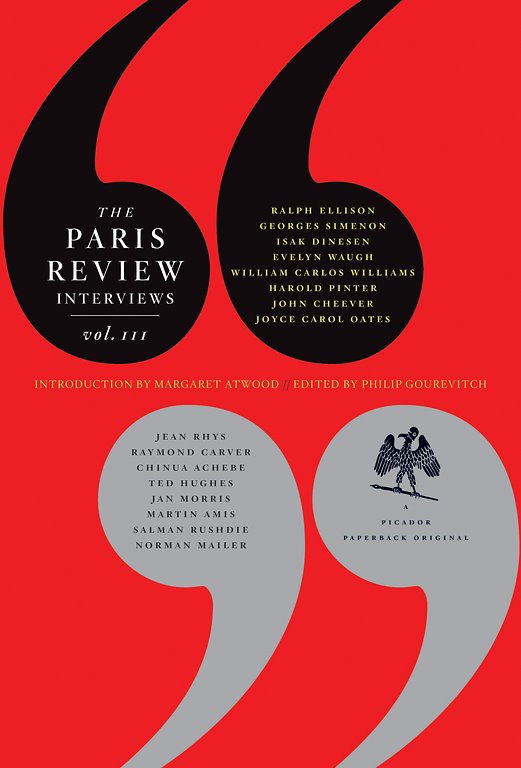
The Paris Review Interviews, Volume III

How much you enjoy the third collection The Paris Review Interviews will depend entirely on how much you enjoy reading intelligent and thoughtful writers discussing intelligent and thoughtful subjects. I happen to love reading author interviews–even interviews with authors I don’t particularly like–and hence, I enjoyed this book quite a bit.

Covering sixteen disparate authors and fifty-two tumultuous years, the interviews here are by turns insightful, hilarious, strange, and at times, infuriating. The first interview (the book is organized chronologically), a 1955 conversation with Ralph Ellison evokes all of these emotions. One can almost feel Ellison’s restraint as he patiently replies to asinine questions like, “Then you consider your novel a purely literary work as opposed to one in the tradition of social protest?” and, “But isn’t it going to be difficult for the Negro writer to escape provincialism when his literature is concerned with a minority?” If anything, these politicized charges prompt Ellison to some of the most salient observations about literature’s universalizing powers that I’ve ever read.

In his 1964 interview, poet William Carlos Williams also sheds quite a bit of light on his art and craft. Interestingly, his wife is also a major part of the interview, discussing at some length her own role in her husband’s writing. Beyond literature, craft, and writing, Williams also sets another early theme that unites the interviews collected here–dissing other writers. He calls T.S. Eliot a “conformist” determined to set poets back twenty years. Evelyn Waugh picks up on this theme in his 1963 interview. Of Faulkner: “I find Faulkner intolerably bad.” And Raymond Chandler: “I’m bored by all those slugs of whiskey. I don’t care for all the violence either.” Zing!

Don’t feel too bad for Chandler, though; he comes off funny and earthy and sad in his 1983 interview, especially when he discusses his alcoholism, and how and why he quit drinking. Apparently, teaching–and drinking–with John Cheever when the two were teaching at the Iowa Writer’s Workshop in 1973 had a major impact on Chandler’s decision to stop drinking.

John Cheever focuses mostly on the writing craft in his 1976 interview–not much talk of drinking here. He does, however, share this insight: “Plot implies narrative and a lot of crap. It is a calculated attempt to hold the reader’s interest at the sacrifice of moral conviction.” I’ve never liked Cheever’s writing, but he’s a great interview. In his 1994 interview, Achebe–an author whose fiction (and essays) I do like comes off as far more insightful and far less pretentious. On why creative writing classes exist: “I think it’s very important for writers who need something else to do, especially in these precarious times. Many writers can’t make a living. So to be able to teach how to write is a valuable to them. But I don’t really know about its value to the student.” Lovely. MFAs beware!

The interviews collected here are funny, smart, and very entertaining–whether its Achebe on general misunderstandings of his famous Conrad essay, Salman Rushdie on New Wave Cinema, or Joyce Carol Oates on Finnegans Wake, The Paris Review Interviews, Volume III is full of smart people talking about smart things–and what’s better than that? Highly recommended.

The Paris Review Interviews, Volume III is available October 28th, 2008 from Picador.