“I don’t know why Against the Day hasn’t been banned” | Ishmael Reed on Thomas Pynchon

I don’t know why Against the Day hasn’t been banned. In one of the most remarkable scenes penned by an American writer, Pynchon cites events that the anti-woke crowd would want deleted. Referring to the Blacks and Filipinos, Mexicans and hillbillies who are present in that scene, the character Lew Basnight “gradually understood that what everybody here had in common was having survived some cataclysm none of them spoke about directly — a bombing, a massacre perhaps at the behest of the U.S. government.” Those with prominent media megaphones today are denying that such cataclysms took place.

Ishmael Reed on one of his favorite Thomas Pynchon novels. The extract is from a piece in The New York Times on different writers and artists sharing their “favorite pinch of Pynchon.” William Gibson’s riff is especially nice too–he singles out Father Rapier’s sermon on They/we systems in Gravity’s Rainbow. Don DeLillo contributes a loose haiku. I didn’t read the remarks of Homer and Lisa Simpson.

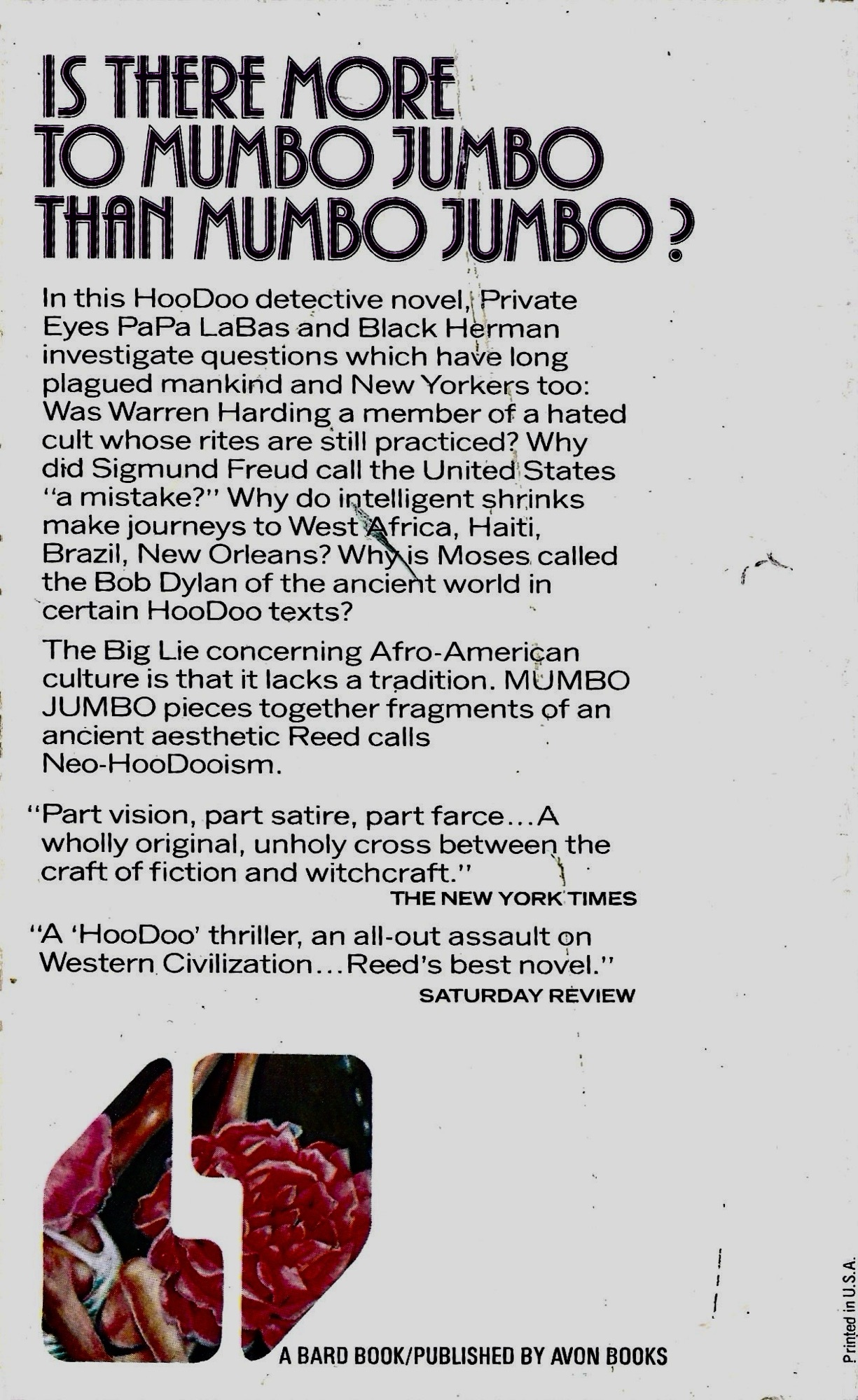
Mass-market Monday | Ishmael Reed’s Mumbo Jumbo

Mumbo Jumbo, Ishmael Reed, 1972. Avon Bard Books (1978). Cover art by Andrew Rhodes (not credited); no designer credited. 256 pages.

A perfect novel. Reed’s five-novel run from ’67 to ’76 is astounding (the later stuff is good too).

From Mumbo Jumbo:

…Faust was an actual person. Somewhere between 1510 and 1540 this “wandering conjurer and medical quack” made his travels about the southwest German Empire, telling people his knowledge of “secret things.” I always puzzled over why such a legend was so basic to the Western mind; but I’ve thought about it and now I think I know the answer. Can’t you imagine this man traveling about with his bad herbs, love philters, physicks and potions, charms, overcharging the peasants but dazzling them with his badly constructed Greek and sometimes labeling his “wonder cures” with gibberish titles like “Polyunsaturated 99½% pure.” Hocus-pocus. He makes a living and can always get a free night’s lodging at an inn with his ability to prescribe cures and tell fortunes, that is, predict the future. You see he travels about the Empire and is able to serve as a kind of national radio for people in the locales. Well 1 day while he is leeching people, cutting hair or raising the dead who only have diseases which give the manifestations of death, something really works. He knows that he’s a bokor adept at card tricks, but something really works. He tries it again and it works. He continues to repeat this performance and each time it works. The peasants begin to look upon him as a supernatural being and he encourages the tales about him, that he heals the sick and performs marvels. He becomes wealthy with his ability to do The Work. Royalty visits him. He is a counselor to the king. He lives in a castle. Peasants whisper, a Black man, a very bearded devil himself visits him. That strange coach they saw, the 1 with the eyes as decorations drawn to his castle by wild-looking black horses. They say that he has made a pact with the devil because he invites the Africans who work in various cities throughout the Empire to his castle. There were 1000s in Europe at the time: blackamoors who worked as butlers, coachmen, footmen, pint-sized page boys; and conjurors whom only the depraved consulted. The villagers hear “Arabian” music, drums coming from the place but as soon as the series of meetings begin it all comes to a halt. Rumors circulate that Faust is dead. The village whispers that the Black men have collected. That is the nagging notion of Western man. China had rocketry, Africa iron furnaces, but he didn’t know when to stop with his newly found Work. That’s the basic wound. He will create fancy systems 13 letters long to convince himself he doesn’t have this wound. What is the wound? Someone will even call it guilt. But guilt implies a conscience. Is Faust capable of charity? No it isn’t guilt but the knowledge in his heart that he is a bokor. A charlatan who has sent 1000000s to the churchyard with his charlatan panaceas. Western man doesn’t know the difference between a houngan and a bokor. He once knew this difference but the knowledge was lost when the Atonists crushed the opposition. When they converted a Roman emperor and began rampaging and book-burning. His sorcery, white magic, his bokorism will improve. Soon he will be able to annihilate 1000000s by pushing a button. I do not believe that a Yellow or Black hand will push this button but a robot-like descendant of Faust the quack will. The dreaded bokor, a humbug who doesn’t know when to stop.

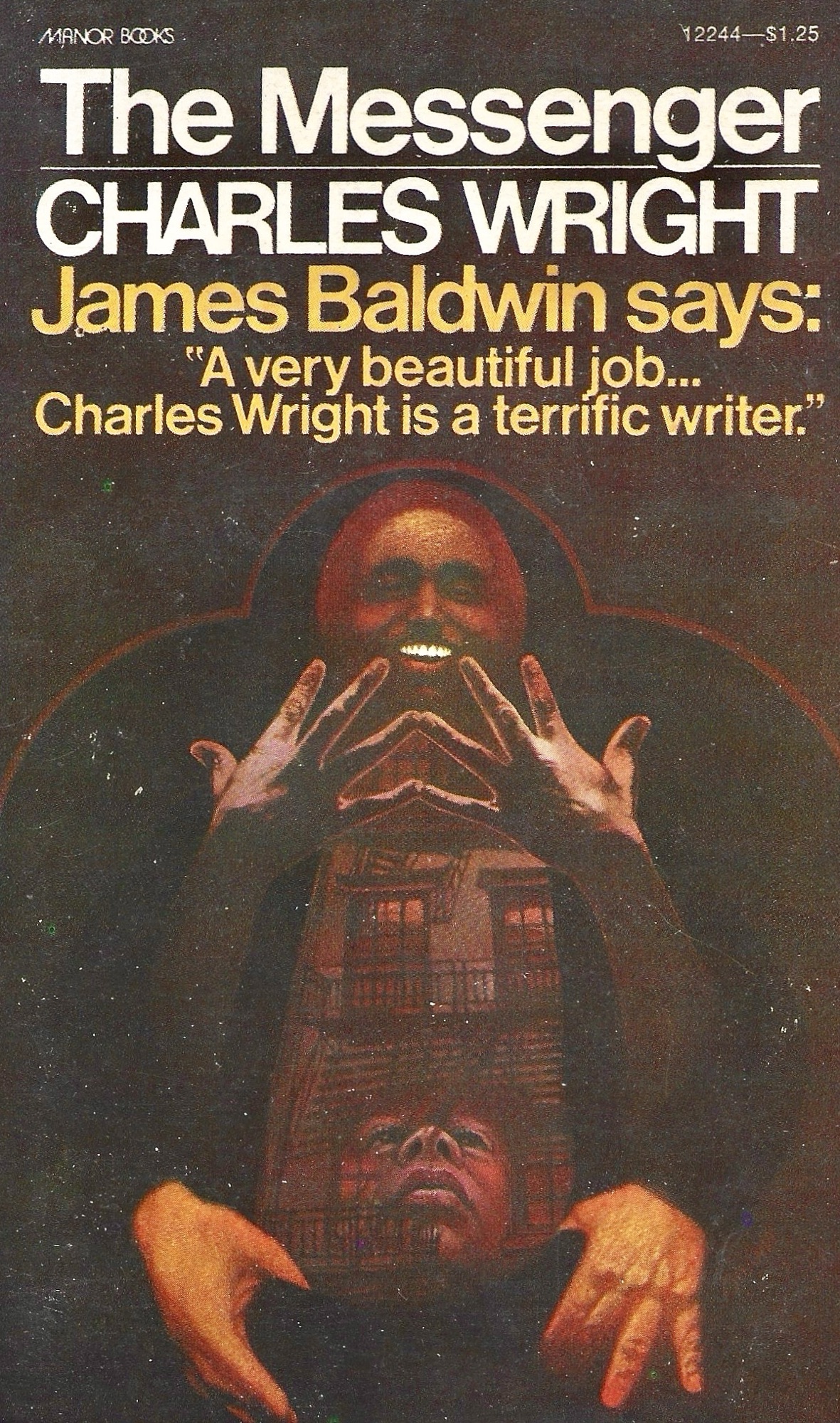
Mass-market Monday | Charles Wright’s The Messenger

The Messenger, Charles Wright. Manor Books (1974). No cover artist or designer credited. 217 pages.

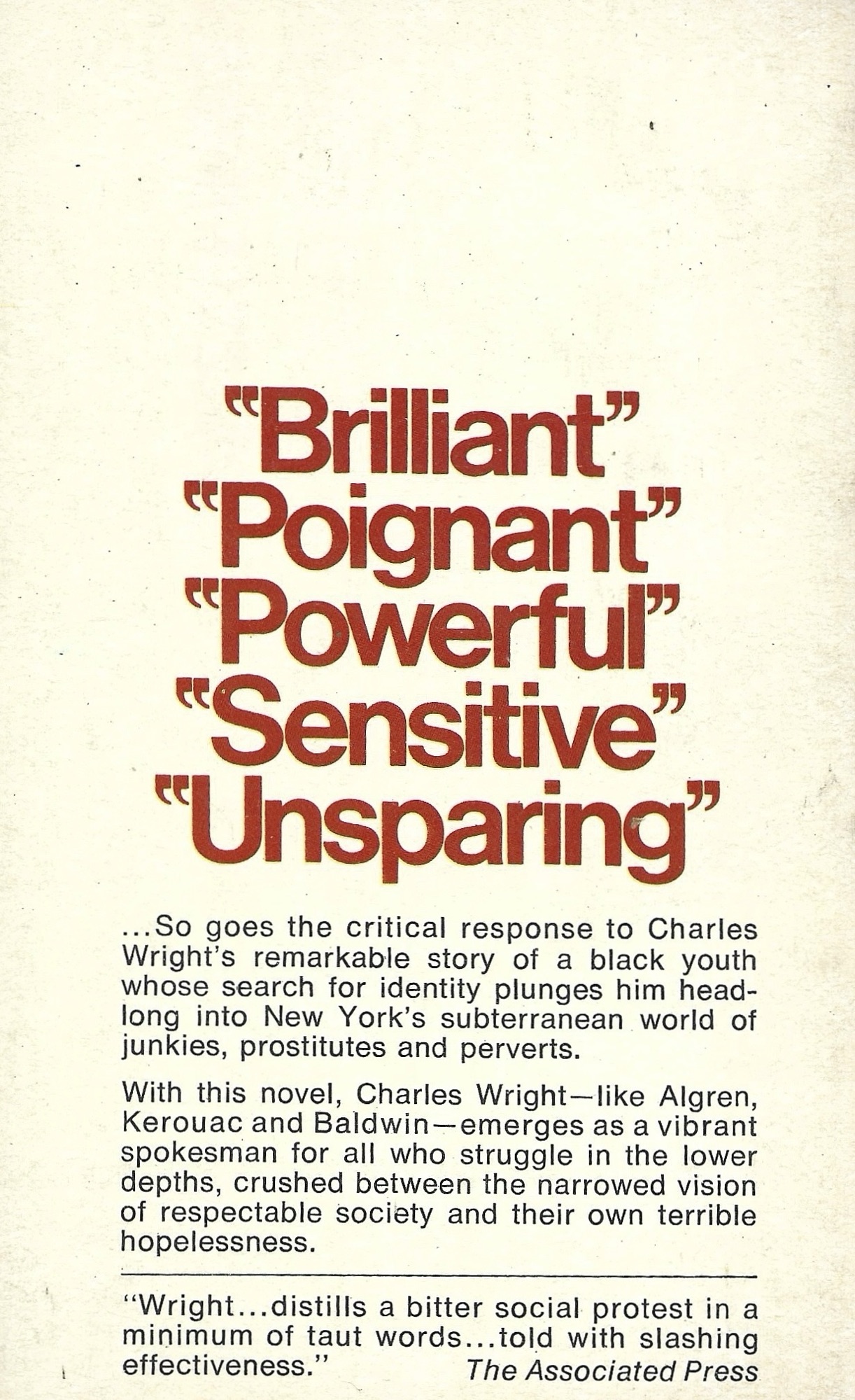
Charles Wright (not to be confused with Charles Wright or Charles Wright) published three novels between 1963 and 1973. His second novel, The Wig (1966) is an under-read, underappreciated gem—a tragicomic satire employing sharp distortions and cartoony edges. Wright’s first novel, The Messenger, is perhaps a bit too beholden to Richard Wright (to whom it is dedicated (along with Billie Holiday))—but many readers may prefer its raw realism to The Wig’s zany (and often crushing) zigs and zags. His last published novel, Absolutely Nothing to Get Alarmed About, is the most accomplished and singular of the trio—fragmentary, polyglossic, kaleidoscopic, messy. The trio remains in print as an omnibus with an introduction by Ishmael Reed. Read Reed on reading Wright.

Ishmael Reed’s Texas Gumbo

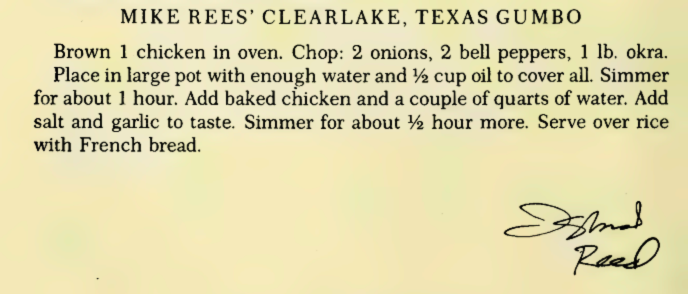
Ishmael Reed’s Mike Rees’ Clearlake, Texas Gumbo:

Brown 1 chicken in oven. Chop: 2 onions, 2 bell peppers, 1 lb. okra. Place in large pot with enough water and 1/2 oil to cover all. Simmer for about an hour. Add baked chicken and a couple of quarts of water. Add salt and garlic to taste. Simmer for about 1/2 hour more. Serve over rice with French bread.

From The Great American Writers’ Cookbook (ed. Dean Faulkner Wells, 1981).

Mass-market Monday | Ishmael Reed’s The Last Days of Louisiana Red

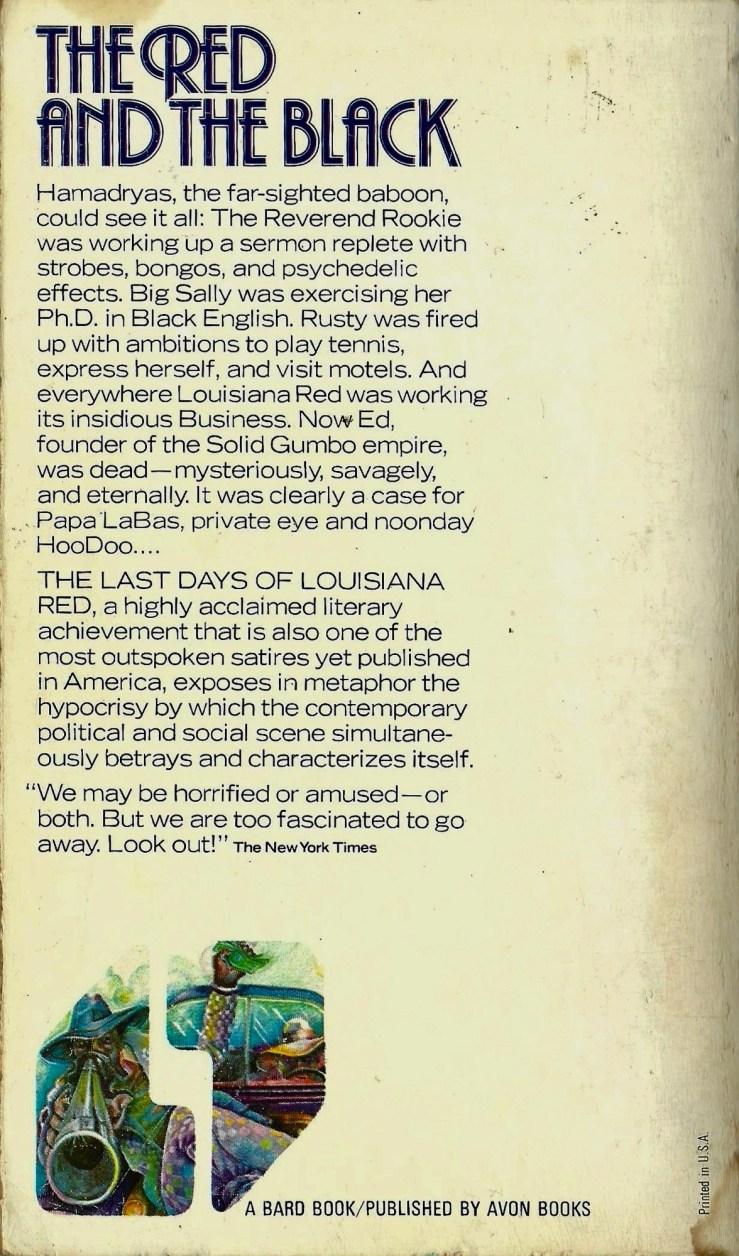
The Last Days of Louisiana Red, Ishmael Reed. Bard Books, First Bard Printing (1976). Cover art is by Andrew Rhodes (not credited). 191 pages.

From my review of The Last Days of Louisiana Red:

Ishmael Reed’s 1974 novel The Last Days of Louisiana Red is a sharp, zany satire of US culture at the end of the twentieth century. The novel, Reed’s fourth, is a sequel of sorts to Mumbo Jumbo (1972), and features that earlier novel’s protagonist, the Neo-HooDoo ghost detective Papa LaBas.

In Mumbo Jumbo, Reed gave us the story of an uptight secret society, the Wallflower Order, and their attempt to root out and eradicate “Jes’ Grew,” a psychic virus that spreads freedom and takes its form in arts like jazz and the jitterbug. The Last Days of Louisiana Red also employs a psychic virus to drive its plot, although this transmission is far deadlier. “Louisiana Red” is a poisonous mental disease that afflicts black people in the Americas, causing them to fall into a neo-slave mentality in which they act like “Crabs in the Barrel…Each crab trying to keep the other from reaching the top.”

Three books (Books acquired, 8 June 2023)

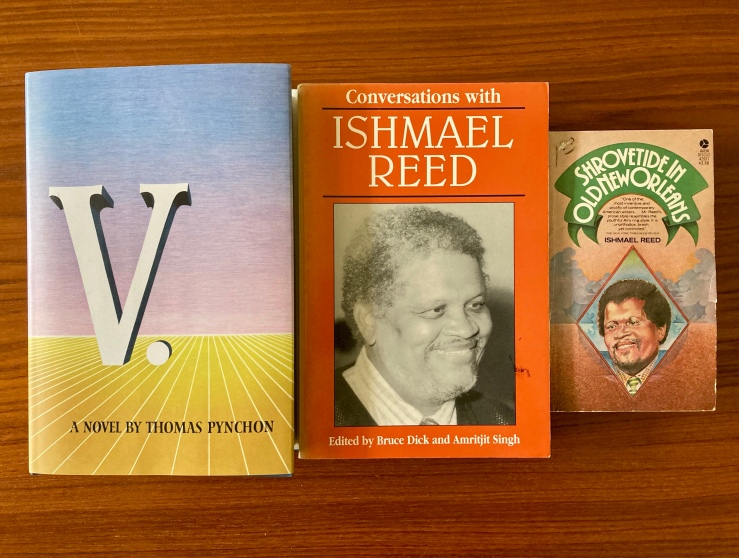
I got a facsimile hardback sixtieth anniversary edition of Thomas Pynchon’s novel V. for my birthday. I also picked up two Ishmael Reed books: Conversations with Ishmael Reed and an Avon Bard edition of Shrovetide in Old New Orleans. Before I even physically picked up these last two, I knew that they formerly belonged to a guy from Perry, Florida and that a stamp with his name and address would be on the inside of the cover or first page. I was correct in this intimation. I now have probably thirty to forty books once owned by this person. I wrote about some Reeds, formerly his, here.

Maybe I should compare my shelf with the checklist he made in the inside cover of Conversations with Ishmael Reed—


A review of Trey Ellis’s polyglossic satire Platitudes

Trey Ellis’s 1988 debut novel Platitudes begins with a typical metatextual conceit: the novel-within-a-novel gambit. Our story starts with Earle, a nerdy, idealistic high school sophomore who lusts after True Love (and some sex if he can get it). After about a dozen pages though, the “author” shows his hand. Depressed divorced Dewayne Wellington is Earle’s creator, and he’s stuck in his novel-in-progress Platitudes. “I’m sorry. I don’t know what more to write,” Wellington declares, before soliciting help from his readers.

Wellington soon receives manuscript pages from bestselling author Isshee Ayam, who transplants his story from 1980s Manhattan to 1930s rural Georgia. When Wellington introduces worldly and gorgeous Dorothy as Earle’s romantic foil, Ayam’s rhetorical interventions take on a new intensity as the two authors duel to guide the spirit of the novel-in-progress.

The plot threads and styles intertwine, with Wellington’s experimental mode clashing with Ayam’s “Afro-baroque” style (as Ellis described it in a 1989 Los Angeles Times profile). A parodic pastiche of competing Black American artistic voices, Platitudes ultimately synthesizes polyglossic tones into a strangely endearing romantic comedy. Sharp but breezy, ironic and earnest, and utterly metatextual yet soaked in pathos, Ellis’s first novel seems to be an overlooked late-postmodernist gem.

Although Platitudes remains in print (via Northeastern University Press’s New England Library of Black Literature series), I have never seen it mentioned along with its contemporaries—books like David Foster Wallace’s 1989 collection Girl with Curious Hair or Bret Easton Ellis’s 1987 novel The Rules of Attraction. Instead, Ellis’s novel seems to be connected more often along with the works of Ishmael Reed, particularly his 1986 novel Reckless Eyeballing.

Reed’s novel concerns an experimental playwright who finds his career under attack from feminists. As Itabari Njeri pointed out in the LA Times profile mentioned above, many readers “assumed that Ayam is a thinly veiled Alice Walker and that Wellington is the novelist, poet and playwright, Ishmael Reed.” Ellis told Njeri that he hadn’t read Reckless Eyeballing until after he finished Platitudes. He also stated in the profile that he hadn’t read Walker’s The Color Purple. Before I read the Njeri profile I was almost certain that Ellis was parodying (lovingly though at times sharply) Reed and Walker.

Ayam’s “Afro-baroque” style is a particularly purple prose, telegraphed in the oh-so-unsubtle titles of her bestsellers: Chillun o’ de Lawd, Hog Jowl Junction, and My Big Ol’ Feets Gon’ Stomp Dat Evil Down. Here’s the first sentence of Ayam’s version of Platitudes:

Earle awakened to a day as new and as fresh as Mama’s hand-starched and sun-dried petticoat, a huge, plain garment as large and as fresh-smelling as the revival tents that bloomed every summer along Route 49 in Lowndes County, Georgia.

What an awesomely bad awesome sentence! The simple sentence is there: “Earle awakened,” but the adornment tacks on and on, a traffic jam of adjectives glommed onto a simile growing out of another simile, like a lichen that grows on a moss that grows on a rock.

Here’s Ayam’s next sentence:

Yes, from out of those wide Baptist thighs, thighs that shook with the centuries of injustice and degradation, thighs that twitched with the hope of generations yet unplanted, thighs that quivered with the friction of jubilant, bed-thumping, and funky-smelling lovemaking, emerged Earle.

“I’m speechless, Ms. Ayam,” responds Wellington by post after receiving her pages, and offers up as a return gift a list of Earle’s favorite things (to be sung to the tune Coltrane’s take on the Rodgers and Hammerstein song):

All kinds of tanks, Janey Rosebloom, Cream of Wheat, neighbors, Corinthians, toast-r-waffles, his own bean-fart vapors,

A tightly-tucked-in-bed,

Chef Boy-Ar-Dee

Schefflera, balsa wood, and Pay TeeVee.

Eff. Ay. Oh. Schwarz, lingerie straps, cowboy boots and hats.

Sunggle sacks, Chap Stick tubes, BeeBee guns, and films!

Sci-fi, cars, dance—Slurpees.

This list, printed in the console font that demarcates the many other lists, charts, menus, etc. that populate Platitudes then gives way to a brick list paragraph in whatever font Vintage Contemporaries are printed in. This second list might also comprise some of Wellington’s (and perhaps even Ellis’s?) favorite things, and includes “Jamaican accents, cleavage, efficiency, artificial cheese-food product” and

the way a pretty woman’s high heel dangles insecurely from the big toe of the crossed leg always near falling or—from a slight kick—flying spike-over-toe—an exotic Oriental weapon; but never doing either, just dangling, the toe of the shoe covering just enough to promise…

The back-and-forth of the two authors plays out as a personification of the tensions between two modes of Black literature that Ellis seeks to parody, synthesize, and ultimately transcend in Platitudes. While appreciative of the traditions and anti-traditions that came before him, he sought something new in his novel. A year later after the publication of Platitudes, Ellis published his essay “The New Black Aesthetic” in the journal Callaloo. Here, Ellis argued for a new kind of Black arts, evoking the concept of a ludic “cultural mulatto,” an artist free to borrow from both tradition and popular culture alike: “We no longer need to deny or suppress any part of our complicated and sometimes contradictory cultural baggage to please either white people or black,” Ellis declared in his essay.

Platitudes is not an essay—far from it—but it does enact the radical hybridization that Ellis put forth in his New Black Aesthetic manifesto. In his LA Times profile, Ellis declared Platitudes an “anti-novel,” adding that “It’s satirical and primarily about language performance, which has its own delights, as opposed to traditional narrative.”

And yet there is a traditional narrative here. Call it boy meets girl or coming of age or classical-in-the-Aristotelian-sense comedy or whatever you want, but Platitudes offers its reader a satisfying conclusion without selling out the ambiguities and ironies that course through its 180 or so pages.

In his back-cover blurb for Platitudes, Ishmael Reed wrote: “I was zapped by Trey Ellis’s humongous talent. His book, Platitudes, is delightfully rad.” Zapped and delightfully rad are perfect descriptors, and I feel like I’ve neglected to share enough of Ellis’s prose, which at times approximates linguistic channel surfing (at one point, quite literally). The book is both fun and funny, and while the book has not been neglected in academia (Christian Schmidt devotes a chapter to it in his study Postblack Aesthetics, for example), it deserves a wider readership from those who enjoy satirical postmodern novels. Highly recommended.

Trey Ellis’s Platitudes (Book acquired, 6 June 2022)

I had a full 90 minutes to browse the second, downtown location of my favorite bookshop today, while my daughter completed onboarding at City Hall for her summer job. I picked up assigned summer reading for both of my kids, and came across a Vintage Contemporaries edition I’d never seen before: Trey Ellis’s debut novel PlatitudesThe blurb on the back by Ishmael Reed sold me on Platitudes:

I was zapped by Trey Ellis’s humongous talent. His book, Platitudes, is delightfully rad. He dares to have the gumption to write comically about American literary politics.

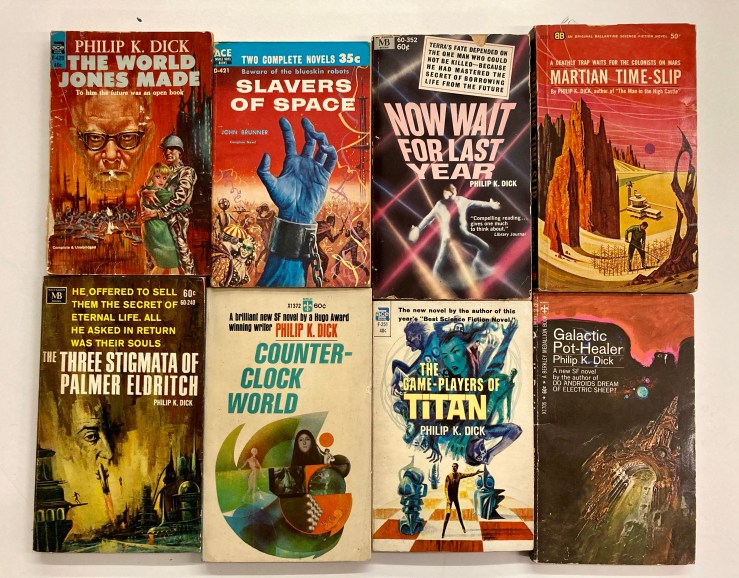
I also managed to avoid leaving with a bunch of massmarket paperbacks by Philip K. Dick—but here’s a pic of all their covers: 

—which I think are so much more interesting than these handsome, respectable, uniform contemporaries:

There’s a nice new big fat interview with Ishmael Reed now up at The Collidescope

2020-01-03_152112_1

There’s a nice new big fat interview with Ishmael Reed now up at The Collidescope. In the interview (conducted by George Salis), Reed discusses lots of stuff, including his love of Nathaniel Hawthorne’s “Young Goodman Brown” (“one of the great short stories [by] the greatest of American white male writers for my money”), his contempt for David Simon’s The Wire, most of his novels, and his new play The Slave Who Loved Caviar. 

Late in the interview, Salis asks Reed to name a novel he thinks deserves more attention. Here’s Reed’s reply:

IR: Let’s see, there’s a novel by Ron Sukenick, one of the experimental writers about the golden calf [Mosaic Man, 1999]. I can’t figure the title right now, but I think it deserves more readers. I think they like Philip Roth and pedestrian writers like him. But Ron Sukenick was an excellent writer and one of those experimental white writers who don’t get enough attention. I like also A Different Drummer by William Melvin Kelley which I have written a review about but it’s not published and there are a lot of excellent writers, excellent novelists, but the Anglo minds of reviewers is just preventing the public from having access to these writers.

Read the interview at The Collidescope.

Percy’s Ruins, Reed’s Spring (Books acquired, 5 May 2022)

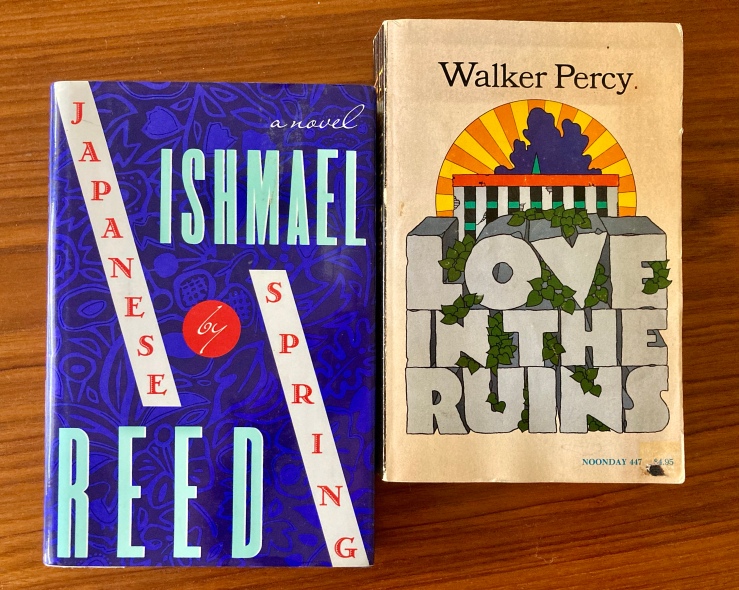
A few years ago I passed up on a hardback first-edition copy of Walker Percy’s weird dystopian Southern Gothic Love in the Ruins, and have regretted it ever since, or at least ever since I read a run of his novels back in 2020. I wound I’m reading a digital copy of Love from my local library, loved it, and would put it up there with Lancelot as his best, knowing damn well I still haven’t read The Last Gentleman or The Thanatos Syndrome. (The Thanatos Syndrome sounds like the name of a bad novel in a dystopian parody novel or film.) The cover for this edition of Love in the Ruins is by Janet Halverson.

I’ve read nine of Ishmael Reed’s first ten novels, but I still haven’t read Japanese by Spring, his ninth work, a campus novel that parodies America’s ever-ongoing culture wars. I picked up this first-edition hardback today. Before I even opened the copy, I wondered if it belonged to the same dude who I’ve managed to cop so many used postmodern novels of the past three decades. This guy—I won’t write his name out here—this guy put stamps or stickers of his name and address in the books he bought, I guess, and I ended up picking up a lot of them used over the years: Ishmael Reed, Stanley Elkin, Don DeLillo…I was thinking about maybe writing the guy? Anyway, sure enough, this copy of Japanese by Spring included a sticker bearing this guy’s name and the same address. I did a basic internet search and it looks like he’s moved, but not far, and that he’s (probably) eighty years old. I guess I’d just want to say Thanks is all.

Four Books (By Ishmael Reed)

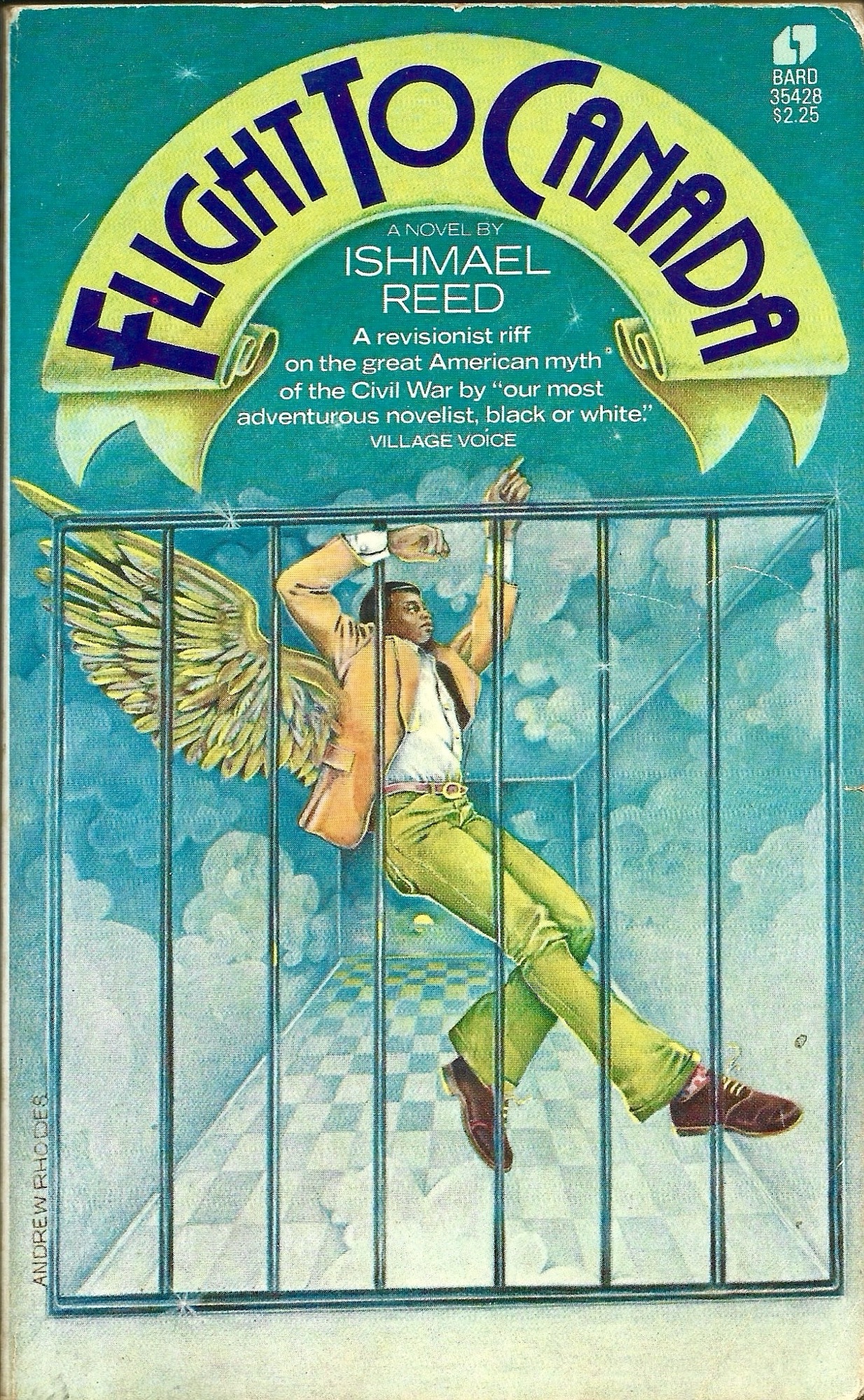
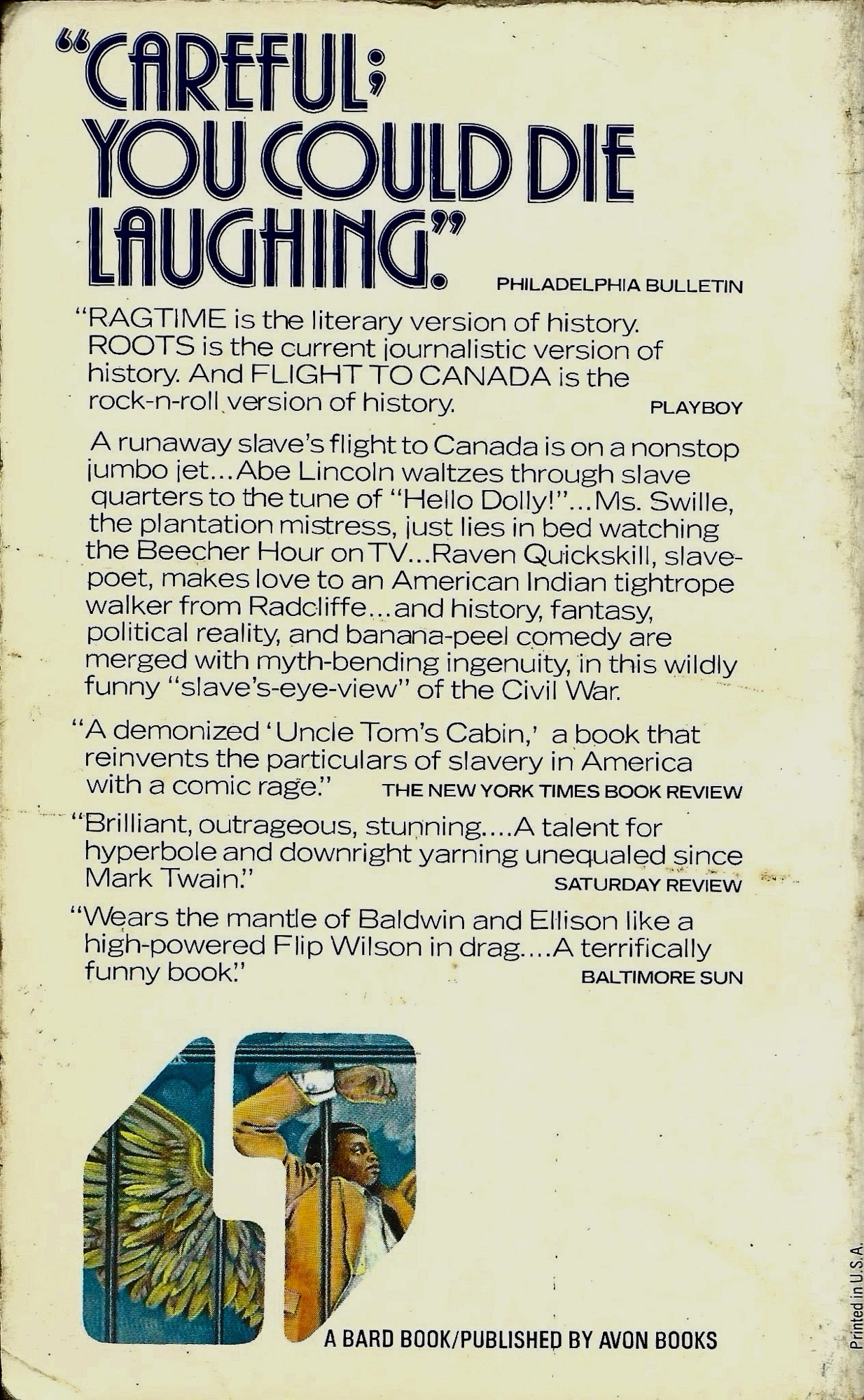
Seven years ago I came across three lovely 1970s mass market paperback Ishmael Reed novels. In the years since then, I’ve consumed most of Reed’s novels, even picking up an undervalued signed copy online. Two of my favorite Reed editions are from Avon Bard. This past Sunday, I came across two more Reed Avon Bard editions, and snapped them up, despite already owning them in hardback. While no designer or artist is credited, the signature on this edition of Flight to Canada clearly says “Andrew Rhodes”:

I’m pretty sure that Rhodes is the artist (and possibly designer) of the other Avon Bard Reeds I picked up years ago, Mumbo Jumbo

IMG_0547

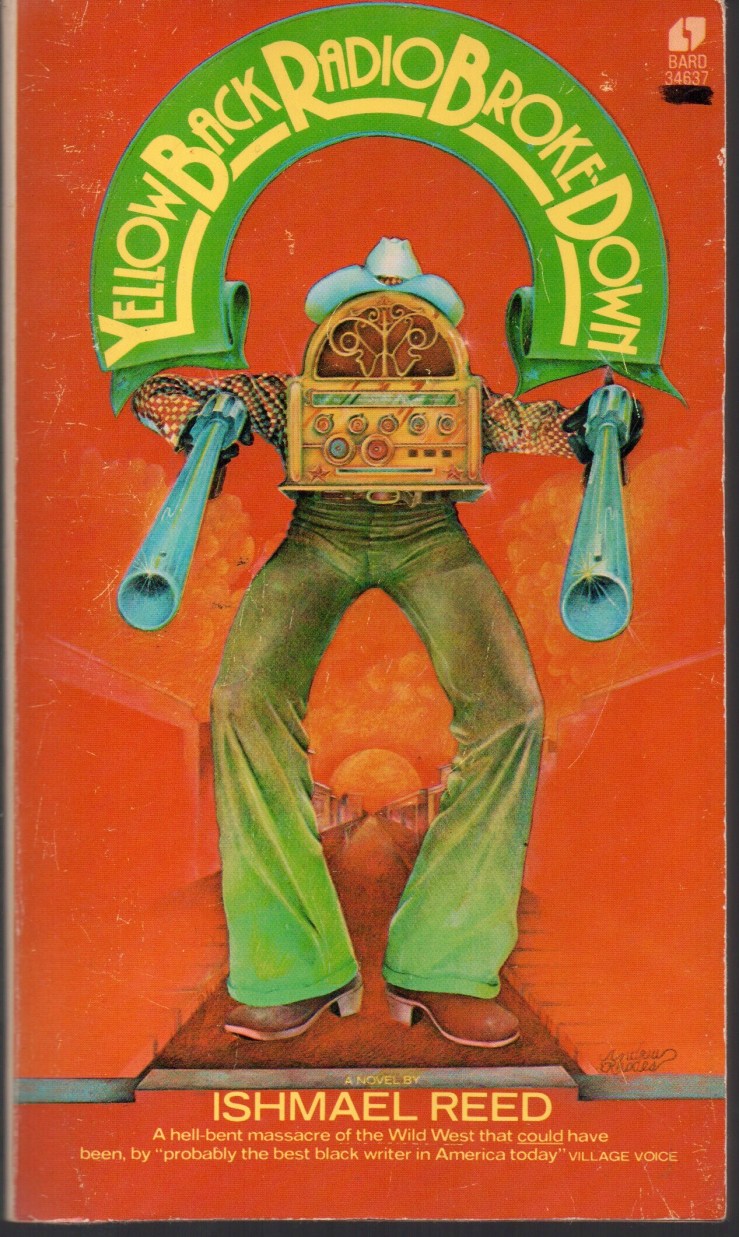
—and Yellow Back Radio Broke-Down (the signature is clear on this one):


IMG_0548

We can also see “Rhodes” on the copy of The Last Days of Louisiana Red I picked up on Sunday. (This book also has the stamp of a guy who lives (lived?) in Perry, Florida, a stamp I’ve come to recognize over the years as a guy who, at least at one point, had very similar taste to my own. I have a lot of his old books and I wonder about him sometimes.)

Here are some reviews I’ve written of Reed’s novels over the past few years:

A review of Ishmael Reed’s sharp satire The Last Days of Louisiana Red

Blog about Ishmael Reed’s 1976 neo-slave narrative Flight to Canada

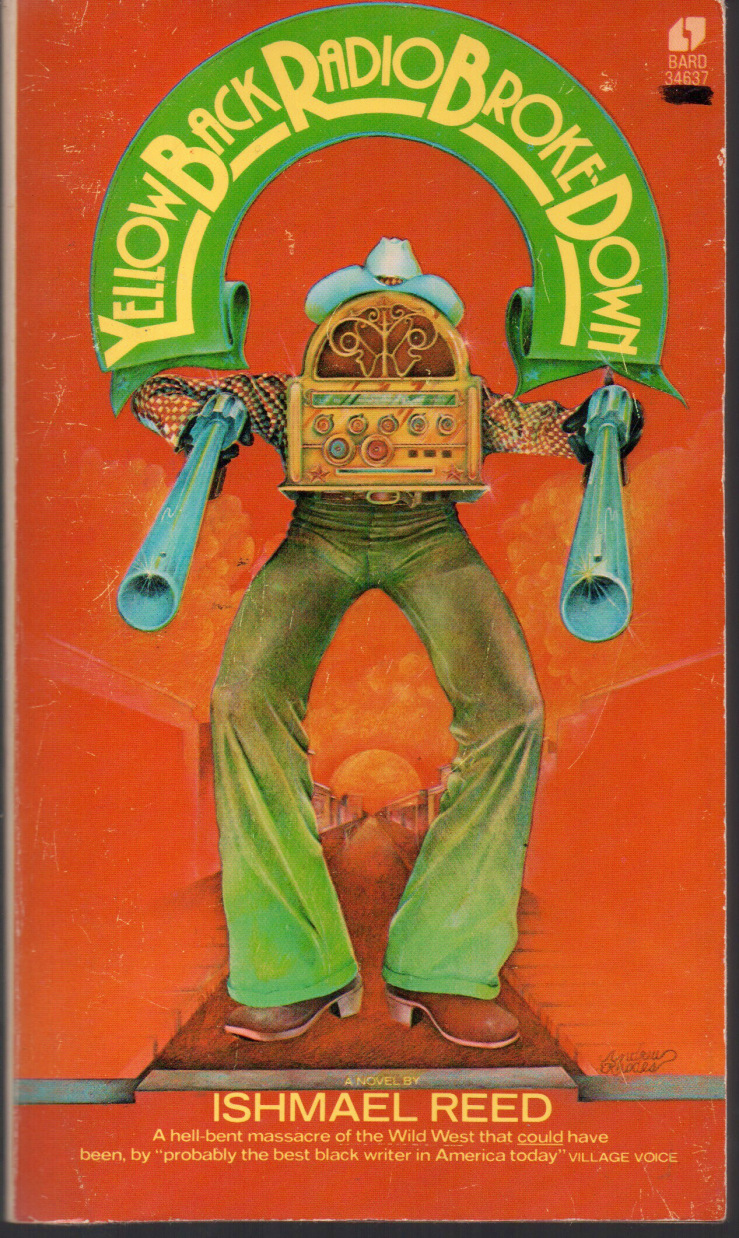
A review of Yellow Back Radio Broke-Down, Ishmael Reed’s syncretic Neo-HooDoo revenge Western

A review of Ishmael Reed’s Christmas satire, The Terrible Twos

Blog about Ishmael Reed’s novel Juice! (Book acquired, 10 Dec. 2019)

A review of Ishmael Reed’s sharp satire The Last Days of Louisiana Red

img_2323

Ishmael Reed’s 1974 novel The Last Days of Louisiana Red is a sharp, zany satire of US culture at the end of the twentieth century. The novel, Reed’s fourth, is a sequel of sorts to Mumbo Jumbo (1972), and features that earlier novel’s protagonist, the Neo-HooDoo ghost detective Papa LaBas.

In Mumbo Jumbo, Reed gave us the story of an uptight secret society, the Wallflower Order, and their attempt to root out and eradicate “Jes’ Grew,” a psychic virus that spreads freedom and takes its form in arts like jazz and the jitterbug. The Last Days of Louisiana Red also employs a psychic virus to drive its plot, although this transmission is far deadlier. “Louisiana Red” is a poisonous mental disease that afflicts black people in the Americas, causing them to fall into a neo-slave mentality in which they act like “Crabs in the Barrel…Each crab trying to keep the other from reaching the top.”

The Last Days of Louisiana Red begins with Ed Yellings, “an american negro itinerant who popped into Berkeley during the age of Nat King Cole. People looked around one day and there he was.” Yellings is the West Coast counterpart to New-York-based Papa LeBas, a fellow Worker of Neo-HooDoo who fights against the secret forces of psychic slavery.

Sliding into the mythological motif that ripple through Louisiana Red, Reed writes,

When Osiris entered Egypt, cannibalism was in vogue. He stopped men from eating men. Thousands of years later when Ed Yellings entered Berkeley, there was a plague too, but not as savage. After centuries of learning how to be subtle, the scheming beast that is man had acquired the ability to cover up.

Yellings’ mission is to destroy the psychic cannibalism that afflicts his people. He gets to it, and earns “a reputation for being not only a Worker [of the voodoo arts] but a worker too.” Yellings’ working class bona fides helps solidify his sympathies and his mission:

Since he worked with workers, he gained a knowledge of the workers’ lot. He knew that their lives were bitter. He experienced their surliness, their downtroddenness, their spitefulness and the hatred they had for one another and for their wives and their kids. He saw them repeatedly go against their own best interests as they were swayed and bedazzled by modern subliminal techniques, manipulated by politicians and corporate tycoons, who posed as their friends while sapping their energy. Whose political campaigns amounted to: “Get the Nigger.”

As always, Reed’s diagnosis of late 20th-century American culture seems to belong, unfortunately, just as much to our own time, giving his novels a perhaps-unintended sheen of prescience. Reed’s work points to dystopia, even as his heroes work for freedom and justice. And yet Reed gives equal air time to the forces that oppress freedom and justice, forces that find expression in “Louisiana Red”:

Louisiana Red was the way they related to one another, oppressed one another, maimed and murdered one another., carving one another while above their heads, fifty thousand feet, billionaires few in custom-made jet planes equipped with saunas tennis courts swimming pools discotheques and meeting rooms decorated like a Merv Griffin Show set….

The miserable workers were anti-negro, anti-chicano, anti-puerto rican, anti-asian, anti-native american, had forgotten their guild oaths, disrespected craftsmanship; produced badly made cars and appliances and were stimulated by gangster-controlled entertainment; turned out worms in the tuna fish, spiders in the soup, inflamatory toys, tumorous chickens, d.d.t. in fish and the brand new condominium built on quicksand.

As a means to fight the culture of erosion, decay, and entropy, Yellings founds the Solid Gumbo Works. Here, he manufactures a gumbo—a spell, really—to combat “Louisiana Red.” In the process he manages to cure cancer, which pisses off a lot of big corporations, and pretty soon Yellings is murdered. Papa LeBas is sent in from New York to solve the case.

Papa LeBas runs into trouble pretty quickly, mostly by way of Yellings’ adult children: Wolf, Street, Sister, and the provocative and gifted Minnie, who leads a group of militants called the Moochers. Each of the children seem to embody an allegorical parallel to some aspect of the American counterculture of the late sixties and seventies, allowing Reed to mash up genres and skewer ideologies. There are a lot flavors in this gumbo: voodoo lore and California history bubble in the same pot as riffs on astrology and Cab Calloway’s hit “Minnie the Moocher.” Reed frequently compares and contrasts East with West, New York with California, underscoring the latter’s anxieties of influence about being the New World of the New World. Throughout the novel, we get routines on Amos & Andy, slapstick pastiches straight out of George Herriman’s Krazy Kat comix, hysterical nods to Kafka. Reed plays off early blaxploitation films like Sweet Sweetback’s Baadasssss Song and Superfly (not to mention Putney Swope), and synthesizes these tropes with kung fu imagery and neo-Nazi nostalgia garb. He turns Aunt Jemima into a loa at one point.

Reed’s prose ping-pongs between genres, skittering from pulp fiction noir to surrealist frenzies, from bizarre sex to raucous action, from political essaying to postmodernist mythologizing. Through these stylistic shifts, Reed satirizes a host of ideologies that feed into “Louisiana Red.” Aspects of the Berkeley youth movement, radical feminism, free love, and intellectual hucksterism all get skewered, but through an allegorical lens—Reed dares us, often explicitly (by way of a character named Chorus) to read Louisiana Red as an allegorical retelling of Sophocles’ Antigone.

This retelling is both tragic and comic though, premodern and postmodern, a carnival of varied voices. The chapters are short, the sentences sting, and the plot shuttles along, pivoting from episode to episode with manic picaresque glee. Reed’s narrator is always way out there in front of both the reader and the novel’s characters, hollering at us to keep up.

Ultimately, The Last Days of Louisiana Red is a bit of a shaggy dog. It’s not that it doesn’t have a climax—it does, it has lots of climaxes, some quite literal. And it’s not that the novel doesn’t have a point—it very much does. Rather, it’s that Reed employs his detective story as a frame for the larger argument he wants to make about American culture. Sure, Papa LaBas gets to the bottom of Yellings’ murder, but that’s not ultimately what the narrative is about.

When we get to the final chapter, we find LaBas, sitting alone “on a plain box” in the empty offices of the Solid Gumbo Works reflecting on the case in a way that, in short, sums up what The Last Days of Louisiana Red is about:

He thought of the eaters and the eaten of this parable on Gumbo…all ‘oppressed people’ who often, like Tod Browning ‘Freaks,’ have their own boot on their own neck. They exist to give the LaBases, Wolfs and Sisters of these groups the business, so as to prevent them from taking care of Business, Occupation, Work. They are the moochers who cooperate with their ‘oppression,’ for they have the mentality of the prey who thinks his destruction at the fangs of the killer is the natural order of things and colludes with his own death. The Workers exist to tell the ‘prey’ that they were meant to bring down killers three times their size, using the old morality as their guide: Voodoo, Confucianism, the ancient Egyptian inner duties, using the technique of camouflage, independent camouflages like the leopard shark, ruler of the seas for five million years. Doc John, ‘the black Cagliostro,’ rises again over the American scene. The Workers conjure and command the spirit of Doc John to walk the land.

So here, near the end of The Last Days of Louisiana Red, Papa LeBas—and Ishmael Reed, of course—conjures up the spirit of Doctor John, the voodoo healer who escaped slavery and brought knowledge of the hoodoo arts to his people. There’s a promise of hope and optimism here at the novel’s end, despite its many bitter flavors. But the passage cited above is not the final moments of Louisiana Red—no, the novel, ends, despite what I wrote about its being a shaggy dog story, with a marvelous punchline.

Ishmael Reed remains an underappreciated novelist whose early work seems as vital as ever. The Last Days of Louisiana Red is probably not the best starting place for him, but it’s a great novel to read right after Mumbo Jumbo, which is a great starting place to read Reed. In any case: Read Reed. Highly recommended.

[Ed. note–Biblioklept first published this review in March, 2019.]
A review of Yellow Back Radio Broke-Down, Ishmael Reed’s syncretic Neo-HooDoo revenge Western

img_0548

Ishmael Reed’s second novel Yellow Back Radio Broke-Down tells the story of the Loop Garoo Kid, a “desperado so onery he made the Pope cry and the most powerful of cattlemen shed his head to the Executioner’s swine.”

The novel explodes in kaleidoscopic bursts as Reed dices up three centuries of American history to riff on race, religion, sex, and power. Unstuck in time and unhampered by geographic or technological restraint, historical figures like Lewis and Clark, Thomas Jefferson, John Wesley Harding, Groucho Marx, and Pope Innocent (never mind which one) wander in and out of the narrative, supplementing its ironic allegorical heft. These minor characters are part of Reed’s Neo-HooDoo spell, ingredients in a Western revenge story that is simultaneously comic and apocalyptic in its howl against the dominant historical American narrative. Yellow Back Radio Broke-Down is a strange and marvelous novel, at once slapstick and deadly serious, exuberant in its joy and harsh in its bitterness, close to 50 years after its publication, as timely as ever.

After the breathless introduction of its hero the Loop Garoo Kid, Yellow Back Radio Broke-Down initiates its plot. Loop’s circus troupe arrives to the titular city Yellow Back Radio (the “nearest town Video Junction is about fifty miles away”), only to find that the children of the town, “dressed in the attire of the Plains Indians,” have deposed the adults:

We chased them out of town. We were tired of them ordering us around. They worked us day and night in the mines, made us herd animals harvest the crops and for three hours a day we went to school to hear teachers praise the old. Made us learn facts by rote. Lies really bent upon making us behave. We decided to create our own fiction.

The children’s revolutionary, anarchic spirit drives Reed’s own fiction, which counters all those old lies the old people use to make us behave.

Of course the old—the adults—want “their” land back. Enter that most powerful of cattlemen, Drag Gibson, who plans to wrest the land away from everyone for himself. We first meet Drag “at his usual hobby, embracing his property.” Drag’s favorite property is a green mustang,

a symbol for all his streams of fish, his herds, his fruit so large they weighed down the mountains, black gold and diamonds which lay in untapped fields, and his barnyard overflowing with robust and erotic fowl.

Drag loves to French kiss the horse, we’re told. Oh, and lest you wonder if “green” here is a metaphor for, like, new, or inexperienced, or callow: No. The horse is literally green (“turned green from old nightmares”). That’s the wonderful surreal logic of Reed’s vibrant Western, and such details (the novel is crammed with them) make Yellow Back Radio Broke-Down a joy to read.

Where was I? Oh yes, Drag Gibson.

Drag—allegorical stand-in for Manifest Destiny, white privilege, capitalist expansion, you name it—Drag, in the process of trying to clear the kids out of Yellow Back Radio, orders all of Loop’s troupe slaughtered.

The massacre sets in motion Loop’s revenge on Drag (and white supremacy in general), which unfolds in a bitter blazing series of japes, riffs, rants, and gags. (“Unfolds” is the wrong verb—too neat. The action in Yellow Back Radio Broke-Down is more like the springing of a Jack-in-the-box).

Loop goes about obtaining his revenge via his NeoHooDoo practices. He calls out curses and hexes, summoning loas in a lengthy prayer. Loop’s spell culminates in a call that goes beyond an immediate revenge on Drag and his henchmen, a call that moves toward a retribution for black culture in general:

O Black Hawk American Indian houngan of Hoo-Doo please do open up some of these prissy orthodox minds so that they will no longer call Black People’s American experience “corrupt” “perverse” and “decadent.” Please show them that Booker T and MG’s, Etta James, Johnny Ace and Bojangle tapdancing is just as beautiful as anything that happened anywhere else in the world. Teach them that anywhere people go they have experience and that all experience is art.

So much of Yellow Back Radio Broke-Down is turning all experience into art. Reed spins multivalent cultural material into something new, something arguably American. The title of the novel suggests its program: a breaking-down of yellowed paperback narratives, a breaking-down of radio signals. Significantly, that analysis, that break-down, is also synthesized in this novel into something wholly original. Rhetorically, Yellow Back Radio Broke-Down evokes flipping through paperbacks at random, making a new narrative; or scrolling up and down a radio dial, making new music from random bursts of sound; or rifling through a stack of manic Sunday funnies to make a new, somehow more vibrant collage.

Perhaps the Pope puts it best when he arrives late in the novel. (Ostensibly, the Pope shows up to put an end to Loop’s hexing and vexing of the adult citizenry—but let’s just say the two Holy Men have a deeper, older relationship). After a lengthy disquisition on the history of hoodoo and its genesis in the Voudon religion of Africa (“that strange continent which serves as the subconscious of our planet…shaped so like the human skull”), the Pope declares that “Loop Garoo seems to be practicing a syncretistic American version” of the old Ju Ju. The Pope continues:

Loop seems to be scatting arbitrarily, using forms of this and that and adding his own. He’s blowing like that celebrated musician Charles Yardbird Parker—improvising as he goes along. He’s throwing clusters of demon chords at you and you don’t know the changes, do you Mr. Drag?

The Pope here describes Reed’s style too, of course (which is to say that Reed is describing his own style, via one of his characters. The purest postmodernism). The apparent effortlessness of Reed’s improvisations—the prose’s sheer manic energy—actually camouflages a tight and precise plot. I was struck by how much of Yellow Back Radio Broke-Down’s apparent anarchy resolves into a bigger picture upon a second reading.

That simultaneous effortlessness and precision makes Reed’s novel a joy to jaunt through. Here is a writer taking what he wants from any number of literary and artistic traditions while dispensing with the forms and tropes he doesn’t want and doesn’t need. If Reed wants to riff on the historical relations between Indians and African-Americans, he’ll do that. If Reed wants to assess the relative values of Thomas Jefferson as a progressive figure, he’ll do that. If Reed wants to attack his neo-social realist critics, he’ll do that. If Reed wants to critique the relationship between militarism and science, he’ll do that. If Reed wants to tell some really dirty jokes about a threesome, he’ll do that. And you can bet if he wants some ass-kicking Amazons to show up at some point, they’re gonna show.

And it’s a great show. Yellow Back Radio Broke-Down begins with the slaughter of a circus troupe before we get to see their act. The real circus act is the novel itself, filled with orators and showmen, carnival barkers and con-artists, pistoleers and magicians. There’s a manic glee to it all, a glee tempered in anger—think of George Herriman’s Krazy Kat, or Thomas Pynchon’s zany rage, or Robert Downey Sr.’s satirical film Putney Swope.

Through all its anger, Yellow Back Radio Broke-Down nevertheless repeatedly affirms the possibility of imagination and creation—both as cures and as hexes. We have here a tale of defensive and retaliatory magic. Yellow Back Radio Broke-Down is the third novel of Reed’s novels I’ve read (after Mumbo Jumbo and The Free-Lance Pallbearers), and my favorite thus far. Frankly, I needed the novel right now in a way that I didn’t know that I needed it until I read it; the contemporary novel I tried to read after it felt stale and boring. So I read Yellow Back Radio Broke-Down again. The great gift here is that Reed’s novel answers to the final line of Loop’s prayer to the Loa: “Teach them that anywhere people go they have experience and that all experience is art.” Like the children of Yellow Back Radio, Reed creates his own fiction, and invites us to do the same. Very highly recommended.

[Ed. note — Biblioklept first published this review in February of 2017.]

Americans love being conned (Ishmael Reed)

img_0548

It was Bo Shmo and the neo-social realist gang. They rode to this spot from their hideout in the hills. Bo Shmo leaned in his saddle and scowled at Loop, whom he considered a deliberate attempt to be obscure. A buffoon an outsider and frequenter of sideshows.

Bo Shmo was dynamic and charismatic as they say. He made a big reputation in the thirties, not having much originality, by learning to play Hoagland Howard Carmichael’s “Buttermilk Sky” backwards. He banged the piano and even introduced some novel variations such as sliding his rump across the black and whites for that certain effect.

People went for it. It was an all the newspapers. He traveled from coast to coast exhibiting his ass and everything was fine until the real Hoagland Howard Carmichael (the real one) showed up and went for Bo Shmo’s goat. He called him a lowdown patent thief and railed him out of town. You would think that finding themselves duped, the impostor’s fans would demand his hide. Not so, Americans love being conned if you can do it in a style that is both grand and entertaining. Consider P.T. Barnum’s success, Semple McPherson and other notables. A guy who rigs aluminum prices can get himself introduced by Georgie Jessel at 100 dollars a plate but stealing a can of beer can get you iced.

So sympathetic Americans sent funds to Bo Shmo which he used to build one huge neo-social realist Institution in the Mountains. Wagon trains of neo-social realist composers writers and painters could be seen winding up its path.

From Ishmael Reed’s 1969 novel Yellow Back Radio Broke-Down, which I am loving the hell out of.

Best Books of 1972?

A conversation with a colleague this week led me on a not-entirely successful search for the “best” books of 1972.

The gist of the conversation is something like this: Asked about the “best” books that came out last year, I admitted I don’t read that much new fiction, so I had no idea.

I also said something cavalier along the lines of, It takes like half a century to know if a novel is important or not. (This is not a statement I entirely believe in.)

So what did folks in 1972 think the best books published that year were?

The first thing I did is check the bestsellers of fiction that year.

(I should be clear that I’m mostly interested in novels here, or books of a novelistic/artistic scope, whatever that means–so I didn’t really pursue nonfiction stuff that much here.)

The New York Time’s fiction bestsellers for 1972 is dominated by two novels: Herman Wouk’s The Winds of War (21 weeks) and Richard Bach’s Jonathan Livingstone Seagull (26 weeks). Fiction bestsellers are often (but not always) entertainments that we don’t expect to last over time, and while Wouk and Bach’s titles still get reprints every decade or so, they aren’t exactly Ulysses (published fifty years earlier in 1922).

So I looked for what titles the NYT critics deemed the best books of 1972. The contemporary NYT comes up with a list of ten titles each year (five fiction, five non-), but things were a little looser fifty years ago. In December of that year, the NYT offered just “Five Significant Books of 1972.”

This list is entirely nonfiction:

The Children of Pride: A True Story of Georgia and the Civil War, edited by Robert Manson Myers (“…a loving work of scholarship. From 6,000 letters written among several branches of a Southern family between 1854 and 1865, Robert Manson Myers has woven 1,200 of them into a massive and touching portrait of a bygone society.”)

The Master by Leon Edel (“With…the fifth and final volume of his biography of Henry James, Leon Edel brings to a close a literary labor of 20 years.”)

Fire in the Lake by Frances FitzGerald (“…the richest kind of contemporary history; it places political and military events in cultural perspective—something rarely done in the hundreds of books written about Vietnam during the last dozen years.”)

The Coming of Age by Simone de Beauvoir, translated by Patrick O’Brian (“…confronts a subject of universal private anguish and universal public silence…she has single‐handedly established a history of and a rhetoric for the process of aging.”)

A Theory of Justice by John Rawls (“…a magisterial exercise in ‘moral geometry.'”)

Rawls’s book is the only one I’ve heard of and de Beauvoir is the only other author whose name I recognize on the list (I did know that there was a ridiculously long multi-volume biography of Henry James). Beyond the list’s being all nonfiction (if there was a fiction version somewhere, I could not find it), it’s also remarkable how long each of the books is: the shortest is 491 pages; the longest is 1,845 pages. Those are long books!

I tried searching for other newspaper and magazine lists of best books of 1972 but came up short. If anyone has anything else to offer for contemporary thoughts on the best of ’72 (by which I mean, folks in ’72 on the best of ’72), I’m all virtual ears.

I then looked into what Goodreads had to say.

I have no idea how their list works, but Richard Adams’s Watership Down tops it. That book completely fucked me up as a kid, which is maybe why I didn’t press too hard when both of my children were reluctant to read it when I pressed it on them. I think it’s a classic though (oh, and it made The New York Times year-end list in 1974–I guess it didn’t get an American publication until then?).

I don’t really think Watership Down is a children’s book, but rounding out the top three on the Goodreads list are two classics of the genre: Arnold Lobel’s Frog and Toad Together and Judith Viorst’s Alexander and the Terrible Horrible No Good Very Bad Day. (Judy Blume’s Tales of a Fourth Grade Nothing comes in way too low at #44.)

And now, because I’m lazy, I will use the rest of the list to offer an incomplete, inconclusive, and ultimately unnecessary list of the best books of 1972. There are many books on the list I’m pilfering from I have not read (including ones by authors whose books I esteem, like Nabokov, Welty, DeLillo, and Atwood), and these books may deserve a spot, as might the many many books that have failed through no fault of their own to wind up under the right eyes, ears, hands.

A list:

Mumbo Jumbo, Ishmael Reed

Invisible Cities, Italo Calvino

The Infernal Desire Machines of Doctor Hoffman, Angela Carter

Watership Down, Richard Adams

The Farthest Shore, Ursula K. LeGuin

Ways of Seeing, John Berger

Roadside Picnic, Arkady Strugatsky and Boris Strugatsky

Chimera, John Barth

Augustus, John Williams

Sadness, Donald Barthelme

There’s a nice long profile of Ishmael Reed in this week’s New Yorker magazine

There’s a nice long profile of Ishmael Reed in this week’s New Yorker magazine.

The profile is by Julian Lucas, who does an excellent job covering both Reed’s extensive literary output as well as his biography. While Lucas’s profile is generally sympathetic, he doesn’t shy away from Reed’s many (many) battles (Lin-Manuel Miranda, Alice Walker, Ralph Ellison, the New York literary establishment, etc. etc. etc.).  The print edition of the article is titled “I Ain’t Been Mean Enough,” which comes from a line from Reed’s 1973 poem “The Author Reflects on His 35th Birthday”: 

For half a century, he’s been American literature’s most fearless satirist, waging a cultural forever war against the media that spans a dozen novels, nine plays and essay collections, and hundreds of poems, one of which, written in anticipation of his thirty-fifth birthday, is a prayer to stay petty: “35? I ain’t been mean enough . . . Make me Tennessee mean . . . Miles Davis mean . . . Pawnbroker mean,” he writes. “Mean as the town Bessie sings about / ‘Where all the birds sing bass.’ ”

Lucas’s Reed is not a cantankerous caricature though. We get a nice survey of the man’s works situated against his ever-evolving politics and aesthetics. Nor does the profile dwell too long on Reed’s earlier novels (which I confess are my favorites—the most recent long work of Reed’s I’ve read was 2011’s Juice! I had absolutely no idea before reading the profile that Reed has a new novel out this summer, The Terrible Fours)

There’s a measure of defiance to his late-career productivity. Wary of being tethered to his great novels of the nineteen-seventies, Reed is spoiling for a comeback, and a younger generation receptive to his guerrilla media criticism may be along for the ride. “I’m getting called a curmudgeon or a fading anachronism, so I’m going back to my original literature,” Reed told me. “In the projects, we had access to a library, and I’d go get books by the Brothers Grimm.” Now, he says, “I’m reverting to my second childhood. I’m writing fairy tales.”


Blog about “Authors’ Authors,” a 1976 round up of various authors’ favorite books that year

The New York Times published “Authors’ Authors” on 5 Dec. 1976. The piece “asked a number of authors, ranging from Vladimir Nabokov to John Dean, to tell us the three books they most enjoyed this year and to say, in a sentence or two, why.”

There’s of course something silly and even gossipy about such articles, which fall far from literary criticism, of course. But, simultaneously, these kinds not-really-lists are fun. I came across the article looking for something else, and ended up reading it all. There are plenty of my favorite authors as well as notable authors who contributed to the piece: Ishmael Reed, William H. Gass, Eudora Welty, Maurice Sendak, Henry Miller, Joan Didion, and loads more. What’s most interesting to me are the “new” books many books include—I mean books published in (or around) 1976. Some I’ve never heard of, others are classics (of one fashion or another) and many are long long forgotten.

John Cheever’s answer opens the list with an appropriate warning:

I’ve always thought the response to these questionnaires cranky and pretentious and associated them with the darkest hours of Sunday. I mention this only to make it clear that you are free to throw my reply away.

He selects the only book by John Updike I’ve retained, Picked-Up Pieces, cites Richard Condon’s The Manchurian Candidate as an airplane read, and reflects on Daniel Deronda:

It may be a reflection on George Eliot’s refinement or my grossness but my most vivid recollection of this estimable classic is a scene where Deronda enthusiastically seizes the oar of a wherry. It seemed the only robust gesture in the book.

(I had to look up the word wherry.)

Cheever’s pick Updike is on the list, providing a bit of satire on the whole business:

I also found some of Nabokov’s response amusing, although I don’t think it was his intention. He gives us “the three books I read during the three summer months of 1976 while hospitalized in Lausanne”: Dante’s Inferno (“in Singleton’s splendid translation”, The Butterflies of North America by William H. Howe (natch), and his own book, The Original of Laura. Nabokov describes it as

The not quite finished manuscript of a novel which I had begun writing and reworking before my illness and which was completed in my mind: I must have gone through it some 50 times and in my diurnal delirium kept reading it aloud to a small dream audience in a walled garden. My audience consisted of peacocks, pigeons, my long dead parents, two cypresses, several young nurses crouching around, and a family doctor so old as to be almost invisible. Perhaps because of my stumblings and fits of coughing the story of my poor Laura had less success with my listeners than it will have, I hope, with intelligent reviewers when properly published.

Nabokov never finished The Original of Laura. A version of it was published in 2009.

Conservative commentator William F. Buckley picked books by John McPhee, Hugh Kenner,  and Malcolm Muggeridge. Joyce Carol Oates liked Ted Hughes’s Season Songs. Despite having “has no taste for contemporary fiction,” Maurice Sendak recommends Leonard Michaels’ collection I Would Have Saved Them If I Could. Maxine Hong Kingston breaks the rule of three, adding Nabokov’s Ada to her trio. Philip Roth includes Bruno Schulz’s The Street of Crocodiles, which was part of a series of translations Roth “edited.” Robert Coles liked Walker Percy’s The Message in the Bottle. Lois Gould lists Anne Rice’s Interview with the Vampire, possibly one of the most enduringly popular books of 1976. Saul Bellow enjoyed Richard Yates’s The Easter Parade. Richard Yates enjoyed Larry McMurty’s Terms of Endearment. Nora Ephron loved Joan Didion’s A Book of Common Prayer. Joan Didion loved Renata Adler’s Speedboat. Cynthia Ozick gives only one title, Leon Edel’s biography of Henry James.

Henry Miller kept it short and sweet:

James Dickey loved something called Dreamthorp by Alexander Smith:

A book of gentle meditations on death in the remote English village: the quietest book of essays I know. To read it is like sinking under the leaves and views and grass of a gentle and caring cemetery and being profoundly glad to be there.

Eudora Welty sticks mostly to Virginia Woolf, recommending the second volume of Woolf’s letters (“Nothing in this book to get between the reader and the writer: Virginia Woolf in her own words, her own mind, speaking for herself”) as well as Mrs Dalloway’s Party. Welty also references Brewer’s Dictionary of Phrase and Fable, which I now must track down.

William H. Gass cites two bona fide postmodern classics and an oddity I’ve never heard of:

J R by William Gaddis. Perhaps the supreme masterpiece of acoustical collage. A real contribution to the art of fiction.

The Geek by Craig Nova. A hard, brilliantly visual novel which is equal in quality to early Hawkes. Few American writers have such a sensuous yet masterfully controlled style.

The Franchiser by Stanley Elkin. Elkin is a genius. I am happy he is also a friend. There are paragraphs in this book in which the language leaps from the page and flies away. The critics owe Elkin much bowing and scraping.

Ishmael Reed describes a book called Dangerous Music by by Jessica Tarahata Hagedorn, a writer I’d never heard of until now:

While the boys were drawing graffiti what were the girls doing? They were writing “Ditty Bop” books, black and white speckled composition books usually, full of gossip, desire, fashion, recipes, proverbs and boyfriends. Written in fire-engine red lipstick “Ditty Bop” books spell “cause” c-u‐z. Nikki Giovanni (“Gemini”) and Alison Mills (“Francisco”) have written classics of the genre. Now Jessica Hagedorn, who makes the S.F. rounds with her West Coast Gangster Choir, has penned the Latino‐Filipino version of the “Ditty Bop.” Reviewers describe “Ditty Bop” books as “sultry”; this one is that. It is a joyous, mean, mambo book blessed by the patron Saint of Latino‐Filipino Ditty Bops, Carmen Miranda.

He also recommends Shouting by by Joyce Carol Thomas, who, thankfully, is not Joyce Carol Oates.

Two authors picked up John Updike’s Picked-Up Pieces (Joyce Carol Oates and John Cheever).

Gabriel Garcia Marquez is cited three times on the list: twice for Autumn of the Patriarch (Lewis Thomas and Bernard Malamud) and once for One Hundred Years of Solitude (John Dean).

John Dean’s Blind Ambition shows up three times (Ishmael Reed, Bob Woodward, and Nikki Giovanni).

Somehow, Nikki Giovanni is the only writer to include Alex Haley’s Roots in a list.