Book Shelves #19, 5.06.2012

20120502-173818.jpg

Book shelves series #19, nineteenth Sunday of 2012.

When I started this project, this shelf was all Tolkien and Joyce; now it’s mostly Gaddis and Joyce.

I have dupes of most of the Joyce books here; there’s also Joyce criticism/guides on the shelf.

Another angle. Glare is horrible. iPhone is not a good camera; lots of glare; shelf is much taller than me, etc.:

20120502-173845.jpg

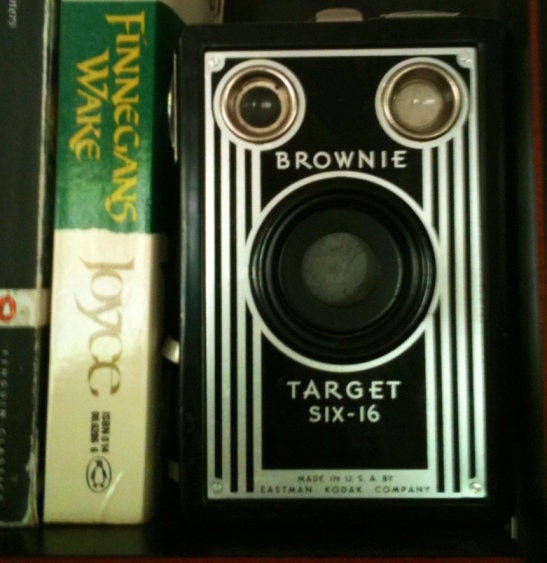
Here’s a tight shot of the Brownie Six-16 that serves as bookend:

20120502-173907.jpg

Something from Finnegans Wake :

20120502-174223.jpg

James Joyce’s Prescription for New Glasses

(Via Disonancia, which is very fine stuff).

“Rhetoric” — A Page from James Joyce’s Notebooks

This page is from a notebook that contains some of Joyce’s preparatory notes for Ulysses—there are notes for characters (“Stephen,” “Simon,” “Leopold,” etc.) as well as lists (“Books,” “Recipes”) and general ideas (“Theosophy”). This particular page, “Rhetoric,” seems to be part of the material that went into the “Aeolus” chapter of Ulysses, which plays with the windiness of rhetorical figures. From the National Library of Ireland, via UbuWeb.

Crews, Gaddis, Lish, Mutis (Books Acquired Late Last Week)

20120410-204343.jpg

I picked up Harry Crews’s novel The Knockout Artist, which I hadn’t read, after his recent death. I was not the only person to pick up Crews books: the Crews section of my favorite used bookstore, once swollen is now depleted (the omnibus and collections all snapped up).

William Gaddis’s last novel Agapē Agape was my occasion (as if I needed one) for visiting said store; I ordered it after finishing The Recognitions. I managed to bend the cover badly in the first five minutes of ownership. I started it over the weekend and then got distracted by a friend calling me to meet at a bar. I started it again last night and got about a third of the way in. Full review on the horizon.

I have no idea why I picked up Lish’s novel other than the fact that Lish is awesome; it’s a first edition paperback and the cover is awesome. Maybe that’s why. I have no idea when I’ll get around to reading it. Compulsive behaviors.

The Mutis novel, or collection of novellas, is half of the book that Dave Cianci aka Noquar reviewed on this blog  a few months ago. I wanted the full version, which collects six novellas, but I’ll settle for this (it’s used; I have store credit, etc.). Anyway, Noquar’s review made me want to read it, so I’ve slated it for summer reading (May?).

A Riff on William Gaddis’s The Recognitions

20120325-143631.jpg

  1. I finished reading William Gaddis’s enormous opus The Recognitions a few days ago. I made a decent first attempt at the book in the summer of 2009, but wound up distracted not quite half way through, and eventually abandoned the book. I did, however, write about its first third. I will plunder occasionally from that write-up in this riff. Like here:

In William Gaddis‘s massive first novel, The Recognitions, Wyatt Gwyon forges paintings by master artists like Hieronymous Bosch, Hugo van der Goes, and Hans Memling. To be more accurate, Wyatt creates new paintings that perfectly replicate not just the style of the old masters, but also the spirit. After aging the pictures, he forges the artist’s signature, and at that point, the painting is no longer an original by Wyatt, but a “new” old original by a long-dead genius. The paintings of the particular artists that Wyatt counterfeits are instructive in understanding, or at least in hoping to understand how The Recognitions works. The paintings of Bosch, Memling, or Dierick Bouts function as highly-allusive tableaux, semiotic constructions that wed religion and mythology to art, genius, and a certain spectacular horror, and, as such, resist any hope of a complete and thorough analysis. Can you imagine, for example, trying to catalog and explain all of the discrete images in Bosch’s triptych, The Garden of Earthly Delights? And then, after creating such a catalog, explaining the intricate relationships between the different parts? You couldn’t, and Gaddis’s novel is the same way.

I still feel the anxiety dripping from that lede, the sense that The Recognitions might be a dare beyond my ken. Mellower now, I’m content to riff.

  1. I read this citation in Friedrich Nietzsche’s Human, All Too Human, Part II the other night, mentally noting, “cf. Gaddis”:

188. The Muses as Liars. —“We know how to tell many lies,” so sang the Muses once, when they revealed themselves to Hesiod.—The conception of the artist as deceiver, once grasped, leads to important discoveries.

  1. The Recognitions: crammed with poseurs and fakers, forgers and con-men, artists and would-be artists.
  2. To recognize: To see and know again. Recognition entails time, experience, certitude, authenticity.

  3. Who would not dogear or underline or highlight this passage?:

That romantic disease, originality, all around we see originality of incompetent idiots, they could draw nothing, paint nothing, just so the mess they make is original . . .

  1. In many ways The Recognitions, or rather the characters in The Recognitions whom we might identify with genuine talent, genius, or spirit (to be clear, I’m thinking of Wyatt/Stephan, Basil Valentine, Stanley, Anselm, maybe, and Frank Sinisterra) are conservative, reactionary even; this is somewhat ironic considering Gaddis’s estimable literary innovations.

  2. Esme: A focus for the novel’s masculine gaze, or a critique of such gazes?

  3. The central problem of The Recognitions (perhaps): What confers meaning in a desacralized world?

Late in the novel, in one of its many party scenes, Stanley underlines the problem, working in part from Voltaire’s (in)famous quote that, “If there were no God, it would be necessary to invent him”:

. . . even Voltaire could see that some transcendent judgments is necessary, because nothing is self-sufficient, even art, and when art isn’t an expression of something higher, when it isn’t invested you might even say, it breaks up into fragments that don’t have any meaning . . .

Here we think of Wyatt: Wyatt who rejects the ministry, contemporary art, contemporary society, sanity . . .

  1. Wyatt’s quest: To find truth, meaning, authenticity in a modern world where the sacred does not, cannot exist, is smothered by commerce, noise, fakery . . .
  • The Recognitions conveys a range of tones, but I like it best when it focuses its energies on comic irony and dark absurdity to detail the juxtapositions and ironies between meaning and noise, authenticity and forgery.

  • (I like The Recognitions least when its bile flares up too much in its throat, when its black humor tips over into a screed of despair. A more mature Gaddis handles bitterness far better in JR, I think—but I parenthesize this note, as it seems minor even in a list of minor digressions).

  • Probably my favorite chapter of the book — after the very first chapter, which I believe can stand on its own — is Chapter V of Part II. This is the chapter where Frank Sinisterra reemerges, setting into motion a failed plan to disseminate his counterfeit money (“the queer,” as his accomplice calls it). We also meet Otto’s father, Mr. Pivner, a truly pathetic figure (in all senses of the word). This chapter probably contains more immediate or apparent action than any other in The Recognitions, which largely relies on implication (or suspended reference).

  • More on Part II, Chapter V: Here we find a savagely satirical and very funny discussion of Dale Carnegie’s How to Win Friends and Influence People, a book that seems to stand as an emblem (one of many in The Recognitions) of the degraded commercial world that Gaddis repeatedly attacks. The entire discussion of Carnegie’s book is priceless — it begins on page 497 of my Penguin edition and unfurls over roughly 10 pages—and the book is alluded to enough in The Recognitions to become a motif.

  • I’ll quote from page 499 a passage that seems to ironically situate How to Win Friends and Influence People against The Recognitions itself (this is one of the many postmodern moves of the novel):

    It was written with reassuring felicity. There were no abstrusely long sentences, no confounding long words, no bewildering metaphors in an obfuscated system such as he feared finding in simply bound books of thoughts and ideas. No dictionary was necessary to understand its message; no reason to know what Kapila saw when he looked heavenward, and of what the Athenians accused Anaxagoras, or to know the secret name Jahveh, or who cleft the Gordian knot, the meaning of 666. There was, finally, very little need to know anything at all, except how to “deal with people.” College, the author implied, meant simply years wasted on Latin verbs and calculus. Vergil, and Harvard, were cited regularly with an uncomfortable, if off-hand, reverence for their unnecessary existences . . . In these pages, he was assured that whatever his work, knowledge of it was infinitely less important that knowing how to “deal with people.” This was what brought a price in the market place; and what else could anyone possibly want?

    1. I’m not sure if Gaddis is ahead of his time or of his time in the above citation.

    The Recognitions though, on the whole, feels more reactionary than does his later novel JR, which is so predictive of our contemporary society as to produce a maddening sense of the uncanny in its reader.

    1. Even more on Part II, Chapter V (which I seem to be using to alleviate the anxiety of having to account for so many of the book’s threads): Here we find a delineation of (then complication of, then shuffling of) the various father-son pairings and substitutions that will play out in the text. (Namely, the series of displacements between Pivner, Otto, and Sinisterra, with the subtle foreshadowing of Wyatt’s later (failed) father-son/mentor-pupil relationship with Sinisterra).
  • Is it worth pointing out that the father-son displacements throughout the text are reminiscent of Joyce’s Ulysses, a book that Gaddis pointedly denied as an influence?

  • Ignorant of Gaddis’s deflections, I wrote the following in my review almost three years ago:

    Gaddis shows a heavy debt to James Joyce‘s innovations in Ulysses here (and throughout the book, of course), although it would be a mistake to reduce the novel to a mere aping of that great work. Rather, The Recognitions seems to continue that High Modernist project, and, arguably, connect it to the (post)modern work of Pynchon, DeLillo, and David Foster Wallace. (In it’s heavy erudition, numerous allusions, and complex voices, the novel readily recalls both W.G. Sebald and Roberto Bolaño as far as I’m concerned).

    1. But, hey, Cynthia Ozick found Joyce’s mark on The Recognitions as well (from her 1985 New York Times review of Carpenter’s Gothic):

    When ”The Recognitions” arrived on the scene, it was already too late for those large acts of literary power ambition used to be good for. Joyce had come and gone. Imperially equipped for masterliness in range, language and ironic penetration, born to wrest out a modernist masterpiece but born untimely, Mr. Gaddis nonetheless took a long draught of Joyce’s advice and responded with surge after surge of virtuoso cunning.

    1. We are not obligated to listen to Gaddis’s denials of a Joyce influence, of course. When asked in his Paris Review interview if he’d like to clarify anything about his personality and work, he paraphrases his novel:

    I’d go back to The Recognitions where Wyatt asks what people want from the man they didn’t get from his work, because presumably that’s where he’s tried to distill this “life and personality and views” you speak of. What’s any artist but the dregs of his work: I gave that line to Wyatt thirty-odd years ago and as far as I’m concerned it’s still valid.

    1. And so Nietzsche again, again from Human, All Too Human, Part II:

    140. Shutting One’s Mouth. —When his book opens its mouth, the author must shut his.

    1. And if I’m going to quote German aphorists, here’s a Goethe citation (from Maxims and Reflections) that illustrates something of the spirit of The Recognitions:

    There is nothing worth thinking but it has been thought before; we must only try to think it again.

    1. And if I’m going to quote Goethe, I’ll also point out then that Gaddis began The Recognitions as a parody of Goethe’s Faust. Peter William Koenig writes in his excellent and definitive essay “Recognizing Gaddis’ Recognitions” (published in the Winter Volume Contemporary Literature, 1975):

    To understand Gaddis’ relationship to his characters, and thus his philosophical motive in writing the novel, we are helped by knowing how Gaddis conceived of it originally. The Recognitions began as a much smaller and less complicated work, passing through a major evolutionary stage during the seven years Gaddis spent writing it. Gaddis says in his notes: “When I started this thing . . . it was to be a good deal shorter, and quite explicitly a parody on the FAUST story, except the artist taking the place of the learned doctor.” Gaddis later explained that Wyatt was to have all talent as Faust had all knowledge, yet not be able to find what was worth doing. This plight-of limitless talent, limited by the age in which it lives-was experienced by an actual painter of the late 1940s, Hans Van Meegeren, on whom Gaddis may have modeled Wyatt. The authorities threw Van Meegeren into jail for forging Dutch Renaissance masterpieces, but like Wyatt, his forgeries seemed so inspired and “authentic” that when he confessed, he was not believed, and had to prove that he had painted them. Like Faust and Wyatt, Van Meegeren seemed to be a man of immense talent, but no genius for finding his own salvation.

    The Faust parody remained uppermost in Gaddis’ mind as he traveled from New York to Mexico, Panama and through Central America in 1947, until roughly the time he reached Spain in 1948. Here Gaddis read James Frazer’s The Golden Bough, and the novel entered its second major stage. Frazer’s pioneering anthropological work demonstrates how religions spring from earlier myths, fitting perfectly with Gaddis’ idea of the modern world as a counterfeit-or possibly inspiring it. In any case, Frazer led Gaddis to discover that Goethe’s Faust originally derived from the Clementine Recognitions, a rambling third-century theological tract of unknown authorship, dealing with Clement’s life and search for salvation. Gaddis adapted the title, broadening the conception of his novel to the story of a wandering, at times misguided hero, whose search for salvation would record the multifarious borrowings and counterfeits of modern culture.

    1. Is Wyatt the hero of The Recognitions? Here’s Basil Valentine (page 247 of my ed.):

    . . . that is why people read novels, to identify projections of their own unconscious. The hero has to be fearfully real, to convince them of their own reality, which they rather doubt. A novel without a hero would be distracting in the extreme. They have to know what you think, or good heavens, how can they know that you’re going through some wild conflict, which is after all the duty of a hero.

    1. If Wyatt is the hero, then what is Otto? Clearly Otto is a comedic double of some kind for Wyatt, a would-be Wyatt, a different kind of failure . . . but is he a hero?

    When I first tried The Recognitions I held Otto in special contempt (from that earlier review of mine):

    Otto follows Wyatt around like a puppy, writing down whatever he says, absorbing whatever he can from him, and eventually sleeping with his wife. Otto is the worst kind of poseur; he travels to Central America to finish his play only to lend the mediocre (at best) work some authenticity, or at least buzz. He fakes an injury and cultivates a wild appearance he hopes will give him artistic mystique among the Bohemian Greenwich Villagers he hopes to impress. In the fifth chapter, at an art-party, Otto, and the reader, learn quickly that no one cares about his play . . .

    But a full reading of The Recognitions shows more to Otto besides the initial anxious shallowness; Gaddis allows him authentic suffering and loss. (Alternately, my late sympathies for Otto may derive from the recognition that I am more of an Otto than a Wyatt . . .).

    1. The Recognitions is the work of a young man (“I think first it was that towering kind of confidence of being quite young, that one can do anything,” Gaddis says in his Paris Review interview), and often the novel reveals a cockiness, a self-assurance that tips over into didactic essaying or a sharpness toward its subjects that neglects to account for any kind of humanity behind what Gaddis attacks. The Recognitions likes to remind you that its erudition is likely beyond yours, that it’s smarter than you, even as it scathingly satirizes this position.

    I think that JR, a more mature work, does a finer job in its critique of contemporary America, or at least in its characterization of contemporary Americans (I find more spirit or authentic humanity in Bast and Gibbs and JR than in Otto or Wyatt or Stanley). This is not meant to be a knock on The Recognitions; I just found JR more balanced and less showy; it seems to me to be the work of an author at the height of his powers, if you’ll forgive the cliché.

    I’ll finish this riff-point by quoting Gaddis from The Paris Review again:

    Well, I almost think that if I’d gotten the Nobel Prize when The Recognitions was published I wouldn’t have been terribly surprised. I mean that’s the grand intoxication of youth, or what’s a heaven for.

    (By the way, Icelandic writer Halldór Kiljan Laxness won the Nobel in lit in 1955 when The Recognitions was published).

    1. Looking over this riff, I see it’s lengthy, long on outside citations and short on plot summary or recommendations. Because I don’t think I’ve made a direct appeal to readers who may be daunted by the size or reputation or scope of The Recognitions, let me be clear: While this isn’t a book for everyone, anyone who wants to read it can and should. As a kind of shorthand, it fits (“fit” is not the right verb) in that messy space between modernism and postmodernism, post-Joyce and pre-Pynchon, and Gaddis has a style and approach that anticipates David Foster Wallace. (It’s likely that if you made it this far into the riff that you already know this or, even more likely, that you realize that these literary-historical situations mean little or nothing).

    26.Very highly recommended.

    A List of Irish Heroes from Joyce’s Ulysses

    One of my favorite passages in Ulysses (it’s from the “Cyclops” chapter, episode 12). Hilarious–

    He wore a long unsleeved garment of recently flayed oxhide reaching to the knees in a loose kilt and this was bound about his middle by a girdle of plaited straw and rushes. Beneath this he wore trews of deerskin, roughly stitched with gut. His nether extremities were encased in high Balbriggan buskins dyed in lichen purple, the feet being shod with brogues of salted cowhide laced with the windpipe of the same beast. From his girdle hung a row of seastones which dangled at every movement of his portentous frame and on these were graven with rude yet striking art the tribal images of many Irish heroes and heroines of antiquity, Cuchulin, Conn of hundred battles, Niall of nine hostages, Brian of Kincora, the Ardri Malachi, Art MacMurragh, Shane O’Neill, Father John Murphy, Owen Roe, Patrick Sarsfield, Red Hugh O’Donnell, Red Jim MacDermott, Soggarth Eoghan O’Growney, Michael Dwyer, Francy Higgins, Henry Joy M’Cracken, Goliath, Horace Wheatley, Thomas Conneff, Peg Woffington, the Village Blacksmith, Captain Moonlight, Captain Boycott, Dante Alighieri, Christopher Columbus, S. Fursa, S. Brendan, Marshal Mac-Mahon, Charlemagne, Theobald Wolfe Tone, the Mother of the Maccabees, the Last of the Mohicans, the Rose of Castille, the Man for Galway, The Man that Broke the Bank at Monte Carlo, The Man in the Gap, The Woman Who Didn’t, Benjamin Franklin, Napoleon Bonaparte, John L. Sullivan, Cleopatra, Savourneen Deelish, Julius Caesar, Paracelsus, sir Thomas Lipton, William Tell, Michelangelo, Hayes, Muhammad, the Bride of Lammermoor, Peter the Hermit, Peter the Packer, Dark Rosaleen, Patrick W. Shakespeare, Brian Confucius, Murtagh Gutenberg, Patricio Velasquez, Captain Nemo, Tristan and Isolde, the first Prince of Wales, Thomas Cook and Son, the Bold Soldier Boy, Arrah na Pogue, Dick Turpin, Ludwig Beethoven, the Colleen Bawn, Waddler Healy, Angus the Culdee, Dolly Mount, Sidney Parade, Ben Howth, Valentine Greatrakes, Adam and Eve, Arthur Wellesley, Boss Croker, Herodotus, Jack the Giantkiller, Gautama Buddha, Lady Godiva, The Lily of Killarney, Balor of the Evil Eye, the Queen of Sheba, Acky Nagle, Joe Nagle, Alessandro Volta, Jeremiah O’Donovan Rossa, Don Philip O’Sullivan Beare. A couched spear of acuminated granite rested by him while at his feet reposed a savage animal of the canine tribe whose stertorous gasps announced that he was sunk in uneasy slumber, a supposition confirmed by hoarse growls and spasmodic movements which his master repressed from time to time by tranquillising blows of a mighty cudgel rudely fashioned out of paleolithic stone.


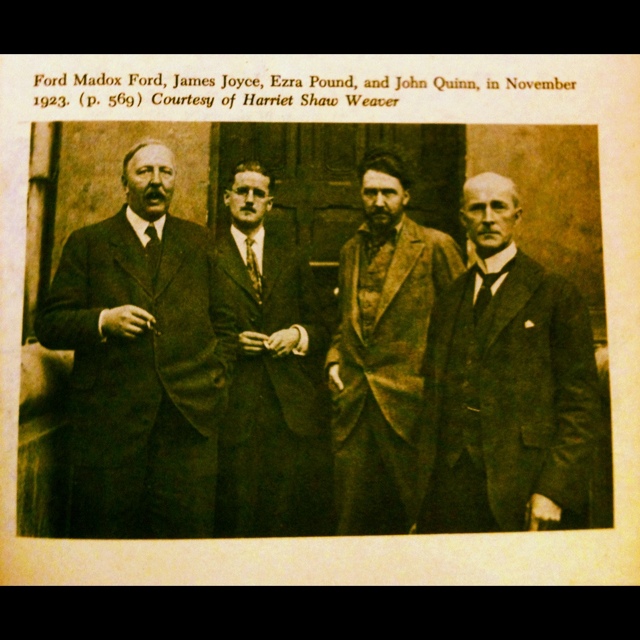
    Modernist Bros

    20120216-190332.jpg

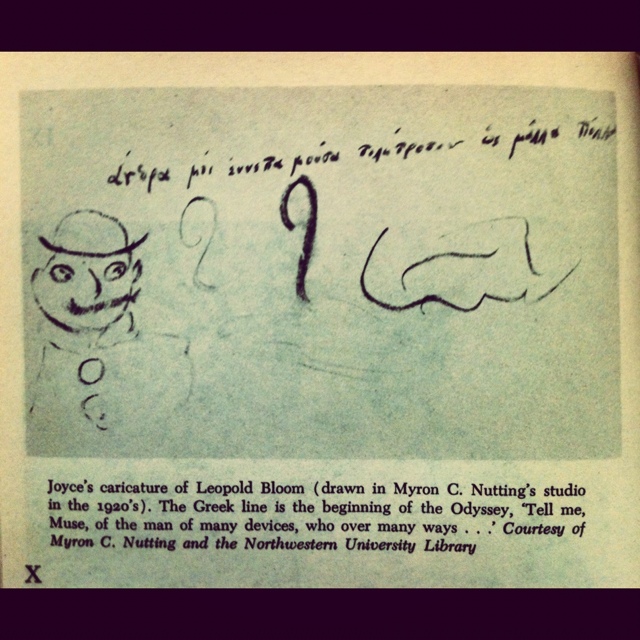
    James Joyce’s Caricature of Leopold Bloom

    20120216-173233.jpg

    From Richard Ellman’s great big bio James Joyce.

    William Gaddis on Hipsters: “An Ill-dressed, Underfed, Overdrunken Group of Squatters with Minds So Highly Developed That They Were Excused from Good Manners”

    gaddis_large

    Love this passage from William Gaddis’s The Recognitions. Mocking “hipsterism” has been around forever (or at least 50 years):

    And by now they were at the door of the Viareggio, a small Italian bar of nepotistic honesty before it was discovered by exotics. Neighborhood folk still came, in small vanquished numbers and mostly in the afternoon, before the two small dining rooms and the bar were taken over by the educated classes, an ill-dressed, underfed, overdrunken group of squatters with minds so highly developed that they were excused from good manners, tastes so refined in one direction that they were excused for having none in any other, emotions so cultivated that the only aberration was normality, all afloat here on sodden pools of depravity calculated only to manifest the pricelessness of what they were throwing away, the three sexes in two colors, a group of people all mentally and physically the wrong size.

    I Riff on William Gaddis’s Enormous Novel J R (From About Half Way Through)

    1. I want to write about William Gaddis’s novel J R, which I am about half way through now.

    2. I’ve been listening to the audiobook version, read with operatic aplomb by Nick Sullivan. I’ve also been rereading bits here and there in my trade paperback copy.

    3. What is J R about? Money. Capitalism. Art. Education. Desperate people. America.

    4. The question posed in #3 is a fair question, but probably not the right question, or at least not the right first question about J R. Instead—What is the form of J RHow is J R?

    5. A simple answer is that the novel is almost entirely dialog, usually unattributed (although made clear once one learns the reading rules for J R). These episodes of dialogue are couched in brief, pristine, precise, concrete—yet poetic—descriptions of setting. Otherwise, no exposition. Reminiscent of a movie script, almost.

    6. A more complex answer: J R, overstuffed with voices, characters (shadows and doubles), and motifs, is an opera, or a riff on an opera, at least.

    7. A few of the motifs in J R: paper, shoes, opera, T.V. equipment, entropy, chaos, novels, failure, frustration, mechanization, noise, hunting, war, music, commercials, trains, eruptions of nonconformity, advertising, the rotten shallowness of modern life . . .

    8. Okay, so maybe that list of motifs dipped into themes. It’s certainly incomplete (but my reading of J R is incomplete, so . . .)

    9. Well hang on so what’s it about? What happens?—This is a hard question to answer even though there are plenty of concrete answers. A little more riffage then—

    10. Our eponymous hero, snot-nosed JR (of the sixth grade) amasses a paper fortune by trading cheap stocks. He does this from a payphone (that he engineers to have installed!) in school.

    11. JR’s unwilling agent—his emissary into the adult world—is Edward Bast, a struggling young composer who is fired from his teaching position at JR’s school after going (quite literally) off script during a lesson.

    12. Echoes of Bast: Thomas Eigen, struggling writer. Jack Gibbs, struggling writer human. Gibbs, a frustrated, exasperated, alcoholic intellectual is perhaps the soul of the book. (Or at least my favorite character).

    13. Characters in J R tend to be frustrated or oblivious. The oblivious characters tend to be rich and powerful; the frustrated tend to be artistic and intellectual.

    14. Hence, satire: J R is very, very funny.

    15. J R was published over 35 years ago, but its take on Wall Street, greed, the mechanization of education, the marginalization of art in society, and the increasing anti-intellectualism in America is more relevant than ever.

    16. So, even when J R is funny, it’s also deeply sad.

    17. Occasionally, there’s a histrionic pitch to Gaddis’s dialog: his frustrated people, in their frustrated marriages and frustrated jobs, explode. But J R is an opera, I suppose, and we might come to accept histrionics in an opera.

    18. Young JR is a fascinating study, an innocent of sorts who attempts to navigate the ridiculous rules of his society. He is immature; he lacks human experience (he’s only 11, after all), and, like most young children, lacks empathy or foresight. He’s the perfect predatory capitalist.

    19. All the love (whether familial or romantic or sexual) in J R (thus far, anyway) is frustrated, blocked, barred, delayed, interrupted . . .

    20. I’m particularly fascinated by the scenes in JR’s school, particularly the ones involving Principal Whiteback, who, in addition to his educational duties, is also president of a local bank. Whiteback is a consummate yes man; he babbles out in an unending stammer of doubletalk; he’s a fount of delicious ironic humor. Sadly though, he’s also absolutely real, the kind of educational administrator who thinks a school should be run like a corporation.

    21. The middlebrow novelist Jonathan Franzen, who has the unlikely and undeserved reputation of being a literary genius, famously called Gaddis “Mr. Difficult” (in an essay of the same name).

    22. Franzen’s essay is interesting and instructive though flawed (he couldn’t make it through the second half of J R). From the essay:

    “J R” is written for the active reader. You’re well advised to carry a pencil with which to flag plot points and draw flow charts on the inside back cover. The novel is a welter of dozens of interconnecting scams, deals, seductions, extortions, and betrayals. Between scenes, when the dialogue yields briefly to run-on sentences whose effect is like a blurry handheld video or a speeded-up movie, the images that flash by are of denatured, commercialized landscapes — trees being felled, fields paved over, roads widened — that recall to the modern reader how aesthetically shocking postwar automotive America must have been, how dismaying and portentous the first strip malls, the first five-acre parking lots.

    23. Franzen, of course, is not heir to Gaddis. If there is one (and there doesn’t need to be, but still), it’s David Foster Wallace. Reading J R I am constantly reminded of Wallace’s work.

    24. But also Joyce. J R is thoroughly Joycean, at least in its formal aspects: that friction between the deteriorated language of commerce and the high aims of art; the sense and sound and rhythms of the street. (Is there a character more frustrated in Western literature than Stephen Dedalus? Surely he finds some heirs in Gibbs, Bast, and Eigen . . .)

    25. Gaddis denied (or at least deflected) a Joycean influence. Better to say then that they were both writing the 20th century, only from different ends of said century.

    26. And then a question for navel-gazing lit major types, a question of little import, perhaps a meaningless question (certainly a dull one for most decent folks): Is J R late modernism or postmodernism? Late-late modernism?

    27. Gaddis shows a touch of the nameyphilia that we see (out of control) in Pynchon: Hence, Miss Flesch, Father Haight, the diCephalis family, Nurse Waddams, Stella Angel, Major Hyde, etc.

    28. To return to the plot, or the non-plot, of J R: As I’ve said, I’m only half way through the thing, but I can’t see its shape. That sentence might need a “yet” at the end; or, J R might be so much chaos.

    29. In any case, I will report again at the end, if not sooner.

    William Gaddis on James Joyce

    William Gaddis on James Joyce (via/more):

    I recall a most ingenious piece in a Wisconsin quarterly some years ago in which The Recognitions’ debt to Ulysses was established in such minute detail I was doubtful of my own firm recollection of never having read Ulysses.

    (March 1972 letter to Jean [?] Howes)

    I’ve about reached the end of the line on questions about what I did or didn’t read of Joyce’s 30 years ago. All I read of Ulysses was Molly Bloom at the end which was being circulated for salacious rather than literary merits; No I did not read Finnegans Wake though I think a phrase about “psychoanaloosing” one’s self from it is in The Recognitions; Yes I read some of Dubliners but don’t recall how many & remember only a story called “Counterparts”; Yes I read a play called Exiles which at the time I found highly unsuccessful; Yes I believe I read Portrait of an Artist but also think I may not have finished it; No I did not read commentary on Joyce’s work & absorb details without reading the original. I also read, & believe with a good deal more absorbtion [sic], Eliot, Dostoevski, Forster, Rolfe, Waugh, why bother to go on, anyone seeking Joyce finds Joyce even if both Joyce & the victim found the item in Shakespear, read right past whole lines lifted bodily from Eliot &c, all of which will probably go on so long as Joyce remains an academic cottage industry.

    (June 1975 letter to Grace Eckley)

    “I Suppose You Become Addicted to a Certain Kind of Writing” — David Markson on Lowry, Joyce, and Gaddis

    David Markson talked with Joseph Tabbi about (among many other things) his friendship with Malcolm Lowry, his love for William Gaddis’s The Recognitions, and how James Joyce teaches us to read. Read the entire interview at the Dalkey Archive:

    JT: You mention your critical study of “Volcano.” But you did a master’s thesis on it at Columbia much earlier?

    DM: While we were in touch, but before I’d actually met him, yes. In 1951.

    JT: Which means it was only four years after the novel had been published. Isn’t that rare, an academic paper on an entirely “new” writer with no body of criticism to verify his status?

    DM: As a matter of fact I had to wander around the English department knocking on doors looking for someone to approve the project. I remember Lionel Trilling’s dismissal in particular: “What is all this drunkenness all about?” My whole object was to explain just that, obviously, but I decided to find less of a current to buck. Finally William York Tindall gave me a go-ahead.

    JT: That brings up a question of a different sort, however. “Volcano” is scarcely your everyday traditional novel. What sort of training or background did you have that let you feel able to confront the challenge of interpreting something that difficult?

    DM: To tell the truth, I’m not sure if I had any real idea what I was getting into, or if any of us do, the first time we’re seduced by a book of that sort. Though Joyce certainly teaches us, for starters. By which I mean that we all learn quickly with “Ulysses” that we cannot simply read the novel itself but have to lean on some of the critical crutches.

    JT: But you had no crutches at all?

    DM: Oh, well, but there are always clues in the text itself—this reference to that which leads to patterns you begin to trace out. On one level I impressed the hell out of myself, surprised at what I did know. And evidently I impressed a few other creatures as well, since I kept hearing that the thesis was being stolen from by students all over the place. The again when I sat down years later to turn that early stuff into a full length book I was almost embarrassed at how little I’d seen after all.

    JT: Not long after that original Lowry thesis you were proselytizing fairly extensively for “The Recognitions” too?

    DM: I suppose you become addicted to a certain kind of writing. There’s little enough of it extant, God knows. I’m not sure how much actual “proselytizing” I did for Gaddis, however. Except of course for practically button-holing friends on street corners.

    JT: But I understand you were very directly responsible for the first reissue of the book, also?

    DM: Evidently I was. It’s a funny story, actually. I was living in Mexico, and someone—well, old Aiken, in fact—gave my address to Aaron Asher, who was the editor of Meridian Books at the time. I picked him and his wife Linda up at their hotel and brought them out to where Elaine and I were living—outside Mexico City—for dinner and then spent approximately three solid hours talking nonstop about Gaddis. Finally Aaron threw up his hands in despair, telling me, “Please, please, I promise I’ll read the darned thing as soon as I get home! But now tell us something about where to go and what to see in Mexico, for heaven’s sake!”

    JT: And then he did publish it. Did Gaddis himself know about the impetus?

    DM: That’s fairly funny too, as it happens. “The Recognitions” came out in 1955. I’d read it twice when it did, and then wrote Gaddis a letter. It’s perhaps the only other letter I’ve written to an author I didn’t know, but it was completely different from the one I wrote to Lowry. In this case I’d just been infuriated by the rotten reviews and simply wanted to tell the man the hell with them all, that there were some few of us out there who did see what he’s accomplished. I didn’t get an answer, though I eventually heard secondhand that Gaddis had been too depressed at the time to send one. Or that he’d ultimately decided it was too late. But then sometime in 1961, not long after the Asher incident, I did hear. Six years after the fact, this was, a long letter beginning with something like, “Dear David Markson, if I can presume to answer yours of June whatever, 1955!” Which went on to say that Asher was in fact about to do a first reprint.

    Enjoy Thanksgiving with Our Literary Recipes Roundup

    Happy Thanksgiving! Enjoy Turkey Day with Biblioklept’s menu of literary recipes:

    F. Scott Fitzgerald’s Turkey Twelve Ways

    Zora Neale Hurston’s Mulatto Rice

    Ian McEwan’s Fish Stew

    James Joyce’s Burnt Kidney Breakfast

    Herman Melville’s Whale Steaks

    Ernest Heminway’s Absinthe Cocktail, Death in the Afternoon

    Vladimir Nabokov’s Eggs à la Nabocoque

    Thomas Pynchon’s Banana Breakfast

    Cormac McCarthy’s Turtle Soup

    Robert Crumb’s Macaroni Casserole

    Christmas Bonus:  George Orwell’s Recipes for Plum Cake and Christmas Pudding

    James Joyce’s Burnt Kidney Breakfast

    Another entry in our ongoing series of literary recipes to celebrate Thanksgiving.

    Leopold Bloom, hero of James Joyce’s Ulysses likes kidneys for breakfast. In fact–

    Mr Leopold Bloom ate with relish the inner organs of beasts and fowls. He liked thick giblet soup, nutty gizzards, a stuffed roast heart, liverslices fried with crustcrumbs, fried hencods’ roes. Most of all he liked grilled mutton kidneys which gave to his palate a fine tang of faintly scented urine.

    Okay, so there’s not much to this recipe. First, you’ve gotta buy the kidney–

    A kidney oozed bloodgouts on the willowpatterned dish: the last. He stood by the nextdoor girl at the counter. Would she buy it too, calling the items from a slip in her hand? Chapped: washingsoda. And a pound and a half of Denny’s sausages.

    Then you cook it with some butter in a frying pan (don’t forget to share with the cat, and don’t forget the pepper)–

    While he unwrapped the kidney the cat mewed hungrily against him. Give her too much meat she won’t mouse. Say they won’t eat pork. Kosher. Here. He let the bloodsmeared paper fall to her and dropped the kidney amid the sizzling butter sauce. Pepper. He sprinkled it through his fingers ringwise from the chipped eggcup.

    Then take your lazy adulterous wife her breakfast that you’ve lovingly prepared for her (she’ll need her strength for later). Oh, and don’t forget about the kidney that’s still cooking for you (unless you’re making some kind of subconscious symbolic burnt offering or something)–

    —There’s a smell of burn, she said. Did you leave anything on the fire?

    —The kidney! he cried suddenly.

    He fitted the book roughly into his inner pocket and, stubbing his toes against the broken commode, hurried out towards the smell, stepping hastily down the stairs with a flurried stork’s legs. Pungent smoke shot up in an angry jet from a side of the pan. By prodding a prong of the fork under the kidney he detached it and turned it turtle on its back. Only a little burnt. He tossed it off the pan on to a plate and let the scanty brown gravy trickle over it.

    Enjoy with gravy, toast, and a cup of tea–

    Cup of tea now. He sat down, cut and buttered a slice of the loaf. He shore away the burnt flesh and flung it to the cat. Then he put a forkful into his mouth, chewing with discernment the toothsome pliant meat. Done to a turn. A mouthful of tea. Then he cut away dies of bread, sopped one in the gravy and put it in his mouth. What was that about some young student and a picnic? He creased out the letter at his side, reading it slowly as he chewed, sopping another die of bread in the gravy and raising it to his mouth.

    He sopped other dies of bread in the gravy and ate piece after piece of kidney.

    Three (Somewhat Literary) Lists for 11 | 11 | 11

    Eleven Authors Who Were Also Veterans of War

    1. Stendahl (Napoleonic Wars)

    2. Ambrose Bierce (Union Army, American Civil War)

    3. Erich Maria Remarque (German Army, WWI)

    4. George Orwell (Republican Army, Spanish Civil War)

    5. Kurt Vonnegut (U.S. Army, WWII)

    6. Joseph Heller (U.S. Air Force, WWII)

    7. Eveyln Waugh (British Royal Marines, WWII)

    8. Norman Mailer (U.S Army, WWII)

    9. Gore Vidal (U.S. Army, WWII)

    10. Tim O’Brien (U.S. Army, Vietnam War)

    11. Anthony Swofford (U.S. Marine Corps, Persian Gulf War)

    *          *          *

    Eleven Encyclopedic Books, Overstuffed with References, That Compel Compulsive Reading

    1. Moby-Dick, Herman Melville

    2. Finnegans Wake, James Joyce

    3. Expelled from Eden, A WilliamVollmann Reader

    4. Species of Spaces and Other Pieces, Georges Perec

    5. Wittgenstein’s Mistress, David Markson

    6. The Silmarillion, J.R.R. Tolkien

    7. Foucault’s Pendulum, Umberto Eco

    8. The Rings of Saturn, W.G. Sebald

    9. The Recognitions, William Gaddis

    10. Between Parentheses, Roberto Bolaño

    11.  The Architecture of the Arkansas Ozarks, Donald Harrington

    *          *          *

    Eleven Excellent Films About Films and Film-making 

    1. Hearts of Darkness, Eleanor Coppola, et al

    2. Lost in La Mancha, Keith Fulton et al

    3. Burden of Dreams, Les Blank

    4. Adaptation, Spike Jonze

    5. Be Kind Rewind, Michel Gondry

    6. The Player, Robert Altman

    7. Ed Wood, Tim Burton

    8. Stardust Memories, Woody Allen

    9. Sullivan’s Travels, Preston Sturges

    10. American Movie, Chris Smith

    11. Barton Fink, Coen Brothers

    Eleven Encyclopedic Books, Overstuffed with References, That Compel Compulsive Reading

    Eleven Encyclopedic Books, Overstuffed with References, That Compel Compulsive Reading

    1. Moby-Dick, Herman Melville

    2. Finnegans Wake, James Joyce

    3. Expelled from Eden, A WilliamVollmann Reader

    4. Species of Spaces and Other Pieces, Georges Perec

    5. Wittgenstein’s Mistress, David Markson

    6. The Silmarillion, J.R.R. Tolkien

    7. Foucault’s Pendulum, Umberto Eco

    8. The Rings of Saturn, W.G. Sebald

    9. The Recognitions, William Gaddis

    10. Between Parentheses, Roberto Bolaño

    11.  The Architecture of the Arkansas Ozarks, Donald Harrington


    Book Acquired, 9.27.2011

    20110926-033724.jpg

    I’m psyched about this one—Uncreative Writing by Kenneth Goldsmith, who you may know as UbuWeb.  Here’s the description from the publisher, Columbia UP

    Can techniques traditionally thought to be outside the scope of literature, including word processing, databasing, identity ciphering, and intensive programming, inspire the reinvention of writing? The Internet and the digital environment present writers with new challenges and opportunities to reconceive creativity, authorship, and their relationship to language. Confronted with an unprecedented amount of texts and language, writers have the opportunity to move beyond the creation of new texts and manage, parse, appropriate, and reconstruct those that already exist.

    In addition to explaining his concept of uncreative writing, which is also the name of his popular course at the University of Pennsylvania, Goldsmith reads the work of writers who have taken up this challenge. Examining a wide range of texts and techniques, including the use of Google searches to create poetry, the appropriation of courtroom testimony, and the possibility of robo-poetics, Goldsmith joins this recent work to practices that date back to the early twentieth century. Writers and artists such as Walter Benjamin, Gertrude Stein, James Joyce, and Andy Warhol embodied an ethos in which the construction or conception of a text was just as important as the resultant text itself. By extending this tradition into the digital realm, uncreative writing offers new ways of thinking about identity and the making of meaning.