
Daniel Green’s The Reading Experience was one of the first sites I started reading regularly when I first started blogging about literature on Biblioklept. If you regularly read literary criticism online, it’s likely you’ve read some of Green’s reviews in publications like The Kenyon Review, 3:AM, Full Stop, The Los Angeles Review of Books, Full Stop, and more.
Green’s got a new collection out from Cow Eye Press, Beyond the Blurb: On Critics and Criticism, which presents his philosophy of literary criticism, drawing on writing he has done over the past dozen years on The Reading Experience, as well as essays he has published elsewhere. Beyond the Blurb lucidly explicates an approach to criticism that stresses careful attention to literary form and language. “The experience of reading is the experience of language” might be a tidy blurb for Beyond the Blurb.
In his own words, Green was trained as an academic literary critic, but has long since seen the error of his ways. He lives in central Missouri. Over a series of emails, Green was kind enough to talk to me about his new book Beyond the Blurb, literary criticism, experimental fiction, William H. Gass, the New Critics, James Wood, Harold Bloom, Susan Sontag, Bob Dylan’s winning the Nobel, and lots more.

Biblioklept: In the introduction to Beyond the Blurb, you outline some of the core tenets of your philosophy of literary criticism. One of these is, “The meaning of a literary work consists of the experience of reading it, not in abstracted ‘themes’ that signify what the work is ‘about.'” Another tenet is that, “The experience of reading is the experience of language.”
This idea of a reader’s experience of reading appears throughout Beyond the Blurb, and indeed, your website is named The Reading Experience. Is it possible to define, or at least describe, what you mean by the reader’s experience of reading, in a general sense?
Daniel Green: The Reading Experience is a direct allusion to John Dewey’s Art as Experience. My insistence that reading is experience of language is an attempt to apply Dewey’s concept of “experience” to reading works of literature. I probably put more emphasis on language per se than Dewey did, which is likely the residual influence of New Criticism. I was a graduate student at a time when many older literary scholars—including some of those with whom I studied—were still New Critics, or at least assigned New Critics in classes I took. (Or maybe I just read a lot of New Criticism on my own).
I still think the New Critics’ general approach, which emphasized the “ambiguity” inherent to a literary work, is sound, although they went too far in using words like “icon” and “heresy,” almost making works of literature into sacred objects. I discovered Dewey’s book and was converted to the notion that works of art are objects of experience whereby the reader/beholder is given the opportunity simply to appreciate experience for its own sake. (Dewey thought works of art gave us the greatest opportunity for this).
The experience of reading is always the experience of language, even though many readers don’t stop often enough to acknowledge this. We read artfully arranged words that in works of literature create “meaning” only relative to their arrangement, which is not the arrangement to be found in newspaper columns or political speeches. A critic should be sensitive to the particular kind of arrangement—which includes the arrangement into “form”—found in a particular work. Even leaping ahead to “story” or “setting” distorts our actual experience of the work unless we also notice the way the writer has used language to create the illusion of story and the illusion of setting.
Biblioklept: Is there a risk though at falling into “the experience of the experience” when reading literature? Many people like to “get lost” in the illusion that the language of literature replicates reality. James Wood, in particular, seems to particularly value reality or life in the literature he esteems.
DG: People are perfectly free to read in any way they want, including for the illusion of reality. But I see that as a secondary effect. Has the work succeeded aesthetically in creating that illusion? It seems to me that critics ought to be those readers who are most sensitive to the “experience of the experience.” This ought to be the first goal of the critic, to describe that experience. Jumping right to “life on the page” is jumping right over the art of literary art.
Frankly, I’ve always found the notion that literature (fiction) is valuable to the extent it provides access to “reality” or “human life” bizarre. Since we’re humans writing about human experience, what other than reality could we possibly find in a literary work? Doing creative things with words isn’t separate from human life. It’s part of human life.
Biblioklept: It seems that there’s a demand that contemporary fiction be “useful” now—that literature is supposed to foster empathy or make us better human beings (or even make us live longer).

DG: Yeah, there are a lot of claims that the primary value of fiction lies in its ability to allow readers to “share” other people’s experience and perspective, to see the world from their point of view. On the one hand this seems to me a fairly innocuous notion. If a novel effectively conveys the illusion that you’re inhabiting another subjectivity and you think the experience has been salutary in your sense of “empathy,” then so be it. It is, however, an illusion, so on the other hand in no way are you really sharing another perspective or point of view, since what’re you are in fact experiencing is an effect of the writer’s skillful disposition of language. There are no “people” in fiction, just words and sentences, and therefore when you talk about empathizing or adopting another perspective, at best you are speaking metaphorically—it’s like empathizing with a real person, even though it’s not.
I would also say that the notion you’re sharing the author’s perspective, or engaging with the author’s “mind,” is misbegotten as well. A work of fiction (at least a good one) doesn’t have a perspective, or it would be a work of nonfiction.
I actually do think reading literature can make you a better human being, by helping you to be a better reader, or by expanding your ability to have a rich aesthetic experience. The idea it can make you ethically or morally better (presumably by teaching you a lesson) is one I assumed had been discarded long ago.
Biblioklept: I think a lot of folks still believe in “moral fiction” of some kind though (Mark Edmundson’s attack on contemporary poets in Harper’s a few years ago comes immediately to mind). Your response recalls to me some favorite lines from William Gass’s “The Medium of Fiction.” “It seems a country-headed thing to say,” he writes, “that literature is language, that stories and the places and the people in them are merely made of words as chairs are made of smoothed sticks and sometimes cloth or metal tubes.” Gass is one of the examples you include in your chapter on “Critical Successes.” What do you admire in his criticism and his critical approach?
DG: I think of Gass as a “poet-critic,” even though he is of course a fiction writer. Indeed, I can think of few critics who make better use of the poetic resources of language in writing a criticism that is also pungent and deeply informed. He is among critics the most sensitive to the aesthetic character of literature and best able to express his aesthetic engagement in his own aesthetically rich prose. He’s a critic who registers an “appreciation” of literature more than he attempts to explicate through analysis, but there is room for both kinds of critics.
Biblioklept: Harold Bloom also strikes me as a critic “sensitive to the aesthetic character of literature,” and he also lands in your examples of “Critical Successes.” Bloom’s had a long history of pissing off various critics and even casual readers. What do you make of his agon with the so-called “School of Resentment”?
DG: I think he probably overdid the rhetoric with the “school of resentment” thing, although his underlying insight, that academic criticism had abandoned the study of literature for its own sake—to illuminate what is valuable about it—in favor of other agendas for which literature is merely a convenient tool of analysis, was certainly correct. I don’t object to forms of criticism or scholarship that favor cultural or political analysis over literary analysis, but these approaches came not to supplement or coexist with literary analysis; instead they completely replaced it. Bloom expressed his love of literature through becoming a learned professor and scholar. Now the idea that a literature professor is someone who loves literature seems quaint, if not outlandish. (Which is no doubt why Bloom seems an outlandish figure to many people).
Biblioklept: Sontag is another figure in your chapter on “Critical Successes”; indeed, you cite her at some length. Sontag wanted us to “learn to see more, to hear more, to feel more.” What are some practical methods for critics (and readers in general) to attend more to the “sensuous surface”?
DG: With literature, that has to mean attention to the palpable features of the writer’s shaping of language. A work of fiction is not a script for the reader to imagine into his/her own movie version. The “sensuous surface” is the sound and movement of the language. Gary Lutz is a good example of a writer who understands this. Lutz’s stories deliberately frustrate attempts to read for the plot or to visualize the characters, instead requiring attention to the transformed effects of word choice and syntax. Lutz may be an extreme example, but critics should approach all works of literature in the way his fiction demands. The notion that poetry should be read this way is not such an outlandish one, and criticism of fiction has moved too far away from criticism of poetry. Both fiction and poetry should be read first of all as aesthetic arrangements of language, although I don’t say that all criticism should necessarily stop there.
Biblioklept: What are some of the directions that criticism might go after appraising the aesthetic arrangements of language?
DG: As I say, I don’t object to criticism that examines works of literature for political or historical contexts and implications, but this should be done with the proviso that works of literature (most works of literature) are offered first of all as works of art. Examining a literary work for the aesthetic arrangements of language is the way of establishing that, because its language has been aesthetically arranged, it can’t coherently be subsumed to a political position or reduced to a cultural symptom. I’m speaking here of fiction and poetry (also drama, to the extent it belongs to literature). Including works of “creative nonfiction” as literature arguably muddies the waters some, but even here the “creative” part must count for something, must mean something other than simply “nice prose.” It ought to involve ways of making “meaning” more complex, more suggestive, not more transparent.
Older, more “canonical” works can certainly serve as the focus of lots of different critical inquiries, since in most cases their specifically literary qualities can be assumed as established, but I’d want them to be taught as first of all works of literary art. Presenting them to students immediately as politics or objects of theoretical discourse seems to me to simply erase “literature” as something about which it makes sense to speak as a separate category of writing.
Biblioklept: You include “Academic Criticism” in your section of “Critical Failures.” The focus in the chapter on “Academic Criticism” is on Joseph M. Conte’s study of American postmodern literature, Design and Debris, and not necessarily academic criticism in general. In general though, do you think American universities and schools are neglecting the aesthetics of literature in favor of different “theoretical” approaches?
DG: Yes, of course they are. I don’t think many academic critics would deny it. Certainly most of the academic journals that determine which approaches are informally—if not “officially”—sanctioned and which are disdained are now completely devoted to non-aesthetic approaches. Lately a quasi-formalist strategy called “surface reading” has become more respectable, but even it is offered as a corrective to certain kinds of theoretical overreach and doesn’t finally threaten the hegemony of theory itself as the primary concern of academic criticism. What’s called “digital humanities”—data-mining using literary texts as data—shares with theory the assumption that assessing works of literature for their aesthetic qualities was long ago deemed insufficiently “rigorous” as a way of organizing the study of literature—although for some reason, unclear to me even now, the term “literature” has been retained to identify the nominal object of study, and what these critics do is still referred to as “literary study.”
There are, of course, professors who do continue to present literary works as works of art. They are surely in the minority, however, particularly in the more prestigious universities.
Biblioklept: Another entry in your section on “Critical Failures” is James Wood, whom you devote quite a few pages to. I often find myself very frustrated with Wood’s approach to literary criticism, but he’s also a very perceptive reader.
DG: Yes, he can be a very insightful reader. I think in the essay I say that he is, on the one hand, one of the few practicing critics who is able to focus very closely on the text under consideration and offer a sensitive “reading.” But, on the other hand, he uses that sensitivity to advance a very narrowly conceived agenda. It seems to me he isn’t reading the work to understand what the author is doing, whatever that might be, but to find support for his bias toward psychologically complex realism. It causes him to unfairly characterize fiction for which he does not have affinity (“hysterical realism”), when he’s not merely ignoring work that contradicts his agenda. I actually learn from his reviews of some writers, especially certain translated authors whose work clearly does conform to his preconceptions of “how fiction works.” But he seems to know very little about American literature, and his critical agenda especially distorts the formal and aesthetic assumptions of many American writers, particularly those in the tradition of nonrealist writing going back to Poe and Hawthorne. Since the kind of experimental writing I admire to a significant extent has its source in that tradition, naturally I find his approach objectionable.
Biblioklept: Wood often violates the first of John Updike’s “rules” of reviewing books (from Picked-Up Pieces): “Try to understand what the author wished to do, and do not blame him for not achieving what he did not attempt.”
DG: Yes, that’s exactly right. You can then either judge the author a failure by the standards he/she has adopted, or you can rule what the author has attempted out of court—that’s not the sort of thing a novelist should be doing. It would be hard to justify the latter position, although you could mount a sustained critique of the author’s chosen mode. Perhaps its conventions are stale or its strategies are incoherent. Mostly Wood doesn’t do this. He instead continues to judge by the standards of his preferred mode—it’s realism all right, but it’s “hysterical.” Continue reading “An interview with literary critic Daniel Green about his new book, Beyond the Blurb”
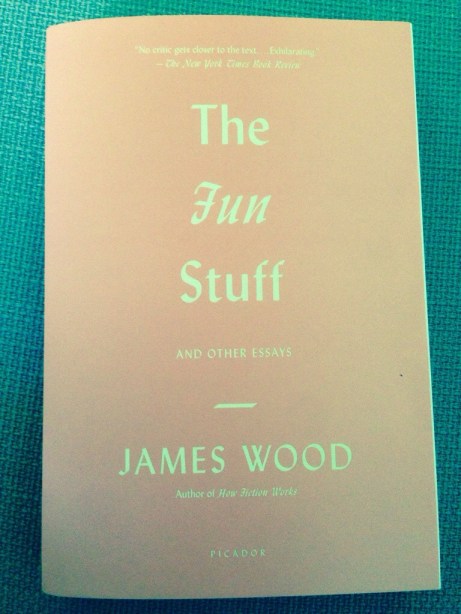
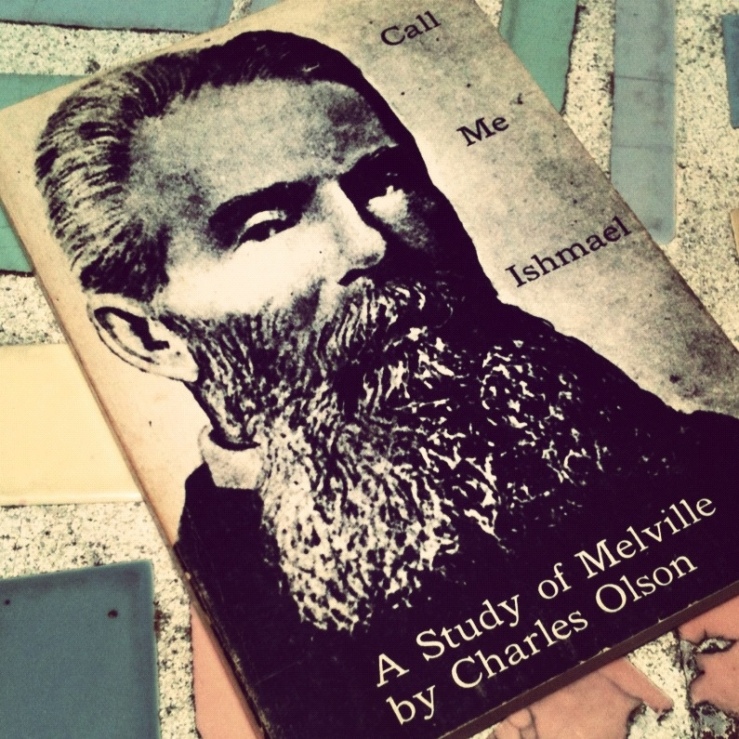


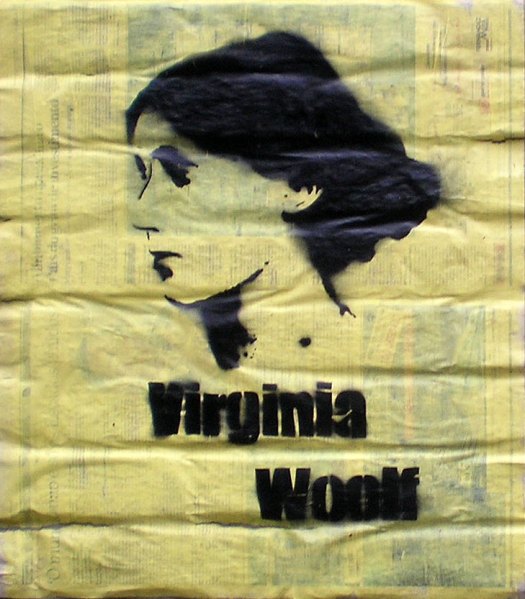 James Wood, writing about Virginia Woolf in his essay “Virginia Woolf’s Mysticism” (collected in The Broken Estate)–

 In his essay “Shakespeare in Bloom,” critic James Wood performs one of the strangest, most backhanded (and yet earnest) defenses I’ve ever read of Harold Bloom‘s aesthetic reaction to (what Bloom has called) “The School of Resentment” — deconstruction, Marxism, gender and queer theory, postcolonial theory, all that good stuff. Wood comes out strong, arguing, that in his prolific output, Bloom “has kidnapped the whole of the English literature and has been releasing his hostages, one by one, over a lifetime, on his own spirited terms.” Wood suggests that “this ceaselessness has produced some hurried, fantastical, and repetitive work,” before going on to throw around words like “garrulous” and “shallow.” Wood then takes Bloom to task over his famous (and improbable) claim that “Shakespeare invented us,” situating the claim against Bloom’s own most famous theory, the anxiety of influence. Wood says–
 As we bring up the term again, we should note that we consider it a bit pejorative and utterly reactionary, and, to borrow from (and perhaps misapply) Wood, shallow. Wood points out that “Deconstruction brings a generalized suspicion to bear on language and in particular on metaphor (or ‘rhetoric’), which it suspects of hiding something–namely, its own metaphoricity.” In short, literature always metaphorizes, and thus hides, some other impulse, one always politicized. Wood continues: “Political criticism, including cultural materialism, converts Freud’s analytical suspicions into political ones. . . . The poem is read as if it were covering something up, as if it were an alibi that is rather too fluent to be entirely trusted.” It must be interrogated to reveal its secret, the secret prejudices of its age. Wood continues, after a page or two–
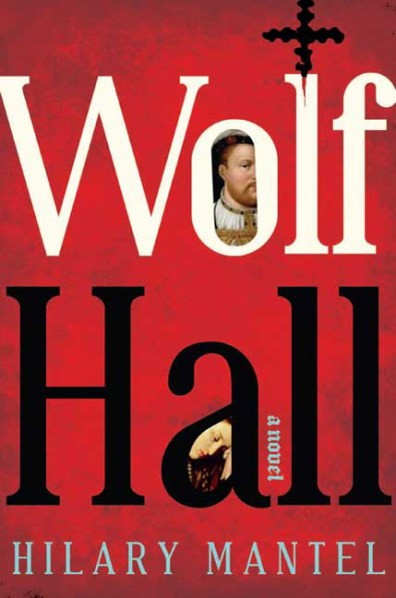 I’m coming to the end of Hilary Mantel’s brilliant treatment of the Tudor saga, Wolf Hall. Sign of a great book: when it’s finished, I will miss her characters, particularly her hero Thomas Cromwell, presented here as a self-made harbinger of the Renaissance, a complicated protagonist who was loyal to his benefactor Cardinal Wolsey even though he despised the abuses of the Church. Mantel’s Cromwell reminds us that the adjective “Machiavellian” need not be a pejorative, applied only to evil Iago or crooked Richard III. The Cromwell of Wolf Hall presages a more egalitarian–modern–extension of power. Cromwell here is not simply pragmatic (although he is pragmatic), he also has a purpose: he sees the coming changes of Europe, the rise of the mercantile class signaling economic power over monarchial authority. Yet he’s loyal to Henry VIII, and even the scheming Boleyns. “Arrange your face” is one of the book’s constant mantras; another is “Choose your prince.” Mantel’s Cromwell is intelligent and admirable; the sorrows of the loss of his wife and daughter tinge his life but do not dominate it; he can be cruel when the situation merits it but would rather not be. I doubt that many people wanted yet another telling of the Tudor drama–but aren’t we always looking for a great book? Wolf Hall demonstrates that it’s not the subject that matters but the quality of the writing. Highly recommended.
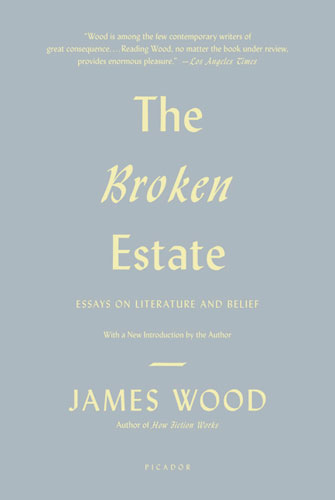
 Cromwell’s greatest foil in Wolf Hall is Thomas More, who is also the subject of the first essay in James Wood’s collection The Broken Estate. I got my review copy in the mail late last week, so it was pure serendipity that I should read “Sir Thomas More: A Man for One Season” after a full day of listening to Wolf Hall (did I neglect to mention that I listened to the audio book? Sorry). Wood is harsher on More than Mantel; whereas she lets us despise him within the logic and framework of the Tudor court, Wood aims to find a contemporary secular standard from which to judge him. He finds license to do so through the work of John Stuart Mill, citing the influential essay On Liberty. Wood writes:
 Biblioklept