Crimes of the Moonlight Melonmounter (Cormac McCarthy’s Suttree)

Still Life with Watermelons, Frida Kahlo

Two pairs of brogans went along the rows.

You aint goin to believe this.

Knowin you for a born liar I most probably wont.

Somebody has been fuckin my watermelons.

What?

I said somebody has been …

No. No. Hell no. Damn you if you aint got a warped mind.

I’m tellin you …

“I dont want to hear it.

Looky here.

And here.

They went along the outer row of the melonpatch. He stopped to nudge a melon with his toe. Yellowjackets snarled in the seepage. Some were ruined a good time past and lay soft with rot, wrinkled with imminent collapse.

It does look like it, dont it?

I’m tellin ye I seen him. I didnt know what the hell was goin on when he dropped his drawers. Then when I seen what he was up to I still didnt believe it. But yonder they lay.

What do you aim to do?

Hell, I dont know. It’s about too late to do anything. He’s damn near screwed the whole patch. I dont see why he couldnt of stuck to just one. Or a few.

Well, I guess he takes himself for a lover. Sort of like a sailor in a whorehouse.

I reckon what it was he didnt take to the idea of gettin bit on the head of his pecker by one of them waspers. I suppose he showed good judgment there.

What was he, just a young feller?

I dont know about how young he was but he was as active a feller as I’ve seen in a good while.

Well. I dont reckon he’ll be back.

I dont know. A man fast as he is ought not to be qualmy about goin anywheres he took a notion. To steal or whatever.

What if he does come back?

I’ll catch him if he does.

And then what?

Well. I dont know. Be kindly embarrassin now I think about it.

I’d get some work out of him is what I’d do.

Ought to, I reckon. I dont know.

You reckon to call the sheriff?

And tell him what?

They were walking slowly along the rows.

It’s just the damndest thing I ever heard of. Aint it you? What are you grinnin at? It aint funny. A thing like that. To me it aint.

One of my favorite passages from Cormac McCarthy’s novel Suttree. The title of this post also comes from the novel, several pages later, after the melonmounter has been apprehended.

David Foster Wallace’s blurbs as “a parallel history to the aesthetic agendas he set down elsewhere”

There’s been a bit of DFW overload in the wake of that movie, which has made me wary (and weary) of so many of the “thought pieces” out there. But I really dug Lucas Thompson’s essay “David Foster Wallace and ‘Blurbspeak'” in the L.A. Review of Books. From the article:

….I think there are three key reasons why it’s worth paying attention to these blurbs. For one thing, they work as an oblique record of Wallace’s evolving views on what literature is really for, comprising a parallel history to the aesthetic agendas he set down elsewhere. Read carefully, his blurbs reveal intriguing overlaps with these broader agendas, as well as gesturing to the particular qualities he valued in fiction. They also indicate an engagement with a surprising and often counterintuitive range of texts, hinting at Wallace’s broad intellectual interests. And finally, the blurbs themselves are in most cases finely crafted, elegant sentences, which may even represent one of the final frontiers of Wallace’s published — though uncollected — work. Although much of Wallace’s previously uncollected essays, teaching documents, and other work have been published in recent years, the twenty-odd blurbs he composed across his career have, in my opinion, been unfairly neglected. The following survey makes a case for giving these blurbs a closer look.

New American Stories, a collection edited by Ben Marcus (Book acquired, 8.04.2015)

IMG_7908

New American Stories is an anthology out now in enormous paperback from Vintage. The collection was collected by collector Ben Marcus. An excerpt from his introduction:

Language is a drug, but a short story cannot be smoked. You can’t inject it. Stories don’t come bottled as a cream. You cannot have a story massaged into you by a bearish old man. You have to stare down a story until it wobbles, yields, then catapults into your face. And yet, as squirrely as they are to capture, stories are the ideal deranger. If they are well made, and you submit to them, they go in clean. Stories deliver their chemical disruption without the ashy hangover, the blacking out, the poison. They trigger pleasure, fear, fascination, love, confusion, desire, repulsion. Drugs get flushed from our systems, but not the best stories. Once they take hold, you couldn’t scrape them out with a knife. While working on this book, I started to think of a it as a medicine chest, filled with beguiling, volatile material, designed by the most gifted technicians. The potent story writers, to me, are the ones who deploy language as a kind of contraband, pumping it into us until we collapse on the floor, writhing, overwhelmed with feeling.

You actually can smoke a short story, but to do so is inadvisable.

I’ll be riffing on the book over the next few weeks with our Correspondent in Colorado, Mr. Ryan Chang.

Here’s the tracklist:

Said Sayrafiezadeh, Paranoia

Rebecca Lee,  Slatland

Jesse Ball, The Early Deaths of Lubeck, Brennan, Harp, and Carr

Deborah Eisenberg, Some Other, Better Otto

Anthony Doerr, The Deep

Yiyun Li, A Man Like Him

George Saunders, Home

NoViolet Bulawayo, Shhh

Maureen McHugh, Special Economics

Sam Lipsyte, This Appointment Occurs in the Past

Lydia Davis, Men

Donald Antrim, Another Manhattan

Zadie Smith*, Meet the President!

Denis Johnson, The Largesse of the Sea Maiden

Joy Williams, The Country

Christine Schutt, A Happy Rural Seat of Various View Lucinda’s Garden

Don DeLillo, Hammer and Sickle

Mathias Svalina, Play

Lucy Corin, Madmen

Mary Gaitskill, The Arms and Legs of the Lake

Wells Tower, Raw Water

Rachel Glaser, Pee on Water

Tao Lin, Love is a Thing on Sale for More Money than There Exists

Rebecca Curtis, The Toast

Robert Coover, Going for a Beer

Charles Yu, Standard Loneliness Package

Deb Olin Unferth, Wait Till You See Me Dance

Kyle Coma-Thompson, The Lucky Body

Rivka Galchen, The Lost Order

Donald Ray Pollack, Fish Sticks

Kelly Link, Valley of the Girls

Claire Vaye Watkins, The Diggings

*Isn’t she English? I guess it’s the stories that are American.

Nabokov, in answer to the question: What scenes one would like to have filmed

IN ANSWER TO THE QUESTION: WHAT SCENES ONE WOULD LIKE TO HAVE FILMED

Shakespeare in the part of the King’s Ghost.

The beheading of Louis the Sixteenth, the drums drowning his speech on the scaffold.

Herman Melville at breakfast, feeding a sardine to his cat.

Poe’s wedding. Lewis Carroll’s picnics.

The Russians leaving Alaska, delighted with the deal. Shot of a seal applauding.

From a 1966 interview with Alfred Appel Jr., originally published in Wisconsin Studies and reprinted in the collection Strong Opinions (1973).

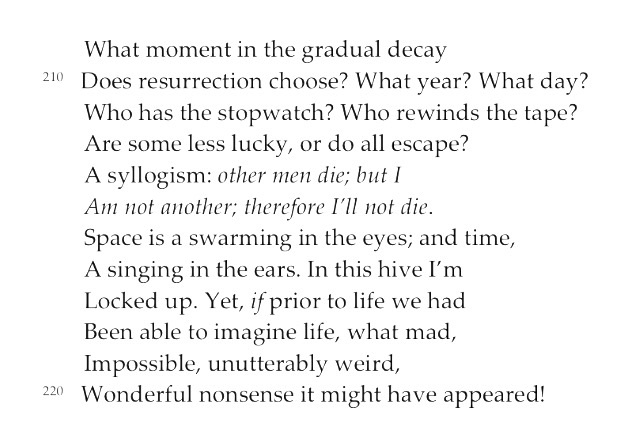
What if we awake one day, all of us, and find ourselves utterly unable to read? (Nabokov’s Pale Fire)

We are absurdly accustomed to the miracle of a few written signs being able to contain immortal imagery, involutions of thought, new worlds with live people, speaking, weeping, laughing. We take it for granted so simply that in a sense, by the very act of brutish routine acceptance, we undo the work of the ages, the history of the gradual elaboration of poetical description and construction, from the treeman to Browning, from the caveman to Keats. What if we awake one day, all of us, and find ourselves utterly unable to read? I wish you to gasp not only at what you read but at the miracle of its being readable (so I used to tell my students). Although I am capable, through long dabbling in blue magic, of imitating any prose in the world (but singularly enough not verse – I am a miserable rhymester), I do not consider myself a true artist, save in one matter: I can do what only a true artist can do – pounce upon the forgotten butterfly of revelation, wean myself abruptly from the habit of things, see the web of the world, and the warp and the weft of that web.

From Vladimir Nabokov’s novel Pale Fire.

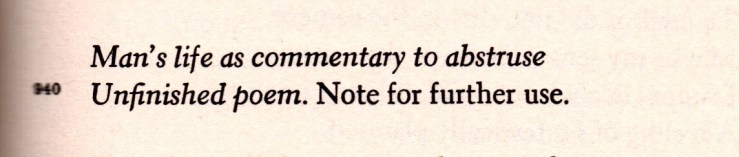
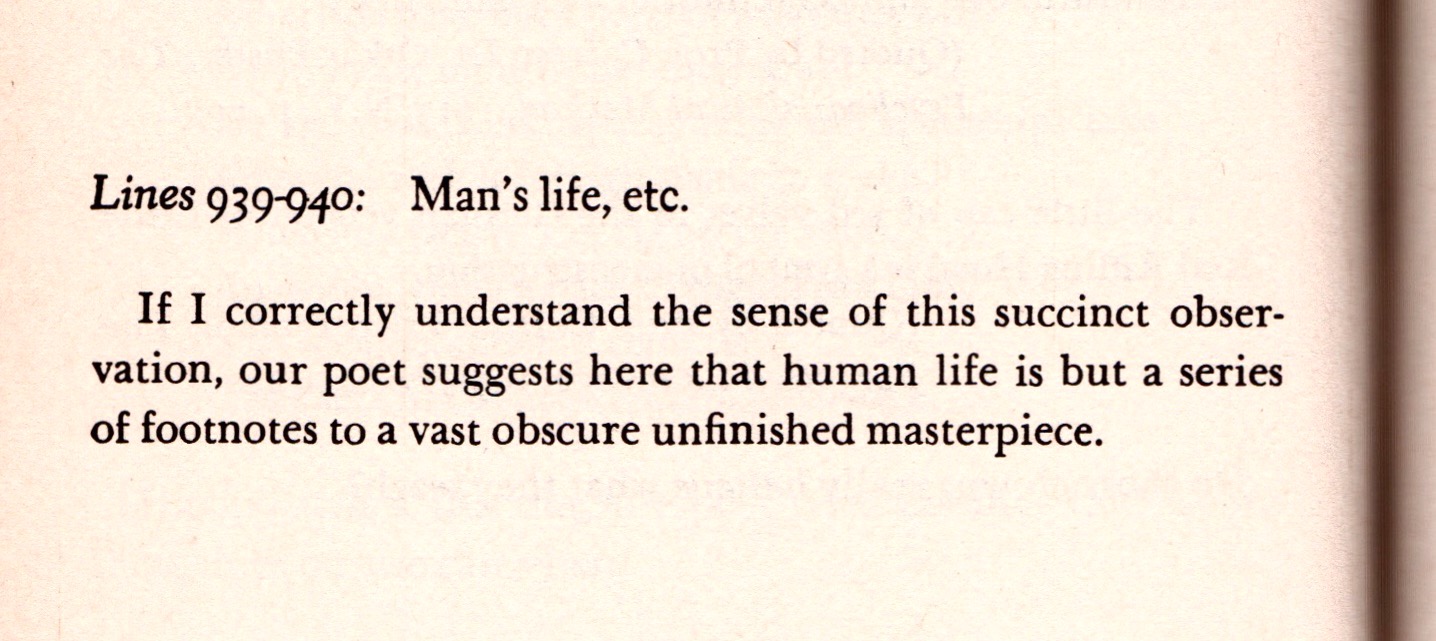
Man’s life, etc. (Nabokov’s Pale Fire)


From Vladimir’s novel Pale Fire.

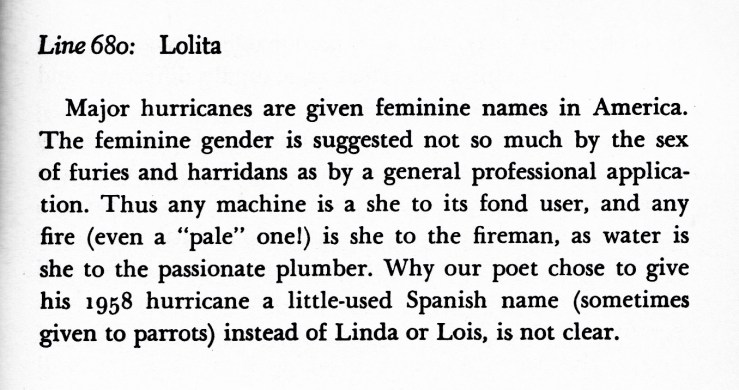
Lolita (Nabokov’s Pale Fire)

IMG_7865

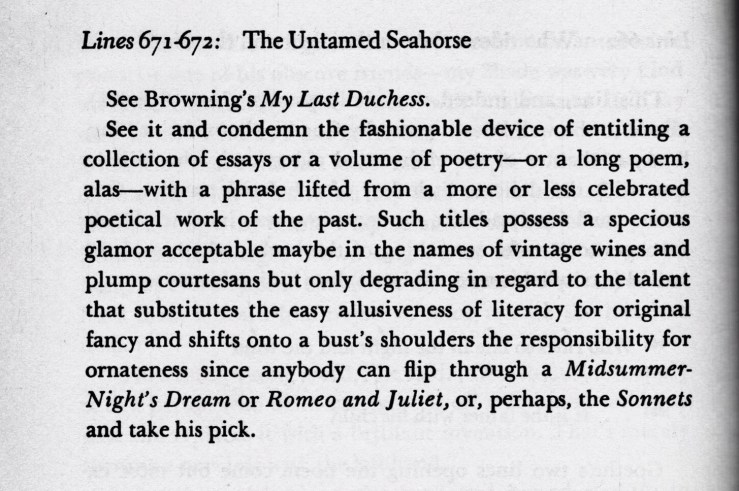
See it and condemn (Nabokov’s Pale Fire)

IMG_7867

I love this passage from Nabokov’s Pale Fire. The title of Pale Fire, of course, comes from Shakespeare’s Timon of Athens. Ironies aside, I dig the sentiment here, and would extend it to the glut of contemporary novels that rest heavily on the weight of other, better would-be precursor texts.

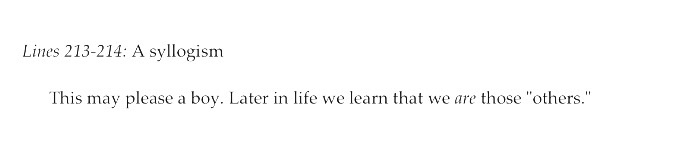
A syllogism (Vladimir Nabokov)

image image

From Vladimir Nabokov’s magnificent novel Pale Fire.

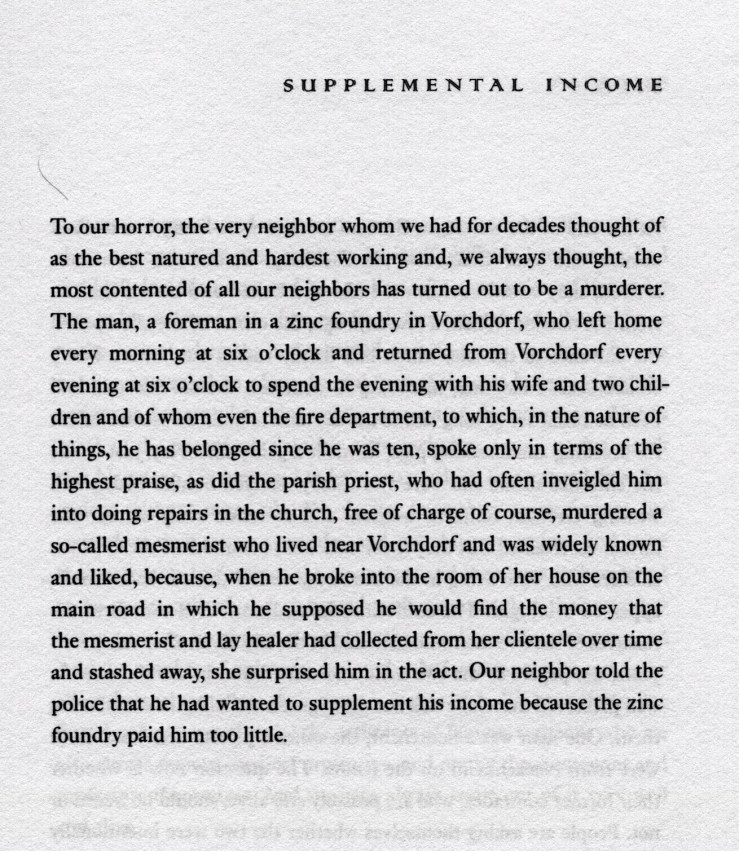
“Supplemental Income” — Thomas Bernhard

IMG_7838

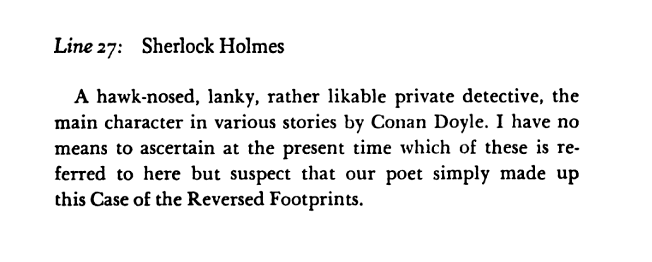
Line 27: Sherlock Holmes (Vladimir Nabokov)

Screenshot 2015-07-27 at 12.20.50 PM

Screenshot 2015-07-27 at 12.19.44 PM

From Pale Fire.

Read Clarice Lispector’s short story “Report on the Thing”

In advance of New Directions’ forthcoming Clarice Lispector collection The Complete Stories, Vice has published “Report on the Thing” in a new English translation by Katrina Dodson (who translated the entire volume of 86 stories. First few paragraphs:

This thing is the most difficult for a person to understand. Keep trying. Don’t get discouraged. It will seem obvious. But it is extremely difficult to know about it. For it involves time.

We divide time when in reality it is not divisible. It is always immutable. But we need to divide it. And to that end a monstrous thing was created: the clock.

I am not going to speak of clocks. But of one particular clock. I’m showing my cards: I’ll say up front what I have to say and without literature. This report is the anti-literature of the thing.

The clock of which I speak is electronic and has an alarm. The brand is Sveglia, which means “awake.” Awake to what, my God? To time. To the hour. To the instant. This clock is not mine. But I took possession of its infernal tranquil soul.

It is not a wristwatch: Therefore it is freestanding. It is less than an inch tall and stands upon the surface of the table. I would like its actual name to be Sveglia. But the owner of the clock wants its name to be Horácio. No matter. Because the main thing is that it is time.

Read the rest of “Report on the Thing.”

What books does William T. Vollmann find himself returning to again and again?

William T. Vollmann is the interviewee in the New York Times feature “By the Book” this week. It’s a fun read (he chooses Sappho to write his life story, which cracked me up). From the piece:

What books do you find yourself returning to again and again?

I often reread certain parts of my Oxford Revised Standard Bible, which I recommend for the maps and footnotes. The parables of Jesus are haunting in the fashion of certain Zen koans. And the story of Jacob, Leah and Rachel, and the way it leads to young Joseph’s conceit and fall, is of gripping psychological interest. When she was very young I used to tell my daughter about the coat of many colors, and she would say: “But, why, Daddy? Why did they throw Joseph underground?” — “Because they were jealous.” — “Why were they jealous?” — “Because his father loved him more than the others.” She and I would follow the story backward and forward; its elegance was so perfect that my little child could understand it.

Georg Christoph Lichtenberg always inspires me to try to be myself. Here is one of his powerful aphorisms: “I believe that man is in the last resort so free a being that his right to be whatever he believes himself to be cannot be contested.”

I love that fountainhead of Norse myth and saga, the Elder Edda. It is, after all, part of my ethnocultural heritage. Its glorification of ruthless and often pointless cruelty troubles me, and I refuse to identify with that. But I can enjoy the delicate eeriness of other ghost stories without reveling in gruesome murders and wailing horrors, so why can’t I drink in the strangeness of Skirnir’s ride down to Hel on his quest to win the giant maiden? Moreover, the Norse ethos privileges steadfast endurance in the face of pain, bravery in the face of inevitable doom, and loyalty. These qualities would well become all of us mortals, and may grow more relevant once climate change really kicks in.

Screams from the abattoir | J.G. Ballard on Francis Bacon

In 1955 there was a modest retrospective of Francis Bacon’s paintings at the Institute of Contemporary Arts, followed in 1962 by a far larger retrospective at the Tate Gallery, which was a revelation to me. I still think of Bacon as the greatest painter of the post-war world. Sadly, when I met him in the 1980s I found, like many others before me, that he was not interested in receiving compliments or in talking about his own work. I suspect that he was still sensitive to charges of gratuitous violence and sensationalism that were levelled at him in the 1950s and 1960s. He chose as his official interviewer the art critic David Sylvester, who was careful to steer clear of the questions everyone was eager to hear answered, and only asked Bacon about his handling of space and other academic topics. In his replies Bacon adopted the same elliptical and evasive language, with the result that we know less about the motives of this extraordinary painter than we do of almost any other 20th-century artist. At least Crivelli’s Annunciation in the 1950s was not screened behind endless lectures on Renaissance perspective and the fluctuating price of lapis lazuli.

Bacon’s paintings were screams from the abattoir, cries from the execution pits of World War II. His deranged executives and his princes of death in their pontiffs’ robes lacked all pity and remorse. His popes screamed because they knew there was no God. Bacon went even further than the surrealists, assuming our complicity in the mid-century’s horrors. It was we who sat in those claustrophobic rooms, like TV hospitality suites in need of a coat of paint, under a naked light bulb that might signal the arrival of the dead, the only witnesses at our last interview.

Yet Bacon kept hope alive at a dark time, and looking at his paintings gave me a surge of confidence. I knew there was a link of some kind with the surrealists, with the dead doctors lying in their wooden chests in the dissecting room, with film noir and with the peacock and the loaf of bread in Crivelli’s Annunciation. There were links to Hemingway and Camus and Nathanael West. A jigsaw inside my head was trying to assemble itself, but the picture when it finally emerged would appear in an unexpected place.

From J.G. Ballard’s autobiography Miracles of Life.

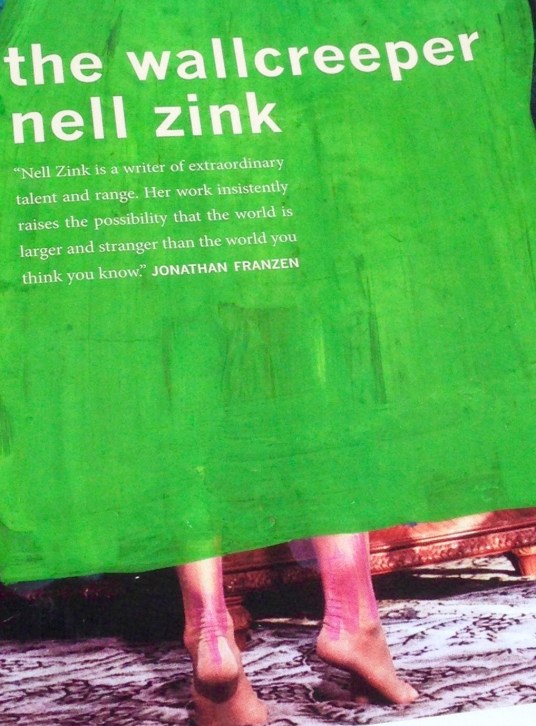
A review of Nell Zink’s extraordinary novel The Wallcreeper

image

The short review is, “Nell Zink’s début novel The Wallcreeper is extraordinary.”

But this argument is insufficient, unsupported, you, dear reader, may protest. Why should you spend your hard-earned time reading The Wallcreeper, eh? (I read the book in four sittings. I was late to Sunday dinner for finishing the thing). To invert one of the better book short book reviews I’ve ever read: Every sentence made me want to read the next sentence. Is that not a good enough reason to read The Wallcreeper? Maybe you want to read some of those sentences. Here’s the first one:

I was looking at the map when Stephen swerved, hit the rock, and occasioned the miscarriage.

Or a page or two later when our heroine/narrator Tiffany describes how she met Stephen:

Our first meeting prevented a crime. He saw me standing in front of the open gate of the vault.

(Don’t worry about that crime). Oh, and, on that first meeting with Stephen:

It was one of those moments where you think: We will definitely fuck. It might take a while, though, because Stephen looked as respectable as I did.

And here’s a simile from Tiffany, just because I love the line and can wedge it in here:

After the cranes had landed, the geese passed overhead in so many Vs that they merged into Xs and covered the entire sky like a fishnet stocking.

It occurs to me now that I’m probably doing this wrong, right? I should be summarizing the book a bit, no? I’m not particularly interested in that—the plot is the sentences—I mean, yeah, there’s a plot, about Tiffany and Stephen in Berne and later Berlin—and some other places too—and the different lovers they take and the various projects they undertake—music, language acquisition, ecoterrorism—and lots of birdwatching.

Maybe I should lazily just reblurb Keith Gessen’s blurb:

Who is Nell Zink? She claims to be an expatriate living in northeast Germany. Maybe she is; maybe she isn’t. I don’t know. I do know that this first novel arrives with a voice that is fully formed: mature, hilarious, terrifyingly intelligent, and wicked. The novel is about a bird-loving American couple that moves to Europe and becomes, basically, eco-terrorists. This is strange, and interesting, but in between is some writing about marriage, love, fidelity, Europe, and saving the earth that is as funny and as grown-up as anything I’ve read in years. And there are some jokes in here that a young Don DeLillo would kill to have written. I hope he doesn’t kill Nell Zink

The DeLillo comparison is apt, but Zink’s novel is funnier than anything DeLillo’s done in ages. Maybe that’s not fair. “Funny” seems like a weak word, really, for Zink and her narrator Tiffany (and Stephen)—all the words I would use to describe what Zink’s doing here seem pale and imprecise. I mean witty, smart, intelligent, devastating, confounding. Extraordinary, right, that was the word I used above, yes? (He looks the word up in an online dictionary, somehow at 36 and a lifelong native English speaker unsure what it actually means). A placeholder like strange would work, except some of y’all take that word as a pejorative. Eccentric or quirky imply, I think, a rhetorical imprecision wholly absent from the novel. The Wallcreeper is a precise book. The book is very good. It is an interesting book. (What awful sentences those were! But true).

Can you know a book through the words the reviewer uses to describe it though? (No). Can you really know a character through the words she launches your way, anyway? In The Wallcreeper, Tiffany doesn’t really know herself, or Stephen, and the narrative is in some ways her kinda sorta finding out about herself (and Stephen, and other stuff), in a non-urgent manner. Or maybe very urgent, I don’t know—she and Stephen are in a constant state of crisis, sort of, or epiphany-making—

Our marriage had begun in the most daunting way imaginable. We had barely known each other, and then we had those accidents and that jarring disconnect between causes (empty-headed young people liking each other, wallcreepers) and effects (pain, death).

A wallcreeper is a small bird with crimson wings, by the way.

The titular wallcreeper, also by the way, is the thing that makes Stephen swerve in that opening sentence I shared for you above. The book is full of swerves, dips, dives, turns—each sentence swerves into the next, artfully, gracefully, precisely. Tiffany’s consciousness, or the language that Zink uses to represent Tiffany’s consciousness, swerves:

We walked down into the lower garden and sat on a bench. He looked into the pond and remarked favorably on the lack of goldfish. I thought of all the spawn-guzzling carp I had admired in the past and felt abashed. I shrank at the vulgarity of raptures over beauty, nature’s most irrelevant and unnecessary quality.

Beautiful!

But where was I? I think swerves was the metaphor I was batting about a bit—well, I suppose I could go on, suggest that all that swerving swerves up to Something More, that the novel swerves (swells? no, not swells) to an ending shot-through with mythical undertones (which our narrator punctures)—I mean to say that, yes, okay, the novel is a wonderful witty aesthetic read—each sentence made me want to read the next sentence—but readers who require More Than That will also get it. Or maybe not. The Wallcreeper, like all extraordinary novels, is Not For Everyone. The Wallcreeper was/is for me though, and I hope it will also be for you too.

The Wallcreeper is available directly from publisher The Dorothy Project and finer bookshops.
“A Human World” — Charlotte Perkins Gilman

“A Human World”

by

Charlotte Perkins Gilman

(from Our Androcentric Culutre; or, The Man Made World)


In the change from the dominance of one sex to the equal power of two, to what may we look forward? What effect upon civilization is to be expected from the equality of womanhood in the human race?

To put the most natural question first—what will men lose by it? Many men are genuinely concerned about this; fearing some new position of subservience and disrespect. Others laugh at the very idea of change in their position, relying as always on the heavier fist. So long as fighting was the determining process, the best fighter must needs win; but in the rearrangement of processes which marks our age, superior physical strength does not make the poorer wealthy, nor even the soldier a general.

The major processes of life to-day are quite within the powers of women; women are fulfilling their new relations more and more successfully; gathering new strength, new knowledge, new ideals. The change is upon us; what will it do to men?

No harm.

As we are a monogamous race, there will be no such drastic and cruel selection among competing males as would eliminate the vast majority as unfit. Even though some be considered unfit for fatherhood, all human life remains open to them. Perhaps the most important feature of this change comes in right here; along this old line of sex-selection, replacing that power in the right hands, and using it for the good of the race.

The woman, free at last, intelligent, recognizing her real place and responsibility in life as a human being, will be not less, but more, efficient as a mother. She will understand that, in the line of physical evolution, motherhood is the highest process; and that her work, as a contribution to an improved race, must always involve this great function. She will see that right parentage is the purpose of the whole scheme of sex-relationship, and act accordingly.

In our time, his human faculties being sufficiently developed, civilized man can look over and around his sex limitations, and begin to see what are the true purposes and methods of human life. Continue reading ““A Human World” — Charlotte Perkins Gilman” →

“July Stories” — Roberto Bolaño

July has been a strange month. The other day I went to the beach and I saw a woman of about thirty, pretty, wearing a black bikini, who was reading standing up. At first I thought she was about to lie down on her towel, but when I looked again she was still standing, and after that I didn’t take my eyes off her. For two hours, more or less, she read standing up, walked over to the water, didn’t go in, let the waves lap her shins, went back to her spot, kept reading, occasionally put the book down while still standing, leaned over a few times and took a big bottle of Pepsi out of a bag and drank, then picked up the book again, and, finally, without ever bending a knee, put her things away and left. Earlier the same day, I saw three girls, all in thongs, gorgeous, one of them had a tattoo on one buttock, they were having a lively conversation, and every once in a while they got in the water and swam and then they would lie down again on their mats, basically a completely normal scene, until all of a sudden, a cell phone rang, I heard it and thought it was mine until I realized it had been a while since I had a cell phone, and then I knew the phone belonged to one of them. I heard them talking. All I can say is that they weren’t speaking Catalan or Spanish. But they sounded deadly serious. Then I watched two of them get up, like zombies, and walk toward some rocks. I got up too and pretended to brush the sand off my trunks. On the rocks, I watched them talk to a huge, hideously ugly man covered in hair, in fact one of the hairiest men I’ve ever seen in my life. They knelt before him and listened attentively without saying a word, and then they went back to where their friend was waiting for them and everything went on as before, as if nothing had happened. Who are these women? I asked myself once it was dark and I had showered and dressed. One drank Pepsi. The others bowed down to a bear. I know who they are. But I don’t really know.

From Roberto Bolaño’s Between Parentheses: Essays, Articles and Speeches, 1998-2003.