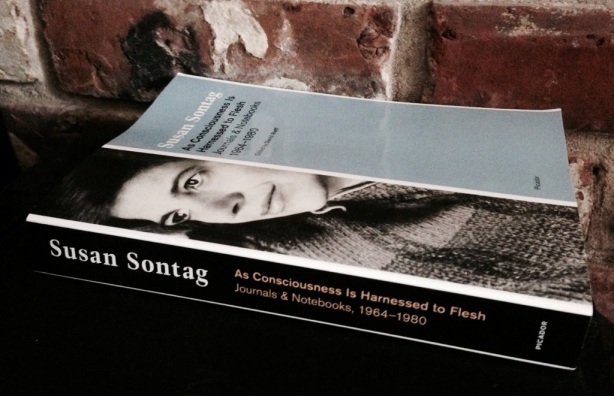
“Recycling one’s own life with books” |Thirteen Notes on Susan Sontag’s Notebook Collection, As Consciousness Is Harnessed to Flesh

20130929-103619.jpg

1. “In my more extravagant moments,” writes David Rieff in his introduction to Susan Sontag’s As Consciousness Is Harnessed to Flesh, “I sometimes think that my mother’s journals, of which this is the second of three volumes, are not just the autobiography she never got around to writing…but the great autobiographical novel she never cared to write.”

2. In my review of Reborn, the first of the trilogy Rieff alludes to, I wrote, “Don’t expect, of course, to get a definitive sense of who Sontag was, let alone a narrative account of her life here. Subtitled Journals & Notebooks 1947-1963Reborn veers closer to the “notebook” side of things.”

As Consciousness Is Harnessed to Flesh is far closer to the ‘notebook’ side of things too, which I think most readers (or maybe I just mean me here) will appreciate.

3. I mean, this isn’t the autobiographical novel that Rieff suggests it might be (except of course it is).

Consciousness/Flesh offers something better: access to Sontag’s consciousness in its prime, not quite ripe, but full, heavy, bursting with intellectual energy,  her mind attuned to (and attuning) the tumult of the time the journals cover, 1964 through 1980.

It’s an autobiography stripped of the pretense of presentation; it’s a novel stripped of the pretense of storytelling.

4. Sontag’s intellect and spirit course through the book’s 500 pages, eliding any distinction between lives personal and professional. “What sex is the ‘I’?” she writes, “Who has the right to say ‘I’?” The journals see her working through (if not resolving, thankfully) such issues.

5. An entry from late 1964, clearly background for Sontag’s seminal essay “Notes on Camp” (itself a series of notes), moves through a some thoughts on artists and poets, from Warhol to Breton to Duchamp (“DUCHAMP”) to simply “Style,” which, Rieff’s editorial note tells us, has a box drawn around it. The entry then moves to define

Work of Art

An experiment, a research (solving a “problem”) vs. form of a play

—before turning to a series of notes on the films of Michelangelo Antonioni.

6. A page or two later (1965) delivers the kind of gold vein we wish to discover in author’s notebooks:

PLOTS & SITUATIONS

Redemptive friendship (two women)

Novel in letters: the recluse-artist and his dealer a clairvoyant

A voyage to the underworld (Homer, Vergil [sic]Steppenwolf)

Matricide

An assassination

A collective hallucination (Story)

A theft

A work of art which is really a machine for dominating human beings

The discovery of a lost mss.

Two incestuous sisters

A space ship has landed

An ageing movie actress

A novel about the future. Machines. Each man has his own machine (memory bank, codified decision maker, etc.) You “play the machine. Instant everything.

Smuggling a huge art-work (painting? Sculpture?) out of the country in pieces—called “The Invention of Liberty”

A project: sanctity (based on SW [Simone Weil]—with honesty of Sylvia Plath—only way to solve sex “I” is talk about it

Jealousy

7. The list above—and there’s so much material like it in Consciousness/Flesh—is why I love author’s notebooks, We get to see the raw material here and imagine along with the writer (if we choose), free of the clutter and weight of execution, of prose, of damnable detail.

There’s something joyfully cryptic about Sontag’s notes, like the solitary entry “…Habits of despair” in late July of 1970—or a few months later: “A convention of mutants (Marvel comics).”

If we wish we can puzzle the notes out, treat them as clues or keys that fit to the work she was publishing at the time or to the personal circumstances of her private life. Or (and to be clear, I choose this or) we can let these notes stand as strange figures in an unconventional autobiographical novel.

8. Those looking for more direct material about Sontag’s life (and really, why do you want more and what more do you want?) will likely be disappointed—everything here is oblique (lovely, lovely oblique).

Still, there are moments of intense personal detail, like this 1964 entry where Sontag describes her body:

Body type

  • Tall
  • Low blood pressure
  • Needs lots of sleep
  • Sudden craving for pure sugar (but dislike desserts—not a high enough concentration)
  • Intolerance for liquor
  • Heavy smoking
  • Tendency to anemia
  • Heavy protein craving
  • Asthma
  • Migraines
  • Very good stomach—no heartburn, constipation, etc.
  • Negligible menstrual cramps
  • Easily tired by standing
  • Like heights
  • Enjoy seeing deformed people (voyeuristic)
  • Nailbiting
  • Teeth grinding
  • Nearsighted, astigmatism
  • Frileuse (very sensitive to cold, like hot summers)
  • Not very sensitive to noise (high degree of selective auditory focus)

There’s more autobiographical detail in that list than anyone craving a lurid expose could (should) hope for.

9. For many readers (or maybe I just mean me here) Consciousness/Flesh will be most fascinating as a curatorial project.

Sontag offers her list of best films (not in order),her ideal short story collection, and more. The collection often breaks into lists—like the ones we see above—but also into names—films, authors, books, essays, ideas, etc.

10. At times, Consciousness/Flesh resembles something close to David Markson’s so-called “notecard” novels (Reader’s Block, This Is Not a NovelVanishing Point, The Last Novel):

Napoleon’s wet, chubby back (Tolstoy).

and

Wordsworth’s ‘wise passiveness.’

and

Nabokov talks of minor readers. ‘There must be minor readers because there are minor writers.’

and

Camus (Notebooks, Vol. II): ‘Is there a tragic dilettante-ism?'”

and

‘To think is to exaggerate.’ — Valéry.

and so on…

11. Sometimes, the lists Sontag offers—

(offers is not the right verb at all here—these are Sontag’s personal journals and notebooks, her private ideas, material never intended for public consumption, but yes we are greedy, yes; and some of us (or maybe I just mean me here) are greedier than others, far more interested in her private ideas and notes and lists than the essays and stories and novels she generated from them—and so no, she didn’t offer this, my verb is all wrong)

—sometimes Sontag [creates/notes/generates] very personal lists, like “Movies I saw as a child, when they came out” (composed 11/25/65). There’s something tender here, imagining the child Sontag watching Fantasia or Rebecca or Citizen Kane or The Wizard of Oz in the theater; and then later, the adult Sontag, crafting her own lists, making those connections between past and present.

12. While Reborn showcased the intimate thoughts of a nascent (and at times naïve) intellect, Consciousness/Flesh shows us an assured writer at perhaps her zenith. In September of 1975, Sontag defines herself as a writer:

I am an adversary writer, a polemical writer. I write to support what is attacked, to attack what is acclaimed. But thereby I put myself in an emotionally uncomfortable position. I don’t, secretly, hope to convince, and can’t help being dismayed when my minority taste (ideas) becomes majority taste (ideas): then I want to attack again. I can’t help but be in an adversary relation to my own work.

13. Readers looking for a memoir or biography might be disappointed in Consciousness/Flesh; readers who seek to scrape its contours for “wisdom” (or worse, writing advice) should be castigated.

But As Consciousness Is Harnessed to Flesh will reward those readers who take it on its own terms as an oblique, discursive (and incomplete) record of Sontag’s brilliant mind.

I’ll close this riff with one last note from the book, a fitting encapsulation of the relationship between reader and author—and, most importantly, author-as-reader-and-rereader:

Recycling one’s own life with books.

As Consciousness Is Harnessed to Flesh is new in trade paperback from Picador; you can read excerpts from the book at their site.

Thomas Bernhard’s Reger on the Purpose of Art

Art is the most sublime and the most revolting thing simultaneously, he said. But we must make ourselves believe that there is high art and the highest art, he said, otherwise we should despair. Even though we know that all art ends in gaucherie and in ludicrousness and in the refuse of history, like everything else, we must, with downright self-assurance, believe in high and in the highest art, he said. We realize what it is, a bungled, failed art, but we need not always hold this realization before us, because in that case we should inevitably perish, he said.

Barthelme’s Influences

INTERVIEWER

Your own influences—whom would you like to cite as your spiritual ancestors?

BARTHELME

They come in assorted pairs. Perelman and Hemingway. Kierkegaard and Sabatini. Kafka and Kleist. Kleist was clearly one of Kafka’s fathers. Rabelais and Zane Grey. The Dostoyevsky of Notes from Underground. A dozen Englishmen. The surrealists, both painters and poets. A great many film people, Buñuel in particular. It’s always a stew, isn’t it? Errol Flynn ought to be in there somewhere, and so should Big Sid Catlett, the drummer.

—From Donald Barthelme’s interview with The Paris Review.

“Beckett’s Theory of Comedy” — Anne Carson

btc

Thomas Bernhard’s Atzbacher on State-Sanctioned Corpses

Irrsigler has that irritating stare which museum attendants employ in order to intimidate the visitors who, as is well known, are endowed with all kinds of bad behaviour; his manner of abruptly and utterly soundlessly appearing round the corner of whatever room in order to inspect it is indeed repulsive to anyone who does not know him; in his grey uniform, badly cut and yet intended for eternity, held together by large black buttons and hanging on his meagre body as if from a coat rack, and with his peaked cap tailored from the same grey cloth, he is more reminiscent of a warder in one of our penal institutions than of a state-employed guardian of works of art. Ever since I have known him Irrsigler has always been as pale as he now is, even though he is not sick, and Reger has for decades described him as a state corpse on duty at the Kunsthistorisches Museum for over thirty-six years.

–Thomas Bernhard, Old Masters, trans. Ewald Osers. Chicago: University of Chicago Press, 1989.
 

The O. Henry Prize Stories 2013 (Book Acquired, Sometime Last Week)

20130914-084712.jpg

Here are the table of contents for the 2013 O. Henry Prize Stories:

Your Duck Is My Duck, by DEBORAH EISENBERG
Sugarcane, by DEREK PALACIO
The Summer People, by KELLY LINK
Leaving Maverley, by ALICE MUNRO
White Carnations, by POLLY ROSENWAIKE
Sail, by TASH AW
Anecdotes, by ANN BEATTIE
Lay My Head, by L. ANNETTE BINDER
He Knew, by DONALD ANTRIM
The Visitor, by ASAKO SERIZAWA
Where Do You Go? by SAMAR FARAH FITZGERALD
Aphrodisiac, by RUTH PRAWER JHABVALA
Two Opinions, by JOAN SILBER
They Find the Drowned, by MELINDA MOUSTAKIS
The Mexican, by GEORGE MCCORMICK
Tiger, by NALINI JONES
Pérou, by LILY TUCK
Sinkhole, by JAMIE QUATRO
The History of Girls, by AYŞE PAPATYA BUCAK
The Particles, by ANDREA BARRETT

My favorite thing about the list is that I’ve only heard of a handful of the writers here. Read the introduction here.

“A Note on Realism” — Robert Louis Stevenson

“A Note on Realism” by Robert Louis Stevenson

Style is the invariable mark of any master; and for the student who does not aspire so high as to be numbered with the giants, it is still the one quality in which he may improve himself at will.  Passion, wisdom, creative force, the power of mystery or colour, are allotted in the hour of birth, and can be neither learned nor simulated.  But the just and dexterous use of what qualities we have, the proportion of one part to another and to the whole, the elision of the useless, the accentuation of the important, and the preservation of a uniform character from end to end—these, which taken together constitute technical perfection, are to some degree within the reach of industry and intellectual courage.  What to put in and what to leave out; whether some particular fact be organically necessary or purely ornamental; whether, if it be purely ornamental, it may not weaken or obscure the general design; and finally, whether, if we decide to use it, we should do so grossly and notably, or in some conventional disguise: are questions of plastic style continually rearising.  And the sphinx that patrols the highways of executive art has no more unanswerable riddle to propound.

In literature (from which I must draw my instances) the great change of the past century has been effected by the admission of detail.  It was inaugurated by the romantic Scott; and at length, by the semi-romantic Balzac and his more or less wholly unromantic followers, bound like a duty on the novelist.  For some time it signified and expressed a more ample contemplation of the conditions of man’s life; but it has recently (at least in France) fallen into a merely technical and decorative stage, which it is, perhaps, still too harsh to call survival.  With a movement of alarm, the wiser or more timid begin to fall a little back from these extremities; they begin to aspire after a more naked, narrative articulation; after the succinct, the dignified, and the poetic; and as a means to this, after a general lightening of this baggage of detail.  After Scott we beheld the starveling story—once, in the hands of Voltaire, as abstract as a parable—begin to be pampered upon facts.  The introduction of these details developed a particular ability of hand; and that ability, childishly indulged, has led to the works that now amaze us on a railway journey.  A man of the unquestionable force of M. Zola spends himself on technical successes.  To afford a popular flavour and attract the mob, he adds a steady current of what I may be allowed to call the rancid.  That is exciting to the moralist; but what more particularly interests the artist is this tendency of the extreme of detail, when followed as a principle, to degenerate into merefeux-de-joie of literary tricking.  The other day even M. Daudet was to be heard babbling of audible colours and visible sounds. Continue reading ““A Note on Realism” — Robert Louis Stevenson”

Biblioklept Is Seven Today, So Here are Seven Sets of Seven Somethings

*

Seven Reviews of Seven Books I Love

The Rings of Saturn — W.G. Sebald

Denis Johnson’s Train Dreams Is a Perfect Novella

The Pale King — David Foster Wallace

Candide — Voltaire

I Riff on Clarice Lispector’s Novella The Hour of the Star, a Strange Work of Pity, Humor, Terror, and Abjection

The Collected Stories of Lydia Davis

Intertexuality and Structure in Roberto Bolaño’s 2666

*

Seven Hands (Van Gogh)

*

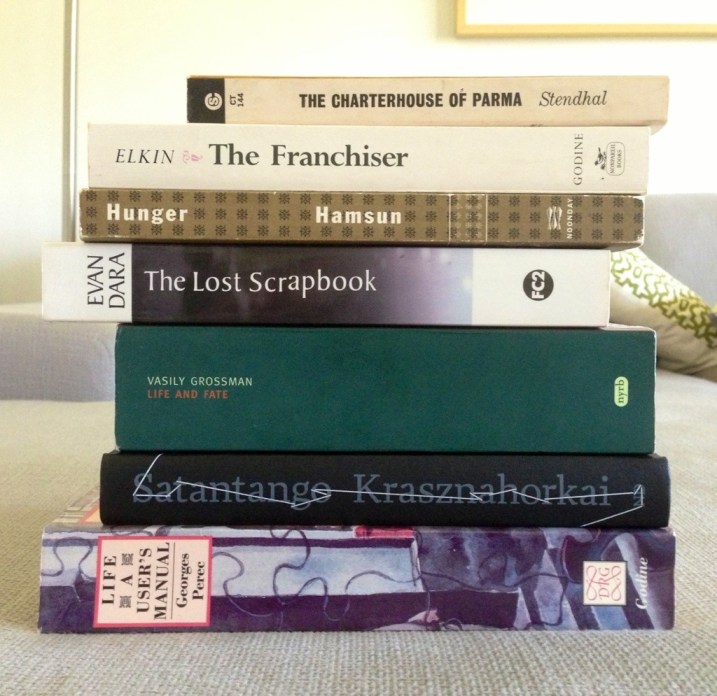
Seven Books I’d Like to Read Sometime in the Next Seven Years

20130909-164115.jpg

*

Seven Negative Reviews

Why I Abandoned Chad Harbach’s Over-Hyped Novel The Art of Fielding After Only 100 Pages

Jonathan Lethem’s Bloodless Prose

I Super Hated Gary Shteyngart’s Super Sad True Love Story

The Instructions — Adam Levin

Sunset Park — Paul Auster

The Passage — Justin Cronin

The Sot-Weed Factor — John Barth

*

Seven Ballerinas (Picasso)

*

Seven Perfect Short Stories

“The Death of Me” — Gordon Lish

“A Good Man Is Hard to Find” — Flannery O’Connor

“Emergency” — Denis Johnson

“The School” — Donald Barthelme

“Sweat” — Zora Neale Hurston

“Wakefield” — Nathaniel Hawthorne

“Good Old Neon” — David Foster Wallace

*

Seven Deadly Sins (Bosch)

*

Biblioklept’s Dictionary of Literary Terms

APHORISM

A concise, often witty, turn of phrase that should be shared out of context on Twitter or Pinterest.

BILDUNGSROMAN

Novel where someone (preferably male) matures into the ideal state of bitter disillusionment.

CATHARSIS

Evocation of fear and pity. Best exemplified in modern storytelling by Lifetime Network original movies.

DECONSTRUCTION

A form of textual analysis. No one knows what it means. Apply liberally.

EXISTENTIALIST

Use to describe any French novel of the 20th century. Serve with coffee and cigarettes.

FOIL

First, Outer, Inner, Last.

GENRE FICTION

Deride genre fiction at all times. If a writer uses genre tropes, praise her for genre bending. (See LITERARY FICTION).

HYSTERICAL REALISM

Use to describe any big ambitious novel that does not meet your aesthetic and/or moral needs.

IAMBIC PENTAMETER

All poetry is composed in iambic pentameter.

JUVENILIA

A writer’s immature work, which she usually (wisely) withholds from publication. After the writer dies, every scrap should be published, scrutinized, and passed around the internet out of context.

KAKFAESQUE

Synonym for “odd.” Apply freely.

LITERARY FICTION

A genre of fiction that pretends not to be a genre. What your book club is reading this month.

MAGICAL REALISM

Use to describe any novel by a South American writer.

NARRATOLOGY

Use structuralist techniques to analyze narrative plots—and watch the kids go wild! Narratology is the number one thing the audience of a book review is interested in.

ORPHAN

All heroes must be orphans.

PANOPTICON

Use this term liberally in any discussion of modern politics. Pairs well with film studies courses.

QUEER THEORY

A form of literary analysis that conveniently begins with the letter “Q,” making it ideal for silly alphabetized lists like this one.

ROUND CHARACTER

A character portrayed in psychological and emotional depth to the degree that she comes alive in your imagination. Round characters provide an excellent alternative to making meaningful human relationships.

SOUTHERN GOTHIC

Use to describe the style of any writer from the Southern part of the United States.

TAUTOLOGY

A tautology is a tautology.

UTOPIA

Synonym for dystopia. Argue about its pronunciation, indicating that you understand the complexities of Greek prefixes.

VERISIMILITUDE

Literary trickery.

WHODUNNIT

A genre of books that sells well in airports.

XENA

Beloved warrior princess. Look, is hardokay?

YOUNG WERTHER

The original sad bastard; he invented emo.

ZEITGEIST

Time’s ghost. You’re soaking in it, which makes it hard to see.

“The Men Running Past” — Franz Kafka

kafka

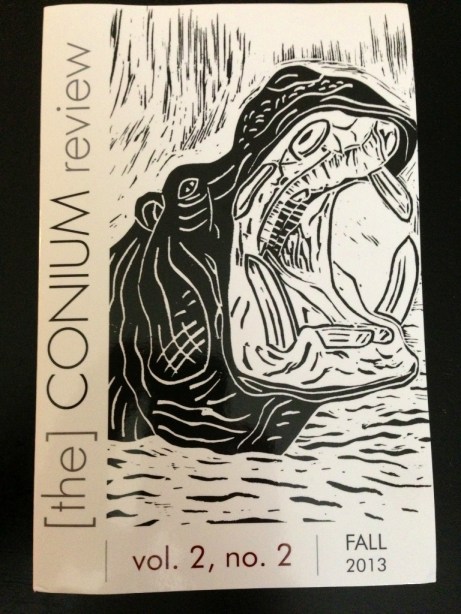
The Conium Review, Vol. 2, No. 2 (Book Acquired, 8,19.2013)

20130824-102848.jpg

This came in the mail a few weeks ago; I read a few of the poems and flash fictions, but haven’t had made time for the stories or the novella. From the The Conium Review’s website:

This issue of The Conium Review contains seventeen poems, five pieces of flash fiction, four short stories, and one novella. The contributing poets and writers are Elena Botts, Valentina Cano, Paola Capó-García, Patrick Cole, Darren C. Demaree, Thomas Dodson, Edward A. Dougherty, Ginger Graziano, Alamgir Hashmi, Kyle Hemmings, Nicholas Kriefall, Connie A. Lopez-Hood, Carlo Matos, Gretchen McGill, Robert McGuill, Thomas Mundt, Catherine Owen, Natalie Peeterse, Richard King Perkins II, Octavio Quintanilla, Charles Rafferty, Scott Ragland, Jonathan H. Roberts, M. A. Schaffner, Jacob Schepers, Claude Clayton Smith, and Emily Strauss. The cover art is courtesy of Loren Kantor.


Don Quixote — Ub Iwerks

The Chums of Chance Reading List (Thomas Pynchon’s Against the Day)

hgdTitles of The Chums of Chance books mentioned in Thomas Pynchon’s Against the Day:

  • The Chums of Chance and the Evil Halfwit
  • The Chums of Chance and the Curse of the Great Kahuna
  • The Chums of Chance and the Ice Pirates
  • The Chums of Chance Nearly Crash into the Kremlin
  • The Chums of Chance and the Caged Women of Yokohama
  • The Chums of Chance and the Wrath of the Yellow Fang
  • The Chums of Chance at Krakatoa
  • The Chums of Chance Search for Atlantis
  • The Chums of Chance in Old Mexico
  • The Chums of Chance in the Bowels of the Earth
  • The Chums of Chance at the Ends of the Earth

The Chums of Chance bits have been some of my favorites in Pynchon’s Against the Day, and have given me more than one occasion to riff. There’s something wonderfully generative (and even generous) about these pulpy, romantic titles—an invitation to daydream, to fly with the boys a bit.

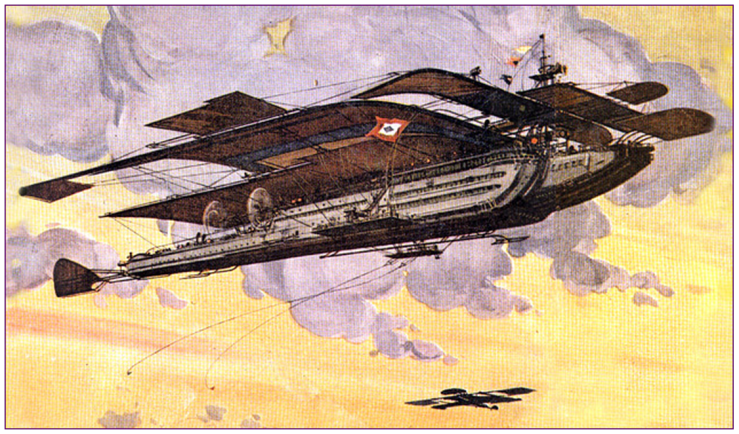
The painting of the airship at the top is by Harry Grant Dart, whose comic strip The Explorigator undoubtedly influenced Pynchon’s vision of The Chums of Chance. You can perhaps glean some of that inspiration in this 1908 broadside:

Explorigator19080503Intro


Borges Riff/Borges Anxiety

borgesscan
Art by Roman Muradov

1. Jorge Luis Borges is 115 today.

2. I’ve shared clips from my scattered readings of Borges on this blog (receiving the occasional takedown notice as well)—but I’ve never mustered the energy to try to say anything about him or describe his writing or try to situate it or analyze it or anything—

3. Because that’s what Borges does: He situates, analyzes, condenses, clarifies, expands, complicates, archives, curates, cultivates, teaches, improves literature.

4. And he does it in a way that makes following him with my own mealy mottled words seem superfluous (or maybe futile is the word I want—although I think Borges is unrelentingly positive and futile is such an ugly word).

5. I read a book of Borges’ essays this summer, a collection entitled Other Inquisitions. I read most of it in the Great Smoky Mountains, where the crisp morning air was perfect for Borges. Or for me to read Borges. It was lovely.

6. I wanted to write about Borges’ book—or, rather, and more exactly, I wanted to have written Borges’ book.

7. In one essay—I’ve put the book aside for now and can’t recall exactly which essay (maybe on FitzGerald and Omar Khayyam?); nor will I go look; if I had it out I’d only cite it, recycle it here; the book would kill this riff immediately, put a stake through its heart—Borges suggests that “A great writer creates his precursors.” — This, years, decades before Harold Bloom makes a career out of the same notion.

8. And Borges’ essays are a canon-making: His own canon–the formation and creation of his own precursors: Whitman, Kafka, DeQuincey, Carlyle, Becher, Valery, Wilde, Poe, Hawthorne…

9. The shock I experienced reading Borges’ essay on Nathaniel Hawthorne. That Borges had set about to riff on Hawthorne’s Note-Books, the same note-books I’d been reading since the early spring, the same note-books that seemed and still seem so generative to me, so full of entire worlds, so rich, so much fuller and richer than Hawthorne’s novels or his stories, so full in their singularity and off-focus, these notes, these Borgesian notes. Oh and that Borges had written the essay that I wished I could write!

10. Borges, who never wrote a novel, whose entire work might be some kind of postmodern novel.

11. Borges, whose short stories often seem like pretexts to an essay he’d like to write—and here pretext is not the right word, again—-so maybe the short stories, so many of them so brilliant, act as some kind of surface text that illuminates and yet simultaneously hides an essay underneath.

12. The great joy of reading Borges: We read through Borges: Borges the librarian grants us access to so many minds. We get to share his perceptions, read over his shoulder, or maybe through his glasses—we get to glance over his annotations, his notes. But that’s not accurate—he’s so much more lucid than that scatter-shot image suggests, even when he’s at his most Borgesian, which is to say his most labyrinthine, mirrored, winding, forking, decentering and recentering, deferring, echoing, prefiguring…

13. I’ve written more than I intended to and have yet barely edged into all the thicket of anxieties that guard Borges’ oeuvre from poseurs like myself. It’s enough to know that his works exist, will exist.

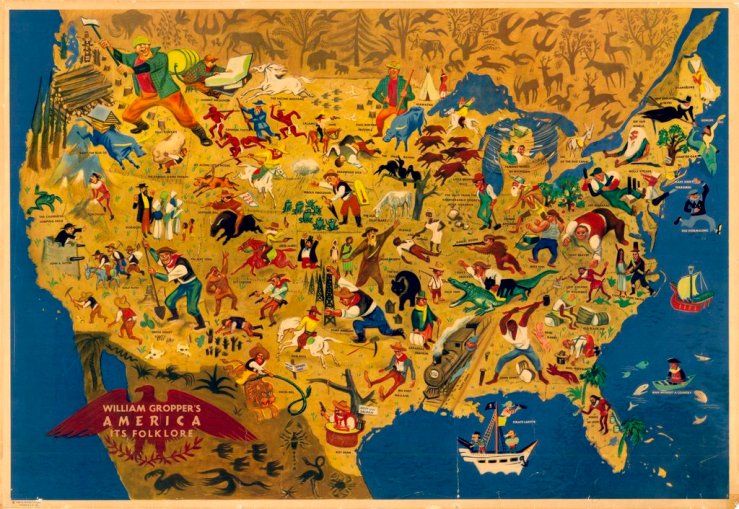
Map of American Folklore

map of folklore

(Via).

“I Am Essentially Marxian” and Other Notes from F. Scott Fitzgerald’s Notebooks

  1. D. H. Lawrence great attempt to synthesize animal and emotional—things he left out. Essential pre-Marxian. Just as I am essentially Marxian.
  2. When Whitman said “Oh Pioneers” he said all.
  3. Byron’s mountains warm.
  4. Reporting the extreme things as if they were the average things will start you on the art of fiction.
  5. Work out my hard luck season—my most productive seasons, etc
  6. Conrad’s secret theory examined.He knew that things do transpire about people. Therefore he wrote the truth and transposed it to parallel to give that quality, adding confusion however to his structure. Nevertheless there is in his scheme a desire to imitate life which is in all the big shots. Have I such an idea in the composition of this book?
  7. Conrad influenced by Man Without a Country
  8. No English painting because of their putting everything into words.
  9. List of Zelda’s faults and virtues as a writer.
  10. Chapter in slow motion.
  11. Right to Pretty heroines
  12. Tie up with Faulkner—Lord Fauntleroy.

–From F. Scott Fitzgerald’s The Notebooks.

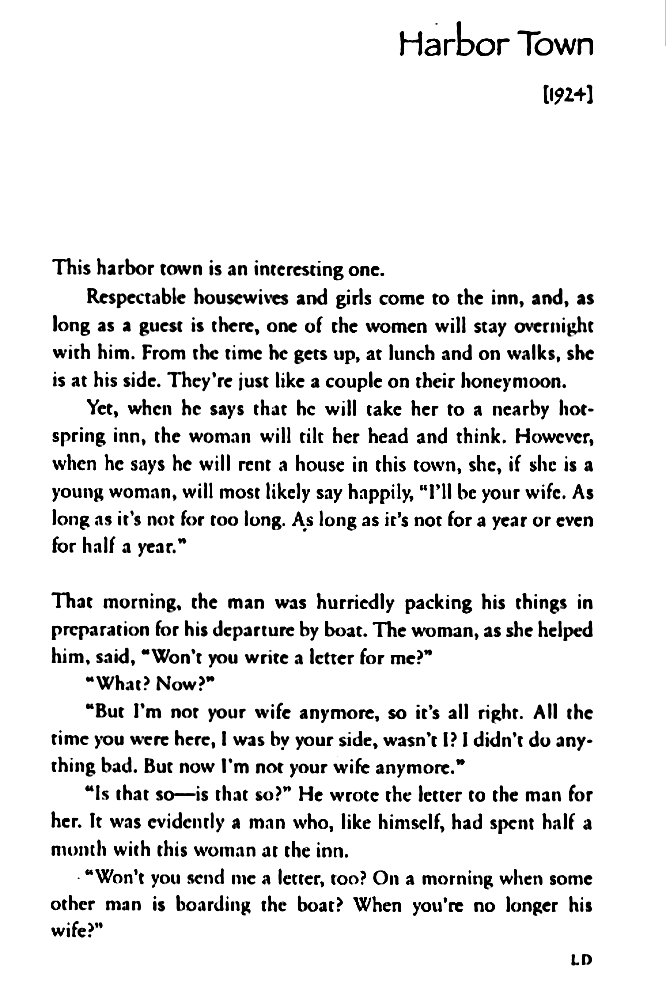
“Harbor Town” — Yasunari Kawabata

kawabata