Watch Kashtanka, A 1952 Animated Adaptation of Anton Chekhov’s Short Story

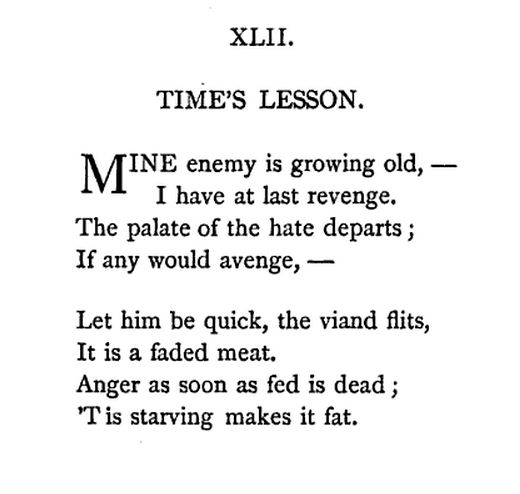
“Mine enemy is growing old” — Emily Dickinson

Capture

Raymond Pettibon: “I read as I write, write as I read”

Read a 1999 interview with Raymond Pettibon in BOMB. Excerpt:

I read as I write, write as I read. If it used to take me five minutes to read the whole newspaper, now, my mind wanders, and then five minutes later I wonder, Gee, did I read that? I used to take notes, and I have notebooks full of drawings and notes that were partly quotations, and I’ve done a lot of marginalia, writing in books. I’m usually reading a number of books at a time, and whether I get through an individual one is probably unlikely. I’ve lost interest in narrative. (sigh) At least in the sense of seeing how a story comes out at the end. There’s a type of reading where you get lost in the narrative and you become part of the story and you’re compelled to finish. I don’t really have any interest in that. For me, reading has become more microscopic, more about dissecting the work. It may start on the level of the novel, then go down to theme or style, then to a paragraph, and finally a sentence. Or the sentence itself becomes about structure, or the words in it. Probably the most obvious example of that kind of reading is James Joyce. It becomes a kind of disease. Every text becomes related to another one, even in a different language, down to each individual word, which then becomes a clue into the etymology of the word, and then that etymological tree. A different context, a different language…you’re just making these associations from one thing to another. I used to start out with a simple drawing that would begin as an idea, and then my writing would make some associations with something else. And then, you know, a day later, or a year later, or whenever, the whole page would be covered with small, finely written text. And it would become a lot of things that were meant to be just in one drawing, expanded into this while still part of my notes. Voluminous notes. You do actually get lost in that morass of associations.


William Gaddis on the Pulitzer Prize: “The Ultimate Seal of Mediocrity”

In William Gaddis’s last novel Agapē Agape (2002), our embittered narrator excoriates the Pulitzer Prize:

. . . write what they want you’ll end up with a Pulitzer Prize follow you right to the grave. Maybe won the Medal of honor the George Cross even the Nobel but once you’ve been stigmatized with the ultimate seal of mediocrity your obit will read Pulitzer Prize Novelist Dies at whatever because they’re not advertising the winner no. No, like this whole plague of prizes wherever you look, it’s the prize givers promoting themselves, trying to rescue their thoroughly discredited profession of journalism. “The press is a school that serves to turn men into brutes,” Flaubert writes to George Sand “because it relieves them from thinking.” The prize winners? They’re just props, cartoonists, sports writers, political pundits, front page photos the bloodier the better for that instant of fame wrap the fish in tomorrow, good God how many Pulitzer Prizes are there? Over fifteen hundred entries, fourteen categories for journalists because if you started your bondage there you’re halfway home with that whole gang of sponsors, trustees, juries, God knows what who’ve survived that Slough of Despond and floated to the top. Just look at the next day’s New York Times, page after page bulging with self-congratulation with seven more categories to leech on, music, what they call drama and of course books where the Grey Lady finally got it both ways with their journalist who reviews books, like the misty-eyed ingenue but also destroys women writers and just for fairness crosses the gender line for an occasional assassination, give that lady a Pulitzer with oak leaf clusters! The books that are candidates are read by a jury whose decisions are passed up to the Olympian trustees with an eye to the multitude. We are thousands and they are millions, write the fiction they want or don’t write at all, ruling out Pound’s cry for the new, the challenging or what’s labeled difficult, so when Gravity’s Rainbow is being devoured by college youth everywhere and wins the National Book Award, its unanimous recommendation is overturned by the trustees for a double-talk spoof of academic vagaries by a bogus “Professor,” to everyone’s relief, and the author at peril escapes unblemished by the, no, no, no you can’t depend on it.

Sappho (Raphael + David Markson)

raphael sappho(2)


Capture


“Walt Whitman” — Willa Cather

“Walt Whitman” by Willa Cather

Speaking of monuments reminds one that there is more talk about a monument to Walt Whitman, “the good, gray poet.” Just why the adjective good is always applied to Whitman it is difficult to discover, probably because people who could not understand him at all took it for granted that he meant well. If ever there was a poet who had no literary ethics at all beyond those of nature, it was he. He was neither good nor bad, any more than are the animals he continually admired and envied. He was a poet without an exclusive sense of the poetic, a man without the finer discriminations, enjoying everything with the unreasoning enthusiasm of a boy. He was the poet of the dung hill as well as of the mountains, which is admirable in theory but excruciating in verse. In the same paragraph he informs you that, “The pure contralto sings in the organ loft,” and that “The malformed limbs are tied to the table, what is removed drop horribly into a pail.” No branch of surgery is poetic, and that hopelessly prosaic word “pail” would kill a whole volume of sonnets. Whitman’s poems are reckless rhapsodies over creation in general, some times sublime, some times ridiculous. He declares that the ocean with its “imperious waves, commanding” is beautiful, and that the fly-specks on the walls are also beautiful. Such catholic taste may go in science, but in poetry their results are sad. The poet’s task is usually to select the poetic. Whitman never bothers to do that, he takes everything in the universe from fly-specks to the fixed stars. His “Leaves of Grass” is a sort of dictionary of the English language, and in it is the name of everything in creation set down with great reverence but without any particular connection.

But however ridiculous Whitman may be there is a primitive elemental force about him. He is so full of hardiness and of the joy of life. He looks at all nature in the delighted, admiring way in which the old Greeks and the primitive poets did. He exults so in the red blood in his body and the strength in his arms. He has such a passion for the warmth and dignity of all that is natural. He has no code but to be  natural, a code that this complex world has so long outgrown. He is sensual, not after the manner of Swinbourne and Gautier, who are always seeking for perverted and bizarre effects on the senses, but in the frank fashion of the old barbarians who ate and slept and married and smacked their lips over the mead horn. He is rigidly limited to the physical, things that quicken his pulses, please his eyes or delight his nostrils. There is an element of poetry in all this, but it is by no means the highest. If a joyous elephant should break forth into song, his lay would probably be very much like Whitman’s famous “song of myself.” It would have just about as much delicacy and deftness and discriminations. He says:

“I think I could turn and live with the animals. They are so placid and self-contained, I stand and look at them long and long. They do not sweat and whine about their condition. They do not lie awake in the dark and weep for their sins. They do not make me sick discussing their duty to God. Not one is dissatisfied nor not one is demented with the mania of many things. Not one kneels to another nor to his kind that lived thousands of years ago. Not one is respectable or unhappy, over the whole earth.” And that is not irony on nature, he means just that, life meant no more to him. He accepted the world just as it is and glorified it, the seemly and unseemly, the good and the bad. He had no conception of a difference in people or in things. All men had bodies and were alike to him, one about as good as another. To live was to fulfil all natural laws and impulses. To be comfortable was to be happy. To be happy was the ultimatum. He did not realize the existence of a conscience or a responsibility. He had no more thought of good or evil than the folks in Kipling’s Jungle book.

And yet there is an undeniable charm about this optimistic vagabond who is made so happy by the warm sunshine and the smell of spring fields. A sort of good fellowship and whole-heartedness in every line he wrote. His veneration for things physical and material, for all that is in water or air or land, is so real that as you read him you think for the moment that you would rather like to live so if you could. For the time you half believe that a sound body and a strong arm are the greatest things in the world. Perhaps no book shows so much  as “Leaves of Grass” that keen senses do not make a poet. When you read it you realize how spirited a thing poetry really is and how great a part spiritual perceptions play in apparently sensuous verse, if only to select the beautiful from the gross.

Nebraska State Journal, January 19, 1896


Lydia Davis/Denis Johnson/Curzio Malaparte (Books Acquired, 4.06.2013)

20130408-201552.jpg

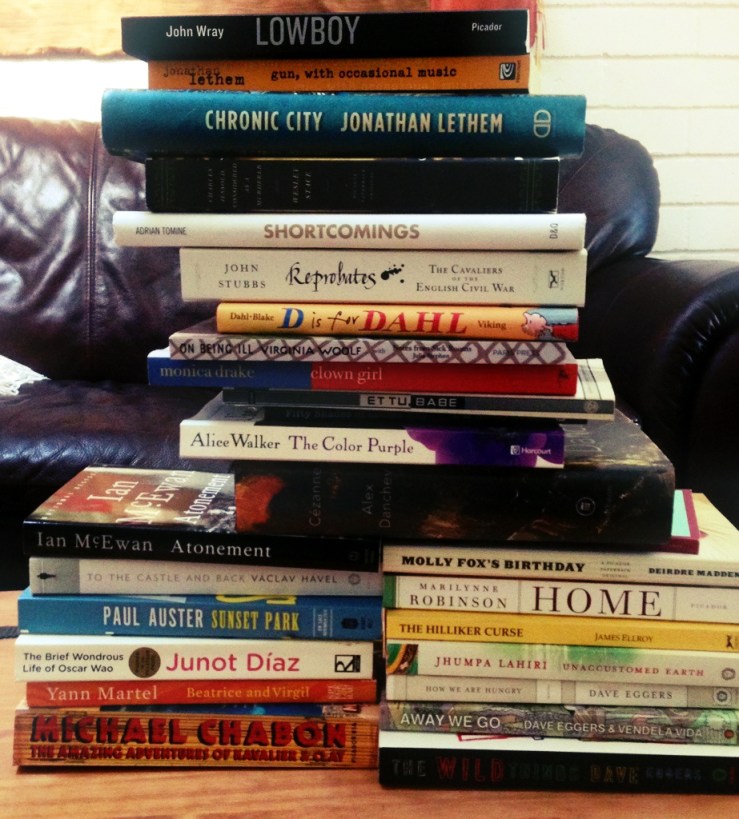
Purged the books pictured in the lower right-hand corner and picked up a few: Curzio Malaparte’s Kaputt, which has intrigued me for awhile now, Denis Johnson’s Fiskadoroin the Vintage Contemporaries edition no less!—and Lydia Davis’s novel The End of the Story, which I somehow haven’t read yet. Hypothesis: Lydia Davis and Denis Johnson may be America’s greatest living novelists (?).


“The Cloak” — Nikolai Gogol

“The Cloak” by Nikolai Gogol

In the department of—but it is better not to mention the department. There is nothing more irritable than departments, regiments, courts of justice, and, in a word, every branch of public service. Each individual attached to them nowadays thinks all society insulted in his person. Quite recently a complaint was received from a justice of the peace, in which he plainly demonstrated that all the imperial institutions were going to the dogs, and that the Czar’s sacred name was being taken in vain; and in proof he appended to the complaint a romance in which the justice of the peace is made to appear about once every ten lines, and sometimes in a drunken condition. Therefore, in order to avoid all unpleasantness, it will be better to describe the department in question only as a certain department.

So, in a certain department there was a certain official—not a very high one, it must be allowed—short of stature, somewhat pock-marked, red-haired, and short-sighted, with a bald forehead, wrinkled cheeks, and a complexion of the kind known as sanguine. The St. Petersburg climate was responsible for this. As for his official status, he was what is called a perpetual titular councillor, over which, as is well known, some writers make merry, and crack their jokes, obeying the praiseworthy custom of attacking those who cannot bite back.

His family name was Bashmatchkin. This name is evidently derived from “bashmak” (shoe); but when, at what time, and in what manner, is not known. His father and grandfather, and all the Bashmatchkins, always wore boots, which only had new heels two or three times a year. His name was Akakiy Akakievitch. It may strike the reader as rather singular and far-fetched, but he may rest assured that it was by no means far-fetched, and that the circumstances were such that it would have been impossible to give him any other.

This is how it came about.

Akakiy Akakievitch was born, if my memory fails me not, in the evening of the 23rd of March. His mother, the wife of a Government official and a very fine woman, made all due arrangements for having the child baptised. She was lying on the bed opposite the door; on her right stood the godfather, Ivan Ivanovitch Eroshkin, a most estimable man, who served as presiding officer of the senate, while the godmother, Anna Semenovna Byelobrushkova, the wife of an officer of the quarter, and a woman of rare virtues. They offered the mother her choice of three names, Mokiya, Sossiya, or that the child should be called after the martyr Khozdazat. “No,” said the good woman, “all those names are poor.” In order to please her they opened the calendar to another place; three more names appeared, Triphiliy, Dula, and Varakhasiy. “This is a judgment,” said the old woman. “What names! I truly never heard the like. Varada or Varukh might have been borne, but not Triphiliy and Varakhasiy!” They turned to another page and found Pavsikakhiy and Vakhtisiy. “Now I see,” said the old woman, “that it is plainly fate. And since such is the case, it will be better to name him after his father. His father’s name was Akakiy, so let his son’s be Akakiy too.” In this manner he became Akakiy Akakievitch. They christened the child, whereat he wept and made a grimace, as though he foresaw that he was to be a titular councillor. Continue reading ““The Cloak” — Nikolai Gogol”

Book Purge, Spring 2013

purge

Got rid of some books today—traded some in at the used bookshop I frequent, others I put in a box to take to the office to give away to colleagues. Anyway, I read these, reviewed many of them on the site, and in some cases enjoyed them—but I can’t see myself ever rereading them or returning to them for anything. And, uh, I hated some of them too.

“The Pleasure of Writing” — A.A. Milne

“The Pleasure of Writing” by A. A.Milne

Sometimes when the printer is waiting for an article which really should have been sent to him the day before, I sit at my desk and wonder if there is any possible subject in the whole world upon which I can possibly find anything to say. On one such occasion I left it to Fate, which decided, by means of a dictionary opened at random, that I should deliver myself of a few thoughts about goldfish. (You will find this article later on in the book.) But to-day I do not need to bother about a subject. To-day I am without a care. Nothing less has happened than that I have a new nib in my pen.

In the ordinary way, when Shakespeare writes a tragedy, or Mr. Blank gives you one of his charming little essays, a certain amount of thought goes on before pen is put to paper. One cannot write “Scene I. An Open Place. Thunder and Lightning. Enter Three Witches,” or “As I look up from my window, the nodding daffodils beckon to me to take the morning,” one cannot give of one’s best in this way on the spur of the moment. At least, others cannot. But when I have a new nib in my pen, then I can go straight from my breakfast to the blotting-paper, and a new sheet of foolscap fills itself magically with a stream of blue-black words. When poets and idiots talk of the pleasure of writing, they mean the pleasure of giving a piece of their minds to the public; with an old nib a tedious business. They do not mean (as I do) the pleasure of the artist in seeing beautifully shaped “k’s” and sinuous “s’s” grow beneath his steel. Anybody else writing this article might wonder “Will my readers like it?” I only tell myself “How the compositors will love it!”

But perhaps they will not love it. Maybe I am a little above their heads. I remember on one First of January receiving an anonymous postcard wishing me a happy New Year, and suggesting that I should give the compositors a happy New Year also by writing more generously. In those days I got a thousand words upon one sheet 8 in. by 5 in. I adopted the suggestion, but it was a wrench; as it would be for a painter of miniatures forced to spend the rest of his life painting the Town Council of Boffington in the manner of Herkomer. My canvases are bigger now, but they are still impressionistic. “Pretty, but what is it?” remains the obvious comment; one steps back a pace and saws the air with the hand; “You see it better from here, my love,” one says to one’s wife. But if there be one compositor not carried away by the mad rush of life, who in a leisurely hour (the luncheon one, for instance) looks at the beautiful words with the eye of an artist, not of a wage-earner, he, I think, will be satisfied; he will be as glad as I am of my new nib. Does it matter, then, what you who see only the printed word think of it?

A woman, who had studied what she called the science of calligraphy, once offered to tell my character from my handwriting. I prepared a special sample for her; it was full of sentences like “To be good is to be happy,” “Faith is the lode- star of life,” “We should always be kind to animals,” and so on. I wanted her to do her best. She gave the morning to it, and told me at lunch that I was “synthetic.” Probably you think that the compositor has failed me here and printed “synthetic” when I wrote “sympathetic.” In just this way I misunderstood my calligraphist at first, and I looked as sympathetic as I could. However, she repeated “synthetic,” so that there could be no mistake. I begged her to tell me more, for I had thought that every letter would reveal a secret, but all she would add was “and not analytic.” I went about for the rest of the day saying proudly to myself “I am synthetic! I am synthetic! I am synthetic!” and then I would add regretfully, “Alas, I am not analytic!” I had no idea what it meant.

And how do you think she had deduced my syntheticness? Simply from the fact that, to save time, I join some of my words together. That isn’t being synthetic, it is being in a hurry. What she should have said was, “You are a busy man; your life is one constant whirl; and probably you are of excellent moral character and kind to animals.” Then one would feel that one did not write in vain.

My pen is getting tired; it has lost its first fair youth. However, I can still go on. I was at school with a boy whose uncle made nibs. If you detect traces of erudition in this article, of which any decent man might be expected to be innocent, I owe it to that boy. He once told me how many nibs his uncle made in a year; luckily I have forgotten. Thousands, probably. Every term that boy came back with a hundred of them; one expected him to be very busy. After all, if you haven’t the brains or the inclination to work, it is something to have the nibs. These nibs, however, were put to better uses. There is a game you can play with them; you flick your nib against the other boy’s nib, and if a lucky shot puts the head of yours under his, then a sharp tap capsizes him, and you have a hundred and one in your collection. There is a good deal of strategy in the game (whose finer points I have now forgotten), and I have no doubt that they play it at the Admiralty in the off season. Another game was to put a clean nib in your pen, place it lightly against the cheek of a boy whose head was turned away from you, and then call him suddenly. As Kipling says, we are the only really humorous race. This boy’s uncle died a year or two later and left about œ80,000, but none of it to his nephew. Of course, he had had the nibs every term. One mustn’t forget that.

The nib I write this with is called the “Canadian Quill”; made, I suppose, from some steel goose which flourishes across the seas, and which Canadian housewives have to explain to their husbands every Michaelmas. Well, it has seen me to the end of what I wanted to say—if indeed I wanted to say anything. For it was enough for me this morning just to write; with spring coming in through the open windows and my good Canadian quill in my hand, I could have copied out a directory. That is the real pleasure of writing.

Dull Melancholy/Fantastical Chimeras

Capture

“The Philosophy of Composition” — Edgar Allan Poe

“The Philosophy of Composition” by Edgar Allan Poe

Charles Dickens, in a note now lying before me, alluding to an examination I once made of the mechanism of Barnaby Rudge, says—”By the way, are you aware that Godwin wrote his Caleb Williams backwards? He first involved his hero in a web of difficulties, forming the second volume, and then, for the first, cast about him for some mode of accounting for what had been done.”

I cannot think this the precise mode of procedure on the part of Godwin—and indeed what he himself acknowledges is not altogether in accordance with Mr. Dickens’s idea—but the author of Caleb Williams was too good an artist not to perceive the advantage derivable from at least a somewhat similar process. Nothing is more clear than that every plot, worth the name, must be elaborated to its dénouement before anything be attempted with the pen. It is only with the dénouement constantly in view that we can give a plot its indispensable air of consequence, or causation, by making the incidents, and especially the tone at all points, tend to the development of the intention.

There is a radical error, I think, in the usual mode of constructing a story. Either history affords a thesis—or one is suggested by an incident of the day—or, at best, the author sets himself to work in the combination of striking events to form merely the basis of his narrative—-designing, generally, to fill in with description, dialogue, or autorial comment, whatever crevices of fact or action may, from page to page, render themselves apparent.

I prefer commencing with the consideration of an effect. Keeping originality always in view—for he is false to himself who ventures to dispense with so obvious and so easily attainable a source of interest—I say to myself, in the first place, “Of the innumerable effects or impressions of which the heart, the intellect, or (more generally) the soul is susceptible, what one shall I, on the present occasion, select?” Having chosen a novel first, and secondly, a vivid effect, I consider whether it can be best wrought by incident or tone—whether by ordinary incidents and peculiar tone, or the converse, or by peculiarity both of incident and tone—afterwards looking about me (or rather within) for such combinations of events or tone as shall best aid me in the construction of the effect.

I have often thought how interesting a magazine paper might be written by any author who would—that is to say, who could—detail, step by step, the processes by which any one of his compositions attained its ultimate point of completion. Why such a paper has never been given to the world, I am much at a loss to say—but perhaps the autorial vanity has had more to do with the omission than any one other cause. Most writers—poets in especial—prefer having it understood that they compose by a species of fine frenzy—an ecstatic intuition—and would positively shudder at letting the public take a peep behind the scenes, at the elaborate and vacillating crudities of thought—at the true purposes seized only at the last moment—at the innumerable glimpses of idea that arrived not at the maturity of full view—at the fully-matured fancies discarded in despair as unmanageable—at the cautious selections and rejections—at the painful erasures and interpolations,—in a word, at the wheels and pinions, the tackle for scene-shifting, the step-ladders and demon-traps, the cock’s feathers, the red paint, and the black patches, which, in ninety-nine cases out of the hundred, constitute the properties of the literary histrio. Continue reading ““The Philosophy of Composition” — Edgar Allan Poe”

An Interview with Evan Lavender-Smith

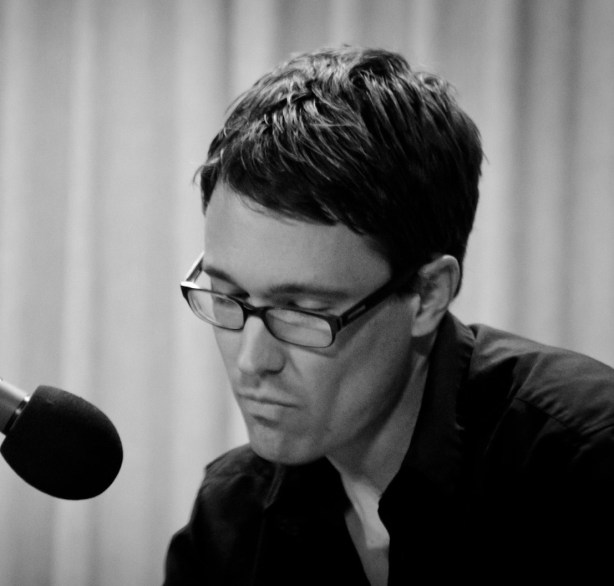
Evan Lavender-Smith is an American writer who has published two books, Avatar and From Old Notebooks.

I really really really like his anti-novel (or whatever you want to call it) From Old Notebooks, which has recently been reissued by the good people at Dzanc Books.

(Here is my review of FON). I still haven’t read Avatar.

Evan talked with me about his writing, his reading, and other stuff over a series of emails. He was generous in his answers and I very much enjoyed talking with him.

Evan lives in New Mexico with his wife, son, and daughter. He has a website. Read his books.

author-photo2

Biblioklept: Do you know that first editions of From Old Notebooks are going for like three hundred dollars on Amazon right now?

ELS: Here at the house I have a whole drawer full of them. That’s how I’m planning to pay for the kids’ college.

Biblioklept: I read that Cormac McCarthy won’t sign his books anymore because he has this reserve of signed editions that are for his son to sell and corner the market on. Or I think I read that.

Speaking of your kids: the parts in From Old Notebooks about them are some of my favorites, perhaps because the moments you describe seem so real to me, or that I relate so strongly to the feelings that you express. (My own kids, a daughter and son, are about the same age as your kids are in the book). Is it weird if I ask how your kids are?

ELS: Glad to hear some of that stuff resonates with you. No, I don’t think it’s weird. I believe the book even sort of self-consciously anticipates a certain reader’s empathetic engagement with it. There’s that passage somewhere, for example, in which we get something like an interview answer, something like “The real Evan Lavender-Smith has never made it past the first section of Ulysses, the real Evan Lavender-Smith has no children,” which I think maybe winks at the possibility of that type of readerly engagement. So no, it’s encouraging to hear that parts of the book seemed to work for you. My kids are great, by the way. Sofia’s at her violin lesson, Jackson’s doing an art project with his mom.

Biblioklept: The faux-interview answers crack me up. I think we’ve all done that in some way—that we go through these little experiments of interviewing ourselves, performing ourselves, imagining how others perceive us. You write your own obituary; at one point we get: ” ‘With my first book I hope to get all the cult of personality stuff out of the way’.” You remark that you don’t put dates on anything as “an act of defiance” against your “literary executors.” Moments like these seem simultaneously ironic and sincere.

I’m curious as to how closely you attended to these disjunctions—From Old Notebooks seems incredibly, I don’t know, organic.

ELS: At a certain point I became very aware that I was performing some version or versions of myself in the book, and I think the book tries to find ways of grappling with problems I perceived as bound up with that performance. One way was to insist on a narrative tone or mode somewhere in between irony and sincerity, or to regularly oscillate between or conflate these competing modes. Something like “I am the greatest writer in the history of the world!” might later be countered by “Gosh, my writing really blows, doesn’t it?”; or “My kids are so beautiful, I love them so much,” might be followed by “I wish those little fuckers were never born.” While the function of this variability is, in From Old Notebooks, probably mostly an apology or a mask for a kind of subjectivity I worry might come off as cliche and naive, that particular representation of the thinking subject — cleaved, inconsistent, heterogeneous — does strike me as truer of human experience and perception than the more streamlined consistency of expression and behavior we tend to associate with the conventional narratological device called “character.” When I try to look deep down inside myself, to really get a handle on my thinking, for example, or on my understanding of truth, I end up facing a real mess of disjunctive, contradictory forces competing for my attention. For me — and likely for the book, as well — the most immediate figure for this condition might be the confluence of sincerity and irony, the compossibility of taking a genuine life-affirming pleasure in, and exhibiting a kind of cynical hostility toward, the fact of my own existence.

Biblioklept: That contest between sincerity and irony seems present in many works of post-postmodern fiction. It’s clearly a conflict that marks a lot of David Foster Wallace’s stuff. You invoke Wallace a number of times in From Old Notebooks, but the style of the book seems in no way beholden to his books. Can you talk about his influence on you as a reader? A writer?

ELS: Wallace hugely influenced the way I think about any number of things. I think his most immediate influence on my writing is this blending of hieratic and demotic modes of language when I’m dealing with pretty much anything that requires the serious application of my writing mind; the hip nerdiness of his language was and still is very empowering to me. He made it seem super cool to geek out on books — “The library, and step on it,” says Hal in Infinite Jest — and back in high school and college that example was so vital for me, as someone entirely too obsessed with being both cool and well read. He served to guide my reading of other writers in a way that only John Barth and Brian Evenson have come close to matching; I poured over his essays for names, then went to the library and checked out and read all the books he mentioned, then reread his essays. His fiction’s most common subject matter — addiction, depression, the yearning for transcendence, the incommensurability of language and lived experience, problems of logic vis-a-vis emotion, metafiction’s values and inadequacies — all of this stuff hit very close to home. To my mind there’s little doubt that Infinite Jest is the best English-language novel published in the last 25 years. His advocacy for David Markson has got to be up there among the greatest literary rescue missions of the 20th century. In “Good Old Neon” he wrote what may be the most haunting long short story since “The Death of Ivan Ilych.” He galvanized young writers everywhere right when the internet was taking off and unwittingly served as a touchstone for emerging online literary communities that thrive today. I think for a lot of young writers, myself included, he was, maybe next to the emergence of the internet, the most important force in the language’s recent history. The list goes on and on. And also he helped me out personally, providing encouragement and advice that was so generous and inspiring. I was extremely troubled by his suicide and wasn’t able to write much or think about much else for quite a while.

With all that said, there are some things he says that bother me a bit. The synthesis of art and entertainment he espouses as it pertains to the role of the writer in the age of television — which I think in many ways corresponds to his striving for a new aesthetic in which the cerebral effects associated with 60s and 70s postmodernist fiction are complemented by or synthesized with the more visceral effects associated with 70s and 80s realist fiction — strikes me now as existing very much in opposition to what I believe in most passionately about writing: that it can and in the most important cases should exist in a state of absolute opposition to our entertainments. I’ve come to better appreciate, years after reading Wallace, the writing of people like Woolf and Beckett and Gaddis, those writers who are uncompromising in their vision of narrative art’s most radical and affecting possibilities and who necessarily, I believe, pay very little attention to any sort of entertainment imperative. The books I love most make me feel things strongly, and think things strongly, but rarely do they entertain me. If I want to be entertained, I know exactly where to go: a room without books. I’ve come to think of certain books as my life’s only source of intellectual solace; when I’m not despairing over the futility of everything under the sun, that unflagging commitment to a truly rigorous and uncompromising art that I perceive in a writer like Beckett seems to me a matter of life and death, just as serious as life can ever get. When Wallace talks that shit about art and entertainment, or about the need to add more heart or greater complexity of character to Pynchon or whatever, it makes me feel like I want to throw up. I heard him say once in an interview that he felt he couldn’t write the unfiltered stuff in his head, that it would be too radical or something, and the admission really upset me; it felt like in some serious way he had allowed his projection of an imaginary target audience’s desire to determine the form of his writing. I often feel something similar in the essays; I find many of them to be merely entertaining. I suppose I often judge the essays in relation to the fictions, which I find far superior in their attempt to overcome the strictures and conventions of language and form. Wallace was always at his best, to my reading, when he was really bearing down — when he was at his most difficult.

But no doubt he’s been monumentally important to me, more so than any other recent fiction writer, and in more ways than I can name. There’s something in From Old Notebooks where the methodical awkwardness and wordiness of so many of his sentences is likened to the affectation of bumping up against the limits of language. That’s probably what I take away from him more than anything: when I sit down at the laptop to face the language, I often feel myself struggling with the words as well as struggling to demonstrate that I’m struggling with the words. That’s pure Wallace: word-by-word, letter-by-letter self-consciousness. (There’s another thing in From Old Notebooks about how I’m always talking shit because I care for him so deeply … which is why the paragraph before this one). Continue reading “An Interview with Evan Lavender-Smith”

“Sound and Fury” — O. Henry

“Sound and Fury” by O. Henry

PERSONS OF THE DRAMA

Mr. Penne An Author
Miss Lore An Amanuensis

Scene—Workroom of Mr. Penne’s popular novel factory.
Mr. Penne—Good morning, Miss Lore. Glad to see you so prompt. We should finish that June installment for the Epoch to-day. Leverett is crowding me for it. Are you quite ready? We will resume where we left off yesterday. (Dictates.) “Kate, with a sigh, rose from his knees, and—”

Miss Lore—Excuse me; you mean “rose from her knees,” instead of “his,” don’t you?

Mr. Penne—Er—no—”his,” if you please. It is the love scene in the garden. (Dictates.) “Rose from his knees where, blushing with youth’s bewitching coyness, she had rested for a moment after Cortland had declared his love. The hour was one of supreme and tender joy. When Kate—scene that Cortland never—”

Miss Lore—Excuse me; but wouldn’t it be more grammatical to say “when Kate saw,” instead of “seen”?

Mr. Penne—The context will explain. (Dictates.) “When Kate—scene that Cortland never forgot—came tripping across the lawn it seemed to him the fairest sight that earth had ever offered to his gaze.”

Miss Lore—Oh!

Mr. Penne (dictates)—”Kate had abandoned herself to the joy of her new-found love so completely, that no shadow of her former grief was cast upon it. Cortland, with his arm firmly entwined about her waist, knew nothing of her sighs—”

Miss Lore—Goodness! If he couldn’t tell her size with his arm around—

Mr. Penne (frowning)—”Of her sighs and tears of the previous night.”

Miss Lore—Oh!

Mr. Penne (dictates)—”To Cortland the chief charm of this girl was her look of innocence and unworldiness. Never had nun—”

Miss Lore—How about changing that to “never had any?”

Mr. Penne (emphatically)—”Never had nun in cloistered cell a face more sweet and pure.”

Miss Lore—Oh!

Mr. Penne (dictates)—”But now Kate must hasten back to the house lest her absence be discovered. After a fond farewell she turned and sped lightly away. Cortland’s gaze followed her. He watched her rise—”

Miss Lore—Excuse me, Mr. Penne; but how could he watch her eyes while her back was turned toward him?

Mr. Penne (with extreme politeness)—Possibly you would gather my meaning more intelligently if you would wait for the conclusion of the sentence. (Dictates.) “Watched her rise as gracefully as a fawn as she mounted the eastern terrace.”

Miss Lore—Oh!

Mr. Penne (dictates)—”And yet Cortland’s position was so far above that of this rustic maiden that he dreaded to consider the social upheaval that would ensue should he marry her. In no uncertain tones the traditional voices of his caste and world cried out loudly to him to let her go. What should follow—”

Miss Lore (looking up with a start)—I’m sure I can’t say, Mr. Penne. Unless (with a giggle) you would want to add “Gallegher.”

Mr. Penne (coldly)—Pardon me. I was not seeking to impose upon you the task of a collaborator. Kindly consider the question a part of the text.

Miss Lore—Oh!

Mr. Penne (dictates)—”On one side was love and Kate; on the other side his heritage of social position and family pride. Would love win? Love, that the poets tell us will last forever! (Perceives that Miss Lore looks fatigued, and looks at his watch.) That’s a good long stretch. Perhaps we’d better knock off a bit.”

(Miss Lore does not reply.)

Mr. Penne—I said, Miss Lore, we’ve been at it quite a long time— wouldn’t you like to knock off for a while?

Miss Lore—Oh! Were you addressing me before? I put what you said down. I thought it belonged in the story. It seemed to fit in all right. Oh, no; I’m not tired.

Mr. Penne—Very well, then, we will continue. (Dictates.) “In spite of these qualms and doubts, Cortland was a happy man. That night at the club he silently toasted Kate’s bright eyes in a bumper of the rarest vintage. Afterward he set out for a stroll with, as Kate on—”

Miss Lore—Excuse me, Mr. Penne, for venturing a suggestion; but don’t you think you might state that in a less coarse manner?

Mr. Penne (astounded)—Wh-wh—I’m afraid I fail to understand you.

Miss Lore—His condition. Why not say he was “full” or “intoxicated”? It would sound much more elegant than the way you express it.

Mr. Penne (still darkly wandering)—Will you kindly point out, Miss Lore, where I have intimated that Cortland was “full,” if you prefer that word?

Miss Lore (calmly consulting her stenographic notes)—It is right here, word for word. (Reads.) “Afterward he set out for a stroll with a skate on.”

Mr. Penne (with peculiar emphasis)—Ah! And now will you kindly take down the expurgated phrase? (Dictates.) “Afterward he set out for a stroll with, as Kate on one occasion had fancifully told him, her spirit leaning upon his arm.”

Miss Lore—Oh!

Mr. Penne (dictates)—Chapter thirty-four. Heading—”What Kate Found in the Garden.” “That fragrant summer morning brought gracious tasks to all. The bees were at the honeysuckle blossoms on the porch. Kate, singing a little song, was training the riotous branches of her favorite woodbine. The sun, himself, had rows—”

Miss Lore—Shall I say “had risen”?

Mr. Penne (very slowly and with desperate deliberation)—”The—sun—himself—had—rows—of—blushing—pinks—and—hollyhocks—and—hyacinths—waiting—that—he—might—dry—their—dew-drenched—cups.”

Miss Lore—Oh!

Mr. Penne (dictates)—”The earliest trolley, scattering the birds from its pathway like some marauding cat, brought Cortland over from Oldport. He had forgotten his fair—”

Miss Lore—Hm! Wonder how he got the conductor to—

Mr. Penne (very loudly)—”Forgotten his fair and roseate visions of the night in the practical light of the sober morn.”

Miss Lore—Oh!

Mr. Penne (dictates)—”He greeted her with his usual smile and manner. ‘See the waves,’ he cried, pointing to the heaving waters of the sea, ‘ever wooing and returning to the rockbound shore.'” “‘Ready to break,’ Kate said, with—”

Miss Lore—My! One evening he has his arm around her, and the next morning he’s ready to break her head! Just like a man!

Mr. Penne (with suspicious calmness)—There are times, Miss Lore, when a man becomes so far exasperated that even a woman—But suppose we finish the sentence. (Dictates.) “‘Ready to break,’ Kate said, with the thrilling look of a soul-awakened woman, ‘into foam and spray, destroying themselves upon the shore they love so well.”

Miss Lore—Oh!

Mr. Penne (dictates)—”Cortland, in Kate’s presence heard faintly the voice of caution. Thirty years had not cooled his ardor. It was in his power to bestow great gifts upon this girl. He still retained the beliefs that he had at twenty.” (To Miss Lore, wearily) I think that will be enough for the present.

Miss Lore (wisely)—Well, if he had the twenty that he believed he had, it might buy her a rather nice one.

Mr. Penne (faintly)—The last sentence was my own. We will discontinue for the day, Miss Lore.

Miss Lore—Shall I come again to-morrow?

Mr. Penne (helpless under the spell)—If you will be so good.

(Exit Miss Lore.)


Chinua Achebe in Conversation with Bill Moyers

“Excellent People” — Anton Chekhov

“Excellent People” by Anton Chekhov

ONCE upon a time there lived in Moscow a man called Vladimir Semyonitch Liadovsky. He took his degree at the university in the faculty of law and had a post on the board of management of some railway; but if you had asked him what his work was, he would look candidly and openly at you with his large bright eyes through his gold pincenez, and would answer in a soft, velvety, lisping baritone:

“My work is literature.”

After completing his course at the university, Vladimir Semyonitch had had a paragraph of theatrical criticism accepted by a newspaper. From this paragraph he passed on to reviewing, and a year later he had advanced to writing a weekly article on literary matters for the same paper. But it does not follow from these facts that he was an amateur, that his literary work was of an ephemeral, haphazard character. Whenever I saw his neat spare figure, his high forehead and long mane of hair, when I listened to his speeches, it always seemed to me that his writing, quite apart from what and how he wrote, was something organically part of him, like the beating of his heart, and that his whole literary programme must have been an integral part of his brain while he was a baby in his mother’s womb. Even in his walk, his gestures, his manner of shaking off the ash from his cigarette, I could read this whole programme from A to Z, with all its claptrap, dulness, and honourable sentiments. He was a literary man all over when with an inspired face he laid a wreath on the coffin of some celebrity, or with a grave and solemn face collected signatures for some address; his passion for making the acquaintance of distinguished literary men, his faculty for finding talent even where it was absent, his perpetual enthusiasm, his pulse that went at one hundred and twenty a minute, his ignorance of life, the genuinely feminine flutter with which he threw himself into concerts and literary evenings for the benefit of destitute students, the way in which he gravitated towards the young—all this would have created for him the reputation of a writer even if he had not written his articles.

He was one of those writers to whom phrases like, “We are but few,” or “What would life be without strife? Forward!” were pre-eminently becoming, though he never strove with any one and never did go forward. It did not even sound mawkish when he fell to discoursing of ideals. Every anniversary of the university, on St. Tatiana’s Day, he got drunk, chanted Gaudeamus out of tune, and his beaming and perspiring countenance seemed to say: “See, I’m drunk; I’m keeping it up!” But even that suited him. Continue reading ““Excellent People” — Anton Chekhov”

“Bread and Butter Letter from a Chicago Gentleman” — F. Scott Fitgerald

Dear Marion,

I certainly enjoyed myself. The chow was all good, mostly, but the butter was rancid. The bed was hard but uncomfortable. The talk was over my head but there was some made sense—that part about my being a great guy for instance.
I got home sick at the stummuck but I do not blame you at all.
Will you tell the servents next time I like my soup hot and more of a sharp edge when they press my pants.
You said I only had to pay one buck for board but even that is too much when the service is not good. That black bean soup was rancid too, and mine had a beetle in it. Besides there wasn’t enough blankets and the only good one was stale like it had been used for a baby or something.
I liked all the people I met except that woman I had to slug at dinner. Tell her I hope she found her teeth in the tomato soup when they emptied it out. No gentleman should have done a thing like that but I cannot stand a warm stocking on my ankle under the table.
I’m sorry I shot the horse and dog but they kep me awake 1/2 the night and I come there for a rest. You will find a lot of cigar stubs in the refrigidaire as I did not know where to put them. I do not want them however so give them to one of the negro servants, you know the colored ones, not your uncle or aunt or anybody like that. The black ones.
I’ll tell you when I can come down again and we will have more of that fun in the dumb waiter—hey kid, you know? Only I’m sorry I left you between floors when I went to bed. I thot it would give you more time to cool off so you could get some sleep too.
All right kid and goodby and I know now you are not such a dumb cluck as you look like.

“Tick”

P.S. If you called that thing a cocktail then listerine is the Holy Grail.

From F. Scott Fitzgerald’s Notebooks.