A Review of Sonic Life, Thurston Moore’s Rock n’ Roll Fantasia

Thurston’s Rock n’ Roll Fantasy

Thurston Moore’s memoir Sonic Life kicks off in 1963 with his older brother Gene bringing home a 45 of the Kingsmen’s “Louie Louie,” blowing open five-year-old Moore’s mind to the sonic possibilities of raw guitar power.

Moore describes the primal garage hit as the introduction to “a new current of electricity,” one that rewrites the “soundworld” of his earlier suburban life. Our narrator chases that current, finding it in its purest form in The Stooges’ “I Wanna Be Your Dog,” a pre-punk anthem Moore’s band Sonic Youth would cover on their first full-length album, 1983’s Confusion Is Sex. Sonic Youth would also play “I Wanna Be Your Dog” live throughout their career and eventually perform it with Moore’s hero Iggy Pop.

Moore meets many of his heroes in his Sonic Life. It’s a goddamn rock n’ roll fantasy, albeit a fantasy filtered through the gritty reality of punk, No Wave, and smelly indie rock touring vans.

Sure, Moore meets some of the biggies, especially late in the memoir, as Sonic Youth reaches their sonic majority. He chats with Paul McCartney, professing a preference for McCartney’s brother Mike McGear’s stuff to the Beatles. Sonic Youth gets to back David Bowie on “I’m Afraid of Americans.” (Bowie later coos to Moore’s toddler daughter Coco). Moore tours and records with Yoko Ono.

But Moore’s eyes star starrier for the rough luminaries of the New York seventies scene he thrust himself into: Patti Smith, Joey Ramone, Richard Hell, Alan Vega, Tom Verlaine, Lenny Kaye, et al. He’s just as hot for contemporaries like the Minutemen, Black Flag, and Dinosaur Jr., and maybe even hotter for the bands that took Sonic Youth’s squeal to heart, like Pavement, Royal Trux, and My Bloody Valentine.

Sonic Life is larded with people, vibrations, art, life, a love of the weird. Sonic Youth were always as important as curators of the underground, channeling it to seekers of the strange, as they were as a musical act, and Sonic Life is the literary summation of that career.

Thurston’s Literary Fantasy

Any fan who followed Sonic Youth closely, especially in their nineties heyday, would attest that Thurston Moore was the band’s loquacious mouthpiece, a bit of tall charmed ADHD in verbal action, chatting up the world. Sonic Life is liquid, loquacious, loving. Literary protopunk hero Patti Smith populates the pages from the earliest chapters through the last.

Moore also works his decades-long sightings and meetings of William S. Burroughs into the book. Moore first spies Burroughs in 1977 in NYC at a Patti Smith show; decades later the band gets to hang with him a bit. (It’s unclear if Burroughs registers any of this.)

Kathy Acker’s spirit occasionally pops up; it’s clear she was a hero to Moore and his band, but she ghosts them at a planned joint performance in Rotterdam in 1985. The band reads passages of Blood and Guts in High School between songs, tearing out the pages and destroying the book.

Longtime Sonic Youth fans will anticipate Moore’s prose. Seemingly-oblique psychedelic expressions explode, artful phrases dash into each other, ultimately cushioned carefully into a comfortable syntactic register. The effect is not unlike much of Sonic Youth’s post-Sister output, which by turns twisted avant-garde experimentation into pop sugar and deconstructed classic rock riffs into punk scuzz.

Moore’s punchy prose is best summed up in the titles of his 71 chapters, most of them cribbed from song titles and lyrics (including his own): “Flaming Telepaths,” “Mere Animal in a Pre-Fact Clamour,” “Ecstatic Stigmatic,” “Secret Knowledge of Backroads,” “Latex Gold,” etc. The chapter titles are wonderful clues, sometimes direct, sometimes cryptic, always evocative. The prose generally hurtles along, with Moore’s verbal tricks wedged into easy, flowing configurations, but some of the tricks get tired. Particularly, Moore is particularly fond of “Particularly” as a linking expression. Too, we find the book peopled by characters who “could only laugh” at whatever absurdity life has conjured. An editor might have attended these repetitions, but I’m not sure if Moore’s best stuff ever came about via the hands of an editor. The book is generally well-written.

Experimental New York, Seventies and No Wave

Sonic Life begins in 1963, blasting the Kingsmen’s “Louie Louie,” and ends in 2009 with Moore naming Sonic Youth’s last album The Eternal. There are moments outside of this neat chronology though. Discussing his family, Moore goes back a few generations, if only for a paragraph or two. He touches briefly on the dissolution of both Sonic Youth and his marriage to Kim Gordon in 2011. That’s not what the book’s about. Sonic Life compresses events before 1977 and events after 1994. The book is almost 500 pages long; Steve Shelley, who joined the band in 1985 and who most fans think of as “the drummer of Sonic Youth,” shows up around page 300. This isn’t a tour diary or a tell-all.

Instead, much of Moore’s narrative focuses on New York in the scummy seventies and early eighties. Dirt, crime, and drone rock rules. Glenn Branca, Teenage Jesus and the Jerks, the last days of Sid Vicious. Difficulty making even the cheapest rents. No phones, No Wave, and his first stolen guitar. Moore documents an interstitial period in NYC history. He arrives after punk’s (non-)glory daze, too young to partake, too old to really fit in with the emerging wave of hardcore. Along with Kim Gordon and Lee Ranaldo, Moore shapes the noise and grime and angles and raw hope into something new–Sonic Youth.

Kim Gordon

Kim Gordon is a huge part of Thurston Moore’s life and a huge part of Sonic Life. She’s not exactly Moore’s muse, but he clearly looks up to her, as he, tall boy, looks up to so many of the people who people this memoir. Moore is frank in his description of Gordon as an artistic and musical partner, one whom he sometimes clearly grated on and at other times found himself astounded by.

In Moore’s telling, Gordon often felt outside of the band. Moore relates that when the band (working with Mike Watt under the name Ciccone Youth) were putting together the noises that eventually became The White(y) Album, Gordon felt herself out of sync with the band. She went to a mall and recorded a video karaoke cover of Robert Palmer’s “Addicted to Love,” an artistic gesture that confounded and impressed Moore and the rest of the band, lending ironic license to their Pop Art leanings.

Fans looking for anything gossipy in Moore’s memoir about his marriage and divorce from Gordon won’t find it. His focus is on Gordon as an artist and musician. Indeed, much of duo’s communication was rooted in the actual songs they wrote and played. In one of the book’s stronger passages, Moore details creating a punk poster that appropriated the image of a naked young Latina from a calendar he’d found. He scrawled some would-be feminist slogans over the image and hung it in their house. Gordon didn’t say anything at the time. However, when the band rehearsed their new song “Flower” (which would appear on 1985’s Bad Moon Rising), Gordon began singing Moore’s slogans as lyrics: “Support the power of women / Use the power of man.” But Moore then added her own words:

There’s a new girl in your lifeLong red wavy hairGreen, green lips and purple eyesSkinny hips and big round breastsHanging on your wall

Moore ends the chapter by noting that “the two of us never talked about it outright, only through our songwriting. It wouldn’t be the last time that music was the mode of dialogue in our relationship.” Throughout Sonic Life, he heaps praise on his ex-wife as an artist, intellect, musician, and mother, but she ultimately remains a cipher–like the other members of Sonic Youth.

Lee Ranaldo

Moore credits Ranaldo as the better musician and guitar player throughout his memoir, but for the most part he’s a blip in a book of nearly five hundred pages. Maybe that was Ranaldo’s choice—maybe he asked his musical partner of three decades if it was okay to share certain stories and Ranaldo said No.

Richard Edson

Richard Edson was the first drummer of Sonic Youth. Moore credits him with suggesting “the music would be far more effective if there was some semblance of an arrangement, guitars locking into a rhythm so changes could be audibly established.” Moore seems to receive this basic concept of songwriting as a revelation.

Edson went on to star in Stranger Than Paradise and Do the Right Thing, although most people would probably recognize him from a bit part as one of the garage guys in Ferris Bueller’s Day Off. He also had a bit part in Desperately Seeking Susan, a film featuring Madonna.

Madonna

Madonna wasn’t in Sonic Youth, but she floated in the same circles (and even briefly dated Swans frontman Michael Gira).

Moore brings up Madonna more than Lee Ranaldo or Steve Shelley.

Bob Bert

Moore spends a paragraph or two of Sonic Life implicitly apologizing to Bob Bert, whom Sonic Youth as a whole treated pretty shabbily. They fired and rehired him a few times. He gets more air time than Richard Edson or Steve Shelley (but not as much as Madonna).

Steve Shelley

Steve Shelley’s drumming made Sonic Youth Sonic Youth. He continues to play and record with Thurston Moore, so maybe the lack of words on Shelley in Sonic Life was by way of Shelley’s own request.

Our Band Could Be Your Sonic Life

Michael Azerrad’s 2001 book Our Band Could Be Your Life devotes a skeptical chapter to Sonic Youth. The editorial position of that history of indie bands in the eighties seems to posit that Sonic Youth were art rock prima donnas who eventually yoked a bevy of underground bands into major label harnesses. Azerrad’s book is really about real-life social networks and overlaps and DIY—Black Flag, SST, The Minutemen, Dischord, seven inches and tapes, and touring! touring! touring! Sonic Life doesn’t exactly duplicate Azzerad’s indie serial, but it does further authenticate it.

Range Life

Michael Azerrad’s 2001 book Our Band Could Be Your Life, at least in my memory, tends to dwell on touring: stinky vans, unpaid gigs, hard lodging. Moore doesn’t elide this aspect of the band’s identity, but neither does he dwell on it. Moore focuses on the energies on the stage, calling the band a “sonic democracy” — and really, here, I take back what I said above. They are not ciphers but sonics, musicians making the vibrations come alive. What else could we want?

Einstein A Go-Go

Thurston Moore includes the Einstein a Go-Go in a very short list of “clubs that welcomed the underground scene into their chambers, each with [their] own distinct environment.”

Einstein’s was an all-ages club that existed from 1985 to 1997 in Jacksonville Beach, FL. You could go there and dance to wild music for like a five buck cover, and you could see all kinds of cool bands play for maybe eight or ten bucks. I was there pretty much every Friday and Saturday night between ’95-’97 (and sometimes just hung out outside and walked the beach if I didn’t have the cover). Kids wept when it closed. I got to move, leave for college, words that now, as I type them, seem so cruel.

Sonic Youth played Einstein’s with fIREHOSE in the fall of 1986. This performance left a weird little dent in the city that could be felt a decade later by bands who had seen (or at least claimed they had seen) Thurston, Watt, Kim. There were always the older kids who had seen the band, or they had heard about it from older kids who had seen the band…this was called “a scene.”

The Faircloth family who ran Einstein’s were great people. Bands didn’t want to come to Florida; still don’t, really. The Faircloths made sure the bands were comfortable, had good lodging, good food (fried chicken!), leading to a pipeline of bands coming through — 10,000 Maniacs, Flaming Lips, They Might Be Giants, Alex Chilton, Ween, Soundgarden, Mudhoney, Meat Puppets, Dinosaur Jr., Primus, The Replacements, Jane’s Addiction, Nirvana…

By the time I was old enough to go to the all-ages club, the major indie acts that had passed through had graduated to Bigger Times. But I got to see so many great second-wave indie bands: Archers of Loaf, Polvo, Sebadoh, Thinking Fellers Union Local 282, Luna, the Swirlies, Superchunk, and so many, many more.

My stupid high school band got to play there a few times too. We were too loud and used weird tunings on the cheap guitars that we kept swapping between songs in lieu of actual songwriting.

Better than that, at Einstein’s I got to dance to the music I wanted to dance to through an incredibly loud speaker system, including Sonic Youth “hits” like “Teenage Riot,” “100%,” and “Bull in the Heather.” Some of that feeling of fucked up dancing reverberates still in Sonic Life.

Punk Breaks, Major $$$, Nirvana, Ecstatic Peace

Where does it all go? Well, you know. Punk breaks. Nirvana breaks. Sonic Youth signs to a major label, opens for Neil Young, and later makes enough money touring on Lollapalooza to build their Echo Canyon studio on Murray Street. They start their own label, SYR, releasing some of their more avant-garde projects. Opportunities expand. All of their equipment gets stolen. Moore and Gordon have a kid and move to the burbs. They still keep an apartment in NYC; Gordon is there the morning of the September 11, 2001 attacks on the Twin Towers. A plane engine crashes on Murray Street; thankfully, Sonic Youth producer and bassist Jim O’Rourke escapes, though not unharrowed. O’Rourke leaves the band and is replaced by Pavement’s Mark Ibold. Sonic Youth releases their last studio record, The Eternal, on indie Matador, having fulfilled their contract with Geffen. Moore begins an affair with Eva Prinz, an editor at Rizzoli. In 2011 he and Gordon divorce and Sonic Youth is kaput. Moore and Prinz marry and start a poetry imprint, Ecstatic Peace Library. He claims to have found his own ecstatic peace.

Radical Compression

As I mentioned above, Moore’s memoir focuses on the late seventies and the eighties. He condenses the band’s last twenty years (and the last ten of their sixteen studio albums) into about 100 pages, just a fifth of the book. And that’s probably for the better; Sonic Youth, while not exactly overexposed, were pretty well documented in print and film and web by the onset of the mid-nineties.

The radical compression is wonderfully effective at times, giving the book a clipped, propulsive rhythm and allowing Moore’s humor to shine through. A standout is Ch. 66, “Latex Gold,” the first chapter of the book’s final sixth section. It begins in 1996 with a Pacific Rim tour with the Beastie Boys and Foo Fighters. Moore and Gordon have enlisted Thurston’s sweet mother Eleanor to help out with Coco (and see a bit of the world). She gets hurt in the mosh pit, trying to take photographs, and ends up wheelchair-bound, but ex-Germs, ex-Nirvana Foo Fighter Pat Smear takes up her cause, making sure she doesn’t get left behind when everyone heads to a flea market in Jakarta. A page later, the band plays Late Night with Conan O’Brien; a few paragraphs later, Moore is remixing Yoko Ono, then playing guitar with Patti Smith. Then the band is on The Simpsons: “It was the single mainstream cultural event that we’d find ourselves identified with across the world.” A paragraph later, Moore is seated on a couch between Lou Reed and Jim Carroll watching a rough cut of The Basketball Diaries. Moore praises DiCaprio’s performance; Reed describes the film as “Fucking terrible” and leaves immediately. On the next page, Moore is driving an aging, overweight, and likely insane John Fahey around a series of gigs in the northeast. Fahey greets Moore at his motel room door one morning, fully nude, Fahey’s cracked CDs strewn across the floor. Moore tells Fahey he could be selling the CDs at their gigs. Fahey offers Moore to take as many CDs he wants. By the end of the ten-page chapter, Sonic Youth are backing up David Bowie at the Thin White Duke’s Madison Square Garden birthday bash.

End Hits

I really loved reading Sonic Life. It’s not a perfectly-written or balanced book, but it feels real. Moore forges a fascinating tone, at times deeply apologetic, particularly to the best friend of his teenage years, Harold Paris, whom he eventually alienates to the point of a break up in the mid eighties. The memoir is filled with conciliatory gestures and admissions of punk snottiness, whether it’s Moore apologizing for a nasty music review he wrote in his one semester of college, conceding that his brattiness to mentor Glenn Branca was likely misplaced, or expressing regret at getting in Dee Snider’s face to flip the bird at a Twisted Sister concert. Moore doesn’t try to spin his divorce from Kim Gordon; his recollection of his affair with Eva Prinz is brief, blunt, and frankly loving. Perhaps the most fascinating example of his zen reflection in the memoir is his take on the 1999 theft of all of Sonic Youth’s musical equipment while on tour in California. The band relied on racks of guitars in alternate tunings for their sound; the theft struck me as devastating at the time. Moore affords the episode just a few spare paragraphs, concluding that although he would miss his Fender Jazzmaster, he “embraced the liberation of losing things, being stripped of attachments” — a chance to “reignite” their musical mission. What did Moore feel at the time though? He doesn’t tell us, but the outlook he provides suggests wisdom and emotional maturity.

Mixtape

I made a mixtape based on the chapter titles and content of Sonic Life. I enjoyed listening to the music as I read Moore’s memoir, revisiting old gems and hearing cuts I haven’t heard in ages, along with a few tracks and artists new to me. And that’s what I think Moore and Sonic Youth always did best—expand a taste of the weird and the noisy, share the sonic love.
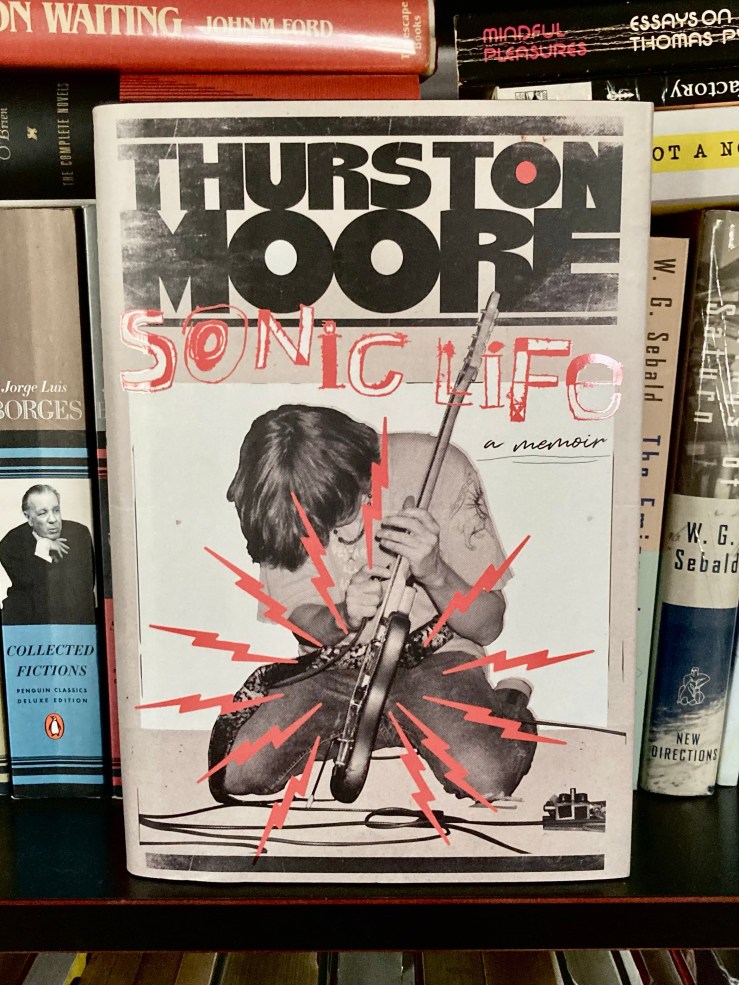
 

Thurston Moore’s memoir Sonic Life (Book acquired, 27 Oct. 2023)

I picked up Thurston Moore’s mammoth memoir Sonic Life yesterday afternoon, started reading it, and kept reading it. I was a huge Sonic Youth fan in my youth, introduced to the band in 1991 via a decent soundtrack to a mediocre film called Pump Up the Volume. Throughout the nineties and early 2000s, I bought all the Sonic Youth records I could get my hands on, and repeatedly watched their 1991 tour diary film The Year Punk Broke more times than I could count. Thurston Moore was a goofy avant hipster, ebullient, verbose, annoying, and endearing, the nexus of a band that were themselves a nexus of nascent bands and artists. (In his chapter on Sonic Youth in his 2001 history Our Band Could Be Your Life, Michael Azerrad repeatedly argues that DGC Records signed the band so that they would reel in the indie groups that majors wanted so badly after Nirvana et al. exploded.) When Thurston Moore and his wife and bandmate Kim Gordon separated in 2011, essentially ending Sonic Youth, I recall being strangely emotionally impacted, like my punk god parents were getting divorced. While I didn’t expect or want dishy answers from Gordon’s 2015 memoir Girl in a Band, I was still disappointed in the book, finding it cold and ultimately dull. So far, Moore’s memoir is richer, denser, sprawls more. It’s written in an electric rapid fire style loaded with phrasing that wouldn’t be out of place in the lyrics of an old SY track. I ended up reading the first 150 or so of the pages last night and this morning, soaking up Moore’s detailed account of the end of the New York punk rock scene and the subsequent birth of  No Wave. Moore’s intense love of music is what comes through most strongly. Chapter titles take their names from song titles or song lyrics, and I’ve started to put together a playlist, which I’ll add to as I read:

 

Richard Wollheim’s Germs (Book acquired, 24 Dec. 2020)

Richard Wollheim’s memoir Germs is forthcoming from NYRB in February. Their blurb:

Germs is about first things, the seeds from which a life grows, as well as about the illnesses it incurs, the damage it sustains. Written at the end of the life of Richard Wollheim, a major British philosopher of the second half of the twentieth century, this memoir is not the usual story of growing up, but very much about childhood, that early world we all share in which we do not know either the world or ourselves for sure, and in which things—houses, clothes, meals, parents, the past—loom large around us, seeming both inevitable and uncontrollable. Richard Wollheim’s remarkable, moving, and entirely original book recovers this formative moment that makes us who we are before we really are who we are and that haunts us all our lives in lucid and lyrical prose.

The Big Love (Book acquired, 13 March 2018)

img_9237

Uh….

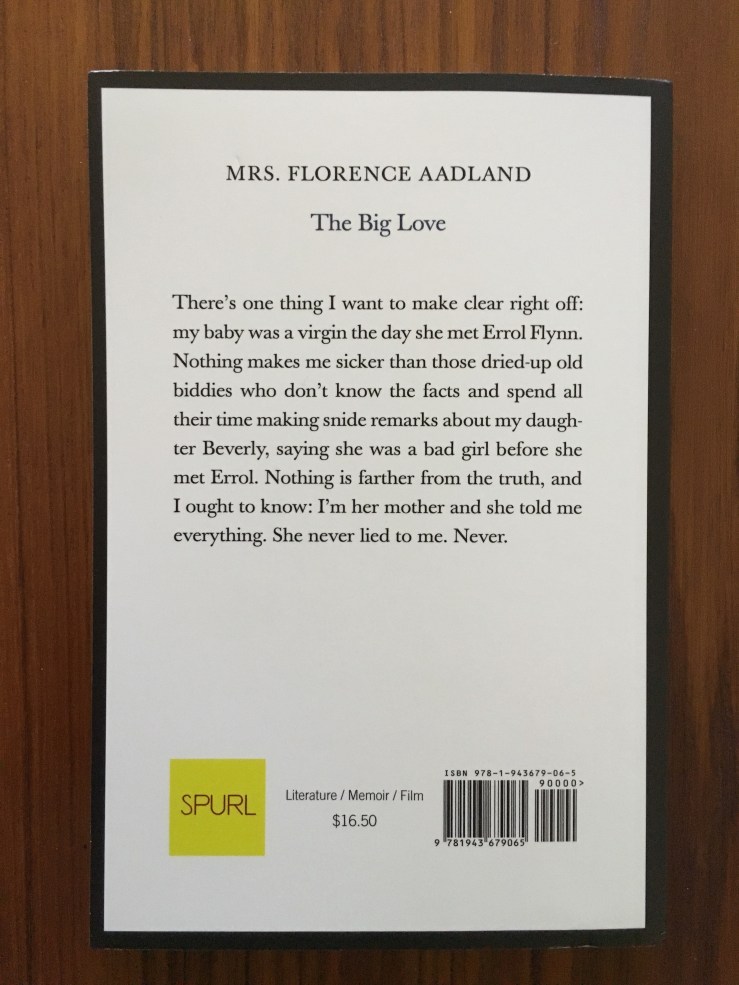
This one looks like a fascinating case of memoir-as-fiction. Florence Aadland’s The Big Love is new from Spurl. Here’s the back cover:

img_9239

And here’s Spurl’s blurb:

The Big Love is a Hollywood nightmare. It tells the story of Errol Flynn – a fading, alcoholic movie star – and the underage dancer-actress Beverly Aadland. The narrator? Beverly Aadland’s fame-worshiping mother Mrs. Florence Aadland, who spurs the relationship on. There is nothing subtle or sympathetic about this memoir: It is outrageous, grotesque, surreal, notorious – an intimate look at Hollywood exploitation and decay.

On the one hand, The Big Love depicts the deterioration of Errol Flynn, an actor who is quickly losing relevance after years of playing irresistible swashbucklers in films such as Captain Blood (1935) and The Adventures of Robin Hood (1938). He is riddled with medical problems, drinking himself to death. On the other hand, there is Mrs. Florence Aadland, also an alcoholic, an uncultured stage mother psychotically pushing her daughter Beverly forward even at the cost of her own marriage.

A bizarre, seedy time capsule of the 1950s, The Big Love is the long-lost literary sister of Barbara Payton’s I Am Not Ashamed. After languishing out of print for years, it is ready to shock brand new audiences with its absurd humor, villainous characters, and sickly dissipation.

Mrs. Florence Aadland was born on September 21, 1909, in Van Zandt County, Texas. She moved to Southern California and subsequently lost her right foot in a car accident. She married bartender Herbert Aadland and gave birth to her daughter Beverly on September 16, 1942, in Los Angeles. The affair between her adolescent daughter and actor Errol Flynn became tabloid news with his death from a heart attack on October 14, 1959. Her account of the relationship between her daughter and Errol Flynn, The Big Love, was “told to” writer Tedd Thomey and originally published in 1961. Mrs. Aadland died from alcohol-related causes in a Los Angeles hospital on May 10, 1965, at the age of fifty-five.

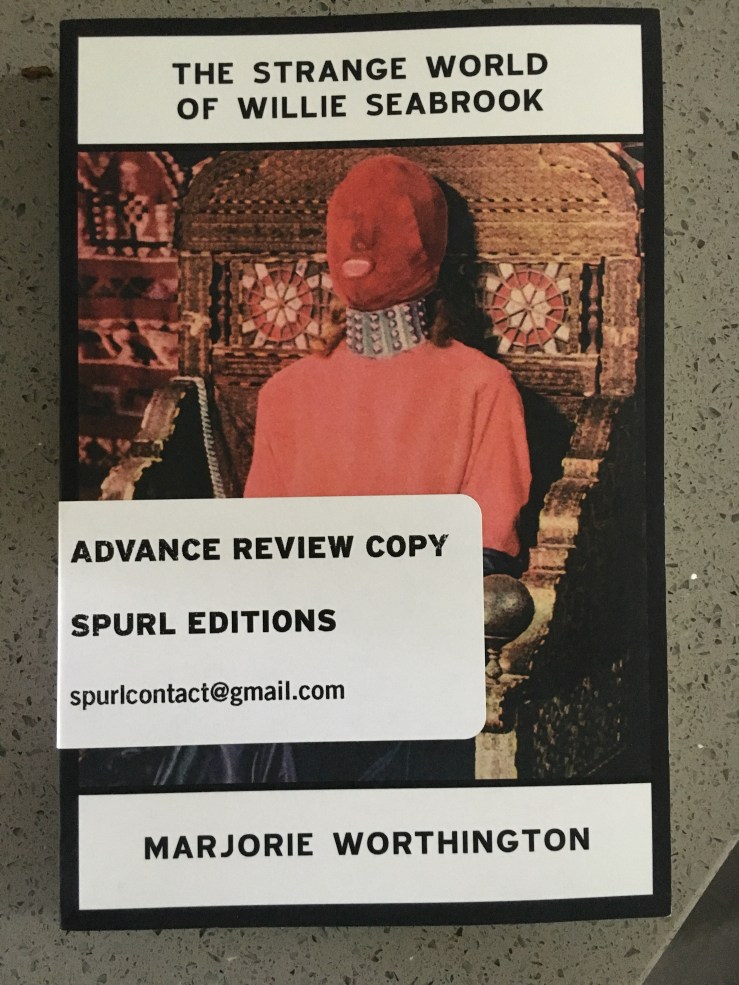
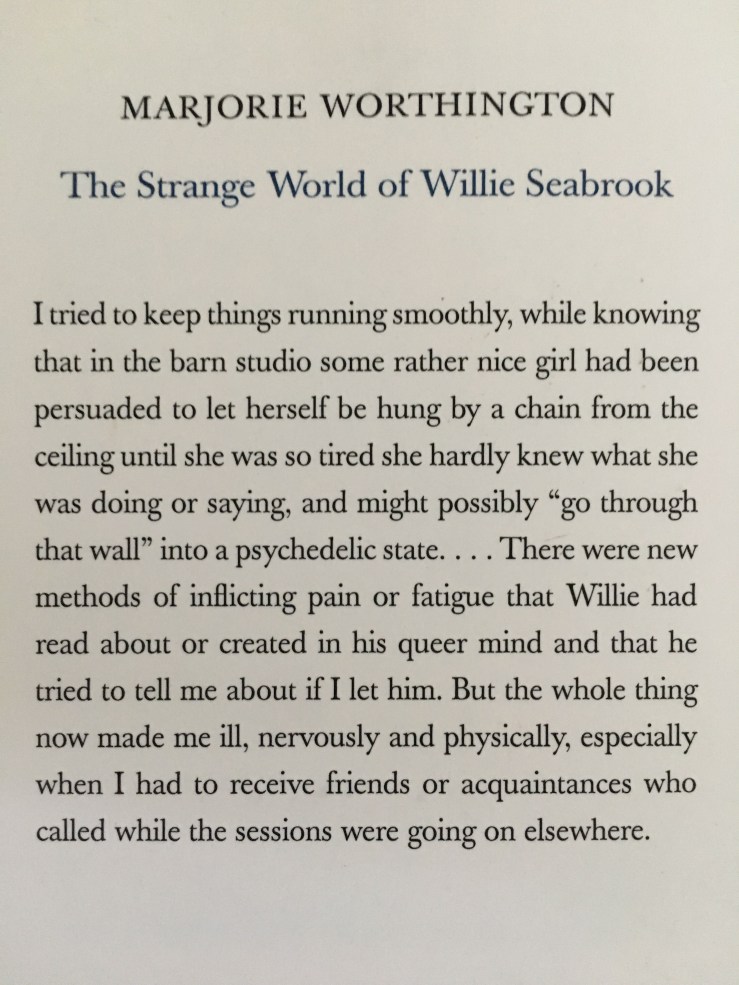
Marjorie Worthington’s The Strange World of Willie Seabrook (Book acquired 26 Sept. 2017)

Marjorie Muir Worthington’s 1966 memoir about her relationship with occultist and fellow Lost Generation weirdo William Seabrook is forthcoming in a new edition from indie Spurl. It looks fascinating. Their blurb:

This is the somber, quietly stunning account of American author Marjorie Worthington’s life and relationship with William Seabrook.

A bestselling writer on the exotic and the occult, Seabrook was an extraordinary figure from the 1920s to the 1940s who traveled widely and introduced voodoo and the concept of the “zombie” to Americans in his book The Magic Island.

In 1966, years after his death from suicide, Worthington, a novelist and Seabrook’s second wife, cast her eye on their years living in France as lost-generation expatriates; their time traveling in the Sahara desert (where Seabrook researched his book The White Monk of Timbuctoo); their friendships with Aldous Huxley, Gertrude Stein, and Michel Leiris; and the gradual erosion of their relationship.

Worthington was with Seabrook in France and later New York when his life became consumed by alcohol, and he took the drastic step of committing himself to a mental institution for a cure; though he wrote about the institution in his book Asylum, he remained an alcoholic. He was also fixated by sadistic games he played with women, which he and the surrealist Man Ray photographed, and which he later viewed as a way to initiate altered psychological states through pain.

The Strange World of Willie Seabrook is an intimate look at the complicated, torturous relationship of two writers. Seabrook was a sadist, yet to Worthington he was also enthralling; he was an alcoholic, but she believed she could protect him. Even after he had hurt her emotionally, she stayed near him. In brilliantly depicted moments of folie à deux, we watch Worthington join Seabrook in his decline, and witness the shared claustrophobic, psychological breakdown that ensues.

The Book of Emma Reyes (Book acquired, 3 Aug. 2017)

img_7636

This one looks pretty cool. The Book of Emma Reyes, an epistolary “memoir,” is new in hardback from Penguin, in English translation by Daniel Alarcón.  Here’s Penguin’s blurb/bio:

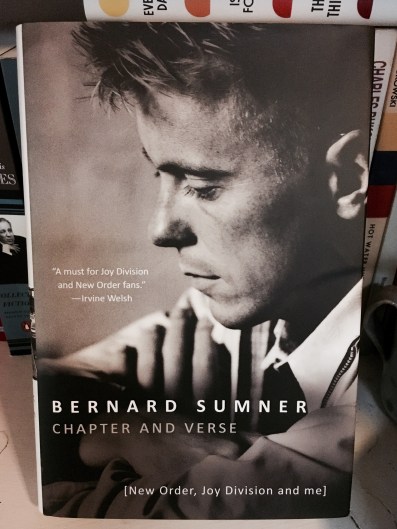
Bernard Sumner’s memoir, Chapter and Verse (Book acquired sometime in November of 2015)

IMG_0971

This afternoon, I finally got into Bernard Sumner’s memoir Chapter and Verse: New Order, Joy Division and Me. Actually, I obviously flicked through it when it showed up, looking at the glossy pictures, dabbling here and there (somehow read not one but two anecdotes about Seal (?)), and then reading the book’s first appendix, a transcript of a recording of Sumner’s hypnotizing Ian Curtis (excuse that mangled clause). The book has a U.S. Hardcover release from Thomas Dunne; their blurb:

Founding member and guitarist of Joy Division and the lead singer of New Order, Bernard Sumner has been famous over the years for his reticence. Until now . . .

An integral part of the Manchester, UK, music scene since the late 1970s, his is the definitive version of the events that created two of the most influential bands of all time.

Chapter and Verse includes a vivid and illuminating account of Bernard Sumner’s childhood, the early days of Joy Division, the band’s enormous critical and popular success, and the subsequent tragic death of Ian Curtis. Sumner describes the formation of New Order, takes us behind the scenes at the birth of classics such as “Blue Monday,” and gives his firsthand account of the ecstasy and the agony of the Haçienda days.

Sometimes moving, often hilarious, and occasionally completely out of control, this is a tale populated by some of the most colorful and creative characters in music history, such as Ian Curtis, Tony Wilson, Rob Gretton, and Martin Hannett. Others have told parts of the story, in film and book form. Now, for the first time, Bernard Sumner gives you chapter and verse.

Read an excerpt of Alejandro Jodorowsky’s psychomagical memoir at BOMB Magazine

BOMB has published an excerpt from filmmaker Alejandro Jodorowsky’s new memoir Where the Bird Sings Best. An excerpt of the excerpt:

In those good old days, Salvador Arcavi, the first of a long series of Salvadors—traditionally all his descendants had the same name—though respectful of the Holy Book, decided he was not to going to be a prisoner to its letters. Following the prophecy Jacob made to his son (“Your hand will be on the neck of your enemy. Your father’s sons will bow down to you. Judah is a young lion.”), he became a lion tamer. His way to draw nearer to God was to study those beasts and to live an itinerant life, giving performances in which his union with his animals surpassed the limits of reality and reached the miraculous. The lions jumped through flaming hoops, balanced on the tight rope, danced on their hind legs, climbed up on one another to form a pyramid, spelled out the name of a spectator by choosing wooden letters, and, the greatest test, accepted within their jaws without hurting it the head of the tamer, then dragged him through the sawdust to draw a six-pointed star.

My ancestor had a simple method for making the beasts love him: he never forced them to do anything, and he made their training into a game. Whenever they wanted to eat, he fed them, and if they decided not to eat, he did not insist. If they wanted to sleep, he let them, and if they were rutting, he let them fornicate without distraction. He adopted the rhythm of the animals with care and tenderness. He let his hair grow into a mane, he ate raw meat, and he slept naked in the cage embracing his lions.

Clothes, Clothes, Clothes. Music, Music, Music. Boys, Boys, Boys. (Book Acquired, 11.18.2014)

IMG_3996.JPG

This one looks pretty good: Viv Albertine’s memoir Clothes, Clothes, Clothes. Music, Music, Music. Boys, Boys, Boys. U.S. publisher St. Martin’s Press’s blurb:

Viv Albertine is a pioneer. As lead guitarist and songwriter for the seminal band The Slits, she influenced a future generation of artists including Kurt Cobain and Carrie Brownstein. She formed a band with Sid Vicious and was there the night he met Nancy Spungeon. She tempted Johnny Thunders…toured America with the Clash…dated Mick Jones…and inspired the classic Clash anthem “Train in Vain.” But Albertine was no mere muse. In Clothes, Clothes, Clothes. Music, Music, Music. Boys, Boys, Boys., Albertine delivers a unique and unfiltered look at a traditionally male-dominated scene.

Her story is so much more than a music memoir. Albertine’s narrative is nothing less than a fierce correspondence from a life on the fringes of culture. The author recalls rebelling from conformity and patriarchal society ever since her days as an adolescent girl in the same London suburb of Muswell Hill where the Kinks formed. With brash honesty—and an unforgiving memory—Albertine writes of immersing herself into punk culture among the likes of the Sex Pistols and the Buzzcocks. Of her devastation when the Slits broke up and her reinvention as a director and screenwriter. Or abortion, marriage, motherhood, and surviving cancer. Navigating infidelity and negotiating divorce. And launching her recent comeback as a solo artist with her debut album, The Vermilion Border.

Clothes, Clothes, Clothes. Music, Music, Music. Boys, Boys, Boys. is a raw chronicle of music, fashion, love, sex, feminism, and more that connects the early days of punk to the Riot Grrl movement and beyond. But even more profoundly, Viv Albertine’s remarkable memoir is the story of an empowered woman staying true to herself and making it on her own in the modern world.

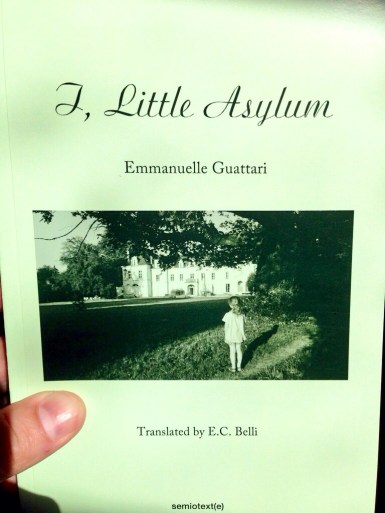
Emmanuelle Guattari’s Memoir (Book Acquired, 9.15.2014)

IMG_3322

I read about half of this yesterday. I, Little Asylum by Emmanuelle Guattari. Publisher Semiotext(e)/MIT’s blurb:

A moment later, Lacan is chattering with me, and giving me some crayons to draw with.
—from I, Little Asylum

Founded in 1951 and renowned in the world of psychiatry, the experimental psychiatric clinic of La Borde sought to break with the traditional internment of the mentally ill and to have them participate in the material organization of collective life. The clinic owed much of its approach to psychoanalyst and philosopher Félix Guattari, who was its codirector with Jean Oury until 1992. In this lyrical chronicle of a childhood at La Borde, Félix Guattari’s daughter Emanuelle Guattari offers a series of impressionistic vignettes drawn from her own experiences.

As a child whose parents worked in the clinic, Emanuelle Guattari (“Manou”) experienced La Borde–which is housed in a castle in the middle of a spacious park–as a place not of confinement but of imagination and play. She evokes a landscape that is surreal but also mundane, describing the fat monkey named Boubou her father kept at the clinic, interactions between the “La Borde kids” and the “Residents” (aka, the “Insane,” feared by the locals), the ever fascinating rainbow-hued “shit pit” on the grounds, and prank-calls to the clinic switchboard. And, of course, there is Félix Guattari himself, at the dinner table, battling a rat, and in his daughter’s dreams. Emmanuelle Guattari’s tale of childlike wonder offers a poetic counterpoint to the writings of her father and his intellectual circle.

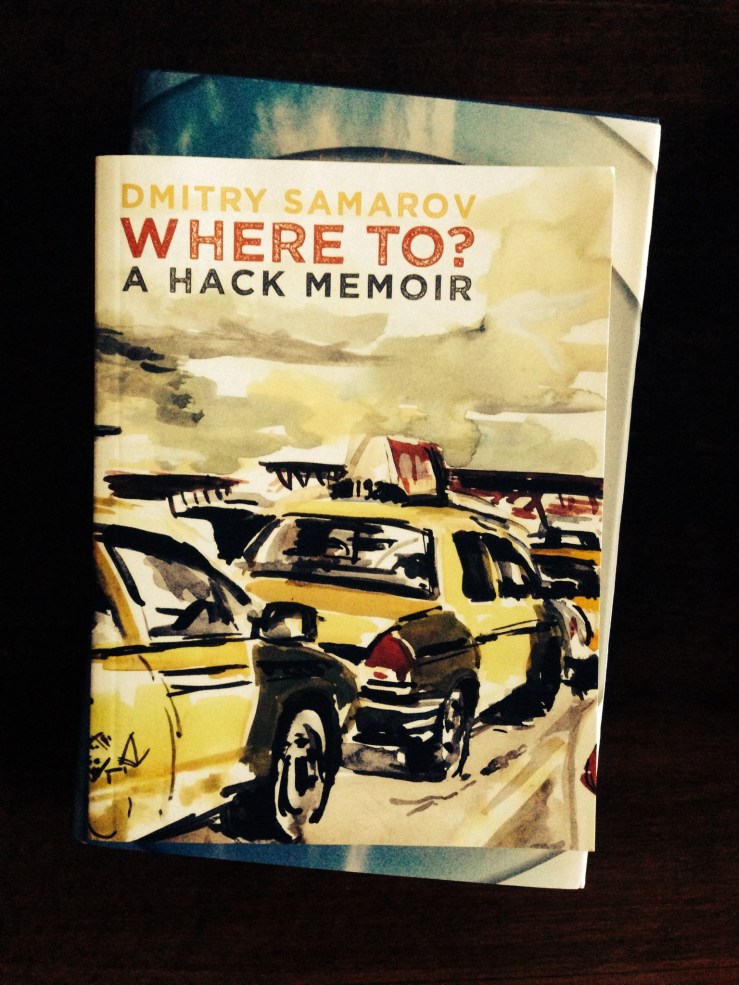
Dmitry Samarov’s Where To? (Book Acquired, 8.22.2014)

IMG_3209

Where To? A Hack Memoir is Dmitry Samarov’s sequel to Hack.

Publisher Curbside Splendor’s blurb:

Dmitry Samarov’s illustrated memoir captures encounters with drunken passengers, overbearing cops, unreasonable city bureaucracy, his fellow cabdrivers, a few potholes, and other unexpectedly beautiful moments. Accompanied by dozens of Samarov’s original artworks—composed during traffic jams, waits at the airport, and lulls in his shifts—the stories in Where To? provide a street-level view of America from the perspective of an immigrant painter driving a cab for money.

I interviewed Dmitry about his art and his writing a few years ago, and he described Hack:

Hack started as a zine around 2000 as a way for me to make sense of my three years driving a cab in Boston (1993-1997). It was called Hack because the license to operate a taxi in Boston was called a Hackney Carriage License and they used to call cabbies hacks in the old days. It was my first attempt at writing outside of school homework assignments and there really wasn’t much writing, it was mostly pictures. Those pictures were a challenge too because, as I’ve said, I work primarily from direct observation and the only way to do these were from memory. These illustrations were made to work together with the words, not to stand on their own and that has continued to be the case through the whole history of Hack.

I started driving a taxi in Chicago in 2003 and revived Hack as a blog late in 2006. To my surprise, it got notice pretty quickly from some in the local press—Whet Moser, then of theChicago Reader especially—-and my high school pal John Hodgman mentioning it in a magazine didn’t hurt either. That got it noticed by a publicist at University of Chicago Press named Levi Stahl. He bought a copy of my self-published compilation (see the third one down) and eventually pitched Hack as a book to his employers. They published it in October 2011.

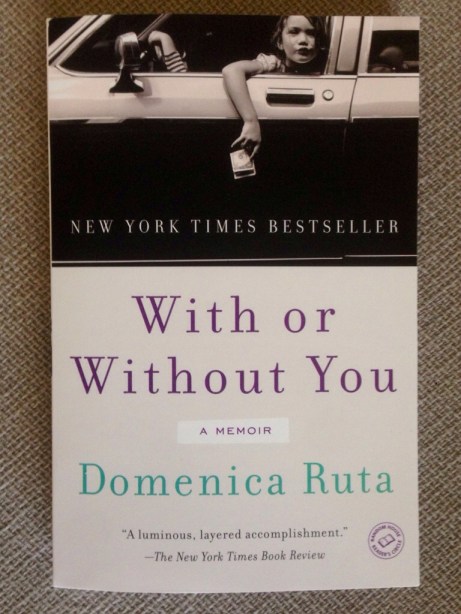
With or Without You (Book Acquired, 2.24.2014)

20140303-140548.jpg

Domenica Ruta’s memoir With or Without You is new in trade paperback next week from Random House. Their blurb:

Domenica Ruta grew up in a working-class, unforgiving town north of Boston, in a trash-filled house on a dead-end road surrounded by a river and a salt marsh. Her mother, Kathi, a notorious local figure, was a drug addict and sometimes dealer whose life swung between welfare and riches, and whose highbrow taste was at odds with her hardscrabble life. And yet she managed, despite the chaos she created, to instill in her daughter a love of stories. Kathi frequently kept Domenica home from school to watch such classics as theGodfather movies and everything by Martin Scorsese and Woody Allen, telling her, “This is more important. I promise. You’ll thank me later.” And despite the fact that there was not a book to be found in her household, Domenica developed a love of reading, which helped her believe that she could transcend this life of undying grudges, self-inflicted misfortune, and the crooked moral code that Kathi and her cohorts lived by.
 
With or Without You is the story of Domenica Ruta’s unconventional coming of age—a darkly hilarious chronicle of a misfit ’90s youth and the necessary and painful act of breaking away, and of overcoming her own addictions and demons in the process. In a brilliant stylistic feat, Ruta has written a powerful, inspiring, compulsively readable, and finally redemptive story about loving and leaving.

Son of a Gun (Book Acquired, 8.5.2013)

20130806-162848.jpg

Son of a Gun, Justin St. Germain’s memoir, explores the life and death of his mother, who was killed by her fifth husband. Here’s publisher Random House’s blurb:

Tombstone, Arizona, September 2001. Debbie St. Germain’s death in her remote trailer, apparently at the hands of her fifth husband, is a passing curiosity. “A real-life old West murder mystery,” the local TV announcers intone before the commercial break, while barroom gossips snicker cruelly. But for her twenty-year-old son, Justin St. Germain, the tragedy marks the line that separates his world into before and after.

Justin decides to confront people from his past and delve into the police records in an attempt to make sense of his mother’s life and death. All the while he tries to be the type of man she would have wanted him to be. Brutally honest and beautifully written, Son of a Gun is a brave, unexpected and unforgettable memoir.

Here’s Publishers Weekly’s write-up:

A young man wrestles with his heartache over his mother’s murder in this lacerating memoir of family dysfunction. St. Germain was a 20-year-old college student when his mother Debbie was shot to death in 2001 by her fifth husband in a desolate trailer in the Arizona desert, a disaster that threw into sharp relief the chaos of his working-class background. St. Germain revisits Debbie’s unstable life as an Army paratrooper and businesswoman, the string of men she took up with (some physically abusive), and his own boyhood resentment at their presence and at incessant domestic upheaval. Intertwined is a jaundiced, somewhat self-conscious meditation on St. Germain’s claustrophobic hometown of Tombstone—all sun-bleached ennui, arid hardpan, and tourist kitsch—and its presiding spirit, Wyatt Earp, archetype of the violent, trigger-happy machismo that he blames for killing his mother, yet feels drawn to as a touchstone of manhood. St. Germain makes harsh judgments of the men in his past (as well as of his sullen, callous adolescent self), but as he seeks them out later, he arrives, almost against his will, at a subtler appreciation of their complexities. At times his trauma feels more dutiful than deeply felt, but his memoir vividly conveys the journey from youthful victimization toward mature understanding.


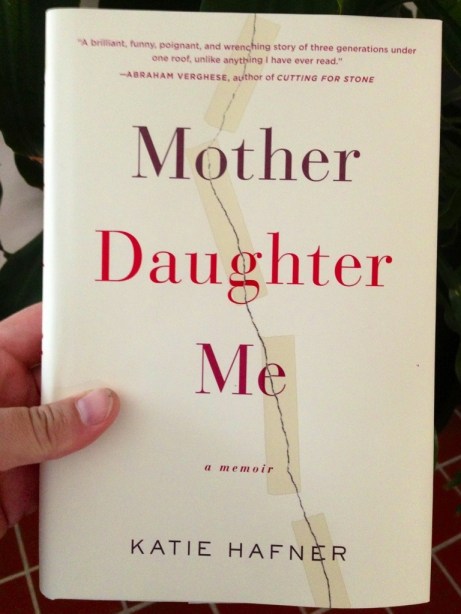
Mother Daughter Me (Book Acquired, 7.08.2013)

20130709-141434.jpg

Mother Daughter Me is Katie Hafner’s memoir, new in hardback from Random House. Their blurb:

The complex, deeply binding relationship between mothers and daughters is brought vividly to life in Katie Hafner’s remarkable memoir, an exploration of the year she and her mother, Helen, spent working through, and triumphing over, a lifetime of unresolved emotions.

Dreaming of a “year in Provence” with her mother, Katie urges Helen to move to San Francisco to live with her and Zoë, Katie’s teenage daughter. Katie and Zoë had become a mother-daughter team, strong enough, Katie thought, to absorb the arrival of a seventy-seven-year-old woman set in her ways.

Filled with fairy-tale hope that she and her mother would become friends, and that Helen would grow close to her exceptional granddaughter, Katie embarked on an experiment in intergenerational living that she would soon discover was filled with land mines: memories of her parents’ painful divorce, of her mother’s drinking, of dislocating moves back and forth across the country,  and of Katie’s own widowhood and bumpy recovery. Helen, for her part, was also holding difficult issues at bay.

How these three women from such different generations learn to navigate their challenging, turbulent, and ultimately healing journey together makes for riveting reading. By turns heartbreaking and funny—and always insightful—Katie Hafner’s brave and loving book answers questions about the universal truths of family that are central to the lives of so many.

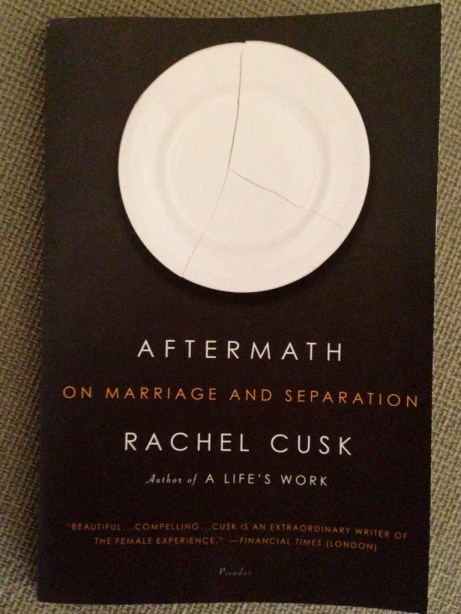
Aftermath (Book Acquired, 7.08.2013)

20130709-141450.jpg

When a review copy of Rachel Cusk’s memoir Aftermath: On Marriage and Separation (new in trade paperback from Picador) showed up the other day, a dim bulb went off—where did I know Cusk’s name? I’m not generally a fan of the memoir, so I doubt I’d read it. And then! Aha! Yes—it was a review of Cusk’s memoir that won Camilla Long this year’s “Hatchet Job of the Year” award.

From Long’s review (originally published in The Sunday Times):

The book is crammed with mad, flowery metaphors and hifalutin creative-writing experiments. There are hectic passages on Greek tragedy and the Christian concept of family, as well as fragments of ghost stories, references to the Anglo-Saxon heptarchy, and heavy Freudian symbolism, including a long description of the removal of a molar, “a large tooth,” she writes portentously, “of great…personal significance”. The final chapter is an out-of-body experience — her situation seen through the eyes of her pill-popping Eastern European au pair. Oddly, I read the whole thing in a Bulgarian accent.

I don’t know, that sounds pretty weird. Kinda intrigues me.


Still Points North (Book Acquired, 3.02.2013)

20130304-154858.jpg

Still Points North is Leigh Newman’s new memoir about growing up in Alaska. Publisher Random House’s blurb:

Part adventure story, part love story, part homecoming, Still Points North is a page-turning memoir that explores the extremes of belonging and exile, and the difference between how to survive and knowing how to truly live.

Growing up in the wilds of Alaska, seven-year-old Leigh Newman spent her time landing silver salmon, hiking glaciers, and flying in a single-prop plane. But her life split in two when her parents unexpectedly divorced, requiring her to spend summers on the tundra with her “Great Alaskan” father and the school year in Baltimore with her more urbane mother.

Navigating the fraught terrain of her family’s unraveling, Newman did what any outdoorsman would do: She adapted. With her father she fished remote rivers, hunted caribou, and packed her own shotgun shells. With her mother she memorized the names of antique furniture, composed proper bread-and-butter notes, and studied Latin poetry at a private girl’s school. Charting her way through these two very different worlds, Newman learned to never get attached to people or places, and to leave others before they left her. As an adult, she explored the most distant reaches of the globe as a travel writer, yet had difficulty navigating the far more foreign landscape of love and marriage.

In vivid, astonishing prose, Newman reveals how a child torn between two homes becomes a woman who both fears and idealizes connection, how a need for independence can morph into isolation, and how even the most guarded heart can still long for understanding. Still Points North is a love letter to an unconventional Alaskan childhood of endurance and affection, one that teaches us that no matter where you go in life, the truest tests of courage are the chances you take, not with bears and blizzards, but with other people.


Andrei Tarkovsky: The Collector of Dreams (Book Acquired, 12.29.2012)

20130107-202014.jpg

Layla Alexander-Garrett’s memoir Andrei Tarkovsky: The Collector of Dreams is new from Glagoslav. Their blurb:

The Sacrifice is Andrei Tarkovsky’s final masterpiece. The film was shot in Sweden, during the summer of 1985, while Tarkovsky was in exile; it turned out to be his final testament. Day after day, while the film was being made, Layla Alexander-Garrett – Tarkovsky’s on-site interpreter – kept a diary which forms the basis of her award-winning book Andrei Tarkovsky: The Collector Of Dreams. In this book the great director is portrayed as a real, living person: tormented, happy, inexhaustibly kind but at times harsh, unrelenting, conscience-stricken and artistically unfulfilled.

I’ve been riffling through it over the past few days. Alexander-Garrett describes her time with Tarkovsky in vivid detail—there’s a concrete richness to the book, and the author doesn’t try to psychoanalyze or interpret or otherwise interpose herself between the reader and the subject. More to come.