First kick | Riff 7 on rereading Herman Melville’s Moby-Dick (All Astir/Going Aboard/Merry Christmas)

Moby-Dick illustration by Barry Moser

I. Look. Moby-Dick is a long book. Not all of these riffs are gonna sing.

II. (I might have had a glass or two of red.)

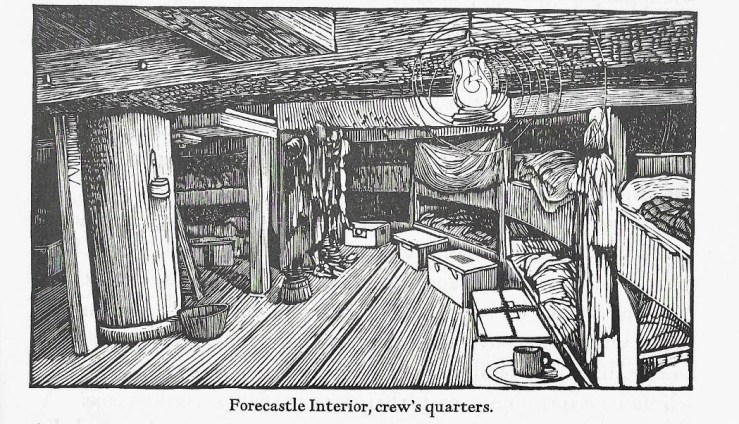
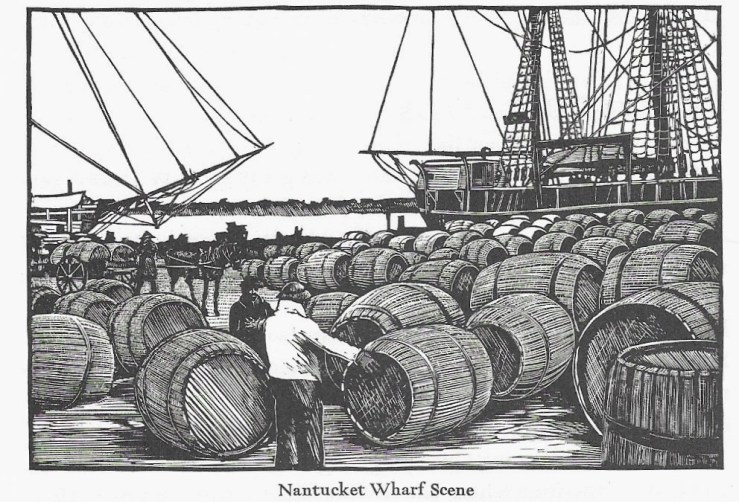
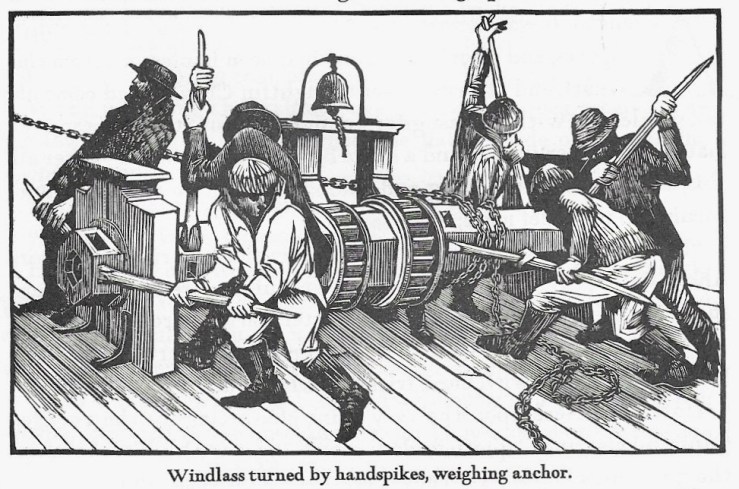
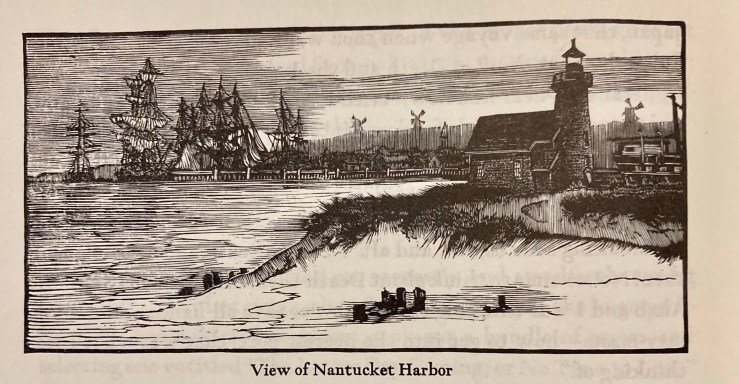
III. Chapters 20, 21, and 22 see The Pequod supplied, boarded, and piloted away from Nantucket out into the wide watery world. They are not especially memorable chapters.

Moby-Dick illustration by Barry Moser

IV. (There are a few choice lines in this ultrahomophallic novel: In “Going Aboard” (Ch. 21), Queequeg helps himself to a seat on a sleeping sailor’s seat: “He put his hand upon the sleeper’s rear, as though feeling if it was soft enough, and then, without more ado, sat quietly down there.” He promises not to hurt the sleepers face.

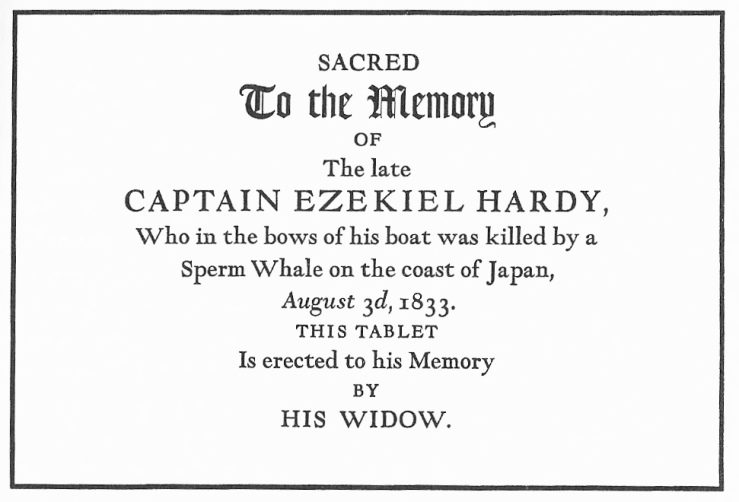
The rearing rerears in Ch. 22, “Merry Christmas,” when Ishmael declares: “I felt a sudden sharp poke in my rear.” It’s Captain Peleg kicking his ass. “That was my first kick,” Ishmael attests, a line that recalls his conversation with Peter Coffin of the Spouter Inn, who kicked his son out of the marriage bed. Paternal Peleg’s infanticidal foot foreshadows a shadowy future.)

Moby-Dick illustration by Barry Moser

V. (I’ll also point out that The Pequod departs on Christmas, linking it to Christ’s birth, linking the novel back to the resurrection theme I’ve been pointing out in these riffs—but yeah, that’s pretty obvious. I didn’t find much to ironize or problematize or whateverize the symbolism on this reread.)

VI. (And still in the parentheses, where I’ll keep most of this riff. We meet, sorta, but not really, Starbuck and Stubbs (but not Flask) in these chapters.)

VII. (Swearing in “Christmas” includes “sons of bachelors” and “Blood and thunder!”)

VIII. Look. Moby-Dick is a long book. Like I said, not all of these riffs are gonna sing.

But! The edition I’m reading this time has some wonderful illustrations by Barry Moser, and there were several for these (workmanlike, occasionally melancholy, not particular profound) chapters. They are dispersed in this brief riff.

Moby-Dick illustration by Barry Moser

IX. I look forward to getting out into the watery world…and the arrival of Ahab!


Humbug or bugbear | Riff 6 on rereading Herman Melville’s Moby-Dick (The Ramadan/His Mark/The Prophet)

Moby-Dick illustration by Barry Moser

I. In this riff: Ch. 17, “The Ramadan,” Ch. 18, “His Mark,” and Ch. 19, “The Prophet.”

II. “The Ramadan” again underscores Moby-Dick’s theme of death and resurrection. In Ch. 16, “The Ship,” Queequeg shuts himself up in his room to undertake a “sort of Lent or Ramadan, or day of fasting, humiliation, and prayer.” This “Ramadan” extends much further than Ish imagined it would, and he soon grows concerned that Queequeg may have fallen into “apoplexy.” He communicates his concerns to the inn’s chambermaid, who loses her head and yells for the proprietor, Mrs. Hussey, who loses her head in turn:

‘He’s killed himself,’ she cried. ‘It’s unfort’nate Stiggs done over again—there goes another counterpane—God pity his poor mother!—it will be the ruin of my house. Has the poor lad a sister? Where’s that girl?—there, Betty, go to Snarles the Painter, and tell him to paint me a sign, with—“no suicides permitted here, and no smoking in the parlor;”—might as well kill both birds at once. Kill? The Lord be merciful to his ghost!’

The scene plays comically—Queeg is perfectly fine—but the comedy is an ironic prefiguration of Queequeg’s fate in Moby-Dick’s strange, tragic climax.

III. At the beginning of “The Ramadan,” Ishmael claims a largehearted, ecumenical open-mindedness towards “everybody’s religious obligations, never mind how comical. Ishmael sings a very different tune at the end of the chapter, however:

 I labored to show Queequeg that all these Lents, Ramadans, and prolonged ham-squattings in cold, cheerless rooms were stark nonsense; bad for the health; useless for the soul; opposed, in short, to the obvious laws of Hygiene and common sense. I told him, too, that he being in other things such an extremely sensible and sagacious savage, it pained me, very badly pained me, to see him now so deplorably foolish about this ridiculous Ramadan of his. Besides, argued I, fasting makes the body cave in; hence the spirit caves in; and all thoughts born of a fast must necessarily be half-starved. This is the reason why most dyspeptic religionists cherish such melancholy notions about their hereafters. In one word, Queequeg, said I, rather digressively; hell is an idea first born on an undigested apple-dumpling; and since then perpetuated through the hereditary dyspepsias nurtured by Ramadans.

Is Ishmael’s viewpoint Melville’s authorial position? Or is Ishmael missing something in Queequeg’s mute devotions that Melville is asking us to pick up on?

IV. In “His Mark,” Ishmael introduces Queequeg to the Quaker captains Bildad and Peleg. Alarmed at his “savage” appearance, Peleg presses the pair for Queeg’s “papers” — for documentation that he’s converted to Christianity. Ish quickly supplies a lie, claiming that Queeg is “a member of the first Congregational Church,” but when pressed harder, turns his lie into a kind of truth of Emersonian over-soulism:

‘I mean, sir, the same ancient Catholic Church to which you and I, and Captain Peleg there, and Queequeg here, and all of us, and every mother’s son and soul of us belong; the great and everlasting First Congregation of this whole worshipping world; we all belong to that; only some of us cherish some queer crotchets no ways touching the grand belief; in that we all join hands.’

‘Splice, thou mean’st splice hands,’ cried Peleg, drawing nearer.

V. While the Quaker captains are impressed by Ishmael’s spiritual oratory, it’s Queequeg’s skill with the harpoon that earns the islander a place on The Pequod. After he demonstrates his acumen by harpooning a speck of tar floating on the water’s surface, Peleg offers him a job:

‘We must have Hedgehog there, I mean Quohog, in one of our boats. Look ye, Quohog, we’ll give ye the ninetieth lay, and that’s more than ever was given a harpooneer yet out of Nantucket.’

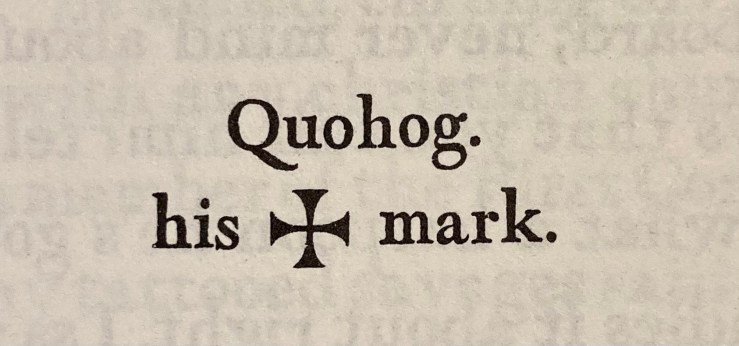
The chapter’s comic tone culminates in Queequeg signing his mark to a misappellation:

VI. As is so often the case in Moby-Dick, comedy shifts into more serious matters. Dour Bildad asks his comrade how he could not think of death and eternity in times of peril:

‘Tell me, when this same Pequod here had her three masts overboard in that typhoon on Japan, that same voyage when thou went mate with Captain Ahab, did’st thou not think of Death and the Judgment then?’

Peleg contrasts Bildad’s morose death-obsession with a drive to survive, to live:

‘Death and the Judgment then? What? With all three masts making such an everlasting thundering against the side; and every sea breaking over us, fore and aft. Think of Death and the Judgment then? No! no time to think about Death then. Life was what Captain Ahab and I was thinking of; and how to save all hands—how to rig jury-masts—how to get into the nearest port; that was what I was thinking of.’

VII. The next chapter is “The Prophet,” where leaving the Quaker captains, Ish and Queeg are immediately accosted by a severe-looking stranger:

 He was but shabbily apparelled in faded jacket and patched trowsers; a rag of a black handkerchief investing his neck. A confluent small-pox had in all directions flowed over his face, and left it like the complicated ribbed bed of a torrent, when the rushing waters have been dried up.

He asks if they’ve signed onto The Pequod, and tells them that they should worry about losing their souls, before mumbling that maybe a chap’s better off without one: “A soul’s a sort of a fifth wheel to a wagon.”

The stranger then warns them about Captain Ahab, who lost “his leg last voyage, according to the prophecy.” The stranger concedes that Ahab has enough soul to make up for all deficiencies of that sort in other chaps.”

Ishmael is not too alarmed by the man and asks for his name: Elijah. Named for the prophet who resisted evil Baal, Elijah is an ambiguous figure. Is he truly a prophet whose heedings should be followed, or simply a madman. Ishmael chooses to read him thus: “he was nothing but a humbug, trying to be a bugbear”; in other words, he was nothing but a hoaxer, trying to be a monster.

And yet the words Ishmael chooses phonetically splice into each other—humbugbear—pointing towards the novel’s shifting tones and ambiguous symbols. Elijah’s warnings have a strange effect on Ishmael:

…his ambiguous, half-hinting, half-revealing, shrouded sort of talk, now begat in me all kinds of vague wonderments and half-apprehensions, and all connected with the Pequod; and Captain Ahab; and the leg he had lost…and the voyage we had bound ourselves to sail; and a hundred other shadowy things.

A hundred other shadowy things to come.

Oblique hints | Riff 5 on rereading Herman Melville’s Moby-Dick (Nantucket/Chowder/The Ship)

Moby-Dick illustration by Barry Moser

I. Two short chapters followed by a rather long one, as we almost nearly maybe might head out on the great whaling voyage!

II. Ishmael and Queequeg arrive at their titular destination in “Nantucket,” Ch. 14.

Ish gives us a story—which I think is entirely fabricated, but I could be wrong—about Nantucket’s founding (emphasis mine):

Look now at the wondrous traditional story of how this island was settled by the red-men. Thus goes the legend. In olden times an eagle swooped down upon the New England coast, and carried off an infant Indian in his talons. With loud lament the parents saw their child borne out of sight over the wide waters. They resolved to follow in the same direction. Setting out in their canoes, after a perilous passage they discovered the island, and there they found an empty ivory casket,—the poor little Indian’s skeleton.

As I stated in my opening riff on rereading M-D, I believe that Melville’s novel can be read as a kind of grieving how against the genocidal scope of American culture. This genocide is frequently coded in infanticidal imagery, as well as images of lost children, orphans, and widows.

Ishmael’s (fanciful) version of the founding of Nantucket shows a US American emblem, the eagle, stealing and destroying an avatar of Indian futurity.

III. The motif of genocide shows up again (somewhat indirectly) in Ch. 16, “The Ship.” Queeg tasks Ish with choosing the ship they will sail on, and Ish chooses carefully (emphasis mine):

After much prolonged sauntering and many random inquiries, I learnt that there were three ships up for three-years’ voyages—The Devil-dam, the Tit-bit, and the Pequod. Devil-Dam, I do not know the origin of; Tit-bit is obvious; Pequod, you will no doubt remember, was the name of a celebrated tribe of Massachusetts Indians; now extinct as the ancient Medes. I peered and pryed about the Devil-dam; from her, hopped over to the Tit-bit; and finally, going on board the Pequod, looked around her for a moment, and then decided that this was the very ship for us.

The Pequod’s voyage symbolically re-enacts an American extinction agenda—an ill-fated, suicidal project with only one (apparent) survivor, saved in the end by the ship the Rachel, which, “in her retracing search after her missing children, only found another orphan.”

IV. Ishmael chooses The Pequod because of her gnarly outfitting:

She was apparelled like any barbaric Ethiopian emperor, his neck heavy with pendants of polished ivory. She was a thing of trophies. A cannibal of a craft, tricking herself forth in the chased bones of her enemies. All round, her unpanelled, open bulwarks were garnished like one continuous jaw, with the long sharp teeth of the sperm whale, inserted there for pins, to fasten her old hempen thews and tendons to.

Ish notes that The Pequod is a “noble craft, but somehow a most melancholy! All noble things are touched with that.”

V. Ish is a bit of a romantic, choosing his ship—and, significantly, his partner Queequeg’s fate—-because of its aesthetic.

As a romantic, he tends to read a bit much into the signs and wonders of the world. In Ch. 15, “Chowder,” Melville has ironic fun with Ish’s tendency toward foreshadowing and symbolic overdeterminism.

On a tip, Ish and Queeg head to the Try Pots for some grub and find—

Two enormous wooden pots painted black, and suspended by asses’ ears, swung from the cross-trees of an old top-mast, planted in front of an old doorway. The horns of the cross-trees were sawed off on the other side, so that this old top-mast looked not a little like a gallows. Perhaps I was over sensitive to such impressions at the time, but I could not help staring at this gallows with a vague misgiving. A sort of crick was in my neck as I gazed up to the two remaining horns; yes, two of them, one for Queequeg, and one for me. It’s ominous, thinks I. A Coffin my Innkeeper upon landing in my first whaling port; tombstones staring at me in the whalemen’s chapel; and here a gallows! and a pair of prodigious black pots too! Are these last throwing out oblique hints touching Tophet?

It turns out that this place has some delicious fucking chowder.

And, for the most part, all of the slight events at the Try Pots skewer towards comedy, ironizing Ish’s gloomy symbolic reading of the events of his journey thus far.

And yet!

Ish’s choice of words at the end of his forecasting is telling: “Are these last throwing out oblique hints touching Tophet?”

While “Tophet” (and, alternately, “Tophet,” “Topheth,” and “Topeth”) might generically be defined as “hell,” the meaning here is more distinct. For Ishmael, the giant pots signal the sacrificial roasting of children. “Tophets” were ancient infant burial grounds, but both legend and scholarship suggest these burials were the resort of ritual sacrifice. Infanticide again.

VI. And yet much of “Chowder” is comical and delicious. Ishmael, prompted with “Clam or Cod” by the owner of the Try Pots, showcases the horror we all face when failing to order correctly at some semi-famous local dive where we are not a local:

‘A clam for supper? a cold clam; is that what you mean, Mrs. Hussey?’ says I, ‘but that’s a rather cold and clammy reception in the winter time, ain’t it, Mrs. Hussey?’

Ish and Queeg devour the chowder.

VII. Mrs. Hussey is, unless I am mistaken, the first woman to speak in Moby-Dick. There are very few others. The novel is heavy-phallic, homo-horny, pricking stiff with spears and dripping in (whale) sperm. I hope it is not uninviting.

VIII. I remarked a bit above on Ch. 16, “The Ship,” mostly focusing on the nomenclature of The Pequod. It’s a long chapter and introduces two comical characters, the Quaker captains Peleg and Bildad, who own the majority shares in The Pequod.

IX. (As an aside, in response to the last bit of language above, id est, majority shares—look, Moby-Dick is full of economic metaphors and the language of commerce. It is a novel that reckons with American capitalism, repeating phrases like shares and insurance in a way divorced from actual dollars and cents—in Moby-Dick capitalism becomes some kind of extended metaphor that I haven’t fully thought through, but, if I had to say something now, as I type this in a bit of a rush, I might write something like, Melville ironically maps terms of American capitalism over transcendentalist ideology, e.g. Emerson’s “Over-Soul.” Not sure what that last sentence means, but there’s clearly a relationship between religion/soul and insurance/bodily life in M-D that I haven’t thought about much before this reread. I might riff more on these going forward.)

X. “The Ship” is full of humor but also dark foreshadowing. We get the name “Ahab” but no formal introduction. Still, Ishmael is put off by the name: “When that wicked king was slain, the dogs, did they not lick his blood?”

But Peleg puts Ish in his place: “Captain Ahab did not name himself,” he points out. We are all called into the world by signs and symbols that we neither created nor chose.

“Ahab has his humanities,” Peleg concludes, asking both Ish and we readers to find kernels of sympathy for the mad captain (“he ain’t sick; but no, he isn’t well either“).

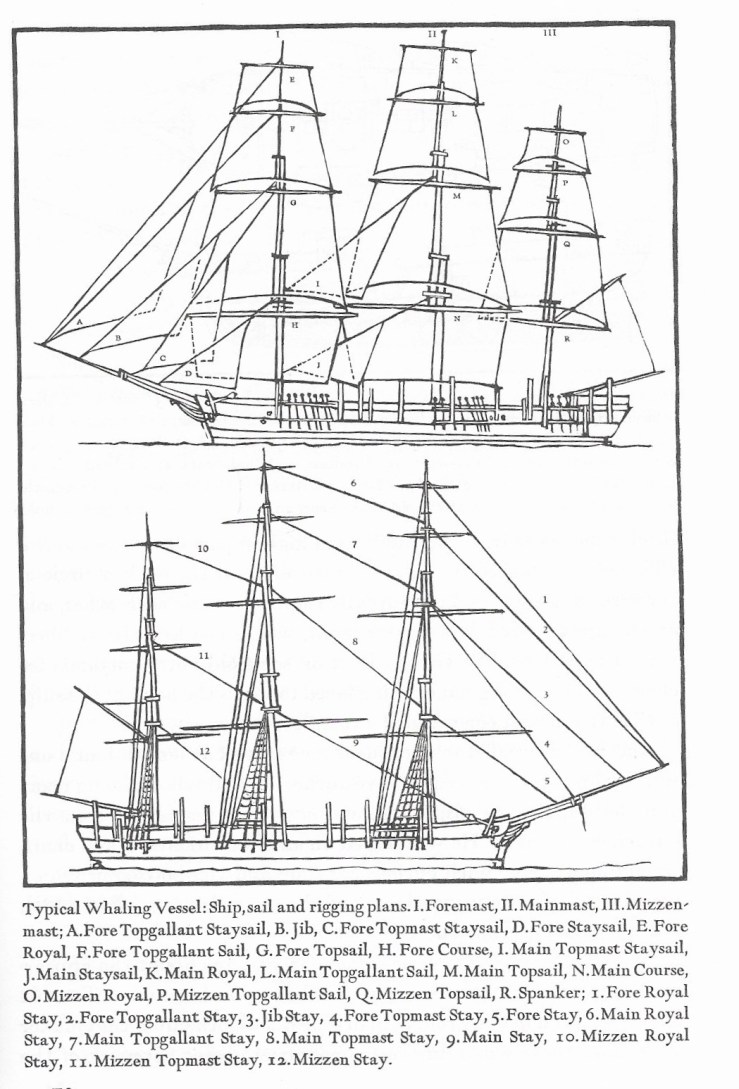
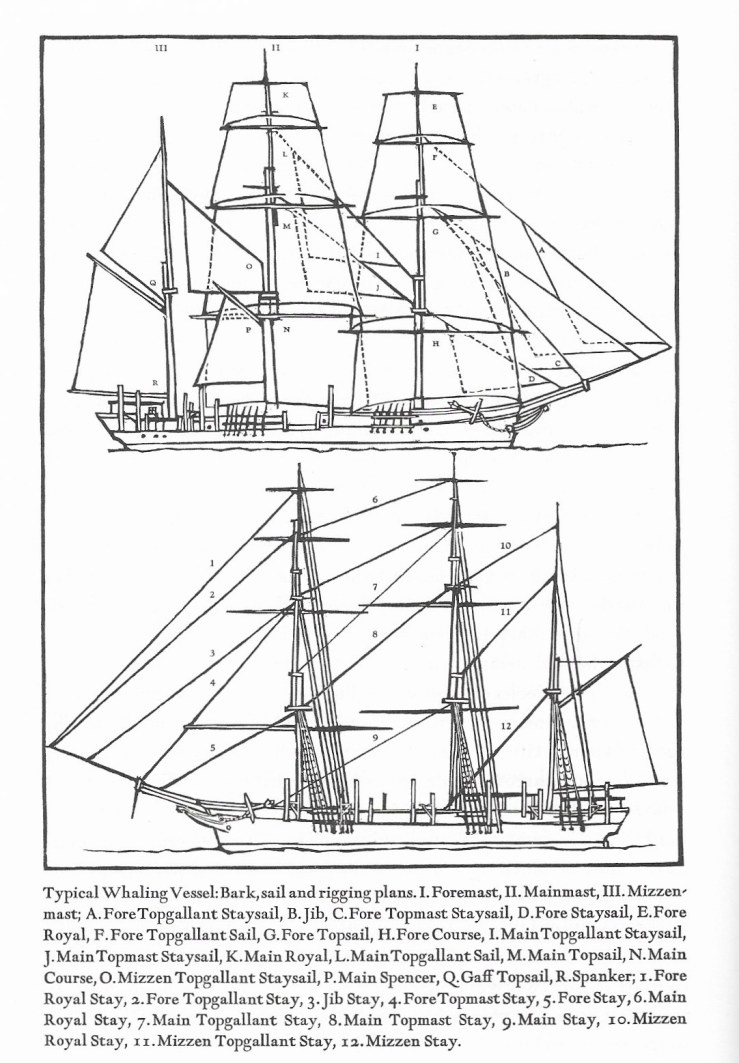
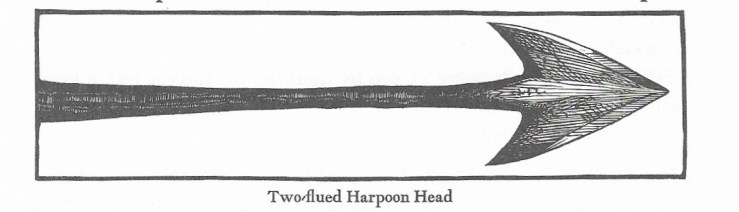
XI. Let me close with Barry Moser’s wonderful diagrams of “The Ship”:

No more my splintered heart and maddened hand were turned against the wolfish world | Riff 4 on rereading Herman Melville’s Moby-Dick (A Bosom Friend/Nightgown/Biographical/Wheelbarrow)

Moby-Dick illustration by Barry Moser

I. “A Bosom Friend” (Ch. 10)  is another one of the remarkable key early chapters of Moby-Dick. It twins Ch. 4, “The Counterpane,” book-ending Ishmael’s Wild New Bedford Nights with Queequeg.

II. While Ishmael’s largehearted acceptance and quick love for Queequeg probably does not seem as eccentric to contemporary readers as it might have been to Melville’s 1851 audience, it’s nevertheless an enduring emblem of Moby-Dick’s expansive spirit.

“Better sleep with a sober cannibal than a drunken Christian,” Ish intones in Ch. 3; by Ch. 10, he admiringly attests that, “Queequeg was George Washington cannibalistically developed.” In a curt but not impolite dismissal of his own culture’s moral compass, Ish declares he’ll, “try a pagan friend…since Christian kindness has proved but hollow courtesy.” Like Huck Finn, another American prototype who wishes to escape into the wild, Ishmael will always value raw truth over empty artifice.

III. There are so many good lines in “A Bosom Friend,” but I think this must be my favorite:

…I began to be sensible of strange feelings. I felt a melting in me. No more my splintered heart and maddened hand were turned against the wolfish world.

Ishmael claims that Queequeg, a “soothing savage” has “redeemed” the world for him.

IV. It is more than possible (and so much has been written on M-D that I’m sure much has been made on the topic) that Ish (and Melville) has (have) taken what might be a complex and nuanced character in Queequeg and othered it into a flat projection screen.

Ishmael, who finds “no civilized hypocrisies and bland deceits” in Queeg, might be accused of turning his bosom friend into a romanticized avatar of Ish’s own desire for a noble “savage” unconstrained by the dictates of Christian morality. However, the events of the novel and its developed characterization of Queequeg do not merit such a facile reading (or is my estimation at this point).

V. Indeed—and to jump ahead, maybe—in Ch. 12, “Biographical,” we learn Queequeg’s origin story.

Queeg is a prince of “Rokovoko, an island far away to the West and South.”

Pause a moment, and look it up, seek it out.

(Wait! “It is not down in any map; true places never are.”)

Queequeg desires to travel the world in the hopes of advancing his culture, and, like so many folks in M-D, runs away to sea (to see). However, his time on whaleboats and in ports of the western world soon soon reveal to him that “it’s a wicked world in all meridians.”

He decides to “die a pagan.”

VI. Notably and necessarily, Queequeg’s “Biographical” chapter is delivered entirely in Ishmael’s voice (unlike Ch. 9, “The Sermon,” where Father Mapple overtakes the narrative).

Queequeg is always a linguistic outsider in M-D—and indeed, an outsider in general, an outsider among outsiders—but also a superhuman superhero, as the events of Ch. 13, “The Wheelbarrow,” show.

VII. I seem to be skipping around, so, fine, okay—

—in “The Wheelbarrow,” Ish and Queeg take a packet schooner from New Bedford to Nantucket, where they plan to join a whaling ship’s crew. On the schooner, one of the several “boobies and bumpkins” aboard mocks Queequeg. Queeg catches ahold of the redneck and tosses him playfully into the air, leaving him shaken but unhurt. Captain, crew, and passengers threaten the “devil” outsider, but chaos erupts when the main-sail’s boom sets loose due because of high winds. The boom knocks the redneck into the ocean. Others panic; Queeg calmly secures the spar dives into the ocean, and rescues his mocker: “The poor bumpkin was restored,” Ishmael remarks. He then tells us that “From that hour I clove to Queequeg like a barnacle; yea, till poor Queequeg took his last long dive,” foreshadowing that not all are to be resurrected in Moby-Dick.

VIII. (Or, alternately—all are to be resurrected in Moby-Dick, but only through Ishmael’s wailing tale.)

IX. But I have skipped around so much—back to Ch. 10, “A Bosom Friend.” In one of the more-remarked upon moments in the book, Ish and Queeg tie the knot after a good smoke:

…he pressed his forehead against mine, clasped me round the waist, and said that henceforth we were married; meaning, in his country’s phrase, that we were bosom friends; he would gladly die for me, if need should be. In a countryman, this sudden flame of friendship would have seemed far too premature, a thing to be much distrusted; but in this simple savage those old rules would not apply.

X. Ishmael then, through a kind of tortuous logic, describes why he, “a good Christian; born and bred in the bosom of the infallible Presbyterian Church,” “must turn idolator” and pray to Queeg’s pagan idol. It’s what God would want him to do, see? Ishmael’s logic is predicated on two simple principles:

–He is “to do to my fellow man what I would have my fellow man to do to me”

and

–“Queequeg is my fellow man”

For me, the remarkable part of Ishmael’s commitment to Queequeg isn’t the first Jesusian imperative to do unto others—it is, in other terms, to recognize the other as a fellow man.This recognition is the moral imperative of Moby-Dick.

XI. And then a sweet ending: “Thus, then, in our hearts’ honeymoon, lay I and Queequeg—a cosy, loving pair.”

XII. “Nightgown,” Ch. 11, is a short chapter where something remarkable and likely inexplicable occurs: Ishmael and Queequeg learn to communicate.

And not just communicate at the level of base transaction or simple need, but rather share philosophical and even aesthetic viewpoints, as born out in the details of Queequeg’s story in Ch. 12, “Biographical.” Again, we might criticize Ishmael as ventriloquizing Queequeg, painting his own broad romantic visions over the possibility of a complex and nuanced character that Melville can’t muster. But I ultimately believe—or at least, I believe up until now on this reread—that Ish and Queeg’s accelerated ability to communicate points to an aspirational transcendental horizon, post-culture, post-language.

XIII. “Nightgown” also has one of my favorite moments in Moby-Dick, a little riff by Ishmael that anticipates the deconstruction of oppositions we later locate in the work of late twentieth-century language theorists:

We felt very nice and snug, the more so since it was so chilly out of doors; indeed out of bed-clothes too, seeing that there was no fire in the room. The more so, I say, because truly to enjoy bodily warmth, some small part of you must be cold, for there is no quality in this world that is not what it is merely by contrast. Nothing exists in itself. If you flatter yourself that you are all over comfortable, and have been so a long time, then you cannot be said to be comfortable any more. But if, like Queequeg and me in the bed, the tip of your nose or the crown of your head be slightly chilled, why then, indeed, in the general consciousness you feel most delightfully and unmistakably warm.

XIV. (As a final note—I remembered this passage in Thanksgiving, 2020, after receiving a very sad text message from my aunt, who we would not be seeing that year, after having not seen her for July 4th—like so many other people feeling the smallbig losses of the year, of the absences of festival and visitation—but also feeling those traditions of festival and visitation so much dearer and warmer in their absence. Nothing exists in itself.)

All these things are not without their meanings | Riff 3 on rereading Herman Melville’s Moby-Dick (Breakfast/The Street/The Chapel/The Pulpit/The Sermon)

I. Chapters 5 through 8 of Moby-Dick are all pretty short and showcase the novel’s ever-shifting moods. Ch. 5, “Breakfast,” brims with humor and energy, which extends through Ch. 6, “The Street.” However, by the time we get off the street and into “The Chapel” (Ch. 7), Ishmael takes a sober, somber turn, meditating on death. Ch. 8, “The Pulpit,” continues the serious, philosophical tone, setting the stage for Father Mapple to take over the narrative in Ch. 9, “The Sermon.”

II. “Breakfast” begins with Ishmael forgiving the landlord Peter Coffin for “skylarking with me not a little in the matter of [Ish’s] bedfellow,” Queequeg. Ish values the humor:

…a good laugh is a mighty good thing, and rather too scarce a good thing; the more’s the pity. So, if any one man, in his own proper person, afford stuff for a good joke to anybody, let him not be backward, but let him cheerfully allow himself to spend and be spent in that way. And the man that has anything bountifully laughable about him, be sure there is more in that man than you perhaps think for.

“Breakfast” has a bustling comic energy. Ish describes the various whalemen setting down to eat: “a brown and brawny company, with bosky beards; an unshorn, shaggy set, all wearing monkey jackets for morning gowns.” (I encourage you to read that line aloud.) We also get the spectacle of Queequeg, “cool as an icicle,” eating bloody beefsteaks at the head of the table—with his harpoon no less!

Moby-Dick illustration by Barry Moser

III. The comedic energy carries out into “The Street.” Here, Ishmael describes for us a carnival of cultures in New Bedford, a pavement teeming with “Feegeeans, Tongatobooarrs, Erromanggoans, Pannangians, and Brighggians” as well as “other sights still more curious, certainly more comical.” He gently mocks “the green Vermonters and New Hampshire men,” who head to New Bedford “athirst for gain and glory in the fishery,” pointing out their tendencies to overdress: “No town-bred dandy will compare with a country-bred one—I mean a downright bumpkin dandy.” Ish’s portrait of New Bedford extends to a description of its wealth and its beautiful homes, parks—and women. We get the sense that he’s over those “hypos” he was suffering in the novel’s opening chapter—or, rather, he’s intoxicated by the newness of his adventure.

IV. The atmospheric shift in “The Chapel,” is announced with a change in weather: “The sky had changed from clear, sunny cold, to driving sleet and mist.” Ishmael makes his way to a church peopled by “a small scattered congregation of sailors, and sailors’ wives and widows.” (A “scattered congregation” strikes me as an oxymoron.)

In strong contrast to the babble and verve of the two preceding chapters, in the chapel “muffled silence reigned, only broken at times by the shrieks of the storm.”

Ishmael gazes upon marble placards memorializing dead sailors, sailors who never returned, and reflects,

Oh! ye whose dead lie buried beneath the green grass; who standing among flowers can say—here, here lies my beloved; ye know not the desolation that broods in bosoms like these. What bitter blanks in those black-bordered marbles which cover no ashes! What despair in those immovable inscriptions! What deadly voids and unbidden infidelities in the lines that seem to gnaw upon all Faith, and refuse resurrections to the beings who have placelessly perished without a grave.

The line “refuse resurrections” calls back to Ch. 4, “The Counterpane,” where Ishmael gives us a rare glimpse into his past. Punished as a child to a kind of small death on the summer solstice (okay, he’s made to go to bed early)—the punished Ish hopes for a “resurrection” from his fate and is visited by some “nameless, unimaginable, silent form or phantom,” an ineffable something that simultaneously signals dread and hope.

Ishmael’s morbid pondering turns philosophical:

…how it is that we still refuse to be comforted for those who we nevertheless maintain are dwelling in unspeakable bliss; why all the living so strive to hush all the dead; wherefore but the rumor of a knocking in a tomb will terrify a whole city. All these things are not without their meanings.

And then in bit of foreshadowing of the book’s catastrophic conclusion, our narrator, thinking of the countless sailors lost and dead at sea, indulges in a bit of self-talk: “Yes, Ishmael, the same fate may be thine.”

V. “The Pulpit” isn’t a particularly memorable chapter, but it serves a significant rhetorical purpose. “The Chapel” gives us some of Ish’s most melancholy philosophizin’, culminating in self-talk about his own death. It’s an introspective, insular chapter; indeed, even as Ishmael furnishes us the details of the memorial placards, he confesses that he does “not pretend to quote.” Ish’s concern is ultimately not for the concrete particulars but for the abstract—the unnamed and unknown dead.

“The Pulpit” refocuses the narrative gaze, moving from Ishmael’s introspection to the imagery of Father Mapple ascending the stage to deliver his sermon.

VI. “The Sermon” is one of many chapters of Moby-Dick that can be read independent of the novel proper. It is one of my favorite chapters. Up until this point, we’ve largely been in Ishmael’s head, and the spare voices we get—a few lines of pidgin from Queequeg, some bantering with Peter Coffin—have the feel of reported speech. In “The Sermon” though, Ish’s consciousness gives way to Father Mapple’s. Mapple retells the story of Jonah in rapt detail, bringing “this book, containing only four chapters—four yarns—” to vivid life. His Jonah is a sympathetic deject on the run who finds himself resurrected in the belly of a whale.

Mapple’s sermon quickly edges out any of Ishmael’s stage directions, flowing out uninterrupted for paragraphs. It usurps the voice of the novel, prefiguring Ahab, whose voice will dominate in future chapters. Ghostly Ishmael seems to fall into the background of his own adventure at times, and “The Sermon” is an early rhetorical example of this phenomenon.

As Mapple’s sermon comes to its conclusion, Ishmael returns to the narrative, but he’s still at a distance, still a mechanical describer of sights and sounds, not an analyzer or thinker here.

And it’s the final line of the chapter that stuck out to me the most in this reread:

He said no more, but slowly waving a benediction, covered his face with his hands, and so remained kneeling, till all the people had departed, and he was left alone in the place.

If he is truly alone, then how does Ishmael witness his solitude?

Nameless, unimaginable, silent form or phantom | Riff 2 on rereading Herman Melville’s Moby-Dick (The Carpet-Bag/The Spouter-Inn/The Counterpane)

I. Much has been made of Ishmael’s first night with Queequeg, and I don’t aim to add to it in any estimable way. Ch. 4 of Moby-Dick—what I take to be a key chapter, although there are probably too many supposed keys to this great big book—Ch. 4 of Moby-Dick, “The Counterpane,” begins: “Upon waking next morning about daylight, I found Queequeg’s arm thrown over me in the most loving and affectionate manner.”

II. (Later Ish refers to Queeg’s “bridegroom clasp”; in the previous chapter, he tells us that he “never slept better in [his] life” — this after initially finding it impossible to fall asleep in Peter Coffin’s old bed, its mattress possibly “stuffed with corn-cobs or broken crockery.”)

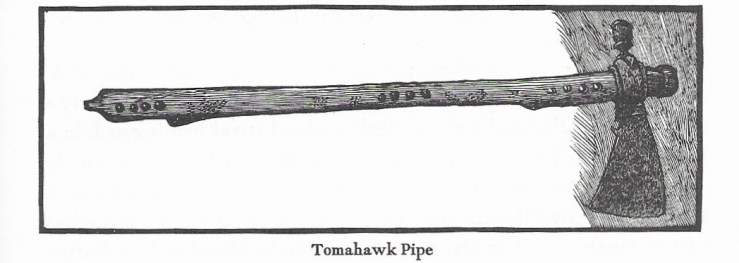
III. Like I said, much has been made of Ish & Queeg, and I don’t know what else I can say. I just love it. I love Ishmael’s initial horror, his yelling for landlord Coffin, his quick realization that his prejudices might be undone via first-hand/eye experience. “Better sleep with a sober cannibal than a drunken Christian,” he tells us, even if he’s wary of Queeg smoking his tomahawk pipe in bed: “It’s dangerous. Besides, I ain’t insured.”

Moby-Dick illustration by Barry Moser

IV. (M-D might be like the main American text in homosocial studies, I guess.)

V. Let’s come back to that key chapter “The Counterpane” in a moment—how about chapters 2 and 3, “The Carpet-Bag” and “The Spouter-Inn”? I guess here is a good place to be clear,

I don’t know who these riffs are for. I mean, I hope if you’ve never read Moby-Dick they make you want to read it and if you’ve read it before maybe it’ll spark you to read again. I don’t want this to just be me summarizing the book. Let me release my anxiety by leaving the italics and maybe opening a new numeral—

VI. “The Carpet-Bag”:

Ish leaves “Manhatto” and arrives in New Bedford, although he’s too late to make it to Nantucket to join the crew of a whaler and fulfill his mission of Not Being Suicidal. The chapter ends with this remarkable paragraph:

Now, that Lazarus should lie stranded there on the curbstone before the door of Dives, this is more wonderful than that an iceberg should be moored to one of the Moluccas. Yet Dives himself, he too lives like a Czar in an ice palace made of frozen sighs, and being a president of a temperance society, he only drinks the tepid tears of orphans.

The Lazarus theme twists all through M-D, right through its cataclysmic ending. It’s clearly there from the opening paragraphs—Ish’s wishes to revive himself—but this is the first overt reference.

VII. The resurrection motif is enriched in “The Counterpane.”

VIII. (Quote above—I really just love the imagery of rich boy Dives who “only drinks the tepid tears of orphans”! And the knock on his being in a temperance society!)

IX. “The Spouter-Inn”: A nice bit of worldbuilding, as the kids might say (M-D is surely a phantasy).

Proprietor Peter Coffin (“Coffin?—Spouter?—Rather ominous in that particular connexion”)—Peter Coffin is far funnier than I remembered. He fucks with Ish, setting him up for a night with Queeg, who’s been out selling a shrunken head. (In a marvelous little episode, he begins to sand down a dining bench for Ish to sleep on.)

Coffin (a carpenter of sorts) prefigures much of the death/rebirth theme to come in M-D. He also tiptoes the novel’s comic-tragic-something-else axis; his initial japes and jabs at Ish in this chapter give way to a heartfelt moment of near-tragedy, as he explains the origin of the bed Ish will share with Queeg:

—it’s a nice bed; Sal and me slept in that ere bed the night we were spliced. There’s plenty of room for two to kick about in that bed; it’s an almighty big bed that. Why, afore we give it up, Sal used to put our Sam and little Johnny in the foot of it. But I got a dreaming and sprawling about one night, and somehow, Sam got pitched on the floor, and came near breaking his arm. Arter that, Sal said it wouldn’t do.

The marriage bed is spliced to infanticidal violence, to the violent exclusion of children.

Moby-Dick illustration by Barry Moser

X. So let’s get to Ch. 4, to “The Counterpane,” Ishmael’s first night with Queequeg in ole Coffin’s marriage bed.

XI. I wrote “first night” above, but that’s wrong—it’s first morning I mean—the first morning after the first night. The day after.

XII. And yesterday, I wrote, in a riff on rereading M-D, that we get to know little of Ishmael’s past. I think that that statement’s true, but Ish does give us crucial information about the worst moment of his life, a kind of founding trauma that the rest of the novel’s quest might be set against.

XIII. Forgive the long quote:

My sensations were strange. Let me try to explain them. When I was a child, I well remember a somewhat similar circumstance that befell me; whether it was a reality or a dream, I never could entirely settle. The circumstance was this. I had been cutting up some caper or other—I think it was trying to crawl up the chimney, as I had seen a little sweep do a few days previous; and my stepmother who, somehow or other, was all the time whipping me, or sending me to bed supperless,

—Okay I have to pause here and ask—Why chimney?

XIV. Continue, Ish:

—my mother

Wait — “my mother”? Not “stepmother”?

XV. –sorry–

…my mother dragged me by the legs out of the chimney and packed me off to bed, though it was only two o’clock in the afternoon of the 21st June, the longest day in the year in our hemisphere. I felt dreadfully. But there was no help for it, so up stairs I went to my little room in the third floor, undressed myself as slowly as possible so as to kill time, and with a bitter sigh got between the sheets.

Our boy Ish is punished, sent to relinquish his consciousness (and any and all adventuring) on the summer solstice.

XVI. He continues (again, emphasis mine):

I lay there dismally calculating that sixteen entire hours must elapse before I could hope for a resurrection. Sixteen hours in bed! the small of my back ached to think of it. And it was so light too; the sun shining in at the window, and a great rattling of coaches in the streets, and the sound of gay voices all over the house.

Ish is without hope here. No Lazarus thing, no resurrection dealie. And all in the whitest brightest light. This in the satanic dark black white novel Moby-Dick.

XVII. Lil’ Ish’s trauma intensifies, and he begs reprieve from the wicked step-mom, but “she was the best and most conscientious of stepmothers, and back I had to go to my room.”

XVIII. He continues; the bold-face emphasis is mine:

For several hours I lay there broad awake, feeling a great deal worse than I have ever done since, even from the greatest subsequent misfortunes.

And then Ishmael has this wild nightmare-not-epiphany:

At last I must have fallen into a troubled nightmare of a doze; and slowly waking from it—half steeped in dreams—I opened my eyes, and the before sun-lit room was now wrapped in outer darkness. Instantly I felt a shock running through all my frame; nothing was to be seen, and nothing was to be heard; but a supernatural hand seemed placed in mine.

XIX. (Melville hits on the terror of a metaphysical encounter here, a phantom moment encoded into a childhood consciousness that cannot name what is happening to it.)

XX: And then Lil’ Ish’s counterpane of days past entangles with the current counterpane of “The Counterpane” in an

My arm hung over the counterpane, and the nameless, unimaginable, silent form or phantom, to which the hand belonged, seemed closely seated by my bed-side. For what seemed ages piled on ages, I lay there, frozen with the most awful fears, not daring to drag away my hand; yet ever thinking that if I could but stir it one single inch, the horrid spell would be broken. I knew not how this consciousness at last glided away from me; but waking in the morning, I shudderingly remembered it all, and for days and weeks and months afterwards I lost myself in confounding attempts to explain the mystery. Nay, to this very hour, I often puzzle myself with it.

XXI. (That “nameless, unimaginable, silent form or phantom” — prefiguration of Moby-Dick? of Ahab? of the cruel wet cold world? or just a child’s small big fears?)

XXII. (In any case, this seems to be Ishmael’s epiphanic founding trauma.)

XXIII. And to bring it back to where I started,

Much has been made of Ishmael’s first night with Queequeg.

Let’s end on the morning after—a kind of healing epiphany, coded in otherness, exploration, and strange love:

Now, take away the awful fear, and my sensations at feeling the supernatural hand in mine were very similar, in their strangeness, to those which I experienced on waking up and seeing Queequeg’s pagan arm thrown round me.

The great flood-gates of the wonder-world swung open | Riff 1 on rereading Herman Melville’s Moby-Dick (Etymology/Extracts/Loomings)

Moby-Dick illustration by Barry Moser


I. I last reread Herman Melville’s 1851 novel Moby-Dick in full way back in 2013.

II. I’ve read chunks and excerpts of it over the intermittent seven years though—there’s always some bit in it that calls to me, prompted by events personal, political, cultural. I read Melville’s 1846 novel Typee during the beginning of 2020’s quarantine, and knew I’d need to reread M-D in full sooner than later.

III. (Why later, why now? I guess I made this kinda sorta tacit promise to myself not to reread in 2020—to expand my palate, to go past all the Dead White Guys.)

IV. I started Moby-Dick this afternoon. I read the two opening salvos, “Etymology” and “Extracts,” and then the first chapter, “Loomings.”

V. (I have read that some folks skip the “Extracts”: No.)

VI. I started Moby-Dick in an edition that I bought years ago but haven’t actually read: the California UP/Arion Press edition with Barry Moser illustrations. It’s lovely—grand, generous, rich on the page.

VII. So I’ve probably read “Etymology” more than any other section of M-D. It was certainly the section I messed around with for years before reading the actual novel in full. The etymology has supposedly been given to the author of M-D — HM? Ishmael? Some other ghost — by a “pale Usher” (not Poe’s), “threadbare in coat, heart, body, and brain…” The poor fellow “loved to dust his old grammars; it somehow mildly reminded him of his mortality.”

VIII. I don’t dwell on the pale Usher, but I’ve long found the next line of “Etymology” fascinating. It’s a quote attributed to the sixteenth-century English author Richard Hakluyt:

While you take in hand to school others, and to teach them by what name a whale-fish is to be called in our tongue, leaving out, through ignorance, the letter H, which almost alone maketh up the signification of the word, you deliver that which is not true.

A former teacher of mine, A. Samuel Kimball (who I am forever indebted to for teaching me to read again) made much of this citation. For Kimball, the foregrounding of the “H” calls attention to one of Melville’s central themes: whaling as wailing—Moby-Dick as a wail, a grief, maybe a resistance to the infanticidal, genocidal scope of American culture. Ishmael, an orphan, goes to sea to resist his suicide-impulse on a ship named after a near-extinct tribe of American Indians. Ishmael, whose very name is marks him, at least in the KJV context Melville was working within, as the rejected son of the patriarch Abraham. In the novel’s last moments, Ishmael is saved (is he though?) by the ship the Rachel, which, “in her retracing search after her missing children, only found another orphan.”

IX. (Whale-wail / whiteness-witness. Etc. etc.)

X. And those “Extracts,” supplied by a “burrower and grub-worm of a poor devil of a Sub-Sub” — who’s the dom?

XI. I remembered the “Extracts” more fondly than I experienced them.

I just really wanted to get into Ishmael’s head (voice). (And then get out of it, into the drama of Ahab and His Whale.)

XII. And so I got into Ishmael’s head (voice).

XIII. “Loomings” is such a great, great, perfect chapter, and the joy in re-reading Melville is having already worked out most of the plot kinks. Instead of dwelling on What is happening? you can experience What is.

XIV. (I always forget how terribly sad poor Ish is at the outset of M-D. He’s depressed, suffering from hypos, the spleen. He’s not just suicidal, he’s homicidal, wanting to step in the street and knock people’s hats off.)

XV. One of the fascinating things about Moby-Dick, at least in my memory of it, which maybe I’ll expand upon in riffs on this reread, is how little we get to know Ishmael. Like his wanderer namesake, he’s an outsider who, despite taking us in to his tale, nevertheless keeps us out: We know very little about his past or his future, and his present (by which I mean Moby-Dick) is mediated in voyeurism, questioning, and philosophy.

XVI. And “Loomings” — well, what a great title, maybe obvious, but great — the indistinct coming into view, but also the mount of the warp, the initial move in a great tapestry: Moby-Dick.

XVII. I’ll close on the closing line of “Loomings,” which point to the great wonder-world to come, and the grand hooded phantom at the end of Ishmael’s journey:

By reason of these things, then, the whaling voyage was welcome; the great flood-gates of the wonder-world swung open, and in the wild conceits that swayed me to my purpose, two and two there floated into my inmost soul, endless processions of the whale, and, mid most of them all, one grand hooded phantom, like a snow hill in the air.

Annotations on a list of books I read in full in 2020

2d27b454-7e45-4ffc-8faf-1c2ba9bda56a


Flight to Canada, Ishmael Reed

A frenetic, zany achronological satire of the American Civil War. I wrote about it here.

We Have Always Lived in the Castle, Shirley Jackson

Jackson gives us a quasi-idyllic-but-also-dystopian world delivered through narrator Merricat, an insane witch whom I adored. Merricat hates with beautiful intensity. The novel’s premise, prose, and mood are more important than its plot, which is littered with trapdoors, smoke and mirrors, and gestures toward some kind of greater gothic paranoia. It’s a slim novel that feels like 300 pages of exposition have been cut away, leaving only mystery, aporia, ghostly traces of maybe-answers.

Titus Groan, Mervyn Peake

The first of Mervyn Peake’s strange castle (and then not-castle trilogy (not really a trilogy, really)), Titus Groan is weird wonderful grotesque fun. Inspirited by the Machiavellian antagonist Steerpike, Titus Groan can be read as a critique of the empty rituals that underwrite modern life. It can also be read for pleasure alone.

926 Years, Tristan Foster and Kyle Coma-Thompson

The blurb on the back of 926 Years describes the book as “twenty-two linked stories,” but it read it not so much as a collection of connected tales, but rather as a kind of successful experimental novel, a novel that subtly and reflexively signals back to its own collaborative origin. My review is here.

Anasazi, Mike McCubbins and Matt Bryan

One of the best books I read (and reread) all year. The joy of Anasazi is sinking into its rich, alien world, sussing out meaning from image, color, and glyphs. This graphic novel has its own grammar. Bryan and McCubbins conjure a world reminiscent of Edgar Rice Burroughs’ Martian novels, Charles Burns’ Last Look trilogy, Kipling’s Mowgli stories, as well as the fantasies of Jean Giraud.

Machines in the Head, Anna Kavan

I have a longish review here.

Machines in the Head was the first book I was able to write about after the onset of the Great Quarantine of 2020.

Gormenghast, Mervyn Peake

Probably the best novel in Peake’s trilogy, Gormenghast is notable for its psychological realism, surreal claustrophobia, and bursts of fantastical imagery. We finally get to know Titus, who is a mute infant in the first novel, and track his insolent war against tradition and Steerpike. The novel’s apocalyptic diluvian climax is amazing.

Gringos, Charles Portis

Gringos was the last of Portis’s five novels. I read the other four greedily last year, and pulled them all out when he passed away in February. I started in on Gringos, casually, then just kept reading. Sweet and cynical, spiked with strange heroism, strange grace, and very, very funny, Gringos might just be my favorite Portis novel. But I’d have to read them all again to figure that out.

Titus Alone, Mervyn Peake

A beautiful mess, an episodic, picaresque adventure that breaks all the apparent rules of the first two books. The rulebreaking is fitting though, given that Our Boy Titus (alone!) navigates the world outside of Gormenghast—a world that doesn’t seem to even understand that a Gormenghast exists (!)—Titus Alone is a scattershot epic. Shot-through with a heavy streak of Dickens, Titus Alone never slows down enough for readers to get their bearings. Or to get bored. There’s a melancholy undercurrent to the novel. Does Titus want to get back to his normal—to tradition and the meaningless lore and order that underwrote his castle existence? Or does he want to break quarantine? 

The Wig, Charles Wright

Hilarious stuff. I read most of it on a houseboat in Jekyll Island, right before lockdown.

Nog, Rudolph Wurlitzer

 Rudolph Wurlitzer’s 1969 cult novel Nog is druggy, abject, gross, and shot-through with surreal despair, a Beat ride across the USA. Wurlitzter’s debut novel is told in a first-person that constantly deconstructs itself, then reconstructs itself, then wanders out into a situation that atomizes that self again.

I should’ve loved it, but I didn’t.

I reviewed it here.

Herman Melville, Elizabeth Hardwick

Typee, Herman Melville

Like a lot of people I was going out of my mind in April of 2020. Elizabeth Hardwick’s lit-crit bio of Melville isn’t necessarily great, but she does work in big fat slices of his texts, making it a kind of comfort read. It also led me to read Typee for the first time, a horny and good novel.

Fade Out, Rudolph Wurlitzer

I liked it more than Nog and wrote about it here.

Welcome Home, Lucia Berlin

A slight and unfinished collection of memoir-slices that will appeal to those already familiar with Berlin’s autofiction.

Reckless Eyeballing, Ishmael Reed

Reed’s 1986 novel skewers Reaganism, but there’s a marked shift from the surreal elastic slapstick anger of Reed’s earlier novels (like 1972’s Mumbo Jumbo). That elastick anger starts to harden into something far more bitter, harder to chew on.

Lake of Urine, Guillermo Stitch

A very weird book. I felt awful that I could never muster a proper review of it. Weird book, indie press, all that. I felt less bad when Dwight Garner praised it in The New York Times. What is Lake of Urine? That was my trouble in reviewing it. The plot is, uh, wild, to say the least. Zany, elastic, slapstick, and often surreal, Stitch’s novel is all over the place. He seems to do whatever he wants on each page with a zealous energy that’s difficult to describe. Great stuff.

Mr. Pye, Mervyn Peake

I recall enjoying it but thinking, Oh, this isn’t Gormenghast stuff.

Bleeding Edge, Thomas Pynchon

I wrote about it here. What may end up being the last Pynchon novel was also the last one I read. It turned out to be much, much better than I thought it would be. It also made me very, very sad. It reminded me of our huge ideological failure after 9/11, an ideological failure we are watching somehow fail even more today.

São Bernando,Graciliano Ramos; translation by Padma Viswanathan

I enjoyed São Bernardo  mostly for the narrator’s voice (which reminded me very much of Al Swearengen of Deadwood). Through somewhat nefarious means, Paulo Honorio takes over the run-down estate he used to toil on, restores it to a fruitful enterprise, screws over his neighbors, and exploits everyone around him. He decries at one point that “this rough life…gave me a rough soul,” which he uses as part confession and part excuse for his failure to evolve to the level his younger, sweeter wife would like him to. São Bernardo is often funny, but has a mordant, even tragic streak near its end. Ultimately, it’s Honorio’s voice and viewpoint that engages the reader. He paints a clear and damning portrait of himself and shows it to the reader—but also shows the reader that he cannot see himself.

The Unconsoled, Kazuo Ishiguro

Kazuo Ishiguro’s The Unconsoled is over 500 pages but somehow does not read like a massive novel, partly, I suppose, because the novel quickly teaches you how to read the novel. The key for me came about 100 pages in, when the narrator goes to a showing of 2001: A Space Odyssey starring Clint Eastwood and Yul Brynner. There’s an earlier reference to a “bleeper” that stuck out too, but it’s at the precise moment of this alternate 2001 that The Unconsoled’s just-slightly-different universe clicked for me. Following in the tradition of Kafka’s The CastleThe Unconsoled reads like a dream-fever set of looping deferrals. Our narrator, Ryder, is (apparently) a famous pianist who arrives at an unnamed town, where he is to…do…something?…to help restore the town’s artistic and aesthetic pride. (One way we know that The Unconsoled takes place in an alternate reality is that people care deeply about art, music, and literature.) However, Ryder keeps getting sidetracked, entangled in promises and misunderstanding, some dark, some comic, all just a bit frustrating. There’s a great video game someone could make out of The Unconsoled—a video game consisting of only side quests perhaps. Once the reader gives in to The Unconsoled’s looping rhythms, there’s an almost hypnotic pleasure to the book. Its themes of family disappointment, artistic struggle, and futility layer like musical motifs, ultimately suggesting that the events of the novel could take place entirely in Ryder’s consciousness, where he orchestrates all the parts himself. Under the whole thing though is a very conventional plot though—think a Kafka fanfic version of Waiting for Guffman.

The Counterfeiters, Hugh Kenner

I wanted to like it a lot more than I did.

Animalia, Jean-Baptiste Del Amo; translation by Frank Wynne

Animalia begins in rural southwest France at the end of the nineteenth century, and ends at the end of the twentieth century, chronicling the hardships of a family farm. The preceding sentence makes the novel sound possibly hokey: No, Animalia is a visceral, naturalistic, and very precise rendering of humans as animals. I had to read Animalia in stages, essentially splitting its four long chapters into novellas. Animalia made me physically ill at times. It’s an excellent novel.

The Prime of Miss Jean Brodie, Muriel Spark

Loved it! Can’t believe I hadn’t read Spark until 2020. Went on a binge.

The Girls of Slender Means, Muriel Spark

I liked it even more than PrimeSlender Means unself-consciously employs postmodern techniques to paint a vibrant picture of what the End of the War might feel like. The climax coincides with the bombings of Hiroshima and Nagasaki, the title takes on a whole new meaning, and the whole thing unexpectedly ends in a negative religious epiphany.

Loitering with Intent, Muriel Spark

My favorite of the four I read by Spark this year: funny, mean, angry postmodern perfection.

Memento Mori, Muriel Spark

A novel that about aging, memory, loss, and coming to terms with death. I was surprised to learn that this was Spark’s third novel, and that she would’ve been around 41—my age—when it was published. Most of the characters are over seventy, and Spark inhabits their consciousnesses with a level of acuity that surprised me. The weakest of the four I read, but still good.

Cherry, Nico Walker

I initially liked Walker’s war-drug-crime-romance-autoficition Cherry–the sentences are zappers and the wry, deadpan delivery approximates an imitation of Denis Johnson. Halfway through the charm starts to wear off; its native ugliness fails to compel, even Walker keeps pushing for the sublime in each chapter, only to puncture it in some way. I probably would’ve liked it at 20.

Skin Folk, Nalo Hopkinson

A mixed bag of fantasy and sci-fi stories based on Caribbean myth, some more successful than others. “A Habit of Waste” and “Slow Cold Chick” are standouts.

Zeroville, Steve Erickson

An excellent novel about film. Does in fiction what Peter Biskind’s history of New Hollywood, Easy Riders, Raging Bulls could not. Zeroville’s unexpectedly-poignant ending transcends the novel’s parodic parameters. It makes you want to go to the movies.

Citizen, Claudine Rankine

A discursive prose-poem-memoir-essay on racism, erasure, bodies, and more. I read it in two afternoons. Highly recommended.

The Divers’ Game, Jesse Ball

I kept waiting for the chapters of Ball’s “novel” to explicitly tangle together, but they never did. One of the very few cases where I feel there should be more pages in a book.

Nova, Samuel R. Delany

I couldn’t make it through Delany’s cult favorite Dhalgren a few years back, but Nova was easier sledding. The book is a riff on Moby-Dick, tarot, monoculture, and the grail quest. It’s jammed with ideas and characters, and if it never quite coheres into something transcendent, it’s a fun quick read (even if the ending, right from the postmodern metatextual playbook is too clever by half).

Zac’s Drug Binge, Dennis Cooper

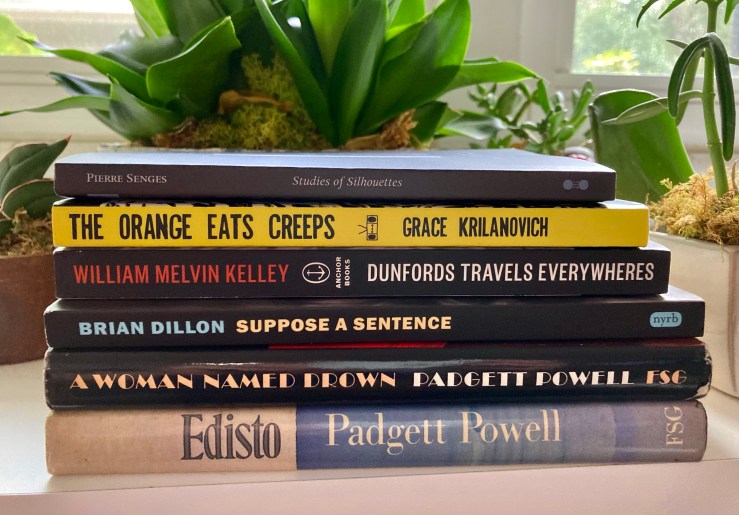
I don’t know if Dennis Cooper’s gif novels are really novels or something else. I’m not sure if putting this gif novel on a list of books I read is any different than adding, say, a list of paintings by Mu Pan that I viewed over the year. The inclusion of ZDB also helps highlight the artificiality of a numbered list of books read in a year. (I know this list isn’t numbered, but it’s countable. I think it’s fifty-seven or fifty-eight.) It took me maybe 10 or 15 minutes to “read” ZBD while novels by Ishiguro, Pynchon, and Brunner are like 500 pages. The Ishiguro is actually pretty “easy” to read though, in a way that Zac’s Drug Binge is not. The Brunner is much “easier” than the many, many stories I read this year in The Complete Gary Lutz. The Lutz is 500 pages, and I read more of those pages than I did of some of the shorter works listed here like Rankine’s Citizen or Ball’s The Divers’ Game—but I didn’t “finish” the Lutz (and I don’t want to ever “finish” the Lutz), so its not on the list. Ditto Brian Dillon’s essay collection Suppose a Sentence, another collection that I’ve used to cleanse my palate between books. I could probably do a whole post on books like that (John Domini’s The Sea-God’s Herb, the Charles Portis MiscellanyThe Minus Times Collected, etc. etc.)

You can read Zac’s Drug Binge here (and, uh, careful who you’re around if you click this link!).

Oreo, Fran Ross

Loved loved loved Oreo. The novel is thoroughly overlooked as a metafictional masterpiece. In my review, I wrote:

“Fran Ross’s 1974 novel Oreo is an overlooked masterpiece of postmodern literature, a delicious satire of the contemporary world that riffs on race, identity, patriarchy, and so much more. Oreo is a pollyglossic picaresque, a metatextual maze of language games, raps and skits, dinner menus and vaudeville routines. Oreo’s rush of language is exuberant, a joyful metatextual howl that made me laugh out loud. Its 212 pages galloped by, leaving me wanting more, more, more.”

A Different Drummer, William Melvin Kelley

I read it after OreoOreo is neon zany polyglossic hijinks, crackling, zipping, and zapping. Kelley’s first novel, despite its rotating set of viewpoints (and conceit of an invented Southern state), was much more down to earth—modernist, not postmodernist—rendered in rusty oranges, dusty browns, muted greens. I enjoyed Kelley’s later novels dem and Dunfords Travels Everywheres more, but A Different Drummer could be his best book. I wrote about it here.

A Rage in Harlem, Chester Himes

Gonna read more Himes in 2021. Any tips? I loved loved loved it.

dem, William Melvin Kelley

From my review:

“As its subheading attests, dem is, like Drummer, a take on white people viewing black people, and over a half-century after its publication, many of the tropes Kelley employs here still ring painfully true. His “hero,” Mitchell Pierce is a lazy advertising executive, bored with his wife, a misogynist who occasionally longs to return to the “wars in Asia.” He’s also deeply, profoundly racist; structurally racist; the kind of racist who does not think of his racism as racism. At the same time, Kelley seems to extend little parcels of sympathy to Pierce, even as he reveals the dude to be a piece of shit, as if to say, What else could he end up being in this system but a piece of shit?

Sátántangó, László Krasznahorkai; translation by George Szirtes

Years ago I put Sátántangó on a list of books I started the most times without finishing.  This summer I listened to the audiobook version while I painted the interior of my house. The novel’s postmodern ending made me pick up the physical copy I acquired like eight years ago, making Sátántangó the only novel I re-read this year.

Edition 69, Jindřich Štyrský, Vítězslav Nezval, František Halas, and Bohuslav Brouk; translation by Jed Slast

Hey yo you like horny Czech interwar surrealism?

Lancelot, Walker Percy

The first Percy I read, and so far, my favorite–a postmodern Gothic screed against postmodernity. I reviewed it here.

The Moviegoer, Walker Percy

Percy’s first novel is probably much better than I credited in my review, but I was disappointed after the claustrophobic zany madness of Lancelot. I think if The Moviegoer were the first Percy I read it would have been the last.

Dunfords Travels Everywheres, William Melvin Kelley

My favorite of the three Kelley novels I read this year.

Edisto, Padgett Powell

 I read most of Padgett Powell’s 1984 debut Edisto in a few sittings, settling down easily into its rich evocation of a strange childhood in the changing Southern Sea Islands. I’d always been ambivalent about Powell, struggling and failing to finish some of his later novels (Mrs. Hollingsworth’s MenThe Interrogative Mood), but Edisto captured me from its opening lines. The story takes two simple tacks–it’s a coming of age tale as well as a stranger-comes-to-town riff. Powell’s sentences are lively and invigorating; they show refinement without the wearing-down of being overworked. The book is fresh, vital.

When I finished Edisto, I thought I’d go for some more early Padgett. I picked up his second novel, A Woman Named Drown, started it that afternoon, and put it down 70 pages later the following afternoon. There wasn’t a single sentence that made me want to read the next sentence. Worse, it was turning into an ugly slog, a kind of attempt to refine Harry Crews’s dirty south into something closer to grimy eloquence. I like gross stuff, but this wasn’t my particular flavor.

The Orange Eats Creeps, Grace Krilanovich

I remember buying this book very clearly. The yellow spine called to me; the fact it was a Two Dollar Radio title; the title itself; and then, the blurb from Steve Erickson. From my review:

“Krilanovich’s novel is coated in brown-grey paste, an accumulation of scum and cum and blood, a vampiric solution zapped by orange bolts of sex, pain, drugs, and rocknroll. It’s a riot grrrl novel, a psychobilly novel, a crustgoth novel. It’s a fragmented, ugly, revolting mess and I loved it. The Orange Eats Creeps is ‘A vortex of a novel,’ as Steve Erickson puts it in his introduction, that will alternately suck in or repel readers.”

The Silence, Don DeLillo

In my unkind review, I wrote:

“The Silence is a slim disappointment, a scant morality play whose thinly-sketched characters speak at (and not to) each other liked stoned undergrads. At least it’s short.”

Motorman, David Ohle

David Ohle’s lean mean mutant Motorman is a dystopia carved from strange stuff. Ohle’s cult novel leaves plenty of room for the reader to wonder and wander around in. Abject, spare, funny, and depressing, Motorman sputters and jerks on its own nightmare logic. Its hapless hero Moldenke anti-quests through an artificial world, tumbling occasionally into strange moments of agency, but mostly lost and unillusioned in a broken universe. I loved it.

Two Stories, Osvaldo Lamborghini; translation by Jessica Sequeira

Not sure if I found a book so baffling all year.

Stand on Zanzibar, David Brunner

John Brunner’s big fat dystopian novel Stand on Zanzibar frankly overwhelmed me and then sorta underwhelmed me there at the end. This sci-fi classic is a big weird shaggy dog that managed to predict the future in all kinds of ways, and it’s mean and funny, but it’s also bloated and booming, the kind of novel that sucks all the air out of the room. It’s several dozen essays dressed up as sci-fi adventure—not a bad deal in and of itself—but there’s very little space left for the reader

Fat City, Leonard Gardner

Fat City is about an “old” boxer (he’s not thirty) on the way out of his career and a young boxer on the rise. (Rise here is a really suspect term.) I really can’t believe I was 41 when I read this. I should’ve read it at 20. I wouldn’t have understood it the same way, of course, and the biggest sincerest compliment I can pin on the novel is that I would’ve loved it at 20 but I know that I would’ve appreciated it more 20 years later. There are plenty of novels that I read and think, Hmm, would’ve loved this years ago, but now, nah, but Fat City is wonderful. It’s a boxing story, sure, but it’s really a book about bodies breaking down, aging, getting stuck in dreams and fantasies. Gardner’s only novel (!) is simultaneously mock-tragic and real tragic, pathetic and moving, and very very moving. Great stuff.

Dog Soldiers, Robert Stone

I read Robert Stone’s Dog Soldiers on the late David Berman’s recommendation) and loved it. Set at the end of the Vietnam War, Dog Soldiers is about a heroin deal going sideways. The CIA is involved, some twisted Hollywood folks, and a fallen cult leader. Everyone’s a bit grimy. I guess it comes from the Hemingway tree, or really, maybe, the Stephen Crane tree—Denis Johnson’s tree, Leonard Gardner’s tree, Raymond Carver’s tree, etc. It reminded me a lot of Johnson’s Angels (and, to some extent, Tree of Smoke), but also Russell Banks’s 1985 novel Continental Drift—and Gardner’s Fat City.

Dog Soldiers gets better and better and ends with an ecstatic punchline—a big Fuck you to God in the whirlwind. Great stuff.

Nothing but the Music, Thulani Davis

In my review, I wrote:

Nothing but the Music cooks raw joy and raw pain into something sublime. I like poems best when they tell stories, and Davis is a storyteller. The poems here capture place and time, but most of all sound, sound, rhythm, and sound. Lovely stuff.”

Love in the Ruins, Walker Percy

Loved this one—more in line with the madness of Lancelot than the ennui of The MoviegoerLove in the Ruins posits a USA falling apart to reveal there never was a center.

The Hearing Trumpet, Leonora Carrington

From my review:

“Leonora Carrington’s novel The Hearing Trumpet begins with its nonagenarian narrator forced into a retirement home and ends in an ecstatic post-apocalyptic utopia “peopled with cats, werewolves, bees and goats.” In between all sorts of wild stuff happens. There’s a scheming New Age cult, a failed assassination attempt, a hunger strike, bee glade rituals, a witches sabbath, an angelic birth, a quest for the Holy Grail, and more, more, more.”

The Oyster, Dejan Lukic and Nik Kosieradzki

I still need to write a proper review of this one. It’s something between an essay and a prose-poem and an aesthetic object.

Heroes and Villains, Angela Carter

One of Carter’s earlier novels, Heroes and Villains takes place in a post-apocalyptic world where caste lines divide the Professors, the Barbarians, and the mutant Out People. After her Professor stronghold is raided, Marianne is…willingly abducted?…by the barbarian Jewel. Marianne goes to live with the Barbarians, and ends up in a weird toxic relationship with Jewel, marked by rape and violence. Heroes and Villains throws a lot in its pot—what is consent? what is civilization? what is language?—but it’s a muddled, psychedelic mess in the end.

Just Us, Claudia Rankine

A short, sometimes painful read, Just Us is a mix of essaying and poetry that documents the horrors of the past few years against the backdrop of the horrors of all American history, all in a personal, moving way.

Lolly Willowes, Sylvia Townsend Warner

Starts subtle and ends sharp. A mix of satire and earnestness, purely modern, wonderful stuff. Our hero surmises at the end that Satan might actually be quite stupid. I love her.


[Ed. note–some of the language of these annotations has been recycled from previous posts.]

A review of Leonora Carrington’s surreal novel The Hearing Trumpet

Leonora Carrington’s novel The Hearing Trumpet begins with its nonagenarian narrator forced into a retirement home and ends in an ecstatic post-apocalyptic utopia “peopled with cats, werewolves, bees and goats.” In between all sorts of wild stuff happens. There’s a scheming New Age cult, a failed assassination attempt, a hunger strike, bee glade rituals, a witches sabbath, an angelic birth, a quest for the Holy Grail, and more, more, more.

Composed in the 1950s and first published in 1974, The Hearing Trumpet is new in print again for the first time in nearly two decades from NYRB. NYRB also published Carrington’s hallucinatory memoir Down Below a few years back, around the same time as Dorothy issued The Complete Stories of Leonora Carrington. Most people first come to know Carrington through her stunning, surreal paintings, which have been much more accessible (because of the internet) than her literature. However, Dorothy’s Complete Stories brought new attention to Carrington’s writing, a revival continued in this new edition of The Hearing Trumpet.

Readers familiar with Carrington’s surreal short stories might be surprised at the straightforward realism in the opening pages of The Hearing Trumpet. Ninety-two-year-old narrator Marian Leatherby lives a quiet life with her son and daughter-in-law and her tee-vee-loving grandson. They are English expatriates living in an unnamed Spanish-speaking country, and although the weather is pleasant, Marian dreams of the cold, “of going to Lapland to be drawn in a vehicle by dogs, woolly dogs.” She’s quite hard of hearing, but her sight is fine, and she sports “a short grey beard which conventional people would find repulsive.” Conventional people will soon be pushed to the margins in The Hearing Trumpet.

Marian’s life changes when her friend Carmella presents her with a hearing trumpet, a device “encrusted with silver and mother o’pearl motives and grandly curved like a buffalo’s horn.” At Carmella’s prompting, Marian uses the trumpet to spy on her son and daughter-in-law. To her horror, she learns they plan to send her to an old folks home. It’s not so much that she’ll miss her family—she directs the same nonchalance to them that she affords to even the most surreal events of the novel—it’s more the idea that she’ll have to conform to someone else’s rules (and, even worse, she may have to take part in organized sports!).

The old folks home is actually much, much stranger than Marian could have anticipated:

First impressions are never very clear, I can only say there seemed to be several courtyards , cloisters , stagnant fountains, trees, shrubs, lawns. The main building was in fact a castle, surrounded by various pavilions with incongruous shapes. Pixielike dwellings shaped like toadstools, Swiss chalets , railway carriages , one or two ordinary bungalows, something shaped like a boot, another like what I took to be an outsize Egyptian mummy. It was all so very strange that I for once doubted the accuracy of my observation.

The home’s rituals and procedures are even stranger. It is not a home for the aged; rather, it is “The Institute,” a cult-like operation founded on the principles of Dr. and Mrs. Gambit, two ridiculous and cruel villains who would not be out of place in a Roald Dahl novel. Dr. Gambit (possibly a parodic pastiche of George Gurdjieff and John Harvey Kellogg) represents all the avarice and hypocrisy of the twentieth century. His speech is a satire of the self-important and inflated language of commerce posing as philosophy, full of capitalized ideals: “Our Teaching,” “Inner Christianity,” “Self Remembering” and so on. Ultimately, it’s Gambit’s constricting and limited patriarchal view of psyche and spirit that the events in The Hearing Trumpet lambastes.

Marian soon finds herself entangled in the minor politics and scheming of the Institute, even as she remains something of an outsider on account of her deafness. She’s mostly concerned with getting an extra morsel of cauliflower at mealtimes—the Gambits keep the women undernourished. She eats her food quickly during the communal dinner, and obsesses over the portrait of a winking nun opposite her seat at the table:

Really it was strange how often the leering abbess occupied my thoughts. I even gave her a name, keeping it strictly to myself. I called her Doña Rosalinda Alvarez della Cueva, a nice long name, Spanish style. She was abbess, I imagined, of a huge Baroque convent on a lonely and barren mountain in Castile. The convent was called El Convento de Santa Barbara de Tartarus, the bearded patroness of Limbo said to play with unbaptised children in this nether region.

Marian’s creative invention of a “Doña Rosalinda Alvarez della Cueva” soon somehow passes into historical reality. First, she receives a letter from her trickster-aid Carmella, who has dreamed about a nun in a tower. “The winking nun could be no other than Doña Rosalinda Alvarez della Cueva,” remarks Marian. “How very mysterious that Carmella should have seen her telepathically.” Later, Christabel, another member/prisoner of the Institute helps usher Marian’s fantasy into reality. She confirms that Marian’s name for the nun is indeed true (kinda sorta): “‘That was her name during the eighteenth century,’ said Christabel. ‘But she has many many other names. She also enjoys different nationalities.'”

Christabel gives Marian a book entitled A True and Faithful Rendering of the Life of Rosalinda Alvarez and the next thirty-or-so pages gives way to this narrative. This text-within-a-text smuggles in other texts, including a lengthy letter from a bishop, as well as several ancient scrolls. There are conspiracies afoot, schemes to keep the Holy Grail out of the hands of the feminine power the Abbess embodies. There are magic potions and an immortal bard. There is cross-dressing and a strange monstrous pregnancy. There are the Knights Templar.

Carrington’s prose style in these texts-within-texts diverges considerably from the even, wry calm of Marian’s narration. In particular, there’s a sly control to the bishop’s letter, which reveals a bit-too-keen interest in teenage boys. These matryoshka sections showcase Carrington’s rhetorical range while also advancing the confounding plot. They recall The Courier’s Tragedy, the play nested in Thomas Pynchon’s 1965 novel The Crying of Lot 49. Both texts refer back to their metatexts, simultaneously explicating and confusing their audiences while advancing byzantine plot points and arcane themes.

Indeed, the tangled and surreal plot details of The Hearing Trumpet recall Pynchon’s oeuvre in general, but like Pynchon’s work, Carrington’s basic idea can be simplified to something like—Resistance to Them. Who is the Them? The patriarchy, the fascists, the killers. The liars, the cheaters, the ones who make war in the name of order. (One resister, the immortal traveling bard Taliesin, shows up in both the nested texts and later the metatext proper, where he arrives as a postman, recalling the Trystero of The Crying of Lot 49.)

The most overt voice of resistance is Marian’s best friend Carmella. Carmella initiates the novel by giving Marian the titular hearing trumpet, and she acts as a philosophical foil for her friend. Her constant warning that people under seventy and over seven should not be trusted becomes a refrain in the novel. Before Marian is shipped off to the Institution, Carmella already plans her escape, a scheme involving machine guns, rope, and other implements of adventure. Although she loves animals, Carmella is even willing to kill any police dogs that might guard the Institution and hamper their escape:

Police dogs are not properly speaking animals. Police dogs are perverted animals with no animal mentality. Policemen are not human beings so how can police dogs be animals?

Late in the novel, Carmella delivers perhaps the most straightforward thesis of The Hearing Trumpet:

It is impossible to understand how millions and millions of people all obey a sickly collection of gentlemen that call themselves ‘Government!’ The word, I expect, frightens people. It is a form of  planetary hypnosis, and very unhealthy. Men are very difficult to understand… Let’s hope they all freeze to death. I am sure it would be very pleasant and healthy for human beings to have no authority whatever. They would have to think for themselves, instead of always being told what to do and think by advertisements, cinemas, policemen and parliaments.

Carmella’s dream of an anarchic utopia comes to pass.

How?

Well, there’s a lot to it, and I’d hate to spoil the surrealist fun. Let’s just say that Marian’s Grail quest scores a big apocalyptic win for the Goddess, thanks to “an army of bees, wolves, seven old women, a postman, a Chinaman, a poet, an atom-driven Ark, and a werewoman.” No conventional normies who might find Marian’s beard repulsive here.

With its conspiracy theories within conspiracy theories and Templar tales, The Hearing Trumpet will likely remind many readers of Umberto Eco’s 1988 novel Foucault’s Pendulum (or one of its ripoffs). The Healing Trumpet’s surreal energy also recalls Angela Carter’s 1972 novel The Infernal Desire Machines of Doctor Hoffman. And of course, the highly-imagistic, ever-morphing language will recall Carrington’s own paintings, as well as those of her close friend Remedios Varo (who may have been the basis for Carmella), and their surrealist contemporaries (like Max Ernst) and forebears (like Hieronymus Bosch).

This new edition of The Hearing Trumpet includes an essay by the novelist Olga Tokarczuk (translated by Antonia Lloyd-Jones) which focuses on the novel as a feminist text. (Tokarczuk also mentions that she first read the novel without knowing who Carrington was). The new edition also includes black and white illustrations by Carrington’s son, Pablos Weisz Carrington (I’ve included a few in this review). As far as I can tell, these illustrations seem to be slightly different from the illustrations included in the 2004 edition of The Hearing Trumpet published by Exact Change. That 2004 edition has been out of print for ages and is somewhat hard (or really, expensive) to come by (I found a battered copy few years ago for forty bucks). NYRB’s new edition should reach the wider audience Carrington deserves.

Some readers will find the pacing of The Hearing Trumpet overwhelming, too frenetic. It moves like a snowball, gathering images, symbols, motifs into itself in an ever-growing, ever-speeding mass. Other readers may have difficulty with its ever-shifting plot. Nothing is stable in The Hearing Trumpet; everything is liable to mutate, morph, and transform. Those are my favorite kinds of novels though, and I loved The Hearing Trumpet—in particular, I loved its tone set against its imagery and plot. Marian’s narration is straightforward, occasionally wry, but hardly ever astonished or perplexed by the magical and wondrous events she takes part in. There’s a lot I likely missed in The Hearing Trouble—Carrington lards the novel with arcana, Jungian psychology, magical totems, and more more more—but I’m sure I’ll find more the next time I read it. Very highly recommended.

Blog about some recent reading

From the bottom of the stack to the top:

I read most of Padgett Powell’s 1984 debut Edisto in a few sittings, settling down easily into its rich evocation of a strange childhood in the changing Southern Sea Islands. I’d always been ambivalent about Powell, struggling and failing to finish some of his later novels (Mrs. Hollingsworth’s MenThe Interrogative Mood), but Edisto captured me from its opening lines. The story takes two simple tacks–it’s a coming of age tale as well as a stranger-comes-to-town riff. Powell’s sentences are lively and invigorating; they show refinement without the wearing-down of being overworked. The book is fresh, vital.

So when I finished Edisto, I thought I’d go for some more early Padgett. On Friday I picked up his second novel, A Woman Named Drown, started it that afternoon, and put it down 70 pages later the following afternoon. There wasn’t a single sentence that made me want to read the next sentence. Worse, it was turning into an ugly slog, a kind of attempt to refine Harry Crews’s dirty south into something closer to grimy eloquence. I like gross stuff, but this wasn’t my particular flavor.

In between, I took another palate cleansing essay from Brian Dillon’s collection Suppose a Sentence. Dillon’s collection of essays is perfect for resetting a reader’s mood between texts. Each essay reflects, sometimes obliquely, sometimes more directly on a single sentence from a range of authors. Good stuff.

I am working on a full review of William Melvin Kelley’s cult classic Dunfords Travels Everywheres. I have misused the phrase “cult classic” in the preceding sentence Dunfords has been long out of print, almost impossible to find, and largely unheralded for the past few decades. However, new editions from Anchor are rectifying this problem. The book is weird, a bit shaggy, funny and perplexing. More thoughts to come.

When I put down Powell’s A Woman Named Drown I picked up Grace Krilanovich’s novel The Orange Eats Creeps. I bought Orange back in July, pulling it out based on its spine (Two Dollar Radio, a small press I admire) and its title (c’mon!). The Steve Erickson blurb sealed the deal. I’m really digging Orange right now. It’s a novel about Slutty Teenage Hobo Vampire Junkies (the narrators term) bumming around and sucking blood and drugs in the Pacific Northwest. It reminds me a lot of Kathryn Bigelow’s film Near Dark, Tim Hunter’s film River’s Edge, and Harmony Korine’s film Gummo. There’s also a healthy dose of Twin Peaks in here, as well as the abject contours of Charles Burns’s Black Hole.

I’ve also been using Pierre Senges’s Studies of Silhouettes (English translation by Jacob Siefring) as literary palate cleansers, opening the book at random to read Senges’s strange riffs on Kafka’s leads. As Siefring’s blurb puts it, “Each of the texts in this work proceed from the fragments and cryptic beginnings found scattered throughout the notebooks Max Brod took possession of after Kafka’s death.” The results are sometimes very funny, sometimes profound, sometimes both. I hope to have a fuller review down the line.

On Walker Percy’s postmodern Gothic novel Lancelot

Walker Percy’s 1977 novel Lancelot opens with an invitation: “Come into my cell. Make yourself at home.”

The invitation is to both the reader and to the titular Lancelot’s audience of one, a friend from his college days he calls Percival. Percival listens to Lancelot’s increasingly-insane, unceasing monologue without interruption.

Lancelot Lamar—Lance, to friends—tells his story from his cell in the Center for Aberrant Behavior. It’s New Orleans, sometime in the mid-seventies. The dream of the sixties has curdled and soured, its failed would-be revolution of love turned to rot.

Lance’s (electrically-sexual) love for his wife Margot begins to sour, fester, and rot. He discovers by chance that he is not the father of their daughter Siobhan, and quickly comes to suspect that Siobhan is the product of Margot’s infidelity with Merlin, a filmmaker whom Margot, an always-aspiring actress, has known for years.

Merlin and his crew are filming at Lance’s ancestral manse, Bell Isle. Belle Isle was once a Great House in its parish, but modernity (and postmodernity) have a way of rotting out traditions. Margot, heiress to a new-money Texas fortune, restores the ancestral home to something-close-to its former glory. Belle Isle and the Lamar name might rub some good old fashioned Southern Aristocracy off on her. Despite those oil dollars, the Lamars still need to allow tour groups to visit Belle Isle—gawking Michiganders and Yankees and the like—in order to keep in the black.

Lancelot Lamar himself has long since stopped working. A one-time liberal who helped the NAACP, he trained as a lawyer, but latterly has taken to lust and drink. At the outset of his tale, our debauched wastrel spends his days in the pigeonnier of Belle Isle slurping bourbon and smoking cigs. His discovery that his daughter is not his own revitalizes him—it’s the revelation—nay, the apocalypse—that splits his life in two: “my life is divided into two parts, Before and After,” he tells Percival in cell.

Percival says all of thirteen words in the novel. Or, really, two words: twelve yeses and one no. It’s never quite clear if Percival is a failed psychiatrist or a failed priest or some hybrid of both, but we do know that Lancelot has long admired Percival since their school days, when the austere intellectual literally jumped ship to swim to a deserted island for a Thoreau-inspired think. Percival, or Lancelot’s ideation of Percival, serves not only as a confessor’s ear, but also as Lancelot’s avatar of intellectual spirituality. In contrast, visceral once-virile Lance (with his oh-so-phallic mantle) rests on his most vibrant college laurels: he once ran 110 yards against the Alabama Crimson Tide.

But back to Lancelot of the Before and After. Specifically, the After. After discovering his wife’s apparent infidelity (infidelities?), Lance enlists the help of his retainer Elgin, the son of Belle Isle’s Black housekeepers. Elgin is an MIT student and a technical genius, a figure whose ascendancy Lancelot can understand but perhaps not fully appreciate. A scion of the South and a one-time “liberal,” Lancelot is unable to fully understand his own racism, even as he understands Elgin’s intellectual and technocratic superiority.

Still, Lancelot comprehends the failure of the 1960’s liberalism to fully follow through on its utopian promise. He relies on Elgin’s gratitude to him, but admits,

…in truth I had done very little for him, the kind of easy favors native liberals do and which are almost irresistible to the doer, if not to the done to, yielding as they do a return of benefit to one and a good feeling to the other all out of proportion to the effort expended. That was one of the pleasures of the sixties: it was so easy to do a little which seemed a lot. We basked in our sense of virtue and what we took to be their gratitude. Maybe that was why it didn’t last very long. Who can stand gratitude?

Driven by his own motives, tech-whiz Elgin sets up secret cameras all around Belle Isle as part of Lancelot’s movie-making scheme: our monologist plans to catch his wife in the act, either with Merlin or another lover. Percy’s postmodernism is subtle but effective here. We see Belle Isle through layers, a Gothic playground of both real and imaginary depravities, some staged, some extemporaneous, all set against the backdrop of the sins of the Gothic South.

Like William Gaddis’s 1985 novel Carpenter’s Gothic, Percy’s Lancelot is a work of Gothic postmodernism. Belle Isle has been converted to a theme park version of its aristocratic past, glossed up for tourists and film crews. It’s certainly not the scene of domestic bliss.

Lancelot’s monologue starts to boil over into crazed horror, taking the reader (and his auditor Percival) into strange new spaces. Belle Isle becomes a haunted house, scene of repeated debaucheries on the cusp of disaster. The film crew prepares a massive weather machine to simulate a hurricane for their fantasy even as a massive hurricane approaches to destroy the real world. But maybe Lance, in his perverted quest, will destroy that world first.

Lancelot’s Gothic quest is for the anti-Grail, the Unholy Grail. As the novel unravels towards its crazed ending, Lancelot’s consciousness ping-pongs about in philosophical ranting. Our hero stands against postmodernity, against the nascent eighties, against the collapse of the Romantic sixties and its failed revolution. He plans a third Revolution, the final part in the trilogy initiated by the American Revolution and the Civil War. Lancelot’s increasingly unhinged screeds disturb both Percival and the reader. His apocalyptic urge for a great cleansing veers into strange, misogynistic territory.

A failed knight who cannot see his own failure, he becomes obsessed with the woman celled next to him, Anna, victim of a gang rape whom he both fetishizes and idealizes. Lancelot reads like a Southern companion to Martin Scorsese’s 1976 film Taxi Driver. Lance reminds one of Travis Bickle: both are strange, nihilistic, optimistic idealists, would-be knights seeking to save damsels in a fallen world, praying for some great rain to come and cleanse the filth of sin away. 

And like Taxi Driver, Percy’s novel—released around the same time, of course—seems like an early analysis of the failure of the sixties. It’s the burn out, the hangover, the realization that the dream was just a dream, and that the business of reality is cruel and cold and dirty. Perhaps insanity is the proper response.

There’s so much in Lancelot I’ve failed to unpack: Its analysis of America–North, South, and West–its treatment of Hollywood, its strange gnostic tinges, its weird tangled and often colliding philosophies. Lancelot Lamar is an enthralling monologist, witty, severe, pathetic and sympathetic, simultaneously cartoonish and ferociously real. I’ve also failed to convey how funny this novel is—Percy’s prose crackles and zaps, zips and dips, turns into weird little unexpected nooks. I ate it up.

Lancelot was the first Walker Percy novel I’ve read, but it won’t be the last. Great stuff.

Blog about blogging for fourteen years (and not blogging so much lately)

Yesterday afternoon, prepping notes for an evening class, I recalled that this blog Biblioklept turned fourteen. I was typing out some notes for an American literature class I teach (and have taught for years now) on Wednesday nights, and something about it resonated with me–What is on 9 September?–and then I remembered why the date should catch in my memory. I posted the first Biblioklept post on 9 Sept. 2006. It was on Lorraine Hansberry’s play A Raisin in the Sun and it was all of four sentences long. I was teaching AP Lang and AP Lit at an inner-city high school in Jacksonville, FL at the time, and I suppose that we must have been reading Raisin at the time. I still know pretty much every line of the play.

I know large chunks of the text that I was preparing my notes for last night, Mark Twain’s novel Adventures of Huckleberry Finn. Some semesters I sleepwalked through my American lit classes, others I find myself revitalized by the material. Lately I’ve been sleepwalking–since 2017ish, if I’m honest, but having to do everything over Zoom has necessitated change. I spent a big chunk of the last few days revisiting Leslie Fiedler and Arnold Weinstein and Harold Bloom and Ralph Ellison on Huck Finn, trying to synthesize the material into something new that might zap me enough to zap my students through Zoom.

In years past I might’ve smuggled my notes into a blog post, a trick I used to pull every now and then, but I didn’t seem to have the energy when I got up today. I had a few composition classes to prep for, as well as remedial college reading class where half of the students speak English as a second language. I needed to figure out a way to communicate through the screen again, a way to figure out how to wrangle all my body language into a tiny digital square. It’s a bit exhausting, but we’ve all been exhausted, right? I’m healthy, my family is healthy, we have enough to eat, the air is still breathable, the water still potable, etc.

I’ve thought about ending this blog a lot in the past two years. I’ve seen so many of the blogs that I admired and conversed with and interacted with disappear over the last five or six or seven years. I still keep a blogroll (called “Elsewhere,” at the bottom of the site), but many of the links there have melted off into unupdated ghosts or, worse, collapsed into vacant 404s. (Is there an archive somewhere of Mark Wood’s wood s lot? Is someone–who?–going to keep David Berman’s Menthol Mountains up?). Other spaces that I had once thought were blogs, or at least bloggish, like The Millions and LitHub, turned out to be other things entirely.

Is this even a blog? A weblog? I’m not sure. For a long time Biblioklept seemed to me a hybrid of the “traditional” blogging that came out of LiveJournal and other spaces with the more image-centric universe of sites like tumblr. I’m not sure what it is anymore. I like to post paintings on here. I like figure painting in particular. I’m jealous of my wife’s art history degree, and have spent the past ten or so years trying to catch up to her.

I’d write about art more but I feel terribly unqualified.

I’d write about literature more but I feel exhausted by it so often, so terribly uninvigorated.

Here’s a big stack of books that I stacked up from three stacks stacked around our stack-stocked house:

Some of these are books that I’m reading and will finish soon (Walker Percys Lancelot, Walter Serner’s Last Loosening), some are books that I keep dipping in and out of (Domini’s The Sea-God’s HerbThe Big Fat Gary Lutz, Pierre Senges’s Studies of Silhouettes), some are books that have recently come into the house and need to be restacked elsewhere. At least one is an enigmatic new indie that I need to muster a review of (look, go buy Guillermo Stitch’s weirdass novel Lake of Urine. It might not be your cup of tea but it is in no way boring, either at the plot or prose level).

But yeah, I wish I blogged about books more.

When I look at that first four-sentence post back in 2006 I feel a bit envious. What the fuck made me feel it was acceptable to string those clauses together so cavalierly? Later September posts (like one on Klaus Kinski’s memoir, or a “review” of Jonathan Lethem’s Fortress of Solitude show a little more dedication to fuller description (maybe even the germ of an inkling of an iota of analysis), but on the whole, those early posts–I mean, just looking at them now–I think I was having a lot more fun.

2006 was different and I was different–still in my mid (okay maybe late twenties), still sans children, still up to see a scuzzy band at a scuzzy bar on a week night even if it meant getting up hungover at 5:30am to teach high school downtown. I was closer in age to the students I taught then than I am to the students in my classes now. Most of my students now would, what, be starting kindergarten in 2006?

2006 was different and blogging seemed full of possibility—possibility of communication, transformation, elation, etceteration. There wasn’t really Facebook yet, or Twitter, or Reddit. Or rather, all of these social media platforms existed, but they were newborn, untested (at least by the masses), not the primary spaces for engagement over the internet. Internet 2.0 was just starting, really, and the second wave of blogging—with blogs like Biblioklept—seemed as vital as any other online presence.

(Should I mention that I only started blogging because two of my friends had started blogs and both of them, independently, insisted I do it because I’d be good at it? So I started, riffing mainly on books that I’d stolen, or at least gotten for free somehow, and those stories ran out, and at some point publishers started sending me books, and then a decade or so passed.)

Today, nothing about Biblioklept feels vital to me, and I realize the hubris in a 27 year old, a 30 year old, that thought the blog was important somehow. In retrospect, I realize that the feeling of doing something important (namely, discussing literature) was really the weird feeling of joy and energy I used to have. And sometimes I still grab a little piece of that old joy when I type out some characters, some words into the little big WordPress box. (I’ve had to retrofit to using WordPress’s old or “classic” editor. They updated to a block editor which I despise, another sign of my age perhaps. (Or maybe, just maybe, the block editor fucking sucks.)) And well so anyway yeah. I’m not really sure what the point of this post is. It’s not a rant, right? It kinda feels like a half-assed apology, but, like, for what?

I guess I wish I had it in me to post more—to post shorter riffs, maybe—to get back to that initial spirit of writing too fast and maybe not thinking too hard.

Anyway. I really do appreciate all of you who have read and looked and lurked for five, six, ten, twelve, fourteen years. Really.

Blog about William Melvin Kelley’s satire Dem (book acquired 12 Aug. 2020)

2020-08-13_184241

I managed to snag a cheap used copy of William Melvin Kelley’s fourth novel Dem (or, more properly, dem) yesterday. I usually just snap a pic when I do these book acquired posts, but the cover for this 1969 Collier mass-market, by Leo and Diane Dillon, was simply too good not to scan.

I read not-quite-half of dem today, and the Dillons’ cover captures Kelley’s hypercolor satire of white upper-middle-class America: the infantalized businessman, attended by a black domestic, his bored wife not-quite-off-scene; and hey—look in that mirror.

I’ll admit that the book was hard to break into for the first few moments, until a wild moment around page 20 or so, that I’m still waiting on the novel to deliver upon (or, as it seems at this point, to depart from entirely). Kelley’s style in dem is choppier, sharper, more cartoonish than his Faulknerian debut A Different Drummer and if dem skews towards absurd irony where Drummer was heroic-tragic, both novels are rooted in intense anger tempered by strange empathy.

As its subheading attests, dem is, like Drummer, a take on white people viewing black people, and over a half-century after its publication, many of the tropes Kelley employs here still ring painfully true. His “hero,” Mitchell Pierce is a lazy advertising executive, bored with his wife, a misogynist who occasionally longs to return to the “wars in Asia.” He’s also deeply, profoundly racist; structurally racist; the kind of racist who does not think of his racism as racism. At the same time, Kelley seems to extend little parcels of sympathy to Pierce, even as he reveals the dude to be a piece of shit, as if to say, What else could he end up being in this system but a piece of shit?

The novel I’m most interested in reading by Kelley is his last, 1970’s Dunfords Travels Everywheres, long out of print and hard (read: expensive on the internet) to find. It is, apparently, his most postmodern novel, his most polyglossic, and, if the stuff I’ve read on it is accurate, it represents his most profound satirical break/engagement with reality. Fortunately, it’s getting a reprint this fall. Looking forward to it.

Blog about William Melvin Kelley’s first novel, A Different Drummer

img_5819

William Melvin Kelley’s 1962 debut novel A Different Drummer has eleven chapters. The first, and shortest, “The State,” opens like this:

AN EXCERPT from THE THUMB-NAIL ALMANAC . . . page 643;

An East South Central state in the Deep South, it is bounded on the north by Tennessee; east by Alabama; south by the Gulf of Mexico; west by Mississippi. 

I am a Southerner, and my brain turned into a wrangled wriggling squiggle trying to visualize where “the State” must be, before giving in to the next few lines that declare that “the  State’s” capital is Willson City (no such place of course), which is named after “Confederate General Dewey Willson…the chief architect of the two well-known victories at Bull’s Horn Creek and at Harmon’s Draw” (never happened).

And so well yeah Kelley has created his own Southern State, an amalgam of sin and poverty that sweats and skulks in the tradition of Faulkner’s Yoknapatawpha. Structurally, too, A Different Drummer recalls Faulkner’s work. Kelley makes his reader cobble the narrative together through myriad, rotating viewpoints—a white farmer, his son, porch talkers, and the members of the Willson family, the aristocratic descendants of Confederate General Dewey Willson, who make their living collecting rent.

We get the perspective of all four Willsons—daughter, brother, mother, and father—who put together a picture of a life entangled with the Calibans. The Calibans were the enslaved descendants of a mythical figure named “the African,” a kind of warrior-king who escapes slavery with his only child, only to be tracked for days and nights by Willson, who shoots him before he can dash the child’s brains to free him.

The Calibans work the Willsons’ land over decades, first as slaves and then as sharecroppers. This brings us to the novel’s central conceit. I’ll let the blurb of the Anchor reissue I read do the heavy lifting:

June, 1957. One hot afternoon in the backwaters of the Deep South, a young black farmer named Tucker Caliban salts his fields, shoots his horse, burns his house, and heads north with his wife and child. His departure sets off an exodus of the state’s entire black population, throwing the established order into brilliant disarray. Told from the points of view of the white residents who remained, A Different Drummer stands, decades after its first publication in 1962, as an extraordinary and prescient triumph of satire and spirit.

I had neglected the blurb until now, and had somehow missed the key idea of the second-to-last line: Told from the points of view of the white residents.

Kelley’s tactic here is extraordinary, and ultimately painful. We first get an “average” citizen of Sutton (the central setting of the novel in our unnamed “state,” Harry Leland, whose sentiments of race probably track with those of the hypothetical white moderate MLK warned us about. Leland’s not a bad guy and he’s trying to make his son a decent human being, but he doesn’t know what he doesn’t know.

We meet that son next, and see the narrative through his young eyes. Kelley’s satiric edge is perhaps sharpest here. The menfolk call the boy “Mister Leland,” an irony underlined when Tucker Caliban—whom Mister Leland counts as a friend—addresses the lad as such. It’s Mister Leland too who accompanies Bennett Bradshaw (excuse me, “THE REVEREND B.T. BRADSHAW [of] THE RESURRECTED CHURCH OF THE BLACK JESUS CHRIST OF AMERICA, INC., NEW YORK CITY,” as his business card attests)—it’s Mister Leland who accompanies Bradshaw (and his chauffeur) to the site of Tucker Caliban’s salted-and-abandoned farm. Unlike the various perspective characters, Bradshaw, an intellectual, understands Caliban’s motivation—and envies his spirit.

Caliban’s primal rejection and refusal of the Southern Way of Life is the novel’s central problem, a “problem” that Kelley addresses somewhat obliquely through primarily white eyes. The various Willsons attempt to reckon with both past and present, but their tools are limited, for the most part. The novel’s penultimate chapter is a series of journal entries by David Willson, starting when he’s a young man off to attend an Ivy up in New England.

Young David attends a socialist meeting, but is bored with “nothing but a bunch of fellows showing each other how much they knew about Marx.” He meets—guess who!—Bennett Bradshaw, and falls fast for the guy. (I might be spoiling too much of the plot here—look, it’s a strong book, skip this and read it.)

Willson’ friendship with Bennett adds a strange ballast late in the narrative, tipping the book in a different trajectory than the course it seemed to have previously been taking. Willson is a tragic Faulknerian figure, an intellect who wishes absolution from his namesake’s sins, from the Sins of the South, but who is also beholden to and limited by the dictates of his own time. Bennett too is limited and beholden. It’s Tucker Caliban who breaks the chains.

A Different Drummer is not the narrative I expected to read. I found Kelley’s name looking for works by black American postmodernists, which is how I found Fran Ross’s Oreo—an utterly postmodern novel, carnivalesque, polyglossic, metatextual. (In her essay on Ross’s novel, Harryette Mullen compares Oreo to Kelley’s last novel, 1970’s Dunfords Travels Everywheres.A Different Drummer’s rotating cast of viewpoint characters and its shifts in point of view point toward postmodern polyglossia, but Kelley’s novel is anchored in a kind of Faulknerian modernism. The great trick of it all though is the ironic layering here, where the only strong truth seems to be Tucker Caliban’s renunciation of white supremacy.

And this renunciation angers and ashames novel’s constituents, summed up in its final chapter, “The Men on the Porch.” Here we have a short, devastating exclamation point to the whole affair, which might be easily characterized by Flannery O’Connor, who said that

I have found that anything that comes out of the South is going to be called grotesque by the Northern reader, unless it is grotesque, in which case it is going to be called realistic.

Born in New York City and educated at Harvard, Kelley was nevertheless attuned to Southern rhythms, Southern voices, Southern eyes. To steal more from O’Connor, “we find that the writer” — here, Kelley— “has made alive some experience which we are not accustomed to observe every day, or which the ordinary man may never experience in his ordinary life.” Kelley’s realism, in the end, hurts—it’s too grotesque, too real. But it’s powerful and powerfully-written. Highly recommended.

The Essential Short Stories of J.G. Ballard

jgb_complete_ss4003111

I. “Manhole 69” (1957)

II. “Chronopolis” (1960)

III.  “The Voices of Time” (1960)

IV. “The Overloaded Man” (1961)

V. “Billennium” (1961)

VI. “Thirteen to Centaurus” (1962)

VII. “The Subliminal Man” (1963)

VIII. “End-Game” (1963)

IX. “Time of Passage” (1964)

X. “The Lost Leonardo” (1964)

XI. “The Terminal Beach” (1964)

XII. “The Drowned Giant” (1964)

XIII. “The Beach Murders” (1966)

XIV.  “The Assassination of John Fitzgerald Kennedy Considered as a Downhill Motor Race” (1966)

XV. “Why I Want to Fuck Ronald Reagan” (1968)

XVI. “Notes Towards a Mental Breakdown” (1976)

XVII. “The Index” (1977)

XVIII. “The Dead Time” (1977)

XIX. “News from the Sun” (1981)

XX. “Myths of the Near Future” (1982)

XXI. “Memories of the Space Age” (1982)

XXII. “Answers to a Questionnaire” (1985)

XXIII. “A Guide to Virtual Death” (1992)

At 1200 pages and just under 100 stories, The Complete Short Stories is frankly too complete—but I read them all anyway. The list above is my suggestion for a volume I’d call The Essential Short Stories of J.G. Ballard. Each selection on the list is linked to a riff I wrote; in several cases, links to the full text of the story can be found at the riff.

[Ed. note: Biblioklept originally ran a series of posts on The Complete Short Stories of J.G. Ballard between October 2013 and March 2014.]

The Complete Short Stories of J.G. Ballard (Eleventh Riff: The Nineties)

jgb_complete_ss4003111

PREVIOUSLY:

Introductions + stories 1956-1959

Stories of 1960

Stories of 1961

Stories of 1962

“The Subliminal Man,” Black Friday, and Consumerism

Stories of 1963-1964

Stories of 1966

Closing out the sixties

The seventies

The eighties

IN THIS RIFF:

“Dream Cargoes” (1990)

“A Guide to Virtual Death” (1992)

“The Message from Mars” (1992)

“Report from an Obscure Planet” (1992)

“The Secret Autobiography of J G B” (1981/2009)

“The Dying Fall” (1996)

“Dream Cargoes” (1990)

By the 1990s Ballard had written essentially the same stories over and over—with diminishing returns. Some of the weakness in the later entries in the Complete Short Stories can be attributed to Ballard’s prescience. The world caught up to him at some point, blunting his satire into something goofier, more cartoonish, but also sharpening the reactionary streak that always glowed under the surface of his writing. At his peak, Ballard used his stories to provoke readers into looking at their culture in a new way, and the best of those stories still retain a futurist power. However, many of the late period stories blazon their moral outrage in a wearisome didactic streak.

1990’s “Dream Cargoes” is paint-by-numbers Ballard: Themes of time, sleep, mutation, ecological disaster, birds, etc. The plot anticipates one of Ballard’s weaker novels, Rushing to Paradise (1994), a day-glo nightmare about misguided attempts to steward the forces of nature. And like Rushing to Paradise, the prose here is weak—Ballard relies on the stock phrases that litter his earliest stories.

“The Message from Mars” (1992) / “Report from an Obscure Planet” (1992) / “A Guide to Virtual Death” (1992)

“The Message from Mars” anticipates public disinterest in astronomy (and science in general), the end of NASA’s space shuttle program, and China’s emerging dominance as a world power with space flight capability. So there you go. (It also posits the horror of a President Quayle!). Ballard sends a group of astronauts on a Mars mission, refuses to share their findings with us, and then leaves them, once they land, in their space shuttle, where they live on for decades, silent, incommunicado, alienated from humanity in their self-imposed exile. Ballard’s cynicism is balanced by his refusal to overstate any kind of moral here—the story succeeds in its evocation of mystery.

“Report from an Obscure Planet” is another riff on millennial anxieties, written in the perspective of a “we” condemning the human race for its shortsighted, disastrous treatment of the planet. Ballard doesn’t seem to keen on the future wonders promised by computers:

Driven by the need for a more lifelike replica of the scenes of carnage that most entertained them, the people of this unhappy world had invented an advanced and apparently interiorised version of their television screens, a virtual replica of reality in which they could act out their most deviant fantasies. These three–dimensional simulations were generated by their computers, and had reached a stage of development in the last years of the millennium in which the imitation of reality was more convincing than the original. It may even have become the new reality to the extent that their cities and highways, their fellow citizens and, ultimately, themselves seemed mere illusions by comparison with the electronically generated amusement park where they preferred to play. Here they could assume any identity, create and fulfill any desire, and explore the most deviant dreams.  

While “Report from an Obscure Planet” uses a didactic narrator and a heavy hand to telegraph its message, its companion piece “A Guide to Virtual Death” is far more fun, wicked, and shockingly accurate (if wildly hyperbolic). Sure, yes, okay—another list from Ballard, and okay, yes, sure—I tend to be keen on his lists (“The Index,” “The Assassination of John Fitzgerald Kennedy Considered as a Downhill Motor Race”)—but they also tend to be his strongest pieces. As usual with his list-stories, Ballard feels obligated to begin with a note:

For reasons amply documented elsewhere, intelligent life on earth became extinct in the closing hours of the 20th Century. Among the clues left to us, the following schedule of a day’s television programmes transmitted to an unnamed city in the northern hemisphere on December 23, 1999, offers its own intriguing insight into the origins of the disaster.

6.00 am Porno–Disco. Wake yourself up with his–and–her hard–core sex images played to a disco beat.

7.00 Weather Report. Today’s expected micro–climates in the city’s hotel atriums, shopping malls and office complexes. Hilton International promises an afternoon snow–shower as a Christmas appetiser.

7.15 News Round–up. What our news–makers have planned for you. Maybe a small war, a synthetic earthquake or a famine–zone! charity tie–in.

7.45 Breakfast Time. Gourmet meals to watch as you eat your diet cellulose.

Brief but Essential. Go ahead and read the whole thing.

“The Dying Fall” (1996) / “The Secret Autobiography of J G B” (1981/2009)

The American edition of Complete Stories is more complete than the British volume, including two extra stories. “The Dying Fall” (read it here if you like) is an unfortunate last entry, a weak note in a grand tome. It’s not bad; it’s simply not good, yet another revenge tale with a bad wife, etc. It feels like a frame for Ballard to riff on architecture and psychoanalysis.

“The Secret Autobiography of J G B” is much stronger (you can read it here), although it was also composed at his peak and republished (“rediscovered”) after his death. The final lines would have made a fitting end for the entire collection:

When the summer was followed by a mild autumn, B had established a pleasant and comfortable existence for himself. He had abundant stocks of tinned food, fuel, and water with which to survive the winter. The river was nearby, clear and free of all pollution, and petrol was easy to obtain, in unlimited quantities, from the filling stations and parked cars. At the local police station, he assembled a small armory of pistols and carbines, to deal with any unexpected menace that might appear.

But his only visitors were the birds, and he scattered handfuls of rice and seeds on his lawn and on those of his former neighbors. Already he had begun to forget them, and Shepperton soon became an extraordinary aviary, filled with birds of every species.

Thus the year ended peacefully, and B was ready to begin his true work.

On the horizon:

I am done! Sort of. One more post—I’ll revisit these riffs and select the tales that I would include in a collection I would call The Essential Short Stories of J.G. Ballard.

[Ed. note: Biblioklept originally ran a series of posts on The Complete Short Stories of J.G. Ballard between October 2013 and March 2014.]

The Complete Short Stories of J.G. Ballard (Tenth Riff: The Eighties)

jgb_complete_ss4003111

PREVIOUSLY:

Introductions + stories 1956-1959

Stories of 1960

Stories of 1961

Stories of 1962

“The Subliminal Man,” Black Friday, and Consumerism

Stories of 1963-1964

Stories of 1966

Closing out the sixties

The seventies

IN THIS RIFF:

“A Host of Furious Fancies” (1980)

“News from the Sun” (1981)

“Memories of the Space Age” (1982)

“Myths of the Near Future” (1982)

“Report on an Unidentified Space Station” (1982)

“The Object of the Attack” (1984)

“Answers to a Questionnaire” (1985)

“The Man Who Walked on the Moon” (1985)

“The Secret History of World War 3” (1988)

“Love in a Colder Climate” (1989)

“The Enormous Space” (1989)

“The Largest Theme Park in the World” (1989)

“War Fever” (1989)

“News from the Sun” (1981) / “Myths of the Near Future” (1982) / “Memories of the Space Age” (1982)

Let me first confess how happy I am to be finished with this enormously enormous book (okay, not physically enormous on my Kindle, but still…). Let me also confess to dread at having to finish out these riffs (no, no one is forcing me, but still…). At this point, I feel like I could write my own Ballard story—a crazed astronaut here, a drained swimming pool there, a femme fatale, some psychotropic drugs, armchair psychology, a swamp, some birds (perhaps), a plane or two, time obsession, sex obsession, space obsession. Obsession obsession Anyway. Ballard arguably peaks in the early 1980s; everything after reads like a day-glow Keith Haringesque pop-approximation of his grittier seventies stuff—or (worse) scolding wrapped up in little morality plays.

But, like I said (wrote), Ballard is in his prime in the early 1980s, and “News,” “Myths,” and “Memories” are some of his finest stories (file these triplets in my quasi-fictional-but-c’mon-we-can-make-this-happen collection The Essential Short Stories of J.G. Ballard)—they are also some of his most Ballardian, riffing on space-travel-as-cosmic-taboo, paranoid parables obsessed with time. A particularly Ballardian paragraph (from “Memories”):

He had almost ceased to breathe. Here, at the centre of the space grounds, he could feel time rapidly engorging itself. The infinite pasts and future of the forest had fused together. A long–tailed parakeet paused among the branches over his head, an electric emblem of itself more magnificent than a peacock. A jewelled snake hung from a bough, gathering to it all the embroidered skins it had once shed.

(Parenthetical aside: “Myths” and “Memories” are both set in Florida. Ballard’s depiction of Florida feels thoroughly inauthentic (I’m Floridian), but that inauthenticity also feels thoroughly appropriate).

 “A Host of Furious Fancies” (1980)

Ballard constructs this little tale around a psychoanalytic reading of Cinderella:

The entire fairy tale of Cinderella was being enacted, perhaps unconsciously, by this deranged heiress. If she herself was Cinderella, Dr Valentina Gabor was the fairy godmother, and her magic wand the hypodermic syringe she waved about so spectacularly. The role of the pumpkin was played by the ‘sacred mushroom’, the hallucinogenic fungus from which psilocybin was extracted. Under its influence even an ancient laundry van would seem like a golden coach. And as for the ‘ball’, this of course was the whole psychedelic trip.

But who then was Prince Charming? As I arrived at the great mansion at the end of its drive it occurred to me that I might be unwittingly casting myself in the role, fulfilling a fantasy demanded by this unhappy girl. . . .

For all my resistance to that pseudo–science, it occurred to me that once again a psychoanalytic explanation made complete sense of these bizarre events and the fable of Cinderella that underpinned them. I walked up the staircase past the dismembered clock. Despite the fear–crazed assault on them, the erect hands still stood upright on the midnight hour – that time when the ball ended, when the courtships and frivolities of the party were over and the serious business of a real sexual relationship began. Fearful of that male erection, Cinderella always fled at midnight.

Etc.

Ballard’s Freudian riff would be more interesting as an essay.

(The story also showcases some of his typical chauvinism: The psychiatrist is described as the “woman psychiatrist” — just as earlier a dentist is referred to as a “lady dentist,” etc. Straight through to the end of the collection. In the 1990s).

“Report on an Unidentified Space Station” (1982) / “The Enormous Space” (1989)

“Report” and “Space” both read like takes on Sigizmund Krzhizhanovsky’s Soviet-era short story “Quadraturin” — both concern space, that corollary to time, and, just as Ballard repeatedly posits time as a matter of perspective, he treats space—area—the same way here. “Report” is a bit more satisfying than “Space,” which feels like a retread of so many of Ballard’s revenge stories—only with, uh, some comical cannibalism.

  1. “The Object of the Attack” (1984) / “Answers to a Questionnaire” (1985)

“Attack” and “Questionnaire” are maybe the same story—only “Questionnaire” is essentially perfect, whereas “Attack” feels like a clumsy, heavy first draft (but only because “Questionnaire” exists—do you see what I mean by this?)

Both stories showcase Ballard’s syntheses of religion (messianic; apocalyptic) and assassination (political; media-saturated). While “Attack” employs a discursive-but-still-linear approach to the theme, “Answers to a Questionnaire” gives us a discontinuous but more engaging riff in the form of (uh) exactly what its title promises.  First fifth:

1) Yes.

2) Male (?)

3) do Terminal 3, London Airport, Heathrow.

4) Twenty–seven.

5) Unknown.

6) Dr Barnardo’s Primary, Kingston–upon–Thames; HM Borstal, Send, Surrey; Brunel University Computer Sciences Department.

7) Floor cleaner, Mecca Amusement Arcades, Leicester Square.

8) If I can avoid it.

9) Systems Analyst, Sperry–Univac, 1979–83.

10) Manchester Crown Court, 1984.

11) Credit card and computer fraud.

12) Guilty.

13) Two years, HM Prison, Parkhurst.

14) Stockhausen, de Kooning, Jack Kerouac.

15) Whenever possible.

16) Twice a day.

17) NSU, Herpes, gonorrhoea.

18) Husbands.

19) My greatest ambition is to turn into a TV programme.

20) I first saw the deceased on 17 February 1986, in the chapel at London Airport. He was praying in the front pew.

Essential, natch.

“The Man Who Walked on the Moon” (1985)

I should’ve wedged this passable but ultimately forgettable little tale in elsewhere. J.G. Ballard’s faux memoir of a faux astronaut. Pass.

“The Secret History of World War 3” (1988)

“The Secret History of World War 3” is Ballard’s “I told you so” sequel to one of his best stories (frankly a much better story), 1968’s “Why I Want to Fuck Ronald Reagan.” In his unofficial sequel, Ballard imagines (the horror!) of a third Reagan term (post-Bush 1), in which the country is obsessed with the President’s (lack of) health:

…the nation’s TV screens became a scoreboard registering every detail of the President’s physical and mental functions. His brave, if tremulous, heartbeat drew its trace along the lower edge of the screen, while above it newscasters expanded on his daily physical routines, on the twenty–eight feet he had walked in the rose garden, the calorie count of his modest lunches, the results of his latest brain–scan, read–outs of his kidney, liver and lung function. In addition, there was a daunting sequence of personality and IQ tests, all designed to reassure the American public that the man at the helm of the free world was more than equal to the daunting tasks that faced him across the Oval Office desk.

The story concerns a man who—alone, always alone, despite his wife, I mean this is Ballard here, hero’s alone (and rightjustified) in his paraonoia—a man who is the only person to remember the brief outbreak of WW3, wedged, as it is, among updates of Ronnie and Nancy’s bowel movements. The story is farcical but juvenile, and if it seems surprisingly sophomoric, it’s worth noting that “TSHofWW3” echoes not just “Fuck Ronald Reagan,” but also one of Ballard’s earliest efforts, “Escapement” (1956), where a man sits on his couch in disbelief as his wife (stand-in for the whole world) fails to perceive what he perceives.

“Love in a Colder Climate” (1989) / “The Largest Theme Park in the World” (1989) /“War Fever” (1989)

A trio of late period lectures blazoned in the day glow approximations that anyone who live in the late eighties will not-so-fondly recall. Ballard evokes the neon apocalyptic impulses of the day, reworking his familiar themes—reproduction, civilization, war (etc.). Our baroque surrealist’s strokes are broader, not as sharp, more magnified—more Haring than Delvaux. Michel Houellebecq will pick up JGB’s torch here (with arguably better results) a decade and a half later.

On the horizon:

A handful of stories of the nineties: Or: Ballard returns to the same well with diminishing returns.

[Ed. note: Biblioklept originally ran a series of posts on The Complete Short Stories of J.G. Ballard between October 2013 and March 2014.]