The Third Reich: Part III — Roberto Bolaño

As a means of plot summary, here’s an excerpt from my review of the second part of Roberto Bolaño’s novel The Third Reich (serialized this year by The Paris Review and forthcoming in hardback from FSG (uh, the Bolaño’s book, not my review, of course))—

If 2666 impossibly haunts The Third Reich from the future, then paranoid Poe haunts it from the past. Last time we checked in, Udo Berger and his beautiful girlfriend Ingeborg had made tentative friends with another German couple while spending the summer at a seaside resort in Spain. Through this pair, they meet up with two nefarious locals, the Wolf and the Lamb; Udo also begins obsessing over a man named El Quemado, a burn victim who rents paddle boats to tourists. For Udo, the holiday is meant to be a working vacation—he’s a wargame enthusiast, and he plans to write a defining strategy for a new game called “The Third Reich” (implicitly, he plays the Nazi’s side). In the meantime, he’s also taken with the hotel’s owner, Frau Else, a German transplant who mysteriously disappears to take care of an ill husband who no one seems to see.

The third installment of The Third Reich amplifies Udo’s paranoia and isolation. He spends most of his time playing Third Reich with El Quemado, and although he assures his best friend Conrad, via telephone, that he’s beating the burned man, we see his control (and sanity) slipping away. Udo seems unconcerned that Conrad has been comforting Ingeborg, probably because Udo is still trying to bed Frau Else, who has mysteriously disappeared in this third chapter. When he’s not busy sleeping nightmarish sleep or lurking around the hotel at night, Udo picks fights with the night-watchman; clearly, he’s outlasted his welcome in this tourist town.

This section of The Third Reich is shorter than the first two, and although I’ve enjoyed reading the novel in pieces, it’s with this section that the strain of serialization begins to show. Bolaño’s slow-burn Lynchian dread is clearly climaxing here, and it’s unsatisfying to have that suspense interrupted. It’s also unclear how The Third Reich will resolve, or if it will resolve—Bolaño isn’t exactly one to neatly tie up loose ends—but I’m hoping that we’ll get to learn more about El Quemado’s strange motivations, and get another glimpse of Frau Else’s husband. We’ll see soon—the winter issue is out soon with the final installment.

Lars Iyer on Roberto Bolaño’s The Savage Detectives

Great great great essay from Lars Iyer today at The White Review. The essay is called “Nude in Your Hot Tub, Facing the Abyss (A Literary Manifesto After the End of Literature and Manifestos).” You should really just read it; I think Iyer does here what David Shields might have meant to do with Reality Hungeronly Iyer is far more clear and cogent (and not, like, all whiny). Here’s a taste, Iyer on Roberto Bolaño’s novel The Savage Detectives:

A final example of literature that faces its own demise and survives: Bolaño’s The Savage Detectives is a book about an attempt to create a literary vanguard in 1975, written after the conditions for vanguardist practice had collapsed. It is a book about political revolution written in a period after the inevitable failures of such revolutions have revealed themselves. It is a novel about a literary avant-garde and yet the novel itself resists the conceptualization and stylization that a literary avant-garde requires. It is an ecstatic, passionate novel—Bolaño himself describes it as a ‘love letter to my generation’—that plays out as a parody of the desires for Literature and Revolution. It is a novel, like all recent novels, that comes too late, but unlike most others it finds a way to address this lateness. In doing so, The Savage Detectives provides another model for how all would-be authors can appropriately speak about our anachronistic dreams.

The supposed heroes of the book, Ulises Lima and Arturo Belano, leaders of the literary ‘gang’ called the Visceral Realists, are rarely on stage in the novel for very long. For the most part, we hear of them only at a remove, through the disparate narrators Bolaño calls forward to tell their tale. And the verdict on them is mixed – they have an admirer in gauche and excitable law student Madero, whose brilliantly funny diaries bookend The Savage Detectives, but they have their detractors, too. ‘Belano and Lima weren’t revolutionaries. They weren’t writers. Sometimes they wrote poetry, but I don’t think they were poets, either. They sold drugs,’ says one of Bolano’s narrators. ‘The whole visceral realism thing was… the demented strutting of a dumb bird in the moonlight, something essentially cheap and meaningless,’ says another. In the end they head towards ‘catastrophe or the abyss’, as they wander the world, still attempting to strike literary and political poses when the time for Literature and Politics has gone. ‘We fought for parties that, had they emerged victorious, would have immediately sent us into a forced labour camp’, Bolaño writes of his generation. ‘We fought and poured all our generosity into an ideal that had been dead for over fifty years’.

(Read our review of Iyer’s novel Spurious. Read our interview with Iyer).

Seven Horror Stories Masquerading In Other Genres

We often identify genre simply by its conventions and tropes, and, when October rolls round and we want scary stories, we look for vampires and haunted houses and psycho killers and such. And while there’s plenty of great stuff that adheres to the standard conventions of horror (Lovecraft and Poe come immediately to mind) let’s not overlook novels that offer horror just as keen as any genre exercise. Hence: Seven horror novels masquerading in other genres:

cormac5.jpg_jpeg_300x1000_q85

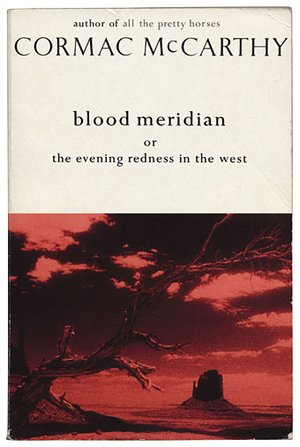
Blood Meridian — Cormac McCarthy

In my review (link above), I called Blood Meridian “a blood-soaked, bloodthirsty bastard of a book.” The story of the Glanton gang’s insane rampage across Mexico and the American Southwest in the 1850s is pure horror. Rape, scalping, dead mules, etc. And Judge Holden. . . [shivers].

Rushing to Paradise — J.G. Ballard

On the surface, Ballard’s 1994 novel Rushing to Paradise seems to be a parable about the hubris of ecological extremism that would eliminate humanity from any natural equation. Dr. Barbara and her band of misfit environmentalists try to “save” the island of St. Esprit from France’s nuclear tests. The group eventually begin living in a cult-like society with Dr. Barbara as its psycho-shaman center. As Dr. Barbara’s anti-humanism comes to outweigh any other value, the island devolves into Lord of the Flies insanity. Wait, should Lord of the Flies be on this list? 

2666 — Roberto Bolaño

Okay. I know. This book ends up on every list I write. What can I do?

While there’s humor and pathos and love and redemption in Bolaño’s masterwork, the longest section of the book, “The Part about the Crimes,” is an unrelenting catalog of vile rapes, murders, and mutilations that remain unresolved. The sinister foreboding of 2666‘s narrative heart overlaps into all of its sections (as well as other Bolaño books); part of the tension in the book–and what makes Bolaño such a gifted writer–is the visceral tension we experience when reading even the simplest  incidents. In the world of 2666, a banal episode like checking into a motel or checking the answering machine becomes loaded with Lynchian dread. Great horrific stuff.

King Lear — William Shakespeare

Macbeth gets all the propers as Shakespeare’s great work of terror (and surely it deserves them). But Lear doesn’t need to dip into the stock and store of the supernatural to achieve its horror. Instead, Shakespeare crafts his terror at the familial level. What would you do if your ungrateful kids humiliated you and left you homeless on the heath? Go a little crazy, perhaps? And while Lear’s daughters Goneril and Regan are pure mean evil, few characters in Shakespeare’s oeuvre are as crafty and conniving as Edmund, the bastard son of Glouscester. And, lest I forget to mention, Lear features shit-eating, self-mutilation, a grisly tableaux of corpses, and an eye-gouging accompanied by one of the Bard’s most enduring lines: “Out vile jelly!Peter Brook chooses to elide the gore in his staging of that infamous scene:

The Trial — Franz Kafka

Kafka captured the essential alienation of the modern world so well that we not only awarded him his own adjective, we also tend to forget how scary his stories are, perhaps because of their absurd familiarity. None surpasses his unfinished novel The Trial, the story of hapless Josef K., a bank clerk arrested by unknown agents for an unspecified crime. While much of K.’s attempt to figure out just who is charging him for what is hilarious in its absurdity, its also deeply dark and really creepy. K. attempts to find some measure of agency in his life, but is ultimately thwarted by forces he can’t comprehend–or even see for that matter. Nowhere is this best expressed than in the famous “Before the Law” episode. If you’re too lazy to read it, check out his animation with narration by the incomparable Orson Welles:

Sanctuary — William Faulkner

In my original review of Sanctuary (link above), I noted that “if you’re into elliptical and confusing depictions of violence, drunken debauchery, creepy voyeurism, and post-lynching sodomy, Sanctuary just might be the book for you.” There’s also a corn-cob rape scene. The novel is about the kidnapping and debauching of Southern belle Temple Drake by the creepy gangster Popeye–and her (maybe) loving every minute of it. The book is totally gross. I got off to a slow start with Faulkner. If you take the time to read the full review above (in which I make some unkind claims) please check out my retraction. In retrospect, Sanctuary is a proto-Lynchian creepfest, and one of the few books I’ve read that has conveyed a total (and nihilistic) sense of ickiness.

n14559

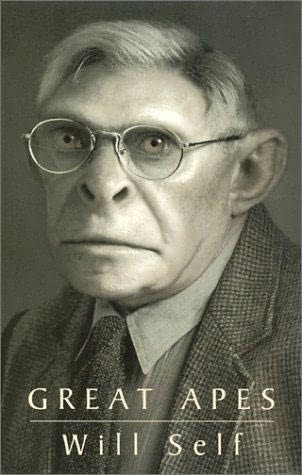
Great Apes — Will Self

Speaking of ickiness…Self’s 1997 novel Great Apes made me totally sick. Nothing repulses me more than images of chimpanzees dressed as humans and Great Apes is the literary equivalent (just look at that cover). After a night of binging on coke and ecstasy, artist Simon Dykes wakes up to find himself in a world where humans and apes have switched roles. Psychoanalysis ensues. While the novel is in part a lovely satire of emerging 21st-century mores, its humor doesn’t outweigh its nightmare grotesquerie. Great Apes so deeply affected us that I haven’t read any of Self’s work since.

[Ed. note: This post is a few years old. We run it again for Halloween and will run a follow up post later today].

Roberto Bolaño’s Chair/Arthur Rimbaud’s Fork and Spoon

Photos by Patti Smith

(Story at The New York Times Magazine).

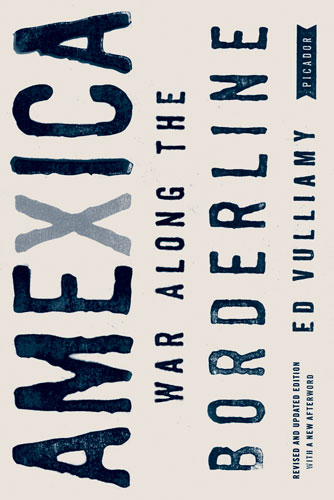
Amexica — Ed Vulliamy’s Violent Chronicle of the Border Wars

Like Cormac McCarthy’s Blood Meridian or Roberto Bolaño’s  2666, Ed Vulliamy’s Amexica explores violence and bloodshed along the porous border between Mexico and America. Unlike those blistering novels, Amexica belongs in the nonfiction section: it’s a sustained work of investigative journalism, part travelogue, part horror story, and all-too real. Blood Meridian and 2666 both have clear roots in the violent history of the borderland, but the membrane of literary fiction serves as a kind of psychological protection for the reader, an affective out, perhaps — “It’s just a book,” we might tell ourselves. Amexica, on the other hand, is unrelentingly true, real, and inescapably ugly. I have a predilection, I almost hate to admit, for literary violence, for bloody books—Blood Meridian and 2666 are two of my favorite books—although bloodshed is not the only reason I read. The violence in Amexica though can be stomach turning at times. Here’s a litmus test—the book’s first paragraph—

As dawn breaks over the vast desert, the body is hanging from a concrete overpass known as the Bridge of Dreams. It has been there for two hours—decapitated and dangling by a rope tied around the armpits. The sun begins to throw its rays across the busy intersection with its rush-hour traffic and former American school buses carrying workers to sweatshops. And it is still there an hour later, this grotesque, headless thing—swaying, hands cuffed behind its back—in the cold early morning wind that kicks up dust and cuts through the Mexican border town of Ciudad Juárez, the most dangerous city in the world.

From the outset, Vulliamy is unflinching in his portrayal of the borderland, the strange, amorphous world he calls “Amexica,” a place riddled with ambiguity, paradox, and uncertainty; indeed the only thing certain in Amexica is violence.

Vulliamy’s book is a west-to-east travelogue of Amexica, from the Pacific Coast (where he takes part in a surreal picnic on the beach where relatives pass food through a wire fence) to the Gulf Coast of Texas. What unites each stop along Vulliamy’s way is the relentless war between rivaling drug cartels and the federal, state, and local police. To clarify that last sentence, let me point out that the drug wars on the border are bellum omnium contra omnes, war of all against all—the drug cartels are at war with each other, but law enforcement are at war against each other as well, the various police forces backing various drug cartels.

Vulliamy’s difficult job is to suss out the whys and the hows of the drug war, but it’s an almost impossibly huge task. He tells us—

This book is not so much about a war as it is a view of a singular place in time of war. It is about the ways war impacts Amexica, but it is also about how the war is a consequence of other—mainly economic—degradations and exploitations, quite apart from drugs, from which the border’s people suffer. A suffering due not least to the fact that narco cartels are corporations like any other, applying the commercial logic and following the same globalized “business models” as the multiplicity of legal enterprises that have wreaked havoc along the borderline. Indeed, the drug violence is in many ways a direct result of this depredation caused by the legal globalized economy. The cartels are not pastiches of multinational capital—they are pioneers of it, integral to it, and apply its rules and logic (or, rather, lack of rules and logic) to their marketplace just as does any other commercial enterprise.

Vulliamy’s indictment of global capitalism as the root of the narco wars is plain—as is his righteous anger—but Amexica works better when it focuses on character and detail than when Vulliamy tries for targets that are simply too unwieldy. Amexica is at its best when Vulliamy plays tour guide, showing us the people of the border first hand, like the coroner in Tijuana who deciphers bodily mutilations as an Egyptologist might study hieroglyphs, or the bereaved mother of two notorious gangsters, or Julian Cardona, whose photographs of Juárez are charged with pathos, loss, and the traces of violence that plague that center of anarchy.

Indeed, Juárez is the grand, ugly center of both Vulliamy’s journey as well as his book; those who thrilled and suffered in Bolaño’s thinly-fictionalized version in 2666, “Santa Theresa,” will find a similar and equally disturbing beast. Anyone still searching for “the real killers” from Bolaño’s murder mystery are encouraged to read Vulliamy’s chapter on Juárez (short answer: we all did it).

Vulliamy’s journalism has a strong literary vein running through it, and like William T. Vollmann (who also chronicled a slice of the border in Imperial), he makes no pretense toward objectivity or neutrality. While Vulliamy puts his subjects and interviewees front and center, he never tries to hide or obscure his own involvement in the process; nor does he aggrandize his role, which surely must have been tempting given the extreme dangers of his project. And if at times his anger or indignation tips into furious verbosity (he could stand to slice a dependent clause or two), he’s surely earned it.

Amexica should be on the radar and reading list of anyone interested in the narco wars, or anyone who wants to learn more of the “real” story behind the murders explored in 2666. For all Amexica’s violence, there’s also dry, ironic humor, and a bristling current of justice, even optimism, at times. Amexica is not for everyone, to be sure, but those who wish to learn more about this massive war (which gets little or no coverage from major media outlets) will not be disappointed. Recommended.

Amexica is available now in an updated trade paperback edition from Picador.

Book Acquired, 9.22.2011

20110922-040608.jpg

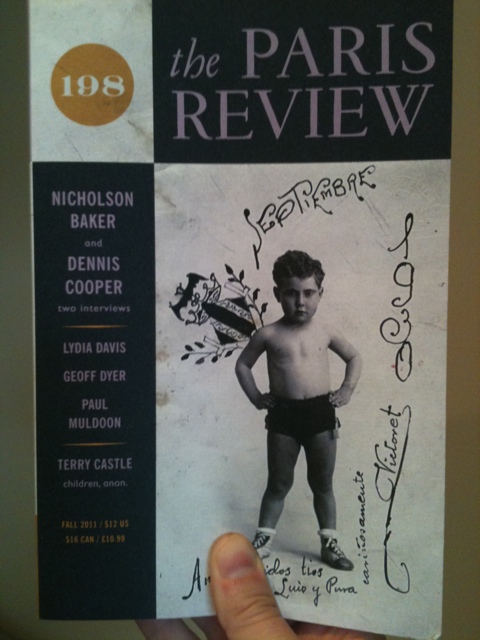
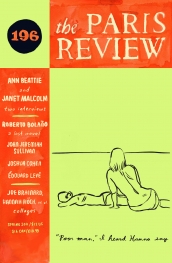
Hey! Sex! Nicholson Baker, Dennis Cooper! Lydia Davis, Geoff Dyer (maybe  not so sex). You can read the cover. Bolaño didn’t make the cover this time, and the third installment of The Third Reich is kinda skinny, but, sure, hey, another intriguing issue.


Biblioklept’s Favorite Books of the Summer

With Memorial Day ’11 just a memory and Labor Day warning off the wearing of white, I revisit some of the best books I read this summer:

Although I posted a review of Roberto Bolaño’s collection Between Parentheses two weeks before Memorial Day, I continued to read and reread the book over the entire summer. It was the gift that kept giving, a kind of blurry filter for the summer heat, a rambling literary dictionary for book thieves. For example, when I started Witold Gombrowicz’s Trans-Atlantyk a week or two ago, I spent a beer-soaked midnight tracing through Bolaño’s many notations on the Polish self-exile.

Trans-Atlantyk also goes on this list, or a sub-list of this list: great books that I’ve read, been reading (or in some cases, listened to/am listening to) but have not yet reviewed. I finished Trans-Atlantyk at two AM Sunday morning (surely the intellectual antidote to having watched twelve hours of college football that day) and it’s one of the strangest, most perplexing books I’ve ever read—and that’s saying something. Full review when I can process the book (or at least process the idea of processing the book).

I also read and absolutely loved Russell Hoban’s Kleinzeit, which is almost as bizarre as Trans-Atlantyk; like that novel (and Hoban’s cult classic Riddley Walker), Kleinzeit  is written in its own idiom, an animist world where concepts like Death and Action and Hospital and even God become concrete characters. It’s funny and sad. Also funny and sad: Christopher Boucher’s How to Keep Your Volkswagen Alive (new from Melville House). Like Trans-Atlantyk and Kleinzheit, Volkswagen is composed in its own language, a concrete surrealism full of mismatched metaphorical displacements. It’s a rare bird, an experimental novel with a great big heart. Full reviews forthcoming.

I’ll be running a review of Evelio Rosero’s new novel Good Offices this week, but I read it two sittings at the beginning of August and it certainly belongs on this list. It’s a compact and spirited satire of corruption in a Catholic church in Bogotá, unwinding almost like a stage play over the course of a few hours in one life-changing evening for a hunchback and his friends. Good stuff.

On the audiobook front, I’ve been working my way through George R. R. Martin’s A Song of Ice and Fire series; I finished the first audiobook, A Game of Thrones, after enjoying the HBO series, and then moved into the second book, A Clash of Kings, which I’m only a few hours from completing. I think that the HBO series, which follows the first book fairly faithfully, is much closer to The Wire or Deadwood than it is to Peter Jackson’s Tolkien films—the story is less about fantasy and magic than it is about political intrigue during an ongoing civil war. This is a world where honor and chivalry, not to mention magic and dragons, have disappeared, replaced by Machiavellian cunning and schemers of every stripe. Martin slowly releases fantastic elements into this largely desacralized world, contesting his characters’ notions of order and meaning. There are also beheadings. Lots and lots of beheadings. The books are a contemporary English department’s wet dream, by the by. Martin’s epic concerns decentered authority; it critiques power as a constantly shifting set of differential relations lacking a magical centering force. He also tells his story through multiple viewpoints, eschewing the glowing third person omniscient lens that usually focuses on grand heroes in fantasy, and concentrates instead, via a sharp free indirect style, on protagonists who have been relegated to the margins of heroism: a dwarf, a cripple, a bastard, a mother trying to hold her family together, a teenage exile . . . good stuff.

Leo Tolstoy’s final work Hadji Murad also depicts a world of shifting power, civil war, unstable alliances, and beheadings (although not as many as in Martin’s books). Hadji Murad tells the story of the real-life Caucasian Avar general Hadji Murad who fought under Imam Shamil, the leader of the Muslim tribes of the Northern Caucuses; Shamil was Russia’s greatest foe. This novel concerns Murad’s attempt to defect to the Russians and save his family, which Shamil has captured. The book is a richly detailed and surprisingly funny critique of power and violence.

William Faulkner’s Light in August might be the best book I read this summer; it’s certainly the sweatiest, headiest, and grossest, filled with all sorts of vile abjection and hatred. Faulkner’s writing is thick, archaeological even, plowing through layers of Southern sediment to dig up and reanimate old corpses. The book is somehow both nauseating and vital. Not a pleasant read, to be honest, but one that sticks with you—sticks in you even—long after the last page.

Although David Foster Wallace’s posthumous novel The Pale King was released in the spring, I didn’t start reading it until June; too much buzz in my ears. If you’ve avoided reading it so far because of the hype, fair enough—but don’t neglect it completely. It’s a beautiful, frustrating, and extremely rewarding read.

Speaking of fragments from dead writers: part two of Roberto Bolaño’s The Third Reich, published in the summer issue of The Paris Review, was a perfect treat over the July 4th weekend. I’m enjoying the suspense of a serialized novel far more than I would have imagined.

Wayne Koestenbaum’s Humiliation is probably the funniest, wisest, and most moving work of cultural studies I’ve ever read.  Unlike many of the tomes that clutter academia, Humiliation is accessible, humorous, and loving, a work of philosophical inquiry that also functions as cultural memoir. Despite its subject of pain and abjection, it repeatedly offers solutions when it can, and consolation and sympathy when it cannot.

So the second posthumously published, unfinished novel from a suicide I read this summer was Ernest Hemingway’s The Garden of Eden, the sultry strange tale of a doomed ménage à trois. (I’m as humiliated by that last phrase as you might be, dear reader. Sorry). Hemingway’s story of young beautiful newlyweds drinking and screwing and eating their way across the French Riviera is probably the weirdest thing he ever wrote. It’s a story of gender reversals, the problems of a three-way marriage, elephant hunting, bizarre haircuts, and heavy, heavy drinking. The Garden of Eden is perhaps Hemingway at his most self-critical; it’s a study in how Hemingway writes (his protagonist and stand-in is a rising author) that also actively critiques his shortcomings (as both author and human). The Garden of Eden should not be overlooked when working through Hemingway’s oeuvre. I’d love to see a critical edition with the full text someday (the novel that Scribner published pared down Hemingway’s unfinished manuscript to about a third of its size).

Also fragmentary fun: F. Scott Fitzgerald’s Notebooks. Like Twitter before Twitter, sort of.

These weren’t the only books I read this summer but they were the best.

A List of Things Roberto Bolaño Discussed with His Friend Rodrigo Fresán

From the entry “All Subjects with Fresán,” in Bolaño’s collection Between Parentheses, a list of stuff the late writer talked about with his good friend, which includes (as usual) plenty of references to writers, poets, directors—and some funny jokes as well. Read part of Fresán’s essay “The Savage Detective” — it was the piece that first got me to go pick up a Bolaño. Here’s the list—

1) The Latin American hell that, especially on weekends, is concentrated around some Kentucky Fried Chicken or McDonald’s.

2) The doings of Buenos Aires photographer Alfredo Garofano, childhood friend of Rodrigo and how a friend of mine and of anyone with the least bit of discernment.

3) Bad translations.

4) Serial killers and mass murders.

5) Prospective leisure as the antidote to prospective poetry.

6) The vast number of writers who should retire after writing their first book or their second or their third or their fourth or their fifth.

7) The superiority of the work of Basquiat to that of Haring, or vice versa.

8 ) The works of Borges and the works of Bioy.

9) The advisability of retiring to a ranch in Mexico near a volcano to finish writing The Turkey Buzzard Trilogy.

10) Wrinkles in the space time continuum.

11) The kind of majestic women you’ve never met who come up to you in a bar and whisper in your ear that they have AIDS (or that they don’t).

12) Gombrowicz and his conception of immaturity.

13) Philip K. Dick, whom we both unreservedly admire.

14) The likelihood of a war between Chile and Argentina and its possible and impossible consequences.

15) The life of Proust and the life of Stendhal.

16) The activities of some professors in the United States.

17) The sexual practices of titi monkeys and ants and great cetaceans.

18) Colleagues who must be avoided like limpet mines.

19) Ignacio Echevarria, whom both of us love and admire.

20) Some Mexican writers liked by me and not by him, and some Argentine writers like by me and not by him.

21) Barcelonan manners.

22) David Lynch and the prolixity of David Foster Wallace.

23) Chabon and Palahniuk, whom he likes and I don’t.

24) Wittgenstein and his plumbing and carpentry skills.

25) Some twilit dinners, which actually, to the surprise of the diner, become theater pieces in five acts.

26) Trashy TV game shows.

27) The end of the world.

28) Kubrick’s films, which Fresán loves so much that I’m beginning to hate them.

29) The incredible war between the planet of the novel-creatures and the planet of the story beings.

30) The possibility that when the novel awakes from its iron dreams, the story will be there.

The Third Reich: Part II — Roberto Bolaño

Literature has a unique power to echo not just from the past into the future, but also backwards through time—later works can somehow cast shadows on earlier ones, and later details of a writer’s biography sometimes seep into fiction that the writer produced earlier. Take for example Edgar Allan Poe. He published his long poem “The Raven,” about a man mourning his lost love, two years before the death of his wife, yet the autobiographical detail nevertheless freights the work with deeper emotional weight. Poe was a hero to Roberto Bolaño (“The honest truth is that with Edgar Allan Poe we would all have more than enough good material to read”), whose own early death seems to haunt the writing that came before it. In turn, the late opus 2666 seems to cast a huge shadow over the rest of Bolaño’s fiction, which of course preceded it. I’ve argued before that 2666 is the labyrinthine culmination of the Bolañoverse, a mirror-world of dread and paranoia and violence and literary criticism and strange beauty. The Third Reich, one of Bolaño’s earliest novels, now in its second part of a four-part serialization from The Paris Review, continues to show Bolaño gesturing toward the beast that would become 2666.

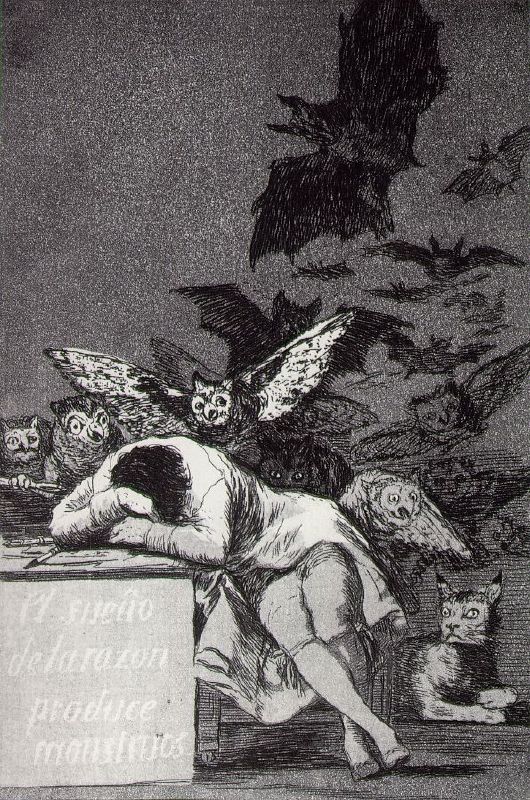
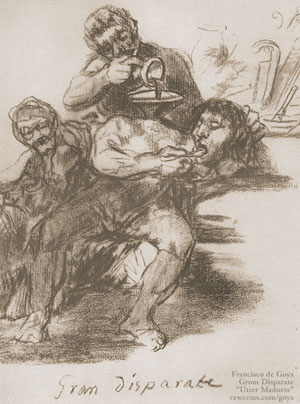
The Sleep of Reason Produces Monsters -- Goya (1797)

If 2666 impossibly haunts The Third Reich from the future, then paranoid Poe haunts it from the past. Last time we checked in, Udo Berger and his beautiful girlfriend Ingeborg had made tentative friends with another German couple while spending the summer at a seaside resort in Spain. Through this pair, they meet up with two nefarious locals, the Wolf and the Lamb; Udo also begins obsessing over a man named El Quemado, a burn victim who rents paddle boats to tourists. For Udo, the holiday is meant to be a working vacation—he’s a wargame enthusiast, and he plans to write a defining strategy for a new game called “The Third Reich” (implicitly, he plays the Nazi’s side). In the meantime, he’s also taken with the hotel’s owner, Frau Else, a German transplant who mysteriously disappears to take care of an ill husband who no one seems to see.

The first part of The Third Reich (published in the Spring ’11 issue) set the stage for dread, mystery, and extreme paranoia—all while on a sunny seaside holiday. The set-up recalls the seemingly innocuous first section of 2666, “The Part About the Critics,” where four European literature professors spend a vacation of sorts in sunny Mexico while ostensibly searching for a mysterious author. The Third Reich showcases the same sinister tension, describing—but never explaining—the stress between differing cultures, the radical alterity of “being on holiday,” of “vacating,” of being in a different place for a different purpose than what is usual, normal.

The second part of The Third Reich (in the new Summer ’11 issue) increases the dread and paranoia, all with a strange, mordant humor. The novel’s conceit is that the writing is Udo’s holiday’s journal; as such, he controls not only perspective and tone, but what details we learn—or don’t learn. It’s what Udo leaves out that becomes increasingly distressing and fascinating. Indeed, at a crucial point in the novel, Udo fails to explain to us why he remains in Spain after his holiday should be over, even as Ingeborg returns to Germany. There is an ostensible explanation—Charly has disappeared and Udo perhaps wants an answer to the mystery (I will withhold further details for fear of spoiling the plot). It seems more likely that Udo remains to work out his strategy for “The Third Reich”; he finds an unlikely gaming partner in El Quemado. Indeed, the wargame begins to define Udo’s perspective at all times—

When I saw from the balcony that the bathers were beating a mass retreat toward the hotels and campgrounds, I went down to the beach. It’s a sad time of day, and the bathers are sad: tired, sated with sun, they turn their gazes toward the line of buildings like soldier s already sure of defeat; with tired steps they cross the beach and the Paseo Maritimo, prudent but with a hint of scorn, of arrogance in the face of remote danger, their peculiar way of turning down side streets where they immediately seek out the shade leading them directly—they’re a tributue—toward the void.

German nihilism on holiday! Still, Udo finds perverse joy in his gaming sessions with El Quemado; in these episodes, his tone escalates to a manic pitch, reminiscent of some of Poe’s crazies (the narrator of “The Tell-Tale Heart” comes to mind in particular), as well as the mounting insanity of Oscar Amalfitano in 2666. And, just as in the early parts of 2666, The Third Reich begins to buzz with rumors of rape. Udo hints at these rumors, but is unwilling to explore them. Also mysterious is the identity of Frau Else’s husband, a pointedly Gothic conceit, of course, that nonetheless may be the beating heart of horror at the center of the story. He haunts Udo’s sleep—

I dreamed that someone was knocking at the door. It was nighttime and when I opened the door I saw someone slipping down the hall. I followed. Unexpectedly we came to a huge dark room filled with the outlines of heavy old furniture. The smell of mildew and dampness was strong. On a bed a shadowy figure was twisting and turning. At first I thought it was an animal. Then I recognized Frau Else’s husband. At last!

I’ve done my best to omit some of the sharp twists in this section of The Third Reich for fear of spoiling the book, but I will add that Part II ends with something of a subtle cliffhanger (as I write the term “subtle cliffhanger” I realize that it is pure oxymoron; mea culpa). In any case, I’m enjoying the serialization very much and look forward to reading Part III.

Seven Fragmentary Novels That Aren’t The Pale King

I finished David Foster Wallace’s The Pale King the other night (don’t worry—I know that there’s been a terrible shortage of coverage for this obscure book, so I’ll post a review pretty soon review here). The Pale King unfolds as a series of fragments, some short as one page, many the length of long short stories, and one novella length piece. Characters recur, but themes, images, and motifs hold these pieces together rather than any linear plot. The better pieces can stand on their own as short stories, yet are much richer when read with/against the rest of the novel. The Pale King remained unfinished at the time of Wallace’s death, but his notes on the manuscript (published at the end of the book) suggest that fragmentation was always his intentional method.

The fragmentary novel is nothing new, but its particular powers have gained resonance against the backdrop of a world where authority, information, and communication are increasingly decentralized, scattered, and, well, fragmented. Fragmentary novels might have roots in the picaresque (those one-damn-thing-after-the-next novels like Don QuixoteCandide, Huckleberry FinnInvisible Man, Orlando, Blood Meridian . . .), but picaresque novels tend to have a shape, a trajectory, even if they seem to lack traditional plot arcs or characterization. What I’m talking about here are novels made of pieces, segments, or chapters that work fine on their own, and  may even seem self-contained, but when synthesized help reveal the novel’s greater project. So, seven fragmentary novels that aren’t The Pale King—

Steps, Jerzy Kosinski

There’s force and vitality and horror in Steps, all compressed into lucid, compact little scenes. In terms of plot, some scenes connect to others, while most don’t. The book is unified by its themes of repression and alienation, its economy of rhythm, and, most especially, the consistent tone of its narrator. In the end, it doesn’t matter if it’s the same man relating all of these strange experiences because the way he relates them links them and enlarges them. At a remove, Steps is probably about a Polish man’s difficulties under the harsh Soviet regime at home played against his experiences as a new immigrant to the United States and its bizarre codes of capitalism. But this summary is pale against the sinister light of Kosinski’s prose. Here’s David Foster Wallace: “Steps gets called a novel but it is really a collection of unbelievably creepy little allegorical tableaux done in a terse elegant voice that’s like nothing else anywhere ever. Only Kafka’s fragments get anywhere close to where Kosinski goes in this book, which is better than everything else he ever did combined.”

Speedboat, Renata Adler

Telegraphed in bristling, angular prose, Speedboat unwinds as a series of seemingly unrelated vignettes, japes, and jokes all filtered through the narrator’s ironic, faux-journalist sensibility. Adler’s novel eschews plot, conventional characters, and resolution—its contours are its center. Speedboat was published in the early 1970s, but it would seem ahead of its time even if it were published tomorrow.  Adler captures the deep existential alienation of modern life, converting dread into verve and despair into marvel.

2666, Roberto Bolaño

Bolaño’s opus bears considerable superficial comparison to Wallace’s The Pale King: both were published posthumously, both have endured a process of buzz and backlash, both are unfinished, and both are purposefully fragmented. 2666 comprises (at least five) parts, some connected explicitly, others tied loosely together, but all interwoven with themes of violence, darkness, art, and love. The book’s most notorious section, “The Part About the Crimes,” is itself a fragmented beast, a procession of murders and rapes, dead-end investigations, bizarre TV appearances, and other sinister doings. Prominent characters disappear into the violence of Santa Teresa never to return again; the great mystery of the book seems unsolved. But like Ariadne, Bolaño offers his readers a thread through the labyrinth, a layering of motifs, as words and images repeat throughout shifts in space and time.

Naked Lunch, William S. Burroughs

Naked Lunch’s cut-up origins are well-known and probably greatly exaggerated: the book is far more coherent than its reputation insists. Still, Burroughs’s infamous novel is all over the place (quite literally), moving through time and space and even to Interzone. Comic, rambling, lusty, and perverse, Naked Lunch’s satire is often overshadowed by its seedier, more sensational side. Burroughs claimed his novels were part of an antique literary pedigree: “I myself am in a very old tradition, namely, that of the picaresque novel. People complain that my novels have no plot. Well, a picaresque novel has no plot. It is simply a series of incidents.”

Vertigo, W. G.  Sebald

Vertigo blurs the lines between fiction, history, autobiography, and biography. The book comprises four sections. The first section tells the story of the romantic novelist Stendhal (or, more to the point, a version of Stendhal); the second section details two trips Sebald made to Italy, one in 1980, and one in 1987; the third section describes a trip Kakfa took to Italy near the end of his life; the final section describes the narrator hiking from Austria to visit the village where he was born in Bavaria. Underwriting and uniting these separate episodes is the narrator’s attempt to find a common thread between past and present, to find a unity in a Europe fractured by time and war. There’s also a deep, throbbing melancholy mixed with beauty and wisdom here.

Cloud Atlas, David Mitchell

Mitchell constructs Cloud Atlas like a doubled matryoshka doll, nesting narratives inside narratives that work their way to an apocalyptic future; once Cloud Atlas hits its middle mark, it works outward to the past, back to its own edges. With the exception of the middle piece, a nod to Russell Hoban’s Riddley Walker, Mitchell fragments each piece of Cloud Atlas at a key turning point, an old literary trick really, but one that pays off. The tales likely hold up on their own, but their intertextual play is the real delight of the novel, as Mitchell showcases a variety of styles and genres and forms that reflect the content and era of each tale. At its core,  Cloud Atlas explores Nietzschean themes of eternal recurrence and the will to power; its clever fragmented structure emphasizes the loops of history humanity finds itself caught in again and again, even as brave souls seek a new way of seeing, living, doing.

Go Down, Moses, William Faulkner

Faulkner always insisted that Go Down, Moses was a novel, although in its initial publication it was presented as a collection of short stories.  And granted, any of the stories can be read on their own. “Was” is hilarious homosocial hijinks, but read against the sorrow and anger in “The Fire and the Hearth” and “Pantaloon in Black,” or the prolonged majesty of “The Bear,” Faulkner’s project becomes much clearer—he is taking on a century in the lives of the Mississippi McCaslins. Go Down, Moses is strange and sad and funny and truly an achievement, a book that works as a sort of time machine, an attempt to undo or recover the racial and familial (and in Faulkner, these are the same) divides of the past.
Between Parentheses — Roberto Bolaño

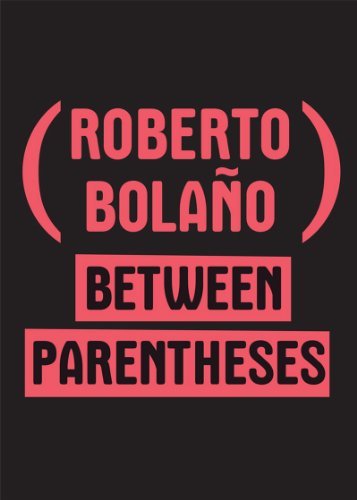
Between Parentheses (new from New Directions and deftly translated by Natasha Wimmer) collects over 400 pages of Roberto Bolaño’s essays, speeches, introductions, and newspaper columns, composed between 1998 and 2003, the year Bolaño died. The bulk of the book, as well as its title, comes from a column that Bolaño wrote for the Chilean newspaper Las Últimas Noticias. As one would expect, these pieces are relatively short, sometimes under 500 words, punctuated with a depth that belies their brevity. Bolaño writes about everything (or, everything worth writing about, I suppose), but, as those familiar will guess, literature is his main subject, whether he’s reviewing a Spanish-language translation of McCarthy’s Blood Meridian, comparing Kafka and Philip K. Dick, explaining his affection for William Burroughs, or discussing the merits of translating literature. If these samples tantalize you, let me go further: Bolaño writes about detective novels, Walter Mosley, Jonathan Swift, Jorge Luis Borges, magic, devils, memoirs, Gunter Grass, murder, troubadours, the Hell’s Angels, poetry, and more, more, more.

Despite its discursive topics, a unified tone inheres throughout Between Parentheses, a distinctly Bolañonian tone, at once grand and romantic (and Romantic) and profound and cynical and biting and flippant. In her blurb on the back of the book, Marcela Valdes (The Nation) declares that in Between Parentheses “we hear Bolaño’s real voice, the one he often disguised through the ventriloquism of his fiction.” This is perhaps a too-bold statement—I’m not sure if Bolaño can be said to have a “real voice”—instead, we find an author who’s constantly inventing and then reinventing, inflating and deflating, expanding and contracting.

And yet I think we’ll have to take Between Parentheses as Bolaño’s “real voice”—it’s perhaps the closest thing we’ll get to memoir or autobiography from the man (at least for now: his literary estate seems to be  in a constant state of excavation, so who knows). But Bolaño, ever the winking imp, is there to warn us against taking memoir at face value—

Of all books, memoirs are the most deceitful because the pretense in which they engage often goes undetected and their authors are usually only looking to justify themselves. Ostentation and memoirs tend to go together. Lies and memoirs get along swimmingly.

If Bolaño may occasionally employ invention in some of the passages here, it’s all to his credit, and all perhaps in the service of Higher Artistic Truth (whatever that means). He shares much of himself in Between Parentheses, especially in the book’s first section, “Three Insufferable Speeches,” (you may have already read “Literature and Exile”) and its second section, “Fragments of a Return to the Native Land,” detailing the writer’s return to Chile in 1998. These are indeed fragments, sketchy, pained moments where we glimpse Bolaño trying to process a difficult and emotional journey. The tone is at once comic, analytical, and depressive—familiar territory to Bolaño’s readers, I suppose. Besides its obvious appeal as a Bolaño memoir, “Fragments” is also fine travel literature, as is the later section “Scenes,” which comprises evocations of various locales, chief among them Bolaño’s adopted home Blanes. Several of the pieces in “Scenes” seem to extend into the realm of pure fiction; a few are narrated by speakers who are only partly-Bolaño (if such a construction can be said to exist). In any case, they are the book’s closest approximations of short fiction.

The book’s fifth section, “The Brave Librarian,” features one of the highlights (and longer pieces) of the volume, a preface for The Adventures of Huckleberry Finn called “Our Guide to the Abyss,” where Bolaño parses Twain and Melville, delving into American literature. I’m sure that for many this piece alone will be worth the price of admission. If you still need convincing, the book’s final section offers a treatise on book theft, advice on the art of writing short stories, a transcript of Bolaño’s last interview before his death, and more, more, more. “More, more, more” might be a simple way to summarize this book.

Between the Parentheses does little, ultimately, to explicate Roberto Bolaño. If anything, it helps to further confound those of us who’ve been puzzling out his fiction for the past few years. And thank God for that. I’ve written before about “the Bolañoverse,” about Bolaño’s labyrinthine genre-crossing intertextuality. Between Parentheses, despite its claims to reality or truth, is nevertheless a part of Bolaño’s maze, a maze by turns dark or illuminating, tragic or comic, and stark and enriching. Most of all, this maze is a strange joy to get lost in. Highly recommended.

The Third Reich: Part I — Roberto Bolaño

Two years ago, a typed manuscript for Roberto Bolaño’s unpublished novel The Third Reich The Third Reich was discovered. The Paris Review is serializing the novel, publishing it in full over four issues in a translation by Natasha Wimmer. I finished the first part of The Third Reich last night, reading the 63 pages in one engrossing session.
Udo Berger, a German from Stuttgart with a passion for war games, narrates the story in the form of a journal he keeps, detailing the daily events of a vacation he is taking in a Spanish resort town with his girlfriend Ingeborg. The couple checks in to the Del Mar, a seaside hotel where Udo spent a few teenage summers with his family. He seems driven to return to this particular hotel, at least in part, by memories of the enigmatic Frau Else, an alluring German woman who married the hotel’s Spanish owner. Frau Else barely remembers Udo, a fact that disappoints him, yet he nevertheless pursues strange awkward conversations with her; it’s unclear to both Udo and the reader what, exactly, he hopes to gain from talking to her.

Indeed, Udo’s intentions and motivations are strange and murky in general. He’s the classic unreliable narrator. In particular, Udo’s perceptions (and descriptions of those perceptions) seem to be clouded by a radical fear of otherness, and an underlying contempt for almost everyone. He’s also a little paranoid, perhaps, in part anyway, because we get the sense that Ingeborg might be just a bit out of his league. Consider the following scene—

Ingeborg was at her most radiant, and when we walked into the club we were greeted with covert admiring glances. Admiring of Ingeborg and envious of me. Envy is something I always pick up on right away. Anyways, we didn’t plan to spend much time there. And yet as fate would have it, before long a German couple sat down at our table.

That German couple is Hanna and Charly, and Udo quickly comes to detest them, although he repeatedly points out that he covers his disgust at all times (and, by the end of Part I, it’s clear that he has an unvoiced sexual attraction to Hanna). Charly is boorish, foolhardy, and quick to make friends with the locals. Through him, the Germans become acquainted with two locals Udo dubs the Wolf and the Lamb. The Wolf and the Lamb take the four tourists to the kind of working class haunts that only locals go to; Charly and the girls find adventure in this, but Udo is contemptuous and disgusted of these clubs, bars, and restaurants. His depictions of the local spots veer into classic Bolaño territory, that mix of unnerving dread and surreal energy, a kind of Lynchian anxiety that suggests abyssal darkness looms under the veneer of every “normal” surface.

Udo would rather stay in the hotel and work on his war game; he’s devoted the summer to playing out a new strategy and writing an essay about it for one of the various magazines devoted to the hobby. Ingeborg is embarrassed and ashamed of Udo’s passion for games, and when Hanna shows interest in the large hexagonal board set up in their room, Ingeborg quickly rushes her out to the beach. Udo, for the first time realizes this division in his relationship with Ingeborg, who spends her time on various daytrips (perhaps, although Udo doesn’t seem to recognize this, with the Wolf and the Lamb)—yet he fecklessly makes amends by buying cheap gift store jewelery, and avers that losing Ingeborg would destroy him. A dark set up.

The only person apart from Frau Else who Udo takes any interest in is El Quemado (“the Burned One”), a horribly burn-scarred, well-muscled man who makes a living renting paddle boats to tourists. Udo becomes obsessed with El Quemado when he realizes that the man seems to build a shelter out of the paddle boats each night; over time, he strikes up a strange friendship, leading to the revelation that they share a trait: both consider themselves writers.

The Third Reich, composed at the beginning of Bolaño’s career as a novelist, doesn’t feature the labyrinthine syntax or heteroglossia of later works, but it does showcase the particularly Bolañonian sense of dread that seethes under so many of his works. The novel feels like a slow burn, with plenty of sinister elements in play—but there’s also the possibility that this nervous dread stems from Udo’s internal paranoia. In any case, Bolaño is beginning to play with the tropes of the detective novels and crime fiction he loved so much. As I argued in my review of Amulet last month, the more one reads Bolaño, the more difficult it is to parse his fictions from each other. Instead, they seem part of the Bolañoverse, a dark visceral inversion of our own world. Thus The Third Reich strongly recalls the title story in the collection Last Evenings on Earth, where the narrator B and his father take a bizarre, sinister vacation in Acapulco. The Third Reich also obviously recalls Nazi Literature in the Americas, which featured an entire chapter on neo-Nazi boardgames.

Of course, my observations are only drawn from the first fourth of the novel, but as a Bolaño fan I was not disappointed. I just wanted more—but I guess I’ll have to wait for the summer issue.

“How to Recognize a Piece of Art” — Roberto Bolaño on the Power of Translation

A sample of Roberto Bolaño’s short essay “Translation Is an Anvil” (from New Directions’ forthcoming Between Parentheses, a collection of Bolaño’s essays, newspaper columns, and other ephemera)——

How to recognize a work of art? How to separate it, even if just for a moment, from its critical apparatus, its exegetes, its tireless plagiarizers, its belittlers, its final lonely fate? Easy. Let it be translated. Let its translator be far from brilliant. Rip pages from it at random. Leave it lying in an attic. If after all of this a kid comes along and reads it, and after reading makes it his own, and is faithful to it (or unfaithful, whichever) and reinterprets it and accompanies it on its  voyage to the edge, and both are enriched and the kid adds an ounce of value to its original value, then we have something before us, a machine or a book, capable of speaking to all human beings; not a plowed field but a mountain, not the image of a dark forest but the dark forest, not a flock of birds but the Nightingale.

Roberto Bolaño on Blood Meridian

A slice of Roberto Bolaño’s review of Cormac McCarthy’s Blood Meridian (from New Directions’ forthcoming Between Parentheses, a collection of Bolaño’s essays, newspaper columns, and other ephemera)——

Blood Meridian is also a novel about place, about the landscape of Texas and Chihuahua and Sonora; a kind of anti-pastoral novel in which the landscape looms in its leading role, imposingly—truly the new world, silent and paradigmatic and hideous, with room for everything except human beings. It could be said that the landscape of Blood Meridian is a landscape out of de Sade, a thirsty and indifferent landscape ruled by strange laws involving pain and anesthesia, laws by which time often manifests itself.

“A Kind of Kafka Steeped in LSD and Rage” — Roberto Bolaño on Philip K. Dick

Here’s Roberto Bolaño on Philip K. Dick (from New Directions’ forthcoming collection of Bolaño’s newspaper columns, forewords, and other ephemera Between Parentheses)—

Dick was a schizophrenic. Dick was a paranoiac. Dick is one of the ten best American writers of the 20th century, which is saying a lot. Dick was a kind of Kafka steeped in LSD and rage. Dick talks to us, in The Man in the High Castle, in what would become his trademark way, about how mutable reality can be and therefore how mutable history can be. Dick is Thoreau plus the death of the American dream. Dick writes, at times, like a prisoner, because ethically and aesthetically he really is a prisoner. Dick is the one who, in Ubik, comes closest to capturing the human consciousness or fragments of consciousness in the context of their setting; the correspondence between what he tells and the structure of what’s told is more brilliant than similar experiments conducted by Pynchon or DeLillo.

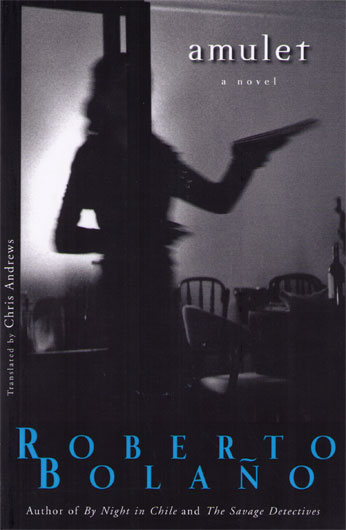
Amulet — Roberto Bolaño

When one takes on the project of reading the novels of Roberto Bolaño — and 2666 is the sort of beast that is likely to hook a reader into such an endeavor — it becomes increasingly impossible to separate and compartmentalize his fictions. Instead, the reader becomes ever more entangled in a labyrinthine Bolañoverse, a chilling, dreadful mirror-maze world that discharges its echoes across continents and epochs. In a fascinating essay at The Quarterly Conversation, Javier Moreno attempts to map out this world. I’d read the essay (and commented on it) a few years ago, but I revisited it after finishing Amulet, mostly because I was pretty sure Moreno had already succinctly stated a key idea that I wanted to bring up in my review. He writes—

Amuleto, which tells the story of an Uruguayan poet that claims herself to be the mother of all Mexican writers, may be seen both as an extra chapter to Los Detectives or as a short introduction to 2666—or both at the same time.

Readers of 2666 and The Savage Detectives will find in Amulet a channel between Bolaño’s “big books,” just as Nazi Literature in the Americas serves as a strange, ironic connective tissue for the violence and chaos of the rest of Bolañoverse. Amulet is narrated by Auxilio Lacouture, and her story appears in a much shorter form in The Savage Detectives. I’ll let her summarize Amulet’s plot (such that it is)—

I am the mother of Mexico’s poets. I am the only one who held out in the university in 1968, when the riot police and the army came in. I stayed there on my own in the Faculty, shut up in the a bathroom, with no food, for more than ten days, for more than fifteen days, from the eighteenth to the thirtieth of September, I think, I’m not sure anymore.

I stayed there with a book by Pedro Garfias and my satchel, wearing a little white blouse and a pleated sky-blue skirt, and I had more than enough times to think things over. But couldn’t think about Arturo Belano , because I hadn’t met him yet.

In these two short paragraphs, late in the book, we get so many of the motifs that populate Bolaño’s world: the self-naming poet, the influence of violence in Latin America, the horrors inherent in resisting this violence, exile, hints of madness. We even get Bolaño’s elusive alter-ego, Arturo Belano, who floats through Amulet and the rest of the Bolañoverse like an unknowable specter.

The fact that Auxilio couldn’t think about Belano when she was stuck in the bathroom in 1968 does not actually stop her from doing so. She is, to borrow a phrase from Vonnegut, a woman unstuck in time. It is as if the entire novel, that is to say her narrative, her telling of her story, is tenuously anchored in the those traumatic days of September, 1968. She tells us, echoing Stephen Dedalus perhaps, that “History is a horror story”; unlike Dedalus, she can’t awake from the nightmare. Here’s a relatively early passage that describes what Auxilio can never really explain—

I don’t know why I remember that afternoon. That afternoon of 1971 or 1972. And the strangest thing is that I remember it prospectively, from 1968. From my watchtower, my bloody subway carriage, from my gigantic rainy day. From the women’s bathroom on the fourth floor of the Faculty of Philosophy and Literature, the timeship from which I can observe the entire life and times of Auxilio Lacouture, such as they are.

The life and times of Auxilio Lacouture, such as they are, will be somewhat familiar to anyone who’s read some of Bolaño’s other novels: plenty of dread, lots of sinister shadows, and many, many drunk poets. The anecdotes and small set pieces that fill Amulet seem culled from Bolaño’s own life (real or imagined), and can be alternately thrilling, dull, or even maddening. For my taste, the novel works itself into its finest moments when Auxilio’s grip on reality — both temporal and spacial — is at its weakest. At one point she tells us—

I don’t know if I’m in 1968 or 1974 or 1980, gliding, finally, like the shadow of a sunken ship, toward the blessed year 2000, which I shall not live to see.

Auxilio’s sanity both unravels and compresses, and Bolaño codes these movements in images of descent and ascension. Auxilio moves through fever dreams and nightmares, memories and prognostications, alternate realities and astral projections. Near the end of the novel, still in the bathroom, starving, probably in shock, she experiences her ordeal as a difficult climb up a frozen mountain. Along the way, she begins casting bizarre literary prophecies. A quick taste—

Virginia Woolf shall be reincarnated as an Argentinian fiction writer in the year 2076. Louis-Ferdinand Celine shall enter Purgatory in the year 2094. Paul Eluard shall appeal to the masses in the year 2101.

These pronouncements continue for a few pages. Underneath the madness, one can sense Bolaño’s goofy joy, but there’s more here than just list-making: Auxilio is pointing toward metempsychosis, suggesting her own soul’s migration, perhaps—here we find a way in which literature might transcend the violence and horror of history. And yet there’s also a sense of doom, of repeated violence and exile. Late in the novel Auxilio finds herself cast in the role of Erigone, daughter Aegisthus and Clytemnestra, forced from home by her half-brother, Orestes. There’s a sense that tragedy capitulates throughout time; that even if Auxilio can survive the army’s occupation, it will nevertheless scar her forever. Cycles of violence are bound to recur indefinitely.

This recurrence evinces in what might be the book’s most famous passage. Auxilio is walking home with some friends—

Then we walked down the Avenida Guerrero; they weren’t stepping so lightly any more, and I wasn’t feeling too enthusiastic either. Guerrero, at that time of night, is more like a cemetery than an avenue, not a cemetery in 1974 or in 1968, or 1975, but a cemetery in the year 2666, a forgotten cemetery under the eyelid of a corpse or an unborn child, bathed in the dispassionate fluids of an eye that tried so hard to forget one particular thing that it ended up forgetting everything else.

The passage names Bolaño’s opus: there is no mention of “2666” in 2666. The reference rests outside the book; or, perhaps Bolaño demands that we read his books intertextually. In any case, 2666 has its graveyards and its corpses, its own demanding geometry of memory. One gets the sense that this oblique reference to “2666” is really part of Bolaño crafting his own canon, an internal canon of the Bolañoverse, almost as if he were J.R.R. Tolkien or even Philip K. Dick. I think again of Auxilio’s prophecies, of her list of writers who will be reborn or forgotten, where we find Bolaño securing a historical place for the writers he loves and values.

Looking over this review, I realize that it might not be helpful for readers new to Bolaño: mea culpa. Amulet is a very fine novel, but not the right starting point. That would be 2666 or, if that prospect is too daunting, Last Evenings on Earth. To me, Amulet reads like the “Mexico” chapter in a trilogy about violence and exile in Latin America; the other two parts would be Distant Star (which I enjoyed more) and By Night in Chile. But perhaps I’m simply reaching for evidence to support this idea that Bolaño’s books are best read together. I’m sure that one can enjoy them on their own—only, at this point, I’m not sure how to do that.

Amulet, translated by Chris Andrews, is available now from New Directions.

On the Feeling of Being In-between Books

Like most bibliophiles, I have a big ole stack of books — multiple stacks, really — lying around the house; that is, I have unshelved books in little intermediary piles that I am either always reading or planning to read “next,” which is to say, sometime in the near future. I’ve written before about books I’m always reading (and re-reading), so I’ll set that aside for the moment; also, there are those books of a somewhat fragmentary nature that I like to read slowly (fodder for a future post, perhaps) — but let’s set those aside as well, because they are not what I’m speaking of here.

I found a few years ago that the best way to finish a book, especially a challenging book, but really any novel worth reading, is to simply give it as much undivided attention as you can — to do your best to not let all those other books jump the queue. And for the most part, I’m pretty good at doing this.

So well anyway.

I finished Roberto Bolaño’s Amulet the night before last. I’ve had the book for a while, and though I had desired to read it, I hadn’t had the feeling of wanting to commit to this particular book; so, what I’m doing now, gentle reader, is distinguishing between these two things. We, that is bibliophiles, we all desire to read certain books (lots of certain books, no doubt), but that’s not the same as the feeling of wanting to commit to the particular book. Because generally a bibliophile knows that a great book, or at least a book worth reading, requires a certain level of commitment.

I picked Amulet out of the stack after reading Malcolm Lowry’s Under the Volcano. I don’t know why. There was no intellectual impulse in the choice, although a connection might easily be made between the two novels, both set in Mexico; indeed, Bolaño opens The Savage Detectives with a quote from Under the Volcano, and the heroine of Amulet shows up in The Savage Detectives — so there is some connection. But again, the decision to read Amulet next, instead of, say, Giuseppe Tomasi di Lampedusa’s The Leopard or Heinrich Böll’s The Train Was on Time or any of the other dozens of books cluttering up Biblioklept International Headquarters, was, or at least I believe was, more a matter of intuition and feeling than intellect.

So, as I mentioned, I finished Amulet the other night, and, during the course of reading that novel, another dead literary darling’s novel came out, David Foster Wallace’s The Pale King. Which I’ve been greatly anticipating. Which I’ve been very much desiring to read. Which I have absolutely no desire to commit to reading now, which is to say in that moment between books. Which is strange, I suppose, but perhaps easy to account for on several fronts. First, every day seems to bring some new, fully realized review of The Pale King to the internet, or some piece about Wallace’s “legacy” and The Pale King, or, even worse, some coverage about coverage of The Pale King (which, yes, I realize this post is now threatening to become). Another reason that might account for the fact that I have no feeling to commit to reading The Pale King now may be that it is Wallace’s last novel; maybe I want to wait a bit, give myself a bit of distance from the internet buzz, let anticipation build again. Divorce myself from the idea of having to read the book — especially in the context of Biblioklept, a maybe-literary blog.

To go back to my earlier point, the point of all of this (if this rambling can be said to have a point) is that I realize that I rarely choose to read the “next” book in an intellectual way — that is, the choice is almost always intuitive, born from some feeling that I don’t know how to name, except to say that it’s the feeling that I have when I’m in-between books. It’s a wonderful feeling, exhilarating and freeing and full of possibility, as corny as that sounds, but also a kind of anxiety, a feeling paradoxically tempered by the temporal messiness of being a reader, which is to say being a human, as if the limited time we have to read dampens — and thus defines — the edges of this particular exhilaration. I love the feeling because it opens a seemingly illimitable range of possibilities — the possibilities of new books, new narratives — even as the choice forecloses the possibility of another choice. Etymologically, the word “decide” means “to cut off.” But enough dithering. Time to riffle through the stack.