“The Image of the Lost Soul” — Saki


“The Image of the Lost Soul” by Saki—

There were a number of carved stone figures placed at intervals along the parapets of the old Cathedral; some of them represented angels, others kings and bishops, and nearly all were in attitudes of pious exaltation and composure. But one figure, low down on the cold north side of the building, had neither crown, mitre, not nimbus, and its face was hard and bitter and downcast; it must be a demon, declared the fat blue pigeons that roosted and sunned themselves all day on the ledges of the parapet; but the old belfry jackdaw, who was an authority on ecclesiastical architecture, said it was a lost soul. And there the matter rested.

One autumn day there fluttered on to the Cathedral roof a slender, sweet-voiced bird that had wandered away from the bare fields and thinning hedgerows in search of a winter roosting-place. It tried to rest its tired feet under the shade of a great angel-wing or to nestle in the sculptured folds of a kingly robe, but the fat pigeons hustled it away from wherever it settled, and the noisy sparrow-folk drove it off the ledges. No respectable bird sang with so much feeling, they cheeped one to another, and the wanderer had to move on.

Only the effigy of the Lost Soul offered a place of refuge. The pigeons did not consider it safe to perch on a projection that leaned so much out of the perpendicular, and was, besides, too much in the shadow. The figure did not cross its hands in the pious attitude of the other graven dignitaries, but its arms were folded as in defiance and their angle made a snug resting-place for the little bird. Every evening it crept trustfully into its corner against the stone breast of the image, and the darkling eyes seemed to keep watch over its slumbers. The lonely bird grew to love its lonely protector, and during the day it would sit from time to time on some rainshoot or other abutment and trill forth its sweetest music in grateful thanks for its nightly shelter. And, it may have been the work of wind and weather, or some other influence, but the wild drawn face seemed gradually to lose some of its hardness and unhappiness. Every day, through the long monotonous hours, the song of his little guest would come up in snatches to the lonely watcher, and at evening, when the vesper-bell was ringing and the great grey bats slid out of their hiding-places in the belfry roof, the brighteyed bird would return, twitter a few sleepy notes, and nestle into the arms that were waiting for him. Those were happy days for the Dark Image. Only the great bell of the Cathedral rang out daily its mocking message, “After joy . . . sorrow.”

The folk in the verger’s lodge noticed a little brown bird flitting about the Cathedral precincts, and admired its beautiful singing. “But it is a pity,” said they, “that all that warbling should be lost and wasted far out of hearing up on the parapet.” They were poor, but they understood the principles of political economy. So they caught the bird and put it in a little wicker cage outside the lodge door.

     That night the little songster was missing from its accustomed haunt, and the Dark Image knew more than ever the bitterness of loneliness. Perhaps his little friend had been killed by a prowling cat or hurt by a stone. Perhaps . . . perhaps he had flown elsewhere. But when morning came there floated up to him, through the noise and bustle of the Cathedral world, a faint heart-aching message from the prisoner in the wicker cage far below. And every day, at high noon, when the fat pigeons were stupefied into silence after their midday meal and the sparrows were washing themselves in the street-puddles, the song of the little bird came up to the parapets — a song of hunger and longing and hopelessness, a cry that could never be answered. The pigeons remarked, between mealtimes, that the figure leaned forward more than ever out of the perpendicular.

One day no song came up from the little wicker cage. It was the coldest day of the winter, and the pigeons and sparrows on the Cathedral roof looked anxiously on all sides for the scraps of food which they were dependent on in hard weather.

“Have the lodge-folk thrown out anything on to the dust-heap?” inquired one pigeon of another which was peering over the edge of the north parapet.

“Only a little dead bird,” was the answer.

There was a crackling sound in the night on the Cathedral roof and a noise as of falling masonry. The belfry jackdaw said the frost was affecting the fabric, and as he had experienced many frosts it must have been so. In the morning it was seen that the Figure of the Lost Soul had toppled from its cornice and lay now in a broken mass on the dustheap outside the verger’s lodge.
     “It is just as well,” cooed the fat pigeons, after they had peered at the matter for some minutes; “now we shall have a nice angel put up there. Certainly they will put an angel there.”

“After joy . . . sorrow,” rang out the great bell.


Book Shelves #36, 9.02.2012


20120902-101430.jpg

Book shelves series #36, thirty-sixth Sunday of 2012

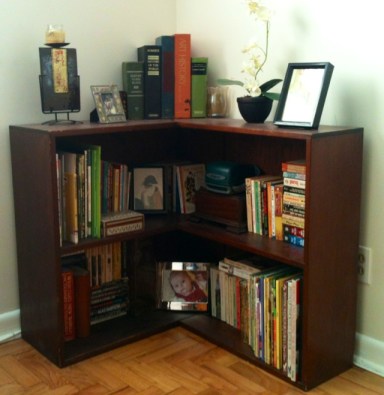
Continuing the corner book shelf in the family room.

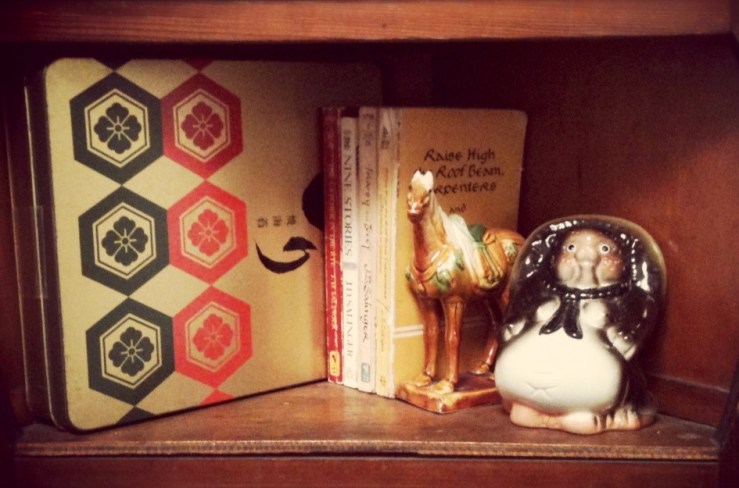
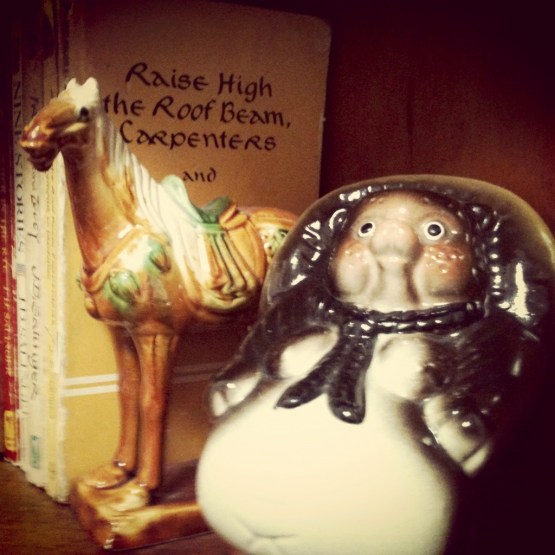
The bookends are tschotskes from a ¥100 shop; we bought them years ago in Tokyo.

Not particularly fancy but they have a sentimental value. (The big guy is a tanuki, if you’re unfamiliar).

The tin on the far left is filled with miscellaneous papers, old stickers, other small bricabrac.


20120902-101437.jpg

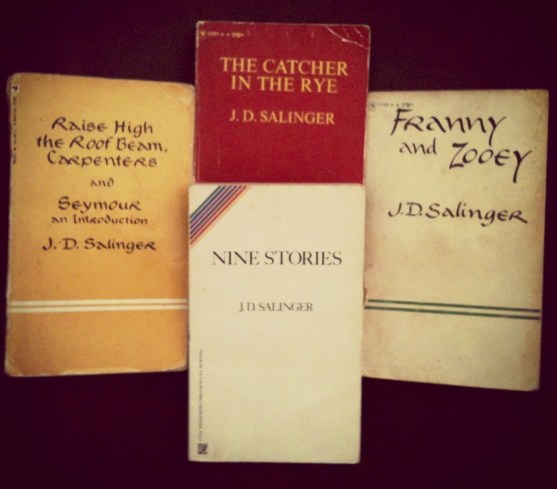
Only four books on this shelf—the more-or-less complete works of J.D. Salinger, in gloriously ratty mass paperback editions:

20120902-101444.jpg

Not sure if these are my wife’s or mine—probably a mix of both. I stole most of these from my high school.

The Catcher in the Rye was as important to me as any other book, I suppose. I wrote about it here.

Nine Stories contains some of Salinger’s most disciplined stuff.

It took me years to finally find the discipline to read Seymour, which is probably the best thing he wrote.


“The Five Boons of Life” — Mark Twain


“The Five Boons of Life,” a short fable from Mark Twain:

CHAPTER I

In the morning of life came a good fairy with her basket, and said:”Here are gifts. Take one, leave the others. And be wary, chose wisely; oh, choose wisely! for only one of them is valuable.”The gifts were five: Fame, Love, Riches, Pleasure, Death. The youth said, eagerly:”There is no need to consider”; and he chose Pleasure.He went out into the world and sought out the pleasures that youth delights in. But each in its turn was short-lived and disappointing, vain and empty; and each, departing, mocked him. In the end he said: “These years I have wasted. If I could but choose again, I would choose wisely.

CHAPTER II

The fairy appeared, and said:”Four of the gifts remain. Choose once more; and oh, remember-time is flying, and only one of them is precious.”The man considered long, then chose Love; and did not mark the tears that rose in the fairy’s eyes.After many, many years the man sat by a coffin, in an empty home. And he communed with himself, saying: “One by one they have gone away and left me; and now she lies here, the dearest and the last. Desolation after desolation has swept over me; for each hour of happiness the treacherous trader, Love, as sold me I have paid a thousand hours of grief. Out of my heart of hearts I curse him.”

CHAPTER III

“Choose again.” It was the fairy speaking.”The years have taught you wisdom — surely it must be so. Three gifts remain. Only one of them has any worth — remember it, and choose warily.”

The man reflected long, then chose Fame; and the fairy, sighing, went her way.Years went by and she came again, and stood behind the man where he sat solitary in the fading day, thinking. And she knew his thought:”My name filled the world, and its praises were on every tongue, and it seemed well with me for a little while. How little a while it was! Then came envy; then detraction; then calumny; then hate; then persecution. Then derision, which is the beginning of the end. And last of all came pity, which is the funeral of fame. Oh, the bitterness and misery of renown! target for mud in its prime, for contempt and compassion in its decay.”


CHAPTER IV

“Choose yet again.” It was the fairy’s voice.”Two gifts remain. And do not despair. In the beginning there was but one that was precious, and it is still here.””Wealth — which is power! How blind I was!” said the man. “Now, at last, life will be worth the living. I will spend, squander, dazzle. These mockers and despisers will crawl in the dirt before me, and I will feed my hungry heart with their envy. I will have all luxuries, all joys, all enchantments of the spirit, all contentments of the body that man holds dear. I will buy, buy, buy! deference, respect, esteem, worship — every pinchbeck grace of life the market of a trivial world can furnish forth. I have lost much time, and chosen badly heretofore, but let that pass; I was ignorant then, and could but take for best what seemed so.”Three short years went by, and a day came when the man sat shivering in a mean garret; and he was gaunt and wan and hollow-eyed, and clothed in rags; and he was gnawing a dry crust and mumbling:”Curse all the world’s gifts, for mockeries and gilded lies! And miscalled, every one. They are not gifts, but merely lendings. Pleasure, Love, Fame, Riches: they are but temporary disguises for lasting realities — Pain, Grief, Shame, Poverty. The fairy said true; in all her store there was but one gift which was precious, only one that was not valueless. How poor and cheap and mean I know those others now to be, compared with that inestimable one, that dear and sweet and kindly one, that steeps in dreamless and enduring sleep the pains that persecute the body, and the shames and griefs that eat the mind and heart. Bring it! I am weary, I would rest.”

CHAPTER V

The fairy came, bringing again four of the gifts, but Death was wanting. She said:     “I gave it to a mother’s pet, a little child. It was ignorant, but trusted me, asking me to choose for it. You did not ask me to choose.””Oh, miserable me! What is left for me?””What not even you have deserved: the wanton insult of Old Age.”


Book Shelves #34, 8.19.2012


20120819-113046.jpg

Book shelves series #34, thirty-fourth Sunday of 2012

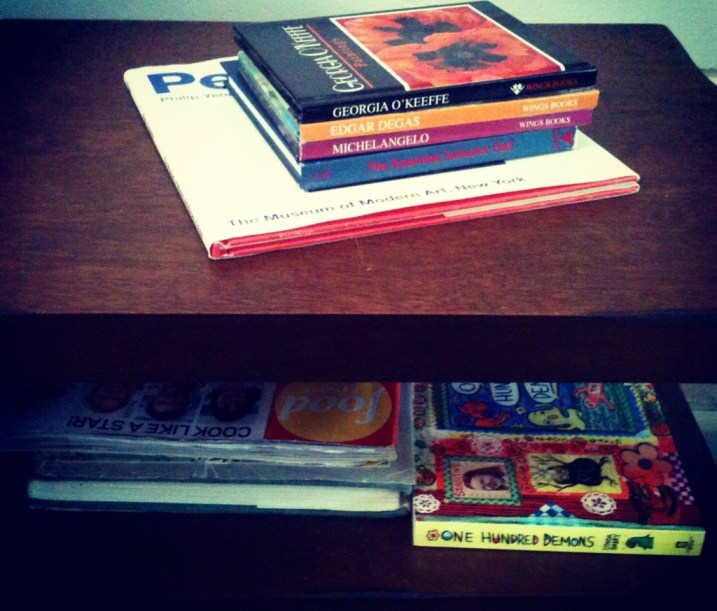
A little end table next to the couch in our family room.

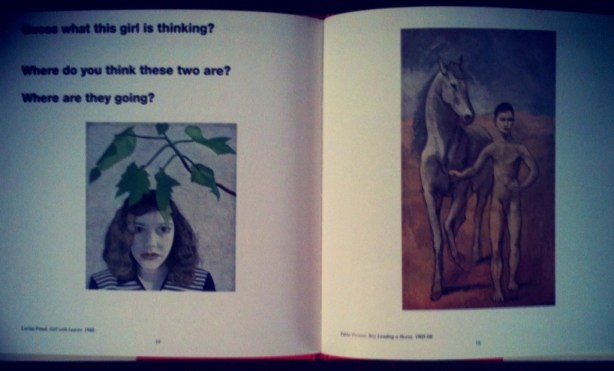
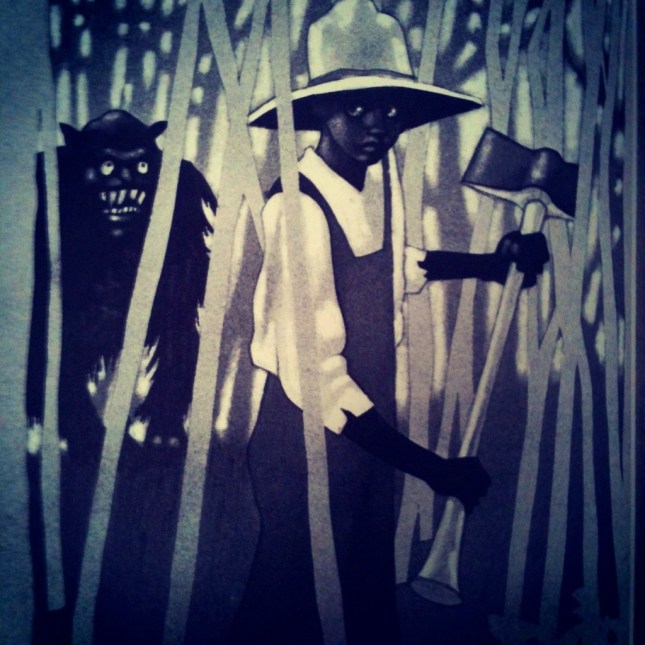
The books on top are little art books we keep out for the kids to look at, including People

20120819-113052.jpg

20120819-113058.jpg

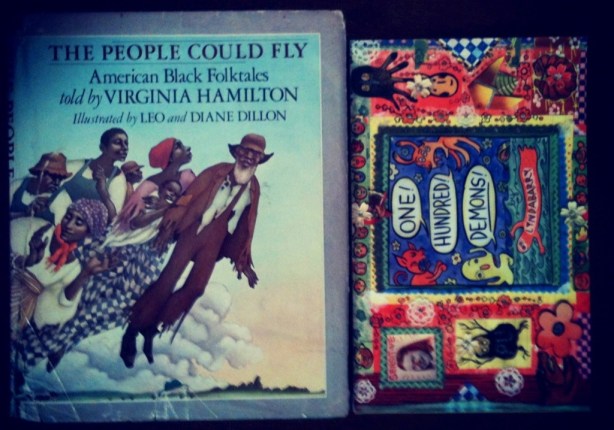
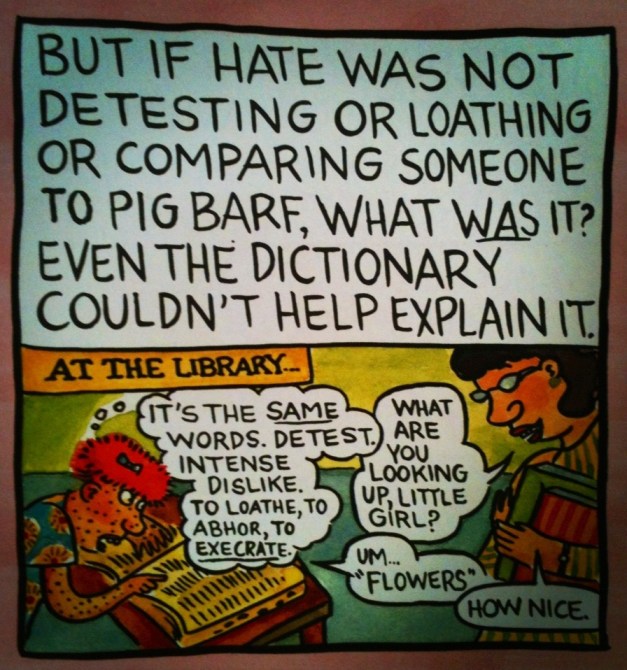
On the second shelf, along with a cooking magazine: The People Could Fly and Lynda Barry’s One Hundred Demons:

20120819-113104.jpg

20120819-113112.jpg

20120819-113121.jpg

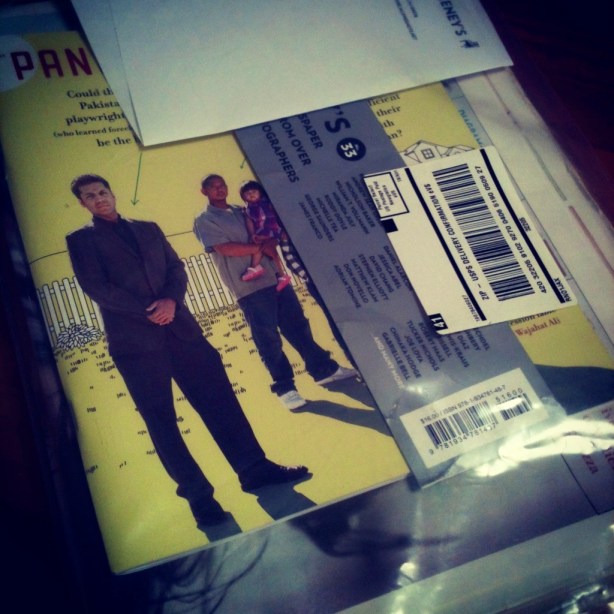
There are two drawers; one holds electronic manuals. The second holds McSweeney’s #33, the newspaper issue, which was pretty damn unwieldy:

20120819-113127.jpg

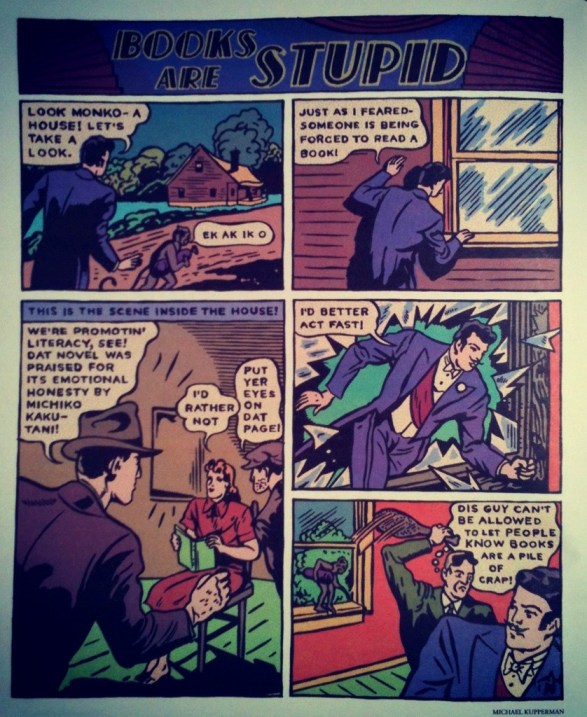
A comic from the McSweeney’s by Michael Kupperman:

20120819-113136.jpg

Bukowski Riff

Charles Bukowski would be 92 if he was still alive, which he isn’t because he died in 1994.

I first read Bukowski in 1994 or 1995.

I can’t remember how I had heard about him, exactly—he might have been on MTV actually (MTV used to promote writers, believe it or not. Writers used to be cool). The Boo Radleys called a song on their 1995 album Wake Up! “Charles Bukowski Is Dead,” and I know I’d read Bukowski by the time I heard the record. I don’t know. In all likelihood, I first read Bukowski by browsing his books at the local Barnes & Noble.

do know that I “borrowed” three beautiful Black Sparrow Press editions of Bukowski from a kid in high school journalism class. I do know that I never returned those books, and they’re still on a shelf with probably five or six other Bukowski volumes. I feel sort of bad about stealing them.

One of those books was/is Women, a rambling riff-novel about Bukowski’s fatter years as a poet of some renown, of some notoriety. I’ve probably read Women in full five times through. It’s hilarious, occasionally silly and hamfisted, and glorious in parts.

I read a lot of Bukowski in high school. A lot. My friends read Bukowski. We all read him, even his poetry. I remember the excitement a friend and I felt when we saw a quick shot of his novel Hollywood in the film Swingers. I don’t know why.

And then I kind of dropped Bukowski. This was when I was a junior or senior in college. I had seen the limitations of his prose, the brutality of his fiction, the sheer sloppiness of it all, the anger, the misogyny—I was aware of these things from the get-go, to be clear—but I became overly concerned with his status as not one of the greats, or as a popular writer, or as a writer from a macho-age better left behind.

But I never traded in my Bukowskis, or put them away. I kept them on the shelf. I go to them every now and then—not for  nourishment, but for what? I don’t know. The work is admittedly spotty—a weird brand of self-deprecation and self-mythology. Henry Chinaski. Hank. Bukowski the autodidact, hunched in an LA library, reading his Shakespeare, his Celine. Bukowski the impoverished drunk. Ugly Bukowski. Romantic Bukowski.

There’s no point to this riff, of course. I was in a faculty meeting all morning and I thought about Bukowski on his birthday. What I mean to say is that Bukowski is a writer I read so thoroughly and so intensely when I was at such a young age that I feel that I know him, or at least know the version of himself that he willed to be let known. But of course I don’t know him.


“Clothes” — Franz Kafka


Clothes

Often when I see clothes with manifold pleats, frills, and appendages which fit so smoothly onto lovely bodies I think they won’t keep that smoothness long, but will get creases that can’t be ironed out, dust lying so thick in the embroidery that it can’t be brushed away, and that no one would want to be so unhappy and so foolish as to wear the same valuable gown every day from early morning till night.

And yet I see girls who are lovely enough and display attractive muscles and small bones and smooth skin and masses of delicate hair, and nonetheless appear day in, day out, in this same natural fancy dress, always propping the same face on the same palms and letting it be reflected from the looking glass.

Only sometimes at night, on coming home late from a party, it seems in the looking glass to be worn out, puffy, dusty, already seen by too many people, and hardly wearable any longer.

“Clothes” by Franz Kafka.


“They Hate Me More Than I Hate Them” — Michel Houellebecq on Critics and the Press

INTERVIEWER

What about your critics? Can you just sum up briefly what you hold against the French press?

HOUELLEBECQ

First of all, they hate me more than I hate them. What I do reproach them for isn’t bad reviews. It is that they talk about things having nothing to do with my books—my mother or my tax exile—and that they caricature me so that I’ve become a symbol of so many unpleasant things—cynicism, nihilism, misogyny. People have stopped reading my books because they’ve already got their idea about me. To some degree of course, that’s true for everyone. After two or three novels, a writer can’t expect to be read. The critics have made up their minds.

From his Paris Review interview.

I Review Stoner, John Williams’s Sad Novel About an English Professor

stoner

John Williams’s 1965 novel Stoner documents the quiet and often painful life of William Stoner, an English professor at the University of Missouri. In a direct, lucid style, the novel follows Stoner from the time he first enters the University of Missouri as a freshman, to his old age and eventual death.

The son of poor farmers, Stoner is sent to school to study agriculture, only to become quickly bewildered by a required survey course of English literature. Obsessed by the affecting mysteries literature presents, Stoner pursues English as a major (never a smart move, young people) and in time becomes a teacher, safe in the university’s protection from the bustle and toil of the real world—he even neglects to enlist to serve in the Great War.

Stoner’s love of literature, learning, and the university itself cannot, however, protect him from the pain and despair of an unfulfilled life. This is a very sad book, and one made even sadder by the plainness and smallness of its tragedies. These tragedies seem all the more real in Williams’s simple, unadorned style, which we see (or, more accurately, don’t see—Williams’s technique is never on show) here in the novel’s opening paragraph:

William Stoner entered the University of Missouri as a freshman in the year 1910. Eight years later, during the height of World War I, he received his Doctor of Philosophy degree and accepted an instructorship at the same University, where he taught until his death in 1956. He did not rise above the rank of assistant professor, and few students remembered him with any sharpness after they had taken his courses. When he died his colleagues made a memorial contribution of a medieval manuscript to the University library. This manuscript may still be found in the Rare Books Collection, bearing the inscription: “Presented to the Library of the University of Missouri, in memory of William Stoner, Department of English. By his colleagues.’

As its beginning suggests, Stoner recounts one man’s professional failures. To steal a line from Dylan Thomas, Stoner’s words forked no lightning — he writes one mediocre book and is clearly no one’s favorite teacher. Even worse, he’s fated to teach scattered freshman composition courses for most of his career instead of the senior seminars most academics crave for intellectual stimulation. Who blocks him? His biggest professional enemy is Lomax, a vengeful hunchback who becomes chair of the English department and then makes Stoner’s professional life hell. Lomax retaliates Stoner’s attempt to prevent Lomax’s protégé—a poseur and an intellectual hack—from completing his degree. It’s the sort of dastardly, petty politics that won’t be unfamiliar to teachers.

It’s not just Stoner’s professional life that languishes in sad, decaying inertia. Stoner’s marriage is also a terrible failure, doomed from the outset. It’s not exactly clear why Stoner falls so hard for Edith, a brittle, neurotic rich girl; it’s even more unclear why she agrees to marry him. Their marriage is doomed before it even begins. Williams writes:

Years later it was to occur to him that in that hour and a half on that December evening of their first extended time together, she told him more about herself than she ever told him again. And when it was over, he felt that they were strangers in a way that he had not thought they would be, and he knew that he was in love.

Stoner’s idealistic love for Edith matches his idealistic love for reading and study, which at times becomes his sole reason for being:

Having come to his studies late, he felt the urgency of study. Sometimes, immersed in his books, there would come to him the awareness of all that he did not know, of all that he had not read; and the serenity for which he labored was shattered as he realized the little time he had in life to read so much, to learn what he had to know.

Stoner’s love for his subject does not translate into his being an inspiring teacher though (just as his initial love for Edith does not lead him to being a successful marriage partner):

He was ready to admit to himself that he had not been a good teacher. Always, from the time he had fumbled through his first classes of freshman English, he had been aware of the gulf that lay between what he felt for his subject and what he delivered in the classroom.

Stoner is very much a novel about that gulf between feeling and form, ideal and expression, and if Williams plumbs Stoner’s frequent failures to cross that gulf, there are still small moments of triumph, ones that brought a broad smile to my face, albeit a smile tempered by irony and pained by the general tone of doom that pervades the book.

Particularly painful is Stoner’s relationship with his daughter Grace. After Grace’s birth, Edith becomes emotionally paralyzed from postpartum depression and even moves out of the house. Undisturbed, Stoner finds great joy in becoming his infant daughter’s primary caretaker. However, when Edith returns, she slowly drives a wedge between Stoner and Grace.

The disintegration of Stoner’s relationship with his only child was by far the most frustrating plot point of the book for me to endure. There were many times when I wished to grab him by his stooped shoulders, shake him hard, and cry, “Look, man, your life is passing you by! Wake up!” Stoner’s inattention and Edith’s neurotic behavior all but destroy their daughter, who becomes pregnant in high school, moves away from home, and eventually becomes a hardcore alcoholic. Here’s a heartbreaking passage from late in the book; Grace has made a rare visit to her aging parents, and stays up to talk with her father:

They talked late into the night, as if they were old friends. And Stoner came to realize that she was, as she had said, almost happy with her despair; she would live her days out quietly, drinking a little more, year by year, numbing herself against the nothingness her life had become. He was glad that she had that, at least; he was grateful that she could drink.

It’s not the great gulf between Stoner and Grace that is most painful—it is the sense of lost opportunity, of unfulfilled love that hurts the most. Stoner chooses paralysis; sure, the narrative is highly realistic, achingly aware of his limited options—but at the same time Stoner’s inaction and inertia can be maddening. He doesn’t even try.

Late in life, sick and approaching death — am I spoiling too much of the novel? — late in life, Stoner reflects (via Williams’s impeccable and unobtrusive free indirect style):

And he had wanted to be a teacher, and he had become one; yet he knew, he had always known, that for most of his life he had been an indifferent one. He had dreamed of a kind of integrity, of a kind of purity that was entire; he had found compromise and the assaulting diversion of triviality. He had conceived wisdom, and at the end of the long years he had found ignorance. And what else? he thought. What else?

What did you expect? he asked himself.

It’s a small epiphany I suppose, and one achieved at great price—it’s also crushingly realistic, even if Stoner is, say, 40 odd years late to a realization most of us make by our mid-twenties. Stoner’s near-death epiphany is wrapped in futility and resignation; there’s no rage against the dying of the light here. Still, Williams’s depiction of the end of his character’s life is one of the most stunning and moving portrayals of death that I’ve read in all of fiction. Here, I was reminded of Katherine Anne Porter’s fantastic story “The Jilting of Granny Weatherall.”  Williams’s style is unlike Porter’s stream-of-consciousness technique—he’s far more lucid, yet keenly attuned to the changing of his protagonist’s consciousness. And while I’m comparing Williams to other writers, I should point out how strongly Stoner reminded me of Harold Brodkey’s sad and moving collection First Love and Other Sorrows.

Stoner’s straightforward style and direct, linear plot make it an unlikely candidate for a cult novel (a status it has achieved thanks in large part to a reissue from the NYRB a few years ago). Stoner flaunts none of the stylistic innovations (or gimmicks) of its postmodern contemporaries and Modernist forbears. It does not obsess over strange or marginalized figures. Its discourse never bristles with dramatic allusion or mythical and archetypal overtones. Nevertheless, it’s the sort of overlooked novel whose dedicated, vocal admirers like to press on others. And with good reason of course: this is a deeply moving, engaging, and often exasperating novel. It will make you truly, deeply sad. Highly recommended.

Barry Hannah Fragment

From Barry Hannah’s novel Hey Jack!:

I began hollering at my wife for her shortcomings. She left the house, 11 P.M. I’d quit drinking and smoking. She brought me back a bottle of rye and a pack of Luckies, too. I hadn’t smoked for two weeks. I must have been a horrible nuisance.

I took a drink and a smoke.

Then I was normal. My lungs and my liver cried out: At last, again! The old abuse! I am a confessed major organ beater. I should turn myself in on the hotline to normalcy.

Book Shelves #3, 1.15.2012

Book shelves series #3, third Sunday of 2012: In which we revisit the master bedroom corner piece bookshelf in the southwest corner; two tiers + top shelf.

So, in last week’s engrossing installment our hero photographed and discussed some of the books in this bookshelf:

20120115-103251.jpg

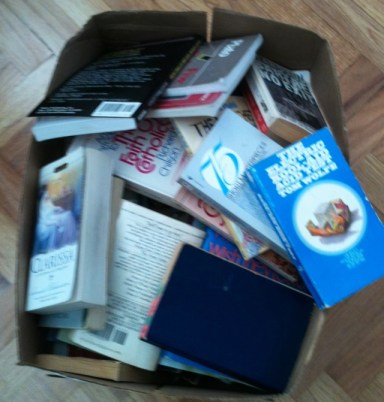
The post optimistically concluded: “So we’ve made it out of my bedroom” — but not so, dear reader, as post-Christmas/New Year cleaning up type activities led to a box of books, still in a storage room in the back of my house, needing to finally be shelved or ejected from the house. Said box:

20120115-103300.jpg

Most of the volumes herein are aesthetically-challenged/of a certain sentimental value: lots of books from my youth and the youth of my wife; lots of books that taught me how to read, books that weirded me out, books that I hope my kids will want to read in a few years. The corner piece bookshelf had the most (only, really) free space for shelving; it’s also tucked away from public view where an eyesore like my crumbling copy of Vonnegut’s Cat’s Cradle won’t sore eyes:

20120115-103312.jpg

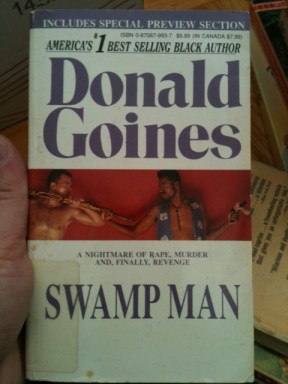
I actually read Goines’s Swamp Man. It’s not the Deliverance knock off you might expect, although it is singularly horrific.

20120115-103322.jpg

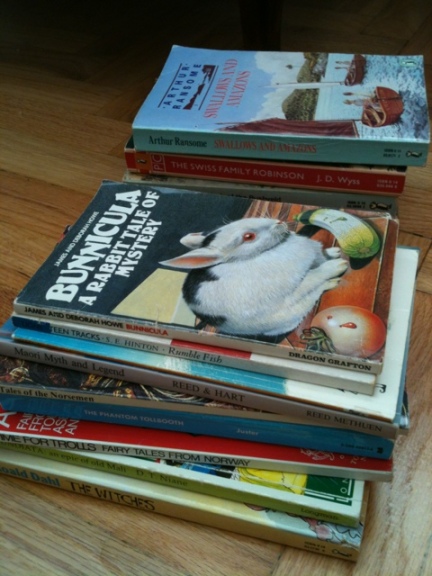
Some beloved childhood classics. Arthur Ransome, S.E. Hinton, various myths and legends, Roald Dahl, etc.:

20120115-103331.jpg

Two books I hated. Hated. I keep them as badges of a strange honor, a sort of “I did it, okay?”:

20120115-103343.jpg

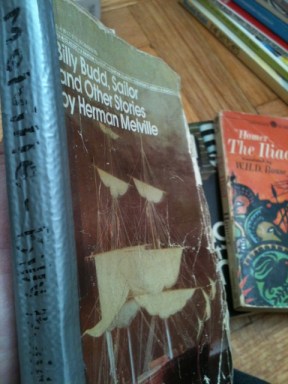
Melville stories held together with duct tape. This was the copy my 11th grade teacher assigned; I stole it of course. I used it in numerous subsequent courses and the annotations I made are somehow (unduly) precious to me. I can’t part with it even though I have at least two other volumes of Melville stories;

20120115-103358.jpg

Never sure where to shelve this RAW volume:

20120115-103428.jpg

Not sure if you can make out the title of this one, but it’s Alcoholic Anonymous’s Big Book. I found it on the beach one night when I was maybe 17 or 18. It’s full of highlighted passages and annotations and I’ve always been intrigued at what led the former owner to cast it away into cattailed dunes, as if the person couldn’t wait to be rid of it but couldn’t bear to bury it in a garbage can. Anyway, I picked it up because I pick up any discarded book, but I’ve kept it because I don’t know why I’ve kept it. Maybe it helped inform my reading of Infinite Jest, I don’t know:

20120115-103503.jpg

And here’s the “after” shot. I’ll try not to fret over re-shooting shelves again. But moving the box of books yesterday, knowing I was going to do the book shelf post today, I couldn’t help but photograph some of these as I went.

20120115-103518.jpg

Book Shelves #1, 1.01.2012

Every library answers a twofold need, which is often also a twofold obsession: that of conserving certain objects (books) and that of organizing them in certain ways.

—Georges Perec, from “Brief Notes on the Art and Manner of Arranging One’s Books” (1978)

For all of 2011 and half of 2010, I ran a death mask on this blog every Sunday. I liked the idea of having a regular, uniform post on the blog, and I enjoyed searching for death masks (and life masks) and learning about them. However, my interest is waning; it’s time to move on.

Still wanting to run a regular post each Sunday, I’ve elected to photograph the bookshelves, or the surfaces that hold books in my house. These will not be beautiful, arranged pictures, but rather simple pics from my iPhone documenting the spaces that books occupy. I will photograph each space “as is” and then remove a book or two, photograph it, and then comment on it.

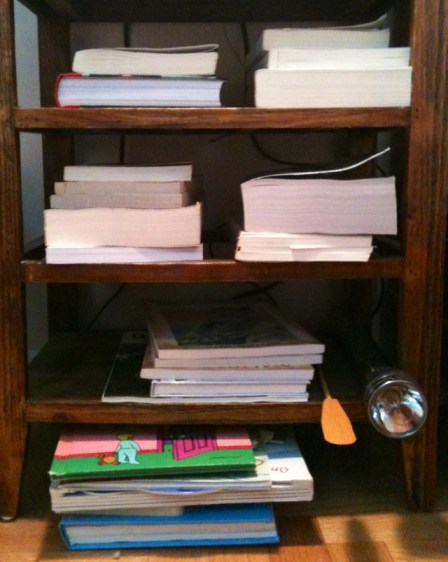
I didn’t know where to start, so I started with what may be the most plain book shelves in my home, the nightstand next to my bed. (Right now it is unusually tidy, having been cleaned out and partially restocked for the new year; in a week or two it will be crammed to its wooden gills). Here is what it looks like:

20111231-112128.jpg

Not very exciting, I know! This is perhaps the only photo in this book shelf series that will not feature shots of spines. Like I said, I don’t plan to arrange any of the shots in this series. I talked about a lot of what’s in here in yesterday’s riff on recent reading and a post last week on stuff I plan to read in 2012.

Stuff on the top tier tends to be stuff I’m currently reading; the second shelf is filled with books I’m always rereading, or picking at slowly. The third shelf is where stuff goes to marinate or get dusty or cry to be shelved.

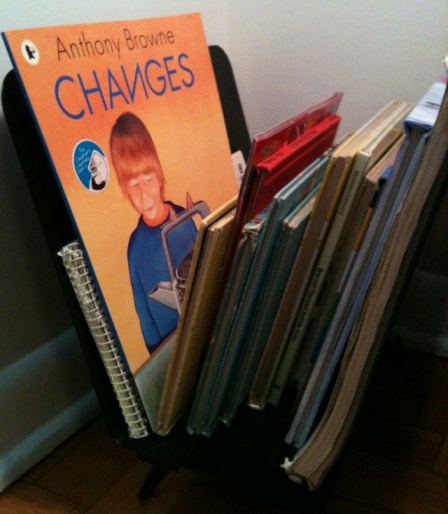
There’s also a bunch of kids book on the floor. More kids books are in this giant magazine stand, along with some notebooks, art pads, and probably an actual magazine or two (Anthony Browne’s book Changes is a surrealist masterpiece for kids, by the way):

20111231-112135.jpg

The Perec quote above comes from an essay collected in Species of Spaces and Other Pieces. “Brief Notes on the Art and Manner of Arranging One’s Books” will be in some ways the guiding inspiration for the Biblioklept book shelf series; my aim is not so much to present beautiful pictures that show off my books (I’m not equipped to do that, and other people do it very well already), but to comment on how my books are arranged and how they move and flow throughout the house; it will also give me a good opportunity to pick up books that might have been lingering (do books linger?) on a shelf for sometime.

I pulled these three books, not quite at random, from the shelves. The Perec book is one of those volumes I like to read scattershot-style. The latest issue of Paris Review still has a few pieces I haven’t read. Nausicaa: I meant to start it the other night. It will migrate to another room, a day-reading room, not a night-reading room:

20111231-112151.jpg

I don’t anticipate future book shelf posts being quite this long; my intention here is to kind of set the ground rules (for myself) or delineate both spirit and letter to this project. As such, a final note on movement: I will move “outward” from this nightstand, photographing any place where books are set. I will photograph every kind of book in this house in its natural habitat; this includes children’s books and cookbooks, but does not include personal photograph albums, instruction manuals, or anything else of that nature. I plan to do 53 total book shelf posts, including this one (there are 53 Sundays in 2012).

My hope is that readers will respond to these posts by sharing their own bookshelving habits.

“Shopping Is a Feeling” — David Byrne