“…a spectral cavalry, faces disquietingly wanting in detail, eyes little more than blurred sockets…” (Another Riff on Thomas Pynchon’s Against the Day)

  1. Another riff on/citation from Thomas Pynchon’s Against the Day.
  2. In this episode, our heroes, Chums of Chance Chick Counterfly (chief science officer) and Darby Suckling (chief horndog) have found their way to an off-brand time machine, managed and (shoddily) maintained by Dr. Zoot (whose doctorate seems unlikely). Dr. Zoot sends the boys (ostensibly) to the future for a brief glimpse:

They seemed to be in the midst of some great storm in whose low illumination, presently, they could make out, in unremitting sweep across the field of vision, inclined at the same angle as the rain, if rain it was—some material descent, gray and wind-stressed—undoubted human identities, masses of souls, mounted, pillioned, on foot, ranging along together by the millions over the landscape accompanied by a comparably unmeasurable herd of horses. The multitude extended farther than they could see—a spectral cavalry, faces disquietingly wanting in detail, eyes little more than blurred sockets, the draping of garments constantly changing in an invisible flow which perhaps was only wind. Bright arrays of metallic points hung and drifted in three dimensions and perhaps more, like stars blown through by the shock waves of the Creation. Were those voices out there crying in pain? sometimes it almost sounded like singing. Sometimes a word or two, in a language almost recognizable, came through. Thus, galloping in unceasing flow ever ahead, denied any further control over their fate, the disconsolate company were borne terribly over the edge of the visible world. . . .

The chamber shook, as in a hurricane. Ozone permeated its interior like the musk attending some mating dance of automata, and the boys found themselves more and more disoriented. Soon even the cylindrical confines they had entered seemed to have fallen away, leaving them in a space unbounded in all directions. There became audible a continuous roar as of the ocean—but it was not the ocean—and soon cries as of beasts in open country, ferally purring stridencies passing overhead, sometimes too close for the lads to be altogether comfortable with—but they were not beasts. Everywhere rose the smell of excrement and dead tissue.

Each lad was looking intently through the darkness at the other, as if about to inquire when it would be considered proper to start screaming for help.

“If this is our host’s idea of the future—” Chick began, but he was abruptly checked by the emergence, from the ominous sweep of shadow surrounding them, of a long pole with a great metal hook on the end, of the sort commonly used to remove objectionable performers from the variety stage, which, being latched firmly about Chick’s neck, had in the next instant pulled him off into regions indecipherable. Before Darby had time to shout after, the Hook reappeared to perform a similar extraction on him, and quick as that, both youngsters found themselves back in the laboratory of Dr. Zoot. The fiendish “time machine,” still in one piece, quivered in its accustomed place, as if with merriment. (403-04)

  1. I think the most obvious interpretation here is that our Chums witness part of a battle of the Great War, which is where Against the Day seems to be heading.

  1. What I find most fascinating, though, is the way that Pynchon moves from the physical to the metaphysical in the series of images the Chums witness.

We get an image of “undoubted human identities, masses of souls, mounted, pillioned, on foot, ranging along together by the millions over the landscape accompanied by a comparably unmeasurable herd of horses” seems simultaneously concrete and metaphysical, specific but also hyperbolic.

The scene continues to tread this line—we witness “a spectral cavalry, faces disquietingly wanting in detail, eyes little more than blurred sockets, the draping of garments constantly changing in an invisible flow which perhaps was only wind.”

On one hand, our disoriented Chums (to whose perspective Pynchon limits us) perceive ghosts here (almost cartoonish ghosts, I might add, of the holes-cut-out-for-eyes variety); on the other hand, the “blurred sockets” suggest gas masks and the “constantly changing” garments could perhaps be the variety of uniforms (and armor) of the soldiers.

Continuing: “Bright arrays of metallic points hung and drifted in three dimensions and perhaps more” — Bullets? Bayonets? Missiles? The concrete image is then likened to “stars blown through by the shock waves of the Creation.” The physical shifts into the metaphysical again as Pynchon sends “the disconsolate company . . . terribly over the edge of the visible world.”

  1. Here, the Chums seem to experience the Great War as an intensely compressed allegorical sensation.
  • The second paragraph in the above citation moves the boys into “a space unbounded in all directions” where they perceive “a continuous roar as of the ocean—but it was not the ocean—and soon cries as of beasts in open country, ferally purring stridencies passing overhead, sometimes too close for the lads to be altogether comfortable with—but they were not beasts.”

  • The Chums have no language to describe what they hear; Pynchon has to mediate the similes available to them in negation. But we (and Darby and Chick, of course) know that this place is no bueno: “Everywhere rose the smell of excrement and dead tissue.”

    1. Where have they gone? Are they still in the midst of war—are the sounds planes, bombs? World War I? WWII, site of that other giant Pynchon novel? Hiroshima? Vietnam? The WTC on 9/11? Where? When?

    1. I take the second paragraph to be a brief homage to the penultimate chapter of H.G. Wells’s slim novel The Time Machine (frequently and directly invoked throughout this particular episode of AtD, btw). At the end of that novella, the time traveler, dispensing with Eloi and Morlock alike, takes his machine to the brink of time, to witness the end of the earth and our solar system: “A horror of this great darkness came on me. The cold, that smote to my marrow, and the pain I felt in breathing, overcame me. I shivered, and a deadly nausea seized me.” The Chums of Chance seem to witness a similar extinction.
    2. Ah, but this is Pynchon, of course—so and how does the episode end? With a gag. In a vaudevillian twist, our players are removed from the stage via hook as the time machine, their audience, quivers “as if with merriment.”

    Despite the zaniness of this exit, keep in mind that our heroes are hooked around their necks, lassoed by a noose of sorts—Pynchon saves them, but at the same time visually suggests their death, linking back to the image of mass extinction at the core of the passage.

    1. The paintings in this riff are by the late Polish artist Zdzisław Beksiński; like all of his work they are untitled.
    Some form of zombie powder (Pynchon’s Against the Day)

    Reef joined Ruperta’s loose salon of neuræsthenics traveling hot spring to spring in search of eternal youth or fleeing the deadweight of time, finding enough impulsive or inattentive cardplayers to keep him in Havanas and $3.50-a-quart Champagne, and Ruperta surprised enough now and then with silver and lapis Indian trinkets and the odd bushel of flowers to keep her guessing, she having figured him for a white savage masquerading as an exquisite. Which did not prevent them from going round and round on average once a week, memorable uproars that sent everybody running for the periphery, uncertain as to what distance was safe. In between these dustups, Reef had long, desultory conversations with his penis, to the effect that there wasn’t much point missing Stray too much right now, was there, as it would only blunt the edge of desire, not only for Ruperta but whoever else, Yup Toy or whoever, might drift by over the course of their travels.

    They finally parted company in New Orleans after a confused and repetitive headache of a night that began at the establishment of Monsieur Peychaud, where the Sazeracs, though said to’ve been invented there, were not a patch, it seemed to Reef, on those available at Bob Stockton’s bar in Denver, though those Absinthe Frappés were another matter. After taking on fuel, the party moved out into the French Quarter hunting for modes of intoxication “more exotic,” meaning, if you pushed it, some form of zombie powder. Ruperta tonight was in a narrow black bengaline costume with a Medici collar and cuffs of bastard chinchilla. Nothing on underneath except for stays and stockings, as Reef had had occasion to find out earlier, at their habitual lateafternoon rendezvous.

    It had soon become apparent in this town that what you could see from the street was not only less than “the whole story” but in fact not even the picture on the cover. The real life of this place was secured deep inside the city blocks, behind ornate iron gates and up tiled passages that might as well’ve run for miles. You could hear faint strands of music, crazy stuff, banjos and bugling, trombone glissandi, pianos under the hands of whorehouse professors sounding like they came with keys between the keys. Voodoo? Voodoo was the least of it, Voodoo was just everywhere. Invisible sentinels were sure to let you know, the thickest of necks being susceptible here to monitory pricklings of the Invisible. The Forbidden. And meantime the smells of the local cuisine, cheurice sausages, gumbo, crawfish étouffé, and shrimp boiled in sassafras, proceeding from no place you could ever see, went on scrambling what was left of your good sense. Negroes could be observed at every hand, rollicking in the street. The so-called Italian Troubles, stemming from the alleged Mafia assassination of the chief of police here being yet fresh in the civic memory, children were apt to accost strangers, Italian or not, with, “Who killa da chief?” not to mention “Va fongoola your sister.”

    Another passage from Thomas Pynchon’s novel Against the Day.


    “It’s all about the light, you control the light, you control the effect, capisci?” (Pynchon’s Against the Day)

    Luca Zombini liked to explain the business, at various times, to those of his children he deluded himself were eager to learn, even someday carry on, the act. “Those who sneer at us, and sneer at themselves for paying to let us fool them, what they never see is the yearning. If it was religious, a yearning after God—no one would dream of disrespecting that. But because this is a yearning only after miracle, only to contradict the given world, they hold it in contempt.

    “Remember, God didn’t say, ‘I’m gonna make light now,’ he said, ‘Let there be light.’ His first act was to allow light in to what had been Nothing. Like God, you also have to always work with the light, make it do only what you want it to.”

    He unrolled an expanse of absolute fluid blackness. “Magician-grade velvet, perfect absorber of light. Imported from Italy. Very expensive. Dyed, sheared, and brushed by hand many, many times. Finished with a secret method of applying platinum black. Factory inspections are merciless. Same as mirrors, only opposite. The perfect mirror must send back everything, same amount of light, same colors exactly—but perfect velvet must let nothing escape, must hold on to every last little drop of light that falls on it. Because if the smallest amount of light you can think of bounces off one single thread, the whole act—affondato, vero? It’s all about the light, you control the light, you control the effect, capisci?”

    I think we get a fairly concise illustration of some of Against the Day’s major themes here: light, invisibility, perception, control, etc.


    “Smite early and often” (Another Riff on Thomas Pynchon’s Against the Day)

    rb
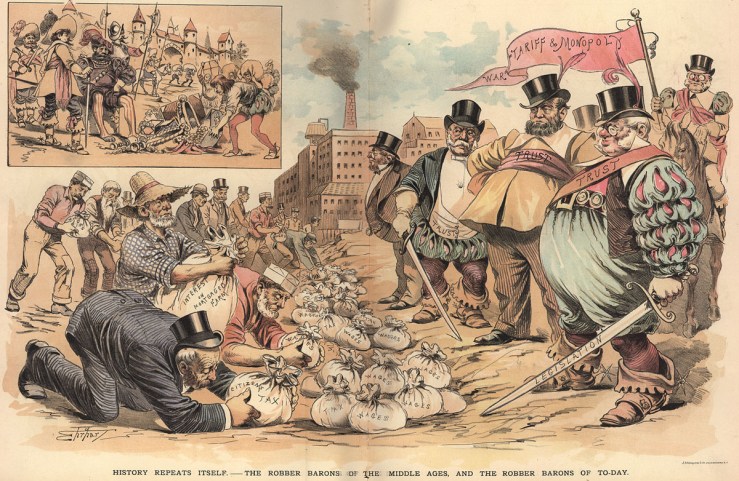
    Image by Samuel Ehrhardt, 1889

    1. The passage I’ll be riffing on today is hardly the funniest or most dazzling piece of writing I’ve encountered so far in Thomas Pynchon’s massive, shaggy novel Against the Day. However, I think this stretch of writing neatly and concisely illustrates the perspective (maybe world view is a better term; hell, we could even go with fancy-pants Weltanschauung here) of who I take to be the novel’s most prominent villain, ruthless robber baron Scarsdale Vibe.

    More significantly, I think this passage illustrates the ways that Pynchon’s big novel analyzes American history and illuminates the contemporary American zeitgeist.

    2. The block quote citations are continuous, although I’ll be interrupting. The passage starts at the very bottom of page 331 and goes through 334 in my hardback Penguin first edition.

    3. Okay, so a bit of context:

    Our scene is mostly a dialogue, or a monologue really, between Scarsdale Vibe and his Other, Foley Walker, who took Scarsdale’s place in the Civil War, took a bullet to the brain, and now, like so many of the characters in Against the Day, has special powers (he can hear voices that tell him how to invest (Scarsdale’s) money in the market).

    Back at Pearl Street, the two Vibes were sitting over brandy and cigars.

    “A tough one to figure, that kid,” Foley opined. “Sure hope we ain’t got another Red in the root cellar like his old man.”

    The “kid” here is hero Kit Traverse, and his old man — the “Red in the root cellar” — is the recently-deceased-on-Scarsdale’s-orders Webb Traverse, the Kieselguhr Kid, enemy of the captains of industry.

    Scarsdale is backing Kit in the hopes that he’ll become “the next Edison” — and not, significantly, the next Tesla.

    5. (Tesla v. Edison—another set of doubles in the book.

    Tesla, Serbian-American, mad magician, prophet of science, seer of the invisible, wants to provide free power for all is clearly allied (in Pynchon’s book, that is) with the unions, the Traverses, labor—the good guys.

    His double, Edison: American-American, reputed idea-thief, dog-electrocuter; Edison, a hustler who sweated out idea after idea, perhaps gracelessly; Edison, whose methods and inventions could generate corporate profits.

    Tesla remarked of Edison, after his death: “he had a veritable contempt for book learning and mathematical knowledge, trusting himself entirely to his inventor’s instinct and practical American sense”).

    6. Note that Scarsdale wouldn’t hesitate to kill Kit:

    “Our duty would be no less clear. There are hundreds of these abscesses suppurating in the body of our Republic,” an oratorical throb creeping into Scarsdale’s voice, “which must be removed, wherever they are found. No other option. The elder Traverse’s sins are documented—once they were brought to light, he was as good as lost. Should there be moral reservations, in a class war, about targeting one’s enemies? You have been in this game long enough to appreciate how mighty are the wings we shelter beneath. How immune we are kept to the efforts of these muckraking Reds to soil our names. Unless—Walker, have I missed something? you aren’t developing a soft spot.”

    As Scarsdale’s was not the only voice Foley had to attend to, he erred, as usual, on the side of mollification. He held out his glowing Havana. “If you can find a soft spot, use it to put this out on.”

    “What happened to us, Foley? We used to be such splendid fellows.”

    “Passage of Time, but what’s a man to do?”

    “Too easy. Doesn’t account for this strange fury I feel in my heart, this desire to kill off every damned socialist and so on leftward, without any more mercy than I’d show a deadly microbe.”

    “Sounds reasonable to me. Not like that we haven’t bloodied up our hands already here.” Scarsdale gazed out his window at a cityscape once fair but with the years grown more and more infested with shortcomings. “I wanted so to believe. Even knowing my own seed was cursed, I wanted the eugenics argument to be faulty somehow. At the same time I coveted the bloodline of my enemy, which I fancied uncontaminated, I wanted that promise, promise unlimited.”

    Foley pretended his narrowing of gaze was owing to cigarsmoke. “Mighty Christian attitude,” he commented at last, in a tone as level as he could make it.

    Here we see Scarsdale’s hatred of organized labor, of anything that impedes on his profits, get tangled into the ideology that underwrites this conflict. He even cites the conflict as “a class war.”  This class war interweaves into his personal life: he is usurping the coveted “bloodline of my enemy” by attempting to adopt Kit.

    7. The scene then takes on a religious dimension, exploring a “Mighty Christian attitude”:

    “Foley, I’m as impatient with religious talk as the next sinner. But what a burden it is to be told to love them, while knowing that they are the Antichrist itself, and that our only salvation is to deal with them as we ought.”

    Pynchon’s villain here sounds like so many figures on the contemporary American Evangelical right, who repeatedly conflate their political/cultural enemies with “Antichrist” as a means to avoid the Jesusian imperative to love the Other.

    8. Remember, wealthy Scarsdale—his father, really—was able to buy a deferment from the Civil War; Foley took his place:

    It did not help Foley’s present mood that he had awakened that morning from a recurring nightmare of the Civil War. The engagement was confined to an area no bigger than an athletic field, though uncountable thousands of men had somehow been concentrated there. All was brown, gray, smoky, dark. A lengthy exchange of artillery had begun, from emplacements far beyond the shadowy edges of the little field. He had felt oppressed by the imminence of doom, of some suicidal commitment of infantry which no one would escape. A pile of explosives nearby, a tall, rickety wood crib of shells and other ammunition began to smolder, about to catch fire and blow up at any moment, a clear target for the cannonballs of the other side, which continued to come in, humming terribly, without pause. . . .

    Foley has actually fought and been wounded and risked. He’s literally put skin in the game.

    In contrast, Scarsdale Vibe was able to continue amassing and controlling wealth—just like other robber barons who bought deferments and then profited from the war (Andrew Carnegie, J.D. Rockefeller, and Jay Gould, just to name a few).

    (Hey, can you think of any wealthy American men in contemporary times who avoided serving in a war but made ludicrous sums as war profiteers?)

    9. Note how Scarsdale, claiming “My civil war has yet to come,” pitches the conflict between capital and labor in terms of a holy war:

    “I didn’t have my war then,” Scarsdale had been saying. “Just as well. I was too young to appreciate what was at stake anyway. My civil war was yet to come. And here we are in it now, in the thick, no end in sight. The Invasion of Chicago, the battles of Homestead, the Coeur d’Alene, the San Juans. These communards speak a garble of foreign tongues, their armies are the damnable labor syndicates, their artillery is dynamite, they assassinate our great men and bomb our cities, and their aim is to despoil us of our hard-won goods, to divide and subdivide among their hordes our lands and our houses, to pull us down, our lives, all we love, until they become as demeaned and soiled as their own. О Christ, Who hast told us to love them, what test of the spirit is this, what darkness hath been cast over our understanding, that we can no longer recognize the hand of the Evil One?

    Note the xenophobia here, the fear that the dark Other with their “garble of foreign tongues” will try “to pull us down, our lives, all we love.” Good thing this poor rich captain of industry will fight for Real America!

    10. Scarsdale, weary from carrying his White Man’s Burden:

    “I am so tired, Foley, I have struggled too long in these thankless waters, I am as an unconvoyed vessel alone in a tempest that will not, will never abate. The future belongs to the Asiatic masses, the pan-Slavic brutes, even, God help us, the black seething spawn of Africa interminable. We cannot hold. Before these tides we must go under. Where is our Christ, our Lamb? the Promise?”

    Seeing his distress, Foley meant only to comfort. “In our prayers—”

    “Foley, spare me that, what we need to do is start killing them in significant numbers, for nothing else has worked. All this pretending—’equality,’ ‘negotiation’—it’s been such a cruel farce, cruel to both sides. When the Lord’s people are in danger, you know what he requires.”

    “Smite.”

    “Smite early and often.”

    And there it is: The ideological veneer of demagoguery quickly gives way to the violent impulses seething underneath. Scarsdale’s Real America has no place for equality and negotiation. Just smiting.

    11. And then quoth Foley:

    “Hope there’s nobody listening in on this.”

    I can’t help but read this as a joke, an echo (pre-echo?) of Nixonian paranoia. The direct recognition that there is a gap between intention at the core and the way that intention is represented (hidden) on the surface (in language, in gesture).

    12. But Scarsdale is unafraid:

    “God is listening. As to men, I have no shame about what must be done.” A queer tension had come into his features, as if he were trying to suppress a cry of delight.

    “But you, Foley, you seem kind of—almost—nervous.” Foley considered briefly. “My nerves? Cast iron.” He relit his cigar, the matchflame unshaking. “Ready for anything.”

    Scarsdale’s God is the god of the white man robber baron Real American capitalist, and “God is listening” not because he is omnipresent but because he is on Scarsdale’s side.

    13. Foley doesn’t quite buy this resolve:

    Aware of the Other Vibe’s growing reluctance to trust reports from out in the field, Foley, who usually was out there and thought he had a good grasp on things, at first resentful and after a while alarmed, had come to see little point these days in speaking up. The headquarters in Pearl Street seemed more and more like a moated castle and Scarsdale a ruler isolated in self resonant fantasy, a light to his eyes these days that was not the same as that old, straightforward acquisitive gleam. The gleam was gone, as if Scarsdale had accumulated all the money he cared to and was now moving on in his biography to other matters, to action in the great world he thought he understood but—even Foley could see—was failing, maybe fatally, even to ask the right questions about anymore.

    Foley, who actually served in war, “who usually was out there,” can see that Scarsdale can only see what he wants to see—the Other Vibe lives in “a moated castle” as a “ruler isolated in self resonant fantasy,” blinded by the lights of his xenophobic ideology, which has moved beyond mere money to pursue some other greater power.

    14. Foley, so far anyway, proves an important contrast, a balance even, to Scarsdale’s zealous evil. Through his eyes we can see the effects that isolation have taken on Scarsdale, who is becoming increasingly paranoid, anxious—crazy even. Scarsdale is completely divided from the men and women who create his wealth—he doesn’t understand (let alone empathize with) the average American—yet he sees himself as the God-appointed, self-created savior of America (an America with no place for equality or negotiation). The ways in which this passage diagnoses certain attitudes in contemporary American politics/big-business strikes me as so transparent that I won’t remark on them at further length. Pynchon’s novel documents the tail-end of the Gilded Age through the end of the Great War, showing us that the conflicts of the past are the conflicts of today—and tomorrow. 

    Admiral Fudge Comes Back to Earth Again (Harry Grant Dart)

    explorigator-2

    (Via; On The Explorigator’s connection to Thomas Pynchon’s Against the Day).

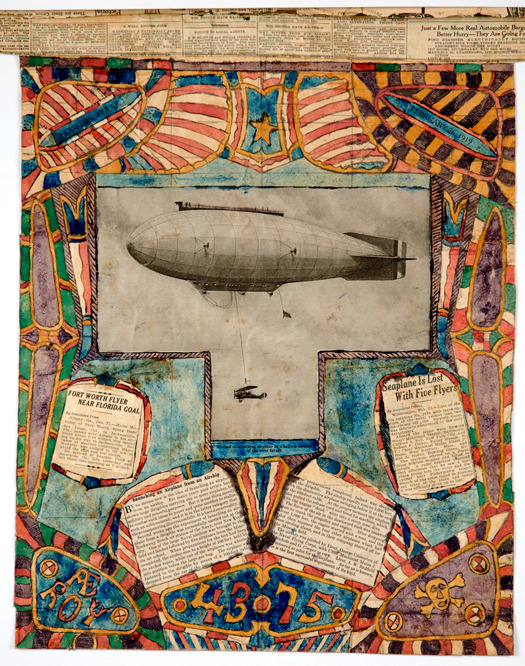
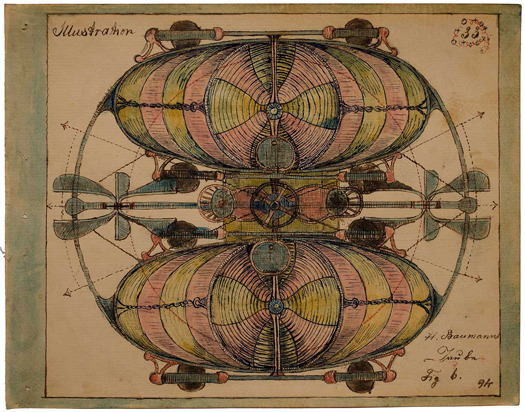
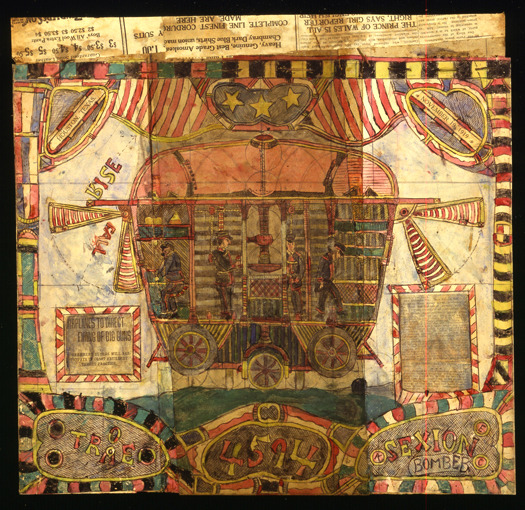
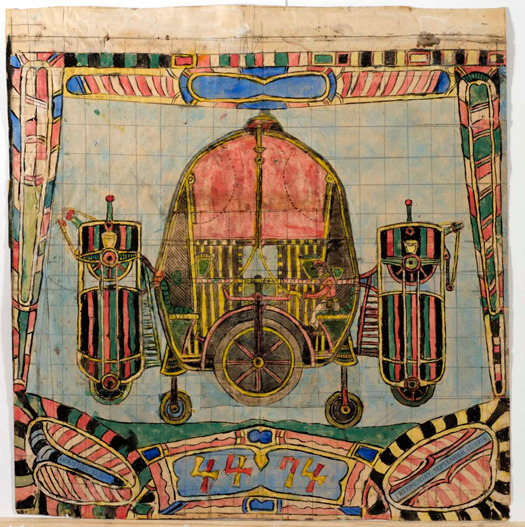
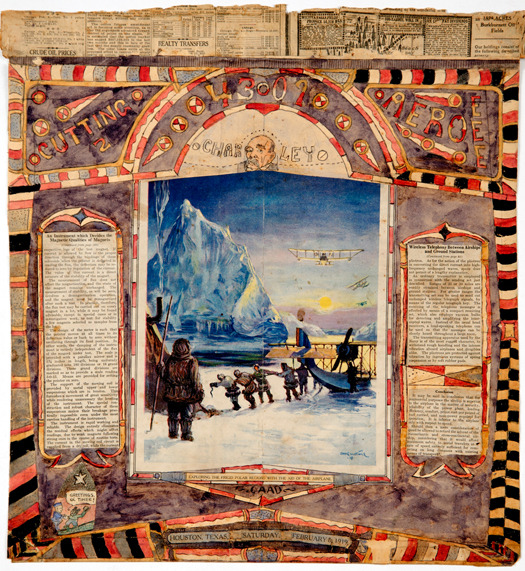
    The Weird and Wonderful World of Charles A. A. Dellschau

    03.17.13.17_525

    I was looking for an image to accompany a riff I wrote on Thomas Pynchon’s novel Against the Day. The riff circles around the skyship adventurers The Chums of Chance, characters who are both “real” in the novel and also “literary” — that is, they are the stars of dime novels that other characters in the novel read. I was hoping that maybe some creative soul had created a Chums of Chance book cover that I could use with the post. Through a few basic searches and a Metafilter board, I found my way to something far more intriguing—the strange watercolor and collage pieces of Charles August Albert Dellschau.

    a

    Here’s a little background on Dellschau (from John Foster’s excellent article–chock full of images!—at Observatory):

    It turns out that the drawings/watercolors were the work of one Charles August Albert Dellschau (1830 – 1923). Dellschau was a butcher for most of his life and only after his retirement in 1899 did he begin his incredible career as a self-taught artist. He began with three books entitled Recollections which purported to describe a secret organization called the Sonora Aero Club. Dellschau described his duties in the club as that of the draftsman. Within his collaged watercolors were newspaper clippings (he called them “press blooms”) of early attempts at flight overlapped with his own fantastic drawings of airships of all kind. Powered by a secret formula he cryptically referred to as “NB Gas” or “Suppa” — the “aeros” (as Dellscahu called them) were steampunk like contraptions with multiple propellers, wheels, viewing decks and secret compartments. Though highly personal, autobiographical (perhaps!), and idiosyncratic, these artworks could cross-pollinate with the fiction of Jules Verne, Willy Wonka and the Wizard of Oz. The works were completed in a furiously creative period from 1899 to 1923, when air travel was still looked at by most people as almost magical. Newspapers of that period were full of stories about air travel feats and the acrobatic aerial dogfights of WWI were legend.

    b

    Verne, Oz, and steampunk are all clear comparisons. I’d add to them the manic spirit of Kurt Schwitters’s collages, the buzzing claustrophobia of Joseph Cornell’s boxes, and the cartoony contours of turn-of-the-century comics.It also reminds me of Luigi Serafini’s surreal cryptoencyclopedia, Codex SeraphinianusAnd of course, Dellschau’s work resonates strongly with Pynchon’s novel Against the Day, more ludic than lunatic. His work shows an obsession fueled by science and science fiction alike, as well as a frankly adolescent sense of line, proportion and color. I love it. See more here and here.

    c

    “…he enjoyed a sort of dual existence” (Another Riff on Thomas Pynchon’s Against the Day)

    03.17.13.14_525
    Art by Charles Dellschau (1830 Prussia – 1923)

    He had brought with him a dime novel, one of the Chums of Chance series, The Chums of Chance at the Ends of the Earth, and for a while each night he sat in the firelight and read to himself but soon found he was reading out loud to his father’s corpse, like a bedtime story, something to ease Webb’s passage into the dreamland of his death.

    Reef had had the book for years. He’d come across it, already dog-eared, scribbled in, torn and stained from a number of sources, including blood, while languishing in the county lockup at Socorro, New Mexico, on a charge of running a game of chance without a license. The cover showed an athletic young man (it seemed to be the fearless Lindsay Noseworth) hanging off a ballast line of an ascending airship of futuristic design, trading shots with a bestially rendered gang of Eskimos below. Reef began to read, and soon, whatever “soon” meant, became aware that he was reading in the dark, lights-out having occurred sometime, near as he could tell, between the North Cape and Franz Josef Land. As soon as he noticed the absence of light, of course, he could no longer see to read and, reluctantly, having marked his place, turned in for the night without considering any of this too odd. For the next couple of days he enjoyed a sort of dual existence, both in Socorro and at the Pole. Cellmates came and went, the Sheriff looked in from time to time, perplexed.

    At odd moments, now, he found himself looking at the sky, as if trying to locate somewhere in it the great airship. As if those boys might be agents of a kind of extrahuman justice, who could shepherd Webb through whatever waited for him, even pass on to Reef wise advice, though he might not always be able to make sense of it. And sometimes in the sky, when the light was funny enough, he thought he saw something familiar. Never lasting more than a couple of watch ticks, but persistent. “It’s them, Pa,” he nodded back over his shoulder. “They’re watching us, all right. And tonight I’ll read you some more of that story. You’ll see.”

    Riding out of Cortez in the morning, he checked the high end of the Sleeping Ute and saw cloud on the peak. “Be rainin later in the day, Pa.”

    “Is that Reef? Where am I? Reef, I don’t know where the hell I am—”

    “Steady, Pa. We’re outside of Cortez, headin up to Telluride, be there pretty soon—”

    “No. That’s not where this is. Everthin is unhitched. Nothin stays the same. Somethin has happened to my eyes. . . .”

    “It’s O.K.”

    “Hell it is.”

    —From Thomas Pynchon’s novel Against the Day (215).

    1. There’s so much I like about this passage.

    2. First, Pynchon explicitly ties together two groups of his characters here. Pynchon connects the Traverses of Colorado with those champions of the ether, The Chums of Chance.

    And he does it through a novel, which I’ll get to in a minute.

    3. I’ve already remarked on the adventurous, even light-hearted tone of the Chums of Chance episodes, which often buoy the narrative out of its byzantine winding.

    4. The Chums passages contrast strongly with the Colorado episodes featuring the Traverses.

    While Pynchon is not really known for his pathos or the depth of his characters, the Traverse story line is genuinely moving. We see the family disintegrate against the greed of the Colorado mining rush. Patriarch Webb cannot hold his family together, and he gives over to a deep bitterness; his union becomes his raison d’etre, and he undertakes dangerous secret missions to fight the forces of capitalism. It’s worth giving Webb’s opinion at length:

    “Here. The most precious thing I own.” He took his union card from his wallet and showed them, one by one. “These words right here”—pointing to the slogan on the back of the card— “is what it all comes down to, you won’t hear it in school, maybe the Gettysburg Address, Declaration of Independence and so forth, but if you learn nothing else, learn this by heart, what it says here—‘Labor produces all wealth. Wealth belongs to the producer thereof.’ Straight talk. No doubletalking you like the plutes do, ’cause with them what you always have to be listening for is the opposite of what they say. ‘Freedom,’ then’s the time to watch your back in particular—start telling you how free you are, somethin’s up, next thing you know the gates have slammed shut and there’s the Captain givin you them looks. ‘Reform’? More new snouts at the trough. ‘Compassion’ means the population of starving, homeless, and dead is about to take another jump. So forth. Why, you could write a whole foreign phrase book just on what Republicans have to say.”

    5. It’s also worth pointing out that Webb is likley the Kieselguhr Kid: He has a secret identity and secret powers, like many of the characters who inhabit Against the Day.

    6. The Traverse passages recall the social realism of Steinbeck at times, with a dose of the moralizing we might find in Upton Sinclair. There’s also a heavy dash of Ambrose Bierce’s cynicism, and something of Bret Harte’s milieu here.

    A kind of ballast for Pynchon’s flightier whims? Not sure.

    7. Returning to our initial citation:

    As prodigal son Reef Traverse moves his father’s corpse across Colorado, he reads from The Chums of Chance at the Ends of the Earth. We learn that he’s had the dime novel for years and we learn of its physical condition — “dogeared, scribbled in, torn and stained from a number of sources, including blood.” The book is a kind of abject survivor, a physical totem with powers of endurance, which, in turn, grants metaphysical powers on its user-reader.

    8. (Parenthetical (i.e. unexplored) aside: The cover of The Chums of Chance at the Ends of the Earth features handsome, uptight Lindsay Noseworth facing off against a “bestially rendered gang of Eskimos.” Here is our Manifest Destiny; here is our White Man’s Burden).

    9. The Chums of Chance at the Ends of the Earth allows Reef brief transcendence of time (“whatever ‘soon’ meant”) and space (it provides him escape from his jail cell).

    10. Also: The Chums of Chance at the Ends of the Earth grants its reader the power to read in the dark. There is something of a huge in-joke here that all late-night readers will appreciate.

    Also: the major motif of At the End of the Day is darkness and light. The Chums of Chance at the Ends of the Earth works as a kind of self-illuminating object outside the confines of the physical world, but only when the user is not conscious of this power (“As soon as he noticed the absence of light, of course, he could no longer see to read”).

    11. The Chums of Chance at the Ends of the Earth bestows upon Reef, its operator,  “a sort of dual existence, both in Socorro and at the Pole.” This relationship, again, won’t be unfamiliar to voracious readers. Hell, many of us chase that transcendent space the rest of our lives. The older we get, the harder it is to get back to Dickensian London or Rivendell or Crusoe’s island or Narnia or Thornfield Hall or wherever it was that we got to live out part of our dual existence.

    Here Reef, a grown-ass man, gets to be one of the Chums and traverse an alien frontier.

    12. And the biggie: Somehow this dime novel wakes the dead.

    Now, it’s easy to say that Webb doesn’t really talk to Reef, just as we can easily say that Reef doesn’t really head to the pole with the Chums, doesn’t really transcend time and space, etc. We could look for simple answers in psychology—Reef has internalized his father’s voice; Reef is going mad.

    But I think Pynchon’s presentation of the scene suggests something more—but something I don’t know how to name or describe, only a fifth of the way into this book. Something to look for in any case.

    And so thus end with Webb’s line: “Somethin has happened to my eyes.”

    Snoods, Gnomes, Loupes, Coffee (A Passage from Pynchon’s Novel Against the Day)

    Electrical arcs stabbed through the violet dusk. Heated solutions groaned toward their boiling points. Bubbles rose helically through luminous green liquids. Miniature explosions occurred in distant corners of the facility, sending up showers of glass as nearby workers cowered beneath seaside umbrellas set up for just such protection. Gauge needles oscillated feverishly. Sensitive flames sang at different pitches. Amid a gleaming clutter of burners and spectroscopes, funnels and flasks, centrifugal and Soxhlet extractors, and distillation columns in both the Glynsky and Le BelHenninger formats, serious girls with their hair in snoods entered numbers into logbooks, and pale gnomes, patient as lockpickers, squinted through loupes, adjusting tremblers and timers with tiny screwdrivers and forceps. Best of all, somebody in here somewhere was making coffee.

    Another passage from Thomas Pynchon’s great big book Against the Day.


    The Chums of Chance vs The Legion of Gnomes (Citation from + Riff on Thomas Pynchon’s Against the Day)

    At first the “noise” seemed no more than the ensemble of magnetoatmospheric disturbances which the boys had long grown used to, perhaps here intensified by the vastly resonant space into which they were moving ever deeper. But presently the emission began to coalesce into human timbres and rhythms—not speech so much as music, as if the twilit leagues passing below were linked by means of song.

    Lindsay, who was Communications Officer, had his ear close to the Tesla device, squinting attentively, but at last withdrew, shaking his head. “Gibberish.”

    “They are calling for help,” ~delared Miles, “clear as day and quite desperately, too. They claim to be under attack by a horde of hostile gnomes, and have set out red signal lamps, arranged in concentric circles.”

    “There they are!” called Chick Counterfly, pointing over the starboard quarter.

    “Then there is nothing to discuss,” declared Randolph St. Cosmo. “We must put down and render aid.”

    They descended over a battlefield swarming with diminutive combatants wearing pointed hats and carrying what proved to be electric crossbows, from which they periodically discharged bolts of intense greenish light, intermittently revealing the scene with a morbidity like that of a guttering star.

    “We cannot attack these fellows,” protested Lindsay, “for they are shorter than we, and the Rules of Engagement clearly state—”

    “In an emergency, that choice lies at the Commander’s discretion,” replied Randolph.

    They were soaring now close above the metallic turrets and parapets of a sort of castle, where burned the crimson lights of distress. Figures could be discerned below gazing up at the Inconvenience. Peering at them through a nightglass, Miles stood at the conning station, transfixed by the sight of a woman poised upon a high balcony. “My word, she’s lovely!” he exclaimed at last.

    Their fateful decision to land would immediately embroil them in the byzantine politics of the region, and eventually they would find themselves creeping perilously close to outright violation of the Directives relating to Noninterference and Height Discrepancy, which might easily have brought an official hearing, and perhaps even disfellowshipment from the National Organization. For a detailed account of their subsequent narrow escapes from the increasingly deranged attentions of the Legion of Gnomes, the unconscionable connivings of a certain international mining cartel, the sensual wickedness pervading the royal court of Chthonica, Princess of Plutonia, and the all-but-irresistible fascination that subterranean monarch would come to exert, Circelike, upon the minds of the crew of Inconvenience (Miles, as we have seen, in particular), readers are referred to The Chums of Chance in the Bowels of the Earth—for some reason one of the less appealing of this series, letters having come in from as far away as Tunbridge Wells, England, expressing displeasure, often quite intense, with my harmless little intraterrestrial scherzo.

    After their precipitate escape from the ill-disposed hordes of thickset indigenous, over another night and day, as time is reckoned on the surface, the Chums swept through the interior of the Earth and at last out her Northern portal, which they beheld as a tiny circle of brightness far ahead. As before, all remarked the diminished size of the planetary exit. It was a tricky bit of steering, as they emerged, to locate the exact spot, on the swiftly dilating luminous circumference, where they might with least expenditure of time find themselves in the vicinity of the schooner Etienne-Louis Malus, carrying the Vormance Expedition toward a fate few of its members would willingly have chosen.

    1.The above citation comprises the final paragraphs of The Light Over the Ranges, the first book in Thomas Pynchon’s massive, byzantine novel Against the Day, which is perhaps too massive and too byzantine for me to approach in any way other way than the occasional riff and citation as I read it.

    2. The Light Over the Ranges both begins and ends by focusing on The Chums of Chance, an intrepid band of adventurers who sail their skyship Inconvenience into every manner of trouble. The passage above—which, hey, don’t worry, there are no real spoilers there—-the passage above showcases a jocular, jaunty voice that Pynchon employs frequently throughout the book, a voice appropriate to pulp fiction, to serialized “boy’s novels,” to speculative fiction narratives, etc. The voice is somehow simultaneously engaged and detached, urging its listener to care about the heroes in peril, but also acknowledging its own formal artificiality, the flatness of its characters, their position as placeholders or checkerboard pieces in Pynchon’s big project.

    3. The voice that relates the Chums of Chance episodes is wonderfully didactic, its earnest, moral tone buoying the narrative into adventure (and fun!); at the same time, everything else in the novel—its violence, its class warfare, its analysis of exploitation—-ensures that this voice is to be read and interpreted with dark irony.

    4. And yet the spirit of adventure, of fun—of imagination—inheres (and not just in the episodes with the Chums).

    5. The Chums of Chance: Miles Blundell, Chick Counterfly, Lindsay Noseworth,  Darby Suckling, and commander Randolph St. Cosmo. The names are Pynchonian, tautologies be damned! (They also remind me of porn aliases). I am remiss: Let me include Pugnax, a dog of discerning literary taste, his ability to read just one of many seemingly-metaphysical powers Pynchon grants his characters in Against the Day.

    6. My favorite paragraph in the above citation is the penultimate one, where we find our heroes “creeping perilously close to outright violation of the Directives relating to Noninterference and Height Discrepancy” by diving into a strange underworld adventure and battling The Legion of Gnomes. Pynchon (or Pynchon’s adventure-voice, if’n ya’ll permit me) offers us a too-brief peek at “the royal court of Chthonica, Princess of Plutonia, and the all-but-irresistible fascination that subterranean monarch would come to exert, Circelike, upon the minds of the crew of Inconvenience” and then refers us to The Chums of Chance in the Bowels of the Earth, a book we cannot read because it doesn’t exist.

    7. But what am I saying? Of course The Chums of Chance in the Bowels of the Earth exists!—we just have to imagine it.

    “…the amazing, world-reversing night of Fourth of July Eve 1899” (Pynchon’s Against the Day)

    For years after, there were tales told in Colorado of the amazing, world-reversing night of Fourth of July Eve 1899. Next day’d be full of rodeos, marching bands, and dynamite explosions—but that night there was man-made lightning, horses gone crazy for miles out into the prairie, electricity flooding up through the iron of their shoes, shoes that when they finally came off and got saved to use for cowboy quoits, including important picnic tourneys from Fruita to Cheyenne Wells, why they would fly directly and stick on to the spike in the ground, or to anything else nearby made of iron or steel, that’s when they weren’t collecting souvenirs on their way through the air—gunmen’s guns came right up out of their holsters and buck knives out from under pants legs, keys to traveling ladies’ hotel rooms and office safes, miners’ tags, fencenails, hairpins, all seeking the magnetic memory of that long-ago visit. Veterans of the Rebellion fixing to march in parades were unable to get to sleep, metallic elements had so got to humming through their bloodmaps. Children who drank the milk from the dairy cows who grazed nearby were found leaning against telegraph poles listening to the traffic speeding by through the wires above their heads, or going off to work in stockbrokers’ offices where, unsymmetrically intimate with the daily flow of prices, they were able to amass fortunes before anyone noticed. .

    A passage from Thomas Pynchon’s novel Against the Day.


    “Exotic smoking practices around the world, of great anthropological value!” (Pynchon’s Against the Day)

    Observers of the Fair had remarked how, as one moved up and down its Midway, the more European, civilized, and . . . well, frankly, white exhibits located closer to the center of the “White City” seemed to be, whereas the farther from that alabaster Metropolis one ventured, the more evident grew the signs of cultural darkness and savagery. To the boys it seemed that they were making their way through a separate, lampless world, out beyond some obscure threshold, with its own economic life, social habits, and codes, aware of itself as having little if anything to do with the official Fair. . . . As if the halflight ruling this perhaps even unmapped periphery were not a simple scarcity of streetlamps but deliberately provided in the interests of mercy, as a necessary veiling for the faces here, which held an urgency somehow too intense for the full light of day and those innocent American visitors with their Kodaks and parasols who might somehow happen across this place. Here in the shadows, the faces moving by smiled, grimaced, or stared directly at Lindsay and Miles as if somehow they knew them, as if in the boys’ long career of adventure in exotic corners of the world there had been accumulating, unknown to them, a reserve of mistranslation, offense taken, debt entered into, here being reexpressed as a strange Limbo they must negotiate their way through, expecting at any moment a “runin” with some enemy from an earlier day, before they might gain the safety of the lights in the distance.

    Armed “bouncers,” drawn from the ranks of the Chicago police, patrolled the shadows restlessly. A Zulu theatrical company reenacted the massacre of British troops at Isandhlwana. Pygmies sang Christian hymns in the Pygmy dialect, Jewish klezmer ensembles filled the night with unearthly clarionet solos, Brazilian Indians allowed themselves to be swallowed by giant anacondas, only to climb out again, undigested and apparently with no discomfort to the snake. Indian swamis levitated, Chinese boxers feinted, kicked, and threw one another to and fro.

    Temptation, much to Lindsay’s chagrin, lurked at every step. Pavilions here seemed almost to represent not nations of the world but Deadly Sins.   Pitchmen in their efforts at persuasion all but seized the ambulant youths by their lapels.

    “Exotic smoking practices around the world, of great anthropological value!”

    “Scientific exhibit here boys, latest improvements to the hypodermic syringe and its many uses!”

    Here were Waziris from Waziristan exhibiting upon one another various techniques for waylaying travelers, which reckoned in that country as a major source of income. . . . Tarahumara Indians from northern Mexico crouched, apparently in total nakedness, inside lathandplaster replicas of the caves of their native Sierra Madre, pretending to eat visionproducing cacti that sent them into dramatic convulsions scarcely distinguishable from those of the common “geek” long familiar to American carnivalgoers. . . . Tungus reindeer herders stood gesturing up at a gigantic sign reading SPECIAL REINDEER SHOW, and calling out in their native tongue to the tip gathered in front, while a pair of young women in quite revealing costumes—who, being blonde and so forth, did not, actually, appear to share with the Tungus many racial characteristics—gyrated next to a very patient male reindeer, caressing him with scandalous intimacy, and accosting passersby with suggestive phrases in English, such as “Come in and learn dozens ways to have fun in Siberia!” and “See what really goes on during long winter nights!”

    “This doesn’t seem,” Lindsay adrift between fascination and disbelief, “quite . . . authentic, somehow.”

    An early episode from Thomas Pynchon’s novel Against the Day; here, the Chums of Chance have flown to Chicago to visit the “World’s Columbian Exposition recently opened there;” Lindsay Noseworth and Miles Blundell fearlessly go beyond “the fabled ‘White City,’ its great Ferris wheel, alabaster temples of commerce and industry, sparkling lagoons, and the thousand more such wonders, of both a scientific and an artistic nature.”

    Thomas Pynchon Portrait — James Jean

    James Jean does Thomas Pynchon. (Via Hey Oscar Wilde!).

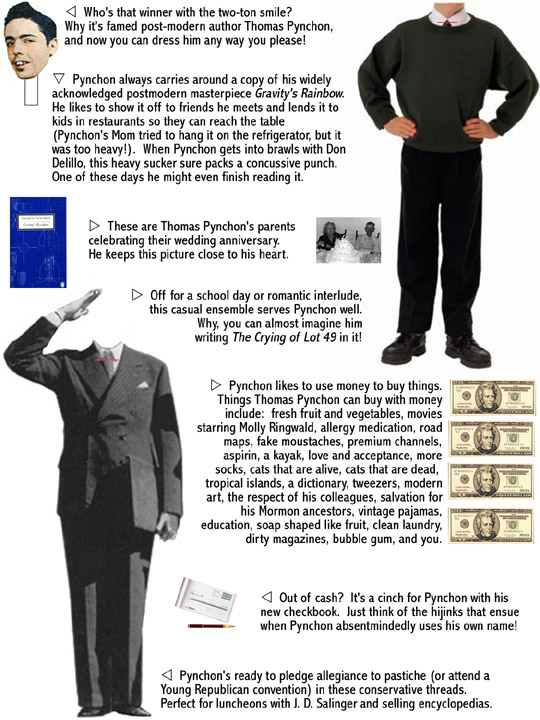
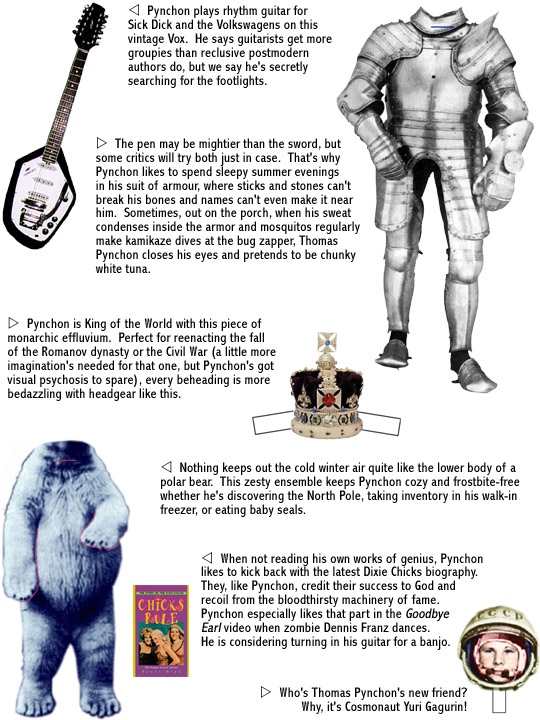
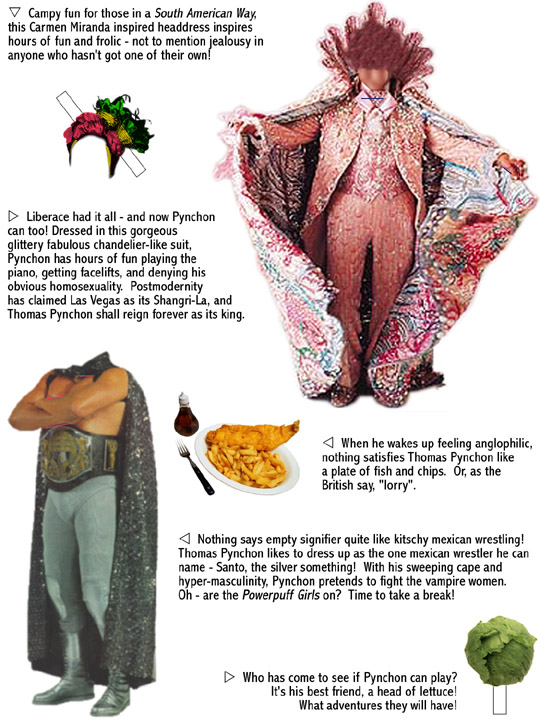
    Thomas Pynchon Paper Dolls

    030130_paperpynchon1030130_paperpynchon2030130_paperpynchon3

    (Via).

    Six (More) Stoner Novels (And a Bonus Short Story)

    A few years ago, to celebrate 4/20, Sam Munson at the Daily Beast wrote an article praising “The Best Stoner Novels.” Not a bad list—Wonder Boys, sure, Invisible Man, a bit of a stretch, The Savage Detectives, a very big stretch, but sure, why not. Anyway, six more stoner novels (not that we advocate the smoking of the weed)—

    Junkie, William Burroughs

    Burroughs’s (surprisingly lucid) early novel Junkie may take its name from heroin, but it’s full of weed smoking. Lesson: weed smoking leads to heroin. And the inevitable search for yage.

    Inherent Vice, Thomas Pynchon

    Doc Sportello, the wonky PI at the off-center of Pynchon’s California noir, is always in the process of lighting another joint, if not burning his fingers on the edges of a roach. A fuzzy mystery with smoky corners.

    Infinite Jest, David Foster Wallace

    Hal Incandenza, protagonist of Wallace’s opus, spends much of his time hiding in the tunnels of Enfield Tennis Academy, feeding his bizarre marijuana addiction, which is, in many ways, more of an addiction to a secret ritual than to a substance. Hal’s hardly the only character in IJ who likes his Mary Jane; there’s a difficult section near the novel’s beginning that features a minor character preparing to go on a major weed binge. His pre-smoking anxiety works as a challenge to any reader seeking to enter the world of Infinite Jest.

    The Lord of the Rings, J.R.R. Tolkien

    I’m pretty sure “pipe-weed” isn’t tobacco.

    Chronic City, Jonathan Lethem

    I kind of hated Chronic City, a novel where characters seem to light up joints on every other page. It seems to have been written in an ambling, rambling fog, absent of any sense of immediacy, urgency, or, uh, plot. Bloodless stuff, but, again, very smoky.

    Stoner, John Williams

    Okay. Stoner has nothing to do with marijuana. But, hey, it’s called Stoner, right?

    Bonus short story: Raymond Carver’s “Cathedral”

    Carver’s classic story features a myopic narrator who comes up against his own shortcomings when he meets an old friend of his wife, a blind man who ironically sees deeper than he does. After drinking too much booze, they spark up, share a doob, and take in a documentary about European cathedrals. Great stuff.


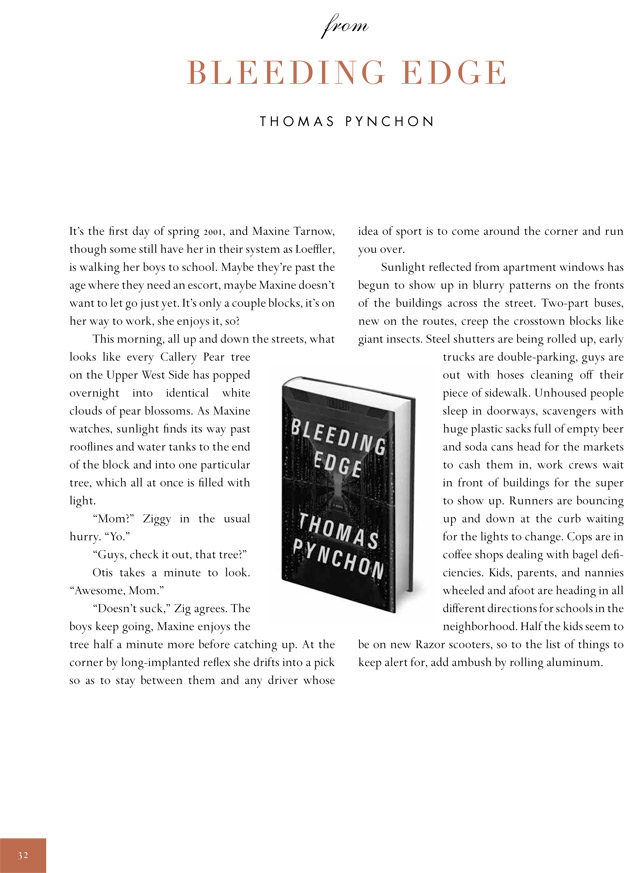
    Read the First Page of Thomas Pynchon’s Forthcoming Novel, Bleeding Edge

    41313pynchon1

    (Via; via).


    William Gaddis on the Pulitzer Prize: “The Ultimate Seal of Mediocrity”

    In William Gaddis’s last novel Agapē Agape (2002), our embittered narrator excoriates the Pulitzer Prize:

    . . . write what they want you’ll end up with a Pulitzer Prize follow you right to the grave. Maybe won the Medal of honor the George Cross even the Nobel but once you’ve been stigmatized with the ultimate seal of mediocrity your obit will read Pulitzer Prize Novelist Dies at whatever because they’re not advertising the winner no. No, like this whole plague of prizes wherever you look, it’s the prize givers promoting themselves, trying to rescue their thoroughly discredited profession of journalism. “The press is a school that serves to turn men into brutes,” Flaubert writes to George Sand “because it relieves them from thinking.” The prize winners? They’re just props, cartoonists, sports writers, political pundits, front page photos the bloodier the better for that instant of fame wrap the fish in tomorrow, good God how many Pulitzer Prizes are there? Over fifteen hundred entries, fourteen categories for journalists because if you started your bondage there you’re halfway home with that whole gang of sponsors, trustees, juries, God knows what who’ve survived that Slough of Despond and floated to the top. Just look at the next day’s New York Times, page after page bulging with self-congratulation with seven more categories to leech on, music, what they call drama and of course books where the Grey Lady finally got it both ways with their journalist who reviews books, like the misty-eyed ingenue but also destroys women writers and just for fairness crosses the gender line for an occasional assassination, give that lady a Pulitzer with oak leaf clusters! The books that are candidates are read by a jury whose decisions are passed up to the Olympian trustees with an eye to the multitude. We are thousands and they are millions, write the fiction they want or don’t write at all, ruling out Pound’s cry for the new, the challenging or what’s labeled difficult, so when Gravity’s Rainbow is being devoured by college youth everywhere and wins the National Book Award, its unanimous recommendation is overturned by the trustees for a double-talk spoof of academic vagaries by a bogus “Professor,” to everyone’s relief, and the author at peril escapes unblemished by the, no, no, no you can’t depend on it.

    “Ye Legend of Sir Stupid and the Purple Knight” — Thomas Pynchon (Juvenilia)

    “Ye Legend of Sir Stupid and the Purple Knight” was published in Thomas Pynchon’s high school newspaper; he was 16 at the time. (Via).

    “Ye  Legend of Sir Stupid and the Purple Knight”


    “Ridiculous!” roared King Arthur, slamming his beer mug on the Round Table. “Purple, you say?”

    “All purple, my liege,” said Sir Launcelot, nervously wiping the foam from his face, “head to toes. Completely.”

    “I say! Most irregular. Well, what does he want?”

    “He wants audience with you, my liege. It seems he’s done ole Cholmondesley in.”

    “Cholmondesley?”

    “With an axe, your grace. A purple axe. He says he’ll do the same to us all if we don’t send a challenger to fight him in fair battle.”“Well?”

    “Well, he— he’s— twenty feet tall.”

    “Twenty! Oh, I say! Ghastly business! Who’ve we got crazy enough to fight him? How about you, Launcelot?”

    “Oh, no, my liege. Cut my finger last night peeling potatoes. The pain is beastly.”

    “Rotten luck, old chap. Well,” he addressed the knights of the round table, “there’s a big purple idiot outside who’s looking for a fight. Who’s game?”

    Then up spake Sir Bushwack, a sturdy youth with a broad beam and a low center of gravity: “Where is the bloke? I’m not afraid, even if he is twenty feet taII!” Sir Bushwack had been drinking.

    Then spake King Arthur to Sir Launcelot, telling him to bid the knight enter. And Launcelot did this, and the horns sounded, and in staggered a tremendous giant, perhaps four feet in height, dragging behind him a ten-foot purple axe. He had a vast quantity of purple hair which fell down over his eyes, and was clad in purple armor, and his feet in purple sneakers. He led a noble steed, also purple, which resembled a cross between a Shetland pony and an armadillo.

    King Arthur whispered to Launcelot, “I thought you said he was twenty feet tall.”“That’s what he told me, your majesty.”

    “That’s what he what? Why you …”

    The rest of King Arthur’s tirade was drowned out by the purple giant, who was bellowing in a mighty voice:

    “Okay, I can beat any man in the house! I ain’t scared of nobody ‘cause you’re all … “ he hiccoughed “ … chicken to fight me! Come on, who’s first?”

    Up spake Sir Bushwack, shouting, “I challenge thee, Sir Knight!” The purple knight laughed. “Look what’sh challenging me! You slob, I can,—hic—can lick you with, — hic— one hand tied behind my back! Come ahead!” Then did the purple knight pick up the purple axe and begin to whirl it about his head, faster and faster. Sir Bushwack waddled up dubiously with sword in hand, feebly attempted to parry, then quickly retreated. The purple knight stood and laughed.

    “Chicken, all of you! Scared to fight me! Har! Har!”

    Suddenly, the horns sounded and into the hall rushed a very brave and manly knight, Sir Stupid.

    “I say!” he shouted to all and sundry, “Old Fotheringay’s run amok! He and his horse fell into that newly-pressed grape juice up at the distillery, and …”.

    Then he caught sight of the purple knight and stopped short. King Arthur started to laugh hysterically, spilling beer hither and yon.

    “I say, old Fotheringay’s gone and fallen into the wine vat! Old Fotheringayl Haw, Haw, Haw! Old Fotheringay’s got high on grape juice! Haw! In the still of the knight!”

    Old Fotheringay stood digesting this in silence. Then slowly he began to chuckle and whirl that axe.

    “Oh, oh,” Sir Stupid whispered to Arthur, “here he goes!” With a savage yell, Old Fotheringay charged the Round Table, swinging his axe. In an instant, the hall became the scene of a free-for-all. The purple knight was in the thick of the whole mess, smashing furniture, beer kegs, and anything else that happened to be in his way. The hall resounded with the clanging of swords, the splintering of wood, and the demonaical chuckling of the purple knight. In the midst of the noise and confusion, Sir Stupid buttonholed Bushwack.

    “Noble knight,” he said, “art thou truly dedicated to thy leige?”

    “Yes.”

    “And wouldst thou suffer discomfort to rid thy liege of this menace?”

    “Surely,” Sir Bushwack said absently, as he ducked a flying beer mug.

    “That’s all I wanted to know! Fotheringay! You feeble-minded halfwit cretin! Over here!”

    Infuriated, the purple knight whirled toward Sir Stupid and raised his axe. Sir Stupid lifted the protesting Bushwack and hurled him bodily at Fotheringay. There was a loud, splintering smash as the purple knight went down, and then all was silent, except for the gurgling of beer from a shattered keg. Sir Stupid stood over the horizontal Fotheringay.

    “Now, thou proud knight,” roared Sir Stupid triumphantly, “now what hast thou to say?”

    Slowly, the purple knight looked up and sneered. “CHICKEN,” he said.