Intertexuality and Structure in Roberto Bolaño’s 2666

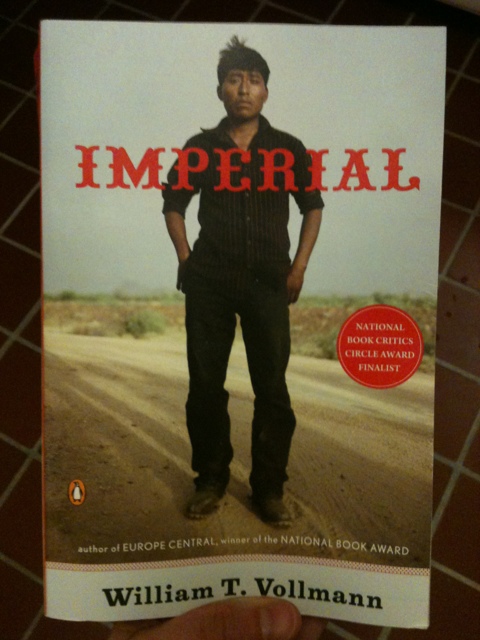
I had been reading William T. Vollmann’s enormous book Imperial. I bought the book in paperback and then put an illicit copy on my Kindle (this riff is not about the ethics of that move). It’s just easier to read that way, especially at night. At some point in Imperial, probably at some mention of coyotes or polleros—smugglers of humans—I felt a tug in the back of my brain pan, a tug that wanted to pull up Roberto Bolaño’s big big novel 2666—also on my Kindle (also an illicit copy, although I bought the book twice).

This is how I ended up rereading 2666 straight through. It was unplanned.

Like many readers, I aim to reread more than I actually end up rereading.

Truly excellent novels are always better in rereading: richer, fuller, more resonant. Sometimes we might find we’ve thoroughly misread them. (Imagine my horror rereading Lolita in my twenties to discover the vein of evil throbbing through it). Sometimes we find new tones that seemed impossible on the first run through. (I’ve read Blood Meridian at least once a year since the first time I read it, and it keeps getting funnier and funnier). Most of the time, rereading confirms the greatness of the novel, a greatness inhabiting the smallest details. (I’m looking at you Moby-Dick).

Even a riff should have a thesis, and here’s mine:  2666 has a reputation for being fragmentary and inconclusive—and in some ways, yes, of course it is—but a second full reading of 2666 reveals a book that is cohesive, densely allusive, and thematically precise.

Rereading is one way of stepping back to see the bigger picture that  Bolaño twists together from smaller fragments. Rereading reveals the intertextual correspondences between the books of 2666 (the five books proper, the “Parts,” of course, but also the texts, invented or real, that those books house).

2666 is also a book about writing.

Earth, Giuseppe Arcimboldo

To wit: “The Part About Archimboldi,” the fifth and final book of 2666, the book that features Benno von Archimboldi, the writer at the heart of 2666—this final chapter sews together many of the book’s (apparently) loose threads.

Two problems with the point above:

A. Benno von Archimboldi (aka Hans Reiter) is not at the heart of 2666 but rather a shadowy trace slipping through the margins, a ghost-presence that’s always there, but not generative or muscular like a heart. (I’m not sure exactly what I mean by this).

B. “The Part About Archimboldi” most decidedly does not sew together all the loose threads: That’s the reader’s job (or task or pleasure or plight or burden).

And so then: “2666 is also a book about writing”): 2666 is also a book about reading: A book about reading as detective work.

Who are the heroes of 2666?

They are all detectives of some kind, literal or otherwise.

Literary critics. Journalists. Philosophers. Psychologists. Psychics and fortune tellers. Police detectives. Private detectives. An American sheriff. A rogue politician. Poets. Publishers. Parents. Searchers.

Archimboldi shows up in the first book of 2666, “The Part About the Critics”; the eponymous critics, literary detectives are searching for him.

How does Archimboldi show up?

Inside a story (the Frisian lady’s) inside a story (the Swabian’s) (inside the story of “Critics,” which is inside the story of 2666).

The Frisian lady asks:

“Does anyone know the answer to the riddle? Does anyone understand it? Is there by chance a man in this town who can tell me the solution, even if he has to whisper it in my ear?”

And Archimboldi answers. He’s a reader, a detective.

Swinging back to the previous point: 2666 is a book about writing, and it shares the postmodern feature of calling attention to its own style and construction, yet it never does this in an overtly clever or insufferable fashion: It’s far more sly.

Water, Giuseppe Arcimboldo

What is the construction or shape of 2666?

A straightforward answer: Five books in an intertextual conversation that seem to loop back around, where the last book prefigures the first book in a strange circuit.

Some possible metaphorical answers:

A void (“Voids can’t be filled,” Archimboldi says).

A labyrinth (the word labyrinth appears 14 times in Wimmer’s translation of 2666).

A mirror (61 times).

An abyss (22 times)

An asylum (43 times; madhouse appears 5 times).

How does Bolaño slyly announce or criticize or puncture his style in 2666?

In Ignacio Echevarria’s “Note to the First Edition” of 2666, he tells us that:

Among Bolaño’s notes for 2666 there appears the single line: “The narrator of 2666 is Arturo Belano.” And elsewhere Bolaño adds, with the indication “for the end of 2666”: “And that’s it, friends. I’ve done it all, I’ve lived it all. If I had the strength, I’d cry. I bid you all goodbye, Arturo Belano.”

Belano is Bolaño’s alter ego, a trace who slips and sails and ducks through the Bolañoverse (he also shows up unnamed in 2666 with his partner Ulises Lima; they manage to father a bastard son, Lalo Cura).

So Belano who narrates 2666 (how?!) is Bolaño: Okay: So? Now?

I suggested earlier on Biblioklept that 2666 is a grand ventriloquist act, a forced possession, a psychic haunting. Bolaño channels Belano who channels detectives, journalists, poets, writers. Readers.

The channeling is metatextual or intertextual, a series of transpositions between the various narrators and protagonists and readers (detectives all).

The passage that I see most frequently cited from 2666 points to its intertextuality.

The passage is likely frequently cited because

A) Ignacio Echevarria cites it in his note at the beginning of 2666 and

B) it describes Bolaño’s project in 2666, both internally (the book as a strange beast, with intertextual readings within its five (plus) parts), and also externally (intertextually against the canon). Here is the passage (from “The Part About Amalfitano”):

One night, while the kid was scanning the shelves, Amalfitano asked him what books he liked and what book he was reading, just to make conversation. Without turning, the pharmacist answered that he liked books like The Metamorphosis, Bartleby, A Simple Heart, A Christmas Carol. And then he said that he was reading Capote’s Breakfast at Tiffany’s. Leaving aside the fact that A Simple Heart and A Christmas Carol were stories, not books, there was something revelatory about the taste of this bookish young pharmacist, who in another life might have been Trakl or who in this life might still be writing poems as desperate as those of his distant Austrian counterpart, and who clearly and inarguably preferred minor works to major ones. He chose The Metamorphosis over The Trial, he chose Bartleby over Moby-Dick,he chose A Simple Heart over Bouvard and Pecuchet, and A Christmas Carol over A Tale of Two Cities or The Pickwick Papers. What a sad paradox, thought Amalfitano. Now even bookish pharmacists are afraid to take on the great, imperfect, torrential works, books that blaze paths into the unknown. They choose the perfect exercises of the great masters. Or what amounts to the same thing: they want to watch the great masters spar, but they have no interest in real combat, when the great masters struggle against that something, that something that terrifies us all, that something that cows us and spurs us on, amid blood and mortal wounds and stench.

At the risk of belaboring or repeating the last point: Bolaño, ever the canon-maker, the list maker, situates 2666, his final work (he knows it’s his final work) along with “the great, imperfect, torrential works, books that blaze paths into the unknown,” a book that struggles “against that something, that something that terrifies us all, that something that cows us and spurs us on, amid blood and mortal wounds and stench.”

Air, Giuseppe Arcimboldo

So some metatextual moments that, read intertextually, perhaps (perhaps!) work to outline that “unknown,” that “something” of 2666:

Near the end of “The Part About Crimes,” a culminating moment, where a female journalist (NB: a female journalist is the first murder victim in “Crimes”) reads the work of the poet/journalist Mercado:

Hernandez Mercado’s style wavered between sensationalism and flatness. The story was riddled with clichés, inaccuracies, sweeping statements, exaggerations, and flagrant lies. Sometimes Hernandez Mercado painted Haas as the scapegoat of a conspiracy of rich Sonorans and sometimes Haas appeared as an avenging angel or a detective locked in a cell but by no means defeated, gradually cornering his tormentors solely by dint of intelligence.

A description of the style of “The Part About the Crimes”: “The story was riddled with clichés, inaccuracies, sweeping statements, exaggerations, and flagrant lies.”

And, from “The Part About Archimboldi,” a moment where some critics read Ivanov’s novel Twilight and assess it:

Professor Stanislaw Strumilin read it. It struck him as hard to follow. The writer Aleksei Tolstoy read it. It struck him as chaotic. Andrei Zhdanov read it. He left it half finished. And Stalin read it. It struck him as suspect.

These are internal criticisms of 2666.

Another moment from Ansky’s journal that seems to describe “The Part About the Crimes,” 2666, and the Bolañoverse in general:

He mentions names Reiter has never heard before. Then, a few pages on, he mentions them again. As if he were afraid of forgetting them. Names, names, names. Those who made revolution and those who were devoured by that same revolution, though it wasn’t the same but another, not the dream but the nightmare that hides behind the eyelids of the dream.

While I’m using Ansky’s journal as a pseudo key for the intertextual labyrinth of 2666, let me grab this nugget:

Only in chaos are we conceivable.

(I added the note “thesis” in the electronic margin).

Or another description of the novel, couched in a description of history:

. . . history, which is a simple whore, has no decisive moments but is a proliferation of instants, brief interludes that vie with one another in monstrousness.

Another description of 2666 can be found in Bubis’s description of Archimboldi’s second novel:

Lüdicke had yet to come off the presses when Mr. Bubis received the manuscript of The Endless Rose, which he read in two nights, after which, deeply shaken, he woke his wife and told her they would have to publish this new book by Archimboldi.

“Is it good?” asked the baroness, half asleep and not bothering to sit up.

“It’s better than good,” said Bubis, pacing the room.

Then he began to talk, still pacing, about Europe, Greek mythology, and something vaguely like a police investigation, but the baroness fell back asleep and didn’t hear him.

The names of the novels here also suggest something about the structure of 2666The Endless Rose suggests an eternal loop, as does Lüdicke, which etymologically suggests ludic, recursively playful . . . (Again, I’m just riffing here).

Another description of Archimboldi’s writing, which is of course a description of Bolaño’s 2666:

The style was strange. The writing was clear and sometimes even transparent, but the way the stories followed one after another didn’t lead anywhere: all that was left were the children, their parents, the animals, some neighbors, and in the end, all that was really left was nature, a nature that dissolved little by little in a boiling cauldron until it vanished completely.

Fire, Giuseppe Arcimboldo

Archimboldi’s name is some sort of secret key to the novel. He invents the name, of course, seemingly on the spot. (Invents is not the right word—rather, he synthesizes the name, cobbles it together from his readings. The name is intertextual).

The last name he appropriates from the painter Arcimboldo, whose paintings are instructive in understanding the structure of 2666, a narrative that comprises hundreds of internal discrete narratives that define the shape of the larger picture.  The first name?

“They called me Benno after Benito Juarez,” said Archimboldi, “I suppose you know who Benito Juarez was.”

The dark heart of 2666, site of “Crimes,” is Santa Teresa, a transparent stand-in for Ciudad Juarez.

(Florita Almada, psychic medium and honest detective of “Crimes” channels Benito Juarez, the shepherd boy who became the president of Mexico; I’m tempted to quote here at some length but resist).

Re: Above: I foolishly suggested that Archimboldi’s name is some sort of secret key. I don’t think there is a secret key. Just reading. Rereading.

I seem to be focusing a lot on “The Part About Archimboldi” in this riff. I riffed about the first three books here, and “The Part About Crimes” here.

But, still dwelling on “Archimboldi,” there’s a moment in it where an old alpine hermit confesses to murdering his wife by pushing her into a ravine. In some way his confession seems to answer all the puzzles of “Crimes,” all the unresolved abysses, all the falls (literal and metaphorical).  How can I justify this claim? How does a man confessing to a murder in a remote German border town in the 1950s answer the murders in Mexico in the 1990s? Or any of the other murders in the book? I suppose it’s a thematic echo, not a solution. Sweating late at night, reading past midnight, the moment struck me as larded with significance. I’m losing whatever thread I had . . .

So to end—how to end? Perhaps I’ll raid my first review of 2666, from January, 2009—surely I must have remarked on the end of the book, or on its apparent inconclusiveness—

—and so I did. And I don’t know if I can do better than this: 

Readers enthralled by the murder-mystery aspects of the novel, particularly the throbbing detective beat of “The Part About The Crimes,” may find themselves disappointed by the seemingly ambiguous or inconclusive or open-ended ending(s) of 2666. While the final moments of “The Part About Archimboldi” dramatically tie directly into the “Crimes” and “Fate” sections, they hardly provide the types of conclusive, definitive answers that many readers demand. However, I think that the ending is perfect, and that far from providing no answers, the novel is larded with answers, bursting at the seams with answers, too many answers to swallow and digest in one sitting. Like a promising, strangely familiar turn in the labyrinth, the last page of the book invites the reader back to another, previously visited corridor, a hidden passage perhaps, a thread now charged with new importance . . . 2666 is a book that demands multiple readings.

It was a good suggestion three years ago and I’ll take it up again.

Everybody Hates a Tourist (I Sort of Review the Audiobook of David Foster Wallace’s A Supposedly Fun Thing I’ll Never Do Again)

I recently listened to Hachette’s new audiobook version of David Foster Wallace’s essay collection A Supposedly Fun Thing I’ll Never Do Again, a collection of essays that I’ve read and enjoyed several times. My outline and notes for a review of the Fun Thing audiobook quickly swelled into an ugly, unmanageable bruise sporting a lengthy intro and dithering asides, when what I really intend to say boils down to “The audiobook is not very good.”

Why is it not very good? I hate to rest all the blame on voice talent Paul Garcia, because I’m sure that there were other people involved—a director, a producer, etc.—who also abetted this thing. If you’ve heard Wallace read—and I had to go back and listen to the few essays from Lobster that he reads to reconfirm this (more on that in a minute)—-if you’ve heard Wallace read his own stuff, you know that he brings this wonderfully restrained not-quite-affectless tone and rhythm to his work. I hesitate to call it naturalistic, but I guess that’s the closest word I can think of for what I’m trying to describe. Another way of putting this might be that when you hear Wallace reading his work, there’s a conversational tone to it, and that even when he’s reading something that is grossly hyperbolic or soaked in venom, he restrains himself from over-emoting these positions. It’s as if a barrier is removed between reader and auditor. In contrast, Paul Garcia mugs and hams his way through the essays in Fun Thing as if he’s doing bad dinner theater. He seems to delight in overzealously stressing every other syllable. The affectations tend to highlight how a certain way of reading—or perhaps hearing Wallace, in reality—can make him seem like a pompous, verbose asshole.

I suppose what I’m getting at is that hearing Garcia read Wallace’s first-person pronoun essays made me hear a different version of Wallace, one that I’d never heard in my own head when I’d read these pieces. Garcia made me hear a version of Wallace that I often disliked—finicky, vituperative, arrogant—one at odds with my own reading.

Reaching for an antidote, I then audited a few of the essays Wallace reads in Consider the Lobster—“Big Red Son,” recounting his trip to the AVN (porn film) awards in Las Vegas, and “Consider the Lobster,” where he visits the Maine Lobster Festival. These two essays balance neatly with the pair that likely stands out the most in Fun Thing: the title essay, Wallace’s infamous documentation of a luxury cruise, and “Getting Away from Already Being Pretty Much Away from It All,” an account of the Illinois State Fair. (I think “David Lynch Keeps His Head,” a rumination on Lynch’s place in cinema set against the backdrop of the filming of Lost Highway also holds up remarkably well—even in Garcia’s reading—but I’ve used some notes on it for another essay I’m working on about Roberto Bolaño and evil, so I’ll hold off any discussion). In any case, these four essays together illustrate the pattern Wallace’s reportage is most often identified with: Wallace goes to some place that he’s not really familiar with and writes about it, usually in obsessive, personal detail, mixing both humor and pathos as he details its absurdities and contradictions.

Several themes unify A Supposedly Fun Thing I’ll Never Do Again (one of the biggest is Wallace’s ever-present agon with irony), but what stood out most in going through the essays again was the sense of despair, the strange sadness that Wallace expresses when he shows us what happens when large groups of people get together for a good time. One of my favorite lines from pop music comes from Pulp’s “Common People,” where crooner Jarvis Cocker gently snarls, “Everybody hates a tourist.” I guess I love the line because I think it’s true, and it’s especially true in its own self-awareness of what it means to be a tourist—that a true tourist must be either oblivious (and thus hated) or self-hating (and thus in despair). So much of David Foster Wallace’s travel writing (if you want to call it that; I mean, it’s not travel writing, it’s more writing-about-mass-groups-of-people-in-contrived-situations) seems to be trying to work out these strange poles, to somehow understand what he is witnessing and overcome the hatred and disgust he feels at the vulgar, venal displays he’s seeing. In a footnote in “Consider the Lobster, Wallace lays it all out better than I can:

I confess that I have never understood why so many people’s idea of a fun vacation is to don flip-flops and sunglasses and crawl through maddening traffic to loud hot crowded tourist venues in order to sample a “local flavor” that is by definition ruined by the presence of tourists. This may (as my Festival companions keep pointing out) all be a matter of personality and hardwired taste: The fact that I just do not like tourist venues means that I’ll never understand their appeal and so am probably not the one to talk about it (the supposed appeal). But, since this note will almost surely not survive magazine-editing anyway, here goes:

As I see it, it probably really is good for the soul to be a tourist, even if it’s only once in a while. Not good for the soul in a refreshing or enlivening way, though, but rather in a grim, steely-eyed, let’s-look-honestly-at-the-facts-and-find-some-way-to-deal-with-them way. My personal experience has not been that traveling around the country is broadening or relaxing, or that radical changes in place and context have a salutary effect, but rather that intranational tourism is radically constricting, and humbling in the hardest way—hostile to my fantasy of being a real individual, of living somehow outside and above it all. (Coming up is the part that my companions find especially unhappy and repellent, a sure way to spoil the fun of vacation travel:) To be a mass tourist, for me, is to become a pure late-date American: alien, ignorant, greedy for something you cannot ever have, disappointed in a way you can never admit. It is to spoil, by way of sheer ontology, the very unspoiledness you are there to experience. It is to impose yourself on places that in all noneconomic ways would be better, realer, without you. It is, in lines and gridlock and transaction after transaction, to confront a dimension of yourself that is as inescapable as it is painful: As a tourist, you become economically significant but existentially loathsome, an insect on a dead thing.

I suppose it’s too easy, maybe even intellectually lazy to gravitate to Wallace’s despair in the cold light of his suicide, but this despair nevertheless is a thick vein that runs through his work. Just a few paragraphs above I offered a bit of bad logic, wherein I suggested that being a tourist is always an either/or position (oblivious, ignorant, smiling or hyper-aware and self- and other-loathing); if I’m more honest I suppose there are third and fourth ways, maybe fifth and sixth, but they become hard to imagine.

Frankly, I’ve always liked Wallace’s essays so much because I relate so strongly to his first-person pronoun’s experience of other people. When Wallace tries to navigate his contempt for the rubes at the Illinois State Fair (“Kmart People,” he calls them!) against the idea that he should try to understand and empathize with other human beings as, like, real human beings with complex inner-lives, hopes, dreams, desires, despairs, I get all that. I’ve been there. Every damn day. But it’s these complex articulations that put Wallace’s travel journalism in such a desperate position. Unlike Hunter S. Thompson, who fully embraced nihilism, Wallace couldn’t simply write off the people around him as creeps, mutants, and lizards; neither could he fully empathize or love them the way that William Vollmann seems to. In the essay “A Supposedly Fun Thing I’ll Never Do Again,” a wistful Wallace admits that he would love to jump from one ship to another in “a bold and William T. Vollmannish bit of journalistic derring-do” — but of course such a feat would never even be on Wallace’s radar (aside from a literary reference): this guy will spend the entire last day of the cruise alone in his room not talking to anyone. Which again, would probably be me.

I quoted a pop song above so I’ll indulge myself and cite another one. I love The Breeders’ fantastic 1993 LP Last Splash, and the song “Saints” is a great jam, but I’ve always felt a little alienated by its opening lyrics, where Kim Deal howls: “I like all the different people / I like sticky everywhere / Look around, you bet I’ll be there!” I guess I couldn’t hang with Kim Deal at the fair, because, if I’m honest, I don’t like all the different people, and I don’t like sticky everywhere. And even when I can enjoy a carnival atmosphere, there is usually some mediating substance like alcohol or irony involved.

This is perhaps a long-winded way of saying that I relate to the central discomfort-cum-despair that runs through Wallace’s essays about having to be in the midst of large groups of people. And while comfort isn’t the sign of great art or great writing (Wallace handles this issue as well in his Lynch essay, but more on that another time), I feel admittedly comfortable in his essays. Which is perhaps why I didn’t care for the Garcia-read audiobook: it made me feel like a tourist.

Book Shelves #21, 5.20.2012

20120520-111437.jpg

Book shelves series #21, twenty-first Sunday of 2012: William T. Vollmann and David Foster Wallace

Sorry about the glare in the photo above. As I seem to attest weekly, photography is hard. Photographing books is hard. Lighting issues, glare etc. Anyway, this shelf is half Vollmann, half DFW. I’ve written so extensively about these guys on the site that I won’t bother linking to anything here. A few months ago, Gaddis’s JR and The Recognitions was hanging out here, but then I put Expelled and Imperial on the shelf, bought Everything and More, and also picked up some more Gaddis, and, well, anyway, had to move him up with Joyce, where he seems to belong. The paperback of The Pale King is a review copy; it has additional stuff. Maybe I should part with the hardback. It seems ridiculous to have them both.

The copy of Girl with Curious Hair is extremely important to me, as silly as that sounds. It was one of the first books I ever “reviewed” on this blog, back when I still focused almost entirely on books I’d stolen or books I’d never returned to. From that review:

Scott Martin was kind enough to loan me this book. Did he know that it would forever change the way I read? It was the first semester of my freshman year in college, and I was slowly reaching beyond stuff like Henry Miller, Wm Burroughs and Franz Kafka. David Foster Wallace’s short story collection Girl With Curious Hair introduced me to a whole new world of writing. Reading DFW is like having a very witty friend tell you a moving and funny story over a few beers. He’s hilarious, thought-provoking, and not nearly as hard to read as people seem to think.

I leave the bookmark I’ve been using in almost every book I read. When I pulled Girl from the shelf, I found a Polaroid of my cat:

20120520-112636.jpg

He’s just a kitten here. His name is Remy. He no longer lives with us, but he’s still around. We moved a year ago from a bungalow set above the ground (i.e. with cat crawl space) to a ranch on a block (i.e. no crawl space). He didn’t want to move because he was having this romance with a stray my daughter named Pearly. I eventually trapped him and moved him to the new place, but I foolishly forgot he’d have no place to run and hide while getting acclimated. He ran away. A few months later I found him down the street. He looked happy and came up and talked to us. He followed us back to the new place and we gave him some people food treats. Then he left again. We seem him every now and then. He’s gotten surprisingly fat and seems to like the new people he’s taken up with. They have two boys, a little older than my kids. Sometimes I miss my cat.

William Gaddis on Hipsters: “An Ill-dressed, Underfed, Overdrunken Group of Squatters with Minds So Highly Developed That They Were Excused from Good Manners”

gaddis_large

Love this passage from William Gaddis’s The Recognitions. Mocking “hipsterism” has been around forever (or at least 50 years):

And by now they were at the door of the Viareggio, a small Italian bar of nepotistic honesty before it was discovered by exotics. Neighborhood folk still came, in small vanquished numbers and mostly in the afternoon, before the two small dining rooms and the bar were taken over by the educated classes, an ill-dressed, underfed, overdrunken group of squatters with minds so highly developed that they were excused from good manners, tastes so refined in one direction that they were excused for having none in any other, emotions so cultivated that the only aberration was normality, all afloat here on sodden pools of depravity calculated only to manifest the pricelessness of what they were throwing away, the three sexes in two colors, a group of people all mentally and physically the wrong size.

Books Acquired, 1.25.2012 (Malcolm Lowry, Paul Auster, and William Gaddis)

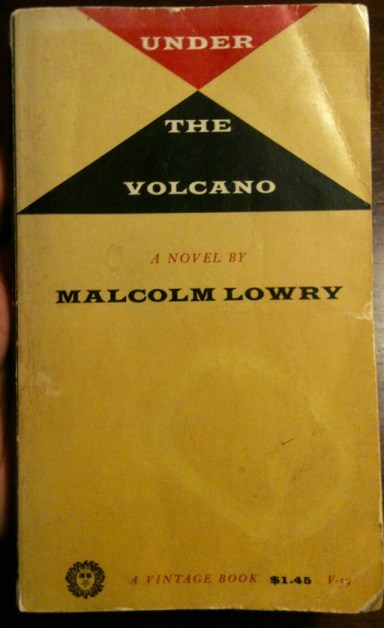
I go to the bookstore once a week, whether I need books or not, which I really don’t. This week, I picked up a book I’ve already read, Lowry’s late-modernist classic Under the Volcano, simply because I hate the cover of the version I have (a bland movie tie-in). Anyway, I’ve been prowling for a version that includes an introduction by William Vollmann, but I saw this midcentury paperback with a nice minimal vibe and had to snap it up (also, it was a dollar, and “I’d buy that for a dollar!”):

20120126-181349.jpg

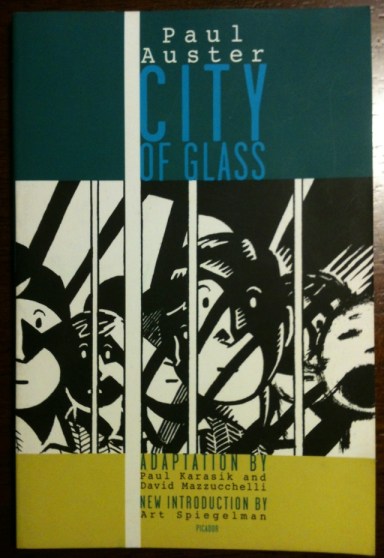
I’m not a huge Paul Auster fan, but I do like artist David Mazzucchelli’s work (especially his novel Asterios Polyp), so when I saw a crisp used copy of the graphic novelization of City of Glass (with an intro by Art Spiegelman), I had to snap it up:

20120126-181414.jpg

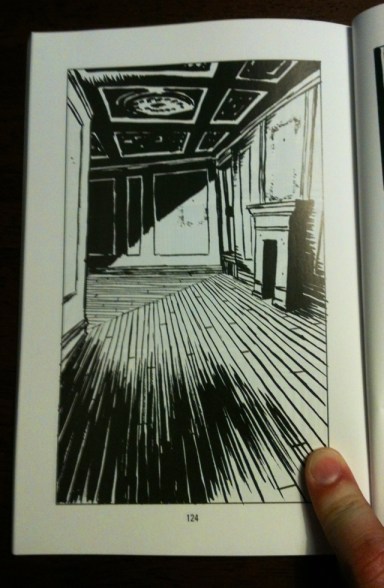
A splash page of a stark empty room which I’m sure is meaningful in some way:

20120126-181426.jpg

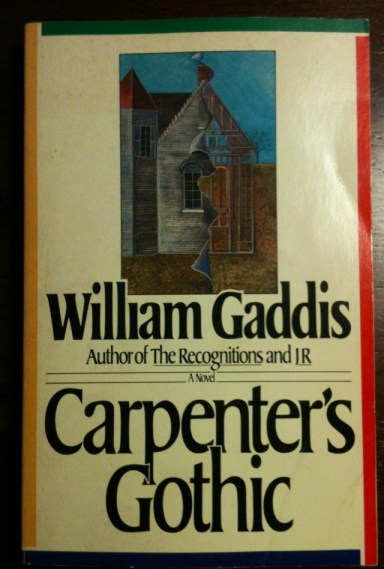
Also, couldn’t help pick up a used copy of Gaddis’s late novel Carpenter’s Gothic, even though I know there’s no way I’ll get to it anytime soon.

20120126-181435.jpg

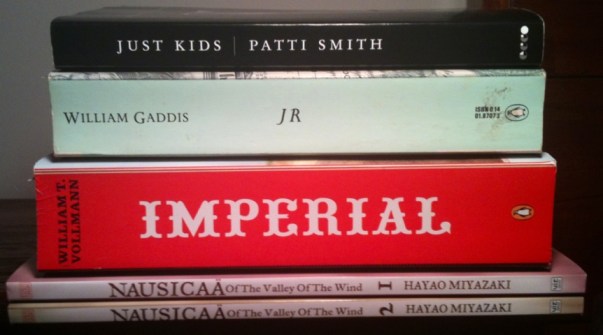
Riff on Recent Reading, 1.09.2012 (Gaddis, Vollmann, Dragons, Nausicaä, Patti Smith)

20120110-181813.jpg

1. Just Kids, Patti Smith

Really slowed down on this one, mostly because the spring semester hath begun, wreaking all sorts of destabilizing tasks on me. Momentum and reading habits will inevitably return. Anyway, Smith’s book is more or less a litany of famous meetings and infamous moments with lots and lots of descriptions of talismanic objects. The scene where she meets Allen Ginsberg is pretty cool. Smith presents herself as earnest, passionate, but also somehow at odds (or at least outs) with the whole Chelsea Hotel scene.

2. Nausicaä of the Valley of the Wind, Vol 1, Hayao Miyazaki

Completed the first volume of Miyazaki’s groundbreaking manga and started the second. The art is well crafted and distinct, but often extremely busy and even frenetic. It sometimes feels squashed in the panels, like it needs room to breathe. I can’t help but compare it to the film that followed, which is visually richer and more expansive. The film, in a sense, helps me to fill out the scope signaled in Miyazki’s inky illustrations.

The story in the manga so far differs subtly but significantly from the film; without adding spoilers (I think fans of the film will enjoy the book), the political dimension of the plot is heightened and gender roles are explored with greater concern. Nausicaä’s initial rashness is also presented with greater intensity (read: violent consequences). More to come.

3. Imperial, William T. Vollmann

Chapter 3 of Imperial, “The Water of Life,” is some of the best gonzo journalism I’ve ever read. Vollmann (along with an improbably game ex-Marine/hotel clerk) takes a raft—a cheap rubber dinghy, really—down the infamous New River, purportedly one of the most polluted waterways in North America. This river is filled with dead birds, dead fish, probably dead humans, lots and lots of garbage, industrial runoff, and lots and lots of human shit.

Of course, Vollmann can find beauty and strangeness and ugliness all at once:

The chapter does everything one wants from the book, and if you’re at all intrigued, there’s a version in the excellent Vollmann reader Expelled from Eden, which is a good starting point for his work.

The next chapter, “Sublineations: Lovescapes,” is this awful emo exploration of a bad breakup and the following heartbreak Volls feels after. It was torturous to get through, the sort of thing that screams for an editor. It also underscores how deeply deeply deeply personal the book is to him, though. More to come.

4. A Dance with Dragons, George R. R. Martin (audiobook read by Roy Dotrice)

Well goddam if I didn’t finally finish it. As I’ve lamented elsewhere in these e-pages, Martin’s fourth and fifth books in the A Song of Ice and Fire series (I hate that name, by the way: Game of Thrones (without the indefinite article) is way cooler sounding) are bloated, sagging, overfilled beasts sorely in need of an enema. Still, Dragons picks up in its final third, and ends with some shockers that, if I remember them 12 years from now when he finally finishes the next one, I may want to read it. Roy Dotrice = a very gifted reader. A great audiobook (still, I can’t believe this one topped so many year end lists).

5. JR, William Gaddis  (tandem reading with audiobook read by Nick Sullivan)

Big thanks to Dwight at A Common Reader for suggesting the audiobook of JR read by Sullivan. I’m a few hours in; I’ve also been rereading bits immediately when I get home (I listen mostly in the car or on walks), retracing the lines that I’ve mentally underlined. Sullivan is a gifted voice actor who brings the many, many voices of JR to vivid life (that line seems hackneyed but it is in no way insincere. If I weren’t riffing I’d revise. If I weren’t riffing I’d edit parenthetical excuses. I’m gonna drink more red zin now). I’m reminded in some ways of RTE’s full-cast unabridged recording—performance really—of Joyce’s Ulysses. I’d read Ulysses twice before, but I feel like the full-cast production was an equally definitive version to the one in my head. Like Ulysses—especially the Sirens episode—JR is extremely aural; it’s mostly dialogue.

I’ve laughed out loud several times so far—had no idea the book would be this funny. Also, reading/hearing it, I can’t help but see how profoundly David Foster Wallace was influenced by Gaddis here: the bizarre corporate-speak, the disjunctive rhythms, the absurd humor, the satire on modernity, the ironic-earnest axis—even the passages of naturalistic description.

On deck: The Orphan Master’s Son by Adam Johnson, Open City by Teju Cole, Smut by Alan Bennett and more more more.

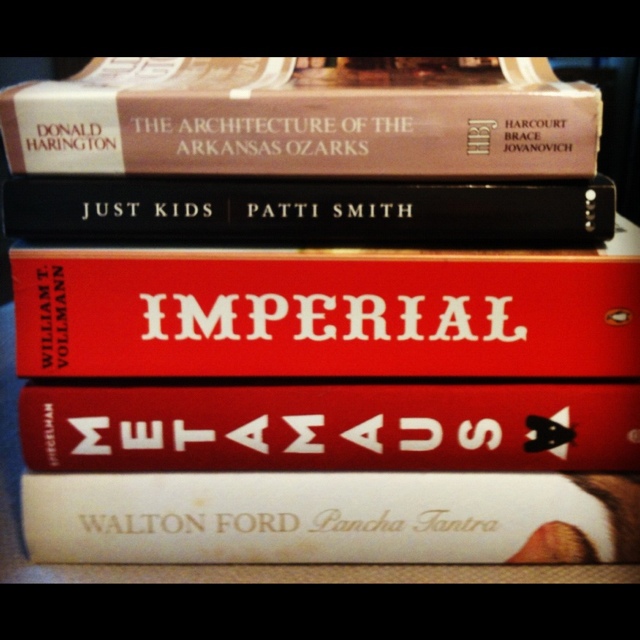
Riff on Recent Reading, 12.31.2011

20111229-200717.jpg

1. Donald Harington, The Architecture of the Arkansas Ozarks

I want to publicly thank blogger BLCKDGRD for sending me this book; it arrived in sections, the binding glue cracked, its abused condition surely a sign of love. I happened to be recaulking the margins of my screened in porch the day it arrived, so I used silicone caulk (along with c-clamp) to repair it.

The Architecture of the Arkansas Ozarks rightfully should have shown up on my Books I Didn’t Read in 2011 post, but it was doubly neglected, left under a pile of half-read books that I intend to keep reading: Georges Perec’s Species of Spaces, the Vollmann reader Expelled from Eden, a volume of stories by Breece D’J Pancake (two stories remain unread; I am sure they are awfully sad), Stendahl’s The Charterhouse of Parma. In short, I didn’t want to own up to abandoning it because I intend to go back and finish it. I read a little over half of Harington’s big, rich, funny history of Arkansas, told through the lens of the species of spaces inhabited by the Ingledews and their fellow Stay Morons. The book is lively, deeply ironic, and stands with Kurt Vonnegut as perfect American satire.

2. Just Kids, Patti Smith

I found Just Kids, which was a Big Deal book in 2010, while looking for a copy of Lillian Smith’s The Killers of the Dream (don’t fret; I found that book too). I’ve loved Smith’s music since I was a kid; like The Talking Heads, she was hard to place, not outright punk rock, definitely not pop, very weird.

I usually read the first few pages of books in the store if I think I’m going to buy them; I ended up reading about 10 pages of Just Kids, taking it home, and then reading for a few more hours. I’m almost finished with it now.

Smith documents a fascinating time in a fascinating place (New York City’s art/lit/music scene in the late sixties/early seventies), but her perspective for most of the book is that of an outsider, a would-be artist struggling to help Robert Mapplethorpe become famous for his art. Smith is in love with literature, particularly Romantic French stuff.

She’s also an object fetishist; I can’t think of another book that details so many tchotchkes, so many surfaces, so many contours, so many things. She’s an aesthete. There are also several incidences of book theft. I’m not sure if I’ll write up a proper review of this book—it won the Nat’l Book award and made all the year end lists in 2010—but I have been enjoying it as a chronicle of creative energy.

3. Imperial, William T. Vollmann

There’s a strange shift between the first and second chapters of Vollmann’s massive book about Imperial County. The first chapter, “The Gardens of Paradise,” reads like a magazine article (and it was; it was published in abbreviated form in Gear in 1999)—lots of dialogue, short paragraph breaks, a spare, lucid syntax, but nevertheless rippling with verve. The second chapter, “Delineations” is a heady brew, a page right out of Ishmael’s big book, as we see Vollmann try to delineate or define his white whale Imperial. And yet he seems to realize that delineation is a fantasy:

People say it was miraculous that Christ walked across the water, and yet they don’t think twice when the same is performed by this entity invisible everywhere except in its representations, whose substance is comprised of equal parts imagination, measurement, memory, authority, and jurisdiction! Delineation is the merest, absurdest fiction, yet delineation engenders control.

The territory and the time Vollmann treks in just a few dozen pages astounds . . .

4. MetaMaus, Art Spiegelman

Okay—not really recent reading, although I did pick it up again and thumb through it before writing this piece; mostly, I wanted to try to write something about this book before the end of the year (I put it on my “best of ’11” list, by the bye). This book is Spiegelman’s attempt to measure Maus: where it came from, how it was made, what making it did to him and for him—and to his family. Like Smith’s book, MetaMaus is very much about the creative process (forgive the hackneyed phrase)—only, where Smith breathlessly gushes in the glowing, enriching flames of art, Spiegelman guides us through the nitty-gritty nooks and crannies of how he made what is perhaps the signature work of comics art of the twentieth century.

The book is beautiful. Take a gander:

5. Pancha Tantra, Walton Ford

The index at the end of Pancha Tantra contains a series of citations that illustrate Ford’s paintings (hang on, the elements of that last phrase should be vice versa, right?). To wit:

20111230-205013.jpg

20111229-200847.jpg

6. A Dance with Dragons, George R. R. Martin (audiobook read by Roy Dotrice)

I really liked the first three Game of Thrones books (yeah, I know they have that long silly name; I’m not gonna write it). I listened to them on audio, all read by Roy Dotrice—who is a great reader—and I gave them a positive review. The first three books detail a world of Machiavellian scheming, a phallocentric, desacralized universe where power is constantly shifting and idealism will get you beheaded. The character development is excellent, the plots are engaging, and the prose is good enough.

The fourth book, narrated by John Lee, was almost too much to get through. Here are some words to describe it: bloated, plodding, sagging, lazy, meandering, over-expansive.

I’d heard that A Dance with Dragons was much better, knew that Dotrice was narrating again, and knew that the book picked up with some of my favorite characters who were left out of that fourth book (Tyrion, Danaerys).

I’m nearing the end—it’s much better than the last one, but not nearly as good as the first three. Martin could probably make the book a third shorter simply by cutting out the endless descriptions of food, the awful, gross sex scenes (actually, he can go ahead and keep those), and the terrible stock phrases. (How long do things last in ADwD? “Half a heartbeat.” Also, I would love to never hear the phrase “Much and more” again in my life. I’m not even kidding. And “Useless as the nipples on a breastplate” doesn’t need to show up more than once in your book).

Even with my gripes, there have been some good episodes so far, including a creepy cabin fever Sadean setpiece that reminded me of the South Africa episode of Pynchon’s V, which is like one of my favorite things in literature.

7. Various public domain books on Kindle Fire, including Poe, Hawthorne, Melville, Whitman, and Dickinson

I got a Kindle Fire. I like it. I downloaded a bunch of obscure American Renaissance stuff—letters, reviews, essays—and have been scrolling over it quite a bit late at night. More thoughts on this device to come.

Book Acquired, 12.23.2011; Or, I Read the First 2% of William Vollmann’s Enormous Book Imperial

20111223-194549.jpg

Earlier this week, Biblioklept correspondent A King at Night suggested on this blog that William T. Vollmann, “literature’s own Batman,” may not be entirely real. While Mr. At Night’s post was perhaps a bit tongue-in-cheek, he did hip us to extremely cheap new copies of Vollmann’s 2009 California opus, Imperial. I bought one, of course, knowing that my chances of actually reading it in full were, uh, slim. It showed up today.

I read the first 25 pages, a little over 2% of the book (not counting Vollmann’s endnotes and bibliography). I read the book in the bathtub, drinking a beer (those of you who fear (or find repulsive the prospect of) visualizing my stubby little birthday-suited body besoaped and besudded, I suggest that that role may be played by Geena Davis, circa early nineties, although, obviously, you can pick whomever you like to imagine reading Imperial in a bathtub). I was cognizant of the fact that I was taking a bath—a luxury of sorts—while reading a book that deals in large part about who controls water. I also managed to get the book wet with both blood and water. I don’t know where the blood came from.

The first few pages thrust us right into typical Vollmann territory, with our protagonist paying a cokehead to guide him through the back alleys of Mexicali (Vollmann takes time to note the “street-whores,” of course). Alternately, Vollmann attends the nocturnal activities of the weary Border Patrol, who regularly catch and release Mexicans heading for the Northside (America).

There’s a great little moment, very early in this first chapter, when Vollmann ponders the Sisyphean task of the men who patrol the border:

. . . I almost pitied the futility of his occupation, as I suspect he did mine (the main purpose of my essays being to line birdcages), but then I fortunately persuaded myself that all vocations and callings are equally futile.

This seems like the prototypical Vollmann moment: earnestness bound in supple irony, self-deprecation glossing the intense pride in work that the contemporary world will be happy to (even sometimes boastfully) ignore.

I enjoyed the first pages of this massive book tremendously. Vollmann’s voluminous scope and strange background often eclipse his powers as a proseslinger, and Imperial, so far, is lucid, clean, sharp, and funny.

So I’ll go for it. I’ll read it. I’ll finish it before this time (id est, late Dec.) next year.

The Myth of The Vollmann

  • Europe Central: 832 pages
  • Imperial: 1344 pages
  • The Royal Family: 800 pages
  • Rising Up and Rising Down: 3352 pages

I still hesitate to believe that William T. Vollmann actually exists. Has anyone ever read one of his super-long books? Can we prove that somewhere around page 700 of Imperial that the text doesn’t just become

ALLWORKANDNOPLAYMAKEWILLIAMLOVEPROSTITUESALLWORKANDNOPLAYMAKEWILLIAMLOVEPROSTITUES ALLWORKANDNOPLAYMAKEWILLIAMLOVEPROSTITUESALLWORKANDNOPLAYMAKEWILLIAMLOVEPROSTITUES ALLWORKANDNOPLAYMAKEWILLIAMLOVEPROSTITUESALLWORKANDNOPLAYMAKEWILLIAMLOVEPROSTITUES ALLWORKANDNOPLAYMAKEWILLIAMLOVEPROSTITUESALLWORKANDNOPLAYMAKEWILLIAMLOVEPROSTITUES ALLWORKANDNOPLAYMAKEWILLIAMLOVEPROSTITUESALLWORKANDNOPLAYMAKEWILLIAMLOVEPROSTITUES ALLWORKANDNOPLAYMAKEWILLIAMLOVEPROSTITUESALLWORKANDNOPLAYMAKEWILLIAMLOVEPROSTITUES ALLWORKANDNOPLAYMAKEWILLIAMLOVEPROSTITUESALLWORKANDNOPLAYMAKEWILLIAMLOVEPROSTITUES ALLWORKANDNOPLAYMAKEWILLIAMLOVEPROSTITUESALLWORKANDNOPLAYMAKEWILLIAMLOVEPROSTITUES ALLWORKANDNOPLAYMAKEWILLIAMLOVEPROSTITUESALLWORKANDNOPLAYMAKEWILLIAMLOVEPROSTITUES ALLWORKANDNOPLAYMAKEWILLIAMLOVEPROSTITUESALLWORKANDNOPLAYMAKEWILLIAMLOVEPROSTITUES

for the next 600 pages? How can we prove this if no one has actually read it? Can we prove that somewhere someone actually read Imperial (and I mean all of it)? What about that seven-volume first edition of Rising Up and Rising Down? Sure we all know about it, but has anyone actually SEEN the thing? I don’t even mean OWN it, certainly not that, none of you OWN the first edition of RURD. Oh heavens no, but have any of you seen it in person, to verify for me its actual existence?

It’s sort of like those kids who had pet monkeys when you were in elementary school, always someone’s cousin, or their neighbor’s friend from another school; sometimes the story was accompanied by a thumbprint-smudged Polaroid of the creature, clutching lovingly to some human torso. But did you ever actually see it? No never. Not once. And anyone who says they did is part of the conspiracy. Sure, maybe somewhere in Mexico someone has a monkey for a pet, but not here, no way, and certainly not your cousin. And look, I agree that it’s a weird thing to lie about, but that’s part of what makes good liars good, it’s some sort of weird emotional long-con that you are complicit in by listening to them.
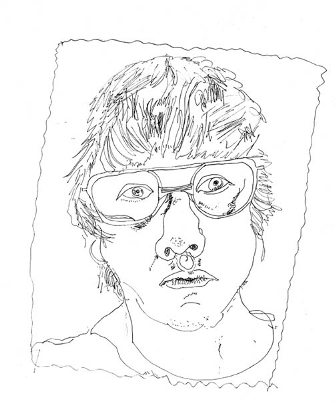
Why would someone lie about writing a 3000 page book about violence? I have no idea. And why the hell would the same guy write 800 pages about Shostakovich and the Russians during World War Two? You got me. It’s a brilliant scheme in a way. If Vollmann is lying about something, then he has avoided attention by writing books so long and esoteric that NO ONE can prove or disprove their legitimacy.

Of course, whatever game he’s playing at, it isn’t money.

I contacted Mr. Bob Amazon (the guy who started Amazon.com) and he confirmed my suspicion that literally no human has ever purchased a copy of either Imperial or The Royal Family. When asked if physical copies of these books were actually housed in an Amazon facility somewhere, just in case someone ever actually did buy one he hung up on me.

So, I’m thinking this thing goes deep, deeper than any of us ever imagined. Obviously Dave Eggers is involved somehow, either as the mastermind behind the whole thing, or just another pawn like the rest of us. I emailed Mr. Heartbreaking Jerk himself, asking if even he of all people can claim to have actually read all of Rising Up and Rising Down, and in return I received an auto-reply, something about the volume of emails he receives blah blah blah—the point is I think I scared him, and now I know I’m on the right trail . . .
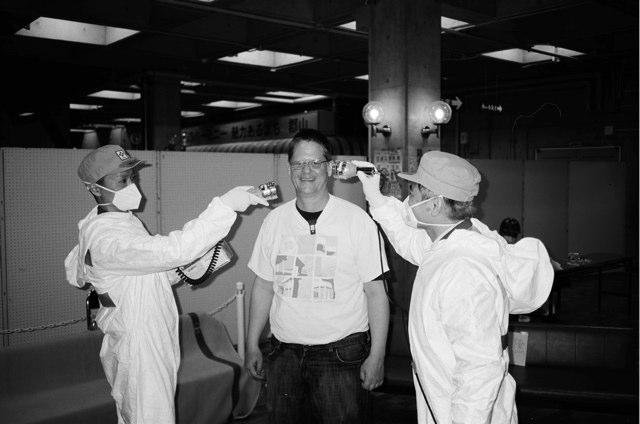
The funny thing with all of this is that I’m pretty sure there is no hoax going on. I have no reason to think William T. Vollmann is anything but a real guy, a weirdo dude who writes epically long books that no one reads. But if you read about his life at all it sounds more made up than any of the recently famous literary hoaxes. Maybe only that old asshole with his holocaust apples can really claim to have a bigger imagination, because neither James Frey nor JT Leroy can hold a candle to this (straight from Wikipedia):

In his youth, Vollmann’s younger sister drowned while under his supervision, a tragedy for which he felt responsible. This experience, according to him, influences much of his work.

What? Really? So he’s literature’s own Batman, The Dark Knight . . . or, wait for it: Vollman!

And I’m not even going to get into all the crack smoking with prostitutes and moving to Afghanistan in the 1980s. But I will talk briefly about his “hobby” of aimlessly train-hopping, which he apparently chronicled in Riding Toward Everywhere (a book whose existence I can confirm, as I bought it as a gift for a friend). Honestly though, that’s his hobby?

“So Mr. Vollmann, when you’re not hanging out with prostitutes in Cambodia, smoking crack, dodging bullets in Bosnia, spending 20 years writing a 3000 page book about violence, running around in the desert with a rebel army, or any of your other notable pursuits . . . what do you do for fun? How does William T. Vollmann relax?”

“Oh you know, I hop trains and just go where they take me.”

What? How do we know that Vollmann’s entire “career” isn’t the longest viral marketing campaign ever for a Wes Anderson movie that’s coming out ten years from now?

I’m not really heading towards anything conclusive or coherent here. I have no big point and the answer to all of my questions is that I should just devote the next few years of my life to actually reading these books instead of doubting their existence. But that would take 1) time and 2) money. Maybe I should turn it into some kind of art project and get funding on Kickstarter or something. Or maybe I could get review copies somehow.

Actually I just looked on Amazon and I see that Imperial is no longer the $40 book it once was. A new copy in paperback will run just $3.23 and with that free prime shipping I could be reading this thing by Friday.

So I just did it,  it is on its way, but we all know I’m not going to actually read it, right? It’s gonna go on the shelf next to Europe Central and the abridged copy of RURD and it will damn well stay there until, I don’t know, I become the omega man or something and I literally have nothing else to do and no one to talk to and no pointless articles to write and nothing to do with my boredom besides consume 1300 pages about border-crossing by a guy who looks like a serial killer.

“The Rules” — William T. Vollmann’s Prescription to Heal Diseased Writing

William T. Vollmann’s essay “American Writing Today” was published over 20 years ago in Conjunctions, but it’s still relevant today (I read it in the indispensable Vollmann reader Expelled from Eden, but you can read the entire essay online). Concerned with the solipsism and insularity of contemporary American writing, Vollmann tells us:  “I now propose to set forth our responsibility, and some rules for reform. This first requires that I set right all the woes of the world.” The second sentence’s naked irony punctures the seriousness of the project proposed by the first sentence; this is classic Vollmann—earnest, ironic, and self-effacing at all times. Here are Vollmann’s rules, which are somehow both tongue-in-cheek and totally sincere at the same time:

1. We should never write without feeling.

2. Unless we are much more interesting than we imagine we are, we should strive to feel not only about Self, but also about Other. Not the vacuum so often between Self and Other. Not the unworthiness of Other. Not the Other as a negation or eclipse of Self. Not even about the Other exclusive of Self, because that is but a trickster-egoist’s way of worshiping Self secretly. We must treat Self and Other as equal partners. (Of course I am suggesting nothing new. I do not mean to suggest anything new. Health is. more important than novelty.)

3. We should portray important human problems.

4. We should seek for solutions to those problems. Whether or not we find them, the seeking will deepen the portrait.

5. We should know our subject, treating it with the respect with which Self must treat Other. We should know it in all senses, until our eyes are bleary from seeing it, our ears ring from listening to it, our muscles ache from embracing it, our gonads are raw from making love to it. (If this sounds pompous, it is perhaps because I wear thick spectacles.)

6. We should believe that truth exists.

7. We should aim to benefit others in addition to ourselves.

“Steinbeck Is Sincere” — William T. Vollmann on East of Eden

William Vollmann writes about John Steinbeck’s East of Eden (excerpted from Imperial via Expelled from Eden)—

The book of his which I admire the most is East of Eden. For a decade now the character of Kate, whom some critics find unconvincing has haunted my head; she’s horrific, she’s pathetic, she’s steady and successful and lonely; she is perfectly what she is. The retelling of the Cain and Abel story is brilliant, the landscape descriptions lovely and lush, the plotting as careful and convincing as the best of George Eliot. And of course there’s a message, a flaw, personified by a Chinese servant who tells us, sometimes at great length, what to think. But Lee has never annoyed me. He speechifies intelligently, at times wittily, and sometimes compassionately. Do I care that nobody I’ve ever met talks like that? He is sincere because Steinbeck is sincere. And this is what I love about Steinbeck most of all, his sincerity.

William T. Vollmann’s Favorite “Contemporary” Books

In a 1990 interview between William T. Vollmann and one of his editors Larry McCaffery. An excerpt from the interview appears as a list in the Vollmann reader Expelled from Eden, which is quickly becoming one of my favorite books (seriously, let’s have another volume—this is clearly the optimum Vollmann delivery system). I’ve kept Expelled from Eden’s  list format because, hey, let’s face it, we like lists—

LM: Who are your favorite contemporary authors?

WV: By “contemporary” I assume you mean “from the last two hundred years.”

1./2./3. Right now it seems like I’ve learned a lot from Mishima, Kawabata, and Tolstoy;

4. Hawthorne may be the best;

5. Then Faulkner;

6. Hemingway is usually a wonderful read, especially Islands in the Stream and For Whom the Bell Tolls—that is to say, the grandly suicidal narratives;

7. Tadeusz Konwicki’s A Dreambook for Our Time is beautiful;

8. I also love everything I’ve read by Mir Lagerkvist;

9. Sigrid Undset’s trilogy Kristin Lavransdatter;

10. Multatuli’s Max Havalaar, or the Coffee Auctions of the Dutch Trading Company;

11. Kundera’s Laughable Loves;

12. Andrea Freud Lowenstein’s This Place (which deserves more recognition than it has received);

13. Jane Smiley’s The Greenlanders (which I had the wonderful experience of finding and reading a few months after completing my own book about Greenlanders, The Ice-Shirt).

14. Evans and Agee’s Let Us Now Praise Famous Men;

15. Farley Mowat’s The People of the Deer;

16. The first three books of Mishima’s Sea of Fertility tetralogy (how could I have forgotten that?);

17. Random bits of Proust, Zola’sL’Assommoir;

18. Shusaku Endo’s The Samurai;

19.The first two books of Mervyn Peake’s Gormenghast trilogy;

20. William Hope Hodgson’s The Night Land;

21. Poe’s stories about love;

22. Everything by Malraux (especially his Anti-Memoirs);

23. Nabokov’s Glory and Transparent Things and Ada;

24. Melville’s Pierre;

25. Thomas Bernhard’s Correction;

26. David Lindsay’s Voyage to Acturus;

27. Philip K. Dick’s A Scanner Darkly;

28. A few of Boll’s short novels (Wo warst du, Adam? and The Train Was on Time);

29. Elsa Morante’s History: A Novel;

30. Maria Dermout’s The Ten Thousand Things;

31.  Walter M. Miller’s A Canticle for Leibowitz;

32. James Blish’s Cities in Flight tetralogy (which is just plane fun);

33. The first three volumes of Lawrence Durrell’sAlexandria Quartet, and I don’t know what all.

There’s lots more. I am sorry not to be able to put down less contemporary things such as Tale of Genji, which is one of my all-time favorites.

“List of Social Changes that Would Assist the Flourishing of Literary Beauty” — William T. Vollmann

“List of Social Changes that Would Assist the Flourishing of Literary Beauty” by William T. Vollmann. Originally published in his essay, “Something to Die For” (Review of Contemporary Fiction) but excised here from Expelled from Eden, the Vollmann reader I’m finding addictive—-

1. Abolish television, because it has no reverence for time.

2. Abolish the automobile, because it has no reverence for space.

3. Make citizenship contingent upon literacy in every sense. Thus, politicians who do not write every word of their own speeches should be thrown out of office in disgrace. Writers who require editors to make their books “good” should be depublished.

4. Teach reverence for all beauty, including that of the word.

“The Stench of Corpses” — William Vollmann Reviews William Vollmann

“The Stench of Corpses” is a self-review by William T. Vollmann of the poorly-received and rarely read book Argall, one of his “Seven Dreams” series (still incomplete). The piece originally ran in the October 7, 2001 edition of The Los Angeles Times, but I read it in Expelled from Eden, a Vollmann reader that I am very much enjoying.  There’s an immediate post-9/11 vibe running through Vollmann’s scathing review of Vollmann, culminating in his declaration that Argall is “positively un-American.”

“The Stench of Corpses”

A hundred years after William T. Vollmann was killed in a gun cleaning accident, I, William the Blind, received a commission to review the long novel “Argall,” which marks the midpoint of his uncompleted “Seven Dreams” series. According to Dombey’s “Easily Digested Biographies of Minor Authors,” which I just happen to have right here inside my reading pod, it was always Vollmann’s hope that the “Seven Dreams,” which were second in ambition only to his still-unpublished essay on violence, “Rising Up and Rising Down,” would “somehow, uh, mean something to people a hundred years from now.”

This desire is best understood as a form of wish compensation. Vollmann lived what can only be called a pathetic life. Isolated within and stubbornly estranged from millennial American society, he consoled himself with a sophomorically romantic belief that art, if protected in time capsules, can outlast Dark Ages. Let’s temporarily ignore the fact that Vollmann’s so-called art was never worth preserving, being infested by individualism, moral relativism and sexual depravity. More to the point, since stars, elephants and gods suffer death, how could even the greatest art be “immortal”? As we all know, the Liu-Mallinger Act of 2027, which made cranial stimulation devices compulsory for all inhabitants of the Global Trans-Industrial Zone, reduced the printed word to irrelevancy at last. Continue reading ““The Stench of Corpses” — William Vollmann Reviews William Vollmann”

Book Acquired, 9.09.11 — Or, I Buy Yet Another William T. Vollmann Book Against My Better Judgment

20110909-044233.jpg

I like William T. Vollmann the persona probably more than I like William T. Vollmann the writer. That isn’t to say that I haven’t thought that the handful of books I’ve read by him were brilliant, strange, and engrossing—because they are—but I’ll admit that his methods, his back story, his sheer and absolute not-giving-a-fuckness is a major attraction. Voluminous Vollmann, unreadable Vollmann; smartypants Vollmann, fragile Vollmann. Vollmann, producer of travelogues, alternate histories, hagiographies for hookers; Vollmann, Ice Age chronicler; saga-slinging Vollmann. I can’t think of a writer who does more and says more and, because of his maximalist approach, will be largely unread, both for his career and for posterity—unless he concedes to edit. I think the irony is that, in wanting to give everything to his reader and wanting to preserve everything about his subjects—an act of love, compassion, empathy, what have you—in these grand, hopeless gestures, Vollmann paradoxically displays that intrinsic not-giving-a-fuckness. He needs an editor.

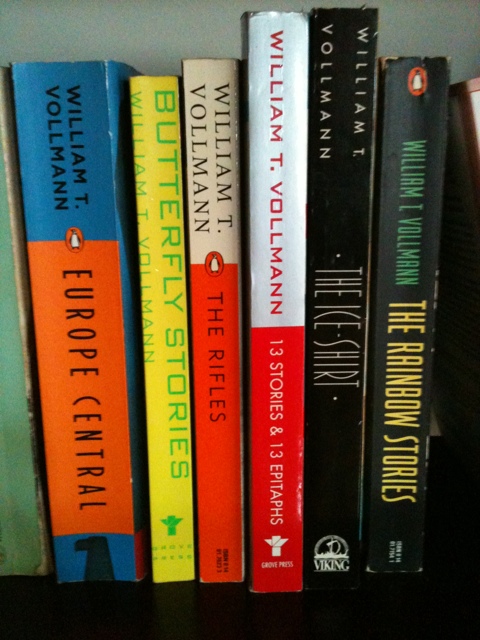
So, this afternoon, browsing at my favorite bookshop, a labyrinthine twisty thing, I ambled innocently past the ‘V’s of General Fiction, looking for a novel by Karel Capek in the sci-fi section, which abuts said ‘V’ aisle. Again, this was all innocence. I had no intention of picking up anything by Vollmann, despite the huge stack of his works there, used testaments to the futility of trying to read Vollmann perhaps—at least a dozen souls who said “fuck it” to Europe Central. Here are the Vollmann volumes (volmumes?) I possess—

20110909-044243.jpg

I’ve read Butterfly Stories, The Rifles, and The Ice-Shirt; I’ve read most of 13 Stories & 13 Epitaphs. I’ve read bits of The Rainbow Stories and mostly nothing of Europe Central, which migrated out of the “to read” stack a few years ago. So, yeah, I wasn’t looking for another Vollmann. But I’m too frequent a visitor at this particular labyrinthy, somewhat famous North Florida bookshop, so I noticed a “new” Vollmann in the stack, Expelled from Eden. And I started thumbing through it. Against my better judgment. 20 minutes later I was brainstorming reasons not to pick it up, but honestly, the credit in book trade I have with the store nails most economic arguments, and really, I’m thinking this is exactly what I wanted someone to do with Vollmann: edit that shit.

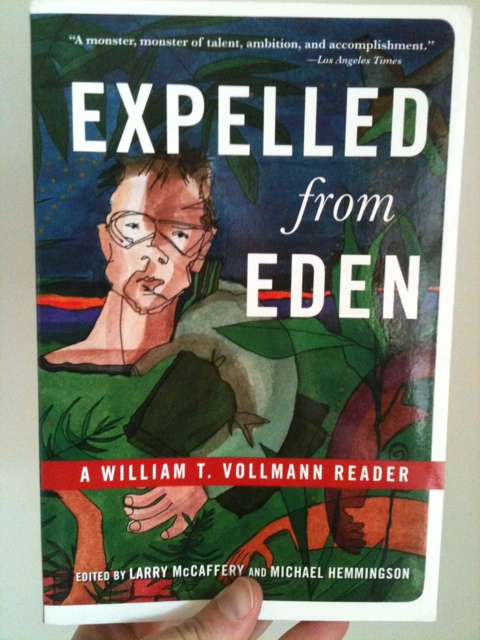
Larry McCaffrey and Michael Hemmingson have excised, chopped, moved around, and pulled from all over Vollmann’s massive world, putting together a book organized around Vollmann’s grand themes—travel writing; war; violence; prostitution; literature. There are lists, drawings, photographs. There is biography. I came home and read for an hour. I’m sure I’ll be sharing some citations down the road.

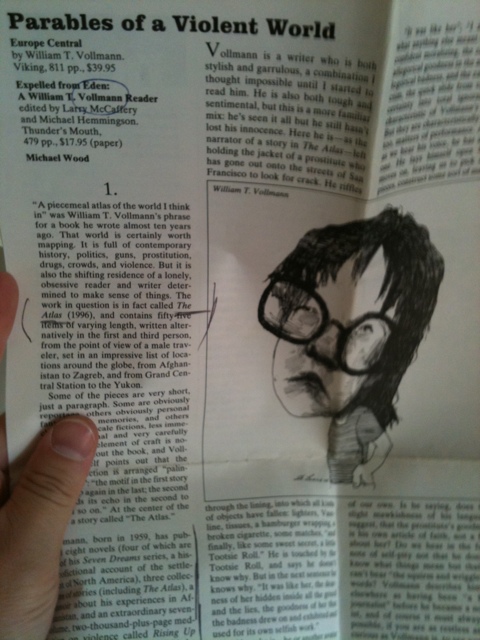
As a sort of bonus—and I always love to pick up a book where something is neatly tucked away—is an entire 2005 feature from The New York Review on Vollmann, focusing on Expelled from Eden and Europe Central.

20110909-044253.jpg

The Best Books We Read in 2010 That Were Published Before 2010

The best books that we read in 2010 that were published before 2010:

Nazi Literature in the Americas by Roberto Bolaño (2008, English translation) — Bolaño’s fake encyclopedia of right-wing writers is a tragicomic crash course in misanthropy, failure, and fated violence. Francisco Goldman’s blurb on the back of the book is spot on–the book is a “key cosmology to Bolaño’s literary universe.” Nazi Literature is like an index for the Bolañoverse–creepy, steeped in dread, deeply, caustically funny, and bitterly poignant.

Butterfly Stories by William T. Vollmann (1993) Adventures in the Southeast Asian sex trade. Bleakly funny, often depressing, and filled with erudite asides on Nobel prizewinners, transvestites, and the benefits of whiskey and benadryl. Plenty of grotesque sex. Not for everyone. In fact, not for most people.

The Friends of Eddie Coyle by George V. Higgins (1970) — Higgins throws his audience into the deep end of gritty urban Boston on the wrong side of the sixties in this crime noir classic. There’s little exposition to spell out Coyle’s intricate and fast-paced plot, but there is plenty of machine-gun dialogue, rendered very true and very raw. Higgins trusts the reader to sort out the complex relationships between hustlers and dupes, cops and finks from their conversations alone. The imagery is straight out of a Scorcese film, and like that director, Higgins has a wonderful gift for showing his audience action without getting in the way.

Home Land (2004) and Venus Drive (2000) by Sam Lipsyte — Is there a better stylist working today than Lipsyte? Does anyone write better sentences? Of course, sentences alone don’t matter much if you don’t have a story worth telling, and both Homeland and Venus Drive deliver. They are seething, funny, poignant books, with characters tipped toward some redemption, awful or otherwise, despite their myriad sins.

Steps by Jerzy Kosinski (1968) — One of the many small vignettes that comprise Steps begins with the narrator going to a zoo to see an octopus that is slowly killing itself by consuming its own tentacles. The piece ends with the same narrator discovering that a woman he’s picked up off the street is actually a man. In between, he experiences sexual frustration with a rich married woman. The piece is less than three pages long. You will either hate or love this book.

Cloud Atlas (2004) and Black Swan Green (2006) by David MitchellCloud Atlas is a postmodern puzzle piece of six nested narratives (each a smart take on some kind of genre fiction), informed by Nietzsche’s idea of eternal recurrence; Black Swan Green (which for some reason we forgot to review here) is a funny and heartwarming coming-of-age story of a boy who copes with his terrible stutter and his parents’ crumbling marriage in early 1980’s England. The books have little in common save their brilliance–which seems kinda sorta unfair. It also seems unfair that Mitchell put them out so quickly. Damn him.

Angels by Denis Johnson (1983) — Angels begins as a small book about not very much and ends as a small book about pretty much everything. Johnson has a keen eye and keener ear for the kinds of marginal characters many of us would rather overlook all together, people who live and sweat and suffer in the most wretched, unglamorous, and anti-heroic vistas of a decayed America. The great achievement of the novel (beyond Johnson’s artful sentences) is in staging redemption for a few–not all, but a few–of its hopeless anti-heroes.

Suttree by Cormac McCarthy (1979) — A beautiful, rambling riff on American literature — Suttree picks up on Emerson and Twain, Faulkner and Whitman, and flows into a new, wild territory that is pure McCarthy. Is it his best novel? Could be. Read it.

“Things Like Kidnapping the Sex Slave” — William T. Vollmann Speaks of Women

More from The Paris Review’s vaults. Highlights from William T. Vollmann’s 2000 interview (the entire thing is precious. Just precious) —

VOLLMANN: One of the things that I had to do occasionally while I was collecting information for that prostitute story, “Ladies and Red Lights” from The Rainbow Stories, was sit in a corner and pull down my pants and masturbate. I would pretend to do this while I was asking the prostitutes questions. Because otherwise, they were utterly afraid of me and utterly miserable, thinking I was a cop.

. . .

I kept thinking when I first began writing that my female characters were very weak and unconvincing. What is the best way to really improve that? I thought, Well, the best way is to have relationships with a lot of different women. What’s the best way to do that? It’s to pick up whores.

. . .

Also, I often feel lonely.

. . .

I almost never sleep with American prostitutes any more, unless they really want me to—if they are going to get hurt if I don’t.

. . .

Anyway, so when I was in Thailand, I went to a town in the south and bought a young girl for the night. This awful brothel—one of these places hidden behind a flowershop with all these tunnels and locked doors and stuff—was like a prison. I tried to help a couple of the girls but you just can’t get them out. I tried and I couldn’t. I made the mistake of going to the police, trying to have the police get them out—all that did was nearly get them arrested and put in jail, because the police are paid off. I managed to get the raid called off by taking all the cops out to dinner and buying them Johnnie Walker. I bought this fourteen-year-old girl and got her in a truck and drove like hell to Bangkok. I was with this other girl at the time—Yhone-Yhone, a street prostitute, a very happy one. She was my interpreter. She put the fourteen-year-old girl at ease and got her to trust me. We got her set up at a school run by a relative of the king of Thailand. I went up north, met her father, gave him some money, and got a receipt for his daughter. He didn’t know she’d been sold to a brothel. When I met him and told him he said, Oh. I didn’t know that, but, well, whatever she wants. He’s not a bad guy, just a total loser. He’s a former Chiang Kai-shek soldier. They’re all squatters there in Thailand. They can’t read or write. He lives on dried dogs and dried snakes.

INTERVIEWER: You own his daughter?

VOLLMANN: That’s right. I own her. She doesn’t particularly like me, but she was really happy to be out of that place. She loves the school. It’s sort of a vocational school. It’s called something like the Center for the Promotion of the Status of Women. Many former prostitutes are in there.

. . .

The common motif is just prostitution and love.

. . .

I want to take some responsibility and act as well as write. I don’t mean to be an actor, but rather to accomplish things . . . do things that will help people somehow . . . things like kidnapping the sex slave. It would be great if I could make my contribution to abolishing the automobile or eliminating television or something like that.