Bloomsday, an annual celebration of James Joyce’s Ulysses, is upon us today with moreexcitement than ever. Even with the festivities, the book’s reputation for density, erudition, and inscrutability still daunts many readers–leading to a glut of guidebooks, summaries, and annotations. Ironically, rather than inviting first-time readers to the text, the sheer volume of these guides to Ulysses can paradoxically repel. Their very existence seems predicated on an intense need, and although some of the guides out there can be helpful, others can get in the way. This need not be. Ulysses deserves its reputation as one the best books in the English language. It generously overflows with insight into the human experience, and it’s very, very funny. And, most importantly, anyone can read it.
Here are a few thoughts on how to read Ulysses, enumerated–because people like lists:
1. Ignore all guides, lists, maps, annotations, summaries, and lectures. You don’t need them; in fact, they could easily weigh down what should be a fun reading experience. Jump right into the text. Don’t worry about getting all the allusions or unpacking all the motifs.
Pretty soon though, you’ll get to the third chapter, known as “Proteus.” It’s admittedly hard to follow. You might want a guide at this point. Or you might just want to give up. (Of course, you might be a genius and totally get what Stephen is thinking about as he wanders the beach. Good for you). If frustration sets in, I suggest skipping the chapter and getting into the rich, earthy consciousness of the book’s hero, Leopold Bloom in chapter four, “Calypso.” It’s great stuff. You can always go back to chapter three later, of course. The real key, at least in my opinion, to reading (and enjoying) Ulysses is getting into Bloom’s head, matching his rhythm and pacing. Do that and you’re golden.
I’ve already advised you, gentle reader, not to follow any guides, so please, ignore the rest of my advice. Quit reading this post and start reading Ulysses.
For those who wish to continue–
2. Choose a suitable copy of the book. The Gabler edition will keep things neat and tidy and it features wide margins for all those clever game-changing annotations you’ll be taking. Several guides, including Harry Blamire’s The New Bloomsday Book align their annotation to the Gabler edition’s pagination.
3. Make a reading schedule and stick to it. The Gabler edition of Ulysses is nearly 700 pages long. That’s a long, long book–but you can read it in just a few weeks. There are eighteen episodes in Ulysses, some longer and more challenging than others, but reading one episode every two days should be no problem. If you can, try to read one episode in one sitting each day. As the book progresses, you’ll find yourself going back to previous chapters to find the figures, motifs, and traces that dance through the book.
4. So you’ve decided you need a guide. First, try to figure out what you want from the guide. Basic plot summary? Analysis? Explication? There’s plenty out there–too much really–so take the time to try to figure out what you want from a guide and then do some browsing and skimming before committing.
The most famous might be Stuart Gilbert’s James Joyce’s Ulysses, a dour book that manages to suck all the fun out of Joyce’s work. In a lecture on Ulysses, Vladimir Nabokov warned “against seeing in Leopold Bloom’s humdrum wanderings and minor adventures on a summer day in Dublin a close parody of the Odyssey,” noting that “it would be a complete waste of time to look for close parallels in every character and every scene in the book.” Nabokov scathingly continued: “One bore, a man called Stuart Gilbert, misled by a tongue-in-cheek list compiled by Joyce himself, found in every chapter the domination of one particular organ . . . but we shall ignore that dull nonsense too.” It’s perhaps too mean to call Gilbert’s guide “nonsense,” but it’s certainly dull. Harry Blamire’s The New Bloomsday Book is a line-by-line annotation that can be quite helpful when Joyce’s stream of consciousness gets a bit muddy; Blamire’s explications maintain a certain analytical neutrality, working mostly to connect the motifs of the book but letting the reader manage meaning. Don Gifford’s Ulysses Annotated is an encyclopedia of minutiae that will get in the way of any first time reader’s enjoyment of the book. Gifford’s notes are interesting but they can distract the reader from the text, and ultimately seem aimed at scholars and fanatics.
Most of the guidebooks I’ve seen for Ulysses share a common problem: they are obtrusive. I think that many readers who want some guidance or insight to aid their reading of Ulysses, rather than moving between books (what a chore!), should listen to some of the fantastic lectures on Joyce that are available. James Heffernan’s lectures for The Teaching Company provide a great overview of the book with some analysis; they are designed to be listened to in tandem with a reading of the book. Frank Delaney has initiated a new series of podcast lectures called re:Joyce; the first lecture indicates a promising series. The best explication I’ve heard though is a series of lectures by Joseph Campbell called Wings of Art. Fantastic stuff, and probably the only guide you really need. It’s unfortunately out of print, but you can find it easily via extralegal means on the internet. Speaking of the internet–there’s obviously a ton of stuff out there. I’ll withhold comment–if you found this post, you can find others, and have undoubtedly already seen many of the maps, schematics, and charts out there.
5. Keep reading. Reread. Add time to that reading schedule you made if you need to. But most of all, have fun. Skip around. If you’re excited about Molly’s famous monologue at the end of the book, go ahead and read it. Again, the point is to enjoy the experience. If you can trick a friend into reading it with you, so much the better. Have at it.
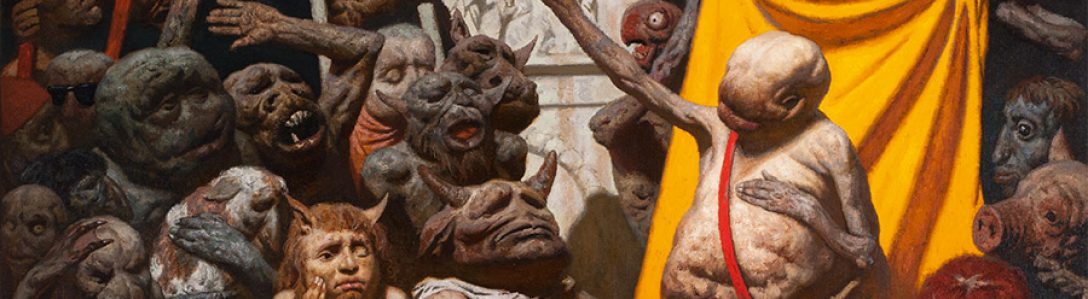
New York’s WBAI will continue their 32 year tradition of celebrating Bloomsday tomorrow with a live broadcast featuring a host of actors reading aloud from James Joyce’s Ulysses. Readings begin at 7pm and continue until 2am. Performers include Paul Muldoon, Alec Baldwin, Jerry Stiller, Charles Busch, T. Ryder Smith, Bob Dishy, Judy Graubart, Aaron Beall, Amy Stiller, Paul Dooley, Bob Odenkirk, John O’Callaghan, Brian O’Doherty, Kate Valk, Mara McEwin, James Kennedy, Jim Fletcher, Richard Maxwell, Anna Goodman-Herrick, Janet Coleman, David Dozer, Emily Mitchell, and Tara Bahna-James. More at their blog.
In This Is Where We Live, Janelle Brown’s follow-up to her 2008 début All We Ever Wanted Was Everything, an artsy newly wed couple find their dreams and their marriage unraveling when the payments on their adjustable rate mortgage suddenly double. Claudia and Jeremy are happy at the novel’s outset, living comfortably in their Los Angeles bungalow. Her film Spare Parts garners a huge buzz at Sundance and he reforms a new band after the breakup of his old group The Invisible Spot; they envision their new neighborhood as a contemporary counterpart to the Laurel Canyon creative scene of the 1960s. But then their ARM adjusts and Spare Parts flops. Claudia has to take a job teaching (Gasp! Oh, the terror! In a particularly funny scene, she shows The Graduate to her film students and one of them raises her hand to declare that her father was one of the film’s executive producers). The couple soon has to take in a roommate. Complicating matters even more is the return of Aoki, Jeremy’s unstable–and now famous–ex-girlfriend, who manipulates him every chance she gets. Aoki, a cartoonishly unhinged avant-gardiste, serves as a foil to the more grounded figure of Claudia; as Claudia begins to mature into a more pragmatic, adult personality, Aoki’s siren song calls Jeremy to return to chaos. This Is Where We Live is timely, of course, and Brown takes pains to show how these two “creatives” could overlook such meaningful financial details when looking to buy a home. Some will find Brown’s sympathetic vision of the privileged L.A. art scene off-putting or even shallow, but the novel’s core exploration of a troubled young marriage will resonate with many readers. This Is Where We Live is available in hardback from Spiegel & Grau on June 15, 2010.
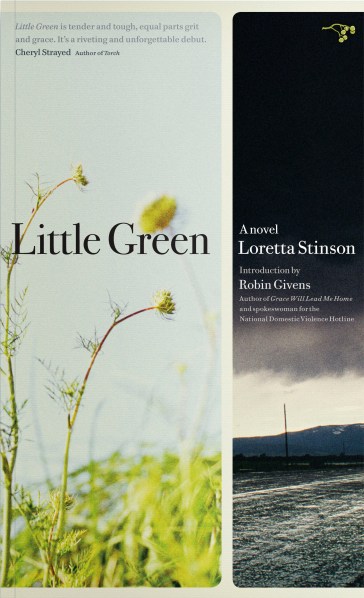
Little Green, Loretta Stinson’s début novel, tells the story of Janie, an orphan who runs away from her stepmother. Life on the road is tough, and Janie has to make money somehow, dancing in strip bars and even bartering for sex when necessary. When she meets a charmer named Paul who is ten years older than her, she feels instantly closer to him–and naturally hits the road again. Hitchhiking is never a good idea though, kids, especially in a loner’s van, and Janie is brutally beaten. She finds herself under the care of the man who owns the last bar she danced at, and in time, under the care of Paul, reiterating one of the novel’s major themes of cyclical violence and female dependence on a man. Paul is a small-time drug dealer whose habits extend beyond weed and acid into heroin and meth. As his drug addiction spirals, he tries to find some control by manipulating Janie; in time, he beats her so terribly that she has to go to the hospital. Janie leaves him but he stalks her wherever she goes, forcing her to find her own strength and self-reliance as the novel reaches its redemptive climax. Paul is probably the most interesting character in Little Green, and although it would be unfair to call Janie a flat character, she spends much of the novel as a victim. In contrast, Paul’s addiction and behaviors are studied with a psychological depth that attempts to understand–without ever rationalizing–his actions. While the novel is hardly sympathetic to him, Stinson resists painting Paul as a static monster; the payoff is a villain far-more frightening because of his authenticity. Authenticity is what keeps Little Green (for the most part) from verging into melodramatic Lifetime movie of the week territory. Stinson’s finely detailed evocation of the Pacific Northwest of the late 1970s explores how attitudes about gender roles, women’s rights, and drugs came to a seething breaking point a decade after the summer of love. Significantly (and sadly), the novel’s depiction of domestic violence reads with a wholly contemporary immediacy. Little Green is new in handsome trade paperback this month from Hawthorne Books, who will donate a portion of sales revenue to the National Domestic Violence Hotline.
Tracy Winn’s debut, Mrs. Somebody Somebody covers over half a century–from Korea to Iraq, in the book’s terms–in the lives of the regular folk of the mining town of Lowell, MA. The book comprises ten stories that can easily stand on their own, but combined together form a novel-in-stories, an evocative portrait of a working-class town under duress. Winn weaves blood lines through generational and political conflicts and re-examines her book’s themes through a variety of perspectives. The result is a layered, detailed reckoning with history and place, class and conflict, drawn in rich, resonant colors. Mrs. Somebody Somebody is new in trade paperback this month from Random House.
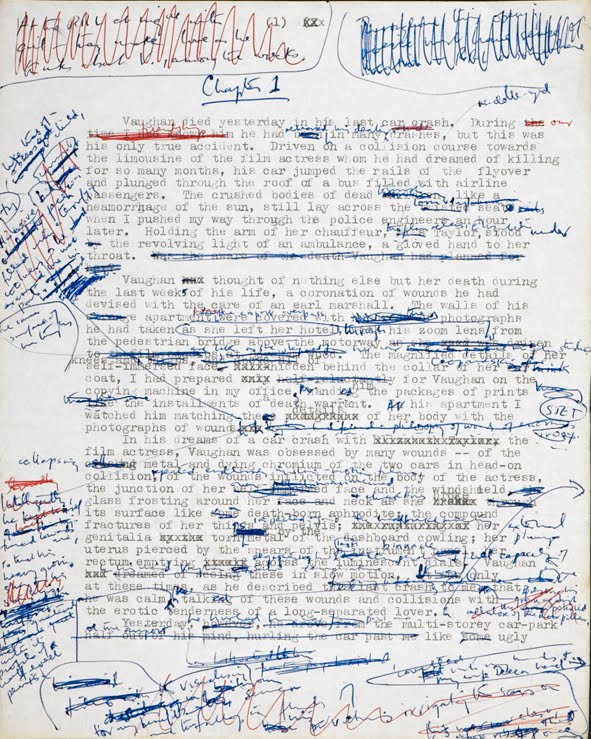
According to a report in yesterday’s Guardian, the British Library has acquired J.G. Ballard’s archival material, including hand-written manuscripts, drafts, letters, and photos. The British Library will make Ballard’s materials fully accessible to the public. From the article:
Ballard was a man of routine and, in the first instance, wrote all his work by hand, once saying he could always tell if a novel had been written on a typewriter (and later computer). One of the highlights of the archive is the far from neatly handwritten first 840-page draft of Empire of the Sun, which is a collage of crossings out, revisions, corrections and additions.
After the first draft Ballard would then type it up and ruthlessly go through it again. The second draft of Crash is in the archive and it is even more crazily corrected. Andrews said: “I think some of those individual pages are works of art. There’s a determination and in some cases a violence.” Also in the archive are notepads with headings such as “topics that interest me”, full of his thoughts and ideas for stories and novels, as well as items relating to the Lunghua internment camp of his childhood.
Photographer Andrew Bush’s instillation Speech Acts combines two photographs of book shelves–one of Jacques Derrida’s and one of John Searle’s. Derrida and Searle rumbled over the primacy of speech vs. writing in the 1970s (read Derrida’s seminal essay “Signature Event Context” for more).
Jacques Derrida's room of his published books in his home in Ris Orange, France, 2001
John Searle's room of his published books in his home in Berkeley, CA, 2000
Barbara King has to forget everything she thought she knew about Rick Steves after reviewing his new bookTravel as a Political Act at Bookslut. Here’s a taste of her review:
The book is an eye-opener. Steves describes himself as a traveler and “a historian, Christian, husband, parent, carnivore, musician, capitalist, minimalist, member of NORML, and a workaholic.” The marijuana habit (I have discovered) has been headlined for a while now; the reveal here is Steves’s brand of forthright liberalism.
Promising not to “take the edge off” his opinions, Steves embraces geopolitical philosophizing “with the knowledge that good people will respectfully disagree with each other.” Speaking of assumptions, that’s a generous one. Given the mood of a large segment of the American public and Steves’s penchant for pointed passages, anyone care to wager how his fan mail is running?
Ahmad Saidullah reviewsKeri Walsh’s compendium The Letters of Sylvia Beachat 3 Quarks Daily. This gives us a chance to plug our own interview with Keri Walsh from last month about the book (See? There’s some original content here after all–even if it’s recycled. Recycling is good, right?)
As part of the new partnership between Salon and McSweeney’s, you can read Nick Hornby’s latest “Stuff I’ve Been Reading” column online. The column has returned to The Believer after a too-long hiatus; it’s easily one of our favorite features in the magazine. It’s also one of the major inspirations for this site.
At The New York Times, Dave Itzkoff uses Kristen Stewart’s reaction shots as a way to review the cultural black hole that was the 2010 MTV Movie Awards. Hilarious.
The habit of list-making can seem arbitrary or absurd, leaving the list-makers endlessly open to second-guessing (although to encourage such second-guessing is perhaps the best reason to make lists). Good writing speaks for itself, and it speaks over time; the best writers at work today are the ones our grandchildren and their grandchildren will read. Yet the lure of the list is deeply ingrained. The Ten Commandments, the twelve disciples, the seven deadly sins, the Fantastic Four—they have the appeal of the countable and the contained, even if we suspect that there may have been other, equally compelling commandments, disciples, sins, and superheroes. What we have tried to do, in selecting the writers featured in this issue, is to offer a focussed look at the talent sprouting and blooming around us.
Finally, here’s one of those celebrated writers, Wells Tower, in an interview at a bar:
The New York Times published a little piece yesterday on the pleasures of finding–and reading–random books in vacation spots. From the article: “There is fate in the moldy, dog-eared paperbacks found on the shelves and bedside tables of summer guest rooms. When the masterpiece we’ve dutifully brought along stalls five pages in, the accidental bounty of other people’s discarded reading beckons. Like conversations with strangers on a train, these random literary encounters can be unsettling, distracting or life changing.” They ask eight authors, including Wells Tower and Dave Eggers about some of their random reading encounters. Here’s Tower on The Bridges of Madison County:
“The Bridges of Madison County,” by Robert James Waller, found in a beach house in Brooklin, Me. Strenuously unrecommended as a novel, but if you strike every third verb and noun it converts into a superb volume of Mad Libs with which to pass idle hours by the sea.
I’ve picked up many weird books over the years, at guest houses, hostels, and other places I was staying: a cheap novelization of old Annie Oakley magazine serials (at a beach condo); H.G. Wells’s A Short History of the World (at a river house); too some mild shame, sundry trashy V.C. Andrews novels (they must have been my older cousin’s); any Stephen King novel I’ve ever read. Probably the best random reading experience I’ve had though was when staying at a friend’s grandfather’s house in Miami. I stayed in his mother’s old room–she had all kinds of cool books, including John Barth’s slim second novelThe End of the Road, which I devoured in one sleepless night. I did not steal it.
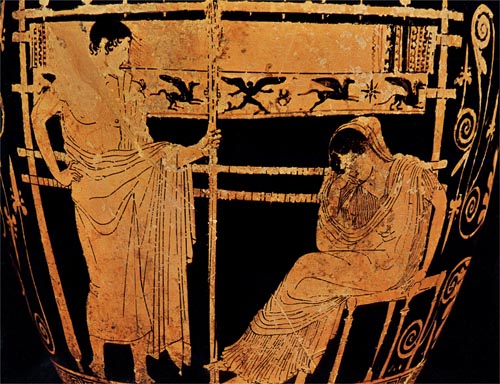
A son is born to The Biblioklept! To celebrate–and, perhaps to respond to last year’s Father’s Day post, Five Favorite Fictional Fathers–I offer five favorite fictional sons. In the earlier post, I suggested that Western literature holds a certain ambivalence toward fatherhood, one that evinces in one of its most ubiquitous tropes–the hero-as-orphan. These orphan-heroes tend to have father-figures, but their biological dads are usually displaced in some way. So, to set some ground rules for the post, I chose heroes whose narratives are still deeply intertwined with their biological parents–particularly their fathers. Yet in the cases below, parental displacement remains.
1. Telemachus, The Odyssey (Homer)
The original angry young man. And who can blame him, what with dad away (having all the fun, tricking gods and monsters and bagging nymphs) and rude would-be step-dads gobbling up all the goods (and, uh, trying to bang your mom to boot). Although the swineherd Eumaeus was probably more of a dad to Telly-Mack than Odysseus was, there’s something touching about the end of The Odyssey, when the pair slaughter the suitors wholesale.
2. Hamlet, Hamlet (William Shakespeare)
Poor, grieving Hamlet–dad departed–a ghost!–revenge me!–uncle usurping dad’s role (and his promised throne (and banging mom to boot))–wait–I think we’ve hit a theme here. This has to be a theme, right? Kids need guidance, and Hamlet has none. No wonder he goes bonkers.
3. Stephen Dedalus, A Portrait of the Artist as a Young Man and Ulysses (James Joyce)
OK, we’ve definitely hit a theme. Through the sympathetic yet often repulsive figure of Stephen Dedalus, Joyce reworked Telemachus and Hamlet (and Icarus and everything else (hang on, shouldn’t Jesus be on this list?)). Bloom gets too much credit as a father figure. Reread Portrait–Simon looms large enough.
4. Quentin Compson, The Sound and the Fury and Absalom, Absalom! (William Faulkner)
The theme is readily conceded. Compson funnels Hamlet’s neuroses and Dedalus’s intellectual acumen through a channel of Southern alienation. Plus, like Stephen, his dad’s a drunk. Like Hamlet, Quentin is ultimately a tragic figure, but he’s nonetheless a hero, a son who attempts to reconcile the traditions of his father’s world against the shifting dimensions of his own time (or something like that).
5. Hal Incandenza, Infinite Jest (David Foster Wallace)
A tennis champ with a secret marijuana addiction (or, more accurately, an addiction to secret behaviors) cursed with an eidetic memory, Prince Hal is easily one of DFW’s finest inventions. And yes, yes, yes, his relationship with dad James (again, a drunk) repeats the drama of Hamlet–right down to the ghost-demands-revenge scene and its usurping uncle (although Charles Tavis ain’t so bad). So, unwittingly, the theme finds its summation in Hal, a kid anyone would be proud to call son.
Because, people love reading lists: The New Yorker reveals their “20 Under 40” list, naming, um, 20 writers who are, like, under 40 years old and, you know, worth reading. Here’s the list, via The New York Times:
They are Chimamanda Ngozi Adichie, 32; Chris Adrian, 39; Daniel Alarcón, 33; David Bezmozgis, 37; Sarah Shun-lien Bynum, 38; Joshua Ferris, 35; Jonathan Safran Foer, 33; Nell Freudenberger, 35; Rivka Galchen, 34; Nicole Krauss, 35; Yiyun Li, 37; Dinaw Mengestu, 31; Philipp Meyer, 36; C. E. Morgan, 33; Téa Obreht, 24; Z Z Packer, 37; Karen Russell, 28; Salvatore Scibona, 35; Gary Shteyngart, 37; and Wells Tower, 37.
Glad to see that Biblioklept faves Wells Tower and Chris Adrian are getting their due.
“Extreme Solitude” — a new story from Jeffrey Eugenides at The New Yorker. Read the whole story here. Here’s an excerpt that might ring true to many an English major:
Madeleine had met Leonard in an upper-level semiotics seminar taught by a renegade from the English department. Michael Zipperstein had arrived at Brown thirty-two years earlier filled with zeal for the New Criticism. He’d inculcated the habits of close reading and biography-free interpretation into three generations of students before taking a Road to Damascus sabbatical, in Paris, in 1975, where he’d met Roland Barthes at a dinner party and been converted, over duck cassoulet, to the new faith. Now Zipperstein taught two courses in the newly created Program in Semiotic Studies: Introduction to Semiotic Theory, in the fall, and, in the spring, Semiotics 211. Hygienically bald, with a seaman’s mustacheless white beard, Zipperstein favored French fisherman’s sweaters and wide-wale corduroys. He buried people with his reading lists: in addition to all the semiotic big hitters––Derrida, Eco, Barthes––the students in Semiotics 211 had to contend with a magpie nest of reserve reading that included everything from Balzac’s “Sarrasine” to issues of Semiotext(e) to xeroxed selections from E. M. Cioran, Robert Walser, Claude Lévi-Strauss, Peter Handke, and Carl Van Vechten. To get into the seminar, you had to submit to a one-on-one interview with Zipperstein during which he asked bland personal questions, such as what your favorite food or dog breed was, and made enigmatic Warholian remarks in response. This esoteric probing, along with Zipperstein’s guru’s dome and beard, gave his students a sense that they’d been spiritually vetted and were now—for two hours Wednesday afternoons, at least––part of a campus lit-crit élite.
Almost overnight it became laughable to read writers like Cheever or Updike, who wrote about the suburbia Madeleine and most of her friends had grown up in, in favor of reading the Marquis de Sade, who wrote about anally deflowering virgins in eighteenth-century France. Madeleine had become an English major for the purest and dullest of reasons: because she loved to read. The university’s “British and American Literature Course Catalogue” was, for Madeleine, what its Bergdorf equivalent was for her roommates. A course listing like “English 274: Lyly’s Euphues” excited Madeleine the way a pair of Fiorucci cowboy boots did Abby. “English 450A: Hawthorne and James” filled Madeleine with an expectation of sinful hours in bed that was not unlike the sensation Olivia got from wearing a Lycra skirt and leather blazer to Danceteria. Right up through her third year of college, Madeleine had kept wholesomely taking courses like “Victorian Fantasy: From ‘Phantastes’ to ‘The Water-Babies,’ ” but by senior year she could no longer ignore the contrast between the blinky people in her Beowulf seminar and the hipsters down the hall reading Maurice Blanchot. Going to college in the moneymaking eighties lacked a certain radicalism. Semiotics was the first thing that smacked of revolution. It drew a line; it created an elect; it was sophisticated and Continental; it dealt with provocative subjects, with torture, sadism, hermaphroditism––with sex and power.
Sam Lipsyte read live from his new novel The Ask last night at HTML GIANT’s Ustream channel. The reading was cool but the best part was the q&a session afterward. We asked Lipsyte the one question all true biblioklepts are dying to know (and the one question we ask every person we interview): “Have you ever stolen a book?”
Vodpod videos no longer available.
Here’s Lipsyte’s response, which you can hear/see at 31:25 in the video:
‘Have you ever stolen a book?’ There was one time when I stole a few books when I worked in a library; it was a university library and my job was to stick the metal strips into the spines of the books that would set off the alarm. And so if a particularly good book came through (and this only happened three or four times) I just wouldn’t–I don’t know if I’d call it stealing–but I wouldn’t put the strip in. And then once it was shelved I would take it.
That’s a pretty sophisticated operation. Kudos to Lipsyte for his candor.
In the spirit of making my headline redundant: Sam Lipsyte will read from his new novel The Ask at HTML GIANT at 9pm EST tonight (id est, 5.27.2010). Lipsyte will read via streaming video and a live chat q&a is planned to follow, so huddle around the warm glow of your monitors with your dearest loved ones for some good ole fashioned acerbic catharsis.
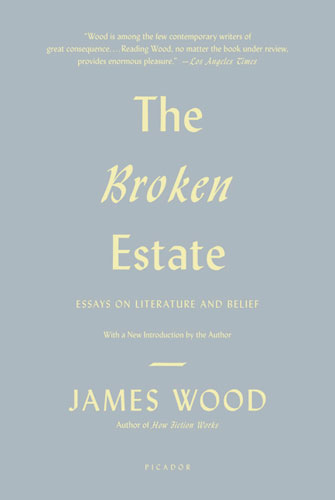
In his essay “Shakespeare in Bloom,” critic James Wood performs one of the strangest, most backhanded (and yet earnest) defenses I’ve ever read of Harold Bloom‘s aesthetic reaction to (what Bloom has called) “The School of Resentment” — deconstruction, Marxism, gender and queer theory, postcolonial theory, all that good stuff. Wood comes out strong, arguing, that in his prolific output, Bloom “has kidnapped the whole of the English literature and has been releasing his hostages, one by one, over a lifetime, on his own spirited terms.” Wood suggests that “this ceaselessness has produced some hurried, fantastical, and repetitive work,” before going on to throw around words like “garrulous” and “shallow.” Wood then takes Bloom to task over his famous (and improbable) claim that “Shakespeare invented us,” situating the claim against Bloom’s own most famous theory, the anxiety of influence. Wood says–
In truth, Bloom’s word invention is an enthusiastic Wildean necessary exaggeration. It is Bloom’s way of registering our almost religious sense that we live in Shakespeare’s shadow and that he does not simply represent human beings but brings new life, more life, into the world. . . . Bloom’s determination to honor Shakespeare’s godly primacy is a kind of secular theology.
The second section of Wood’s essay should be required reading for all English majors (or anyone serious about literary criticism). Here, Wood provides a wonderfully succinct overview of the history of literary criticism, connecting Freudian analysis and the New Critics to the various theories that Bloom would come to call the “The School of Resentment.” As we bring up the term again, we should note that we consider it a bit pejorative and utterly reactionary, and, to borrow from (and perhaps misapply) Wood, shallow. Wood points out that “Deconstruction brings a generalized suspicion to bear on language and in particular on metaphor (or ‘rhetoric’), which it suspects of hiding something–namely, its own metaphoricity.” In short, literature always metaphorizes, and thus hides, some other impulse, one always politicized. Wood continues: “Political criticism, including cultural materialism, converts Freud’s analytical suspicions into political ones. . . . The poem is read as if it were covering something up, as if it were an alibi that is rather too fluent to be entirely trusted.” It must be interrogated to reveal its secret, the secret prejudices of its age. Wood continues, after a page or two–
This is a long way around to Bloom, but it may explain the venom and desperation of his attacks. For although deconstruction did not intend to, it has produced mutant modes of reading that, when combined with leftish political guilt or ressentiment, seem to threaten the existence of literature as a discipline.
Wood espouses some common sense here uncommon in literary criticism, taking a long view that recognizes–and attempts to step outside of–the fact that it’s not all academic when it comes to how we read our books. History and politics matter, but so does our passion, our love for our books (as silly as that may sound). He defends Bloom’s work even as he calls it an overreaction. He credits deconstruction as having “produced some brilliance and many distinguished readings (no one could deny the acuities of Derrida, of Paul de Man, of Barbara Johnson).” Wood’s essay “Shakespeare in Bloom” is the kind of thing that students and aspiring critics alike should read before they feel the need to draw arms. You can read it in the second printing (the first in a decade) of Wood’s essay collection The Broken Estate, which debuts in June, 2010 from Picador.
Keri Walsh’s new book The Letters of Sylvia Beach sheds light on one of modern literature’s most fascinating figures. Sylvia Beach was the nexus point for the ex-pat/Lost Generation/Modernist scene in the first half of the twentieth century. Along with her partner Adrienne Monnier, Beach ran the Left Bank bookstore Shakespeare & Company until the Nazi occupation of Paris in 1941. She was the first publisher of Joyce’s Ulysses, she translated Paul Valéry into English, and she was close friends to a good many great writers, including William Carlos Williams, Ezra Pound, H.D., and Ernest Hemingway. Walsh’s book compiles Beach’s letters, revealing a woman who cared deeply about literature and art, who was funny and sincere, and who loved her famous (and not so famous) friends dearly. Over a series of emails, we talked to Dr. Walsh about The Letters of Sylvia Beach, which is out now from Columbia UP. Keri Walsh teachers 20th Century British and Irish Literature at Claremont McKenna College in Los Angeles.
Biblioklept: How did you get interested in Sylvia Beach?
Keri Walsh: I got interested in Sylvia Beach in the same way that many English-speaking visitors to Paris do: when I stumbled upon the Shakespeare and Company bookstore in Paris. Of course, the current bookstore is its own entity: it’s not the direct descendant of Beach’s. It was founded after the Second World War by George Whitman, and it’s been there so long that it’s now legendary in its own right. Today it’s run by Whitman’s daughter, Sylvia Beach Whitman. The shop preserves many of the qualities of Beach’s original: the whimsicality, the friendliness, the sense of being a gathering place for expats. So it was easy to fall in love with it and to want to learn more about its origins.
Sylvia Beach grew up in Princeton, New Jersey. Beach’s father was minister of the Presbyterian Church just up the street from the university campus. I didn’t know that when I began my Ph.D. studies in the English department there. I was delighted to learn that Firestone library, where I worked every day, owned a vast collection of Sylvia Beach’s letters, photographs, books, and belongings. They even had the original “Shakespeare and Company” sign that had hung in front of her store. I started to read through her letters, beginning with the ones she wrote as a teenager. Even then she was always reading. I was charmed by how funny she was, and how resourceful. She could talk her friends into just about anything– including smuggling illegal copies of Ulysses into the United States.
Her correspondents were so illustrious that I was surprised to learn that her letters had never been published. Because she wrote to Gertrude Stein, Ernest Hemingway, H.D. and others, I hoped that this volume might make a contribution to the study of modernist literary culture. But I also wanted to share Beach’s story for its own sake, because she was so fascinating and endearing. I had a hunch that there would be other readers like me who wanted to know more about Beach, and about the sensibility that informed Shakespeare and Company. I thought about all the people who love modernist Paris and independent bookstores. Beach is a kindred spirit for bookworms, expatriates, bohemians, bluestockings, francophiles and salonnieres of all stripes.
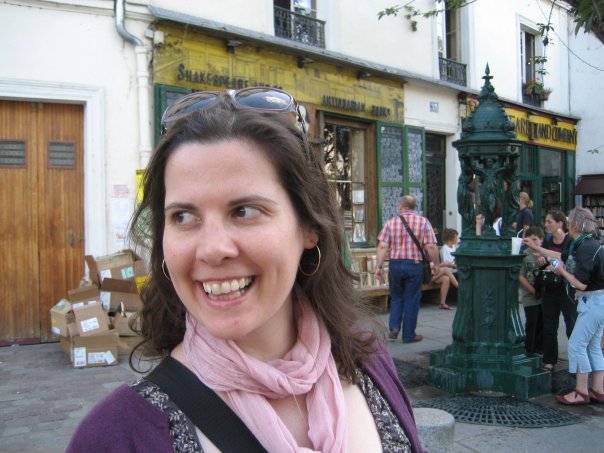
Keri Walsh at Shakespeare and Company, Paris
B: You mention Sylvia Beach Whitman. I’ve read that she’s an ancestor of Walt Whitman–is that true?
KW: About Sylvia Beach Whitman and the Whitman connection– I don’t know. But I do know that the original Sylvia Beach had a Whitman connection, and she was proud of it. An aunt of hers had visited Whitman and asked permission to dig some manuscripts out of his trash bin. Sylvia had these on display in her shop. She writes in her memoir of “several little manuscripts of Walt Whitman scribbled on the backs of letters. These were the gift of the poet to my Aunt Agnes Orbison. Aunt Agnes, when she was a student at Bryn Mawr, had gone with her friend Alys Smith to Camden to visit Walt Whitman . . ..Manuscripts were strewn all over the floor, and some of them . . . were in the waste-paper basket. She got up the courage to draw out a few of these scribblings, mostly on the backs of letters addressed to Walt Whitman, Esq., and asked if she might keep them. “Certainly, my dear,” he replied. And that’s how our family got its Whitman manuscripts” (20).
B: Can you tell us a bit about Beach’s involvement in smuggling copies of Ulysses into the States?
KW: As for the smuggling of Ulysses, Beach tells us in her memoir Shakespeare and Company that some of Hemingway’s friends in Toronto smuggled copies to the Ulysses subscribers underneath their clothes. The original edition of Ulysses was paid for by subscribers in advance, so when Ulysses was banned in the US, it wasn’t a matter of getting copies into bookstores, it was a matter of getting them to the people who’d already bought them. Beach’s letters show us that she relied on her old friend Marion Peter to do some of the smuggling, receiving the books in non-descript looking parcels and forwarding them on to the subscribers in America. “You were such an angel to take all that trouble bootlegging for me!” she wrote to Marion Peter in 1923, a characteristically Sylvia-esque joke at the height of Prohibition to her eminently respectable friend.
B: In Beach’s letters, she comes across as both a friend and a fan to many of the authors to whom she writes. At times, there seems to be a tension there–there’s a late letter to Ezra Pound (#188), for example, where she seems almost ironically deferential; there’s a letter to Hemingway (#211) where she apologizes ahead of time for early “references to [his] domestic life” in her memoir Shakespeare and Company that “should be deleted.” How important was Beach to these writers, and how important were they to her? What was the response to her memoir?
KW: It must have been hard to know what to say to Pound in the years after the Second World War. His politics during the conflict had been abominable, and his mental health was precarious to say the least. Beach was a tactful person who disliked turning her back on anyone, so I think she struck a compromise, holding Pound at a distance but remaining polite. Beginning in the early 1930s her letters register her discomfort with his attraction to Italian fascism. In 1931 Beach wrote to Hemingway that “Ezra Pound is making us a visit, and an Italian tried to stick a stiletto into him during a soiree given in his honor at the Brasserie de l’Odeon. I think people should control themselves better” (134-5). You’re right to pick up on that ironic deference in the later letters. Perhaps it was her way of “handling” Pound: “Do tell me what the “factual error” was in my piece. Not the color of your shirt, I hope. I could swear it was blue. But I know how inaccurate I am. Adrienne is in despair over it” (214).
Her relationships varied, but as a general pattern her relationships with women like Bryher, H.D., and Adrienne Monnier were deep and mutual. One gets the sense that Joyce was more important to her than she was to him. Beach and Hemingway were genuine kindred spirits in the 1920s, and they retained a fond regard for each other throughout their lives. I think that by the 1950s Beach felt less certain about her friendship with Hemingway, wondering whether this cultural icon and Nobel Prize-winning writer still had time for her. But it was a gesture of thoughtfulness on her part to write to him wondering how much of his private story she could share in her memoir. And he responded with implicit trust in her judgment, telling her that anything she wrote would be OK.
One of my favorite Hemingway moments to come out of the Sylvia Beach archives nicely demonstrates their mutual understanding. Beach recorded on Hemingway’s Shakespeare and Company bill of 1934 that “Hemingway read Wyndham Lewis’s article ‘The Dumb Ox in Life and Letters’ and punched a vase of tulips on the table. Paid SB 1500 fr damages. SB returned 500 fr.” (“The Dumb Ox” was, of course, Lewis’s famously unflattering study of Hemingway’s writing).
B: You mention that “One gets the sense that Joyce was more important to her than she was to him.” There’s a letter published in the volume that Beach never actually sent to Joyce that is extremely angry and shows that, at least to some extent, she felt hurt by Joyce’s treatment of her–that she felt used. The letter also reveals the economic difficulties faced by writers and publishers alike, and perhaps hints that Joyce was more mercenary than he would have liked his public to know. To what extent was Beach merely a bank to Joyce?
KW: That letter is remarkable, isn’t it, because it shows the deep resentment Beach eventually felt toward Joyce. But more characteristically, especially in the early 1920s when they were working together on the publication of Ulysses, Beach was indulgent about the privileges of genius. To an extent that amazes me, she welcomed his incursions on her goodwill. She loved his writing, and she made a conscious decision to serve him and his art. This attitude was probably integral to her success. A less devoted, tenacious, and flexible person would simply not have been able to get Ulysses into print. But their intense and one-sided relationship proved unsustainable as his needs escalated and her resources diminished during the Depression.
Beach wasn’t the only one who put Joyce ahead of her own needs: Harriet Weaver, Paul Léon, Samuel Beckett, and Eugene Jolas were similarly devoted. Now, ideally, Joyce would have repaid these personal debts with magnanimity and grace. Sometimes he did. And sometimes he didn’t. In her recent piece on Beach’s letters in the London Times, Jeanette Winterson expresses the frustration that Beach admirers often feel:
“Joyce’s gigantic ego nearly ruined her. He took her cash, let her take all the risks on his (at the time) unpublishable book, and later reneged on the letter and the spirit of their agreements, simply reselling to Random House when he was famous enough to do so.”
But whatever his weaknesses of character, we have to remember that Beach indulged them. She was moved by Joyce’s work ethic in spite of his wretched health, the fact that he was terribly short of funds, and that he always seemed overmatched by circumstance. Her letters give us a glimpse into the sufferings he endured with his eye surgeries, for instance, and it’s harrowing reading. No, they never patched things up, but Beach remained loyal to Joyce’s family after his death, and she was a careful guardian of his legacy.
B: Beach lived with her partner Adrienne Monnier for years. To what extent were they “out” among Paris society, their literary friends, and their family?
KW: Most people who knew them accepted Beach and Monnier as a couple. Paris in the 1920s was tolerant of alternative lifestyles. As George Orwell put it in “Inside the Whale,” “for a time, the populace had grown so hardened to artists that gruff-voiced lesbians in corduroy breeches and young men in Grecian or medieval costume could walk the streets without attracting a glance.”
Beach was considered a member of the Monnier family and spent weekends and summers at Monnier’s parents’ home in Rocfoin. In Women of the Left Bank, Shari Benstock offers an insightful analysis of their relationship. She notes that Beach and Monnier’s relationship differed from Gertude Stein and Alice Toklas’s in its mutuality, and in its refusal of butch/femme roles or the model of heterosexual marriage. “Perhaps because both partners were strong feminists,” says Benstock, their relationship was characterized by: “an egalitarianism unusual in either homosexual or heterosexual relationships of the period. It was not marked by self-destructive behavior, neither was it given to self-indulgence. Indeed, this union might well serve as an alternative model to the more popular view of Paris lesbian experience… (210-211).”
Of course, then, as now, intolerance could rear its head at any time. I came across one patently homophobic response to Beach and Monnier’s relationship. It came from William Carlos Williams’ Autobiography. He wrote of Monnier: “She enjoyed the thought, she said, of pigs screaming as they were being slaughtered, a contempt for the animal—a woman toward whom it was strange to see the mannishly dressed Sylvia so violently drawn” (93). I think he misunderstood Monnier’s sense of humor, and the fun she had shocking the sensibilities of Americans.
B: Have you ever stolen a book?
KW: Hmm . . . does picking up novels left behind on planes count?
This isn’t a theft, but it did feel like a piece of good luck: while editing Beach’s letters, I wanted a copy of her translation of Henri Michaux’s A Barbarian in Asia. I ordered one though a second-hand bookstore online, and when it arrived, I found that it was inscribed with the name of Sylvia Beach’s Ulysses-bootlegger friend Marion Peter. It was the copy Beach had sent to her as a gift when it came out in 1949.

 New York’s WBAI
 In This Is Where We Live, Janelle Brown’s follow-up to her 2008 début All We Ever Wanted Was Everything, an artsy newly wed couple find their dreams and their marriage unraveling when the payments on their adjustable rate mortgage suddenly double. Claudia and Jeremy are happy at the novel’s outset, living comfortably in their Los Angeles bungalow. Her film Spare Parts garners a huge buzz at Sundance and he reforms a new band after the breakup of his old group The Invisible Spot; they envision their new neighborhood as a contemporary counterpart to the Laurel Canyon creative scene of the 1960s. But then their ARM adjusts and Spare Parts flops. Claudia has to take a job teaching (Gasp! Oh, the terror! In a particularly funny scene, she shows The Graduate to her film students and one of them raises her hand to declare that her father was one of the film’s executive producers). The couple soon has to take in a roommate. Complicating matters even more is the return of Aoki, Jeremy’s unstable–and now famous–ex-girlfriend, who manipulates him every chance she gets. Aoki, a cartoonishly unhinged avant-gardiste, serves as a foil to the more grounded figure of Claudia; as Claudia begins to mature into a more pragmatic, adult personality, Aoki’s siren song calls Jeremy to return to chaos. This Is Where We Live is timely, of course, and Brown takes pains to show how these two “creatives” could overlook such meaningful financial details when looking to buy a home. Some will find Brown’s sympathetic vision of the privileged L.A. art scene off-putting or even shallow, but the novel’s core exploration of a troubled young marriage will resonate with many readers. This Is Where We Live is available in hardback from
  Little Green, Loretta Stinson’s début novel, tells the story of Janie, an orphan who runs away from her stepmother. Life on the road is tough, and Janie has to make money somehow, dancing in strip bars and even bartering for sex when necessary. When she meets a charmer named Paul who is ten years older than her, she feels instantly closer to him–and naturally hits the road again. Hitchhiking is never a good idea though, kids, especially in a loner’s van, and Janie is brutally beaten. She finds herself under the care of the man who owns the last bar she danced at, and in time, under the care of Paul, reiterating one of the novel’s major themes of cyclical violence and female dependence on a man. Paul is a small-time drug dealer whose habits extend beyond weed and acid into heroin and meth. As his drug addiction spirals, he tries to find some control by manipulating Janie; in time, he beats her so terribly that she has to go to the hospital. Janie leaves him but he stalks her wherever she goes, forcing her to find her own strength and self-reliance as the novel reaches its redemptive climax. Paul is probably the most interesting character in Little Green, and although it would be unfair to call Janie a flat character, she spends much of the novel as a victim. In contrast, Paul’s addiction and behaviors are studied with a psychological depth that attempts to understand–without ever rationalizing–his actions. While the novel is hardly sympathetic to him, Stinson resists painting Paul as a static monster; the payoff is a villain far-more frightening because of his authenticity. Authenticity is what keeps Little Green (for the most part) from verging into melodramatic Lifetime movie of the week territory. Stinson’s finely detailed evocation of the Pacific Northwest
  of the late 1970s explores how attitudes about gender roles, women’s rights, and drugs came to a seething breaking point a decade after the summer of love. Significantly (and sadly), the novel’s depiction of domestic violence reads with a wholly contemporary immediacy. Little Green is new in handsome trade paperback this month from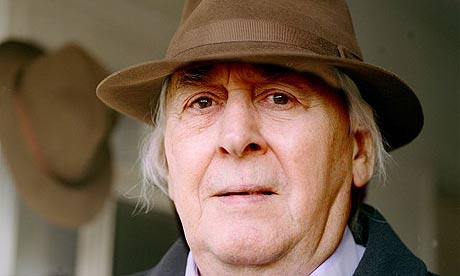



 In his essay “Shakespeare in Bloom,” critic James Wood performs one of the strangest, most backhanded (and yet earnest) defenses I’ve ever read of Harold Bloom‘s aesthetic reaction to (what Bloom has called) “The School of Resentment” — deconstruction, Marxism, gender and queer theory, postcolonial theory, all that good stuff. Wood comes out strong, arguing, that in his prolific output, Bloom “has kidnapped the whole of the English literature and has been releasing his hostages, one by one, over a lifetime, on his own spirited terms.” Wood suggests that “this ceaselessness has produced some hurried, fantastical, and repetitive work,” before going on to throw around words like “garrulous” and “shallow.” Wood then takes Bloom to task over his famous (and improbable) claim that “Shakespeare invented us,” situating the claim against Bloom’s own most famous theory, the anxiety of influence. Wood says–
 As we bring up the term again, we should note that we consider it a bit pejorative and utterly reactionary, and, to borrow from (and perhaps misapply) Wood, shallow. Wood points out that “Deconstruction brings a generalized suspicion to bear on language and in particular on metaphor (or ‘rhetoric’), which it suspects of hiding something–namely, its own metaphoricity.” In short, literature always metaphorizes, and thus hides, some other impulse, one always politicized. Wood continues: “Political criticism, including cultural materialism, converts Freud’s analytical suspicions into political ones. . . . The poem is read as if it were covering something up, as if it were an alibi that is rather too fluent to be entirely trusted.” It must be interrogated to reveal its secret, the secret prejudices of its age. Wood continues, after a page or two–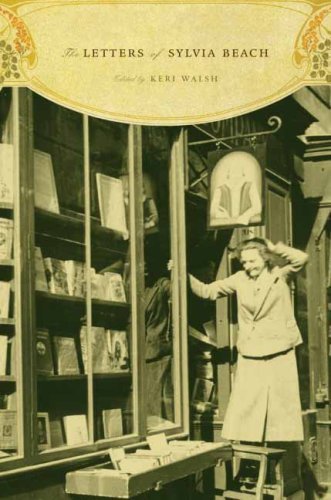
 Biblioklept