“On Getting Started” — John Steinbeck Shares Writing Tips

From John Steinbeck’s 1969 “interview” in The Paris Review (the piece reads more like a series of short writings than a conventional interview):

ON GETTING STARTED

It is usual that the moment you write for publication—I mean one of course—one stiffens in exactly the same way one does when one is being photographed. The simplest way to overcome this is to write it to someone, like me. Write it as a letter aimed at one person. This removes the vague terror of addressing the large and faceless audience and it also, you will find, will give a sense of freedom and a lack of self-consciousness.

Now let me give you the benefit of my experience in facing 400 pages of blank stock—the appalling stuff that must be filled. I know that no one really wants the benefit of anyone’s experience which is probably why it is so freely offered. But the following are some of the things I have had to do to keep from going nuts.

1. Abandon the idea that you are ever going to finish. Lose track of the 400 pages and write just one page for each day, it helps. Then when it gets finished, you are always surprised.

2. Write freely and as rapidly as possible and throw the whole thing on paper. Never correct or rewrite until the whole thing is down. Rewrite in process is usually found to be an excuse for not going on. It also interferes with flow and rhythm which can only come from a kind of unconscious association with the material.

3. Forget your generalized audience. In the first place, the nameless, faceless audience will scare you to death and in the second place, unlike the theater, it doesn’t exist. In writing, your audience is one single reader. I have found that sometimes it helps to pick out one person—a real person you know, or an imagined person and write to that one.

4. If a scene or a section gets the better of you and you still think you want it—bypass it and go on. When you have finished the whole you can come back to it and then you may find that the reason it gave trouble is because it didn’t belong there.

5. Beware of a scene that becomes too dear to you, dearer than the rest. It will usually be found that it is out of drawing.

6. If you are using dialogue—say it aloud as you write it. Only then will it have the sound of speech.

Harry Crews on Writing (Video)

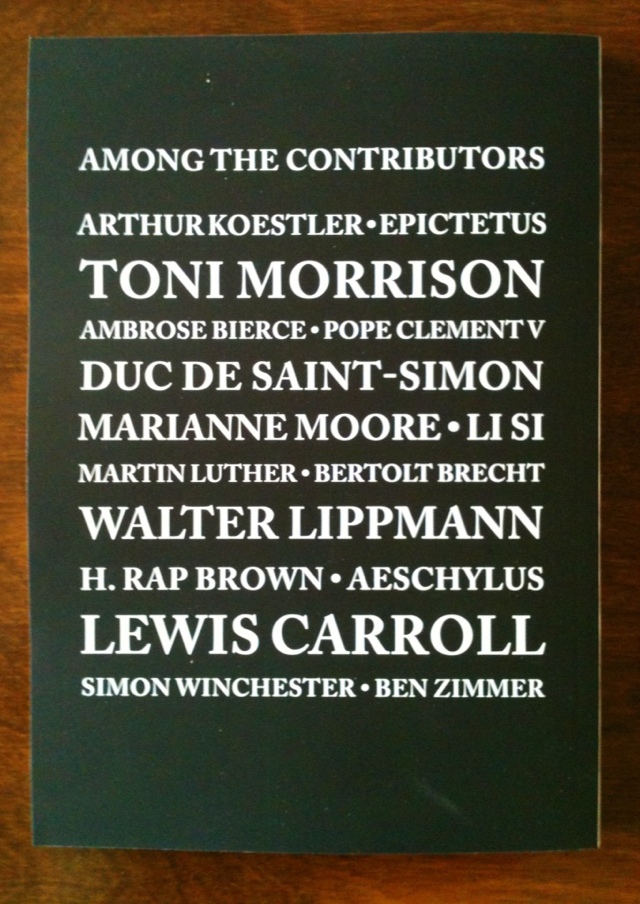
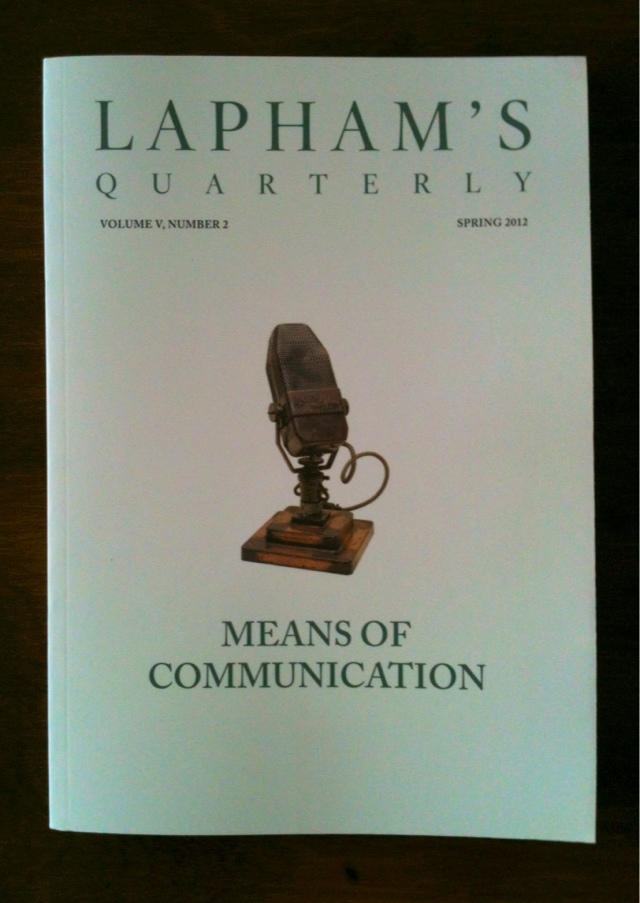
Book Acquired, 3.14.2012 (Lapham’s Quarterly, Spring 2012)

20120317-165618.jpg

20120317-165625.jpg

(Yes, I am enjoying my subscription).

I Review House of Holes, Nicholson Baker’s Ovidian Raunchfest

In his Paris Review interviewNicholson Baker says that “one of the questions House of Holes is trying to answer” is: is “there still a point to writing words about sex when you can see anything you want, and a lot of things you don’t want to see, on the Web?” The book answers a goofy, gooey, bright-hearted “yes” to this question, unfolding its pornographic vignettes in a surreal Ovidian holiday, a midsummer’s night sexfest that sails lusty and smiling over the borders of morality, social convention, and plain old biology. Baker creates an organic, oozing world where genitalia is swapped freely between lovers, where one might exchange an arm for a bigger dick, where old tattoos get fucked away, where a woman and a tree can make sweet, sweet love:

She looked out from her high-splayed vantage and she said, “I’m a treefucking woman!” Dappled sunlight shone and emptied itself onto her. She squeezed her Kegeling love muscle around the smooth, thickened branch within, and when the wind came up again all the leaves twittered and shook. The tree itself shuddered: It was having some kind of orgasm.

If it seems like I’m getting ahead of myself, citing text before outlining plot, I assure you I’m not: There really isn’t much of a plot to House of Holes. Well, if there is one, it’s something like this: Lila, a large-breasted madame runs The House of Holes, an equal-opportunity brothel/fantasy factory that can only be accessed through portals that appear in strange spaces. This pornographic Arcadia operates on slippery wet-dream logic in which strangers cheerfully and eagerly engage in all sorts of raunch. Characters of varying physical attributes screw their way through a surreal holiday. There are a few conflicts, most of which are too light to touch on (this is a light book, for sure).

Two conflicts stand out with some (slight) weight though:

First, there’s the Pornmonster, “a personification of polymorphousness unlike anything the world of human suck-fuckery has ever known.” The Pornmonster is the mutant offspring of all the bad porn slurry collected on a pornsucking mission (don’t ask). The Pornmonster is typical of Baker’s tone throughout House of Holes, and its polymorphousness embodies the book’s depictions of sexual metamorphoses. This monster is tamed through playful, loving lust, and becomes a good guy, its raw sexual energy redirected for the forces of good (i.e., good sex). This is a book full of good guys.

Second, there’s the Pearloiner, an embittered, sexually-jealous TSA agent who steals clitorises (two of our heroines are afflicted by this heinous crime). The Pearloiner is a product of post-Homeland Security draconian measures, and her inclusion is about as close to contemporary culture criticism that House of Holes approaches. Sexy fun times interest Baker more.

Like the Pornmonster, the Pearloiner finds herself redeemed at the end of the book; moral shifts of allegiance are as easy as physical transformations in House of Holes. The Pearloiner and the Pornmonster alike atone their sins with a facile simplicity that fits the ludic silliness of Baker’s book. They are invited to participate in the handjob contest that (quite literally) climaxes the book. It’s an easy, orgasmic end to an easy, orgasmic book.

In some ways, House of Holes is more remarkable for what it’s not. Most of the so-called pornographic literature (or literature of pornography, if you prefer) that I’ve read has a darker streak. (I’m thinking of Anaïs Nin, Henry Miller, de Sade,The Story of O, Alan Moore’s The Lost Girls, etc.). Holes shares Willliam Burroughs’s sense of surreal transmogrification and picaresque rambling and J.G. Ballard’s infatuation with the bizarre intersections of sex and technology, but it’s never sinister or cruel, or honestly, even disturbing.

House of Holes is a fundamentally good-natured book,” suggests Baker in his Paris Review interview, also pointing out that it’s a work of “crazy joy”—and he’s absolutely right: The book is joyous, good-natured, affable even. When Baker approaches a remotely Sadean cuckold fantasy he punctures it with a politeness that’s humorous—but he also dramatically lowers any stakes that may have been in play. In short, this is a novel of pure fun, of infinite gain and no loss (quite literally—Lose an arm? Get it back. Lose a clit? Get it back). Holes is silky and slippery and light, more ephemeral than ethereal in the end.

But shame on me. I seem to be faulting the book for not doing something it never sets out to do (namely, I seem to be faulting Holes for a lack of depravity and depth and darkness, three “d’s” the book’s rubric never sets out to register). It’s pure fantasy stuff, reminiscent of the partner-swapping exercise A Midsummer Night’s Dream (I am not saying Baker is Shakespeare) or the erotic shifts in Metamorphoses (ditto: Baker is no Ovid) or the voluptuous Victorian serial The Pearl: dreamy, and perhaps (small r) romantic, but not turbulent—sure, Holes will ruffle unwitting feathers (let’s be clear, it’s pointedly sexually graphic), but it’s unlikely to damage anyone’s soul. (If you’re worried about soul-damage, check out the editorial style-sheet for Holes, which lays out Baker’s invented porn-lexicon).

Is House of Holes a novel or a flimsy pornographic riff? Baker is less interested in ideas than he is in sensations, or rather representations of sensations (which is the most literature can do anyway, I suppose). Holes is unwilling to offer any answers or explications about the deep mysteries behind human desire, but it does pose questions about those desires, and it poses those questions with shameless glee. A fun, breezy read.

Sam Shepard Talks About Working with Terrence Malick on Days of Heaven

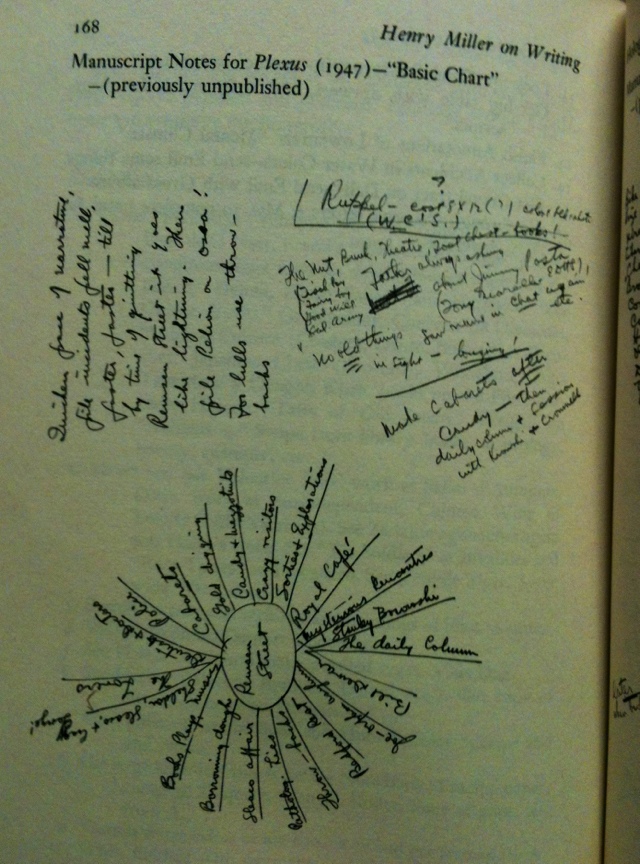
Henry Miller’s Basic Chart of Plexus

20120125-160448.jpg

(From Henry Miller on Writing, New Directions).

Gertrude Stein Next to Her Portrait (Portrait by Picasso; Photo by Man Ray; Commentary by David Markson)

In The Last NovelDavid Markson offers the following citations re: Picasso, Stein, Man Ray (citations not in Markson’s (anti-)order):

Gertrude Stein once delighted Picasso by reporting that a collector had been dumbfounded, years afterward, to hear that Picasso had given her her portrait as a gift, rather than asking payment.

Not understanding that that early in Picasso’s career, the difference had been next to negligible.

Among the many paintings in her Paris flat, Gertrude Stein had two exceptional Picassos.

If there were a fire, and I could save only one picture, it would be those two. Unquote.

Picasso. Cézanne. Matisse. Braque. Bonnard. Renoir.

All of whom painted portraits of Ambroise Vollard.

Cartier-Bresson. Brassaï. Man Ray. Lee Miller. Robert Doisneau. Robert Capa. David Douglas Duncan. Cecil Beaton.

All of whom photographed Picasso.

“A Book Lives as Long as It Is Unfathomed” — D.H. Lawrence on Reading

D.H. Lawrence in his long essay Apocalypse:

Now a book lives as long as it is unfathomed. Once it is fathomed, it dies at once. It is an amazing thing, how utterly different a book will be, if I read it again after five years. Some books gain immensely, they are a new thing. They are so astonishingly different, they make a man question his own identity. Again, other books lose immensely. I read War and Peace once more, and was amazed to find how little it moved me, I was almost aghast to think of the raptures I had once felt, and now felt no more.

“Words Ruin One’s Thoughts” — William Gaddis Quotes Thomas Bernhard

Late in his life, William Gaddis became a big fan of Thomas Bernhard who he quoted at length in a letter he sent to critic Gregory Comnes (that’s Gaddis’s handwriting). Via/more.

Biblioklept Talks to Daniel Nayeri About Capturing Voice, Being a YA Gatekeeper, and Writing His Novella Quartet on an iPhone

Daniel Nayeri was born in Iran and spent a couple of years as a refugee before immigrating to Oklahoma at age eight with his family. He is the author of Straw House, Wood House, Brick House, Blow, a collection of four novellas; Kirkus called it, “Provocative and deeply satisfying,” Bookpage named it “a delightful amalgam of the high and the low, the silly and the sublime,”and the BCCB mentioned the “breathtakingly vivid word smithery” in its starred review.

In addition to his writing, Daniel is an editor of picture books, novels, and graphic novels at Houghton Mifflin Harcourt, an accomplished filmmaker, and a professional pastry chef.

Daniel was kind enough to talk to us about his work via email.

Biblioklept: Your book was composed entirely on an iPhone. Can you tell us a bit about that process? How did you start? How intentional was the process in the beginning? Did you use a specific program? Did you edit on the iPhone at all?

Daniel Nayeri: Several years ago, I was reading an article about the “cell phone novel” phenomenon in Japan. The tone of the article was basically, “check out this super popular thing in Japan that all the literary folks hate.” It described the authors as these quiet teen girls, and early-twenty-something women, who would dash off a few chapters on the subway and email them to a website service. The authors didn’t do themselves any favors by saying they disliked reading “real” books, and the critics didn’t do themselves any favors by flipping out and wondering out loud if this trend meant the “death of the author.”

For me, the fascinating tidbit came from a few comments that noted the possible effects of writing on a cell phone. Every undergrad discusses the interplay of form and content (Dickens’s serialized form, the oral iterations of the Iliad, etc). I got really excited about forcing my imagination to live in an incredibly small space. The Japanese authors discussed that when they moved to computers, their vocabulary became “richer” and their “sentences have also grown longer.” I wanted to see if I could push those boundaries out a little (maybe I’m the crazy person who tries to paint the Mona Lisa on an Etch-a-Sketch).

As for the program I used. I bought the first-gen iPhone, so I was using the notepad app that comes with the phone (without cut and paste). To edit, I got very tired of deleting sentences and retyping them three pages down, so I created a code system. For example, if I wanted to move a paragraph up by two pages, I would bracket off the section I wanted and place a symbol next to it. Then I would go up two pages and just place the same symbol. By the end of my editing, there would be pages of work that were nothing but symbols, connected with various prepositions.

Biblioklept: Did you always have the idea to write a quartet of novellas over different genres? How did the idea come about?

DN: I think in general, novels have gotten fatter. As an editor, my first pass on nearly every manuscript is to ask for major cuts. I’m actually kind of petulant about it. My position is that if a book isn’t going to be as good as Anna Karenina, then it probably shouldn’t be as long.

It’s a reactionary position to take, so I thought I would challenge myself with telling stories and building worlds as large and as complex as I could possibly make them, with the limitation of 35-45 thousand words. Obviously, I sort of cheated by connecting some of my thoughts and themes in a collection of four. Hypocrisy and petulance—that’s the sort of delightful company you’ll get if you find yourself working with me.

(Another reason was that I’m still young, and I’d like to learn a lot more before I start demanding the attention of readers for five hundred pages at a time).

Biblioklept: What challenges did you face when working in the variety of genres you worked in?

DN: Presenting four very different voices (to whatever extent one might think it succeeded) is the aspect of this project I am most proud of, actually. The nicest thing anyone has said about the book so far has been to say it is, “the literary equivalent of a singer with a four-octave range.”

To me, it represents the ability to assimilate—a quality any first-generation immigrant valorizes at one point or another. When I first came to the states, I quickly took up the Texas/Oklahoma speech patterns. I was a voracious cataloguer of idioms. When I moved to New York, I did the same. I picked up “kitchen Spanish” in my years as a pastry chef. I love local parlance. As a kid struggling with English, having a proficient knowledge of colloquial expressions represented mastery over the language.

So to me, genres and forms with heavy use of lingo (sports writing, noir, poetry) were the height literary achievement. It sounds backwards, but if you learned the queen’s English first, then you value Huckleberry Finn’s jargon highest of all.

Biblioklept:  Straw House, Wood House, Brick House, Blow is being marketed as a YA book. There’s been some debate in the past few years about a perceived sense of darkness or violence in YA. What place do dark or violent themes have in YA fiction?

DN: I almost never think about this as a writer. I almost never stop thinking about it in my capacity as an editor at Houghton Mifflin Harcourt. My personal interests keep me PG-13, generally. But geez, people send me some crazy-inappropriate material—even for general consumption. Lots of incest. Lots of racial hang-ups. Lots of creepy.

I believe strongly in an editor’s responsibility to put out well-written work (whether or not it’s politically or ethically aligned with one’s self). The old Voltaire quote -– “I disapprove of what you say, but will defend to the death your right to say it” –- has difficult implications for “gatekeepers” in any media.

But just because there is an ethical challenge to acquire broadly, doesn’t mean the public can’t resist-—meaning that the marketplace often creates pressure to move material toward the unobjectionable. When minors are involved, however, I would hope there are adults who will curate the material. I think the majority of adults agree that there is such a thing as “age appropriateness.” I think both sides of the argument are often concern-trolling-—one side saying kids shouldn’t hear the f-word, and the other side screaming censorship to the culling of anything short of snuff-porn.

The conversation seems to dance around a rating system (as with the MPAA for films, or the ESA for video games), but that has a ton of complications. I’m not sure what I think of a rating system, personally. I just think the discussion would be more interesting than making fun of people over Twitter.

Biblioklept:  What are you working on next?

DN: Straw House has four very western genres, so I’m working on another set of four stories, but this time in eastern genres. I’m from Iran and immigrated to Oklahoma, so collections about the East West interaction have always fascinated me (Rushdie wrote a great essay collection call East West).

There’s an Ibn Battuta travelogue, a 1001 Nights tale, a parable, etc. I’m about halfway finished.

Biblioklept: Have you ever stolen a book?

DN: I’ve never stolen from a retailer, but when I was in middle school, I volunteered at the local library. When I forgot to return books after a long time, the head librarian would let me go into the database and erase my fine, as well as the book itself. That’s how I got my first copy of The Fellowship of the Ring, a CD of Boston’s greatest hits, and a book on juggling. So basically what I’m saying is that I was pretty hardcore.
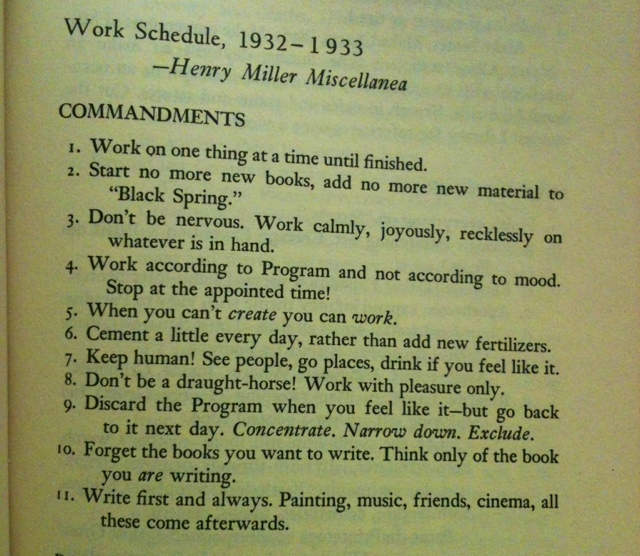
Henry Miller’s Eleven Commandments

20120125-160347.jpg

(From Henry Miller on Writing, New Directions).

“Marks of the Good Writer” — Nietzsche

Friedrich Nietzsche. From Mixed Opinions and Maxims:

(138) Marks of the good writer.— Good writers have two things in common; they prefer to be understood rather than admired; and they do not write for knowing and over-acute readers.

“The Worst Readers” — Nietzsche

Friedrich Nietzsche. From Mixed Opinions and Maxims:

(137) The worst readers.— The worst readers are those who behave like plundering troops: they take away a few things they can use, dirty and confound the remainder, and revile the whole.

“On the Difficulty of Imagining an Ideal City” — Georges Perec

“On the Difficulty of Imagining an Ideal City,” a poem or essay or something—a text—by Georges Perec. The piece is one of the selections in Perec’s collection of miscellany, Species of Spaces and Other Pieces:

I wouldn’t like to live in America but sometimes I would

I’d love to live on the Boulevard St Germain but sometimes I wouldn’t

I wouldn’t like to live on a coral reef but sometimes I would

I wouldn’t like to live in a dungeon but sometimes I would

I wouldn’t like to live in the East but sometimes I would

I love living in France but sometimes I don’t

I’d love to live in Greenland but not for too long

I’d like to live to a hundred but sometimes I wouldn’t

I wouldn’t like to live in Issoudun but sometimes I would

I wouldn’t like to live on a junk but sometimes I would

I wouldn’t like to live in a ksar but sometimes I would

I’d have loved to go in a lunar module but it’s a bit late

I wouldn’t like to live in a monastery but sometimes I would

I wouldn’t like to live at the Hotel Negresco but sometimes I would

I wouldn’t like to live in the open air but sometimes I would

I love living in Paris but sometimes I don’t

I wouldn’t like to live in Quebec but sometimes I would

I wouldn’t like to live by my own resources but sometimes I would

I wouldn’t like to live in a submarine but sometimes I would

I wouldn’t like to live in a tower but sometimes I would

I wouldn’t like to live with Ursula Andress but sometimes I would

I wouldn’t like to live in a village but sometimes I would

I wouldn’t like to live in a wigwam but sometimes I would

I’d love to live in Xanadu but not for ever

I wouldn’t like to live in the Yonne but sometimes I would

I wouldn’t like us all to live in Zanzibar but sometimes I would

Ricky Gervais Talks About Writing Comedy

“Art Makes People Aware of What They Know and Don’t Know That They Know” — William S. Burroughs Talks About Creative Thinking

Writing (and Drinking) Advice from Christopher Hitchens