H Is for House — Peter Greenaway

Oh Well, Whatever, Nevermind (Kurt Cobain Reconsidered)

I was twelve years old when Nirvana’s landmark record Nevermind came out in September of 1991 and supposedly changed the American cultural landscape forever. I was the perfect age to be radically influenced by the onset of the whole grunge thing. Before I got a hold of Nevermind, my favorite records were R.E.M’s Out of Time and De La Soul’s De La Soul is Dead, both of which had come out a few months earlier that year. I also really, really loved Aerosmith’s Greatest Hits (you know…the red album), and U2’s The Joshua Tree. These were some of the earliest CDs I ever owned, and reflecting on this now, it seems odd that my favorite albums could also be brand new, contemporary.

I mention a few of the CDs I owned because I think I’m a relatively typical audiophile of the age group I’m discussing here (roughly, persons born between 1975-1981, although these dates, as I write them, seem awfully silly and arbitrary). I had already outgrown dumb hair metal and had begun to realize that most of the hip-hop I was listening to was not nearly as offensive as I thought it should be. I wanted something new and different and weird, and by the beginning of the seventh grade I’d already begun to scour Rolling Stone, which still had a modicum of cultural relevance in the early nineties. I was also cherry-picking from cool movie soundtracks, and to this day I know that the soundtrack to the oh-so-forgettable 1990 film Pump Up the Volume (Christian Slater as pirate DJ leads a minor youth rebellion) had as much to do with the forging of my musical taste as any other source: this is where I was exposed to two of the bands that would help forge my musical taste for the next decade, Pixies and The Sonic Youth. So, like many other young audiophiles, by the end of 1991–around the time “Smells Like Teen Spirit” was blowing up–I was already moving away from “mainstream” music as quickly as I knew how. Only Nirvana became the new mainstream, grunge became a fashion status, and, feeling like a cultural movement that I was barely even tangentially a part of had been commodified and commercialized, I had rejected the whole thing by the time I had gotten to high school in 1993. This meant rejecting wholesale a number of albums I had loved throughout middle school.

The same month Nevermind came out, so did the Red Hot Chili Pepper’s Blood Sugar Sex Magik, spawning the massive hit “Under the Bridge.” Pearl Jam’s debut Ten came out a month before Nevermind, but really didn’t pick up steam until mid ’92–grunge was in full effect by then; it too produced a mega-hit with “Jeremy.” U2’s Achtung Baby dropped in November–at this point they seemed like the elder statesmen of what was now so brashly defined as “alternative” music (“Alternative to what?” we wondered). “One” was a smash hit. The aforementioned R.E.M. album Out of Time became the year’s critical favorite, with “Losing My Religion” as one of the most unexpected number-ones of 1991. By the end of 1992, U2 and R.E.M. were “the most important bands in the world,” according to every music and entertainment magazine, and Nirvana was getting major credit for initiating a cultural revolution. I loved all of these albums dearly, and, as I mentioned above, denied all of them just a few short years later in favor of a new wave of independent label music–bands like Pavement, Superchunk, and the Archers of Loaf–bands that probably would never have achieved such successful careers without the aforementioned mega-hits that prompted the shift in cultural zeitgeist.

I present all of this evidence merely to point out that the success of these bands–contrasted with the other crap that was happening at the end of the 80s and beginning of the 90s, like White Snake and The New Kids on the Block and Warrant and Nelson and C + C Music Factory–points to something larger than the force of Nevermind alone. (It’s worth pointing out here that Guns N’ Roses released Use Your Illusion I & II a week before Nevermind; these albums had a number of hits including the monster-success of “November Rain,” and, in retrospect, I believe, for all their cock-rockery, are more akin to the albums indicative of paradigm shift I described above than to the hair metal schlock they’re often identified with). Nevermind is often credited with spearheading a musical/cultural “revolution”; this “revolution” in music was already well underway though.

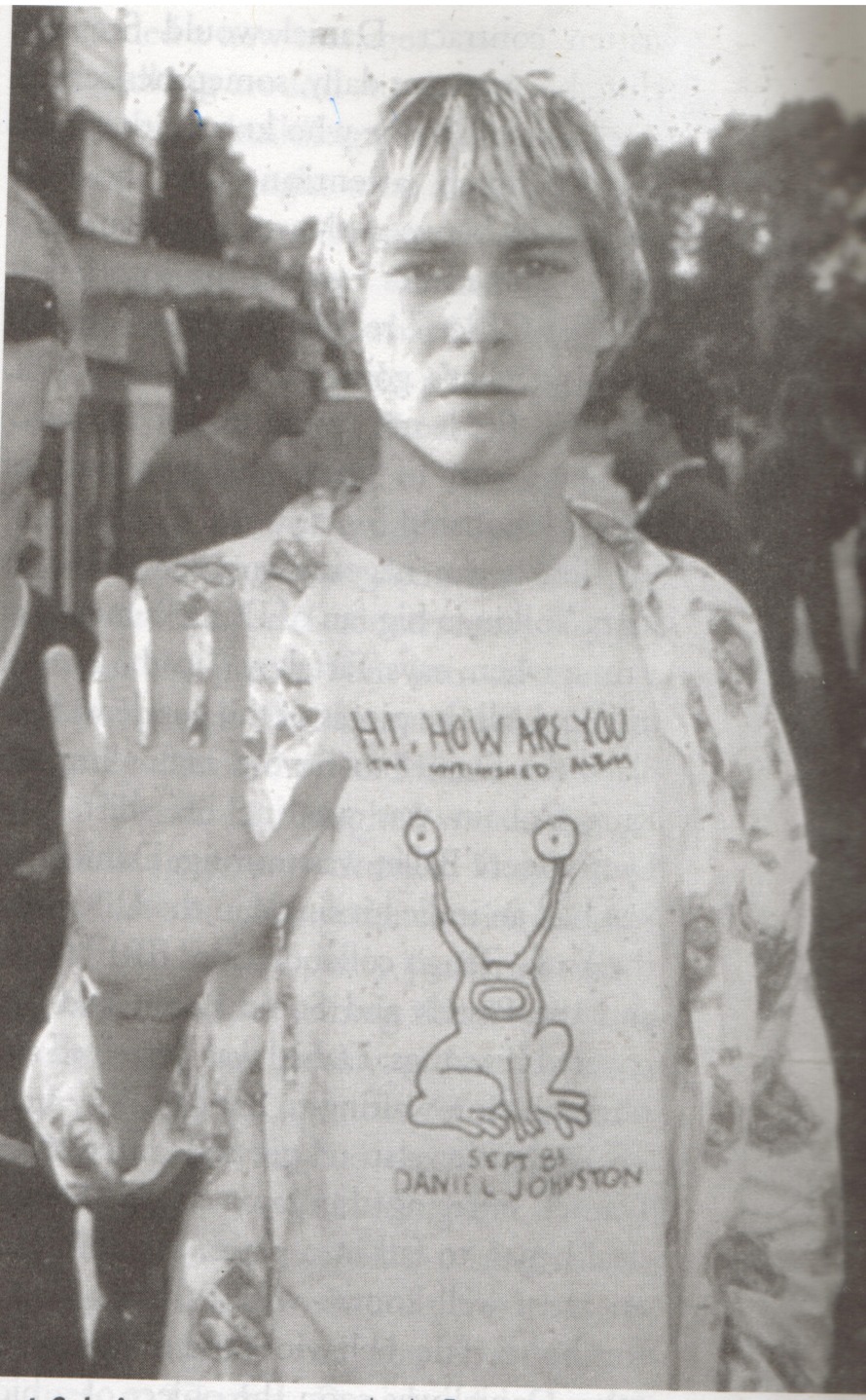
To be sure, Nevermind is a great album, but its cultural cache has more to do with the figure of Kurt Cobain than its relevance and popularity at the time (to see how the myth of Nevermind has grown, simply look at Rolling Stone‘s successive reviews of the album, from 1991, 1992, and 2004, respectively: the magazine gives the album three out of five stars, then four, before finally awarding it five stars thirteen years after the fact). Millions of kids saw Cobain wear Daniel Johnston t-shirts, reference the Melvins, and admit that his songs were really just crude Pixies ripoffs. Cobain, in short, exposed millions of regular kids to an angrier, rougher youth culture, a truly underground music that could react to the failed youth culture of the (now old) boomer generation of the 1960s, which had been forcing an illusory idealization of that decade down our throats forever. Ironically, it was this same boomer generation that greedily milked grunge for all it was worth, commodifying youth culture again into a twisted joke, a stupid lunch box, an action figure, a t-shirt at the mall. No wonder Cobain offed himself.

So why write about this now? It’s been 20 years, and there hasn’t been a record like Nevermind or mega-hits as salient, and dare I suggest meaningful, as “Smells Like Teen Spirit,” “Losing My Religion,” “Under the Bridge,” “One,” or “Jeremy” for quite sometime. The success in the mid-nineties of bands like Smashing Pumpkins and Soundgarden–bands that I didn’t hate but made fun of–seems strange now. Even the music of those elegant bachelors, the Stone Temple Pilots–grunge 2.0–seems oddly strong when held up against the watered-down drivel that passes for contemporary hard rock. Youth music today is archly, ironically aware of its own cultural position and its own performativity in a marketplace. I’m sickened by even thinking of the toothless fourth generation emo-or-whatever-you-wanna-call-it derived from Green Day (another band I didn’t hate but but made fun of) that passes for “pop-punk.” In all its silly winking at the audience, its safe-as-milk non-personality, much of this music represents the ultimate commodifiaction and commercialization of “punk”–the aesthetic that Nevermind helped to re-ignite. (In another genre, hip-hop, after 30 years of existence, has claimed its right–with a sharp vengeance–to be as stupid as any other form of music. Don’t get me started). The irony Cobain and others explored was never a smart-assed irony that coyly winked at the audience, inviting them to laugh along with whatever cultural references were being rehashed; Cobain’s irony was mean and angry–it was a critique of American hegemonic mall culture. Current youth music, rock, emo, whatever it is, is simply a celebration of greedy materialism hiding under the thinnest ironic sheen.

And here’s what I think is the saddest part: I don’t think there can be another Nevermind. To be sure, there will always be fantastic, landmark, music-changing records–I have no doubt about that (see: 1997’s OK Computer f’r’instance). But a record that channels a truly punk aesthetic into mainstream American consciousness is simply not going to happen again. For over fifteen years, critics (and executives) have been looking to award “next big thing” status to just about anyone (do you remember when the Chemical Brothers were supposed to be the “next big thing”? You don’t?). The internet has changed the old model. In the past, records like Nevermind propagated a “trickle-down” effect, if you will–kids in the heartland see Cobain give the Raincoats props, buy Raincoats’ records, get into X-Ray Spex, get into Black Flag, get into Pavement, whatever. In contrast, the internet provides a diffusion model of immediately accessible cultural immersion. Anyone with a DSL connection and a few hours to kill on Allmusic can access indie culture. And that’s a good thing. But still: I’ll get nostalgic here: in the old days, we used to write to the labels and get catalogs and order music via snail mail. We used to buy albums on pure faith that they were good. You couldn’t just click on an mp3 (or steal entire albums on p2p networks or over torrents). But I’m not railing against the internet. I think it’s great that a kid in Montana can become thoroughly exposed to Drag City records or the works of Big Black in just a week. But that will never translate into a wide-scale youth culture shift. Instead, we’ll continue to have what we have now: lots of really, really shitty music on radio and TV. And this is our culture.

There won’t be another Beatles or another Sex Pistols–there won’t be another group that challenges our collective cultural sensibility to make a large jump. There won’t even be an Elvis or a Madonna, a performer that challenges our ethics and morality. Instead, we will continue to have watered-down crap on mainstream media, as well as plenty of choices for those who take the time to look. But those choices will be marginalized, kept on the sidelines out of mainstream American-consciousness, and what we’ll lose is an opportunity to progress and enrich the entirety of our culture. Who knows though–I could be wrong; perhaps I’m just old and out of touch. Perhaps a wholly new and dynamic artist or group will come out that will capture the anti-establishment roots of rock and roll and inspirit a new and dramatically different course in contemporary youth culture. But I don’t see it happening again. I hope I’m wrong.

[Editorial note: We ran a slightly different (but pretty much the same) version of this post in April of 2008]

Jesse James’s Death Mask

Winterfell Weather Report

The Body of Abel Found by Adam and Eve — William Blake

William T. Vollmann’s Favorite “Contemporary” Books

In a 1990 interview between William T. Vollmann and one of his editors Larry McCaffery. An excerpt from the interview appears as a list in the Vollmann reader Expelled from Eden, which is quickly becoming one of my favorite books (seriously, let’s have another volume—this is clearly the optimum Vollmann delivery system). I’ve kept Expelled from Eden’s  list format because, hey, let’s face it, we like lists—

LM: Who are your favorite contemporary authors?

WV: By “contemporary” I assume you mean “from the last two hundred years.”

1./2./3. Right now it seems like I’ve learned a lot from Mishima, Kawabata, and Tolstoy;

4. Hawthorne may be the best;

5. Then Faulkner;

6. Hemingway is usually a wonderful read, especially Islands in the Stream and For Whom the Bell Tolls—that is to say, the grandly suicidal narratives;

7. Tadeusz Konwicki’s A Dreambook for Our Time is beautiful;

8. I also love everything I’ve read by Mir Lagerkvist;

9. Sigrid Undset’s trilogy Kristin Lavransdatter;

10. Multatuli’s Max Havalaar, or the Coffee Auctions of the Dutch Trading Company;

11. Kundera’s Laughable Loves;

12. Andrea Freud Lowenstein’s This Place (which deserves more recognition than it has received);

13. Jane Smiley’s The Greenlanders (which I had the wonderful experience of finding and reading a few months after completing my own book about Greenlanders, The Ice-Shirt).

14. Evans and Agee’s Let Us Now Praise Famous Men;

15. Farley Mowat’s The People of the Deer;

16. The first three books of Mishima’s Sea of Fertility tetralogy (how could I have forgotten that?);

17. Random bits of Proust, Zola’sL’Assommoir;

18. Shusaku Endo’s The Samurai;

19.The first two books of Mervyn Peake’s Gormenghast trilogy;

20. William Hope Hodgson’s The Night Land;

21. Poe’s stories about love;

22. Everything by Malraux (especially his Anti-Memoirs);

23. Nabokov’s Glory and Transparent Things and Ada;

24. Melville’s Pierre;

25. Thomas Bernhard’s Correction;

26. David Lindsay’s Voyage to Acturus;

27. Philip K. Dick’s A Scanner Darkly;

28. A few of Boll’s short novels (Wo warst du, Adam? and The Train Was on Time);

29. Elsa Morante’s History: A Novel;

30. Maria Dermout’s The Ten Thousand Things;

31.  Walter M. Miller’s A Canticle for Leibowitz;

32. James Blish’s Cities in Flight tetralogy (which is just plane fun);

33. The first three volumes of Lawrence Durrell’sAlexandria Quartet, and I don’t know what all.

There’s lots more. I am sorry not to be able to put down less contemporary things such as Tale of Genji, which is one of my all-time favorites.

The Peach Orchard Song from Akira Kurosawa’s Dreams

A favorite scene from a beautiful film.

Book Acquired, 9.22.2011

20110922-040608.jpg

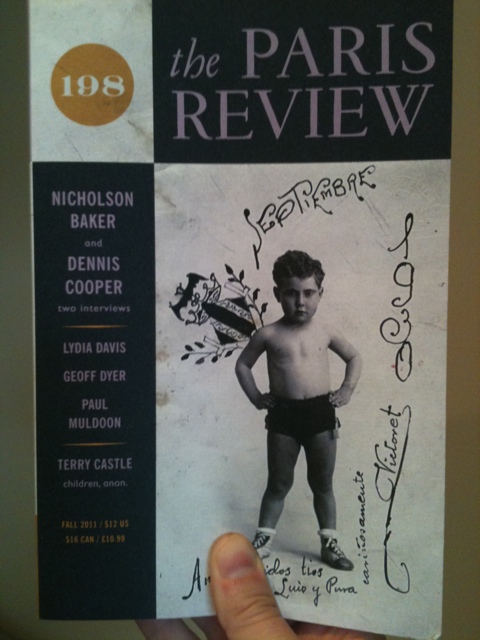
Hey! Sex! Nicholson Baker, Dennis Cooper! Lydia Davis, Geoff Dyer (maybe  not so sex). You can read the cover. Bolaño didn’t make the cover this time, and the third installment of The Third Reich is kinda skinny, but, sure, hey, another intriguing issue.


“One of the Gestures of Deconstruction Is to Not Naturalize What Isn’t Natural” — Derrida Kinda Sorta Almost Defines Deconstruction

Lebowski Nighthawks

Deadwood Bloopers

In the Company of Strangers — We Review Barry McCrea’s New Book About Queer Family Ties in Dickens, Joyce, and Proust

Barry McCrea’s In the Company of Strangers: Family and Narrative in Dickens, Conan Doyle, Joyce, and Proust is one of the more engaging works of literary criticism I’ve seen in some time. And while I’m interested in McCrea’s subjects (the weird lines between the Victorian era and modernism, family and marriage plots, Dickens and Joyce, etc.), it’s the clarity of his writing that I find most impressive. Clear, frank writing is too rare in current literary criticism. Here’s McCrea describing his project—

This book argues that the formal innovations of the high-modernist novel are inseparable from a fundamental rethinking of how family ties are formed and sustained. Genealogy was thematically and structurally central to the English nineteenth-century novel. In the Company of  Strangers shows how the formal strategies employed by Joyce and Proust grow out of an attempt to build a fully coherent narrative system that is not rooted in the genealogical family. Modernism’s rejection of the familiar and cultivation of the strange, in other words, are inseparable from its abandonment of the family and embrace of the bond with the stranger as an alternative to it.

[In the Company of Strangers] offers a reassessment of the relationship between the modernists and their Victorian predecessors, suggesting that the key precursor to this queer model of narrative can be located, paradoxically, in the genealogical obsession of the English nineteenth-century novel. Far from representing a clean break with the Victorian family novel, the radical narrative formalism of high modernism exploits the potential of an alternative queer plot that was already present as a formal building block in the nineteenth-century novel.

McCrea’s queer theory lens is keenly attuned to the homoerotic content present in the novels he examines, but his critical gaze is ultimately more interested in how “queer time” functions as an organizing principle throughout the structure of these narratives. McCrea argues that this queer model of time is a central and defining characteristic of literary modernism. The agent (or one agent) of queer time is “the stranger,” the character who figuratively threatens (and paradoxically defines) the family. McCrea points out that the typical Victorian marriage plot resolves the problem of the stranger by incorporating him or her into the family as a point of narrative resolution. In contrast, in “the queer modernist narrative strategies of Ulysses and the Recherche, the stranger rivals and ultimately usurps the family plot.”

McCrea sifts through family plots (and the strangers who would challenge or queer them) in Dickens (Oliver Twist, Bleak House, Great Expectations), Arthur Conan Doyle’s Sherlock Holmes stories, Ulysses (“a queer family epic”), and Proust’s big book. In the Company of Strangers constantly scrutinizes the ways that family organizes narrative (and narrative organizes family). The book also analyzes what “urban literature” might mean, examining what it means to live in proximity to one’s fellows, and the ways in which urban living necessitate ad hoc families.

In the Company of Strangers does a lovely job of tracing the strange currents that run from Victorian lit to modernism and beyond—currents that extend from our conceptions of family itself, and indeed, our conceptions of life and an end to life. McCrea’s writing is precise, supported by a close textual readings, and if I didn’t always agree with his conclusions, he achieved what every critic ought to aim for: he made me want to read the books he was writing about again.

In the Company of Strangers is new from Columbia University Press.

Ray Bradbury Offers Writing Advice; Wears Short Shorts

(Some Very Beautiful) Books Acquired, 9.17.2011

20110920-120114.jpg 20110920-120126.jpg 20110920-120138.jpg

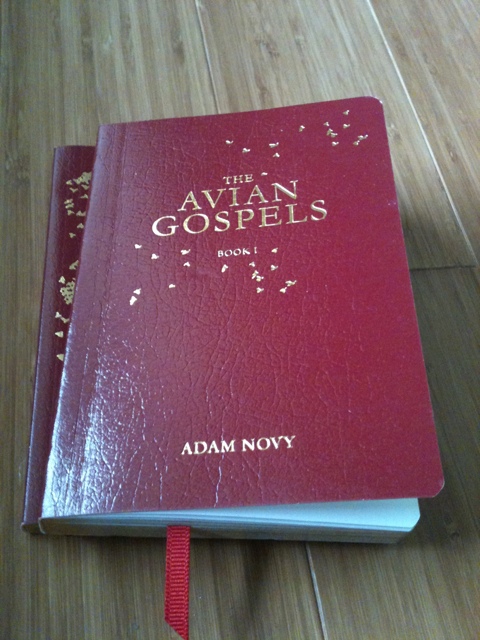
Adam Novy’s début novel The Avian Gospels arrived at Biblioklept World Headquarters this Saturday. I was at a football game all day (drinking beer and then watching my alma mater’s team vanquish men in orange), so I didn’t get to dip into these gorgeous, strange books until the next day, at which point my four-year old daughter took possession of the second volume (declaring it beautiful) and pretended to read it on the couch with me.

I’ve read the first 80 or so pages since then; so far, The Avian Gospels is about a boy named Morgan and his father, both of whom have the power to control birds. This is a handy skill, as the strange, burnt world of Novy’s novel is afflicted by swarms and swarms of birds, creatures that the Gypsies claim to be the souls of all the dead who have died in the city’s endless warring with Hungary. Ruthless Judge Giggs, the tyrannical ruler of the city, wants to enlist the talents of Morgan and his father. The book is surreal, dystopian and perhaps post-apocalyptic, but also very funny and at times even heartwarming in its tender treatment of parent-child relationships. Full review forthcoming.

Good Offices — Evelio Rosero

In Poetics, that ancient didact Aristotle informs us that admirable drama adheres to unities of action, place, and time. There must be no extraneous subplots, just one central action confined to a specific and defined place and time—no more than 24 hours, in fact.

I was reminded of these (oft-broken) rules when reading Evelio Rosero’s Good Offices, a sharp, gleaming novel that illustrates just how effective these classical unities might be in the hands of a gifted author. Rosero’s tale snakes out over the course of only a few hours and takes place entirely in a Catholic church in Bogotá, Colombia. The action—more on that in a moment—is indivisible from the time and place.

Good Offices centers on Tancredo, a hunchback afflicted with “a terrible fear of being an animal.” Tancredo is basically an indentured servant of the church, strung along by Father Almida’s promises of a college education that never seems to surface. His great “cross to bear” is the program of Community Meals that Father Almida mandates (yet never helps execute) each night—charity meals for children, old people, blind people, whores, and families (all segregated by day of the week, naturally). In particular, Tancredo hates the nights for the old people, indigents who complain about the free food and then pretend to be dead so they don’t have to go back to the dark streets of Bogotá. Sometimes they do die though, and it’s Tancredo who must discover their abject corpses.

Aiding Tancredo in the family meal labor are Sabina Cruz, and the Lilias, three ancient widows of the same name who bear more than a passing resemblance to the Moirae. It is the Lilia’s lot to cook these massive meals, making something from nothing, essentially, a job made all the harder by their arthritic joints. They pester Tancredo mercilessly. Sabina doesn’t so much pester Tancredo as haunt him, imploring repeatedly that they run away together. She’s the sexton’s god-daughter, and like Tancredo she is more or less church property. What our cast shares in common is a suppressed humanity, that vital spark now ground down to a dim nub.

This feeling of endless, indefinite weariness hangs over our heroes at the beginning of the novel, as we see here, when the sexton and priest begin an interrogation of sorts of Tancredo—

. . . he felt worn out, exhausted: after the old people crawling around the hall, over and under the table, bathed in soup, stepped in filth and saliva, like a Roman orgy or a witches’s Sabbath, to have a to face the sacristan’s inquisition infuriated him. Once again he experienced the dreadful fear of becoming an animal, or the desire to be one, which was worse. He imagined himself dashing that table against the ceiling; kicking over the chairs of the Church’s two representatives; tipping out their occupants, pissing on their sacred heads; pursuing Sabina, pulling up her heavy lay sister’s skirt, ripping into the apparent innocence of her blouse, buttoned up to the neck, pawing her breasts, pinching her belly button, her thighs, her backside. Truly, he thought, aghast, he needed to confess to the Father about his dreadful fear of being an animal, and the sooner the better.

Rosero’s remarkable prose here twists through the writhing subsurface urges the Catholic Church has worked for hundreds of years to suppress. The writing is violent, funny, sexy, and passionate, culminating in a devastating punchline. The passage is indicative of the book’s strange blending of tones, a sardonic but also sensual crash course in the seven sins.

Almida is too busy to take the time to fully listen to Tancredo’s confession though—he and the sexton must rush to meet a rich benefactor (a gangster, of course). For the first time ever, Almida will miss the mass, necessitating a substitute: Father Matamoros.

To Tancredo’s horror, part of Matamoros’ preparation involves getting drunk; however, he sings the mass in a beautiful voice that entrances the congregants—including Tancredo and the Lilias, who are so enthralled they set to work preparing a feast. Matamoros insists they drink with him, and in time, our principals are all quite drunk, not just on the fine wine that Almida and the sexton secret away for themselves, but also on the Lilia’s rich feast and Matamoros’ splendid singing. These visceral pleasures inject a humanity (and real purpose for living) that has been missing in the church for far too long, and as the night creeps into the morning, the rapture caused by the stranger’s presence overwhelms our cast.

Having lost faith in Almida (and perhaps Catholicism and even God), Tancredo confesses to Matomoros. Before I offer another passage of Rosero’s sensual, intense writing, let me commend the work of translators Anne McLean and Anna Milsom. From Tancredo’s second confession—

Without knowing how, Tancredo resumed the conversation, as if he really had been holding that non-existent conversation with the Father, or did it exist?  Whatever the case, he said, or kept on saying, as if it were the most natural thing in the world, that he had dreamt, Father, that he had an Indian slave-girl, tied up in with a chain like an animal, and that he took her for a walk through a sunlit meadow, the sun, the smell of the sunshine, “everything full of the most terrible lustfulness, Father, hanging over our heads, it was impossible not to take her in my arms, the soft moss offered itself, the leafy oak gave its shade, she stretched out wearily on the grass, it wrapped itself around her like a sheet, offering her rest, and, with the same chain I used for leading her about, she drew me toward her, as if I were an animal and not her, and she spread her legs and all her Hell burned me, Father.”

Matamoros offers Tancredo comfort, if not wisdom, but in treating the young man like a human and not an animal in bondage, he underscores the simple but strong theme of the book.

I won’t spoil more of Good Offices, which I think you should read. It’s a compact, vigorous treat, often blue, sharp as a scimitar, and saturated in suspense. Like any good Aristotelian drama, Rosero’s novel offers catharsis for its audience, but its greater impact comes from what it withholds, from what is left implicit, lingering under the details that ball together toward an end that is funny, horrific, and quite moving. Highly recommended.

Good Offices is new from New Directions this month.

Big Electric Chair — Andy Warhol

“The Lowest Male Mythology” — Slavoj Žižek on Tarkovsky’s Solaris