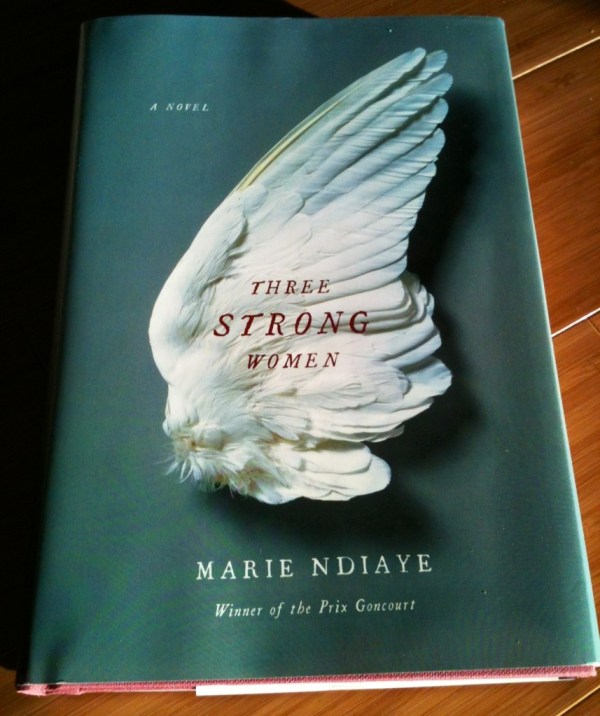
Marie NDiaye’s novel Three Strong Women won the Prix Goncourt in 2009 and is now published in English translation (John Fletcher) from Random House. Their blurb:
In this new novel, the first by a black woman ever to win the coveted Prix Goncourt, Marie NDiaye creates a luminous narrative triptych as harrowing as it is beautiful.
This is the story of three women who say no: Norah, a French-born lawyer who finds herself in Senegal, summoned by her estranged, tyrannical father to save another victim of his paternity; Fanta, who leaves a modest but contented life as a teacher in Dakar to follow her white boyfriend back to France, where his delusional depression and sense of failure poison everything; and Khady, a penniless widow put out by her husband’s family with nothing but the name of a distant cousin (the aforementioned Fanta) who lives in France, a place Khady can scarcely conceive of but toward which she must now take desperate flight.
With lyrical intensity, Marie NDiaye masterfully evokes the relentless denial of dignity, to say nothing of happiness, in these lives caught between Africa and Europe. We see with stunning emotional exactitude how ordinary women discover unimagined reserves of strength, even as their humanity is chipped away. Three Strong Women admits us to an immigrant experience rarely if ever examined in fiction, but even more into the depths of the suffering heart.
Book shelves series #31, thirty-first Sunday of 2012
When I started this project I thought it would be a fun way to keep stock of the books that I have, and also a way to perhaps question why I hold on to the books that I hold on to.
I mean, why keep a book after you’ve read it?
Anyway, at times throughout this series I’ve gotten bored, or rushed; other times I’ve thought the idea was stupid, or narcissistic, or something even worse (although I don’t know what).
I like the shelves above the pedestrian, utilitarian jobber that I’ll feature this Sunday and the next: lots of aesthetically pleasing stuff there.
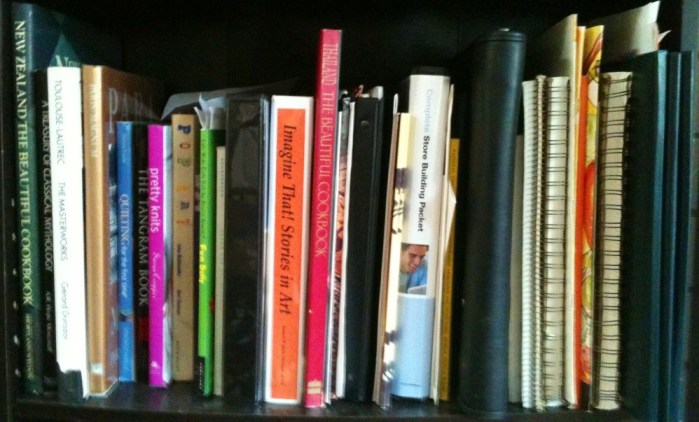
Not so this one, which holds photos and cookbooks and art books and old notebooks and sketchbooks and every kind of etcetera:
At least that’s what I thought until I started digging into the cramped top shelf, dutifully bound to this project.
I wound up really enjoying myself, pausing over volumes that I haven’t looked at in ages, like this beauty:
I’m not sure if the aesthetic joy of this postcard collection comes across in these lousy iPhone photo shots.
I got this on a trip to London when I was 11. It was just my mom and my brother and I. First we went to Singapore. We were coming back to the States for Christmas, and also to live, eventually. My brother broke his leg in Singapore jumping down some stairs and we didn’t realize it was broken until we got back to Florida.
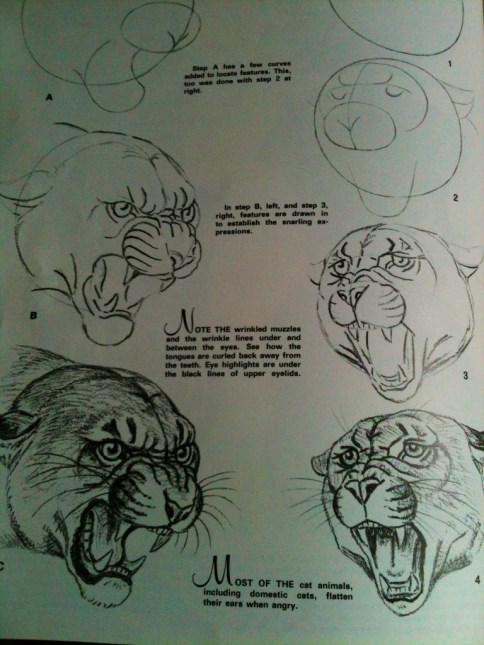
I used to draw and paint all the time, especially as a kid. Mostly animals.
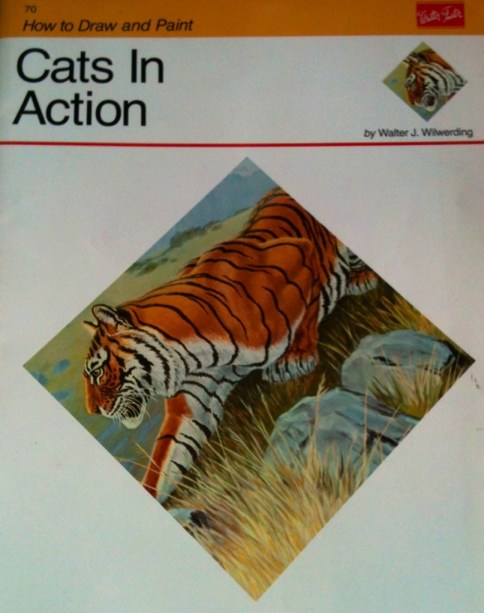
There are at least a dozen skinny books like this on the shelf:
I must have done hundreds of these as a kid:
The shelf is also full of old comic strip collections that you probably recognize, like these guys:
And this guy (and yes, I have the 7″ record from this collection)
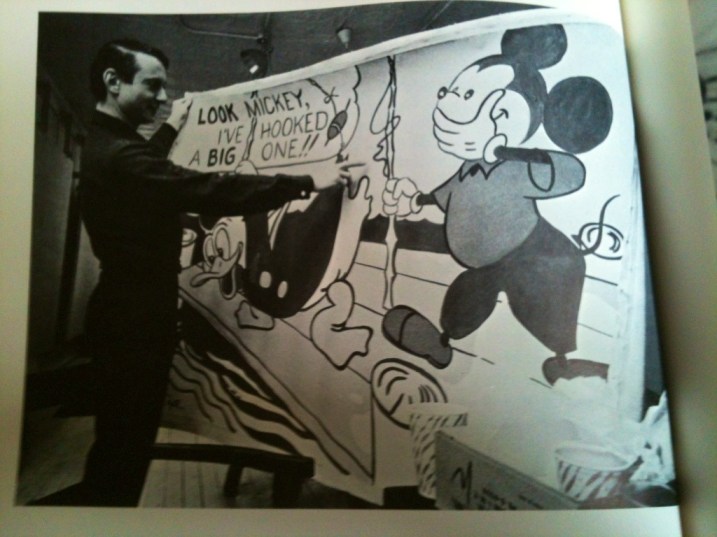
I also spent half an hour revising Rublowsky’s 1965 volume Pop Art, which is kind of fascinating in its contemporary proximity to its subject.
The cover’s not interesting, but Ken Heyman’s photos are; they show the artists in process. This one is kinda famous:
In a house besieged lived a man and a woman. From where they cowered in the kitchen the man and woman heard small explosions. “The wind,” said the woman. “Hunters,” said the man. “The rain,” said the woman. “The army,” said the man. The woman wanted to go home, but she was already home, there in the middle of the country in a house besieged.
“In a House Besieged,” from Lydia Davis’s first collection Break It Down (1986); available in The Collected Stories.
At certain moments I felt that the entire world was turning into stone: a slow petrification, more or less advanced depending on people and places but one that spared no aspect of life. It was as if no one could escape the inexorable stare of Medusa. The only hero able to cut off Medusa’s head is Perseus, who flies with winged sandals; Perseus, who does not turn his gaze upon the face of the Gorgon but only upon her image reflected in his bronze shield. Thus Perseus comes to my aid even at this moment, just as I too am about to be caught in a vise of stone— which happens every time I try to speak about my own past. Better to let my talk be composed of images from mythology.
To cut off Medusa’s head without being turned to stone, Perseus supports himself on the very lightest of things, the winds and the clouds, and fixes his gaze upon what can be revealed only by indirect vision, an image caught in a mirror. I am immediately tempted to see this myth as an allegory on the poet’s relationship to the world, a lesson in the method to follow when writing. But I know that any interpretation impoverishes the myth and suffocates it. With myths, one should not be in a hurry. It is better to let them settle into the memory, to stop and dwell on every detail, to reflect on them without losing touch with their language of images. The lesson we can learn from a myth lies in the literal narrative, not in what we add to it from the outside.
The relationship between Perseus and the Gorgon is a complex one and does not end with the beheading of the monster. Medusa’s blood gives birth to a winged horse, Pegasus—the heaviness of stone is transformed into its opposite. With one blow of his hoof on Mount Helicon, Pegasus makes a spring gush forth, where the Muses drink. In certain versions of the myth, it is Perseus who rides the miraculous Pegasus, so dear to the Muses, born from the accursed blood of Medusa. (Even the winged sandals, incidentally, come from the world of monsters, for Perseus obtained them from Medusa’s sisters, the Graiae, who had one tooth and one eye among them.) As for the severed head, Perseus does not abandon it but carries it concealed in a bag. When his enemies are about to overcome him, he has only to display it, holding it by its snaky locks, and this bloodstained booty becomes an invincible weapon in the hero’s hand. It is a weapon he uses only in cases of dire necessity, and only against those who deserve the punishment of being turned into statues. Here, certainly, the myth is telling us something, something implicit in the images that can’t be explained in any other way. Perseus succeeds in mastering that horrendous face by keeping it hidden, just as in the first place he vanquished it by viewing it in a mirror. Perseus’s strength always lies in a refusal to look directly, but not in a refusal of the reality in which he is fated to live; he carries the reality with him and accepts it as his particular burden.
On the relationship between Perseus and Medusa, we can learn something more from Ovid’s Metamorphoses. Perseus wins another battle: he hacks a sea-monster to pieces with his sword and sets Andromeda free. Now he prepares to do what any of us would do after such an awful chore—he wants to wash his hands. But another problem arises: where to put Medusa’s head. And here Ovid has some lines (IV740-752) that seem to me extraordinary in showing how much delicacy of spirit a man must have to be a Perseus, killer of monsters: “So that the rough sand should not harm the snake-haired head (anquiferumque caput dura ne laedat harena), he makes the ground soft with a bed of leaves, and on top of that he strews little branches of plants born under water, and on this he places Medusa’s head, face down.” I think that the lightness, of which Perseus is the hero, could not be better represented than by this gesture of refreshing courtesy toward a being so monstrous and terrifying yet at the same time somehow fragile and perishable. But the most unexpected thing is the miracle that follows: when they touch Medusa, the little marine plants turn into coral and the nymphs, in order to have coral for adornments, rush to bring sprigs and seaweed to the terrible head.
This clash of images, in which the fine grace of the coral touches the savage horror of the Gorgon, is so suggestive that I would not like to spoil it by attempting glosses or interpretations.
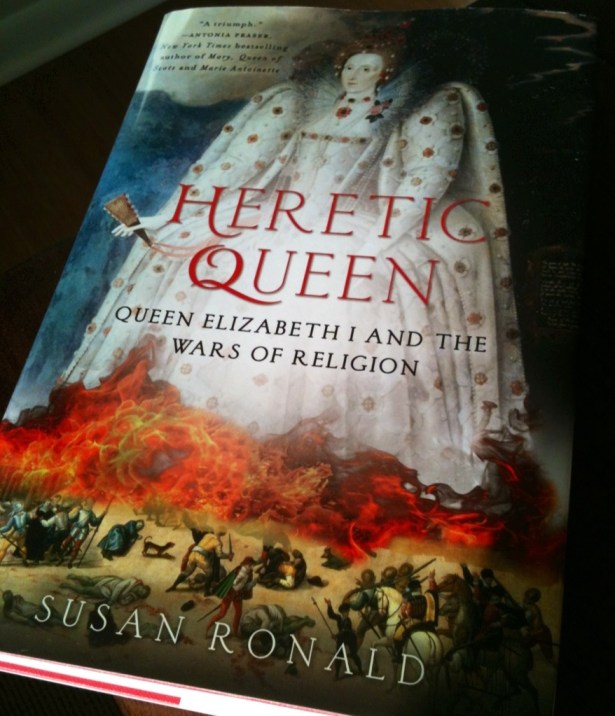
Susan Ronald’s Heretic Queen is new in hardback from Macmillan. Their blurb:
Elizabeth’s 1558 coronation procession was met with an extravagant outpouring of love. Only twenty-five years old, the young queen saw herself as their Protestant savior, aiming to provide the nation with new hope, prosperity, and independence from the foreign influence that had plagued her sister Mary’s reign. Given the scars of the Reformation, Elizabeth would need all of the powers of diplomacy and tact she could summon.
Extravagant, witty, and hot-tempered, Elizabeth was the ultimate tyrant. Yet at the outset, in religious matters, she was unfathomably tolerant for her day. “There is only one Christ, Jesus, one faith,” Elizabeth once proclaimed. “All else is a dispute over trifles.” Heretic Queen is the highly personal, untold story of how Queen Elizabeth I secured the future of England as a world power. Susan Ronald paints the queen as a complex character whose apparent indecision was really a political tool that she wielded with great aplomb.
It seems so dreadful to stay a bachelor, to become an old man struggling to keep one’s dignity while begging for an invitation whenever one wants to spend an evening in company, to lie ill gazing for weeks into an empty room from the corner where one’s bed is, always having to say good night at the front door, never to run up a stairway beside one’s wife, to have only side doors in one’s room leading into other people’s living rooms, having to carry one’s supper home in one’s hand, having to admire other people’s children and not even being allowed to go on saying: ‘I have none myself,’ modeling oneself in appearance and behavior on one or two bachelors remembered from one’s youth.
That’s how it will be, except that in reality, both today and later, one will stand there with a palpable body and a real head, a real forehead, that is, for smiting on with one’s hand.
Mitchell’s Cloud Atlas comprises six sections, each interrupted by the next section (with the exception of the sixth section), and then commenced again in reverse order (a simpler way to think of this might be a schema: 1-2-3-4-5-6-5-4-3-2-1). Sections 1-6 move forward chronologically and, significantly, each section represents a new literary trend. (Again, perhaps a schema with illustrating examples would work better here; for more detail, check out my review: 1: Melville-2: Modernism-3: Airport novel-4: Contemporary novel (Roth?)-5: Dystopian sci-fi (post-Orwell, shades of PKD)-6: Post-apocalyptic (language games, à la Russell Hoban’s Riddley Walker)). In short, Cloud Atlas is an exercise in several genre styles, glommed onto a few ideas cribbed from Nietzsche: eternal recurrence, master/slave relationships, will to power, all that jazz. Ultimately—and more interestingly, I think—Cloud Atlas is an exercise in postmodernism-as-genre, a sort of critique perhaps (intentional or not), brought into even greater relief when one examines Mitchell’s novels Black Swan Green (a coming of age story) and The Thousand Autumns of Jacob de Zoet (a straight-up historical romance), which are, again, genre exercises.
This leads me up to the film adaptation of Cloud Atlas, the long trailer for which dropped today.
I would embed the goddamn trailer, but it’s been blocked on YouTube and other similar sites by Warner Brothers, who apparently have absolutely no idea how publicity works.
I know that trailers have to advertise films to a wide range of potential audience members, and that often leads to overwrought musical cues and lines pulled out of context and big flashing words in all caps, but damn, this is cheeseball stuff. Mitchell’s Cloud Atlas is a subtle book (at times), one that works best when the readers are allowed to do most of the work. The trailer suggests spectacle over nuance, bombast over substance. But again—just a trailer.
Not that the Wachowskis—who are directing and writing and producing (along with Tom Tykwer, whose films Run Lola Run and Perfume I recall enjoying)—-are known for restraint.
And, while I’m bringing up the Wachowskis: They are most famous for their visual inventiveness (these are the guys who did The Matrix), but great looking films don’t necessarily mean much. I mean, the last film they did was Speed Racer (okay, Cloud Atlas looks a lot more restrained than that fiasco, but still, these guys have major problems with storytelling).
Now, based on the trailer, the filmmakers seem to have done some significant rewrites. In Mitchell’s novel, each section (or sections 1-5, at least), exists as a narrative of some kind—fictional narratives, in a few cases. Each protagonist comes to find him or herself echoing or tracing or otherwise repeating or prefiguring the protagonist of another narrative—but there’s always the recognition of the textuality (and hence, metatextuality) to this patterning. Put another way, these are all characters in stories that are awfully familiar to us, and Mitchell strives to make the reader aware of this textuality: it’s a thoroughly postmodern move.
The film seems to connect the characters in two ways: 1, it seems to use actors across separate roles (this could work) and 2, it seems to have characters from previous segments interact with each other across segments. I might be misreading the trailer when it comes to point 2 here, but I think that having characters actively puncture the nested narratives of Cloud Atlas is a bad idea. And, even if I am misreading this, the film clearly imposes a unifying style across the narratives—sure the dystopian sci-fi scenes will have different set dressing, etc., than the Pacific journal narrative scenes—but take note of how all the scenes seem to follow a unified visual sensibility. The joy of Mitchell’s novel is the way he plays with, parodies, adores (etc.) the narrative styles he’s reworking. For example, Half-Lives: The First Luisa Rey Mystery reads like a bad airport mystery (or at least a mediocre one). I was hoping that the filmmakers would attempt to do something similar with the film—actually play with the concept of genre, actually manipulate and amplify the distinct genre conventions at work in Mitchell’s book. Which, maybe they do. Again, I know: it’s just a trailer.
But it’s an awfully slick, shiny trailer.
Okay, perhaps I’m griping too much. All the characters seem to be there, and the casting doesn’t seem terrible. My curiosity is piqued, admittedly, but mostly because I want to know how the filmmakers will handle the nested narratives (also: how long will the movie be?). In any case, I’m sure this will be one of those movies where people sigh and say, “Yeah, the book is way better.”










 Biblioklept