“Amazona” (Live) — Roxy Music

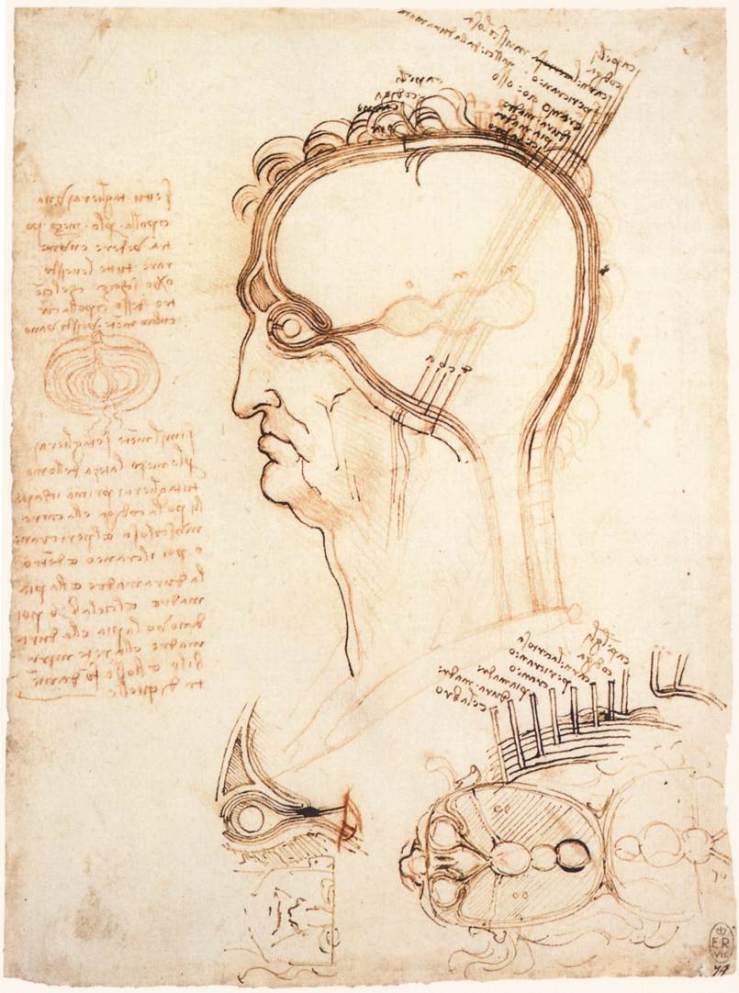
Comparison of Scalp Skin and Onion — Leonardo da Vinci

comparison-of-scalp-skin-and-onion-1489

“The Glass Dog” — L. Frank Baum

“The Glass Dog” by L. Frank Baum

An accomplished wizard once lived on the top floor of a tenement house and passed his time in thoughtful study and studious thought. What he didn’t know about wizardry was hardly worth knowing, for he possessed all the books and recipes of all the wizards who had lived before him; and, moreover, he had invented several wizardments himself.

This admirable person would have been completely happy but for the numerous interruptions to his studies caused by folk who came to consult him about their troubles (in which he was not interested), and by the loud knocks of the iceman, the milkman, the baker’s boy, the laundryman and the peanut woman. He never dealt with any of these people; but they rapped at his door every day to see him about this or that or to try to sell him their wares. Just when he was most deeply interested in his books or engaged in watching the bubbling of a cauldron there would come a knock at his door. And after sending the intruder away he always found he had lost his train of thought or ruined his compound.

At length these interruptions aroused his anger, and he decided he must have a dog to keep people away from his door. He didn’t know where to find a dog, but in the next room lived a poor glass-blower with whom he had a slight acquaintance; so he went into the man’s apartment and asked:

“Where can I find a dog?”

“What sort of a dog?” inquired the glass-blower.

“A good dog. One that will bark at people and drive them away. One that will be no trouble to keep and won’t expect to be fed. One that has no fleas and is neat in his habits. One that will obey me when I speak to him. In short, a good dog,” said the wizard.

“Such a dog is hard to find,” returned the glass-blower, who was busy making a blue glass flower pot with a pink glass rosebush in it, having green glass leaves and yellow glass roses.

The wizard watched him thoughtfully.

“Why cannot you blow me a dog out of glass?” he asked, presently.

“I can,” declared the glass-blower; “but it would not bark at people, you know.” Continue reading ““The Glass Dog” — L. Frank Baum”

Portrait of Ivan Turgenev — Vasily Perov

La Razòn — Jesus Leguizamo

caras

(More/via).

Of Mice and Men (Full Film, 1939)

The Pancake Baker — Adriaen Brouwer

“Name the Parts” (A Scene from DeLillo’s Underworld)

A favorite scene from Don DeLillo’s novel Underworld:

“Sometimes I think the education we dispense is better suited to a fifty-year-old who feels he missed the point the first time around. Too many abstract ideas. Eternal verities left and right. You’d be better served looking at your shoe and naming the parts. You in particular, Shay, coming from the place you come from.”

This seemed to animate him. He leaned across the desk and gazed, is the word, at my wet boots.

“Those are ugly things, aren’t they?”

“Yes they are.”

“Name the parts. Go ahead. We’re not so chi chi here, we’re not so intellectually chic that we can’t test a student face-to-face.”

“Name the parts,” I said. “All right. Laces.”

“Laces. One to each shoe. Proceed.”

I lifted one foot and turned it awkwardly.

“Sole and heel.”

“Yes, go on.”

I set my foot back down and stared at the boot, which seemed about as blank as a closed brown box.

“Proceed, boy.”

“There’s not much to name, is there? A front and a top.”

“A front and a top. You make me want to weep.”

“The rounded part at the front.”

“You’re so eloquent I may have to pause to regain my composure. You’ve named the lace. What’s the flap under the lace?”

“The tongue.”

“Well?”

“I knew the name. I just didn’t see the thing.”

He made a show of draping himself across the desk, writhing slightly as if in the midst of some dire distress.

“You didn’t see the thing because you don’t know how to look. And you don’t know how to look because you don’t know the names.”

He tilted his chin in high rebuke, mostly theatrical, and withdrew his body from the surface of the desk, dropping his bottom into the swivel chair and looking at me again and then doing a decisive quarter turn and raising his right leg sufficiently so that the foot, the shoe, was posted upright at the edge of the desk.

A plain black everyday clerical shoe.

“Okay,” he said. “We know about the sole and heel.”

“Yes.”

“And we’ve identified the tongue and lace.”

“Yes,” I said.

With his finger he traced a strip of leather that went across the top edge of the shoe and dipped down under the lace.

“What is it?” I said.

“You tell me. What is it?”

“I don’t know.”

“It’s the cuff.”

“The cuff.”

“The cuff. And this stiff section over the heel. That’s the counter.”

“That’s the counter.”

“And this piece amidships between the cuff and the strip above the sole. That’s the quarter.”

“The quarter,” I said.

“And the strip above the sole. That’s the welt. Say it, boy.”

“The welt.”

“How everyday things lie hidden. Because we don’t know what they’re called. What’s the frontal area that covers the instep?”

“I don’t know.”

“You don’t know. It’s called the vamp.”

“The vamp.”

“Say it.”

“The vamp. The frontal area that covers the instep. I thought I wasn’t supposed to memorize.”

“Don’t memorize ideas. And don’t take us too seriously when we turn up our noses at rote learning. Rote helps build the man. You stick the lace through the what?”

“This I should know.”

“Of course you know. The perforations at either side of, and above, the tongue.”

“I can’t think of the word. Eyelet.”

“Maybe I’ll let you live after all,”

“The eyelets.”

“Yes. And the metal sheath at each end of the lace.”

He flicked the thing with his middle finger.

“This I don’t know in a million years.”

“The aglet.”

“Not in a million years.”

“The tag or aglet.”

“The aglet,” I said.

“And the little metal ring that reinforces the rim of the eyelet through which the aglet passes. We’re doing the physics of language, Shay.”

“The little ring.”

“You see it?”

“Yes.”

“This is the grommet,” he said.

“Oh man.”

“The grommet. Learn it, know it and love it.”

“I’m going out of my mind.”

“This is the final arcane knowledge. And when I take my shoe to the shoemaker and he places it on a form to make repairs—a block shaped like a foot. This is called a what?”

“I don’t know.”

“A last.”

“My head is breaking apart.”

“Everyday things represent the most overlooked knowledge. These names are vital to your progress. Quotidian things. If they weren’t important, we wouldn’t use such a gorgeous Latinate word. Say it,” he said.

“Quotidian.”

“An extraordinary word that suggests the depth and reach of the commonplace.”


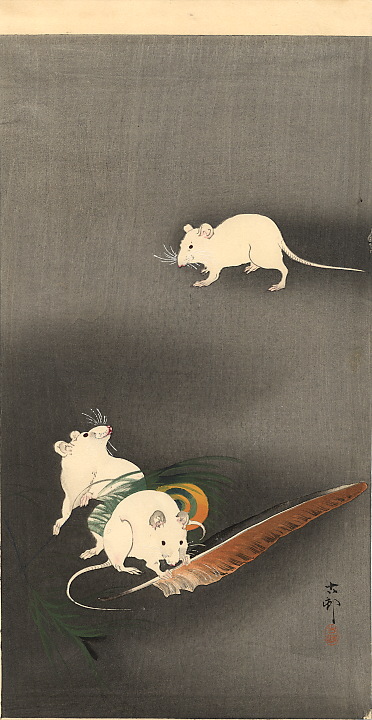
Three White Mice — Ohara Koson

three-white-mice-1900

“Two Gallants” — James Joyce

“Two Gallants” by James Joyce

The grey warm evening of August had descended upon the city and a mild warm air, a memory of summer, circulated in the streets. The streets, shuttered for the repose of Sunday, swarmed with a gaily coloured crowd. Like illumined pearls the lamps shone from the summits of their tall poles upon the living texture below which, changing shape and hue unceasingly, sent up into the warm grey evening air an unchanging unceasing murmur.

Two young men came down the hill of Rutland Square. One of them was just bringing a long monologue to a close. The other, who walked on the verge of the path and was at times obliged to step on to the road, owing to his companion’s rudeness, wore an amused listening face. He was squat and ruddy. A yachting cap was shoved far back from his forehead and the narrative to which he listened made constant waves of expression break forth over his face from the corners of his nose and eyes and mouth. Little jets of wheezing laughter followed one another out of his convulsed body. His eyes, twinkling with cunning enjoyment, glanced at every moment towards his companion’s face. Once or twice he rearranged the light waterproof which he had slung over one shoulder in toreador fashion. His breeches, his white rubber shoes and his jauntily slung waterproof expressed youth. But his figure fell into rotundity at the waist, his hair was scant and grey and his face, when the waves of expression had passed over it, had a ravaged look.

When he was quite sure that the narrative had ended he laughed noiselessly for fully half a minute. Then he said:

“Well!… That takes the biscuit!”

His voice seemed winnowed of vigour; and to enforce his words he added with humour:

“That takes the solitary, unique, and, if I may so call it, recherche biscuit!” Continue reading ““Two Gallants” — James Joyce”

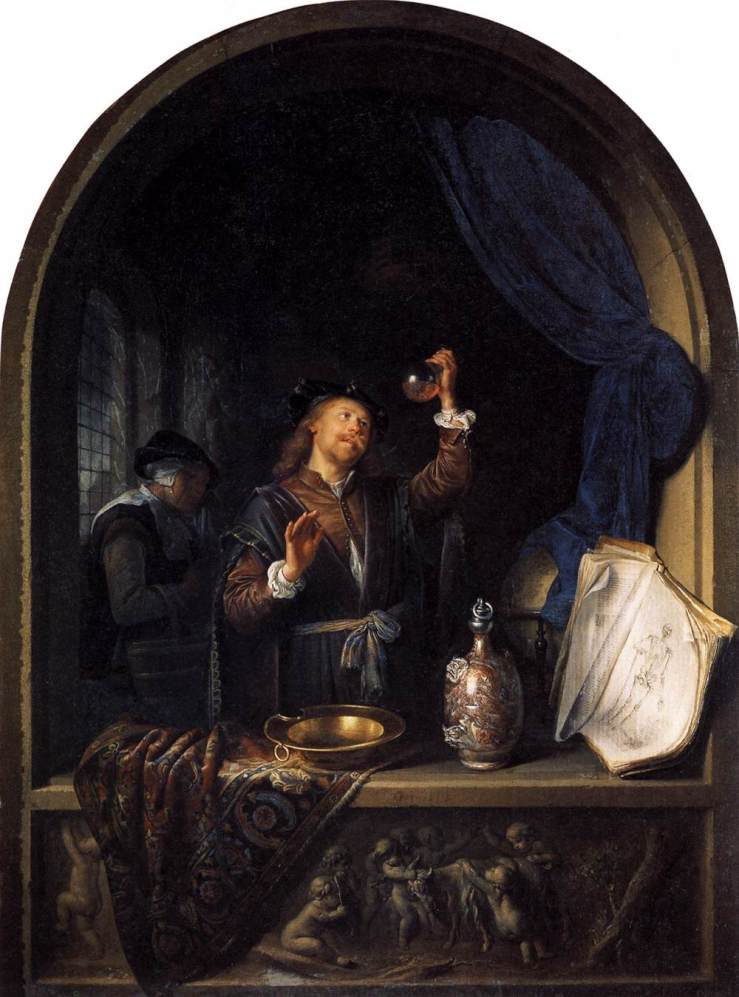
The Physician — Gerrit Dou

the-physician-1653-1

Kon Ichikawa’s The Burmese Harp (Full Film with English Subtitles)

Forever Still (Short Film) — Beach House

“To produce a mighty book, you must choose a mighty theme” (Moby-Dick)

One often hears of writers that rise and swell with their subject, though it may seem but an ordinary one. How, then, with me, writing of this Leviathan? Unconsciously my chirography expands into placard capitals. Give me a condor’s quill! Give me Vesuvius’ crater for an inkstand! Friends, hold my arms! For in the mere act of penning my thoughts of this Leviathan, they weary me, and make me faint with their outreaching comprehensiveness of sweep, as if to include the whole circle of the sciences, and all the generations of whales, and men, and mastodons, past, present, and to come, with all the revolving panoramas of empire on earth, and throughout the whole universe, not excluding its suburbs. Such, and so magnifying, is the virtue of a large and liberal theme! We expand to its bulk. To produce a mighty book, you must choose a mighty theme. No great and enduring volume can ever be written on the flea, though many there be who have tried it.

From “The Fossil Whale,” Chapter 104 of Melville’s Moby-Dick.


Ben Marcus/Victor Segalen/George Saunders (Books Acquired, 2.01.2013)

20130203-165505.jpg

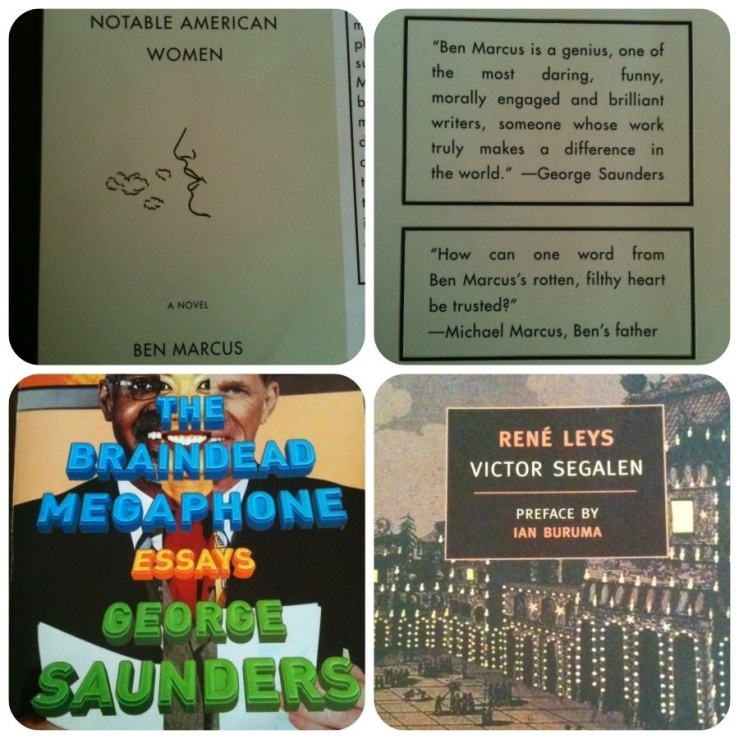
I went to the bookstore on Friday afternoon to drop off some trade-ins and order a few books for my wife and kids for Valentine’s Day. I had no intention of buying anything, but a bit of random browsing led to me leaving with Ben Marcus’s collection Notable American Women (how could I resist that blurb?), a collection of George Saunders essays, and René Leys by Victor Segalen—the NYRB edition stuck out, and then the blurb sold me on this tale of a Westerner trying to access the Forbidden City of imperial China.

I’m reading Ben Marcus’s The Flame Alphabet right now, along with some short stories by Yoko Ogawa, as well as Lars Iyer’s latest, Exodus; I’m pretty sure René Leys is on deck after one of those.


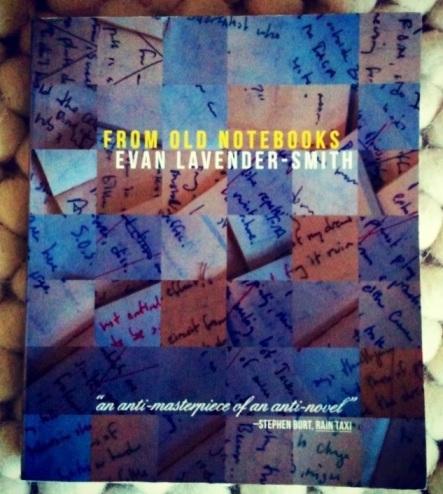
I Anti-Review Evan Lavender-Smith’s Anti-Novel, From Old Notebooks

20130202-121935.jpg

The style of this review is probably a bad idea.

In fact, it’s such a bad idea that it’s probable someone has already done it. Or considered doing it but had the good sense to refrain.

From Old Notebooks as the presentation of a subject through his daily jotting downs.

To clarify: All block quotes—like the one above—belong to Evan Lavender-Smith’s From Old Notebooks.

Which I read twice last month.

And am writing about here.

From Old Notebooks: A Novel: An Essay.

From Old Notebooks: An Essay: A Novel.

From Old Notebooks blazons its anxiety of influence: Ulysses, Infinite Jest, Nietzsche, Wittgenstein. Shakespeare.

Joycespeare.

References, critiques, ideas about Joyce, DFW, Wittgenstein, Nietzsche repeatedly evince in From Old Notebooks—and yet David Markson, whose format E L-S so clearly borrows, is evoked only thrice—and not until page 74 (this in a book of 201 pages):

I count David Markson’s literary-anecdote books among the few things I want to read over and over again, yet I have no idea whether they are actually any good. They’re like porn for English majors.

And then again on page 104:

If David Markson hadn’t written his literary-anecdote novels, would I have ever thought to consider F.O.N. a novel? Would I have ever thought to write such a book?

(I should point out that the page numbers I cite are from Dzanc Book’s first edition of From Old Notebooks; Dzanc’s 2012 printing puts the book back in print).

Like Markson’s anti-novels (Reader’s Block, This Is Not a Novel, Vanishing Point, The Last Novel), E L-S’s F.O.N. is constantly describing itself.

There may be some question as to F.O.N.’s status as fiction, poetry, philosophy, nonfiction, etc., but hopefully there will be no question about its status as a book.

Is E L-S’s book postmodern? Post-postmodern?

Perhaps there is nothing quintessentially postmodern about the self-reflexivity, fragmentation and pastiche of F.O.N., if only because all of it follows from form.

From Old Notebooks as a document constantly performing its self-critique:

If there were a Viking Portable Lavender-Smith containing an abridgment of F.O.N., I would be very interested to read it, because there’s no reason that the total value of the book wouldn’t be gained, through editorial happenstance, with much greater efficiency.

From Old Notebooks as a document of authorial anxiety.

A reader could make a case that there are a number of elided texts within or suggested by From Old Notebooks, including the one that gives the author the authority to write such a book.

F.O.N. is also a generative text, bustling with ideas for short stories, novels, plays, films, pamphlets, somethings—it is E L-S’s notebook after all (maybe). Just one very short example—

Novel about a haunted cryonics storage facility.

F.O.N.’s story ideas reminded me of my favorite Fitzgerald text, his Notebooks.

Reading From Old Notebooks is a pleasurable experience.

Personal anecdote on the reading experience:

Reading the book in my living room, my daughter and wife enter and begin doing some kind of mother-daughter yoga. My wife asks if they are distracting me from reading. I suggest that the book doesn’t work that way. The book performs its own discursions.

I shared the tiniest morsel here of my family; E L-S shares everything about his family in F.O.N.:

I know that the reconciliation of my writing life and my family life is one of the things that F.O.N. is finally about, but I can’t actually see it in the book; I don’t imagine I could point to an entry and say, Here is an example of that.

It would be impossible for me not to relate to the character of the author or novelist or narrator of F.O.N. (let me call him E L-S as a simple placeholder): We’re about the same age, we both have a son and a daughter (again of similar ages); we both teach composition. Similar literary obsessions. Etc. After reading through F.O.N. the first time I realized how weird it was that I didn’t feel contempt and jealousy for what E L-S pulls off in F.O.N.—that I didn’t hate him for it. That I felt proud of him (why?) and liked him.

There are moments where our obsessions diverge; the E L-S of F.O.N. is preoccupied with death to an extent that I simply don’t connect to. He:

1) Think always about sex. 2) Have a family. 3) Think always about death.

I:

1) Think always about sex. 2) Have a family. 3) Think always about sex.

But generally I get and feel and empathize with his descriptions of his son and daughter and wife.

And his work. Big time:

Getting up the motivation to grade student essays is like trying to pass a piece of shit through the eye of a needle.

Or

I have perfected my lecture after giving it for the third time, but my fourth class never gets to realize it because my voice is hoarse and I’m so tired from giving the same lecture four times in one day, so their experience of my perfect lecture at 8-9:40 PM is of approximately equal value to that of my students receiving my imperfect lecture at 8-9:40 AM, as well as my students at 2:30-3:55 and 5:30-7:10—and it all evens out to uniform mediocrity in the end.

The novel is not jaded or cynical or death-obsessed though (except when it is).

What E L-S is trying to do is to remove as much of the barrier between author and reader as possible:

Contemporary authors who construct a thick barrier between themselves and their readers such that authorial vulnerability is revealed negatively, i.e., via the construction of the barrier.

Perhaps my suggestion that E L-S tries to remove the barrier is wrong. Maybe instead: E L-S’s F.O.N. maps the barrier, points to the barrier’s structure, does not try to deny the barrier, but also tries to usher readers over it, under it, through its gaps—-and in this way channels a visceral reality that so much of contemporary fiction fails to achieve.

I really, really liked this book and will read it again.
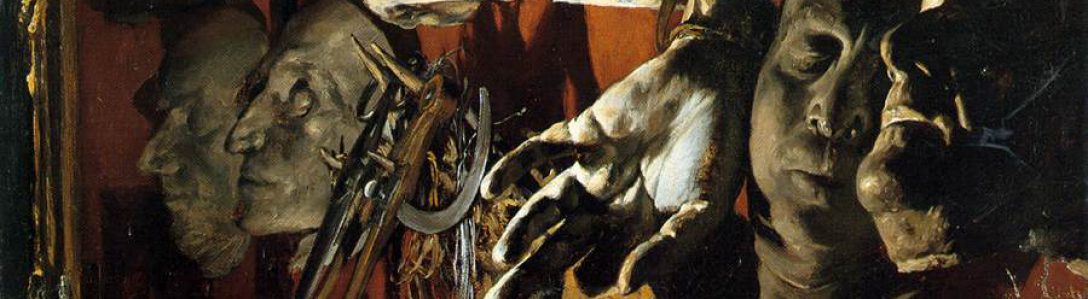
 

I Don’t Like to Look at Him, Jack — Walton Ford

PK_15822_burke_img4

(More/via)