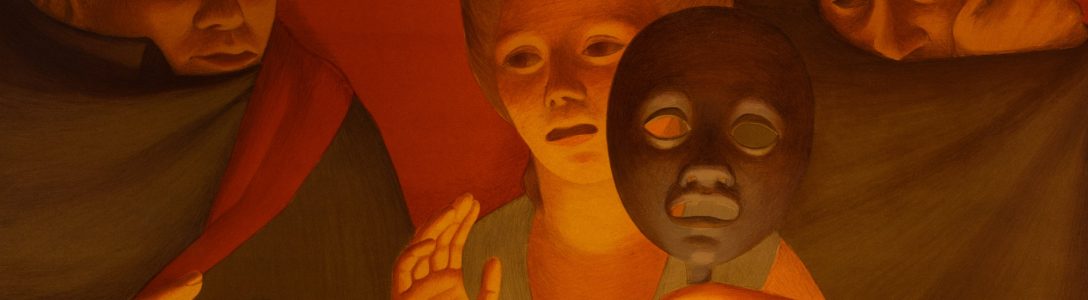
Waiting for the Barbarians — Neo Rauch

“The Girl Who Owned a Bear” — L. Frank Baum

“The Girl Who Owned a Bear” by L. Frank Baum

Mamma had gone down-town to shop. She had asked Nora to look after Jane Gladys, and Nora promised she would. But it was her afternoon for polishing the silver, so she stayed in the pantry and left Jane Gladys to amuse herself alone in the big sitting-room upstairs.

The little girl did not mind being alone, for she was working on her first piece of embroidery—a sofa pillow for papa’s birthday present. So she crept into the big bay window and curled herself up on the broad sill while she bent her brown head over her work.

Soon the door opened and closed again, quietly. Jane Gladys thought it was Nora, so she didn’t look up until she had taken a couple more stitches on a forget-me-not. Then she raised her eyes and was astonished to find a strange man in the middle of the room, who regarded her earnestly.

He was short and fat, and seemed to be breathing heavily from his climb up the stairs. He held a work silk hat in one hand and underneath his other elbow was tucked a good-sized book. He was dressed in a black suit that looked old and rather shabby, and his head was bald upon the top.

“Excuse me,” he said, while the child gazed at him in solemn surprise. “Are you Jane Gladys Brown?”

“Yes, sir,” she answered.

“Very good; very good, indeed!” he remarked, with a queer sort of smile. “I’ve had quite a hunt to find you, but I’ve succeeded at last.”

“How did you get in?” inquired Jane Gladys, with a growing distrust of her visitor.

“That is a secret,” he said, mysteriously.

This was enough to put the girl on her guard. She looked at the man and the man looked at her, and both looks were grave and somewhat anxious.

“What do you want?” she asked, straightening herself up with a dignified air.

“Ah!—now we are coming to business,” said the man, briskly. “I’m going to be quite frank with you. To begin with, your father has abused me in a most ungentlemanly manner.”

Jane Gladys got off the window sill and pointed her small finger at the door.

“Leave this room ‘meejitly!” she cried, her voice trembling with indignation. “My papa is the best man in the world. He never ‘bused anybody!” Continue reading ““The Girl Who Owned a Bear” — L. Frank Baum”

St. Cecilia — John William Waterhouse

Spellbound — Alfred Hitchcock (Full Film)

“Poem Written in a Copy of Beowulf” — Jorge Luis Borges

jlb

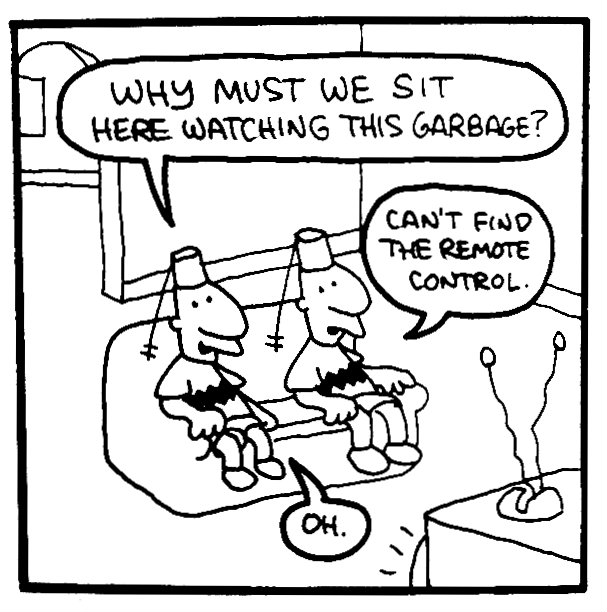
Garbage (Life in Hell)

garbage

EBB — Kaye Donachie

(More/via).

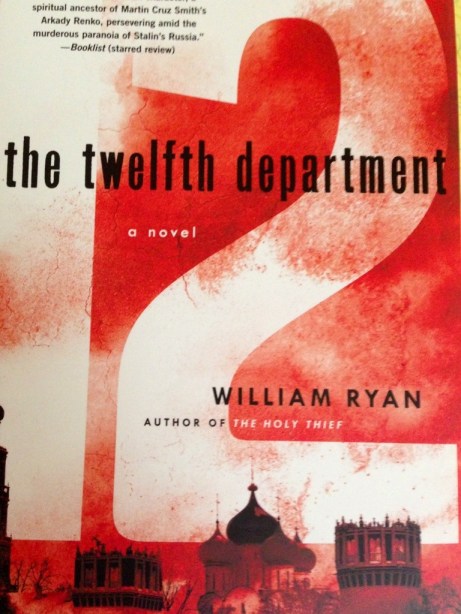
The Twelfth Department (Book Acquired, Sometime Last Week)

20130621-194131.jpg


The Twelfth Apartment is a forthcoming thriller from William Ryan. Macmillan’s blurb:

The new Captain Korolev mystery set in 1930s Stalinist Russia, from the lauded author of The Holy Thief and The Bloody Meadow

Moscow, 1937. Captain Korolev, a police investigator, is enjoying a long-overdue visit from his young son Yuri when an eminent scientist is shot dead within sight of the Kremlin and Korolev is ordered to find the killer.

It soon emerges that the victim, a man who it appears would stop at nothing to fulfil his ambitions, was engaged in research of great interest to those at the very top ranks of Soviet power. When another scientist is brutally murdered, and evidence of the professors’ dark experiments is hastily removed, Korolev begins to realise that, along with having a difficult case to solve, he’s caught in a dangerous battle between two warring factions of the NKVD. And then his son Yuri goes missing . . .

A desperate race against time, set against a city gripped by Stalin’s Great Terror and teeming with spies, street children and Thieves, The Twelfth Department confirms William Ryan as one of the most compelling historical crime novelists at work today.


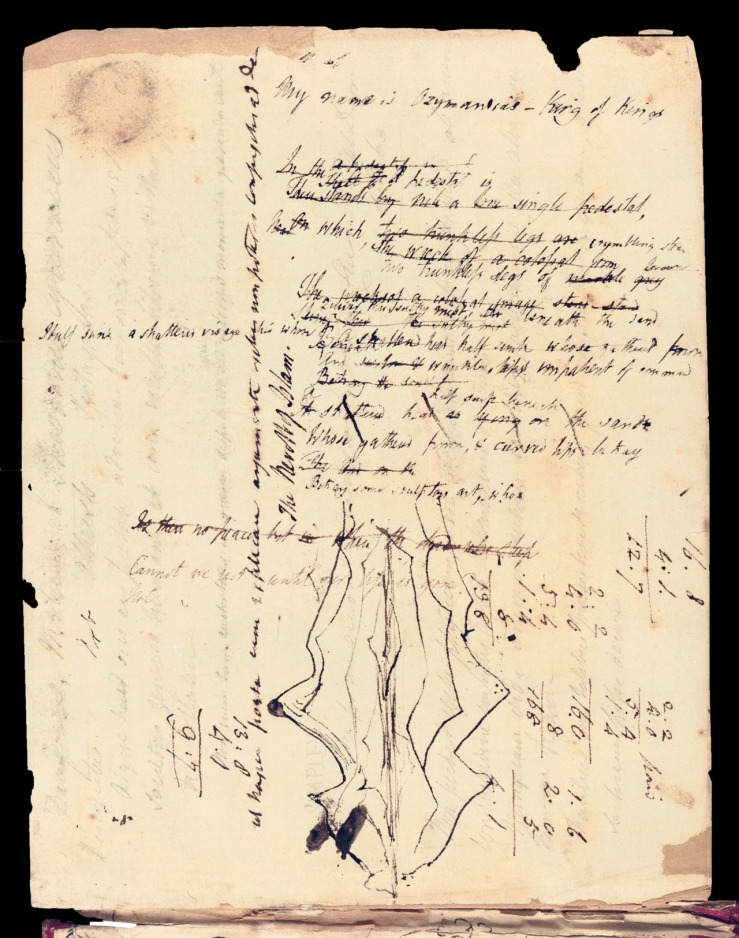
Percy Bysshe Shelley’s Manuscript for “Ozymiandias”

shelley manuscript

“Ozymandias” by Percy Shelley—

I met a traveller from an antique land,
Who said — “two vast and trunkless legs of stone
Stand in the desert … near them, on the sand,
Half sunk a shattered visage lies, whose frown,
And wrinkled lips, and sneer of cold command,
Tell that its sculptor well those passions read
Which yet survive, stamped on these lifeless things,
The hand that mocked them, and the heart that fed;
And on the pedestal these words appear:
My name is Ozymandias, King of Kings,
Look on my Works ye Mighty, and despair!
Nothing beside remains. Round the decay
Of that colossal Wreck, boundless and bare
The lone and level sands stretch far away.” —

(Via).


Truman Capote (1954) — Andy Warhol

Maria — Helene Schjerfbeck

A Midsummer Night’s Dream (1935)

“Insect Life of Florida” — Lynda Hull

“Insect Life of Florida” by Lynda Hull

In those days I thought their endless thrum
   was the great wheel that turned the days, the nights.
      In the throats of hibiscus and oleander


I’d see them clustered yellow, blue, their shells
   enameled hard as the sky before the rain.
      All that summer, my second, from city


to city my young father drove the black coupe
   through humid mornings I’d wake to like fever
      parceled between luggage and sample goods.


Afternoons, showers drummed the roof,
   my parents silent for hours. Even then I knew
      something of love was cruel, was distant.


Mother leaned over the seat to me, the orchid
   Father’d pinned in her hair shriveled
      to a purple fist. A necklace of shells


coiled her throat, moving a little as she
   murmured of alligators that float the rivers
      able to swallow a child whole, of mosquitoes


whose bite would make you sleep a thousand years.
   And always the trance of blacktop shimmering
      through swamps with names like incantations—


Okeefenokee, where Father held my hand
   and pointed to an egret’s flight unfolding
      white above swamp reeds that sang with insects


until I was lost, until I was part
   of the singing, their thousand wings gauze
      on my body, tattooing my skin.


Father rocked me later by the water,
   the motel balcony, singing calypso
      with the Jamaican radio. The lyrics


a net over the sea, its lesson
   of desire and repetition. Lizards flashed
      over his shoes, over the rail


where the citronella burned merging our
   shadows—Father’s face floating over mine
      in the black changing sound


of night, the enormous Florida night,
   metallic with cicadas, musical
      and dangerous as the human heart.

Harry Grant Dart Painting

harry grant dart

(Via/about).

Riff on Goya’s Painting Highwaymen Attacking a Coach

highwaymen-attacking-a-coach-1787

1. Francisco Goya’s Asalto de ladrones — Highwaymen Attacking a Coach in Ingles, 1786-87. Oil on canvas. 169 by 127 cm. Currently in some lucky soul’s private collection.

2. I love this painting.

3. It’s easy—and probably correct—to call Goya’s work dark. We can see that in his engraving series The Disasters of War and Caprichos, or his famous works Third of May 1808 or Saturn Devouring His Son. And the darkness, the heaviness, in these works, isn’t just in the subject but also on the canvas, in the grooves of the etchings. The blacks and browns blister; the acid goes to work.

4. It would be wholly wrong to suggest that Goya only painted the dark—but even his most joyful paintings, like Playing at Giants or The Swing contain a dark kernel. (Or, perhaps, maybe I find that kernel there, suggested by his oeuvre).

5. The blue skies of Playing at Giants and The Swing both pale in comparison to the top third of Highwaymen Attacking a Coach.

1

That beautiful bright blue sky is somehow the darkest aspect of this very dark painting, a terrible, terrible joke, an ironic reminder of glorious nature’s inglorious indifference to misery, suffering, murder, rape.

6. Moving down—the tree: long, twisting, phallically jutting into the blue sky. It seems to crookedly shift in the wind. Softly echoed by those happy little clouds it takes us down to the vernal forest floor, where we seem to be just-off-the-beaten-path.

2

7. I’ll admit to a certain fascination with the concept of highway robbery—the perils of the path, the road as a dangerous place, Barry Lyndon, Robin Hood, etc.—but what Goya gives us here is shock and horror.

8. If we continue to move our eyes down from that blue sky, we find, just off-center, a gun-wielding usurper perched on a lovely gilded carriage, its mules patiently stalled.

3

9. Left to right: Murder victim number one, his jacket open, torn, his ribs and breast bloodied—he’s already a corpse, but his naked skin suggests something even more sinister.

4

10. Just beside victim number one, a passenger fights for his life against a bandit brandishing a knife. Their twisted, violent grappling prefigures the threat of rape that lurks under the painting.

5

11. To the right of this strange couple, another couple—aristocratic mother-father team—plead for their lives, their palms facing up to that blue sky. The man’s cloak is earth-brown, and the woman’s cape black, but between them rests—I don’t know? Some pink bundle. The hem of the woman’s dress? Something bloodied? The suggestion of infanticide?

6

12. We find their guard uselessly sprawled to the right, his worthless sword neatly parallel to the gun under the grappling couple, blood trickling from under his blood-red coat. As Robert Hughes points out in his long biography of Goya, the guard’s corpse figures “the same pose that Goya would repeat several times in future drawings and paintings to indicate a dead body, so that it became part of his shorthand for death”; Hughes goes on to remind us that this sprawl is the same one we can see of “the dead man facedown to the left of the French firing squad in the Tres de Mayo, his hands scrabbling palms-down to the earth.”

7

13. Immediately above the guard, and to the viewer’s left of him, stands his likely assassin, his chest bared and his gun (jutting from the pelvis) now confidently trained on our hapless couple.

8

14. Gunman #2 is not half so menacing though as his partner who occupies the low dark center of the painting.

9

His hat cocked ever-so-slightly to the right, this central bandit, clothed in greenish-gold garb, raises a rope in his left hand. The rope signifies every awful kind of horror the viewer cares (“cares” is not the right verb) to imagine, but it’s the action that bandit performs with his right hand that is somehow the most menacing gesture of the painting: We can almost hear him coo, “Shhhhhhhh…”

15. And our poor victims? Their hands up, in supplication, what do they have to look to? Perhaps, like the attendant viewer, they return to the sky blue sky.

z

Seated Figure of Summer — Giuseppe Arcimboldo

“The Snow Child” — Angela Carter

“The Snow Child” by Angela Carter

Midwinter — invincible, immaculate. The Count and his wife go riding, he on a grey mare and she on a black one, she wrapped in the glittering pelts of black foxes; and she wore high, black, shining boots with scarlet heels, and spurs. Fresh snow fell on snow already fallen; when it ceased, the whole world was white. “I wish I had a girl as white as snow,” says the Count. They ride on. They come to a hole in the snow; this hole is filled with blood. He says: “I wish I had a girl as red as blood.” So they ride on again; here is a raven, perched on a bare bough. “I wish I had a girl as black as that bird’s feathers.”

As soon as he completed her description, there she stood, beside the road, white skin, red mouth, black hair and stark naked; she was the child of his desire and the Countess hated her. The Count lifted her up and sat her in front of him on his saddle but the Countess had only one thought:how shall I be rid of her?

The Countess dropped her glove in the snow and told the girl to get down to look for it; she meant to gallop off and leave her there but the Count said: “I’ll buy you new gloves.” At that, the furs sprang off the Countess’s shoulders and twined round the naked girl. Then the Countess threw her diamond brooch through the ice of a frozen pond: “Dive in and fetch it for me,” she said; she thought the girl would drown. But the Count said: “Is she a fish to swim in such cold weather?” Then her boots leapt off the Countess’s feet and on to the girl’s legs. Now the Countess was bare as a bone and the girl furred and booted; the Count felt sorry for his wife. They came to a bush of roses, all in flower. “Pick me one,” said the Countess to the girl. “I can’t deny you that,” said the Count.

So the girl picks a rose; pricks her finger on the thorn; bleeds; screams; falls.

Weeping, the Count got off his horse, unfastened his breeches and thrust his virile member into the dead girl. The Countess reined in her stamping mare and watched him narrowly; he was soon finished.

Then the girl began to melt. Soon there was nothing left of her but a feather a bird might have dropped; a blood stain, like the trace of a fox’s kill on the snow; and the rose she had pulled off the bush. Now the Countess had all her clothes on again. With her long hand, she stroked her furs. The Count picked up the rose, bowed and handed it to his wife; when she touched it, she dropped it. “It bites!” she said.