The Reader — Wyndham Lewis

Roman Muradov’s Enigmatic Graphic Novella (In a Sense) Lost and Found Reviewed

If you regularly read The New York Times or The New Yorker, you’ve probably already seen Roman Muradov’s compelling illustrations. If you’re a fan, you also know about his strange and wonderful Yellow Zine comics (and if you don’t know them, check out his adaptation of Italo Calvino).

Muradov’s début graphic novella (In a Sense) Lost and Found was released recently by Nobrow Press, and it’s a beauty—rich, imaginative, playful, and rewarding. And it smells good.

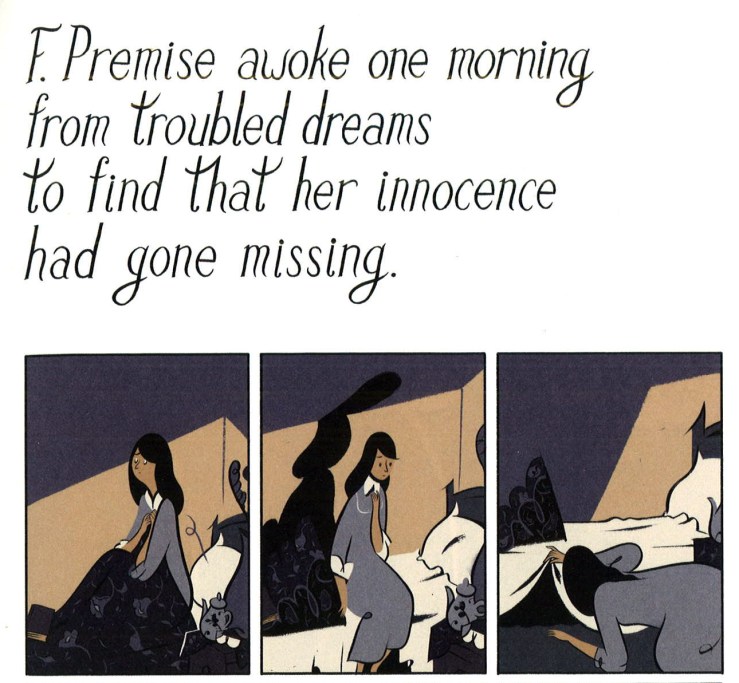
(In a Sense) Lost and Found begins with a nod to Kafka’s Metamorphosis:
8

Although we’re told by the narrative script that our heroine F. Premise (faulty premise?) “awoke,” the surreal world Muradov creates in Lost and Found suggests that those “troubled dreams” continue far into waking hours. The story runs on its own internal dream-logic, shifting into amorphous spaces without any kind of exposition to guide the reader who is, in a sense, as lost as the protagonist becomes at times on her Kafkaesque quest.

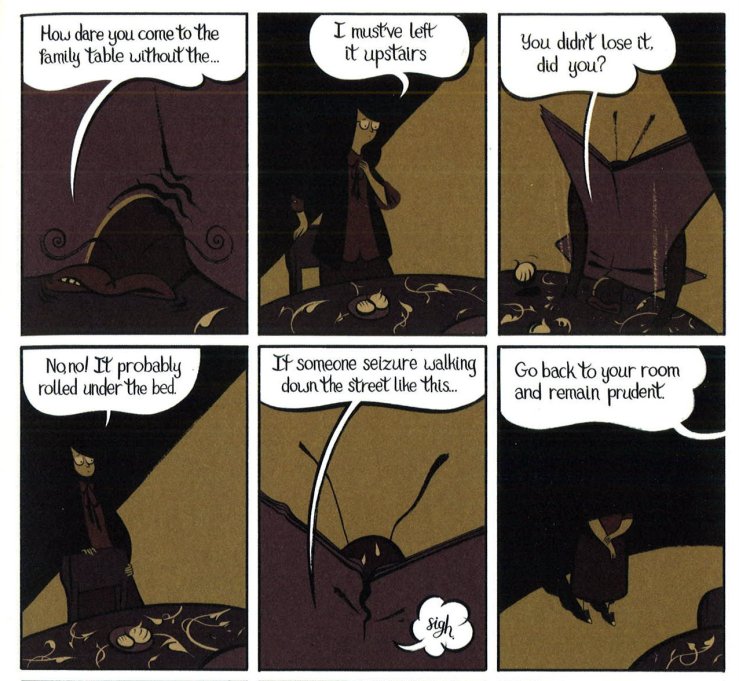
What is F. Premise’s mission? To regain her innocence, perhaps, although only the initial narrative script and the punning title allude to “innocence.” The characters seem unable or unwilling to name this object; each time they mention it, their speech trails off elliptically, as we see when Premise’s father (?) confronts her at the breakfast table:
6

Muradov’s imagery suggests Kafka’s bug again—the father’s antennae poke over the broadsheet he’s reading (the book is larded with readers), his strange mouth sagging out under it. Even more Kafkaesque though is Muradov’s refusal to reveal the father’s face, the face of authority, who sends his daughter back up to her room where she must remain locked away.

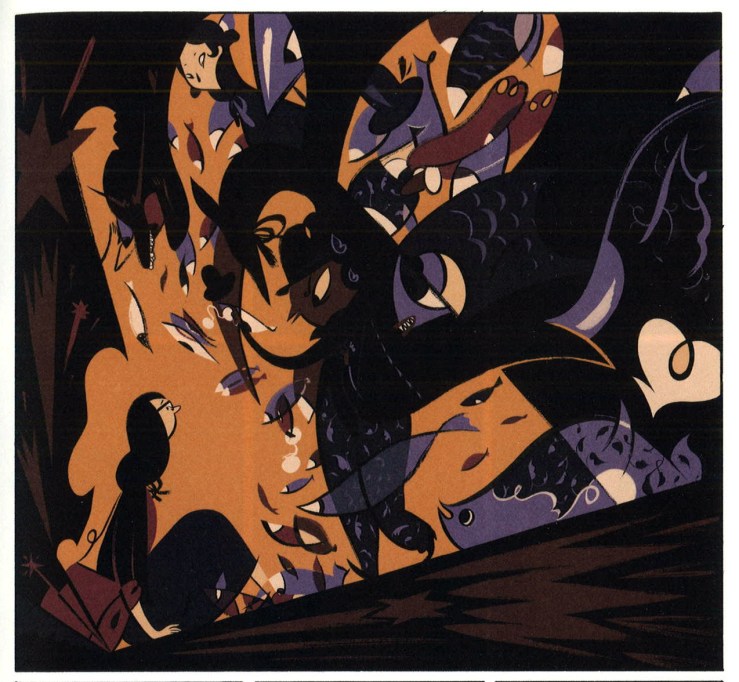
She sneaks out of course—would there be an adventure otherwise?—and it turns out that faceless father is right: F. Premise falls (literally) under the intense gaze of the community. F. Premise is startlingly present to others now by virtue of her absent virtue.
5

Muradov uses traditional nine-panel grids to tell his story, utilizing large splashes sparingly to convey the intensity of key moments in the narrative. The book brims with beautiful, weird energy, rendered in intense color and deep shadow. Muradov’s abstractions—pure shapes—cohere into representative objects only to fragment again into abstraction. (Perhaps I should switch “cohere” and “fragment” here—I may have the verbs backwards).

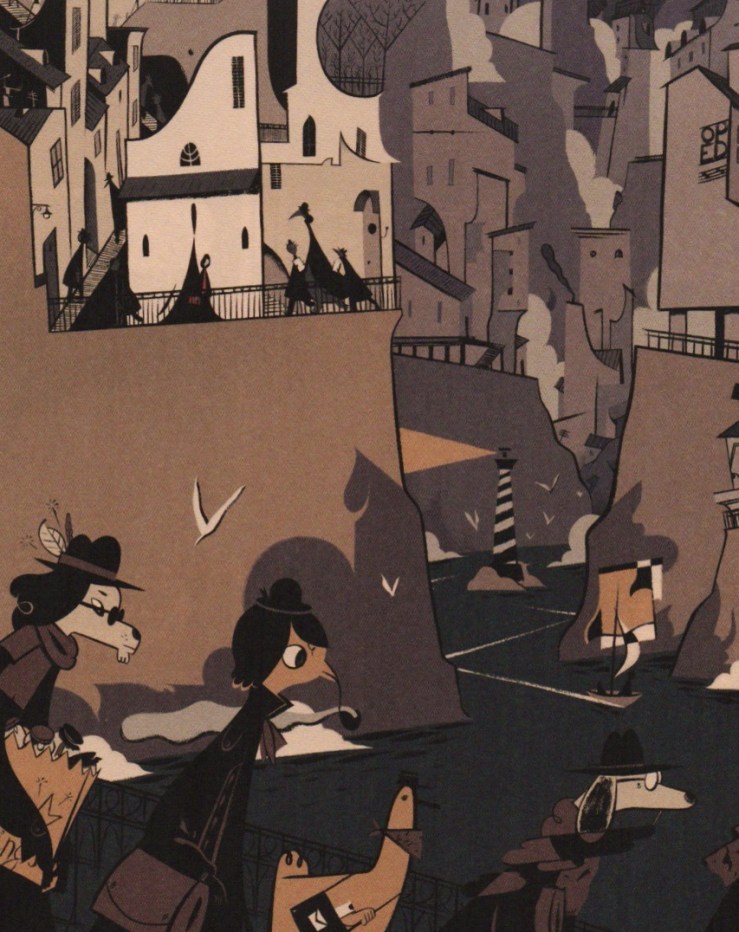
The art here seems as grounded in a kind of post-cubism as it does in the work of Muradov’s cartooning forebears. In the remarkable passage below, for example, our heroine moves from one world to another, her form nearly disappearing into complete abstraction by the fifth panel (an image that recalls Miró), before stabilizing again (if momentarily) in the sixth panel.

2

It’s in that last panel that F. Premise returns to her adopted home (of sorts)—a bookstore, of course. Earlier, the kindly owner of the bookstore loans her a pair of old plus-fours, and all of a sudden her identity shifts—or rather, the community shifts her identity, their penetrating gaze no longer trying to screw her to a particular preconception. Identity in Lost and Found is as fluid and changeable as the objects in Muradov’s haunting illustrations.

I have probably already belabored too much of the plot. Suffice to say that our heroine’s quest takes strange turns, makes radical shifts, she descends up and down and into other worlds. Embedded in the journey is a critique of nostalgia, of the commodification of memory (or, more accurately, the memory of memory). Is our innocence what we thought it was? Can we buy it back like some mass-produced object?
IMG_3292

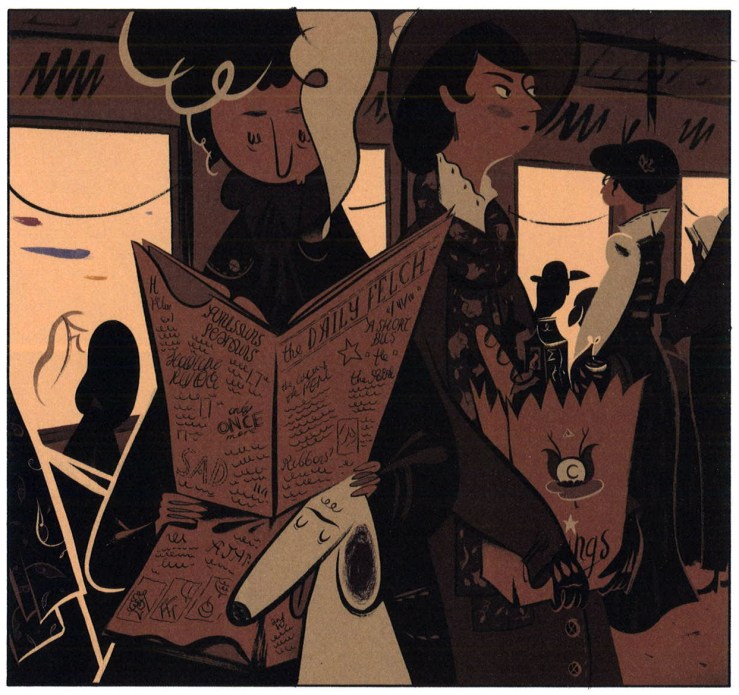
As I noted before, Lost and Found is stuffed with images of readers. There’s something almost Borgesian in the gesture, as if each background character might be on the threshold (if not right in the middle of) their own adventures.
3

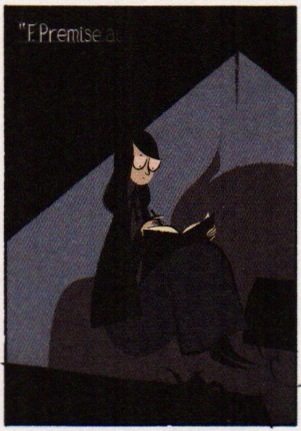
It’s in the book’s final moments though that we see a move from reading to writing: Our heroine F. Premise picks up the pen and claims agency, writes her own life. She is indeed the narrative voice after all, the imposing script that, like some all-knowing hand, guided us into the narrative in the first place, only to disappear until the end.
IMG_3293

I loved Lost and Found, finding more in its details, shadowy corners, and the spaces between the panels with each new reading. My only complaint is that I wish it were longer. The book is probably not for everyone—readers looking for a simple comic with an expository voice that will guide them through a traditional plot should probably look elsewhere. But readers willing to engage in Muradov’s ludic text will be rewarded—and even folks left scratching their heads will have to admit that the book is gorgeous, an aesthetic experience unto itself. And it smells good. Highly recommended.
 

David Bowie, Brian Eno and Tony Visconti Record “Warszawa”

(By the Brothers McLeod).

Does Werner Herzog subscribe to the belief that his films are art?

So you certainly don’t subscribe to the belief that your films are in any way ‘art films’?

Absolutely not, they are no such thing. I dislike intensely even the concept of artists in this day and age. The last King of Egypt, King Farouk, completely obese in exile, wolfing one lamb leg after another, said something very beautiful: ‘There are no kings left in the world any more, only the King of Hearts, the King of Diamonds, the King of Spades, and the King of Clubs.’ The whole concept of being an artist is also somehow outdated today. There is only one place left where you find artists: the circus. There you can find the trapeze artists, the jugglers, even the hunger artist. Film is not analysis, it is the agitation of the mind; cinema comes from the country fair and the circus, not from art and academicism. I truly feel that in the world of the painter or novelist or film director there are no artists. This is a concept that belongs to earlier centuries, where there was such a thing as virtue and pistol duels at dawn with men in love, and damsels fainting on couches.

Michelangelo, Caspar David Friedrich and Hercules Segers: these men are artists. ‘Art’ is a legitimate concept in their respective eras. They are like the emperors and kings who remain the crucial figures in the history of humankind and whose influence is felt even today, something that certainly cannot be said of monarchies today. I am speaking not about the death of the artist; I just feel that creativity is perceived with something of an outdated and antiquated perspective. That is why I detest the word ‘genius’. It too is a word that belongs to an earlier time and not to our own era. It is a sick concept nowadays, and this is why with utmost caution did I once call Kinski a ‘genius’. My use of the word comes close to my feelings about the man, but the expression itself and the concept behind it is something that heralds from the late eighteenth century and just does not fit comfortably today.

From Herzog on Herzog.

Reading — Claudio Bravo

reading

“God Sees the Truth, but Waits” — Leo Tolstoy

“God Sees the Truth, but Waits”

by

Leo Tolstoy

In the town of Vladimir lived a young merchant named Ivan Dmitrich
Aksionov. He had two shops and a house of his own.

Aksionov was a handsome, fair-haired, curly-headed fellow, full of fun, and very fond of singing. When quite a young man he had been given to drink, and was riotous when he had had too much; but after he married he gave up drinking, except now and then.

One summer Aksionov was going to the Nizhny Fair, and as he bade good-bye to his family, his wife said to him, “Ivan Dmitrich, do not start to-day; I have had a bad dream about you.”

Aksionov laughed, and said, “You are afraid that when I get to the fair I shall go on a spree.”

His wife replied: “I do not know what I am afraid of; all I know is that I had a bad dream. I dreamt you returned from the town, and when you took off your cap I saw that your hair was quite grey.”

Aksionov laughed. “That’s a lucky sign,” said he. “See if I don’t sell out all my goods, and bring you some presents from the fair.”

So he said good-bye to his family, and drove away.

When he had travelled half-way, he met a merchant whom he knew, and they put up at the same inn for the night. They had some tea together, and then went to bed in adjoining rooms.

It was not Aksionov’s habit to sleep late, and, wishing to travel while it was still cool, he aroused his driver before dawn, and told him to put in the horses.

Then he made his way across to the landlord of the inn (who lived in a cottage at the back), paid his bill, and continued his journey.

When he had gone about twenty-five miles, he stopped for the horses to be fed. Aksionov rested awhile in the passage of the inn, then he stepped out into the porch, and, ordering a samovar to be heated, got out his guitar and began to play.

Suddenly a troika drove up with tinkling bells and an official alighted, followed by two soldiers. He came to Aksionov and began to question him, asking him who he was and whence he came. Aksionov answered him fully, and said, “Won’t you have some tea with me?” But the official went on cross-questioning him and asking him. “Where did you spend last night? Were you alone, or with a fellow-merchant? Did you see the other merchant this morning? Why did you leave the inn before dawn?” Continue reading ““God Sees the Truth, but Waits” — Leo Tolstoy”

I had a terror since September (Emily Dickinson)

I had a terror since September, I could tell to none; and so I sing, as the boy does by the burying ground, because I am afraid.

You inquire my books. For poets, I have Keats, and Mr. and Mrs. Browning. For prose, Mr. Ruskin, Sir Thomas Browne, and the Revelations. I went to school, but in your manner of the phrase had no education. When a little girl, I had a friend who taught me Immortality; but venturing too near, himself, he never returned. Soon after my tutor died, and for several years my lexicon was my only companion. Then I found one more, but he was not contented I be his scholar, so he left the land.

You ask of my companions. Hills, sir, and the sundown, and a dog large as myself, that my father bought me. They are better than beings because they know, but do not tell; and the noise in the pool at noon excels my piano.

From an April 1862 letter Emily Dickinson wrote to Thomas Wentworth Higginson.

Cláudio nos Rochedos — Antonio Carneiro

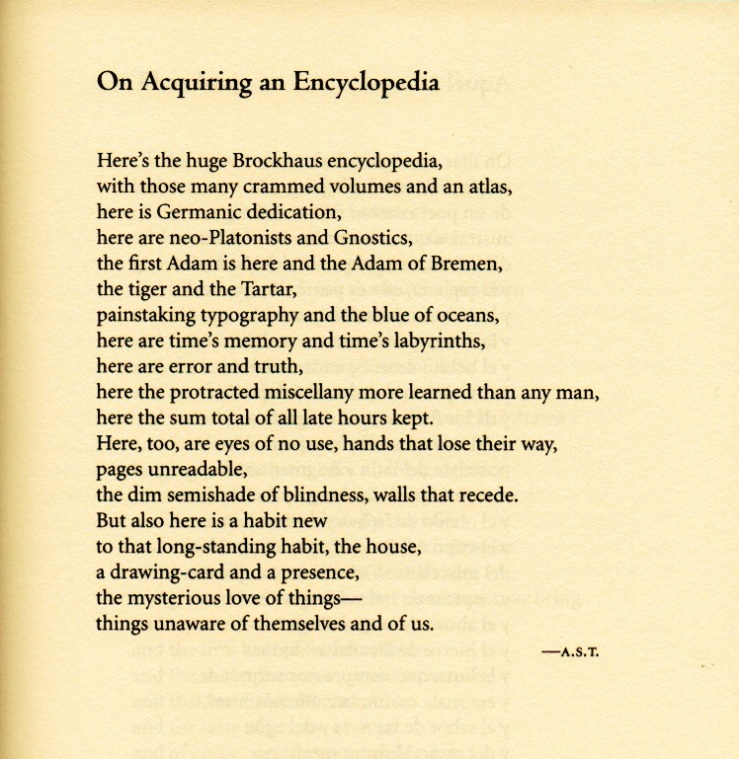
“On Acquiring an Encyclopedia” — Jorge Luis Borges

IMG_3141.JPG

Harry Dean Stanton Is Rip Van Winkle in Francis Ford Coppola’s Awful Adaptation of an American Classic

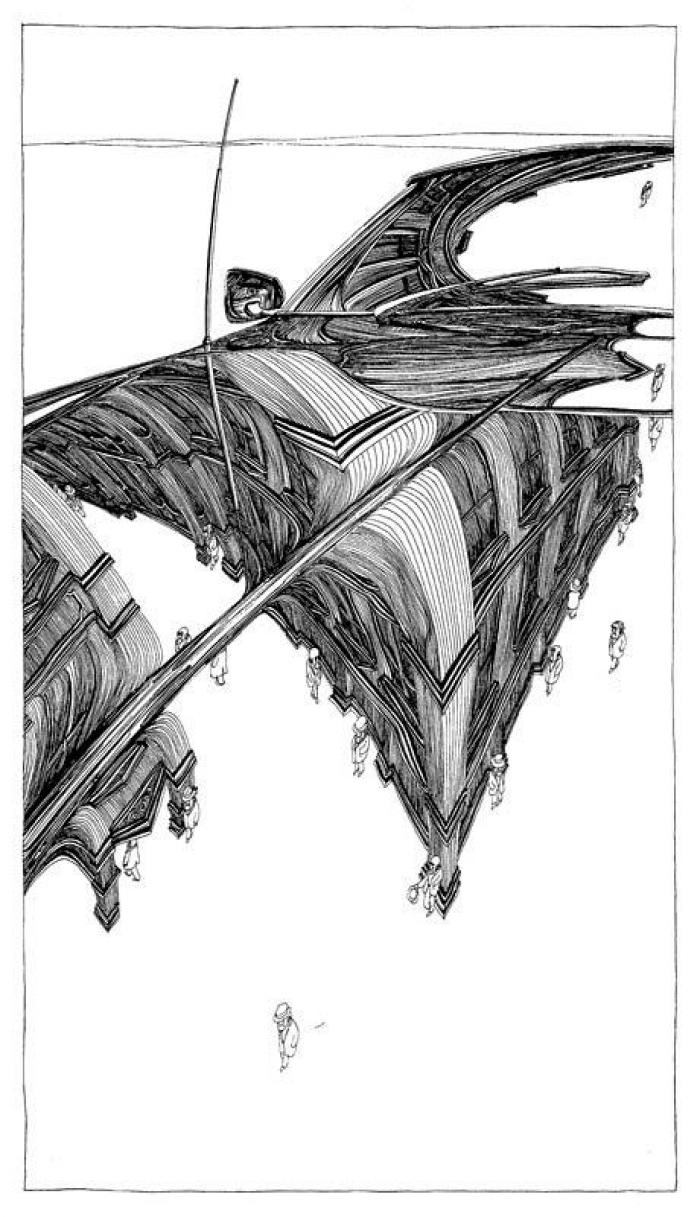
The School of Postmodernism — Vittorio Pelosi

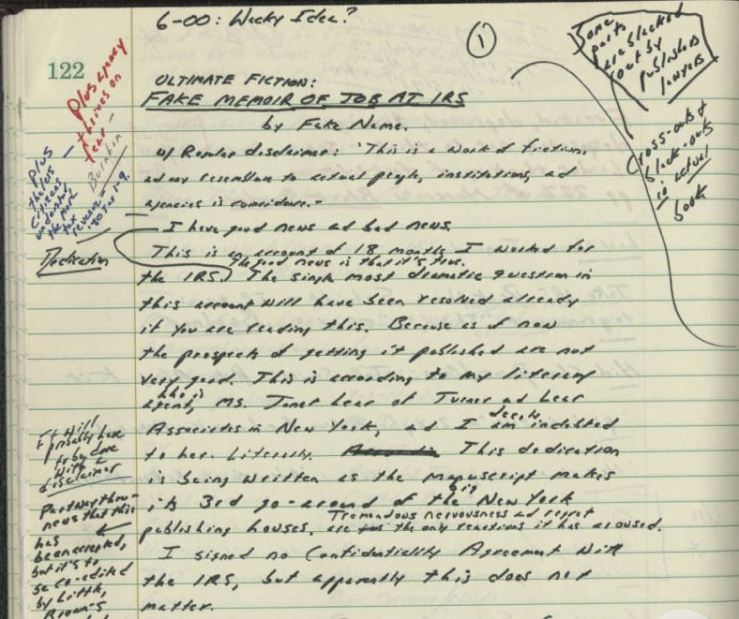
Ultimate Fiction: Fake Memoir of Job at IRS by Fake Name (David Foster Wallace Archive)

dfwThe David Foster Wallace archive at the Harry Ransom Center UT has made some documents from The Pale King accessible online, including a few pages of his workbook, handwritten drafts, and typed edits.

dfw2

(Via).


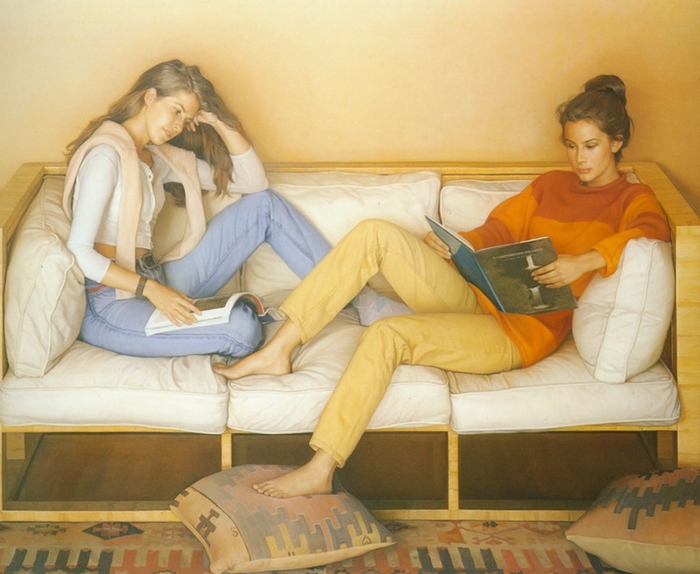
Two Friends — Claudio Bravo

Claudio Bravo - Tutt'Art@ (9)

The Holy Family — Egon Schiele

“All art constantly aspires towards the condition of music”

The ideal logotopia (William H. Gass)

In the ideal logotopia, every person would possess his own library and add at least weekly if not daily to it. The walls of each home would seem made of books; wherever one looked one would only see spines; because every real book (as opposed to dictionaries, almanacs, and other compilations) is a mind, an imagination, a consciousness. Together they compose a civilization, or even several. Utopias, however, have the bad habit of hiding in their hearts those schemes for success, those requirements of power, rules concerning conduct, which someone will one day have to carry forward, employ and enforce, in order to achieve them, and afterward, to maintain the continued purity of their Being. Books have taught me what true dominion, what right rule, is: It is like the freely given assent and labor of the reader who will dream the dreams of the deserving page and expect no more fee than the reward of its words.

From William H. Gass’s “Gutenberg’s Triumph: An Essay in Defense of the Book.”