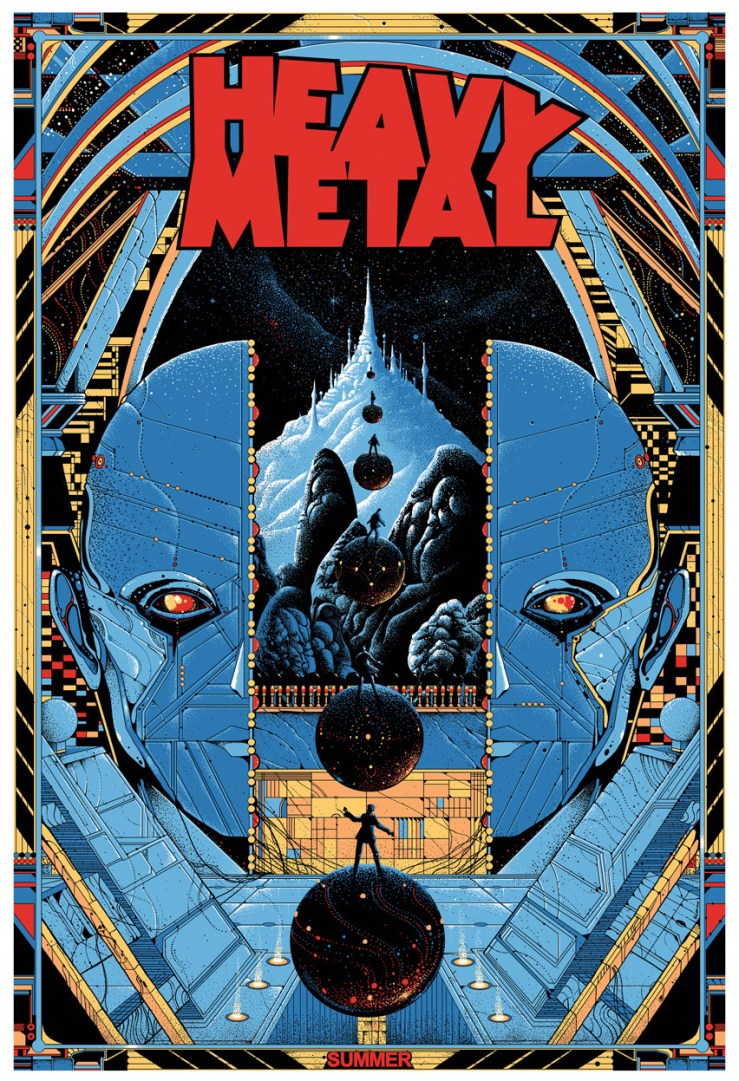
Heavy Metal — Kilian Eng

tumblr_n9acsdAPzs1qbluruo1_1280

2001: A Space Odyssey Posters by Kilian Eng

z00c

Read a new short story by Evan Lavender-Smith

Husband and wife’s children finally grown, starting their own families, etc. Out of the house at long last.

Life is all good.

Husband returns to his home improvement projects, etc., wife returns to her writing, etc.

Finally socializing again, etc.

Life is pretty good.

Life becoming less good.

Life worsening with each passing week. Husband and wife grow bored.

With each other? With monogamy? Maybe.

Go see a marriage counselor, like they did way back when. Same counselor, now older, wiser, or, at least, more confident.

Marriage counselor insists on vacuum created by kids’ absence, etc. Makes silly suggestions re how to fill vacuum. Gives them worksheets, etc.

Husband and wife diligently follow suggestions, complete worksheets. Obviously in love, or, at least, obviously committed to the idea of being in love, they try their best to make it work.

Go on vacation? A cruise? Yes.

Still bored.

Have a threeway? Maybe? No.

Still bored, etc.

Read the rest of Evan Lavender-Smith’s “Short Story Idea (The Macaque)” at BOMB.

Books Acquired (1.8.2015)

_20150108_212440

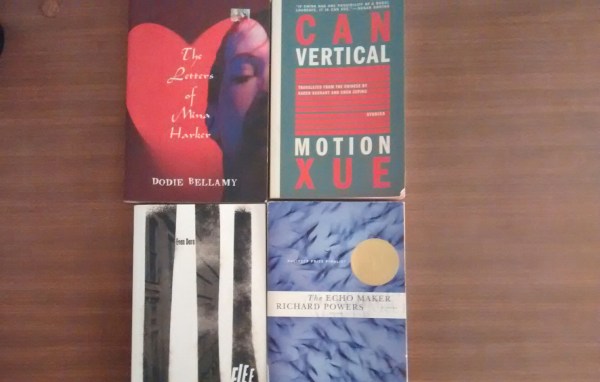
I am taking a class titled 21st-Century Fiction: What Is The Contemporary? and three of the books in this photograph are part of the reading list. Absent titles are by Dan Chaon, Kathryn Davis, Ben Marcus, Blake Butler, Sheila Heti. Some others. Wanted titles: Tao Lin’s Taipei (which I am reading now, which is surprisingly good).

I don’t know anything about Dodie Bellamy beyond the fact that she is often grouped with Kathy Acker, who are both often grouped with Dennis Cooper, who are all New Narrative people. New Narrators make the author present, her body and sexuality usually the prime subject. Letters of Mina Harker is a “sequel” to Dracula, except Mina Harker is a young woman who lives in 1980s San Francisco. On conceit alone, it reminds me of Kathy Acker’s Don Quixote: Which Was a Dream.

Richard Powers and Evan Dara are often grouped together, mainly because Powers blurbed his first book, The Lost Scrapbook, and that both of them write books that weave disparate discourses into their fiction. Also, there is speculation that Powers is Dara (Or Dara is Powers). Flee is, according to its publisher Aurora Books, about “in which a New England town does just that.” I’ve read the first chapter, titled “38,839,” and it reeks of Gaddis (in a good way). Disembodied voices colliding into each other, a cacophonous plot; the absurd & banal drama of everyday, throwaway conversation. An Australian book show on Triple R Radio, who have a good and very rare interview with Gerald Murnane (whose book Inland I was really, really jazzed on), also really loves Dara. I’m pretty excited to read this one.

Evan Dara and Richard Powers are often grouped together, mainly because Dara’s first book was blurbed by Richard Powers, and that both of them write books that weave disparate discourses into their fiction. Dara might be Powers (or Powers might be Dara?), but that doesn’t really matter. The Echo Maker is supposed to be one of those Big, Important American Books (as noted by the shallow, embossed seal on my used copy of the book). As I write this, I am listening to Powers read from The Echo Maker from an old Lannan Foundation talk (who also really love Gass) and I am really intrigued. I haven’t flipped through this, so I will reproduce the back copy.

On a winter night on a remote Nebraska road, twenty-seven-year-old Mark Schluter has a near-fatal car accident. His older sister, Karin, returns reluctantly to their hometown to nurse Mark back from a traumatic head injury. But when Mark emerges fro a coma, he believes that this woman–who looks, acts, and sounds just like his sister–is really an imposter. When Karin contacts the famous cognitive neurologist Gerald Weber for help, he diagnoses Mark as having Capgras syndrome. The mysterious nature of the disease, combined with the strange circumstances surrounding Mark’s accident, threaten to change all of their lives beyond recognition.


Can Xue (which roughly translates from Chinese, according to my mother, to “persistent & dirty snow”) is hailed by western critics to be the Chinese avant-garde heir to Kafka and Borges. Can Xue is a pen name for Deng Xiaohua. She is of my mother’s generation and her class, which means she grew up persecuted during the Cultural Revolution, which means she was sent to a “re-education camp” in the Chinese sticks and learned to farm. She taught herself English, has written criticism on Kafka and Borges. The strangeness of Kafka echoes in Xue. While the former’s strangeness arrives in the narrative with a kind of grim inevitability, the discovery of a debilitating truth lands like an obvious punchline that the reader stupidly forgets (or realizes too late, like the classic Seinfeld episode “The Comeback“), Xue’s arrives with a kind of startling innocence against the backdrop of dramatic irony. It is like watching, in Michael Haneke’s words in his great interview in The Paris Review,  a tragedy from the perspective of an idiot. The title story, “Vertical Motion,” can be read here.

Meditation on the History of Italy — Francesco Hayez

“All art constantly aspires towards the condition of music”

“The Snow Man” — Wallace Stevens

“The Snow Man” by Wallace Stevens


One must have a mind of winter
To regard the frost and the boughs
Of the pine-trees crusted with snow;


And have been cold a long time
To behold the junipers shagged with ice,
The spruces rough in the distant glitter


Of the January sun; and not to think
Of any misery in the sound of the wind,
In the sound of a few leaves,


Which is the sound of the land
Full of the same wind
That is blowing in the same bare place


For the listener, who listens in the snow,
And, nothing himself, beholds
Nothing that is not there and the nothing that is.

Woman Reading — Felix Vallotton

Félix Vallotton Tutt'Art@ (42)

The final test of truth is ridicule (H.L. Mencken)

The final test of truth is ridicule. Very few religious dogmas have ever faced it and survived. Huxley laughed the devils out of the Gadarene swine. Dowie’s whiskers broke the back of Dowieism. Not the laws of the United States but the mother-in-law joke brought the Mormons to compromise and surrender. Not the horror of it but the absurdity of it killed the doctrine of infant damnation…. But the razor edge of ridicule is turned by the tough hide of truth. How loudly the barber-surgeons laughed at Harvey—and how vainly! What clown ever brought down the house like Galileo? Or Columbus? Or Jenner? Or Lincoln? Or Darwin?… They are laughing at Nietzsche yet…

From H.L. Mencken’s Damn! A Book of Calumny.


While the real peach spoils (William H. Gass)

A dedicated storyteller, though – a true lie-minded man – will serve his history best, and guarantee its popularity, not by imitating nature, since nature’s no source of verisimilitude, but by following as closely as he can our simplest, most direct and unaffected forms of daily talk, for we report real things, things which intrigue and worry us, and such resembling gossip in a book allows us to believe in figures and events we cannot see, shall never touch, with an assurance of safety which sets our passions free. He will avoid recording consciousness since consciousness is private – we do not normally “take it down” – and because no one really believes in any other feelings than his own. However, the moment our writer concentrates on sound, the moment he formalizes his sentences, the moment he puts in a figure of speech or turns a phrase, shifts a tense or alters tone, the moment he carries description, or any account, beyond need, he begins to turn his reader’s interest away from the world which lies among his words like a beautiful woman among her slaves, and directs him toward the slaves themselves. This illustrates a basic principle: if I describe my peach too perfectly, it’s the poem which will make my mouth water…while the real peach spoils.

From William H. Gass’s essay “The Medium of Fiction.”

“When I Have Fears That I May Cease to Be” — John Keats

fears

Leda — Leonardo da Vinci

Woman Reading — Fulvio de Marinis

Marinis, Fulvio de (1971-...) Liseuse

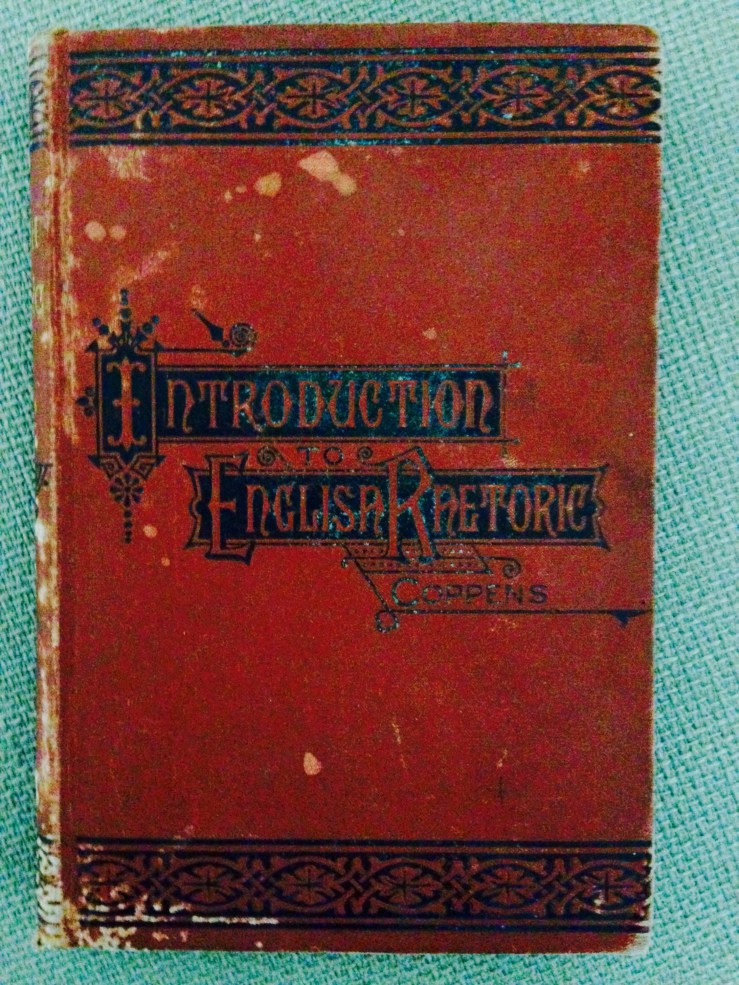
Introduction to English Rhetoric (Book acquired, 12.25.2014)

IMG_4803

For Christmas, my mother-in-law gave me Introduction to English Rhetoric (1886) by the Rev. Charles Coppens, SJ. You can read the book here.

ors: buttock, tail. Gk oura: tail.

IMG_4804

From Joseph T. Shipley’s The Origin of English Words: A Discursive Dictionary of Indo-European Roots.