Tom Pynchon was quiet and neat and did his homework faithfully. He went to Mass and confessed, though to what would be a mystery. He got $25 a week spending money and managed it perfectly, did not cut class and always got grades in the high 90’s. He was disappointed not to have been pledged to a fraternity, but he lacked the crude sociability required for that. Besides, he had his own room at Cascadilla, one of the more pleasant dormitories, not tight College Tudor tile but pre-Civil War Victorian, high-ceilinged and muted. Fraternity houses offered neither the charm nor the privacy, and he was, if anything, a very private person.
From Jules Siegel’s March 1977 Playboy profile “Who is Thomas Pynchon… And Why Did He Take Off With My Wife?” Steven Weisenburger references the article a few times in his Companion, so I gave it a Googlin’.
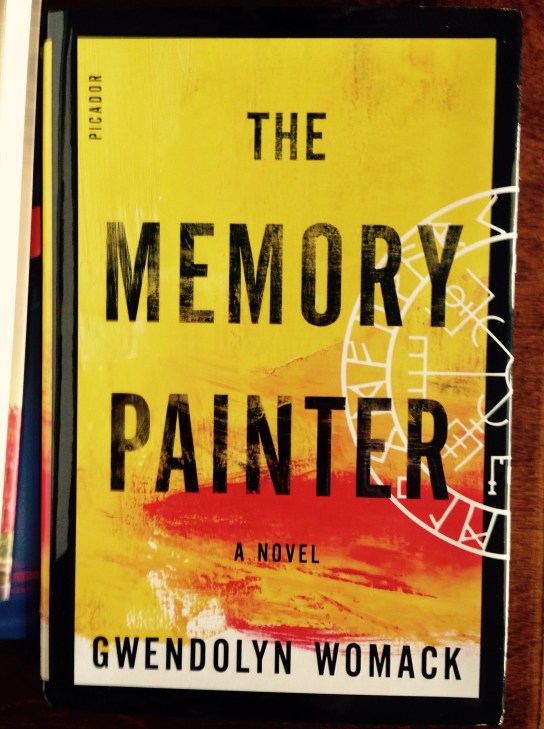
Gwendolyn Womack’s novel The Memory Painter is new in hardback from Picador. Their blurb:
Bryan Pierce is an internationally famous artist whose paintings have dazzled the world. But there’s a secret to his success: Every canvas is inspired by an unusually vivid dream. When Bryan awakes, he possesses extraordinary new skills…like the ability to speak obscure languages and an inexplicable genius for chess. All his life, he has wondered if his dreams are recollections, if he is re-experiencing other people’s lives. Linz Jacobs is a brilliant neurogeneticist, absorbed in decoding the genes that help the brain make memories, until she is confronted with an exact rendering of a recurring nightmare at one of Bryan’s shows. She tracks down the elusive artist, and their meeting triggers Bryan’s most powerful dream yet: visions of a team of scientists who, on the verge of discovering a cure for Alzheimer’s, died in a lab explosion decades ago.As Bryan becomes obsessed with the mysterious circumstances surrounding the scientists’ deaths, his dreams begin to reveal what happened at the lab, as well as a deeper mystery that may lead all the way to ancient Egypt. Together, Bryan and Linz start to discern a pattern. But a deadly enemy watches their every move, and he will stop at nothing to ensure that the past stays buried.A taut thriller and a timeless love story spanning six continents and 10,000 years of history, The Memory Painterby Gwendolyn Womack is a riveting debut novel unlike any you’ve ever read.
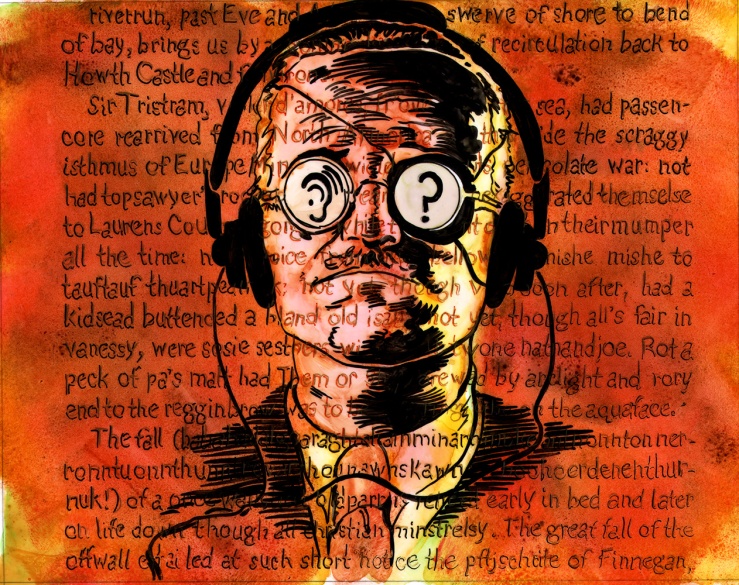
I recently talked to Derek Pyle about his project Waywords and Meansigns, which adapts James Joyce’s novel Finnegans Wake into a new musical audiobook. Derek worked for years as half of Jubilation Press. Printing the poems of Lawrence Ferlinghetti, Thich Nhat Hanh, and William Stafford, Derek’s letterpress work can be found in the special collections of the New York Public Library, Brown University, and the Book Club of California. Derek co-founded Waywords and Meansigns in 2014 and became the project’s primary director in 2015. While living part-time in Western Massachusetts, Derek produces Waywords and Meansigns in eastern Canada.
Image by Robert Berry
Biblioklept: What is Waywords and Meansigns?
Derek Pyle: Waywords and Meansigns is a collaborative music project recreating James Joyce’s Finnegans Wake. Seventeen different musicians from all around world have each taken a chapter of Finnegans Wake and set it to music, thereby creating an unabridged audio version of Finnegans Wake.
Finnegans Wake is an incredible book, but it’s notoriously difficult to read. One hope of the project is to create a version of the Wake that is accessible to newcomers — people can just listen to and enjoy the music. To maximize accessibility, we are distributing all the audio freely via our website. But the project does not only appeal to Wake newcomers — as we’ve seen so far, a lot of scholars and devoted readers are also finding Waywords and Meansigns an exciting way of interpreting and engaging with Joyce’s text.
Biblioklept: How did the project come about?
DP: In 2014 I organized a party to celebrate the 75th anniversary of the publication of Finnegans Wake. To celebrate we decided to listen to Patrick Healy’s audiobook recording of Finnegans Wake, which is 20-odd hours long. The party, as you can imagine, lasted all weekend — we actually listened to Johnny Cash’s unabridged reading of the New Testament that weekend too. There was very little sleep, and fair amount of absinthe.
A lot of people really rag on Healy’s recording, because it’s read at breakneck speed. I actually like it though — he creates a very visceral flood of experience, which is one way of reading, or interpreting, Finnegans Wake. But during the party I started wondering about other ways you could perform the text, and that’s when I came up with the idea of approaching musicians to create a new kind of audiobook.
As it turns out, a lot of people seemed to think my idea was a good one. We’ve had no shortage of musicians willing to contribute, including some really cool cats like Tim Carbone of Railroad Earth and bassist Mike Watt, who currently plays in Iggy Pop’s band The Stooges.
Biblioklept: Watt rules! I love the Minutemen and his solo stuff. He seems like a natural fit for this kind of project, as so much of his music is based around story telling. I imagine the musicians involved are composing the music themselves…are they also recording it themselves?
DP: Yeah, it’s very cool to have Watt on board. Turns out he’s a huge fan of Joyce — he recorded a track for Fire Records in 2008, for an album of various musicians turning the poems of Joyce’s Chamber Music into songs. Mary Lorson, of the bands Saint Low and Madder Rose, also played on that Fire Records album, and she’s collaborating with author Brian Hall for our project.
To answer your question, yes, all the musicians are recording their own chapters. Since we have contributors from all around the world — from Berlin to Amsterdam to British Columbia — it would be a logistical nightmare to figure out where and when to record everyone. Not to mention the cost of it. One of the really cool things, I think, about this project — for everyone, it’s a labor of love. No one is making a profit, off any of this. People are just doing it because they love Joyce, or they’re obsessed with Finnegans Wake, or it just seems like a fun challenge to think creatively in this unique way. Either way it’s a pursuit of passion. That’s why we will distribute all the audio freely. There’s this phrase in Finnegans Wake, “Here Comes Everybody!” We’re having fun with Finnegans Wake and everybody is invited to the party. Continue reading “Derek Pyle Discusses Waywords and Meansigns, an Unabridged Musical Adaptation of James Joyce’s Finnegans Wake”→
Between end of term papers and Gravity’s Rainbow, I’ve been a bit too busy to do more than glance at a lot of the review copies that have been coming in this month. But Ronald Fraser’s forthcoming novel Drought looks interesting.
Fraser, a British historian, was the founder of New Left Books, now Verso Books—publisher of Drought.Verso’s blurb:
A brilliant novel about memory, love, and the clash between the old world and the new, set in 1950s Spain
“He turned his back on the old man to mourn in silence this unnecessary death and his part in it; but the sight of the coffin brought anger instead …”
In 1957, burned-out journalist John leaves London to recover in the Andalusian haven of Benalamar. Here he finds a village that has not changed since the Civil War, but when a foreign businessman, Bob, comes with plans to develop the area, the community is sent into turmoil. As a time of drought threatens, Bob promises to build a reservoir but this has unforeseen consequences. When a local farmer, Miguel, commits suicide, John is sent off on an investigation that leads back into recent history, lost love, and civil war.
“The Girls of Herland,” below, is Chapter 8 of Charlotte Perkins Gilman’s 1915 novel Herland, a feminist utopian novel that was serialized during its author’s lifetime, but not published in one volume until 1979. This chapter can, I believe, stand alone or serve even as an introduction even to Herland, depsite coming rather late in the text, but readers who wish more context/want the whole thing can legally download Herland via Project Gutenburg.
***
“The Girls of Herland”
by
Charlotte Perkins Gilman
At last Terry’s ambition was realized. We were invited, always courteously and with free choice on our part, to address general audiences and classes of girls.
I remember the first time—and how careful we were about our clothes, and our amateur barbering. Terry, in particular, was fussy to a degree about the cut of his beard, and so critical of our combined efforts, that we handed him the shears and told him to please himself. We began to rather prize those beards of ours; they were almost our sole distinction among those tall and sturdy women, with their cropped hair and sexless costume. Being offered a wide selection of garments, we had chosen according to our personal taste, and were surprised to find, on meeting large audiences, that we were the most highly decorated, especially Terry.
He was a very impressive figure, his strong features softened by the somewhat longer hair—though he made me trim it as closely as I knew how; and he wore his richly embroidered tunic with its broad, loose girdle with quite a Henry V air. Jeff looked more like—well, like a Huguenot Lover; and I don’t know what I looked like, only that I felt very comfortable. When I got back to our own padded armor and its starched borders I realized with acute regret how comfortable were those Herland clothes.
We scanned that audience, looking for the three bright faces we knew; but they were not to be seen. Just a multitude of girls: quiet, eager, watchful, all eyes and ears to listen and learn.
The art of losing isn’t hard to master;
so many things seem filled with the intent
to be lost that their loss is no disaster.

Lose something every day. Accept the fluster
of lost door keys, the hour badly spent.
The art of losing isn’t hard to master.

Then practice losing farther, losing faster:
places, and names, and where it was you meant
to travel. None of these will bring disaster.

I lost my mother’s watch. And look! my last, or
next-to-last, of three loved houses went.
The art of losing isn’t hard to master.

I lost two cities, lovely ones. And, vaster,
some realms I owned, two rivers, a continent.
I miss them, but it wasn’t a disaster.


—Even losing you (the joking voice, a gesture
I love) I shan’t have lied.  It’s evident
the art of losing’s not too hard to master
though it may look like (Write it!) like disaster.








 Biblioklept