A Jester — Marx Reichlich

1520-MARX-REICHLICH-A-JESTER

Nothing music (William Gaddis)

—No it’s all right . . . he’d brought his eyes up sharply from the loose collar of her blouseless suit, more the appeal of asking a favor than granting one in his tone—that was when he was old though, Wagner I mean, when Wagner was old and . . .

—Yes but that’s what you meant isn’t it, about creating an entirely different world when you write an opera, about asking the audience to suspend its belief in the . . .

—No not asking them making them, like that E flat chord that opens the Rhinegold goes on and on it goes on for a hundred and thirty-six bars until the idea that everything’s happening under water is more real than sitting in a hot plush seat with tight shoes on and . . .

—Mrs Joubert could I have a dime?

—I think you’ve had enough to eat Debby, we’re . . .

—It’s Linda.

—Linda yes I’m sorry, where’s your sweater.

—Over on the table, I don’t want to eat they said it costs a dime to go to the toilet here, you have to put a dime in to get in the . . .

—Yes yes all right if, oh thank you again we must be taking every penny you.

—No no it’s all right I’ve, I’d put some aside for the union and when they wouldn’t take me, when you say you’re a concert pianist they give you as hard a score as they can find there was a drummer there and all they asked for was give us a paradiddle . . .

—But why must you join at all, if you simply want to compose . . .

—No well since this teaching was, since it didn’t really work out too well I thought if I could find some work playing I could keep on with my . . .

—Mrs Jou . . .

—Here . . .! he thrust a dime at the figure shifting rapidly foot to foot beside her,—that I could keep working on my . . .

—But couldn’t you earn something writing music for, I don’t know but there must be somewhere you could . . .

—Yes well that’s what I did, what I’m doing I mean somebody I met there, a bass player, he was on standby he’s getting paid not to play at a Broadway show they say is a musical just because it . . .

—Mis . . .

—Excuse me, boys please! You’ve just had a dollar J R you don’t need . . .

—No I know, I just wondered if Mister Bast wants me to change some nickels from a dollar for him.

—Not, no but if you’d like something?

—Some, just some tea I think, I don’t feel awfully well . . .

—Yes wait, here . . . he peeled away a bill under the table.

—And he found you something? this bass player?

—No well yes sort of indirectly, he said he wanted to help me out and sent me to a place over on the West Side where they said they wanted some nothing music, three minutes of nothing music it’s for television or something, they said they had three minutes of talk on a track or a tape they needed music behind it but it couldn’t have any real form, anything distinctive about it any sound anything that would distract from this voice this, this message they called it, they . . .

—But of all things how absurd, paying a composer to . . .

—Yes well they didn’t, I couldn’t do it I mean, they were in a hurry they would have paid me three hundred dollars and I tried and all I could, everything I did they said was too . . .

—And that’s hardly what I meant, someone being paid not to play who sends you somewhere to write nothing mus . . .

—Well what do you think I . . .! he caught one hand back with the other,—I’m sorry I, three hundred dollars all I could think of was that concerto of Mozart’s the D-minor, that’s more than he got paid for the whole series and I couldn’t even . . .

—But I think it’s marvelous, that you couldn’t write their nothing music? I mean just because you can’t get paid to play Chopin or even write music that’s . . .

—No but I am though, I didn’t finish . . . he looked up from her fingertips touching his hands clenched there,—when I left somebody else there said he’d like to help me out and sent me downtown to see some dancers who want their own music for . . .

—Boys . . .! her hand was gone,—settle down! she called after the collision at the marbled cashier’s cage—I’m sorry, we . . .

—Do you like Chopin?

—Oh of course I do yes, that ballade the Ballade in G? it’s simply the most roman . . .

—In G-minor yes that’s on the program if I could get tickets would you, it’s next week would you like to go if I can get the tickets it’s a recital by . . .

—That’s awfully sweet Mister Bast I . . .

—No well I guess I, I mean you’re married I didn’t think of that I just . . .

—That’s hardly the reason no but, I’m just afraid I can’t, I’m . . .

—No that’s all right I just, I just thought you, you wanted some tea yes I’m sorry I’ll get it . . .

—Thank you I’d, oh be careful! she’d seized his wrist.

—No I’m all right . . . he came up slowly as her hand fell away,—I’ll get it . . . he righted the chair and stood looking, turned toward the figures huddled at a table near the telephone booths foreheads almost touching, hands churning coins.

Another intersection of art and commerce in William Gaddis’s novel J R.

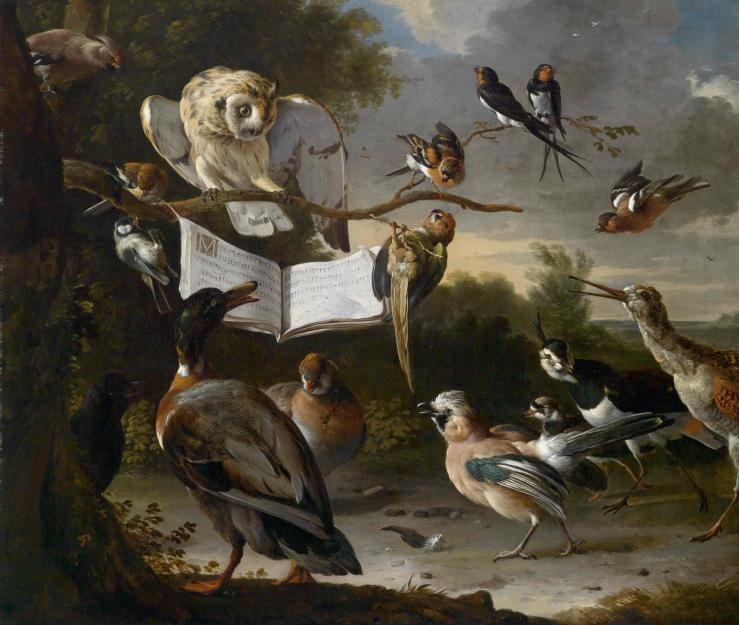
The Morning Birds — Melchior d’Hondecoeter

melchior_de_hondecoeter_-_das_vogelkonzert

The Coen Brothers talk with Guillermo del Toro about Inside Llewyn Davis

Order is simply a thin, perilous condition we try to impose on the basic reality of chaos (William Gaddis)

Before we go any further here, has it ever occurred to any of you that all this is simply one grand misunderstanding? Since you’re not here to learn anything, but to be taught so you can pass these tests, knowledge has to be organized so it can be taught, and it has to be reduced to information so it can be organized do you follow that? In other words this leads you to assume that organization is an inherent property of the knowledge itself, and that disorder and chaos are simply irrelevant forces that threaten it from the outside. In fact it’s the opposite. Order is simply a thin, perilous condition we try to impose on the basic reality of chaos . . .

So I’m going through William Gaddis’s novel J R again (via Nick Sullivan’s amazing audiobook recording-performance)…

Red Got Shanked — Andrew Hem

49_redshankedlo

Sybil — Cecil Collins

Sybil 1960 by Cecil Collins 1908-1989

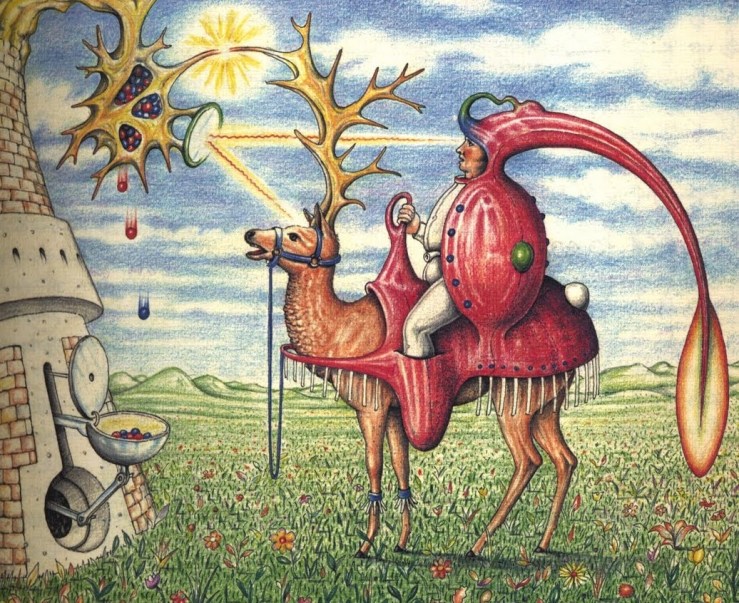
…from Codex Seraphinianus

tumblr_lxdfgkJT9s1qgwtuco1_1280

Hawksbill Turtle — Mark Catesby

catesby_natural_history_of_carolina_plate_139_hawksbill_turtle

Nile Rodgers talks about the riff for David Bowie’s “Let’s Dance”

Scene from the Apocalypse — Francis Danby

apocalyp

Some fine thoughts

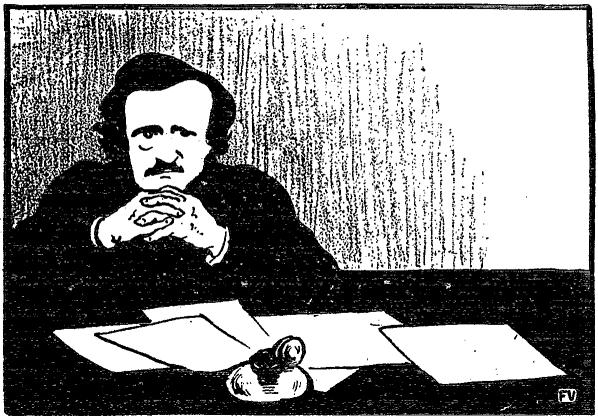
Edgar Allan Poe — Felix Vallotton

edgar-allan-poe-1895

Clown Making Up — John French Sloan

clown-making-up-1909

A riff on Ursula K. Le Guin’s Hainish novels


img_1190

“Are we not Men?”

— The Island of Dr. Moreau, H.G. Wells (1896)

“A country, a people…Those are strange and very difficult ideas.”

— Four Ways to Forgivenss, Ursula K. Le Guin (1995)

—Each of the novels in Ursula K. Le Guin’s so-called Hainish cycle obliquely addresses Wells’s question by tackling those strange and very difficult ideas of “a country, a people.” The best of these Hainish books do so in a manner that synthesizes high-adventure sci-fi fantasy with dialectical philosophy.

—What am I calling here “the best”? Well—

The Left Hand of Darkness

Planet of Exile/City of Illusions (treat as one novel in two discursive parts)

The Dispossessed

—(How oh how oh how dare I rank The Dispossessed—clearly a masterpiece, nay?—so low on that little list? It’s too dialectical, maybe? Too light on the, uh, high adventure stuff, on the fantasy and romance and sci-fi. Its ideas are too finely wrought, well thought out, expertly cooked (in contrast to the wonderful rawness of Rocannon’s World, for example). None of this is to dis The Dispossessed—it’s probably the best of the Hainish books, and the first one casual readers should attend to. (It was also the first one I read way back when in high school)).

—The novels in Le Guin’s so-called Hainish cycle are

Rocannon’s World (1966)

Planet of Exile (1966)

City of Illusions (1967)

The Left Hand of Darkness (1969)

The Dispossessed (1974)

The Word for World is Forest (1976)

Four Ways to Forgiveness (1995)

The Telling (2000)

—Okay, so I decided to include For Ways to Forgiveness in the above list even though most people wouldn’t call it a “novel” — but its four stories (novellas, really) are interconnected and tell a discrete story of two interconnected planets that are part of the Hainish world. And I pulled a quote from it above. So.

—I read, or reread, Le Guin’s so-called Hainish cycle close to the chronological order proposed by the science fiction writer Ian Watson. I don’t necessarily recommend this order.

—(I keep modifying “Hainish cycle” with “so-called” because the books aren’t really a cycle. Le Guin’s world-building isn’t analogous to Tolkien’s Middle Earth or Faulkner’s Yoknapatawpha County. (Except when her world-building is analogous). But let us return to order).

Le Guin on the subject:

People write me nice letters asking what order they ought to read my science fiction books in — the ones that are called the Hainish or Ekumen cycle or saga or something. The thing is, they aren’t a cycle or a saga. They do not form a coherent history. There are some clear connections among them, yes, but also some extremely murky ones. And some great discontinuities (like, what happened to “mindspeech” after Left Hand of Darkness? Who knows? Ask God, and she may tell you she didn’t believe in it any more.)

OK, so, very roughly, then:

Rocannon’s World, Planet of Exile, City of Illusions: where they fit in the “Hainish cycle” is anybody’s guess, but I’d read them first because they were written first. In them there is a “League of Worlds,” but the Ekumen does not yet exist.

—I agree with the author. Read this trilogy first. Read it as one strange book.

—(Or—again—pressed for time and wanting only the essential, read The Dispossessed and The Left Hand of Darkness—but you already knew that, no?).

Continue reading “A riff on Ursula K. Le Guin’s Hainish novels”

Three Books

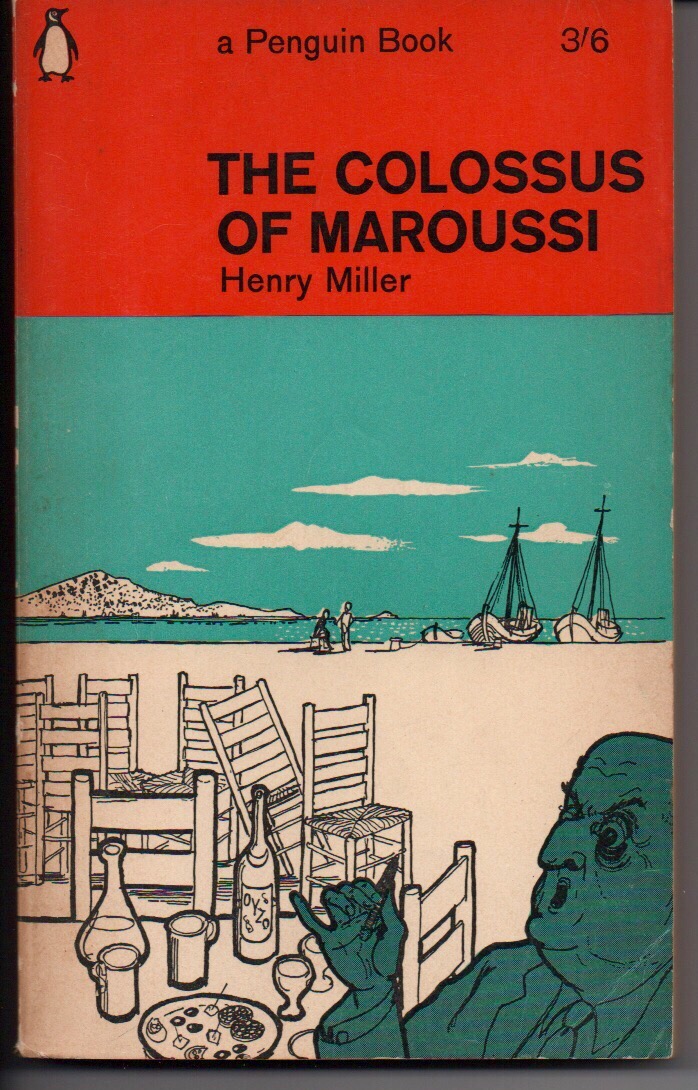
The Colossus of Maroussi by Henry Miller. 1964 paperback by Penguin Books. Cover drawing by the English cartoonist and art critic Osbert Lancaster.

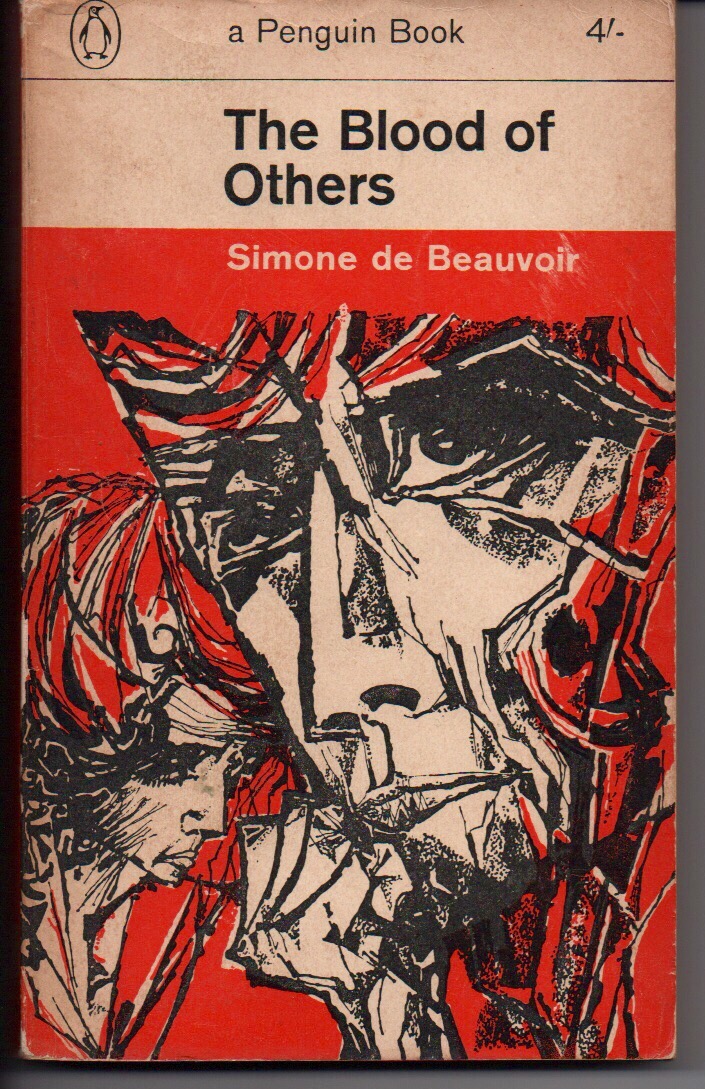
The Blood of Others by Simone de Beauvoir. 1964 paperback by Penguin Books. Cover art by Anthony Common.

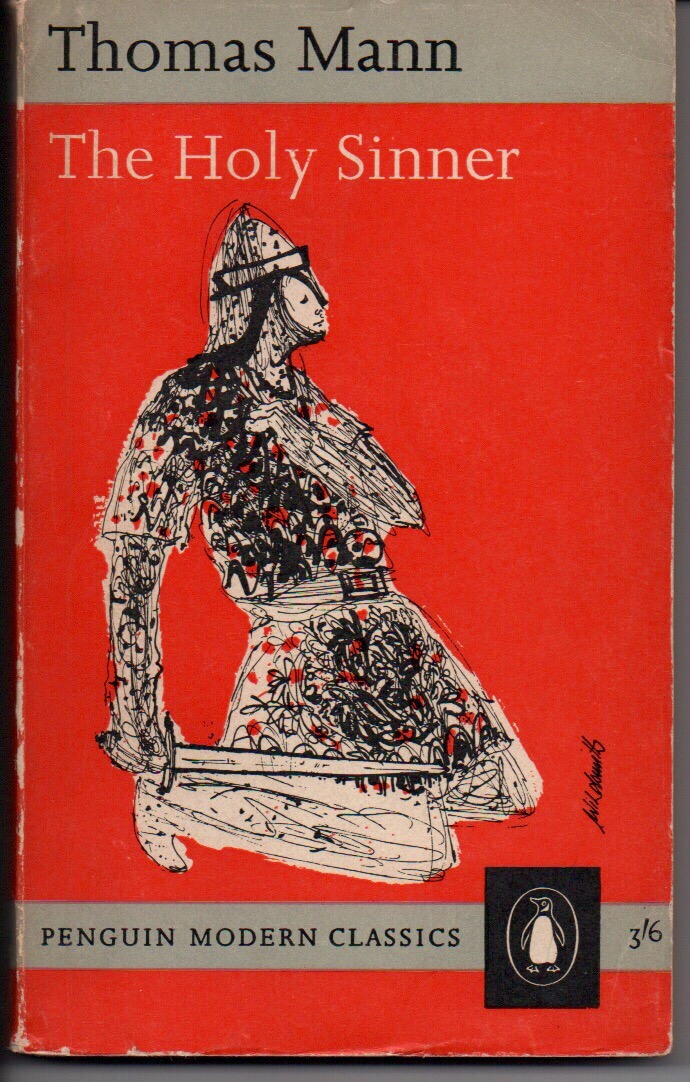
The Holy Sinner by Thomas Mann. 1961 paperback by Penguin Books. Cover art by the English artist Brian Wildsmith, who is perhaps most famous for his marvelous children’s book illustrations.

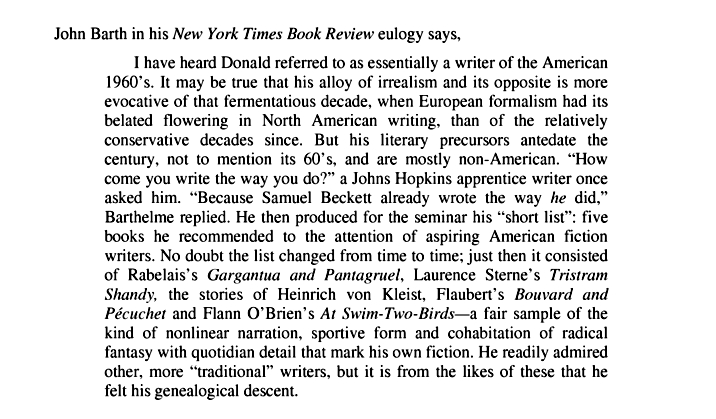
Donald Barthelme’s short list

Screenshot 2016-01-17 at 4From Michael Thomas Hudgens’s Donald Barthelme, Postmodernist American Writer