Three Books

2019-10-27_164045

Complete Tales & Poems by Edgar Allan Poe. Fat trade paperback by Vintage; most recent date indicates 1975 but that can’t be right. No designer credited.

You know Poe.

2019-10-27_164045_1-1

Tell My Horse by Zora Neale Hurston. 1983 trade paperback edition from Turtle Island. Neither designer nor photographer are credited.

A wonderful and weird trip to Jamaica and Haiti…and zombies!

2019-10-27_164045_2

From Hell by Alan Moore & Eddie Campbell. 2004 irregular-big trade paperback from Top Shelf. No designer/artist credited, but it’s clearly Campbell’s work.

One of my favorite scary novels ever. I reviewed it like a decade ago on this site. I found this postcard in it, a collage by the surealist Jacques Prévert:

2019-10-27_170449

The postcard, from James Cooke, included this text, a quote of Cormac McCarthy’s horror novel Blood Meridian:

They entered the city haggard and filthy and reeking with the blood of the citizenry for whose protection they had contracted.

James won a postcard-based contest on this site like a decade ago, god love him.


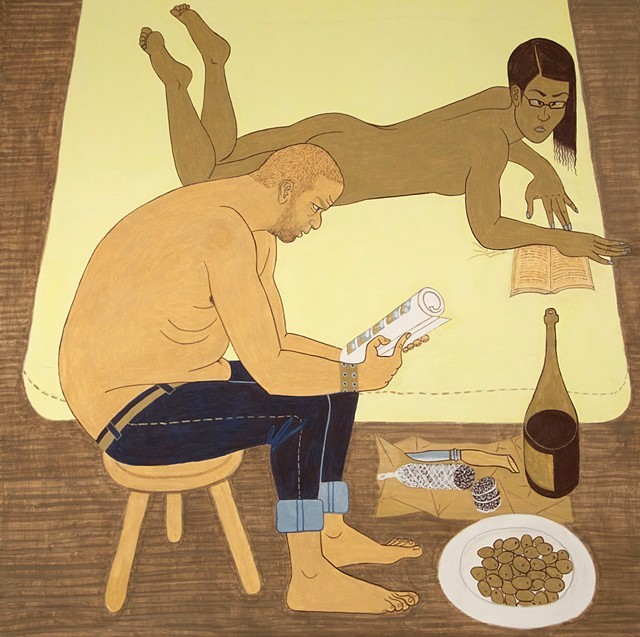
À la Bonne Franquette — Yves Tessier

84605cace9621879f569dfe518bc3dba

À la bonne franquette (A Simple Meal), 2019 by Yves Tessier (b. 1955)

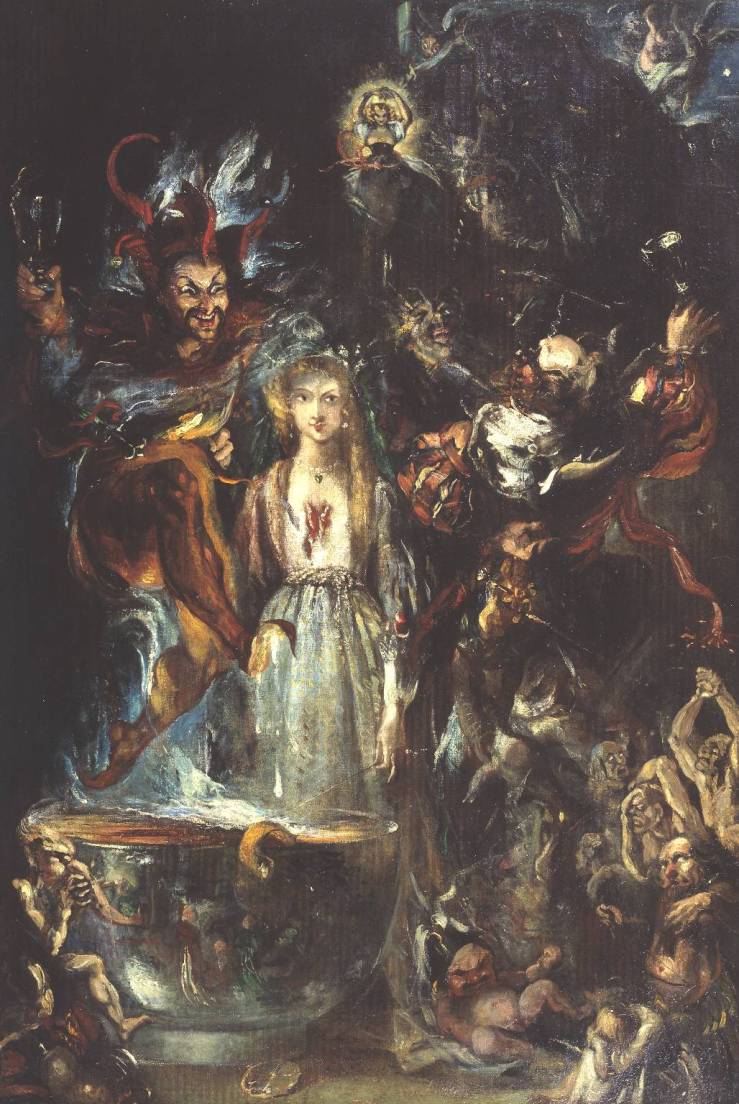
Fantasy Based on Goethe’s Faust — Theodor von Holst

Fantasy Based on Goethe's 'Faust' 1834 by Theodore Von Holst 1810-1844

Fantasy Based on Goethe’s Faust, 1834 by Theodor von Holst (1810–1844)

“Question” — May Swenson

“Question”

by

May Swenson


Body my house
my horse my hound
what will I do
when you are fallen

Where will I sleep
How will I ride
What will I hunt

Where can I go
without my mount
all eager and quick
How will I know
in thicket ahead
is danger or treasure
when Body my good
bright dog is dead

How will it be
to lie in the sky
without roof or door
and wind for an eye

With cloud for shift
how will I hide?

Dead Soldier (Fascism) — Francisco Dosamantes

restricted

Dead Soldier (Fascism), 1940 by Francisco Dosamantes (1911-1986)

Untitled — Marcelo Grassman

aa

Untitled, 1962 by Marcelo Grassman  (1925–2013)

Portrait of a Boy — Pinturicchio

portrait-of-a-boy-1500

Portrait of a Boy, c. 1500 by Pinturicchio (Bernardino di Betto, 1454–1513)

Hallelujah. Hallelujah. Hallelujah. Hallelujah. Hallelujah. Hallelujah. Hallelujah. Hallelujah, lujah, lujah, lujah, hallelujah, lujah, hallelujah.| From Alfred Döblin’s Berlin Alexanderplatz

2019-10-06_172844

And there are mountains, and the old man gets up and says to his son: come with me. Come with me, says the old man to his son, and he goes and his son goes with him, and they walk together into the mountains, up and down, mountains and valleys. How much further, Father? I don’t know, we are walking uphill, downhill, into the mountains, come with me. Are you tired, son, don’t you want to come with me. Oh, I’m not tired, if you want me to come, I’ll come. Yes, come. Up, down, valleys, it’s a long way, it’s midday, we’ve arrived. Look about you, son, is that an altar. Father, I am afraid. Why are you afraid, son? You woke me, we went out early, and we forgot the sheep we meant to sacrifice. Yes, we forgot it. Up and down, the long valleys, we forgot it, the sheep is not with us, there is the altar, I am afraid. I must take off my coat, are you afraid, my son. Yes, Father, I am afraid. I am afraid too, son, come closer, don’t be afraid, we must do it. What must we do? Up and down, the long valleys, I got up so early. Fear not, son, do it willingly, come closer to me, I have taken off my coat, so as not to bloody the sleeves. I am afraid, because you have the knife. Yes, I have the knife, I must slaughter you, I must sacrifice you, the Lord commands it, do it gladly, my son.

No, I cannot do it, I will scream, don’t touch me, I don’t want to be slaughtered. Now you are on your knees, do not scream, my son. Yes, I am screaming. Do not scream; if you don’t want, then I can’t do it, you must want it. Up and down, why should I not go home again. What will you do at home, is not the Lord more than a home. I cannot, yes I can, no I cannot. Move closer, see, I have the knife here, look at it, it is very sharp, it will touch your throat. Will it cut my throat? Yes. Then the blood will bubble forth? Yes. The Lord wills it. Do you want it? I cannot yet, Father. Come quickly, I must not slay you; if I do it, then it must be as though you did it unto yourself. I unto myself? Ah. Yes, and be not afraid. Ah. And not live life, not live your life, because you will give it unto the Lord. Move closer. The Lord our God wills it? Up, down, I got up so early. You surely will not be cowardly. I know, I know, I know! What do you know, my son? Apply the knife to me, wait, let me turn down my collar so that my neck is open. You seem to know something. You must only will it, and I must will it, we will both do it, then the Lord will call, we will both hear Him call: yes, come here, give me your throat. There. I am not afraid, I do it willingly. Up and down, the long valleys, there put the knife to me, and cut, I will not scream.

And the son throws his head back, his father steps behind him, clasps his forehead, and shows him the butcher’s knife in his right hand. The son wills it. The Lord calls. They both fall on their faces.

What calls the voice of the Lord. Hallelujah. Through the mountains, through the valleys. You are obedient unto me, hallelujah. You shall live. Hallelujah. Stop, throw the knife away. Hallelujah. I am the Lord whom you obey, and whom alone you always must obey. Hallelujah. Hallelujah. Hallelujah. Hallelujah. Hallelujah. Hallelujah. Hallelujah. Hallelujah, lujah, lujah, lujah, hallelujah, lujah, hallelujah.

From Berlin Alexanderplatz by Alfred Döblin. English translation by Michael Hoffmann. (NRYB trade paperback, 2018).

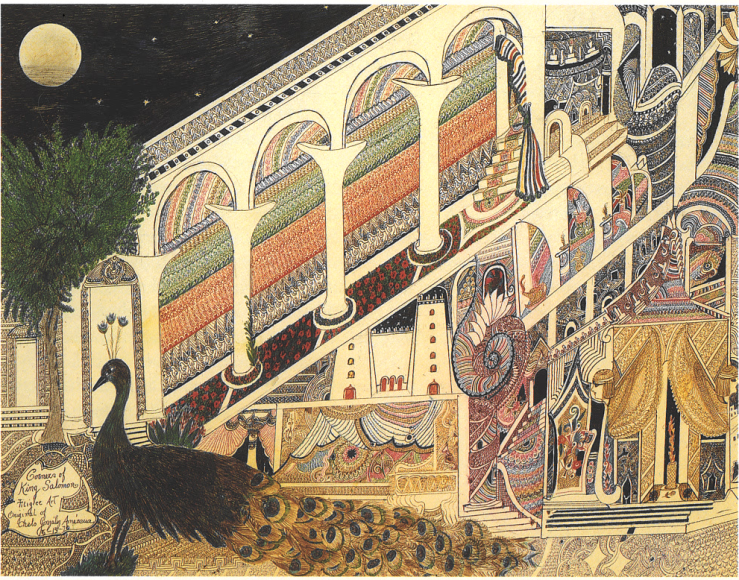
Corners of King Solomon — Consuelo González Amezcua

dd

Corners of King Solomon, 1970 by Consuelo González Amezcua (1903–1975)

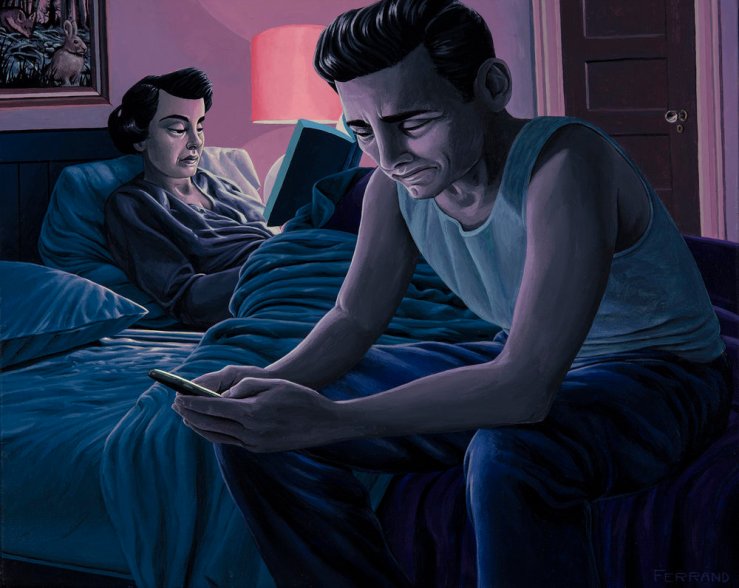
The Fortune Teller Was Mistaken — Gregory Ferrand

thefortunetellerwasmistaken

The Fortune Teller Was Mistaken, 2017 by Gregory Ferrand (b. 1975)

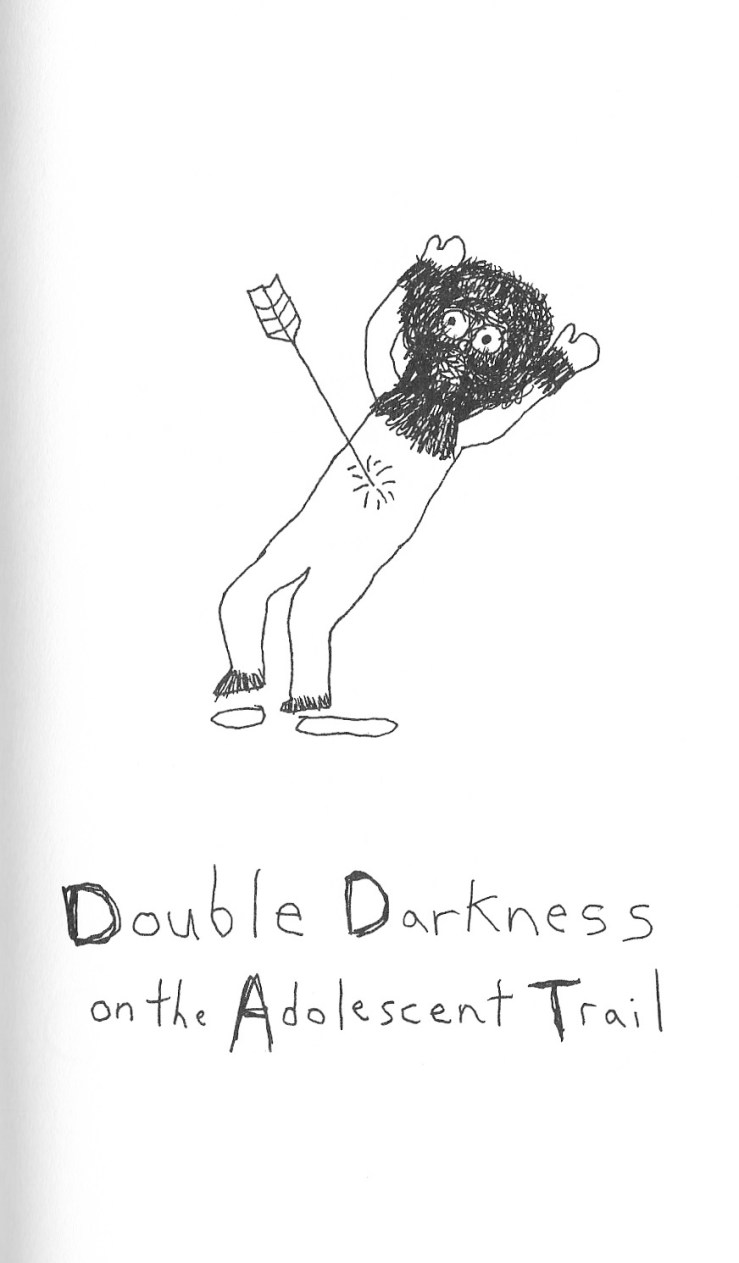
“Double Darkness on the Adolescent Trail” — David Berman

2019-10-22_194010_1

From The Portable February, 2009, Drag City.

Withers, wilts, and drops off | Nathaniel Hawthorne’s journal entry for October 22nd, 1841

October 22d.–A continued succession of unpleasant, Novembery days, and autumn has made rapid progress in the work of decay. It is now somewhat of a rare good fortune to find a verdant, grassy spot, on some slope, or in a dell; and even such seldom-seen oases are bestrewn with dried brown leaves,–which, however, methinks, make the short, fresh grass look greener around them. Dry leaves are now plentiful everywhere, save where there are none but pine-trees. They rustle beneath the tread, and there is nothing more autumnal than that sound. Nevertheless, in a walk this afternoon, I have seen two oaks which retained almost the greenness of summer. They grew close to the huge Pulpit Rock, so that portions of their trunks appeared to grasp the rough surface; and they were rooted beneath it, and, ascending high into the air, overshadowed the gray crag with verdure. Other oaks, here and there, have a few green leaves or boughs among their rustling and rugged shade.

Yet, dreary as the woods are in a bleak, sullen day, there is a very peculiar sense of warmth and a sort of richness of effect in the slope of a bank and in sheltered spots, where bright sunshine falls, and the brown oaken foliage is gladdened by it. There is then a feeling of comfort, and consequently of heart-warmth, which cannot be experienced in summer.

I walked this afternoon along a pleasant wood-path, gently winding, so that but little of it could be seen at a time, and going up and down small mounds, now plunging into a denser shadow, and now emerging from it. Part of the way it was strewn with the dusky, yellow leaves of white-pines,–the cast-off garments of last year; part of the way with green grass, close-cropped, and very fresh for the season. Sometimes the trees met across it; sometimes it was bordered on one side by an old rail-fence of moss-grown cedar, with bushes sprouting beneath it, and thrusting their branches through it; sometimes by a stone-wall of unknown antiquity, older than the wood it closed in. A stone-wall, when shrubbery has grown around it, and thrust its roots beneath it, becomes a very pleasant and meditative object. It does not belong too evidently to man, having been built so long ago. It seems a part of nature.

Yesterday I found two mushrooms in the woods, probably of the preceding night’s growth. Also I saw a mosquito, frost-pinched, and so wretched that I felt avenged for all the injuries which his tribe inflicted upon me last summer, and so did not molest this lone survivor.

Walnuts in their green rinds are falling from the trees, and so are chestnut-burrs.

I found a maple-leaf to-day, yellow all over, except its extremest point, which was bright scarlet. It looked as if a drop of blood were hanging from it. The first change of the maple-leaf is to scarlet; the next, to yellow. Then it withers, wilts, and drops off, as most of them have already done.

Nathaniel Hawthorne’s journal entry for October 22nd, 1841. From Passages from the American Note-Books.

Annunciation — Wilfredo Lam

wilfredo

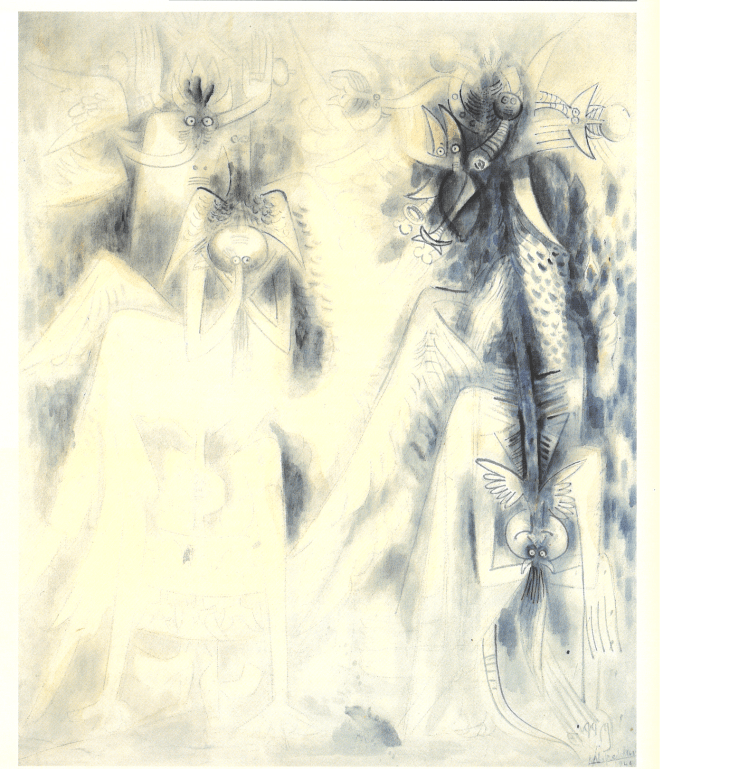
Annunciation, 1944 by Wilfredo Lam (1902-1982)

Drive-in Dancers — Jamie Adams

adams.driveindancers.4mlt

Drive-in Dancers, 2018 by Jamie Adams (b. 1961)

Three Books

2019-10-20_185738_1

Taking Care by Joy Williams. 1985 trade paperback from Vintage Contemporaries. Cover design by Lorraine Louie. Cover illustration by Rick Lovell.

I read this book earlier this year. It’s really great. I reviewed it on this site, writing—

These are stories of domestic doom and incipient madness, alcoholism and lost pets. There’s humor here, but the humor is ice dry, and never applied as even a palliative to the central sadness of Taking Care. Williams’ humor is something closer to cosmic absurdity, a recognition of the ambiguity at the core of being human, of not knowing. It’s the humor of two girls eating chips on a beach, unable to decide if the people they are gazing at are drowning or just having a good time.

2019-10-20_185738_3

Norwood by Charles Portis. 1985 trade paperback by Vintage Contemporaries. Cover design by Lorraine Louie. Cover illustration by Rick Lovell.

Norwood isn’t the best book I’ve read so far this year but it is the book I most enjoyed reading, and after reading it, I sought everything else by Portis (consuming everything so far except the late novel Gringos, which I’m sort of holding onto as like…I dunno? A consolation prize at some point? Is that grim?). I picked Norwood up on a wonderful whim this summer, possibly simply because it was a Vintage Contemporaries edition (and slim). I’m so glad I did. Great read.

2019-10-20_185738_2

Cathedral by Raymond Carver. 1989 trade paperback from Vintage Contemporaries. Cover design by Lorraine Louie. Cover illustration by Garnet Henderson.

This was the first Vintage Contemporaries edition I ever bought. I bought it when I was maybe 17, sometime in the late nineties, I guess, and I was always vaguely embarrassed of the cover, especially when I used it in not one but two college courses at the end of that decade (Carver was still very cool in that era. He seems to have fallen out of favor. Good for him!) Henderson’s ultra-literal cover of the story “Cathedral” is…something. (I still prefer Lovell’s whimsical work, which is more, uh, I dunno, metaphysical (?)). I circled four short story titles on the table of contents for some reason: “A Small Good Thing,” “Where I’m Calling From,” “Vitamins,” and “Cathedral.” All great numbers. I also am fond of “Feathers” and “Chef’s House,” but I didn’t circle those titles. The rest of the stories I don’t remember, although I’m sure I read them at least once or twice.

“I Wrote a Letter…” — Donald Barthelme

“I Wrote a Letter…”

by

Donald Barthelme


I wrote a letter to the President of the moon, asked him if they had towaway zones up there. The cops had towed away my Honda and I didn’t like it. Cost me seventy-five dollars to get it back, plus the mental health. You ever notice how the tow trucks pick on little tiny cars? You ever seen them hauling off a Chrysler Imperial? No, you haven’t.

The President of the moon replied most courteously that the moon had no towaway zones whatsoever. Mental health on the moon, he added, cost only a dollar.

Well, I needed mental health real bad that week, so I wrote back saying I thought I could get there by the spring of ’81, if the space shuttle fulfilled its porcelain promise, and to keep some mental health warm for me who needed it, and could I interest him in a bucket of ribs in red sauce? Which I would gladly carry on up there to him if he wished?

The President of the moon wrote back that he would be delighted to have a bucket of ribs in red sauce, and that his zip code, if I needed it, was 10011000000000.

I cabled him that I’d bring some six-packs of Rolling Rock beer to drink with the ribs in red sauce, and, by the way, what was the apartment situation up there?

It was bad, he replied by platitudinum plate, apartments were running about a dollar a year, he knew that was high but what could he do? These were four-bedroom apartments, he said, with three baths, library, billiard room, root cellar, and terrace over- looking the Sea of Prosperity. Maybe he could get me a rent abatement, he said, ’cause of me being a friend of the moon.

The moon began to sound like a pretty nice place. I sent a dollar to the Space Shuttle Hurry-Up Fund.

Drumming fiercely on a hollow log with a longitudinal slit tuned to moon frequencies, I asked him about employment, medical coverage, retirement benefits, tax shelterage, convenience cards, and Christmas Club accounts.

That’s a roger, he moonbeamed back, a dollar covers it all, and if you don’t have a dollar we’ll lend you a dollar through the Greater Moon Development Mechanism.

What about war and peace? I inquired by means of curly little ALGOL circuits I had knitted myself on my Apple computer.

The President of the moon answered (by MIRV’D metaphor) that ticktacktoe was about as far as they’d got in that direction, and about as far as they would go, if he had anything to say about it.

I told him via flights of angels with special instructions that it looked to me like he had things pretty well in hand up there and would he by any chance consider being President of us? Part-time if need be?

No, he said (in a shower of used-car asteroids with blue-and-green bumper stickers), our Presidential campaigns seemed to damage the candidates, hurt them. They began hitting each other over the head with pneumatic Russians, or saying terminally silly things about the trees. He wouldn’t mind being Dizzy Gillespie, he said.

From The Teachings of Don B. (Via.)

“Anecdote of the Prince of Peacocks” — Wallace Stevens

“Anecdote of the Prince of Peacocks”
by
Wallace Stevens

In the moonlight
I met Berserk,
In the moonlight
On the bushy plain.
Oh, sharp he was
As the sleepless!
And, “Why are you red
In this milky blue?”
I said.
“Why sun-colored,
As if awake
In the midst of sleep?”
“You that wander,”
So he said,
“On the bushy plain,
Forget so soon.
But I set my traps
In the midst of dreams.”
I knew from this
That the blue ground
Was full of blocks
And blocking steel.
I knew the dread
Of the bushy plain,
And the beauty
Of the moonlight
Falling there,
Falling
As sleep falls
In the innocent air.