Huge thanks to BLCKDGRD for sending me Anne Boyer’s aphoristic, poetic memoir-essay The Undying. I guess he read that I went to my bookstore to buy it a few weeks ago and came home not empty handed but nevertheless Undyingless. I wanted to read Boyer’s book after reading her essay collection (“essay” isn’t really the right word, but) A Handbook of Disappointed Fate this summer—-also sent to me by generous Mr. BLCKDGRD
I’m about 100 pages away from finishing The Undying, a book that doesn’t so much chronicle Boyer’s 2014 diagnoses and treatment of breast cancer as it explores and explodes what cancer—a “twentieth-century disease” that we still treat with “twentieth-century” methods, in Boyer’s words—means and is and does in our neoliberal late-capitalist early twenty-first century. Boyer writes,
To become a cancer patient is to become a system-containing object inside another system that only partially allows the recognition of the rest of the systems in which one is a node and also almost wholly obscures the heaviest system of the arrangement of the world as it is, which hangs around, too, in the object that contains a system (by which I mean “me”) as part of the problem in the first place, requiring our latent unhealth just as it profits from our active one.
Later, again addressing that “latent unhealth” which is part and parcel of the system, Boyer declares: “I would rather write nothing at all than propagandize the world as is.” This is a wonderfully angry book.
This is a wonderfully angry, discursive, recursive book: literary biography, literary criticism, art history, art criticism, Foucault, John Donne, Susan Sontag, Lucretius, Virginia Woolf; a howl at the hoaxers, frauds, self-helperists and their pinkwashed platitudes. And lots of pain, expressed with sentiment that bears no trace of sentimentality.
Boyer’s aphoristic style is engrossing. Her paragraphs and one-liners bear a ludic stamp seemingly at odds with her subject matter. The work of the writing, the heavy burden of smithing those sentences is all but elided—instead we get the clarity of a focused mind drawing together seemingly-disparate threads into a cohesive and compelling memoir that transcends the personal without necessarily meaning to.
Showing is a betrayal of the real, which you can never quite know with your eyes in the first place, and if you are trying to survive for the purpose of literature, showing and not telling is reason enough to endure the disabling processes required for staying alive.
Rusty Brown, Ware’s latest novel (or, more precisely, novel-in-progress) strengthens the argument that Ware is a Serious American Novelist, one who deserves a large crossover audience. Like Jimmy Corrigan and Building Stories, Rusty Brown has a central primary setting, a small private school in Nebraska. And like those novels, Rusty Brown comprises material (lightly reworked) from Ware’s Acme Novelty Library series (issues 16, 17, 19, and 20, specifically). The cast here is much larger and the themes are arguably more ambitious though.
Rusty Brown is a sprawling story about memory and perception, about minor triumphs and chronic failures, about how our inner monologues might not match up to the reality around us. In Ware’s world, life can be blurry, spotty, fragmented. His characters are so bound up in their own consciousnesses that they cannot see the bigger picture that frames them.
She stood upon the castle wall, Oriana:
She watch’d my crest among them all, Oriana:
She saw me fight, she heard me call,
When forth there stept a foeman tall, Oriana,
Atween me and the castle wall, Oriana.
The bitter arrow went aside, Oriana:
The false, false arrow went aside, Oriana:
The damned arrow glanced aside,
And pierced thy heart, my love, my bride, Oriana!
Thy heart, my life, my love, my bride,Oriana!
Oh! narrow, narrow was the space, Oriana.
Loud, loud rung out the bugle’s brays, Oriana.
Oh! deathful stabs were dealt apace,
The battle deepen’d in its place, Oriana;
But I was down upon my face, Oriana.
They should have stabb’d me where I lay, Oriana!
How could I rise and come away, Oriana?
How could I look upon the day?
They should have stabb’d me where I lay, Oriana
They should have trod me into clay,Oriana.
O breaking heart that will not break, Oriana!
There’s a “new” video interview with Barry Hannah and his wife Susan at Southwest Review. The interview was conducted by Southwest Review editor-in-chief Greg Brownderville some time in “the late aughts” in Hannah’s back yard, under his muscadine arbor. Brownderville and his friend Luke Duncan (both grad students at Ole Miss at the time) were trying to put together a film about muscadine grapes, and interviewed the Hannahs about the project. Hannah’s extemporaneous responses veer all over the place though, using muscadines as kind of kernels of memories from which to riff on: dead pets, boyhood oyster shell fights, and “the wonderful time my dad and I had at Arkansas drinking wine and watching the University of Arkansas, who was number one in the nation, whoop Texas, both of us high on wine from Altus.” The whole interview approaches something close to one of Hannah’s looser short stories, and is definitely worth the 20 minutes.
(Thanks to Patrick for sending me the link.)
(Tangential note: My wife’s grandmother makes her own muscadine wine. We get a bottle of it for Christmas every now and then. It’s pretty sweet stuff.)
“The blackmarket blights peace,” Dutch postwar propaganda poster, 1946
Don’t forget the real business of the War is buying and selling 1. The murdering and the violence are self-policing, and can be entrusted to non-professionals. The mass nature of wartime death is useful in many ways 2. It serves as spectacle, as diversion from the real movements of the War. It provides raw material to be recorded into History, so that children may be taught History as sequences of violence, battle after battle, and be more prepared for the adult world 3. Best of all, mass death’s a stimulus 4 to just ordinary folks, little fellows 5, to try ’n’ grab a piece of that Pie while they’re still here to gobble it up. The true war is a celebration of markets 6. Organic markets, carefully styled “black” 7 by the professionals, spring up everywhere. Scrip, Sterling, Reichsmarks continue to move, severe as classical ballet, inside their antiseptic marble chambers. But out here, down here among the people, the truer currencies come into being. So, Jews are negotiable. Every bit as negotiable as cigarettes, cunt, or Hershey bars. Jews also carry an element of guilt, of future blackmail, which operates, natch, in favor of the professionals. 8
From page 105 of Thomas Pynchon’s 1973 novel Gravity’s Rainbow.
1Gravity’s Rainbow is often (unjustly and unfairly) maligned as a messy, even pointless affair—but here’s our author speaking through the narrator, offering up one of the novel’s points—clearly, without equivocation.
2 Our narrator digs irony though…
3 Entropy is all—but entropy doesn’t make for good capitalism, by which our sly narrator means, Their Capitalism. The adult world needs to be organized, systematized, caused and effected.
Cf. Jack Gibbs’s rant to his erstwhile young students, early in William Gaddis’s 1975 novel of capitalism, J R:
Before we go any further here, has it ever occurred to any of you that all this is simply one grand misunderstanding? Since you’re not here to learn anything, but to be taught so you can pass these tests, knowledge has to be organized so it can be taught, and it has to be reduced to information so it can be organized do you follow that? In other words this leads you to assume that organization is an inherent property of the knowledge itself, and that disorder and chaos are simply irrelevant forces that threaten it from the outside. In fact it’s the opposite. Order is simply a thin, perilous condition we try to impose on the basic reality of chaos . . .
4 Note the not-so-oblique reference to GR’s theme of stimulus-response (and upending that response).
Not too much earlier in the narrative, dedicated Pavlovian Dr. Edward W.A. Pointsman worries about the end of cause and effect, the rise of entropy:
Will Postwar be nothing but ‘events,’ newly created one moment to the next? No links? Is it the end of history?
5…the preterite?
6 Pynchon reiterates his thesis.
7 Note that organic (entropic?) markets fall outside of Their System—y’know, Them—the Professionals—these organic (chaotic, necessary) markets must be labeled “black” (preterite?).
Here’s another Dutch propaganda poster:
“Protect them against the black market!”, Dutch propaganda poster, 1944
Page 105 of Gravity’s Rainbow “happens,” more or less, in 1944, in the middle of an extended introduction of Katje Borgesius, a Dutch double agent. (Or is that double Dutch agent?). The propaganda poster above strikes me as overtly racist, but also seems to nod to King Kong (1933, dir. Cooper and Schoedsack). Gravity’s Rainbow is larded with references to King Kong, a sympathetic but powerful force of entropy, a force against the Professionals.
Fay Wray look, 57; Fay Wray, 57, 179, 275; “You will have the tallest, darkest leading man in Hollywood,” 179; “headlights burning like the eyes of” 247; “the black scapeape we cast down like Lucifer,” 275; Mitchell Prettyplace book about, 275; “Giant ape” 276; “the Fist of the Ape,” 277; “orangutan on wheels,” 282; taking a shit, 368; “The figures darkened and deformed, resembling apes” 483; “a troupe of performing chimpanzees” 496; “on the tit with no motor skills,” 578; “Negroid apes,” 586; “that sacrificial ape,” 664; “a gigantic black ape,” 688; Carl Denham, 689; poem based on King Kong, 689; See also: actors/directors film/cinema references;
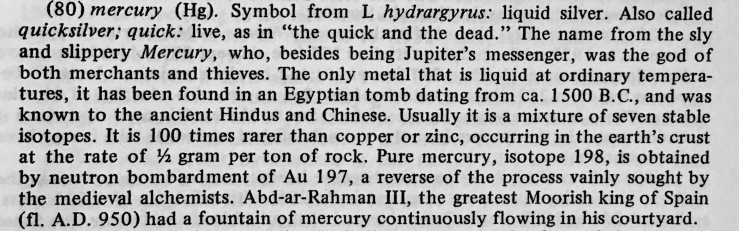
The Kong-figure in the Dutch propaganda poster seems to wear the petasos (winged hat) and wield the caduceus of Hermes or Mercury—god of thieves. But also god of the market, of commerce, merchandise, all things mercenary.
From Joseph T. Shipley’s The Origin of English Words: A Discursive Dictionary of Indo-European Roots (1984):
8 The passage as a whole, which emphasizes war as a conduit for the techne of the market (or do I have that backwards? should I note the market of techne?) echoes an earlier passage. From page 81:
It was widely believed in those days that behind the War—all the death, savagery, and destruction—lay the Führer-principle. But if personalities could be replaced by abstractions of power, if techniques developed by the corporations could be brought to bear, might not nations live rationally? One of the dearest Postwar hopes: that there should be no room for a terrible disease like charisma.
Masters of Atlantis by Charles Portis. 1985 first-edition hardback from Knopf. Jacket design by Sara Eisenman; jacket illustration by Dagmar Frinta.
The Dog of the South by Charles Portis. 1985 trade paperback from Windstone Trade. Cover art by Linda Bordelon; no designer credited.
True Grit by Charles Portis. 1968 hardback Book Club from Simon & Schuster. Jacket design by Paul Davis.
I picked up a 1985 Vintage Contemporaries edition of Charles Portis’s first novel Norwood this summer and promptly snorted the thing up my brain. I then sought out the rest of Portis, and read most of it, with the exception of Gringos, which I’m, I don’t know, saving, if that makes sense.
True Grit might be the best of the novels, from a technical standpoint. Walker Percy’s blurb on the back of my copy compares it to Adventures of Huckleberry Finn, and he’s not wrong. Mattie Ross’s is as achieved and engrossing and complex as Huck’s, a wonderful layering of author-narrator-speaker. The prose is beautiful and Mattie is an endearing American hero. I wish I had read it years ago. I’ll make sure my kids don’t repeat my error. Like Huck Finn, True Grit seems like a book one returns to like an old friend, only to find the friend has changed in some deep way. (But of course it’s only you that’s changed you old bastard, reading now through older dimmer eyes.)
While True Grit is likely Portis’s best novel, my favorite in the quartet I’ve read is The Dog of the South, a road trip novel, shaggy, grotesque, and very, very funny. It reads like a novel that Barry Hannah was never quite sober enough to manage—or maybe that’s unfair (I love Hannah, godbless his soul)—maybe what I mean is that Portis’s loose ironic folk-blues ballad of a novel has more structure than Hannah’s jazz. Anyway, I loved Dog, but in spite of and because of its faults.
Masters of Atlantis is the strangest in the quartet. It’s a novel about con-men and poseurs, secret societies and secret scams, capitalism and the price of knowledge. Again, a very American novel, whatever that means. Atlantis has a Pynchonian paranoid vibe and a Pynchonian zaniness. It also belongs to the American tradition of grifter novels (think of Melville’s The Confidence-Man, or Baum’s Oz, or Adventures of Tom Sawyer, or Gatsby, etc.). Atlantis, told in a third-person voice, feels a bit more distant than the first-person immediacy of True Grit or The Dog of the South, or even the third-person voice of Norwood, which hovers around its protagonist’s brain pan and eye line, and doesn’t flit much farther. Atlantis also covers a hearty lifetime of secret society shenanigans. It’s a loose, shaggy epic, and seems to sprawl beyond its 250-odd pages. In any case, I ate it up, just like I ate up the other three. I waited far too long for Charles Portis, but I suppose late is better than never. Highly recommended.
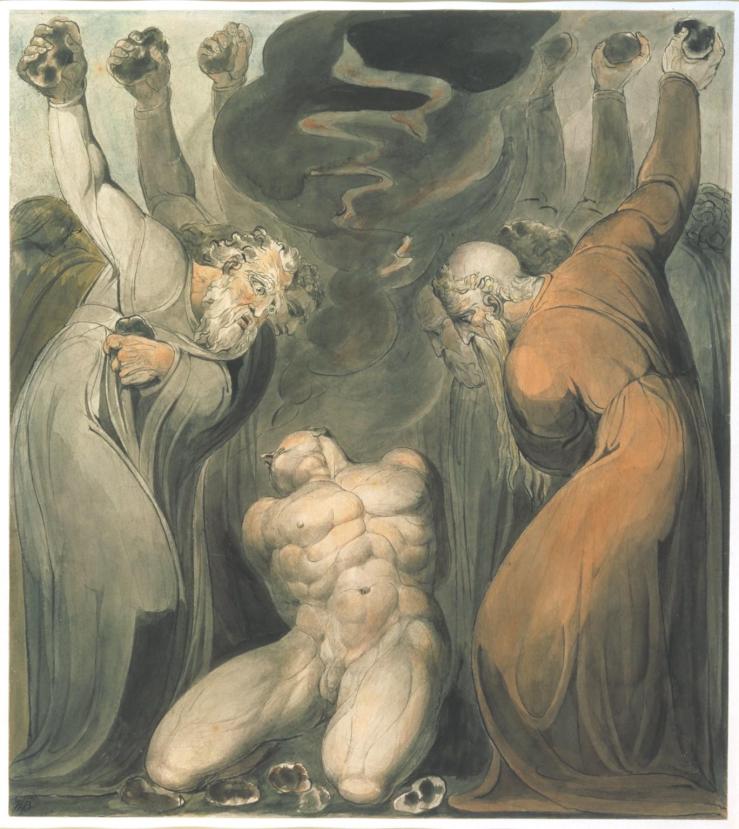
The Blasphemer, c. 1800 by William Blake (1757-1827)
And he that blasphemeth the name of the LORD, he shall surely be put to death, and all the congregation shall certainly stone him: as well the stranger, as he that is born in the land, when he blasphemeth the name of the LORD, shall be put to death.
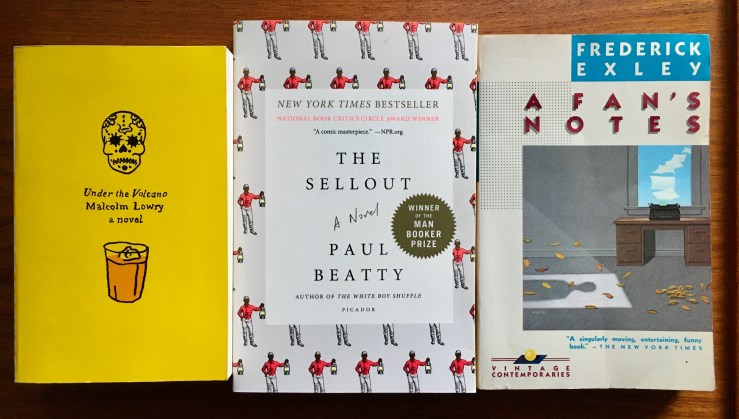
I took a shoebox of old books to my favorite used bookstore this afternoon and came back with three books. I picked up a Vintage Contemporaries edition of Frederick Exley’s novel A Fan’s Notes on something of a whim. Can’t remember what I was looking for when I saw it, but I saw it and grabbed it.
I was shuffling around in the B’s, looking for a copy of Anne Boyer’s The Undying but I did not find it, but I saw Paul Beatty’s The Sellout, which was a big hit a few years ago, which means I sort of ignored it, but I saw it today, a few copies, and grabbed one, after reading “Taken out of Context” at Granta,” but not really in that order—I mean, I’d read that piece earlier this year, my mental ears pricked up, and etc.
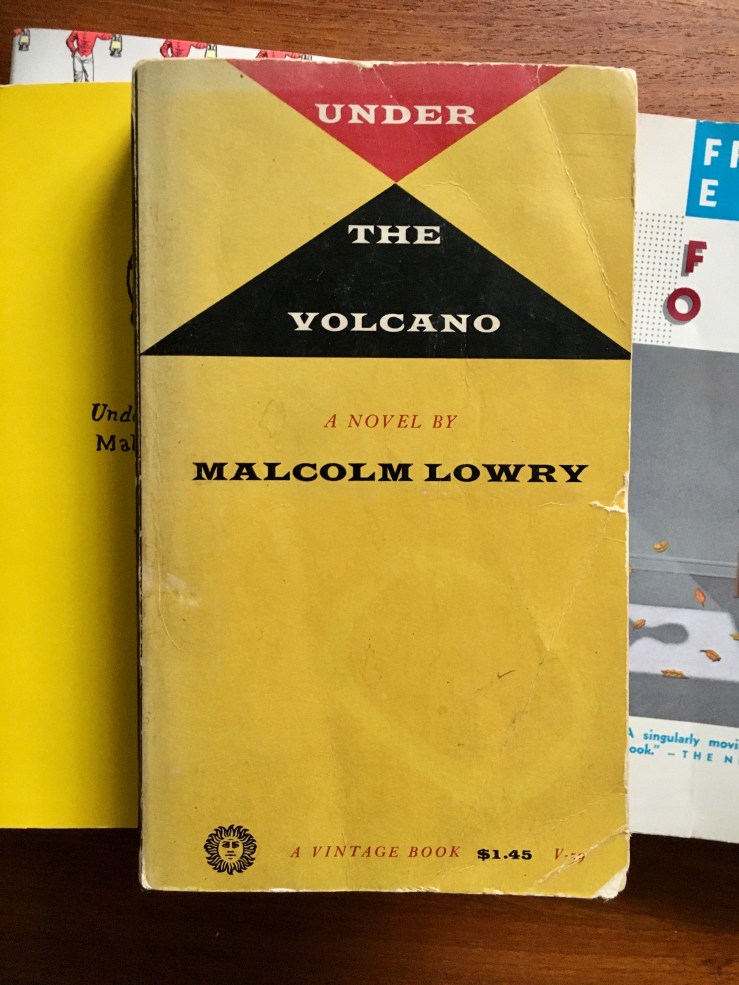
I also couldn’t resist another copy of Malcolm Lowry’s novel Under the Volcano. I mean, fuck me, I’m a fucking idiot, I bought it for the cover. Or really, I bought it for the cover and for the handfeel—I mean it felt good as a copy to read, strange short fat like me. Very readable. So maybe I should read it again.
I gave away my ugly movie tie-in cover a few years ago and replaced it with this number, which isn’t so bad:
—but this midcentury edition isn’t very readable. I mean, I haven’t ever wanted to thumb through it. Great book though (hard to read, a bit repulsive, thoroughly depressing). Anyway. Peace to you this Friday.










 Biblioklept